
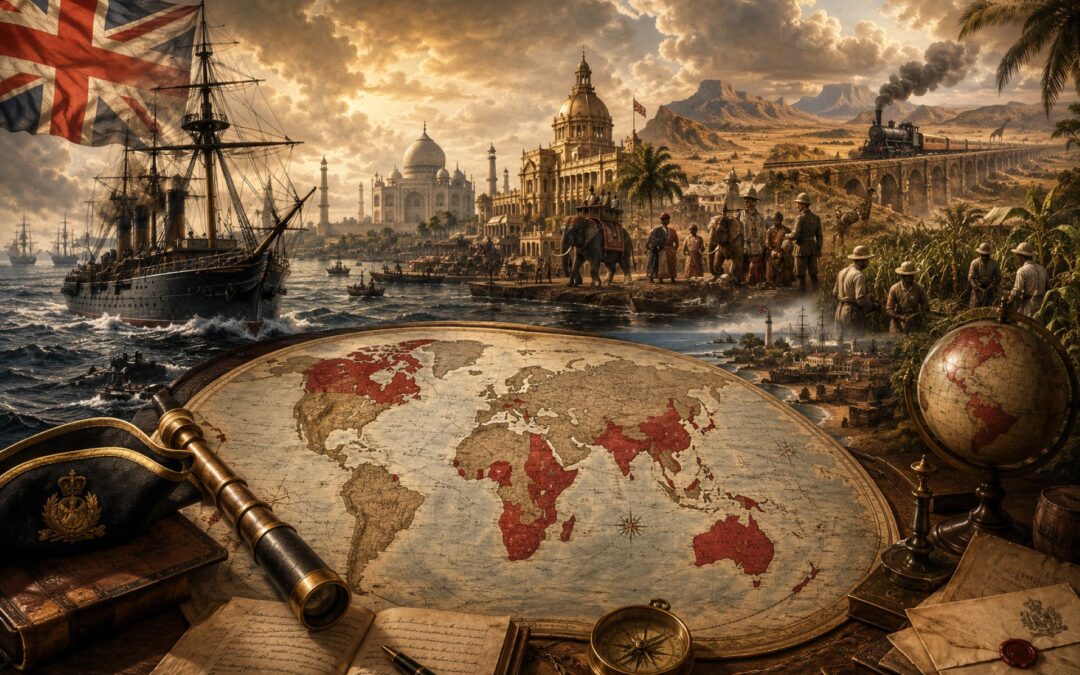
At its height, the British Empire governed roughly a quarter of the world’s land and population. Its territories stretched from Canada and the Caribbean to Africa, India, Southeast Asia, Australia, New Zealand, and scattered islands across the world’s oceans. British ships moved through the major sea lanes, British companies controlled vital commodities, and British officials claimed authority over societies far larger and older than Britain itself.
That extraordinary reach can make the empire appear inevitable—as though England began with a plan for global supremacy and then steadily carried it out.
Nothing could be further from the truth.
The British Empire was assembled across centuries by people pursuing different and often conflicting goals. Monarchs sought prestige and security. Merchants wanted monopolies and profits. Settlers wanted land. Missionaries wanted converts. Naval commanders wanted strategic ports. Plantation owners wanted labor. Chartered companies wanted commercial privileges that gradually became political power.
At many points, the British government followed private expansion rather than directing it. It inherited commitments created by merchants, settlers, soldiers, and local allies. It improvised one administrative system in India, another in Canada, another in Nigeria, and another in Australia. Much of the empire was governed not by large numbers of Britons but through Indigenous rulers, colonial troops, local administrators, commercial intermediaries, and political collaborators.
Force remained indispensable. So did slavery, dispossession, taxation, diplomacy, finance, law, migration, technology, and the manipulation of local rivalries. Yet British power was never absolute. It depended on cooperation and constantly encountered resistance.
The empire’s eventual collapse was no simpler than its creation. Britain did not suddenly lose the will to rule, nor did one battle or one independence movement bring the entire system down. Two world wars weakened Britain’s finances and military position. Anti-colonial movements challenged the legitimacy and practicality of foreign rule. Colonial subjects demanded that promises of liberty and self-determination apply to them. The United States and Soviet Union displaced Europe’s imperial powers, while the United Nations gave international legitimacy to decolonization.
The British Empire rose because Britain learned to combine naval power, private capital, local alliances, settlement, and adaptable institutions across a connected world.
It fell when those methods could no longer overcome the economic cost, political resistance, moral contradictions, and changing international order that empire itself had helped create.
England Before the Empire
The history of the British Empire did not begin with Alfred the Great, but the formation of a unified English kingdom created the state from which later expansion would emerge.
In the ninth century, the kingdoms of Anglo-Saxon England faced repeated Viking invasions. Alfred, king of Wessex, survived a severe military crisis before defeating the Viking leader Guthrum at Edington in 878. His successors expanded their authority, and in 927 Athelstan brought much of England under a single monarchy.
These rulers were not imagining colonies in America or trading posts in India. Their challenge was more immediate: survival, consolidation, taxation, defense, and control over competing regional powers.
Once England became more politically unified, however, its monarchs began projecting authority beyond its original borders. Wales was conquered under Edward I in the late thirteenth century and incorporated more fully into the English state under the Tudors. English involvement in Ireland began through the Anglo-Norman invasion of the twelfth century and Henry II’s intervention in 1171, but Ireland’s subsequent relationship with England was never simple.
Ireland was at different moments a neighboring kingdom, a subordinate lordship, a field of settlement, a laboratory for colonial practices, a formal part of the United Kingdom, a source of soldiers and officials for overseas expansion, and a center of anti-imperial resistance. That complicated position is explored in the scholarship on Ireland’s place within the British imperial system, which resists the temptation to label it neatly as either Britain’s first colony or merely another domestic territory.
England’s ambitions in medieval Europe were often directed toward France rather than distant oceans. The Hundred Years’ War consumed resources from the fourteenth into the fifteenth century. Soon afterward, the Wars of the Roses divided the English political elite. Henry Tudor’s victory at Bosworth in 1485 created a more stable monarchy, but England remained a secondary European power compared with Spain, Portugal, France, and the Habsburg territories.
The Tudor state gradually became more centralized. It collected taxes more effectively, expanded royal administration, and invested more seriously in naval power. Henry VIII’s break with Rome in the 1530s also transformed England’s place in Europe.
The English Reformation was not simply the product of Henry’s desire to end his marriage to Catherine of Aragon. It involved dynastic insecurity, disputes over papal authority, the appropriation of church wealth, parliamentary legislation, and a broader European religious upheaval. The result was a monarchy that claimed authority over the English church and was increasingly separated from Catholic Europe.
That separation was neither immediate nor uncontested. Mary I attempted to restore Catholicism, while Elizabeth I established a Protestant religious settlement after taking the throne in 1558. England’s religious identity became entangled with its geopolitical rivalries. Catholic Spain was not merely a commercial competitor; it was presented as a religious and existential threat.
By the late sixteenth century, English expansion overseas could therefore be justified in several languages at once. It promised trade, plunder, national glory, strategic security, Protestant advancement, and resistance to Catholic empires.
England still had no global imperial master plan.
It did, however, possess an increasingly capable state, a developing navy, ambitious merchants, religious conflict, and a powerful incentive to challenge the empires already profiting from the Atlantic world.
The Atlantic World Opens
When Christopher Columbus crossed the Atlantic in 1492, Spain and Portugal moved rapidly to establish colonies, seize territory, exploit labor, and connect the Americas to European and African trade. England entered this contest late and initially achieved little.
John Cabot’s 1497 voyage under Henry VII gave England a basis for claiming land in the North Atlantic. Cabot probably reached somewhere along the northeastern coast of North America, although his precise landfall remains uncertain. He did not create a permanent settlement, and England lacked the money, ships, and administrative commitment to follow his journey with immediate colonization.
For much of the sixteenth century, Spain remained the dominant Atlantic power. Silver from the Americas flowed into Spanish ports. Spanish colonies stretched through the Caribbean and across large portions of Central and South America. Portugal had established its own Atlantic and Asian networks.
England’s first sustained challenge came through raiding and privateering rather than settlement.
Privateers operated with government approval to attack enemy shipping during periods of conflict. In practice, the boundary between merchant, naval officer, explorer, smuggler, and pirate was often thin. Elizabeth I’s government could benefit from attacks on Spanish wealth while denying full responsibility when diplomacy required restraint.
John Hawkins represented the darkest side of this new commercial aggression. During the 1560s, he organized English voyages that captured, purchased, transported, and sold enslaved Africans in the Spanish Americas. His expeditions helped establish England’s direct participation in the transatlantic slave trade long before the country possessed a large plantation empire.
Hawkins’s voyages were not isolated adventures disconnected from the state. Investors included members of England’s political and commercial elite, and the Crown supported ventures that promised profit and damage to Spain. England would later become one of the principal carriers of enslaved Africans across the Atlantic, a history reflected in the extensive record of Britain’s parliamentary relationship with the slave trade.
Francis Drake sailed with Hawkins and later became the most celebrated English privateer of the Elizabethan age. Between 1577 and 1580, Drake circumnavigated the globe, raided Spanish possessions along the Pacific coast of the Americas, crossed the Indian Ocean, and returned with immense wealth.
His voyage demonstrated that English ships could operate across the world’s oceans. It also revealed the fusion that would repeatedly shape British expansion: exploration accompanied commerce, commerce accompanied violence, and violence was rewarded when it served the state.
Permanent settlement proved harder.
In the 1580s, Walter Raleigh sponsored attempts to establish a colony at Roanoke off the coast of present-day North Carolina. The first settlement was abandoned. A second group disappeared, leaving behind one of the most famous mysteries in early colonial history. The failure showed that planting a colony required far more than claiming land. Settlers needed food, reliable supply lines, workable relationships with Indigenous societies, effective leadership, and continued financial support.
Meanwhile, conflict with Spain intensified.
Philip II’s Armada of 1588 was intended to secure control of the English Channel long enough to support an invasion from the Spanish Netherlands. The English fleet harassed the Armada, disrupted its formation near Gravelines, and prevented it from completing its mission. Spanish difficulties were compounded by poor coordination, logistical problems, and severe weather during the return voyage.
The Armada’s defeat did not instantly give England command of the oceans. Spain remained a formidable imperial and naval power for decades. England’s own counter-armada the following year ended disastrously.
Yet 1588 carried enormous symbolic importance. England had survived the most serious invasion threat of Elizabeth’s reign. Its navy gained prestige. Protestant identity became further connected to national survival. Merchants and courtiers could imagine that Spain’s overseas power was not beyond challenge.
The foundations of expansion were now visible: armed commerce, state-backed private enterprise, maritime skill, anti-Spanish rivalry, and a willingness to claim lands already inhabited by other peoples.
The next challenge was to turn those tools into settlements that could survive.
Colonies, Companies, and Enslavement
England’s first durable overseas empire developed through several distinct institutions. Settlers established agricultural colonies in North America. Plantation owners built societies around enslaved labor in the Caribbean. Chartered companies negotiated commercial access to powerful Asian states.
These were not versions of a single administrative plan. They were different solutions to different opportunities, and each created obligations that eventually pulled the English government more deeply into imperial rule.
Settler Colonies in North America
In 1607, the Virginia Company established Jamestown on the land of the Powhatan Confederacy. The settlement was designed to make money, not to create a democratic refuge or a new nation.
Its investors expected valuable minerals, commercial crops, and perhaps a route toward Asia. Instead, the settlers encountered disease, food shortages, poor planning, internal conflict, and an environment they did not understand. Many arrived without the agricultural skills necessary for survival.
Jamestown depended heavily on an unstable relationship with the Powhatan peoples. Trade sometimes kept the English alive, but territorial expansion, cultural misunderstanding, violence, and competing political expectations repeatedly produced conflict.
Tobacco transformed the colony’s prospects. John Rolfe developed a variety that found a profitable market in Europe, and Virginia acquired an export capable of attracting settlers and investment. But tobacco required land and labor. Its success therefore intensified expansion onto Indigenous territory and stimulated the growth first of indentured servitude and eventually of racial slavery.
Farther north, Plymouth Colony was founded in 1620 by English Separatists and other migrants who crossed the Atlantic aboard the Mayflower. Their survival depended on local knowledge and assistance, including help from members of the Wampanoag Confederacy.
The popular image of the Pilgrims as uncomplicated champions of religious liberty conceals a more difficult reality. They sought freedom to organize their own religious community, not necessarily a society in which all beliefs would be treated equally.
That tension became even clearer in Massachusetts Bay, founded by Puritans beginning in 1630. John Winthrop and his followers imagined a disciplined Christian commonwealth whose example would inspire the world. The colony attracted thousands of migrants during the Great Migration and became one of the most populous English settlements in North America.
Yet the Puritan project also enforced religious conformity. Dissenters such as Roger Williams and Anne Hutchinson were expelled. Williams helped establish Rhode Island, where religious toleration became more extensive. Maryland was founded under the Calvert family partly as a refuge for Catholics, although religious and political conflict continued there as well. Pennsylvania, established by William Penn in the 1680s, became associated with Quaker ideals, religious diversity, and a comparatively open political culture.
These differences mattered, but every settler colony faced the same underlying problem: continued population growth required land.
English settlers usually understood land through exclusive ownership, surveys, legal deeds, and permanent transfer. Indigenous societies possessed their own political boundaries, territorial rights, seasonal patterns, and systems of use. Agreements made across these systems were often understood differently by each side.
The imbalance became increasingly severe as colonial populations expanded. Settlers cleared fields, founded towns, built roads, and asserted legal ownership over territories on which Indigenous communities depended.
King Philip’s War of 1675–1676 exposed the consequences. Metacom, known to the English as King Philip, led a coalition that resisted the accelerating expansion of New England settlements. The war devastated both sides, destroying towns and Indigenous communities across the region.
The colonists ultimately prevailed, but not because conflict had been minor or inevitable. The war marked the defeat of a major regional challenge to settler expansion. Indigenous captives were killed, displaced, or sold into slavery, while colonial control over southern New England deepened.
From Virginia to Massachusetts, English colonization therefore followed a pattern that would recur elsewhere: fragile footholds became self-sustaining settler societies, and successful settlement created pressure for more land.
Sugar, Slavery, and the Caribbean
The Caribbean developed along a different path.
English settlers established themselves on St Kitts in the 1620s and subsequently expanded to Barbados, Nevis, Montserrat, Antigua, and other islands. Early settlements experimented with tobacco and other crops, but sugar eventually transformed the region.
Producing sugar on a profitable scale required substantial capital. Land had to be cleared. Mills and boiling houses had to be built. Cane had to be planted, cut, crushed, processed, and shipped quickly. The labor was exhausting, dangerous, and relentless.
Planters responded by importing increasing numbers of enslaved Africans.
Barbados became a model for the plantation system during the seventeenth century. Large estates displaced smaller farmers. Laws hardened racial categories and granted slaveholders extensive power over the people they claimed as property. Wealth accumulated among a narrow planter elite, while the enslaved majority endured forced labor, family separation, punishment, disease, and high mortality.
England’s seizure of Jamaica from Spain in 1655 created another major center of sugar production. The island became one of the empire’s most valuable colonies and one of its most violent slave societies.
Plantation slavery was not a marginal or accidental feature of the early empire. Sugar, tobacco, and later other commodities connected enslaved labor to merchants, shipbuilders, insurers, manufacturers, financiers, consumers, and the state. Port cities such as London, Bristol, and Liverpool profited from trade linked to colonial slavery.
The system also depended on coercion beyond plantation boundaries. European settlement displaced Indigenous populations. Colonial governments passed slave codes that restricted movement, assembly, property, education, and legal protection. Military forces suppressed revolts. Maroon communities formed by people who escaped slavery fought long struggles to preserve their autonomy.
The Crown became increasingly involved. The Royal African Company, chartered in the reign of Charles II, received monopolistic privileges in English trade along parts of the African coast. Private merchants later broke that monopoly, but competition expanded rather than ended Britain’s participation in human trafficking.
By the eighteenth century, the Atlantic empire was not simply a collection of distant colonies. It was a commercial system in which plantation production, enslaved labor, shipping, finance, and consumer demand reinforced one another.
Sugar made fortunes because millions of people were denied control over their bodies, families, and labor.
The East India Company Enters Asia
While settlers and planters claimed land across the Atlantic, English merchants entered Asia under very different circumstances.
The East India Company was chartered in 1600 to pursue trade east of the Cape of Good Hope. It did not arrive in India as a conquering state. It entered a region governed by powerful rulers, sophisticated commercial networks, wealthy cities, and experienced merchants.
The Mughal Empire was vastly richer and more populous than England. Company representatives therefore sought permission, negotiated privileges, and adapted themselves to existing political structures.
After English naval success against Portuguese forces near Surat, the Company secured a more stable commercial presence on India’s western coast. Sir Thomas Roe’s embassy to the Mughal court between 1615 and 1618 sought favorable trading conditions, but the English remained one small group of foreign merchants among many.
The Company acquired additional footholds over time. It established Fort St George at Madras in 1639. Bombay came under English control through the marriage settlement of Charles II and Catherine of Braganza before being transferred to the Company. Calcutta developed as a Company center toward the end of the seventeenth century.
From these settlements, English merchants purchased textiles, spices, indigo, saltpeter, and other valuable goods. Indian cottons became especially important in European and Atlantic markets.
Trade generated tensions. The Company fortified its settlements, maintained armed ships, and competed with Portuguese, Dutch, and French interests. It also occasionally overestimated its strength.
During the conflict sometimes called Child’s War in the 1680s, Company leaders attempted to pressure the Mughal Empire through naval action. Emperor Aurangzeb responded by seizing Company positions and forcing the English to seek pardon and accept a fine.
The episode made the balance of power clear. The Company could bargain, trade, and cause disruption, but it could not yet dictate terms to the Mughal state.
That would change only when political conditions within India changed and the Company learned to combine commercial wealth, private armies, local alliances, and revenue collection.
For the moment, English expansion remained divided among Atlantic settlers, Caribbean slaveholders, and Asian merchants.
Domestic upheaval would soon bind these worlds more closely to the power of the state.
From English Expansion to a British Empire
The seventeenth century transformed both the British Isles and England’s overseas possessions. Civil war, revolution, conquest, commercial rivalry, and political union created a stronger fiscal and military system capable of supporting global expansion.
The English Civil Wars began in 1642 after years of conflict between Charles I and Parliament over taxation, religion, military authority, and the limits of royal power. The struggle extended beyond England. Scotland and Ireland had their own political and religious conflicts, and armies moved throughout the three kingdoms.
Parliament’s eventual victory led to the execution of Charles I in 1649 and the creation of a republic. Oliver Cromwell emerged as its dominant military and political figure.
Cromwell’s campaign in Ireland remains among the most controversial episodes in the history of the British Isles. His forces captured Drogheda and Wexford with extreme violence. The wider conquest was followed by executions, transportation, land confiscation, and the transfer of property to soldiers, creditors, and Protestant settlers.
These policies intensified patterns of dispossession already visible in the plantations of Ireland. Yet Irish history should not be reduced to a simple rehearsal for overseas empire. Political allegiance, religion, landholding, regional identity, and social class intersected in complicated ways. Catholics could support royal authority against Parliament, while Irish, Scottish, and English individuals later participated on many sides of Britain’s global expansion.
Cromwell also turned outward. His government launched the Western Design against Spanish possessions in the Caribbean. An attempt to capture Hispaniola failed, but English forces took Jamaica in 1655. The island became a durable imperial possession and eventually one of the centers of plantation slavery.
The monarchy was restored under Charles II in 1660, but overseas expansion continued. Restoration governments supported chartered companies, naval development, settlement, and commercial warfare.
England seized New Amsterdam from the Dutch in 1664 and renamed it New York. The Hudson’s Bay Company received a royal charter in 1670 and claimed trading privileges across the immense watershed draining into Hudson Bay. Its operations depended on trade with Indigenous peoples who supplied furs, guided travelers, and shaped the commercial geography of northern North America.
The Royal African Company expanded English participation in the slave trade. The Carolinas were developed as plantation colonies, drawing heavily on practices and settlers from Barbados. English possessions were becoming more interconnected, with people, capital, commodities, and systems of coercion moving between them.
The Glorious Revolution of 1688–1689 replaced James II with William III and Mary II and strengthened Parliament’s position within the constitution. It also contributed to the growth of a fiscal-military state able to borrow large sums, collect taxes, and finance long wars.
Institutions such as the Bank of England and a developing market for government debt gave Britain advantages that were less visible than ships or forts but equally important. The state could mobilize private wealth for public war, sustain fleets over long periods, and distribute the costs of conflict across future revenues.
War with France remained frequent. The Nine Years’ War and the War of the Spanish Succession were fought not only in Europe but across imperial frontiers. The Treaty of Utrecht in 1713 gave Britain strategic and commercial gains, including Gibraltar, Minorca, territories in North America, and access to the asiento contract for supplying enslaved Africans to Spanish America.
By then, the political identity of the expanding state had also changed.
England and Scotland had shared a monarch since 1603 but retained separate parliaments. Security concerns, trade, succession, financial interests, and access to overseas markets all shaped negotiations that produced the Acts of Union creating Great Britain in 1707.
The Union was deeply unpopular among many Scots, and allegations of bribery became part of its historical memory. It nevertheless created one kingdom with a common Parliament and opened English colonial trade more fully to Scottish merchants, investors, soldiers, doctors, administrators, and settlers.
The empire that followed was not merely England enlarged.
Scots became disproportionately important in imperial commerce, military service, administration, medicine, education, and settlement. Irish people served as soldiers and officials while Ireland itself remained subject to political and religious inequality. Welsh ports, industries, and migrants also participated.
The term British Empire increasingly described a genuinely composite project.
It rested on unequal foundations, but it drew personnel, capital, and ambition from across the British Isles. Its decisive breakthrough would come when Britain defeated its principal European rival in a war fought across several continents.
The Seven Years’ War Changes the Balance of Power
The Seven Years’ War was the conflict that turned Britain from one imperial competitor among several into the leading global power of the eighteenth century.
The fighting began in North America before war was formally declared in Europe. British colonists were expanding toward the Ohio Valley, a region already inhabited by Indigenous nations and contested by France. A young George Washington participated in the clashes that helped ignite the wider conflict.
When European war began in 1756, the struggle connected North America, the Caribbean, West Africa, Europe, India, and the world’s oceans. For that reason, the global war that transformed Britain’s imperial position is sometimes described as the first world war, although the label remains an interpretation rather than an uncontested definition.
Britain’s advantages did not guarantee immediate success. Its forces suffered serious reverses, and the French possessed experienced commanders, fortified positions, colonial allies, and relationships with Indigenous nations.
What Britain eventually brought to the war was a powerful combination of public credit, naval strength, colonial resources, and European alliances. British money helped support Prussia on the continent, while the Royal Navy attacked French shipping and restricted France’s ability to reinforce distant colonies.
In North America, Britain captured Louisbourg in 1758, opening access to the St Lawrence River. The following year, forces under James Wolfe defeated those of Louis-Joseph de Montcalm on the Plains of Abraham outside Quebec. Both commanders were mortally wounded, but the British victory led to Quebec’s surrender. Montreal followed in 1760.
These victories did not mean that Canada simply became culturally British. French-speaking Catholics remained the majority in Quebec, forcing imperial authorities to accommodate institutions and legal traditions they might otherwise have suppressed. Britain’s empire expanded partly because it learned when uniformity was impossible.
In India, the conflict overlapped with political struggles inside the subcontinent. Robert Clive’s victory at Plassey in 1757 depended less on battlefield brilliance than on conspiracy, negotiation, financial interests, and the defection of forces aligned with Mir Jafar.
Plassey gave the East India Company greater influence in Bengal, but it did not instantly create British India. More decisive institutional change followed the Company’s victory at Buxar in 1764 and the grant of Diwani rights in 1765, which allowed it to collect revenue in Bengal, Bihar, and Orissa.
A trading corporation was becoming a territorial government.
Elsewhere in India, British forces defeated French power at Wandiwash and captured Pondicherry. France retained trading posts, but it no longer posed the same political and military challenge to Company expansion.
Britain also seized valuable islands and ports in the Caribbean. Some conquests were returned in peace negotiations, demonstrating that imperial territory could serve as bargaining currency. What mattered was the overall shift: Britain had used naval power to connect victories across separate theaters.
The Treaty of Paris in 1763 confirmed Britain’s control of Canada and strengthened its position in India and the Caribbean. Spain ceded Florida in exchange for the return of Havana. France’s North American empire was drastically reduced.
Victory created new problems.
Britain had acquired vast territories, new populations, extensive borders, and a large national debt. It had to decide how to defend western lands, manage relations with Indigenous nations, govern French Catholics, supervise the East India Company, and make colonists contribute to imperial costs.
The Proclamation of 1763 attempted to limit settlement west of the Appalachian Mountains, partly to reduce conflict with Indigenous peoples. Many land speculators and colonists ignored or resented the restriction.
Parliament also introduced new taxes and tighter enforcement. British officials believed the colonies should help finance the empire that had defended them. Many colonists believed taxation without representation violated their constitutional rights.
The empire had won the war that made it dominant.
It had also created the imperial crisis that became the American Revolution.
Britain Loses America and Rebuilds Its Empire
The American Revolution revealed a central weakness in Britain’s imperial system: settlers who had developed strong local institutions could become difficult to govern when London attempted to reassert authority.
The Stamp Act, Townshend duties, military occupation, and punitive legislation turned disputes over revenue into a larger constitutional struggle. Parliament claimed authority over the entire empire. Colonial leaders increasingly insisted that taxation required consent through their own assemblies.
Independence was not the colonists’ first objective, but repeated escalation narrowed the space for compromise. Fighting began in 1775. The Declaration of Independence followed in 1776.
Britain possessed a stronger army and navy, but military superiority did not solve its political problem. It had to suppress a rebellion across a vast territory while maintaining support among Loyalists and defending its wider empire.
The American victory at Saratoga in 1777 persuaded France that the rebellion might survive. French entry transformed the conflict into another global war. Spain and the Dutch Republic also became involved, forcing Britain to distribute ships and troops across multiple theaters.
The surrender at Yorktown in 1781 made continued efforts to reconquer the colonies politically unattractive. The Treaty of Paris in 1783 recognized the independence of the United States.
Britain had lost thirteen colonies, but it had not lost its navy, its Caribbean possessions, its commercial networks, or its expanding position in India. Rather than bringing imperial history to an end, American independence encouraged a change in geography and strategy.
Tens of thousands of Loyalists left the United States. Many resettled in British North America, strengthening English-speaking communities in territories that would become Canada. Britain divided Quebec into Upper and Lower Canada in 1791, creating separate political structures for predominantly English-speaking and French-speaking populations.
This arrangement remained unequal and imperial, but it demonstrated a recurring pattern. Britain could preserve control by allowing limited legal, religious, or cultural differences when assimilation threatened instability.
Black Loyalists faced a different reality. Thousands of enslaved people had fled to British lines during the Revolution after receiving promises of freedom. Some were evacuated to Nova Scotia, where they encountered poverty, discrimination, and inadequate land.
In 1792, more than a thousand sailed from Nova Scotia to Sierra Leone and helped establish Freetown. The settlement emerged from abolitionist ideals, commercial ambitions, resettlement schemes, and British strategic interests. It offered freedom from slavery, but it was also incorporated into a new form of imperial control in West Africa.
Australia became another destination for imperial reconstruction.
James Cook did not discover an empty continent. Aboriginal and Torres Strait Islander societies had inhabited Australia for tens of thousands of years, and European navigators had previously reached parts of its coastline. Cook’s voyage combined astronomy, scientific observation, mapping, and imperial ambition. In 1770 he charted much of the eastern coastline and claimed it for Britain, a process documented in the account of Cook’s scientific and imperial voyages across the Pacific.
After Britain lost the American colonies, it needed another destination for transported convicts. In 1788, the eleven ships of the First Fleet arrived at Port Jackson and founded a settlement at Sydney Cove.
The colony struggled with hunger, inadequate supplies, unfamiliar conditions, and poor soil. Its establishment also began a profound transformation of Eora land and life. Disease, violence, dispossession, and continued settlement followed the First Fleet’s arrival at Sydney Cove.
Britain also strengthened its route toward Asia. It occupied the Dutch Cape Colony in 1795 during the French Revolutionary Wars, returned it, and seized it permanently in 1806. The Cape offered a strategic station between the Atlantic and Indian oceans.
Closer to home, the Irish Rebellion of 1798 and fears of French intervention encouraged another constitutional transformation. The Acts of Union created the United Kingdom of Great Britain and Ireland in 1801. The Irish Parliament disappeared, but Catholic emancipation was delayed until 1829, deepening resentment toward the union.
By the beginning of the nineteenth century, Britain’s empire was no longer centered primarily on the Atlantic mainland colonies it had lost.
Canada protected the northern approaches to the United States. The Caribbean remained profitable. Australia provided a settler and convict frontier. The Cape guarded the route east.
Above all, India was becoming the strategic and financial center of British imperial power.
Company Conquest Across India and Asia
The East India Company’s transformation from merchant corporation to territorial ruler was one of the most remarkable and consequential developments in imperial history.
It did not conquer India by deploying an entirely British army against a united subcontinent. It advanced through alliances, treaties, financial arrangements, political interventions, Indian troops, and wars against rival Indian states. British power grew inside an existing political system before it stood above much of it.
The East India Company Becomes a Territorial Power
The Company’s acquisition of revenue rights in Bengal changed its character. It could now tax millions of people and use Indian revenue to fund administration, trade, and military expansion.
This created a circular system of power. Revenue paid for armies. Armies secured more territory. New territory generated more revenue.
The Company’s rule also produced corruption, instability, and severe economic disruption. Company servants accumulated private fortunes, while officials in Britain worried that a corporation had acquired sovereign powers without adequate supervision.
Parliament responded through a series of reforms. The Regulating Act of 1773 increased government oversight, and Pitt’s India Act of 1784 created a Board of Control through which the British government supervised major political decisions. The Company retained its commercial identity and administrative machinery, but it could no longer claim to operate independently of the state.
Expansion continued through war.
Mysore under Haidar Ali and Tipu Sultan presented one of the strongest challenges. Tipu modernized his forces, sought alliances, and resisted British encroachment. Four Anglo-Mysore wars were fought between the 1760s and 1799. Tipu died defending Seringapatam in the final conflict, after which Mysore lost substantial territory and the restored Wodeyar dynasty ruled under British influence.
The Maratha Confederacy was another major power. Its chiefs controlled extensive territories but often pursued their own interests. The Company exploited those divisions through diplomacy, subsidiary alliances, and military action.
Under subsidiary alliances, Indian rulers accepted British troops and influence, often surrendered control over foreign policy, and paid for forces that limited their own independence. These arrangements could turn nominal allies into dependent states without immediate annexation.
The Anglo-Maratha wars culminated in 1818 with the defeat of the peshwa and the destruction of the confederacy as an independent political force. British authority now extended across much of India either through direct Company administration or indirectly through allied princely states.
None of this would have been possible without Indian participation. The Company’s armies were composed primarily of sepoys—Indian soldiers serving under European and Indian officers. Indian bankers financed campaigns. Merchants supplied troops. Regional rulers allied with the Company against their rivals.
Collaboration did not necessarily mean enthusiasm for foreign rule. Many actors made constrained choices inside unstable political conditions. The Company succeeded because it inserted itself into local struggles and gradually became powerful enough to decide their outcomes.
Nepal, Burma, and Singapore
As Company power expanded across India, British strategic concerns reached toward the Himalayas, Southeast Asia, and the maritime routes connecting India with China.
The Anglo-Nepalese War began in 1814 after disputes along a shifting frontier. British commanders initially underestimated the difficulty of mountain warfare and the effectiveness of Gurkha resistance.
The Treaty of Sugauli, concluded through negotiations in 1815–1816, forced Nepal to surrender territory and accept a British resident. Nepal remained formally independent, however, and Gurkha soldiers later became an important part of British and Indian military history.
The Company’s advance against the Marathas and other Indian states also increased the importance of ports in Southeast Asia. In 1819, Stamford Raffles established a British trading settlement at Singapore through agreements with local Malay authorities.
Singapore’s location near the Strait of Malacca made it exceptionally valuable. Its natural harbor and free-port policy attracted merchants and connected trade between India, China, Southeast Asia, and Europe. It became an example of empire built as much through commercial geography as territorial conquest.
Burma posed another challenge. Border disputes, Burmese expansion, and British concerns about India’s eastern frontier contributed to the First Anglo-Burmese War of 1824–1826.
The war was expensive and difficult. Disease killed large numbers of British and Indian troops. The Treaty of Yandabo forced Burma to cede territories and pay an indemnity. Further wars later expanded British control until all of Burma was annexed.
By the mid-nineteenth century, British strategic thinking linked India, Singapore, Burma, Malaya, and China into a single Asian system. India supplied troops, opium, textiles, and revenue. Singapore connected maritime commerce. Hong Kong would soon provide access to the Chinese coast.
China, Opium, and Hong Kong
Britain’s trade with China revealed both the power and the violence of its commercial empire.
British consumers wanted Chinese tea, porcelain, and silk. Qing officials had relatively little demand for British manufactured goods, so British merchants paid heavily in silver. The East India Company sought a product that could reverse the imbalance.
That product was opium grown under Company supervision in India and sold through private merchants into China.
Opium consumption expanded despite Qing restrictions. The trade generated revenue for British India and profits for merchants, but it also produced addiction, corruption, and an outflow of Chinese silver.
In 1839, the Qing official Lin Zexu confiscated and destroyed large quantities of opium at Canton. British merchants demanded compensation, while the government framed the dispute as a defense of property and commercial access.
The resulting First Opium War exposed the military imbalance between the two states. Steam-powered ships, naval artillery, and Britain’s ability to strike along the coast overwhelmed Qing defenses.
The Treaty of Nanking in 1842 ceded Hong Kong to Britain, opened treaty ports, imposed an indemnity, and ended restrictions associated with the Canton trading system. It did not itself legalize opium, although the drug remained central to the commercial conflict and was addressed more directly through later agreements.
Hong Kong became a strategic port, commercial entrepôt, and symbol of the treaty system imposed on China by foreign powers.
British expansion in Asia therefore took several forms at once. The Company ruled Indian territory, influenced princely states, fought frontier wars, established commercial ports, and used naval force to open foreign markets.
This was not free trade replacing empire.
It was trade backed by armies, revenue systems, unequal treaties, and the capacity to punish states that resisted British commercial demands.
The Victorian Empire and the British Raj
During the nineteenth century, Britain became the world’s leading industrial, financial, and naval power. Steamships shortened journeys. Telegraphs accelerated communication. Railways moved troops and commodities. Industrial production increased the scale of British trade and weaponry.
Yet there was no single Victorian model of empire.
Some colonies were governed directly from London. Others remained under the East India Company until 1858. Settler colonies acquired responsible government. Princely states retained monarchs under British supremacy. Indigenous peoples were subjected to treaties, removals, violence, or legal systems that denied their sovereignty.
The age also contained one of the empire’s deepest contradictions. Britain celebrated abolition and political liberty while expanding foreign rule, racial hierarchy, and settler dispossession.
Abolition Without Equality
Opposition to the slave trade grew during the late eighteenth century through the work of formerly enslaved writers, Black activists, religious campaigners, political organizers, and a wider public movement.
In 1807, Parliament abolished British participation in the transatlantic slave trade. The law made it illegal for British ships and subjects to transport enslaved people across the Atlantic, but it did not free those already enslaved in the colonies.
Britain later used the Royal Navy’s West Africa Squadron to intercept slave ships. This campaign became an important part of the country’s self-image, and it did contribute to the suppression of the Atlantic trade.
It did not erase the fact that British merchants, consumers, plantation owners, financiers, and governments had profited from slavery for generations.
The Slavery Abolition Act of 1833 initiated emancipation across most of the empire. Enslaved people were initially forced into an apprenticeship system that preserved substantial control for former slaveholders. Full emancipation arrived in 1838.
The settlement revealed whose losses the state considered compensable. The British government paid £20 million to slave owners for the loss of what the law had treated as their property. Formerly enslaved people received no comparable compensation for stolen labor, violence, displacement, or generations of captivity.
Freedom also did not produce equality. Colonial societies remained dominated by landowners, racial hierarchy, restricted voting rights, and unequal access to wealth. Employers sought new forms of controllable labor, including indentured migration from India and other parts of Asia.
Abolition was a genuine moral and political achievement created through sustained activism. It also became part of a civilizing narrative through which Britain presented itself as the enemy of slavery while continuing to expand coercive rule elsewhere.
Both realities belong in the same history.
From Company Rule to the British Raj
By the 1850s, the East India Company governed large territories directly and exercised supremacy over numerous princely states.
Its expansion generated widespread anxiety. Annexations displaced rulers and courtly elites. Land-revenue policies disrupted social relationships. Missionary activity and legal reforms created fears that British officials intended to undermine Indian religions and customs. Indian soldiers received lower pay and status than their British counterparts and could be ordered far from their communities.
The Doctrine of Lapse allowed the Company to annex certain states when rulers died without heirs recognized under British rules. Awadh was annexed separately in 1856 on the claim of misgovernment, displacing a dynasty and affecting many soldiers, landholders, and officials.
The controversy over rifle cartridges rumored to be greased with cow and pig fat became an immediate catalyst in 1857, but it cannot explain the rebellion by itself. The accumulated causes of the Indian Rebellion of 1857 included political annexation, military grievances, economic disruption, racial arrogance, religious fears, and local disputes that varied greatly by region.
The uprising began among sepoys at Meerut in May 1857 and quickly reached Delhi, where rebels declared the aging Mughal emperor Bahadur Shah Zafar a symbolic leader.
Conflict spread through much of northern and central India. Kanpur, Lucknow, Jhansi, and other centers became associated with sieges, massacres, resistance, and brutal reprisals. Rani Lakshmibai of Jhansi emerged as one of the rebellion’s most famous leaders after British authorities rejected her adopted son’s claim to succession.
The rebellion was formidable but not universal. Many Indian rulers, soldiers, and communities remained neutral or supported the British. The Sikh states, Gurkha troops, and other forces contributed to the Company’s recovery.
British forces retook Delhi and suppressed the uprising with extreme violence. Rebels were executed, villages punished, and civilians subjected to collective reprisals. Atrocities committed against British civilians became central to imperial memory, while the scale of British retaliation was often minimized.
The rebellion ended the Company’s political rule.
The Government of India Act of 1858 transferred authority to the Crown. A secretary of state for India and a council in Britain supervised policy, while a viceroy represented the monarch in India. Queen Victoria’s proclamation promised respect for religious practice and princely rights, partly to avoid repeating policies blamed for the uprising.
The British Raj governed through a mixture of direct administration and alliances with princely states. It relied on an Indian civil service, provincial governments, landlords, police, courts, and an army still composed largely of Indian soldiers.
British officials increasingly emphasized racial separation and imperial superiority. Queen Victoria was proclaimed Empress of India in 1877, turning monarchical symbolism into a tool of imperial unity.
The Raj presented itself as orderly, modern, and paternal. It constructed railways, telegraphs, canals, schools, and legal institutions. These projects could create local benefits, but they also served military mobility, revenue collection, export trade, administrative control, and Britain’s strategic interests.
The empire developed India while extracting from it.
The two processes were not mutually exclusive.
Settler Colonialism in Australia, New Zealand, and Canada
Britain’s settler colonies followed a different political trajectory from India.
As free migration to Australia expanded, settlements spread beyond the original penal colonies. British authorities and settlers claimed land under legal assumptions that failed to recognize Indigenous sovereignty and systems of ownership.
Conflict occurred across the frontier. Aboriginal communities resisted intrusion, defended resources, and adapted to catastrophic disruption. Settlers, police, soldiers, and colonial governments responded with violence, removals, and policies designed to control Indigenous life.
In Tasmania, then called Van Diemen’s Land, the conflict known as the Black War devastated the Palawa population. The Black Line of 1830 attempted to sweep across settled districts and force remaining Aboriginal people onto an isolated peninsula. It largely failed as a military operation, but subsequent removals contributed to death through disease, malnutrition, and despair.
New Zealand was incorporated into the empire through treaty as well as settlement.
The Treaty of Waitangi was signed beginning in February 1840 by representatives of the Crown and many Māori chiefs. The English and Māori texts did not express political authority in identical terms.
In the English version, chiefs ceded sovereignty. In the Māori text, the Crown received kawanatanga, commonly translated as governance, while chiefs retained tino rangatiratanga over their lands and treasured possessions. The crucial differences between the Treaty of Waitangi texts, together with oral discussions surrounding the agreement, created fundamentally different expectations.
Many Māori believed the treaty would regulate settlers while preserving chiefly authority. British officials increasingly treated it as establishing comprehensive Crown sovereignty.
Disputes over land purchases, political authority, and settlement contributed to the New Zealand Wars. Māori resistance demonstrated sophisticated military and diplomatic organization, but the colonial government brought increasing numbers of troops and settlers into the conflict.
The New Zealand Settlements Act of 1863 enabled extensive land confiscations from groups labeled rebellious. Settler government expanded while Māori communities lost territory and political power.
Canada also developed toward settler self-government. The Dominion of Canada was created in 1867 through the federation of several British North American colonies. Its government controlled domestic affairs while remaining connected to the Crown and empire.
These colonies were often presented as evidence that British rule could evolve peacefully toward liberty. Yet the liberty extended to settlers rested on continued control of Indigenous lands.
The contrast was central to the imperial order. White settler societies received increasingly broad political autonomy. Colonized populations elsewhere remained governed through officials, companies, chiefs, or racial restrictions.
The empire could therefore become more liberal and more expansionist at the same time.
The Scramble for Africa and the Empire at Its Peak
Britain had maintained forts, trading relationships, settler communities, and naval stations around Africa for centuries. The late nineteenth century introduced a different scale of expansion.
European powers began converting commercial influence and coastal footholds into formal claims over enormous inland territories. Strategic rivalry, private companies, missionary activity, finance, industrial demand, and new military technologies all contributed.
Britain’s occupation of African territory was not effortless. African states negotiated, resisted, collaborated, adapted, and exploited rivalries of their own. European military advantages were formidable, but conquest still required campaigns, treaties, local intelligence, colonial soldiers, and long-term systems of taxation and administration.
Egypt, Suez, and the Route to India
The Suez Canal opened in 1869 and transformed the geography of empire. Ships traveling between Europe and Asia no longer needed to sail around the Cape of Good Hope.
For Britain, the canal’s greatest importance lay in the route to India. It shortened communications with the Raj and became essential to imperial trade and military planning.
Egypt’s ruler, Isma’il Pasha, accumulated severe debts while pursuing ambitious modernization projects. In 1875, Benjamin Disraeli’s government purchased the Egyptian ruler’s shares in the canal company.
Owning shares did not give Britain complete control of the waterway, but it increased British influence and made Egyptian stability a major strategic concern.
Foreign debt also increased European intervention in Egypt’s finances. Resentment grew among officers, officials, landowners, and ordinary Egyptians. Ahmed Urabi emerged as the leader of a nationalist movement opposing elite privilege and foreign domination.
In 1882, Britain intervened militarily. British forces bombarded Alexandria and defeated Urabi’s army at Tel el-Kebir. Although Egypt formally remained connected to the Ottoman Empire, British occupation placed its finances, army, and foreign policy under decisive British influence.
This was imperial rule without immediate formal annexation.
Britain claimed that occupation was temporary and necessary for order. In practice, control of Egypt and the canal lasted for decades. Strategic geography had turned financial involvement into military intervention and military intervention into political domination.
The Scramble for Africa
The Berlin Conference of 1884–1885 did not divide the entire African continent with a single set of lines, nor did it simply authorize European states to claim anything they wanted.
It established principles and diplomatic expectations through which European powers recognized one another’s claims, particularly the idea that territorial assertions required some form of effective authority. No African representatives participated.
The most consequential borders and occupations emerged through later treaties, company charters, military campaigns, and negotiations conducted without meaningful African consent.
Britain often tried to expand without paying the full cost of direct government. Chartered companies received powers to make treaties, administer territories, raise forces, and develop trade.
The British South Africa Company under Cecil Rhodes pushed northward from southern Africa. The Imperial British East Africa Company operated in territories associated with modern Kenya and Uganda. Similar arrangements extended commercial influence in other regions until the government assumed more direct responsibility.
African rulers responded in different ways. Some signed treaties to gain protection against rivals. Some sought access to weapons or trade. Others resisted when British interpretations of agreements threatened their authority.
The Anglo-Zulu War began in 1879 after British officials issued demands designed to undermine the independent Zulu kingdom. Zulu forces destroyed a British column at Isandlwana, demonstrating that imperial armies were not invincible. Britain eventually returned with reinforcements, defeated the Zulu army, and broke the kingdom’s political power.
The Ashanti Empire fought several wars with British forces over trade, coastal influence, sovereignty, and relations with neighboring peoples. British military victories gradually restricted Ashanti independence before final annexation around the beginning of the twentieth century.
In southern Africa, the Ndebele state confronted settlers and forces associated with Rhodes’s company. Industrial weapons, including Maxim guns, gave company troops a devastating advantage. Ndebele and Shona uprisings in 1896–1897 were eventually suppressed, but resistance forced the colonial regime to negotiate as well as punish.
The 1897 expedition against Benin followed the killing of a British party that had entered the kingdom despite warnings. British forces captured and burned Benin City, removed the oba from power, and looted thousands of artworks and sacred objects.
Many of the Benin Bronzes entered European museums and private collections. Their continuing presence outside Nigeria has become one of the most visible debates over restitution and imperial plunder.
The Fashoda Incident of 1898 revealed that competition in Africa could also bring European powers close to war. British and French forces confronted one another in Sudan, where rival visions of territorial expansion intersected. France withdrew, and subsequent diplomacy reduced Anglo-French tensions.
By then, British claims stretched from Egypt and Sudan through parts of East and southern Africa, as well as across territories in West Africa.
The empire’s maps suggested coherence. The reality was a patchwork of colonies, protectorates, settler territories, company jurisdictions, allied rulers, and regions where control remained shallow.
The Boer War and Concentration Camps
The Boer republics of the Transvaal and Orange Free State represented a different challenge. Their white settler populations descended largely from Dutch-speaking colonists and resisted British political supremacy.
Britain had already fought and lost a short war against the Transvaal in 1880–1881. The discovery of immense gold deposits transformed the stakes. The Transvaal became economically vital, attracting foreign workers and international capital.
Tensions over political rights, regional dominance, and British ambition contributed to the outbreak of the South African War in 1899.
Boer forces initially invaded British territory and besieged key towns. Britain eventually brought overwhelming numbers into the conflict, occupied the Boer capitals, and declared victory.
The war continued through guerrilla resistance.
British commanders responded with a scorched-earth strategy. Farms were destroyed, livestock seized, and civilians removed from rural areas to deny guerrillas food and intelligence.
Boer women and children were confined in concentration camps where overcrowding, inadequate sanitation, poor nutrition, and disease caused tens of thousands of deaths. Black Africans were also displaced, interned, exploited for labor, and confined in separate camps whose suffering received far less attention.
The Treaty of Vereeniging ended the war in 1902. The Boer republics accepted British sovereignty and later became part of the Union of South Africa, created as a self-governing dominion in 1910.
Reconciliation between white British and Afrikaner political elites came at the expense of the Black majority, whose political rights were severely restricted.
The war revealed both the strength and limits of imperial power. Britain could mobilize soldiers and resources from across the world, but defeating a relatively small settler population required years of war, vast expense, civilian coercion, and reputational damage.
The empire had reached astonishing territorial scale.
Maintaining it was becoming harder.
How the British Empire Actually Ruled
The British Empire was never governed through one constitution or a single chain of command.
A Crown colony such as Jamaica differed from a self-governing dominion such as Canada. India combined provinces ruled by British officials with princely states governed by hereditary rulers under imperial supremacy. Nigeria developed systems of indirect rule through local authorities. Egypt remained nominally connected to the Ottoman Empire while British officials exercised decisive influence. Chartered companies governed territories before handing them to the state.
This variety was not accidental. It was one of the empire’s greatest sources of resilience.
Britain rarely possessed enough officials or soldiers to govern its territories without assistance. It therefore relied on local institutions and intermediaries.
Indian sepoys fought Company and imperial wars. Princely rulers collected revenue and maintained order. African chiefs served within systems of indirect rule. Merchants supplied armies and extended credit. Landowners, judges, translators, teachers, clerks, police officers, and religious leaders connected imperial policy with local society.
Some collaborators benefited materially or politically. Others sought protection against rivals, preserved limited autonomy, or made choices under coercive conditions. Cooperation could be strategic without representing broad consent.
British officials repeatedly claimed that they had brought order to divided societies. In reality, imperial power often entered through existing conflicts and then reshaped them. Administrators classified communities, codified customs, recognized selected leaders, and fixed identities that had previously been more flexible.
The phrase divide and rule captures part of this process, but it can become too simple. Britain did not invent every ethnic, religious, regional, or political division within its territories. It did, however, exploit some differences, institutionalize others, and distribute representation or authority in ways that could deepen competition.
Knowledge became a form of power.
Surveys mapped territory. Censuses classified populations. Legal codes translated complex practices into administrative categories. Intelligence networks monitored dissent. Schools trained clerks and professionals who could work within colonial systems.
Infrastructure also served multiple purposes.
Railways moved passengers and encouraged trade, but they also carried troops, exported raw materials, and linked inland production to imperial ports. Telegraphs accelerated communication while allowing crises to be directed from distant capitals. Roads, canals, and harbors could improve local economies while strengthening extraction and military control.
This dual character explains why arguments over imperial development remain so contentious.
It would be wrong to claim that railways, universities, courts, or medical institutions produced no benefits. People used them, expanded them, and transformed them after independence.
It would be equally wrong to treat those institutions as charitable gifts detached from power. Colonial investment was shaped by strategic priorities, expected returns, settler demands, and the needs of administration.
Law contained a similar contradiction.
British political identity celebrated parliamentary government and the rule of law. In parts of the empire, colonial courts standardized procedures and created new avenues of appeal. Yet rights were never distributed equally. Emergency regulations, collective punishments, racial restrictions, censorship, detention without trial, and separate legal systems remained common.
Settler colonies gradually received responsible government because Britain trusted populations defined as culturally and racially British. Colonized majorities elsewhere were told they required prolonged tutelage.
Imperial ideology tried to reconcile this inequality through the language of civilization. Missionaries, reformers, educators, administrators, and politicians argued that British rule would suppress slavery, spread Christianity, expand commerce, improve government, and prepare subject peoples for progress.
Some believed those claims sincerely. Some used them to justify strategic or economic interests. Often sincere reform and coercive power operated together.
Missionaries could oppose abuses while undermining Indigenous religions. Administrators could condemn local oppression while preserving racial hierarchy. Abolitionists could attack slavery while supporting conquest. Colonial schools could create new opportunities while teaching the superiority of British culture.
The empire therefore cannot be understood through a ledger in which each railway is placed against each massacre until a moral balance emerges.
Its institutions and violence were connected.
The same administrative systems that expanded education could censor nationalist newspapers. The railways that connected regions could transport soldiers during rebellions. The law that protected contracts could validate dispossession. The English language could support imperial authority and later unite anti-colonial movements.
Over time, colonized people appropriated imperial institutions for their own purposes. Lawyers used constitutional arguments against arbitrary rule. Journalists built public opinion across large territories. Soldiers returned from imperial wars with new political expectations. Students encountered liberal, socialist, nationalist, religious, and revolutionary ideas.
Empire created instruments of control.
It also created networks through which resistance could spread.
World War I and the Cracks in Imperial Power
When Britain entered World War I in 1914, it did so as the center of a global empire. The conflict therefore mobilized far more than the population of the British Isles.
Troops and laborers came from India, Canada, Australia, New Zealand, Africa, the Caribbean, and other territories. Colonial governments supplied food, raw materials, taxes, ships, and military bases. The global conflict that mobilized Britain’s empire demonstrated the system’s enormous reach.
It also exposed its contradictions.
Indian soldiers fought on the Western Front, in East Africa, and across the Middle East. Australians and New Zealanders suffered heavily at Gallipoli. African troops and carriers served in campaigns that devastated local societies through requisition, displacement, disease, and famine.
Britain’s war aims included security, alliance commitments, European balance, maritime power, and imperial interests. It did not deliberately create the war as a scheme to seize Ottoman land. Yet wartime diplomacy did include plans for dividing enemy territories.
The Sykes–Picot Agreement outlined British and French spheres in parts of the Ottoman Middle East. After the war, the mandate system placed former Ottoman territories such as Iraq and Palestine under British administration, while Britain also acquired former German colonies in Africa.
The empire reached its greatest territorial extent after World War I.
Its foundations were already weakening.
The war imposed immense financial costs. Britain became more dependent on the United States. The language of national self-determination circulated widely but was applied selectively. Colonial subjects who had sacrificed for victory expected political change.
Ireland’s struggle showed how quickly imperial legitimacy could unravel.
The Easter Rising of 1916 was militarily defeated, but British executions helped transform public opinion. In the 1918 election, Sinn Féin won most Irish seats and established an independent parliament rather than taking them at Westminster.
The Irish Republican Army fought British forces and police during the War of Independence. The conflict involved ambushes, assassinations, reprisals, intelligence operations, and violence against civilians.
The Black and Tans and Auxiliary Division, recruited in 1920, became notorious for retaliatory attacks. Bloody Sunday in November 1920 included the killing of British intelligence personnel by the IRA and the shooting of civilians by Crown forces at Croke Park.
The Anglo-Irish Treaty of 1921 created the Irish Free State as a self-governing dominion. Six counties in Northern Ireland remained within the United Kingdom. Disagreement over the treaty contributed to the Irish Civil War.
Ireland had not been granted simple and complete independence through British benevolence. Sovereignty emerged through elections, armed struggle, political negotiation, partition, and internal conflict.
India followed a different path, but opposition intensified there as well.
The Rowlatt Acts of 1919 extended wartime powers of detention and repression. Protests spread under Mahatma Gandhi, whose philosophy of satyagraha had developed before the war through campaigns in South Africa and India.
At Amritsar in April 1919, troops under Brigadier General Reginald Dyer fired into a trapped gathering at Jallianwala Bagh. Official and Indian estimates of the dead differed greatly, but the massacre became a decisive symbol of colonial brutality.
Gandhi gradually transformed the Indian National Congress into a mass movement. Non-cooperation, boycott, civil disobedience, and the rejection of colonial authority allowed people who could not participate in conventional politics to challenge the Raj.
The Salt March of 1930 turned a basic commodity into a demonstration of imperial power. By walking to the coast and making salt in defiance of the law, Gandhi showed that British rule depended on everyday obedience. Thousands were arrested, but repression spread the campaign rather than eliminating it.
The Government of India Act of 1935 expanded provincial autonomy and led to elections in 1937. It did not create national self-government, and ultimate power remained with British authorities.
Elsewhere, the dominions acquired greater autonomy, formalized through the Statute of Westminster in 1931. Britain was adapting the empire into a looser association where settler governments were strong enough to demand equality.
Colonized peoples could see the contrast.
The empire claimed to defend liberty against authoritarian enemies while denying meaningful sovereignty to millions of its own subjects.
A second world war would make that contradiction impossible to contain.
World War II, Decolonization, and the Empire’s Afterlife
Britain entered World War II with a global empire and ended it as a victorious but deeply weakened power.
The empire remained essential to the war effort. India supplied soldiers, money, food, and industrial production. African colonies provided troops, labor, minerals, and strategic territory. Canada, Australia, New Zealand, and South Africa participated as self-governing dominions. Caribbean personnel served in military and support roles.
Britain’s survival in 1940 became a powerful national story, but the wider history of how World War II remade the global balance of power cannot be separated from empire.
The fall of Singapore to Japan in 1942 inflicted a particularly damaging psychological blow. British authority in Asia had depended partly on the belief that imperial power was technologically and militarily irresistible. Japanese victory shattered that image.
Japan’s own occupation was often exceptionally brutal and did not constitute liberation. Yet the defeat of European colonial armies showed that Western rule could be overthrown.
By 1945, Britain faced enormous debt, reconstruction needs, military commitments, and pressure from anti-colonial movements. The United States had become the dominant Western power. The Soviet Union supported anti-imperial rhetoric when it served its interests. The United Nations provided a forum in which colonial rule faced increasing international scrutiny.
Britain still attempted to manage the timing and form of withdrawal. It sometimes negotiated, sometimes delayed, and sometimes used severe violence.
The empire did not end in a single wave.
Each territory produced a different struggle over who would inherit the state, where borders would be drawn, and what independence would mean.
India and Pakistan Leave the Empire
India was central to the empire and therefore central to its collapse.
British authorities declared India at war in 1939 without consulting elected Indian representatives. Congress ministries resigned in protest. The Muslim League under Muhammad Ali Jinnah expanded its political position and increasingly demanded a separate Muslim homeland.
Congress launched the Quit India movement in 1942. Gandhi and other leaders were imprisoned, while protests, strikes, sabotage, and repression spread. Subhas Chandra Bose pursued armed resistance through the Indian National Army, which fought alongside Japan.
India’s wartime contribution remained immense, but Britain could no longer assume that the political order would survive after peace returned. The Royal Indian Navy mutiny of 1946, labor unrest, communal conflict, and uncertainty within the armed forces added to the crisis.
Britain’s postwar Labour government concluded that power had to be transferred, but agreement between Congress and the Muslim League proved impossible. The demand for Pakistan, fear of permanent minority status, competing constitutional plans, and escalating communal violence drove the subcontinent toward partition.
The 1947 legislation ending British rule in India created the independent dominions of India and Pakistan.
Independence was a historic victory over colonial rule.
It was also accompanied by catastrophe.
Borders divided Punjab and Bengal. Millions of Hindus, Muslims, and Sikhs crossed in opposite directions amid fear, expulsion, abduction, massacre, and the destruction of communities. The human consequences of the independence and partition of British India cannot be treated as a secondary complication to an otherwise orderly transfer.
British withdrawal did not create every cause of communal division, but colonial institutions, political representation, hurried planning, and the compressed transfer of power shaped the conditions under which partition occurred.
The Raj ended because of decades of political organization, mass mobilization, sacrifice, ideological struggle, and resistance within India. British economic and strategic weakness made continued rule increasingly impractical.
Independence was neither simply granted nor won by one leader or one method.
It emerged from the interaction of anti-colonial politics and imperial decline.
Decolonization Across Africa, Asia, and the Caribbean
The departure from India did not cause every other colony to become independent immediately. It did, however, remove the center of Britain’s Asian empire and demonstrate that even its most important possession could not be retained indefinitely.
Burma and Ceylon became independent in 1948. Elsewhere, Britain attempted to reshape colonial rule through development programs, constitutional reform, regional federations, and limited political participation.
Nationalist movements increasingly demanded more.
The process became part of the wider global movement of decolonization, through which dozens of former colonies entered the international system as sovereign states.
In the Gold Coast, Kwame Nkrumah built a mass movement around the demand for self-government. The territory became independent Ghana in 1957, the first sub-Saharan African colony under British rule to achieve independence in the postwar era.
Ghana’s example inspired movements across the continent.
Nigeria became independent in 1960. Uganda followed in 1962 and Kenya in 1963. Each inherited borders and institutions created under colonial rule, but the politics of transfer varied significantly.
In Kenya, the Mau Mau uprising drew support primarily from sections of the Kikuyu population and challenged settler landholding and colonial authority. Britain declared an emergency, detained vast numbers of people, imposed collective punishments, and used coercive interrogation and violence. Political negotiations eventually produced independence, but only after a struggle that colonial narratives had often dismissed as criminal disorder.
Malaya followed another path. Britain fought a long counterinsurgency against communist guerrillas during the Malayan Emergency while negotiating with political leaders who could build a postcolonial state aligned with Western interests. The Federation of Malaya became independent in 1957 and later formed Malaysia with Sabah and Sarawak, although Singapore subsequently separated.
Cyprus became independent in 1960 after conflict involving Greek Cypriot demands for union with Greece, Turkish Cypriot fears, British strategic interests, and armed resistance. Britain retained sovereign military base areas on the island.
In the Caribbean, Jamaica and Trinidad and Tobago became independent in 1962. Barbados followed in 1966. Other islands moved through federation, associated status, independence, or continued territorial links with Britain.
The end of empire was therefore neither uniformly peaceful nor uniformly violent. Britain negotiated where acceptable political partners existed and strategic interests could be preserved. It resisted where settlers, military bases, commercial resources, or Cold War calculations raised the stakes.
Southern Rhodesia produced one of the longest final crises.
Its white-minority government issued a Unilateral Declaration of Independence in 1965 to prevent the transition to Black-majority rule. Britain rejected the declaration but did not invade. Sanctions, diplomatic pressure, guerrilla war, regional intervention, and negotiations continued for years.
The Lancaster House settlement led to recognized independence as Zimbabwe in 1980 under Robert Mugabe.
By then, most of Britain’s formal empire had disappeared. The new states inherited railways, civil services, militaries, courts, borders, export economies, and systems of government shaped by colonial rule.
They also inherited political divisions and economic dependencies that independence could not instantly resolve.
Hong Kong, the Commonwealth, and the Imperial Afterlife
Hong Kong became the most prominent late symbol of British imperial retreat.
Britain had acquired Hong Kong Island after the First Opium War, expanded its territory through later agreements, and leased the New Territories from China for ninety-nine years beginning in 1898. Because the colony could not realistically be divided when that lease expired, Britain and China negotiated the transfer of the entire territory.
On July 1, 1997, British sovereignty ended and Hong Kong became a Special Administrative Region of China.
The handover closed one of the empire’s most commercially significant remaining chapters, but it did not mean every British territory had disappeared.
The United Kingdom still retains 14 British Overseas Territories, each with its own constitutional arrangements and relationship with Britain. They include Gibraltar, Bermuda, the Cayman Islands, the Falkland Islands, Anguilla, Montserrat, Pitcairn, and several territories with small or no permanent populations.
These territories raise continuing questions about sovereignty, strategic interest, local consent, self-determination, and the meaning of decolonization.
The Commonwealth represents a different form of continuity. It is a voluntary association whose members include republics, monarchies with their own heads of state, and countries that continue to recognize the British monarch.
It is not an empire, and Britain cannot command its members. Yet its language, institutions, ceremonies, educational networks, and diplomatic relationships emerged from imperial history.
The empire’s deeper legacies are even harder to separate from the modern world.
English became a global language partly through British conquest, administration, migration, education, and trade. Common-law traditions and parliamentary institutions spread through colonial rule, though each society subsequently adapted them.
Railways, ports, and administrative capitals still structure national economies. Borders drawn or consolidated under empire continue to shape conflicts, identities, and political institutions.
Migration transformed Britain itself. People from the Caribbean, South Asia, Africa, Hong Kong, and other former colonies moved to the metropolitan center, carrying citizenship claims, cultural traditions, labor, and family histories created by empire.
Museums and private collections contain objects removed during conquest, punitive expeditions, unequal transactions, and colonial rule. Demands for restitution challenge institutions to confront the conditions under which those objects were acquired.
Economic arguments remain equally contested. Imperial systems integrated markets, moved capital, and constructed infrastructure. They also redirected production toward imperial needs, extracted revenue, privileged British firms, and left many colonies dependent on a narrow range of exports.
No universal formula can measure these effects across every territory.
What can be said is that empire transformed societies without giving those societies equal power over the terms of transformation.
Formal sovereignty ended in stages.
Imperial history did not.
The British Empire became the largest empire in modern history because Britain learned to combine methods that other powers often treated separately.
Its navy protected trade. Trade financed war. Chartered companies reduced the immediate cost of expansion. Settlers turned migration into territorial claims. Enslaved labor made plantation commodities enormously profitable. Local allies supplied soldiers, intelligence, legitimacy, and administrative reach. Industrial technology widened military inequalities. Finance allowed the state to sustain conflicts across oceans.
Britain did not control a quarter of the world because every colonized society was powerless or every British policy succeeded. It did so because local resistance was divided, because alliances shifted, because imperial authority adapted, and because the costs of foreign rule were imposed largely on the ruled.
The same system generated the forces that eventually destroyed it.
Colonial institutions created educated elites capable of challenging imperial law in its own language. Soldiers who fought Britain’s wars returned with new expectations. Railways and newspapers connected nationalist movements. Settler demands for autonomy exposed racial double standards. Imperial promises of liberty could be turned against imperial rule.
The world wars then broke the imbalance on which the empire depended. Britain survived and emerged victorious, but victory drained its wealth, weakened its military independence, and elevated powers that had little interest in restoring nineteenth-century European supremacy.
Nationalism made foreign rule harder to justify. Resistance made it more expensive to maintain. International institutions gave sovereignty a new legitimacy. Colonial populations no longer accepted that political freedom was something Britain could postpone indefinitely.
The empire’s fall was therefore not the sudden collapse of an omnipotent state.
It was the long unravelling of a system built on unequal power once that inequality could no longer be sustained.
Britain withdrew, negotiated, partitioned, fought, transferred authority, and tried to preserve influence. New nations inherited both the instruments of government and the wounds of colonial rule.
That is why the British Empire cannot be understood only as a vanished map colored red.
It survives in borders and languages, courts and railways, diasporas and trade routes, constitutional ceremonies and museum galleries. It survives in disputes over sovereignty, compensation, memory, identity, and responsibility.
The sun eventually set on British rule across most of the world.
The history created under that sun remains very much alive.
Last Updated on July 25, 2026 by Aseem Gupta