
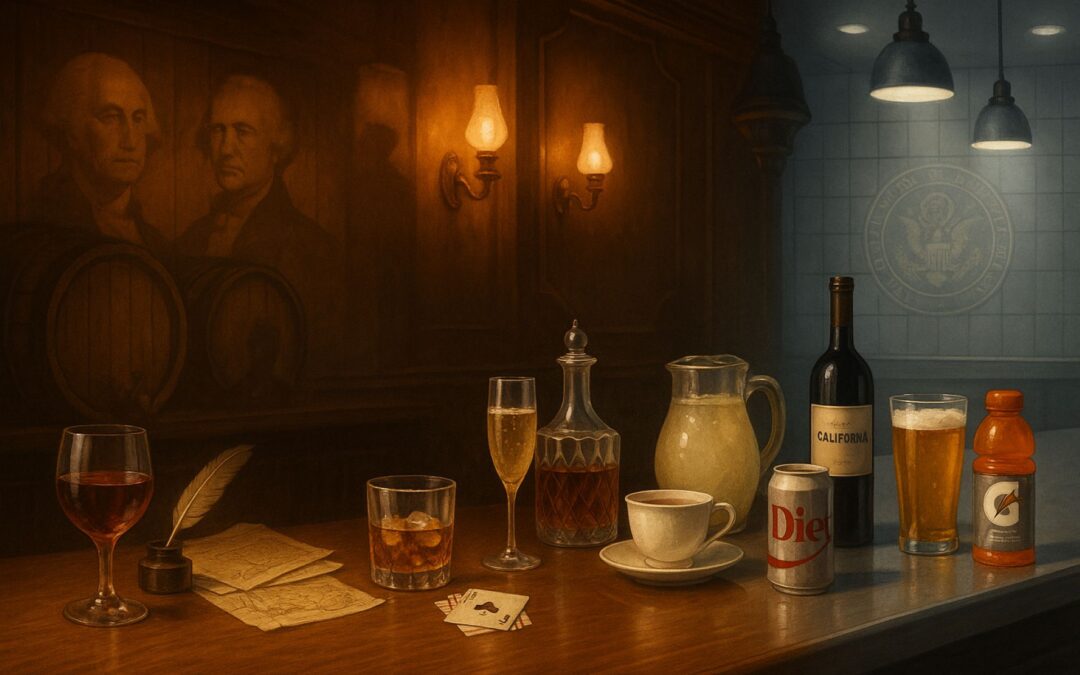
From whiskey-soaked inaugurations to soda-fueled strategy sessions, the history of American presidents can be traced not just through wars and speeches, but also through what they drank. Behind every glass lies a confession: of temperament, taste, and time. Some leaders found courage in rum, while others found it in coffee. Some used alcohol to celebrate victory; others avoided it to survive the weight of command.
The evolution of these presidential drinks tells us more than trivia ever could — it reveals the soul of each era. In the burn of bourbon, the chill of milk, or the fizz of Diet Coke, you can glimpse the changing face of America itself — from rebellion to refinement, from indulgence to image.
The Founding Drinkers: Wine, Cider, and Revolution
In the beginning, America ran on courage, chaos, and alcohol. The nation was still raw, the ink on its Constitution barely dry, and the White House had not yet become the sanctum of polished politics it is today. These early presidents lived in an era when water could be deadly, whiskey could be a cure, and wine — sweet, fortified, and often smuggled — could symbolize both refinement and rebellion at once. To understand the Founders, you only need to look into their glasses.
George Washington’s drink of choice was Madeira, a fortified Portuguese wine that was both indulgent and practical. Its high alcohol content allowed it to survive long sea voyages without spoiling, making it the lifeblood of colonial cellars. But Washington’s affection for it went far beyond taste — it became a symbol of defiance. When the British Empire levied steep taxes on imported Madeira, Washington didn’t abstain; he circumvented. He smuggled barrels into Virginia through secret trade channels, effectively turning his love for wine into a political act. This wasn’t the drink of leisure — it was liquid resistance. His Mount Vernon estate became a hub for sophisticated smuggling, where a man who had defeated the mightiest army in the world also defied its tariffs, one glass at a time.
If Washington drank for rebellion, John Adams drank for resilience. His mornings began with a bracing glass of hard cider — not the sugary novelty it is today, but a robust, alcoholic tonic brewed from New England apples. To Adams, it was breakfast, medicine, and motivation all in one. He claimed it kept him “healthy and fit for work,” though his wife Abigail likely had her doubts. The practice wasn’t unusual — in the late 1700s, cider was safer than water and cheaper than imported spirits. But for Adams, who was as sharp-tongued as he was disciplined, it became a daily ritual of vigor and virtue. His moral code even extended to his beverages: after the Boston Tea Party, he swore off tea permanently, seeing it as a symbol of British tyranny. In his household, coffee replaced tea — the new patriotic drink of the revolutionaries.
Where Washington embodied leadership and Adams embodied duty, Thomas Jefferson represented curiosity — and refinement. While serving as the American ambassador to France, Jefferson discovered wine not as a luxury but as an intellectual pursuit. He toured vineyards, met vintners, and filled notebooks with meticulous tasting notes: color, aroma, acidity, terroir. His cellar at Monticello became legendary, stocked with fine Bordeaux, Burgundy, and Italian Chianti. To Jefferson, wine was not indulgence; it was civilization distilled. It symbolized order, artistry, and the idea that democracy could coexist with taste. He once remarked that “good wine is a necessity of life for me,” a sentiment that might have scandalized the puritans but charmed the philosophers. In a country still clearing forests and fighting debts, Jefferson’s refined palate felt like an aspiration — a glimpse of what America could one day become.
Then came James Madison, proof that even among titans, moderation could be revolutionary. At five feet four and barely one hundred pounds, Madison was small in stature but monumental in intellect. Unlike his predecessors, he avoided alcohol almost entirely. His delicate constitution couldn’t tolerate it, and his disciplined mind didn’t require it. He thrived on tea and coffee — stimulants of reason rather than escape. At formal dinners, while others raised their glasses in cheer, Madison preferred clarity over cheerfulness. His restraint reflected his philosophy: government, like drinking, required control, balance, and temperance.
Madison’s successor, James Monroe, however, swung the pendulum back toward indulgence. Having served as a diplomat in France during the Revolution, Monroe developed a fondness for Bordeaux and Champagne — symbols of continental sophistication. When he became president, his White House imported over a thousand bottles of French wine, turning state dinners into glittering spectacles. The capital may have been young and rough around the edges, but inside those candlelit halls flowed the finest vintages of Europe. Monroe’s presidency marked a new phase — the transition of America from a rough frontier republic to a nation finding its taste, quite literally, for refinement.
Together, these early presidents captured the paradox of America’s birth: a republic forged in rebellion yet enamored with European taste; built by rough hands but dreaming of elegance. Washington smuggled for freedom, Adams drank for duty, Jefferson savored for wisdom, Madison abstained for focus, and Monroe imported for prestige.
Each glass they raised was more than a drink — it was an early reflection of America’s soul: fierce, idealistic, contradictory, and forever thirsty for something greater.
Whiskey and the Age of War
By the time America entered the 19th century, refinement had taken a back seat to raw energy. The new republic was flexing its muscles, expanding westward, and wrestling with its own identity. The genteel wine of Jefferson’s France gave way to something darker, stronger, more distinctly American — whiskey. It was cheap, fierce, and democratic. It spoke the language of the frontier. And for the next generation of presidents, whiskey wasn’t merely a drink — it was an emblem of power, masculinity, and populism.
Andrew Jackson was the whiskey man incarnate. A brawler from Tennessee with a temper as volatile as his liquor, Jackson saw whiskey as both comfort and currency. It was the drink of soldiers, settlers, and the self-made. When he won the presidency in 1829, he invited “the people” to celebrate in the White House — and they did, with such ferocity that it became legend. Thousands of supporters poured through the doors, trampling carpets, smashing furniture, and leaving the executive mansion reeking of spilled whiskey punch. The chaos was so intense that Jackson escaped through a window, the first and only president to flee his own inauguration party. The event symbolized more than debauchery; it was democracy unfiltered. Whiskey had stormed the gates of power, and populism had found its flavor.
Jackson’s successor, Martin Van Buren, inherited not just Jackson’s political machine but his drinking reputation. A shrewd tactician and relentless socializer, Van Buren earned the nickname “Blue Whiskey Van” for his legendary tolerance. He could drink glass after glass and still debate policy with precision. To his allies, this endurance was impressive; to his enemies, it was emblematic of indulgence. But in a nation that valued grit over grace, Van Buren’s appetite for both alcohol and ambition made him a symbol of frontier cunning. He drank as if proving he could outlast anyone — and often did.
The next great drinking story belonged to William Henry Harrison, whose presidency was shorter than most hangovers. During the campaign of 1840, Harrison’s opponents mocked him as an out-of-touch old soldier who’d be content to live in a log cabin with a barrel of hard cider. What they intended as ridicule became a political masterstroke. Harrison embraced the image, turning cider — the drink of the common man — into a populist weapon. His rallies featured cider barrels, log cabin floats, and raucous songs about simple virtues. He became the embodiment of frontier authenticity, proving that in politics, image often intoxicates more than truth. But the celebration was brief: Harrison delivered his inaugural address in a snowstorm without a coat, caught pneumonia, and died thirty-one days later. The man who made cider fashionable didn’t live long enough to enjoy it.
When John Tyler assumed the presidency, the tone shifted from rustic to refined. Tyler was more aristocrat than populist, and his favorite indulgence reflected that — French champagne. He hosted elegant parties filled with music, dancing, and endless bubbles, bringing a touch of European grandeur to a recovering White House. To Tyler, champagne was not excess but ceremony — the drink of diplomacy and civility after years of whiskey-soaked rebellion. Yet this civility was short-lived, for Tyler’s successor would swing the pendulum once more toward discipline.
James K. Polk, one of the hardest-working presidents in American history, had little time for spirits. He saw alcohol as a distraction and moral compromise. His wife, Sarah, agreed — fervently. Together, they banned hard liquor from all White House events. Guests who once sipped Bordeaux or bourbon were now served coffee, tea, and the occasional lemonade. The couple’s rigid sobriety earned Sarah the nickname “Sahara Sarah,” a nod to both her dryness and the barren receptions that followed. But Polk didn’t care for popularity; he cared for progress. Under his disciplined watch, the U.S. expanded by millions of acres. Where others toasted victory, Polk worked through the night — coffee replacing cognac as the fuel of empire.
This period, from Jackson to Polk, marks one of the most revealing transitions in American leadership. The country was shifting from a nation of ideals to one of ambition — from philosophical musings over wine to practical conquest over whiskey and caffeine. The White House mirrored the battlefield: loud, restless, and unpredictable. Presidents drank to celebrate democracy, to endure its chaos, or to escape it altogether.
Each man’s drink became a portrait of his presidency:
Jackson’s whiskey — fiery and populist.
Van Buren’s — cunning and enduring.
Harrison’s cider — symbolic and fleeting.
Tyler’s champagne — elegant and elusive.
Polk’s coffee — industrious and sober.
Together, they distilled a young nation’s transformation — from rebellion to order, from indulgence to purpose. America was maturing, but it wasn’t sobering up just yet. It was simply learning to hold its liquor.
The Rise of Temperance and Tragedy
By the mid-1800s, America was sobering up—at least in theory. Industrialization, urbanization, and a new moral conscience were reshaping the nation’s appetite for vice. The same republic that had once toasted liberty now began questioning whether too much liberty, too much indulgence, might erode its moral core. The temperance movement was gathering steam in churches, women’s circles, and newspapers. But even as sermons condemned the bottle, the presidency became a stage for the contradictions of self-control and excess. What a man drank, or refused to drink, was no longer just habit—it was politics, philosophy, and, in some tragic cases, destiny.
Zachary Taylor embodied this tension perfectly. A career soldier with the plain manners of the frontier, Taylor was no lover of liquor. He preferred cold milk—humble, wholesome, and, to his mind, safe. Yet that very innocence proved fatal. On a scorching Fourth of July in 1850, President Taylor attended Independence Day celebrations in Washington. Exhausted and overheated, he sought relief in a simple refreshment: a bowl of iced milk with fresh cherries. Unbeknownst to him, the cherries had been washed in contaminated water drawn from the city’s polluted pumps. Within hours, he was violently ill. Within five days, he was dead. The irony was cruel—America’s twelfth president, a man who had survived battlefields and Mexican bullets, was undone by fruit and dairy. His death became both a cautionary tale and a national riddle: had purity itself become dangerous?
While Taylor’s end was accidental, Franklin Pierce’s decline was deliberate, drawn out, and painfully human. Handsome, eloquent, and deeply afflicted, Pierce carried personal tragedy like a shadow. Before taking office, he lost all three of his children, the last in a horrific train accident he witnessed firsthand. His wife, Jane, withdrew from public life, leaving Pierce isolated with his grief—and his glass. Whiskey, rum, and wine became his constant companions. Unlike the jovial excesses of earlier presidents, Pierce’s drinking was quiet, desperate, and self-destructive. Once out of office, he famously confided, “What can an ex-president do but get drunk?” He wasn’t joking. Alcohol dulled his pain until it consumed him entirely. By the time he died of cirrhosis, the bottle had replaced both the presidency and prayer. His story revealed something new about America’s leaders: they were not just symbols of power but fragile men drowning in expectation.
James Buchanan offered a different kind of devotion to the drink—one of passion rather than despair. While studying law in his youth, Buchanan became enamored with Madeira wine, the same fortified favorite of Washington. He loved it so much that he once chose the island of Madeira as his destination for a nautical navigation project. Decades later, his estate in Pennsylvania boasted one of the largest wine cellars in the country, stacked floor to ceiling with imported bottles. Buchanan was not a tragic drinker but a methodical one, a man of routine who enjoyed control even in his indulgence. Yet, like his leadership, his pleasure was detached and static. He sipped while the nation fractured, his caution indistinguishable from paralysis. His beloved Madeira symbolized his presidency: rich, refined, and utterly out of step with the fires burning around him.
Then came Abraham Lincoln, a man who refused the cup altogether. Lincoln’s sobriety was not puritanical but pragmatic. He understood that clarity was his only defense against chaos. In an era when politicians drank through debates, Lincoln raised glasses of water. He believed a clear head was a moral necessity, especially for a leader navigating a country on the brink of war. His restraint was legendary. At dinners and diplomatic events, when others toasted wine, Lincoln would gently raise his glass of water without irony or apology. It wasn’t that he disdained pleasure—he simply couldn’t afford distortion. In a nation splitting apart, sobriety became his symbol of steadiness. While others sought courage in spirits, Lincoln found it in conscience.
But his successor, Andrew Johnson, shattered that composure in spectacular fashion. Sworn in as vice president in 1865, Johnson arrived at the inauguration nursing a hangover. His remedy was predictable—more whiskey. By the time he took the podium, he was visibly drunk, slurring and stammering through what was meant to be a short address. It became a rambling embarrassment in front of Congress, the Supreme Court, and the newly re-elected Lincoln himself. The contrast could not have been sharper: Lincoln, the sober statesman; Johnson, the stumbling populist. When Lincoln was assassinated weeks later, Johnson inherited both the presidency and the impossible expectation of steadiness. Instead, he inherited the bottle. His tenure became a political hangover, a sobering lesson in how easily power can magnify a man’s flaws.
Together, these five presidents formed a cautionary tapestry of temperance and tragedy. Taylor’s milk symbolized innocence undone by ignorance. Pierce’s whiskey represented grief turned into dependence. Buchanan’s wine marked refined paralysis. Lincoln’s water embodied moral clarity. Johnson’s whiskey dramatized chaos unrestrained. Their stories mirrored the country’s own divided soul—torn between indulgence and restraint, idealism and weakness, reason and ruin.
As the century progressed, America’s leaders—and its people—were forced to confront an uncomfortable truth: the pursuit of virtue often revealed the depth of vice. The age of temperance was not about abstaining from drink; it was about learning how to live with one’s own thirst.
The Lemonade Years: When the White House Went Dry
After the Civil War, America’s mood began to change. The smoke cleared, the cities grew, and the same whiskey that had once fueled revolution now seemed to symbolize moral decay. The temperance movement, led largely by religious reformers and women’s advocacy groups, began to shape public life — and even the presidency wasn’t immune. The White House, once home to whiskey punch and champagne fountains, became a battleground between indulgence and integrity. This was the age of the dry presidents, where lemonade, tea, and virtue replaced bourbon, beer, and bravado.
No story embodied this clash more vividly than that of Ulysses S. Grant. A war hero and a man of undeniable courage, Grant was also a man haunted by the bottle. His fondness for whiskey was legendary — and often exaggerated by his critics — but his discipline on the battlefield was undeniable. When someone complained to Abraham Lincoln about Grant’s drinking, Lincoln famously quipped, “Find out what whiskey he drinks and send a barrel to my other generals.” The remark, half jest and half admiration, revealed a national paradox: America celebrated strength but feared its excess. Grant carried both in his veins.
Then came Rutherford B. Hayes, who swung the pendulum completely in the opposite direction. His wife, Lucy Webb Hayes, was a devout Methodist and a vocal supporter of the temperance cause. She banned alcohol from all White House events, replacing wine with water and whiskey with lemonade. Guests quickly began calling her “Lemonade Lucy,” a nickname that was both affectionate and mocking. Her receptions were proper, polite, and painfully dull. But behind the mockery was a social revolution. Lucy Hayes represented the rise of women’s moral authority in politics — the idea that virtue, not vigor, should define leadership. Hayes himself supported her decision, believing sobriety to be a mark of discipline. Together, they turned the White House into a citadel of moral reform — a dry oasis in a nation still thirsty for vice.
Their successor, James Garfield, quietly rebelled. A man of humble origins and sharp intellect, Garfield saw no sin in a cold beer. When he became president in 1881, he lifted the Hayes-era ban on alcohol and allowed beer to flow again at official receptions. For Garfield, moderation was not weakness but wisdom. He believed temperance did not mean denial — it meant knowing when to stop. His presidency, tragically cut short by assassination, became a brief flicker of normalcy between two extremes: the rigid dryness of Hayes and the elegant indulgence of those who followed.
Chester A. Arthur, Garfield’s successor, was everything Hayes wasn’t — refined, urbane, and quietly extravagant. Nicknamed “Elegant Arthur,” he turned the White House into a haven of taste and class. His wardrobe was impeccable, his manners polished, and his drinks — exquisite. Arthur loved fine wines, aged whiskey, and imported liqueurs served in crystal decanters. Under his watch, state dinners regained their glamour. Where Hayes had served lemonade, Arthur served brandy. His White House glittered with gold chandeliers, European furnishings, and the clinking of glasses — a symbol that America, though moral in rhetoric, still craved sophistication in practice. For Arthur, refinement wasn’t rebellion; it was restoration. The republic could afford elegance again.
But not everyone agreed. The pendulum swung yet again with Grover Cleveland, the only president to serve two non-consecutive terms — and one of the most unapologetic beer drinkers in White House history. Cleveland was a large man with a hearty laugh and a bigger thirst. During his time as governor of New York, he struck a deal with a friend to limit themselves to four beers a day. But when they realized how quickly four glasses disappeared, they redefined the rule: four tankards a day. Problem solved. His drinking wasn’t reckless — it was communal, blue-collar, relatable. Cleveland loved crowded saloons and loud conversations. He wasn’t a champagne statesman; he was a beer man of the people. In an era obsessed with moral image, his open fondness for beer was both political risk and populist charm.
Then came Benjamin Harrison, who reintroduced restraint to the office. A man of Presbyterian discipline, Harrison preferred black tea to bourbon, and decorum to decadence. His table was austere, his manners impeccable. Where Cleveland’s presidency had been soaked in camaraderie and clinking glasses, Harrison’s was defined by quiet dignity. It was as if the White House itself needed to dry out between rounds. His return to moderation reflected a growing cultural fatigue — the nation was tired of moral lectures but wary of excess. Harrison’s cup of tea was more than a personal preference; it was a political signal. The presidency, once again, sought moral equilibrium.
Across these decades, the White House became a mirror of America’s identity crisis. From Grant’s whiskey to Hayes’s lemonade, from Garfield’s beer to Arthur’s champagne, from Cleveland’s tankards to Harrison’s tea, the pattern was unmistakable: the moral pendulum swung between indulgence and abstinence, between sin and sanctity. Every president became a symbol of the nation’s struggle to define virtue — was it restraint or authenticity, refinement or rebellion?
The irony was rich. The age that prided itself on moral purity was also the age of political corruption, industrial monopolies, and Gilded Age greed. Lemonade in the East Wing couldn’t hide the whiskey flowing in back rooms and saloons. The country was dry in speech, wet in spirit.
And so, the “Lemonade Years” were less about what the presidents drank and more about what they represented. They were the nation’s awkward adolescence — trying to outgrow its vices while secretly missing them. In those years, every glass of water, every pour of champagne, every tankard of beer was an unspoken argument about who America wanted to be: the moral reformer, the gentleman, or the honest drunk.
From Prohibition to Martini Diplomacy
By the dawn of the 20th century, America’s relationship with alcohol had matured — or at least learned to hide itself better. Industrial progress, global wars, and the rising chorus of moral reformers had transformed the national conversation. Drinking was no longer just about pleasure; it was about propriety. The temperance movement had exploded into a political force, and as the 18th Amendment loomed on the horizon, even presidents began walking the uneasy line between indulgence and image. Yet behind the closed doors of the Oval Office and the glitter of state dinners, the bottle never truly disappeared. It merely changed shape — from raucous whiskey barrels to elegant crystal martini glasses.
William McKinley was among the first to understand that the art of leadership required a drink with character. During his 1896 presidential campaign, a bartender in New York crafted a cocktail in his honor: McKinley’s Delight. It was a potent mixture of rye whiskey, sweet vermouth, cherry brandy, and a hint of absinthe — bold, complex, and slightly dangerous, just like the age he led. The drink mirrored McKinley himself — conventional on the surface, but with a kick of ambition underneath. It became the unofficial beverage of his administration, symbolizing a nation on the cusp of empire, ready to flex its new global muscles.
Then came Theodore Roosevelt, who brought the energy of a cavalry charge to the presidency. A man of robust appetites — for adventure, power, and mint — Roosevelt’s favorite drink was the mint julep. Unlike his predecessors, he made it himself, crushing fresh mint leaves grown in the White House garden and mixing them with Kentucky bourbon and sugar. The drink, cooling and commanding, suited him perfectly. Roosevelt wasn’t merely sipping; he was crafting — much as he crafted his own image of rugged nobility. His juleps were as famous as his charge up San Juan Hill. In a time when America was discovering its confidence, Roosevelt’s handcrafted bourbon cocktails became a symbol of self-reliance wrapped in sophistication.
William Howard Taft, Roosevelt’s successor and the largest man ever to hold the presidency, preferred a gentler fizz. His drink of choice was ginger ale, which he consumed with the same gusto others reserved for champagne. During a visit to Savannah in 1909, he downed four bottles at lunch alone. To some, this seemed comically tame compared to Roosevelt’s juleps. But Taft’s restraint was deliberate. He represented a quieter, more measured America — less frontier, more institution. His bubbly indulgence reflected a leader comfortable with comfort, not conquest.
Then the pendulum swung toward contradiction. Woodrow Wilson led the country into Prohibition — and then quietly broke its rules. Under his presidency, the 18th Amendment outlawed the manufacture, sale, and transport of alcohol in 1920. Publicly, Wilson appeared to support temperance; privately, he enjoyed his scotch whiskey. When his term ended, he even requested congressional permission to move his personal liquor supply to his new home, since transporting alcohol was technically illegal. Congress agreed — proof that power makes its own loopholes. The irony was sharp: the man who presided over the nation’s greatest moral crackdown became its most refined bootlegger.
Then came Warren G. Harding, who treated Prohibition as a suggestion rather than a law. Charismatic, reckless, and perpetually in over his head, Harding hosted weekly poker nights in the White House where bootleg whiskey flowed freely. The bottles often came from confiscated police raids — technically “evidence.” His friends drank it anyway, laughing around the poker table while the nation preached sobriety. Harding’s administration would later collapse under scandal — but his parties never lacked entertainment. He was the first president to prove that Prohibition didn’t stop drinking; it just made it more interesting.
Calvin Coolidge, nicknamed “Silent Cal,” offered the inevitable reaction. Stoic, restrained, and allergic to chaos, he dried the White House out again. Publicly, his administration exuded virtue — no whiskey, no wine, no revelry. Yet in private, Coolidge reportedly enjoyed the occasional sweet Tokay wine, a dessert favorite of European courts. The contrast was striking: outward modesty, inward refinement. Coolidge’s approach captured the era’s hypocrisy perfectly. America wanted to appear moral, not necessarily to be moral.
Herbert Hoover, who followed, brought Prohibition to its symbolic peak — and its collapse. A devout believer in temperance, Hoover once called it a “noble experiment.” Yet after leaving office, he became the image of quiet indulgence. Each evening, he mixed himself two extremely dry martinis — mostly gin, barely vermouth. He measured the proportions with engineer-like precision, the way he measured everything else. His nightly ritual revealed an essential truth about the American presidency: power demands order, and even leisure must follow rules. Hoover didn’t drink to forget; he drank to calibrate.
Then came Franklin D. Roosevelt, who made drinking democratic again. His presidency coincided with the end of Prohibition in 1933, and he personally celebrated by mixing a martini — the drink that would define his administration. FDR wasn’t content to be served; he was the bartender-in-chief. At the 1943 Tehran Conference, he mixed martinis for Winston Churchill and Joseph Stalin himself. Churchill reportedly loved it. Stalin grimaced and said, “It is cold on the stomach.” But the symbolism was perfect: Roosevelt, with his cigarette holder and easy charm, turned the cocktail into an instrument of diplomacy. In his hands, the martini became not just a drink but a metaphor — controlled, composed, and potent.
Harry Truman carried the torch — or rather, the tumbler — into the postwar world. His mornings began with what he called an “eye-opener”: bourbon mixed into orange juice, a dose of courage before a day of decisions. He justified it pragmatically: “If I didn’t drink bourbon, I’d probably never get through this job.” Truman’s morning ritual, unpretentious and potent, reflected the new American ethos — work hard, drink early, and never flinch.
By the time Dwight D. Eisenhower entered the White House, the drama had mellowed. A general turned president, Eisenhower’s tastes were as disciplined as his demeanor. His nightly drink — scotch on the rocks — was straightforward, calm, and deliberate. There was no grand gesture, no symbolic cocktail. Just a simple drink at day’s end, accompanied by reflection. If Roosevelt’s martini embodied diplomacy, Eisenhower’s scotch represented duty — a quiet strength beneath the surface calm.
This era, spanning from McKinley to Eisenhower, marked the transformation of the presidential drink from indulgence to ritual. Each glass held not just alcohol but image. The whiskey-fueled populism of Jackson’s time had evolved into something subtler — the curated sophistication of the modern statesman. The White House cellar was no longer a playground of excess; it was a stage for taste, perception, and politics.
In truth, the so-called “dry age” had never really arrived. It had only learned discretion. Presidents still drank, but now they did it with purpose — to charm, to calm, to connect. The drink had become diplomacy. The martini had become metaphor. And America, always in flux between restraint and rebellion, continued to toast its contradictions — one polished glass at a time.
Modern Mixers and Presidential Preferences
By the mid-20th century, America had entered a new kind of intoxication — not with liquor, but with image. The camera, the headline, the television screen — these became the new bar counters where presidents mixed their public personas. Drinking, once a private habit or political statement, now lived under scrutiny. Each sip could signal relatability or recklessness, authenticity or artifice. The White House bar cart evolved again, reflecting a society caught between indulgence and decorum, between the gentleman’s cocktail and the diet beverage. From John F. Kennedy to Joe Biden, what the presidents drank became shorthand for the times they governed — the mood of a nation bottled in flavor.
John F. Kennedy ushered in a new aesthetic — the age of cool. Young, tanned, and effortlessly charming, Kennedy was the first president to make leisure look like leadership. His favorite drinks, Bloody Marys and Heinekens, fit the image perfectly: cosmopolitan, light, and quietly confident. The Bloody Mary — a spicy, social cocktail — was his weekend companion during brunches at Hyannis Port, where family, friends, and politics mingled under the Massachusetts sun. The Heineken, then a rare European import, signaled refinement without pretension. Kennedy’s drinking habits reflected his broader philosophy: tradition reinvented, old forms made new. The public saw a man in control — sipping rather than swigging — and in that restraint, Kennedy redefined presidential charisma.
Lyndon B. Johnson, his Texan successor, couldn’t have been more different. Where Kennedy measured elegance in moderation, LBJ measured confidence in ounces. His go-to drink was a scotch and soda highball, served in large tumblers filled with ice — and often refilled by his ever-vigilant Secret Service detail as he cruised around his Texas ranch. LBJ called them “roadies.” The sight of the president holding a sweating glass of amber liquor while shouting orders from a convertible became iconic — part absurd, part endearing. Johnson’s drinking was as unfiltered as his politics: bold, brash, and unapologetically American. If Kennedy’s Heineken whispered diplomacy, Johnson’s scotch bellowed dominance.
Then came Richard Nixon, a man whose relationship with alcohol mirrored his complicated inner life. Nixon had a taste for fine French Bordeaux — but like much of his presidency, his indulgence came with secrecy. At formal White House dinners, guests were served affordable California wines, while Nixon’s own glass was discreetly filled from a hidden bottle of Château Lafite Rothschild or Haut-Brion, wrapped in a napkin so no one could see the label. It was the perfect metaphor for Nixon’s administration — luxury cloaked in paranoia, privilege hidden behind performance. The red wine became his private comfort and his political emblem: refined yet isolated, rich yet restrained. When his presidency collapsed under the weight of Watergate, the image of that secret bottle felt prophetic — a man trying to control perception until the truth inevitably poured out.
In contrast, Gerald Ford approached his glass with transparency and simplicity. Taking office in the aftermath of scandal, Ford sought normalcy. His preferred drink was the double martini, strong but straightforward. Friends described him as genial, grounded, and consistent — he drank like a man who wanted balance, not escape. During the long evenings of political repair, Ford’s martinis served as punctuation marks in his daily rhythm — not symbols of power, but reminders of calm. In a country desperate for steadiness, his unpretentious ritual felt reassuring.
Jimmy Carter reversed the pattern completely. The son of a Georgia farmer and a devout Baptist, Carter avoided alcohol altogether. His personal history was marred by family struggles with alcoholism, and he vowed early in life to abstain. As president, he preferred iced tea, water, and occasionally milk. In Carter’s White House, virtue replaced vice. He saw sobriety not as an image but as integrity — an act of solidarity with those trying to live clean in a culture of excess. His presidency may have been politically turbulent, but his abstinence made him one of the rare American leaders who treated clarity as both moral and mental necessity.
When Ronald Reagan arrived, the tone shifted again — from moral earnestness to cinematic glamour. Reagan, the Hollywood icon turned statesman, revived the image of the polished drinker without the taint of indulgence. His favorite was California wine, especially vintages from Napa and Sonoma. He and Nancy Reagan became unofficial ambassadors for American winemaking, serving fine local bottles at state dinners and turning domestic vineyards into symbols of national pride. It wasn’t just about taste — it was branding. Reagan’s wine was as symbolic as his smile: optimistic, sunny, distinctly American. In an era defined by television and soft power, the Reagans made the toast itself a performance of confidence.
George H. W. Bush returned sobriety to stoicism. A disciplined navy pilot and lifelong statesman, Bush Sr. favored the vodka martini — clean, crisp, and meticulously prepared. He drank rarely and quietly, preferring a single glass over social display. At public events, he often switched to beer, particularly during baseball games, where he appeared like any other fan in the stands. His moderation reflected his temperament: cautious, calculated, and understated. Where Reagan’s glass was about charisma, Bush’s was about control.
Then came Bill Clinton, the consummate social politician. Clinton’s favorite drink was the snakebite — a British pub concoction of equal parts lager and hard cider, discovered during his Oxford days. The combination was unusual but effective: smooth on the surface, potent underneath. It suited him perfectly. Clinton drank casually, rarely to excess, and when he wasn’t indulging in alcohol, he favored Diet Coke, iced tea, and conversation. His beverage choices mirrored his leadership style — adaptable, affable, and a little unpredictable.
George W. Bush, by contrast, began his political career with a hard reckoning. In his younger years, he was known for his devotion to what he called “the four B’s” — beer, bourbon, B&B, and Black Velvet whiskey. His reputation as a party-loving Texan preceded him. But on his 40th birthday, Bush quit drinking completely. The decision, born of introspection and faith, became a cornerstone of his personal redemption story. As president, he abstained entirely, replacing whiskey with Coke Zero and the occasional non-alcoholic beer. For a man leading a nation through war and uncertainty, sobriety became a quiet badge of discipline — a symbol of inner control in a world spinning out of it.
Barack Obama brought balance back to the mix. He was the rare modern president who could sip a beer and still look presidential doing it. His beverage of choice was beer — approachable, relatable, and distinctly populist. But Obama didn’t stop there. In 2011, he made history by commissioning the first White House homebrew: the Honey Ale, brewed with honey harvested from Michelle Obama’s South Lawn beehives. It was the perfect marriage of tradition and innovation — a literal taste of homegrown leadership. Obama even hosted a “beer summit” at the White House to foster dialogue between a police officer and a Harvard professor after a public racial controversy. In his hands, beer became not escapism but diplomacy — a liquid symbol of unity.
When Donald Trump took office, America met the first lifelong teetotaler since the early 19th century. Having lost his brother Fred to alcoholism, Trump swore never to touch alcohol. But he wasn’t without vice — his obsession with Diet Coke became legendary. He reportedly drank as many as 12 cans a day, each delivered at the push of a red button on his Oval Office desk. Visitors often froze when he pressed it, fearing nuclear catastrophe — only to watch a butler arrive with a fizzing can. The prank became part of the mythos, an absurd blend of power and play. In Trump’s presidency, soda replaced scotch, spectacle replaced substance, and the fizz of carbonated sugar became the soundtrack of excess reimagined.
And then there was Joe Biden, the everyman president, who carried the ethos of authenticity back into the White House. Like Trump, Biden never drank alcohol — a personal choice rooted in family history and faith. Instead, his preferred drink is orange Gatorade — bright, functional, and unmistakably ordinary. It fuels his long speeches, his morning workouts, and his image as the steady, hardworking patriarch of modern politics. The fluorescent bottle, often spotted in the background of Oval Office photos, says what his presidency aims to: energy without extravagance.
From Kennedy’s Heineken to Biden’s Gatorade, the evolution of the presidential glass traces more than personal preference — it charts America’s cultural transformation. The whiskey-soaked populism of Jackson gave way to the image-conscious hydration of the 21st century. The drinks grew lighter, the optics cleaner, the indulgence subtler.
Each beverage reflected its age:
The mint julep spoke of confidence.
The martini of order.
The beer of unity.
The Diet Coke of spectacle.
The Gatorade of endurance.
The arc of the presidential palate bends toward perception. Where once power was measured by how hard a man could drink, it is now defined by how carefully he is seen to sip. The story of modern presidents is not about intoxication, but about presentation — a chronicle of how America learned to toast without getting drunk.
Conclusion: What the Presidential Glass Reveals
Across two and a half centuries, from Washington’s smuggled Madeira to Biden’s Gatorade bottle, the contents of the presidential glass have mirrored the character of the nation that filled it. Each era poured its own spirit — rebellion in the Founding Fathers’ wine, resilience in Jackson’s whiskey, remorse in the temperance years, and sophistication in the martinis of the modern age. By the 21st century, alcohol had given way to optics: coffee for clarity, Coke for control, and electrolyte drinks for endurance. What began as a toast to freedom evolved into a performance of discipline.
The truth is timeless — power, like liquor, must be handled with care. Too much indulgence clouds judgment; too much restraint dulls humanity. Between the two lies the art of leadership — to sip, not to drown. Every president’s drink, whether fermented, fizzy, or fluorescent, has revealed a private truth about public power: that leadership, at its core, isn’t measured by what a man drinks, but by how he holds the glass.