
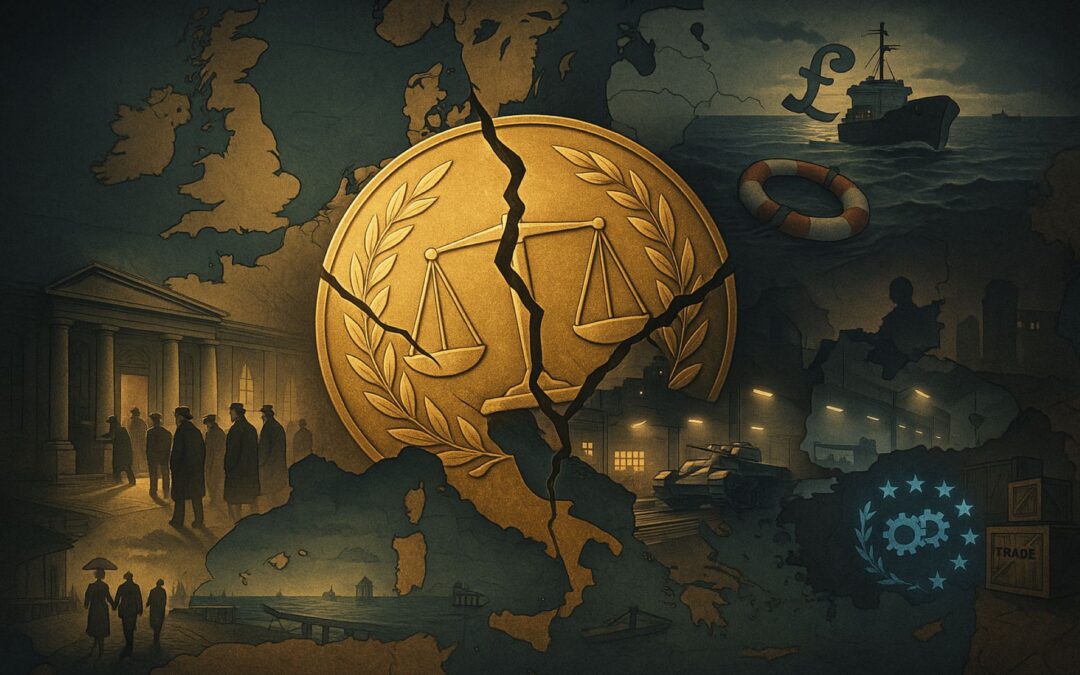
What holds a civilization together—wealth or belief? In 1931, Europe discovered that the two were one and the same. A bank fell in Vienna, and with it, the confidence of an entire continent. What began as an accounting failure became a crisis of faith. Gold, once a symbol of security, turned into a chain. Governments balanced budgets while their citizens starved. Democracy, exhausted by indecision, gave way to men who promised miracles in uniforms and slogans.
This is not just the story of markets collapsing; it is the story of people losing faith in tomorrow. The Great Depression in Europe was less an economic disaster than a moral reckoning—a reminder that when societies worship stability over compassion, even prosperity becomes a form of blindness.
The Collapse That Shook a Continent
In May 1931, Vienna woke up to silence. The kind of silence that follows catastrophe. The Credit-Anstalt, Austria’s most powerful and prestigious bank—a financial empire with deep roots in Central Europe—had declared insolvency. Overnight, what had once been the backbone of the Austrian economy dissolved into panic. Depositors swarmed branches, clutching passbooks that had just turned into relics of misplaced faith. Bankers spoke in whispers; markets spoke in screams.
But this was not just Austria’s tragedy. Within days, fear leapt across borders like wildfire. Germany’s Danatbank began to tremble. Hungary’s National Bank saw its reserves vanish. The interconnectedness of Europe’s financial web—its strength in good times—became its fatal flaw in bad ones. The contagion moved faster than governments could react, faster than anyone could comprehend.
This was no ordinary bank failure. It was the moment the illusion of postwar stability cracked. After the devastation of World War I, Europeans had clung to the belief that progress was inevitable—that technology, trade, and treaties could outpace the ghosts of the past. The Credit-Anstalt collapse proved otherwise. Confidence—the invisible currency on which all modern economies depend—had vanished. And once faith disappears, even the most fortified systems crumble.
For millions, the collapse marked the beginning of a long descent. Life savings disappeared overnight. Farmers who had rebuilt their lands after the war now found their crops worthless. Small industries, starved of credit, shut their doors. The psychological damage was deeper than any monetary loss. People began to question not just their governments or banks, but the entire postwar order—the notion that progress was permanent and peace could be engineered through policy.
Every economic era has its spark that ignites the inferno. For Europe, the Credit-Anstalt’s fall was that spark—a single failure that turned private anxiety into public panic. It showed how fragile the idea of “recovery” really was. Europe had not healed after the Great War; it had merely papered over its wounds with borrowed money and blind optimism.
The fall of a bank became the fall of an era—the moment when Europe realized that its miracle of stability had been a mirage.
From Ashes to Illusions of Recovery
To understand Europe’s collapse in the 1930s, one must first understand its illusion of recovery in the 1920s. The Great War had left the continent physically devastated and psychologically broken. Fields once fertile had become battlefields. Factories lay in ruins, trade routes had collapsed, and entire currencies were worthless. Yet within a decade, much of Europe appeared reborn.
Cities like Berlin, Paris, and Vienna were alive again—cafés thrived, jazz bands played, and the rich toasted to “normalcy.” Governments, desperate to show progress, celebrated economic growth and industrial revival. Newspapers spoke of modernization and reconstruction. But beneath this surface prosperity was a silent dependency—the invisible hand of American credit.
Through the Dawes Plan of 1924, the United States began pumping billions of dollars into Europe. Germany, crushed under the burden of reparations, became the main beneficiary. The loans stabilized the mark, rebuilt infrastructure, and reignited industry. Yet these loans were not gifts—they were lifelines, fragile and temporary. Germany used American loans to pay reparations to France; France used that money to repay debts to Britain; Britain used it to pay back the United States. It was a global circle of obligation, a financial ouroboros devouring its own tail.
This arrangement kept Europe afloat—but it was unsustainable. Real productivity lagged far behind the borrowed prosperity. The continent was still reeling from inflation, war debts, and political instability. By the late 1920s, economic growth depended almost entirely on the continued generosity of U.S. banks and investors. When Wall Street crashed in 1929, that generosity evaporated overnight.
The collapse revealed a deeper moral truth: Europe hadn’t rebuilt—it had borrowed time. The glittering recovery of the Roaring Twenties was built on foundations of paper and promises. Factories hummed not because of innovation, but because of infusion. Currencies were “stable” only because America had made them so. Governments talked of independence while living off foreign credit.
Meanwhile, a generation of Europeans—scarred by war and desperate for stability—mistook debt for development. They equated a rising skyline with a rising future. Politicians spoke of “modern Europe,” yet the continent’s economic heart still beat to the rhythm of American interest rates.
When the music stopped, the silence was deafening. The same nations that had borrowed their way into optimism now faced a reckoning. As American money retreated, Europe’s false prosperity was exposed for what it was—a fragile illusion held together by the thin thread of international faith.
And faith, as 1931 would prove, is the first thing to break when fear returns.
Gold — The God That Wouldn’t Bleed
Gold was more than metal in 1920s Europe—it was memory, mythology, and moral compass all at once. To a generation haunted by the inflationary horrors of post–World War I, gold seemed divine. In Weimar Germany, people had watched their life savings turn into wallpaper; in Hungary and Austria, wages became meaningless before the ink dried on pay slips. You could burn banknotes for heat, but gold—gold endured. It glittered with the promise of permanence in a world that had lost all sense of it.
When the hyperinflation nightmares faded, governments sought refuge in orthodoxy. By the mid-1920s, nearly every major European nation had returned to the gold standard, a monetary system in which each currency was pegged to a fixed amount of gold. On paper, it meant discipline. In practice, it meant self-imposed paralysis. Under gold, money could not expand freely to match growth or crisis; governments could not print their way out of recession. To defend their gold reserves, nations had to slash spending, cut wages, and raise interest rates whenever capital fled their borders.
The moral language of the time cloaked this rigidity in virtue. Stability was called honor; austerity, prudence. Politicians and central bankers spoke of “defending the currency” as if they were generals defending the homeland. The average worker, however, paid the price for that moral theater. Unemployment rose as industries suffocated under deflation. Farmers sold wheat for less than the cost of harvesting it. Every gain in “confidence” came at the expense of the common citizen’s survival.
Gold had become Europe’s god—a god that demanded sacrifice. The faith was so deep that even when evidence of its cruelty mounted, leaders refused to question it. Britain returned to gold at its prewar rate in 1925, overvaluing the pound and crippling its exports. France, obsessed with restoring prestige, accumulated vast gold reserves but starved its economy of liquidity. Italy, under Mussolini’s “Battle for the Lira,” pegged its currency at an artificially strong rate to project imperial strength, crushing its industries in the process.
It was a tragedy of misplaced faith. The more Europe tried to prove its discipline, the more it courted collapse. In clinging to gold, the continent revealed something deeper than economic ignorance—it revealed a psychological obsession with control. After the chaos of war, leaders mistook rigidity for strength. But strength, in economics as in life, often lies in flexibility.
The gold standard did not just fail—it taught a painful lesson that still echoes today: the quest for perfect stability can destroy the very stability one seeks. Europe didn’t bleed gold. It bled people.
When America Sneezed
If Europe’s recovery was built on American loans, then it was also bound to American moods. And in October 1929, those moods turned to fear. When Wall Street crashed, billions in paper wealth vanished, and investors scrambled to save themselves. U.S. banks, once generous lenders to Europe, now slammed their doors shut. They called in debts, recalled loans, and liquidated foreign assets. The money that had sustained Europe’s fragile prosperity began flowing back across the Atlantic like a receding tide—exposing the bare rocks beneath.
Europe’s dependency became undeniable. Without American credit, Germany could no longer pay reparations; France could no longer balance its accounts; Britain’s export markets evaporated. It was as if the lights had gone out across the continent, one after another.
Then came the second blow—the Smoot-Hawley Tariff Act of 1930. Designed to protect American farmers and manufacturers, it instead set off a global economic war. By raising tariffs on thousands of imported goods, the U.S. effectively told Europe, “You’re on your own.” Europe retaliated. France imposed quotas on over 3,000 products, Germany raised tariffs by half, and even Britain—the high priest of free trade for nearly a century—abandoned its liberal creed.
Trade collapsed. Ships idled in ports. Wheat rotted in silos because no one could afford to buy it. Coal mines shut down as neighboring countries refused imports. The entire continent fragmented into hostile economic blocs, each trying to outlast the others. The phrase of the decade became “beggar thy neighbor.” Every nation tried to save itself by exporting its suffering elsewhere.
The human consequences were immediate. In Poland, peasants starved as global grain prices fell below subsistence levels. In Britain’s industrial north, families burned furniture to stay warm. In Germany, middle-class shopkeepers shuttered their stores and joined the swelling ranks of the unemployed. The depression was no longer an abstraction of graphs and gold reserves—it was a daily humiliation etched into ordinary lives.
The tragedy was that none of it was inevitable. Economists like John Maynard Keynes warned that austerity and protectionism would only deepen the pain. But leaders, trapped in the moral arithmetic of “sound finance,” mistook contraction for virtue. They tightened budgets as economies imploded, mistaking starvation for discipline.
When America sneezed, Europe didn’t just catch a cold—it developed pneumonia. The global economy that had once bound nations together now suffocated them. What had begun as a financial crisis became a moral one, revealing how quickly cooperation can collapse into isolation when fear dictates policy.
Europe had built its prosperity on interdependence—and in 1929, it discovered what happens when every partner turns inward.
The Human Cost of Austerity
By the early 1930s, Europe was no longer fighting a financial crisis—it was fighting for survival. And the weapons chosen by its leaders were tragically misguided. Instead of stimulus, they prescribed austerity. Instead of compassion, they offered cold arithmetic. Across the continent, governments slashed spending, raised taxes, and cut public wages, convinced that the only path to salvation was through sacrifice.
In Germany, Chancellor Heinrich Brüning embodied this doctrine. Obsessed with defending the gold standard and preserving Germany’s creditworthiness, he imposed severe deflationary policies. Public works were frozen, social welfare gutted, and wages forcibly reduced. He called it discipline; his citizens called it despair. Within a year, industrial production had fallen by 40%, and six million Germans were unemployed. Entire families sold furniture for food, teachers moonlighted as street vendors, and engineers shoveled coal to survive. Brüning became known as der Hungerkanzler—the Hunger Chancellor—a title that captured not only the suffering of the people but the starvation of democracy itself.
Austerity was not uniquely German. Britain, still struggling to maintain its imperial identity, found its northern industrial towns hollowed out. Shipyards in Newcastle and coal mines in Wales fell silent. Unemployment soared to 20%, leaving over two and a half million without work. In 1936, the Jarrow March became the face of British despair: hundreds of jobless men walking nearly 300 miles to London, carrying a petition that pleaded simply for “the right to work.” Their dignity, not their demands, was the loudest protest—a moral indictment of a nation that had confused balanced budgets with justice.
Across Eastern Europe, peasants faced a different form of cruelty. Agricultural prices collapsed as global demand shrank, forcing farmers to sell their crops for less than it cost to harvest them. In Poland, Romania, and Hungary, rural hunger reached medieval proportions. Entire villages were trapped in cycles of debt, starvation, and hopelessness.
Austerity was sold as medicine, but it functioned as poison. It eroded the middle class, destroyed trust in democratic institutions, and created a breeding ground for extremism. The economic vacuum left by cautious technocrats was quickly filled by demagogues who promised action—any action. By the mid-1930s, the working poor no longer believed in parliaments or banks; they believed in men who shouted from podiums and promised bread.
The tragedy of this era wasn’t just the suffering it produced—it was the moral blindness that justified it. Policymakers mistook pain for progress. They measured success not by the well-being of their people, but by the purity of their ledgers. When you make virtue out of austerity, you don’t just drain economies—you drain empathy. And when empathy disappears, democracy soon follows.
The Gold That Turned to Dust
In 1931, Britain reached its breaking point. Gold reserves were vanishing, banks were teetering, and investors were losing faith in the pound. The country stood on the edge of collapse—until it did the unthinkable. It abandoned the gold standard. The decision shocked the world. For decades, Britain had been the moral and monetary anchor of the global economy. To sever its currency from gold was to commit what orthodox economists saw as heresy.
But heresy can sometimes be salvation. The pound’s value plummeted by nearly 25%, yet that fall became Britain’s rise. Freed from the rigid constraints of gold, the government could finally lower interest rates, expand credit, and stimulate trade. Factories reopened, exports surged, and unemployment slowly began to decline. What had been branded as recklessness became the first sign of recovery. The British economy began to breathe again—not because it found new wealth, but because it rediscovered flexibility.
The contrast with the continent was stark. Germany, under Brüning’s iron austerity, refused to let go of gold, treating its defense as a patriotic duty. Italy clung to Mussolini’s overvalued lira, pretending that a strong currency symbolized a strong nation. In both countries, economic rigidity led to political collapse. When prosperity failed, dictators filled the void with promises of national rebirth.
Britain’s choice to float the pound wasn’t just a financial decision—it was a philosophical one. It signaled a shift from moral absolutism to pragmatic realism. It acknowledged that stability built on suffering was no stability at all. Yet even as Britain’s democracy bent, it did not break. The institutions of debate, accountability, and compromise—though strained—held firm.
Meanwhile, on the continent, governments equated control with virtue and compromise with weakness. They clung to gold as though it were identity itself, unwilling to see that the very symbol of strength had become their shackle. The gold standard, once a badge of honor, was now a chain dragging entire nations into the abyss.
Britain’s recovery was modest, but it carried an invaluable lesson: economic resilience depends not on rigidity, but on adaptability. The willingness to bend saved its democracy. The refusal to change elsewhere destroyed others. In that sense, gold did not lose its value in 1931—it simply revealed its price.
Dictatorship as Economic Therapy
By the early 1930s, Europe had grown weary of speeches about “fiscal discipline.” People were hungry, humiliated, and desperate for hope that wasn’t measured in budget surpluses. Out of this despair rose a new kind of leader—one who didn’t speak of restraint, but of revival. Dictators offered something democracy could no longer seem to provide: certainty.
In Germany, Adolf Hitler’s rise was the political symptom of an economic disease. The Weimar Republic, strangled by austerity and foreign debt, had lost its credibility. Voters who had once believed in democracy now believed only in deliverance. Hitler understood this better than anyone. He didn’t talk about interest rates or gold reserves—he talked about pride, work, and revenge. He promised to resurrect Germany’s greatness by rejecting everything that had humiliated it: the Treaty of Versailles, foreign bankers, and “weak” liberal politicians. His speeches were less about policy than catharsis.
When Hitler became Chancellor in 1933, he inherited a nation on its knees. Within months, he began an economic mobilization masked as recovery. Public works programs like the autobahn construction absorbed millions of unemployed men. Rearmament secretly began under the banner of national renewal. The German Labor Front replaced independent trade unions, giving workers jobs but stripping them of rights. The illusion was complete: unemployment fell to near zero, factories roared to life, and wages rose—at least on paper.
But this prosperity came with invisible shackles. Germany’s new “economic miracle” was built on militarization and coercion. The state controlled prices, production, and labor with the efficiency of a machine—but also with the brutality of one. The people were no longer citizens; they were instruments of policy. Economic planning became ideological indoctrination. Propaganda told them they were rebuilding Germany. In truth, they were building the weapons that would destroy Europe.
Italy followed a similar script, though with its own flavor of theatrical nationalism. Benito Mussolini had long boasted of creating a “new Roman Empire.” His Battle for the Lira had already damaged Italy’s competitiveness, but rather than admit failure, he doubled down. When the Depression hit, Italy’s industries began to collapse. Mussolini’s solution was total control. In 1933, he created the IRI (Istituto per la Ricostruzione Industriale)—a government holding company that nationalized failing banks and industries under the guise of reconstruction. It was corporatism dressed as modern efficiency, but in practice, it concentrated power in the state and erased market independence.
Mussolini’s Italy turned to war as economic stimulus. The invasion of Ethiopia in 1935 provided jobs for soldiers and contracts for weapons manufacturers. The propaganda machine framed it as destiny; in reality, it was desperation—a way to hide unemployment behind the smoke of conquest. Italy’s people were told they were building empire. They were, in fact, building debt.
Dictatorship thrived not because it solved economic problems, but because it offered emotional relief. It replaced uncertainty with order, choice with command. In a time when liberal democracies hesitated and argued, dictators acted. And in that action, even when brutal, many saw salvation. What they didn’t see was that they were trading bread for freedom, security for servitude.
Europe’s dictators became the physicians of despair, prescribing control as the cure for chaos. The medicine worked—but only long enough to ensure that the next crisis would not be economic, but existential.
France’s Late Awakening
France entered the Great Depression with misplaced confidence. Its postwar economy had been more insulated than Germany’s or Britain’s, and its memories of hyperinflation were less traumatic. French banks held limited exposure to American debt, and its large agricultural sector provided a modest buffer against industrial collapse. As its neighbors suffered, France convinced itself it had escaped the storm.
But complacency is the most dangerous illusion of all. The country’s adherence to the gold standard—long after others had abandoned it—became both its pride and its poison. As the franc remained strong, French exports grew prohibitively expensive, crippling industries and discouraging investment. Farmers could not sell their produce abroad, manufacturers could not compete, and workers could not find jobs. Prices fell, profits vanished, and deflation spread like frost across the economy.
The government’s response was paralyzed by politics. Between 1931 and 1935, six separate administrations rose and fell, each too weak to enact meaningful reform. Political fragmentation mirrored the economic one: conservatives demanded austerity, socialists demanded redistribution, and both mistrusted the other more than the crisis itself.
By 1934, the social temperature reached a boiling point. On February 6, right-wing leagues—some openly fascist—clashed violently with police outside the French Parliament in Paris. The riots nearly toppled the republic. Across France, extremist movements gained strength as moderates floundered. The far-right rallied under nationalism; the far-left, under revolution. France stood divided not by class alone, but by conviction.
It wasn’t until 1936 that a new hope emerged. The Popular Front, a coalition of left-wing parties led by Léon Blum, won the elections and promised to humanize capitalism. His government introduced historic reforms: the 40-hour workweek, mandatory paid vacations, and collective bargaining rights. For the first time in modern French history, workers could take holidays—“les congés payés”—and taste leisure as a right, not a privilege.
For a brief moment, France became the face of humane recovery. Trains carried workers to the Mediterranean; factories painted their walls anew; the air was filled with cautious optimism. But the honeymoon was short. Business elites revolted, capital fled abroad, and foreign investors lost confidence. Inflation surged, growth stagnated, and by 1938, the Popular Front had collapsed under its own contradictions.
France’s tragedy was not ignorance, but hesitation. It recognized the need for change too late and implemented it too timidly. When the winds of fascism began to blow from across the Rhine, France was too divided and too demoralized to resist. Its political class clung to procedure while its society fractured beneath it.
The Great Depression had not destroyed France’s economy as completely as Germany’s—but it had shattered its unity, its confidence, and its will. When war finally came, the republic that had once proclaimed liberty, equality, and fraternity would find all three in short supply.
The Rebirth Through War
By the late 1930s, Europe’s economies were exhausted, their political systems fractured, and their people disillusioned. Yet, paradoxically, the continent began to recover—not through innovation or cooperation, but through militarization. The factories that had fallen silent during the Depression now hummed again, their furnaces blazing, not for consumer goods but for guns, tanks, and airplanes.
In Germany, Hitler’s rearmament policy functioned as the most aggressive economic stimulus the continent had ever seen. Factories that once produced machinery or farm tools were converted to build weapons. Steel production surged, unemployment fell to near zero, and propaganda hailed the return of national strength. Men who had once stood in breadlines now marched in uniform. Women were told that their patriotic duty was to bear soldiers, not question policy. The Four-Year Plan, launched in 1936, aimed to make Germany self-sufficient and ready for war—its goal not economic balance, but preparation for conquest.
What the world called “recovery” in Germany was, in truth, mobilization disguised as prosperity. Military spending accounted for the majority of the national budget, and state control over production erased the line between economy and ideology. Private companies like Krupp and IG Farben flourished under state contracts, binding industry and dictatorship together in a partnership of profit and power. By the time Hitler invaded Poland in 1939, the unemployment problem had vanished—but so had liberty, justice, and truth.
In Italy, Mussolini mirrored the model, albeit with less efficiency. His invasion of Ethiopia in 1935 provided the illusion of revival. The conquest was meant to showcase Italy’s imperial ambition and restore national pride. But it also served a darker purpose: it absorbed labor, boosted arms manufacturing, and distracted the public from domestic stagnation. The propaganda machine declared a new Roman Empire rising, even as the treasury bled from overextension and sanctions.
Elsewhere, smaller nations followed similar paths. Hungary, Romania, and Bulgaria rearmed under nationalist regimes; Spain descended into civil war, where rival ideologies tested their weapons and wills on Spanish soil. Europe, which had spent two decades proclaiming “never again,” now marched back toward militarism as a means of escape.
The grim irony was that war succeeded where peace had failed. Rearmament restored employment, demand, and production—the very elements of prosperity that democratic leaders had been too cautious to stimulate. The factories roared back to life, the currencies stabilized, and consumer confidence, though artificial, returned. For many, it felt like the Depression had ended. In reality, Europe had only traded one crisis for another.
This was the most tragic economic paradox of the century: the engines of recovery became the engines of destruction. By 1939, Europe’s resurgence was built not on creativity or commerce, but on cannon fire and conscription. The continent had cured its unemployment problem by preparing for its own annihilation.
The Death of Faith
By the mid-1930s, Europe’s collapse was no longer merely economic—it was existential. The Great Depression had stripped away the illusions of progress and rationality that had defined the modern age. Once, Europeans had believed in institutions—markets, parliaments, and treaties—as safeguards of civilization. Now, those same institutions lay discredited, impotent in the face of suffering.
Democracies faltered because they had failed to deliver. In Germany, the Weimar Republic’s endless coalition governments had looked indecisive next to Hitler’s commanding certainty. In France, parliamentary instability made politics feel like theater—endless talking while the nation drifted toward crisis. In Britain, even as recovery began, disillusionment spread: people no longer saw empire as destiny, only as burden. Across the continent, faith in democracy had eroded, replaced by cynicism, fatalism, or fanaticism.
The economic catastrophe had exposed the fragility of human cooperation. Countries that once traded and allied with one another turned inward, seeing neighbors as competitors rather than partners. Tariffs became fortresses, designed to protect but ultimately suffocating trade. Currencies became weapons, manipulated to undercut rivals. “Beggar-thy-neighbor” policies replaced diplomacy with economic aggression.
The moral consequences were even deeper. The Depression created a psychological vacuum that extremism eagerly filled. Fascism, communism, and militarism became the new religions of a faithless age. Each offered certainty in place of complexity, identity in place of nuance. The old faith in reason, progress, and humanism gave way to a hunger for order and belonging—no matter the cost.
International institutions failed catastrophically. The League of Nations, created after World War I to preserve peace, stood paralyzed as aggressors advanced. When Japan invaded Manchuria in 1931, when Italy conquered Ethiopia in 1935, when Germany reoccupied the Rhineland in 1936—the League did nothing. Its impotence was not just political but symbolic: the world’s commitment to cooperation had evaporated.
This loss of faith spread into the soul of Europe itself. Artists, writers, and thinkers sensed it before politicians did. Literature grew darker, art more fragmented, philosophy more cynical. The optimism that had driven the early twentieth century—the belief in progress and reason—was gone. In its place stood disillusionment, the sense that civilization was merely a thin shell covering chaos.
By the time the 1930s drew to a close, Europe was no longer merely a continent in recession; it was a continent in spiritual collapse. The Depression had not only destroyed jobs and banks—it had destroyed meaning. When the bombs began to fall in 1939, they landed on societies already hollowed out by despair.
The Great Depression had begun as an economic tragedy. It ended as a moral one.
The Lessons Etched in Blood
When the Second World War ended in 1945, Europe was a graveyard of its own ambitions. Cities lay in ruins, railways twisted like skeletons, entire nations bled dry. Yet amid the ashes, something extraordinary happened. For the first time in centuries, the victors and the vanquished alike agreed on one thing: the old system had to die for civilization to live.
The Great Depression had proven that unchecked markets and uncoordinated nationalism could drag humanity to the brink of extinction. The war that followed only confirmed it. Out of this shared trauma came a new consensus—an understanding that prosperity and peace were not the natural states of society but constructs that had to be deliberately built and protected.
In the late 1940s, the architects of a new world order set out to prevent the economic chaos that had birthed fascism. Institutions like the International Monetary Fund (IMF) and the World Bank were created not out of idealism, but out of fear—fear that another depression would once again unleash the monsters of extremism. Their mission was simple yet revolutionary: stabilize currencies, facilitate global trade, and ensure that nations could never again isolate themselves into collapse.
For Europe, this was a turning point. The gold standard, once worshipped as the guarantor of order, was buried for good. In its place rose the era of Keynesian economics, named after the British economist John Maynard Keynes, who had argued that governments must intervene during crises to sustain employment and demand. Keynes’ message had been ignored in the 1930s; now, it became gospel. Economic policy was no longer about punishing deficits but preventing despair. Spending became an instrument of stability, not a sin against it.
The Marshall Plan of 1948 embodied this new ethos. The United States, having learned from its earlier withdrawal, poured billions of dollars into rebuilding Western Europe. But more than a transfer of money, it was a transfer of mindset: cooperation over competition, integration over isolation. Nations that had once been enemies became economic partners, bound together not by force but by shared interest. This would later evolve into the European Economic Community, and eventually, the European Union—a project built on the conviction that trade could succeed where treaties had failed.
Yet perhaps the greatest lesson of all was not economic but ethical. The Great Depression and the war it helped ignite had shown that prosperity without empathy leads to ruin. Economic systems are not neutral; they reflect the moral choices of those who design them. Austerity had been chosen over compassion, gold over people, and the result was genocide, war, and ruin. When Europe rebuilt, it carried that moral scar.
Social democracies emerged with a new promise—to temper capitalism with conscience. Welfare systems expanded, education was prioritized, and workers gained representation. The idea was not to abolish markets but to humanize them—to make sure that the invisible hand did not choke the vulnerable.
These reforms were imperfect, but they worked. For the first time in modern history, Europe experienced not a brief recovery, but decades of peace and growth. The continent that had once torn itself apart over ideology began to unite over pragmatism.
Still, the lessons of that era remain fragile. Every generation since has flirted with forgetting them—romanticizing austerity, glorifying nationalism, distrusting cooperation. But the ghosts of the 1930s are patient. They return whenever arrogance convinces humanity that it has outgrown the need for humility.
The Great Depression’s ultimate legacy is not the numbers written in history books—it’s the warning written in blood: economic failure is never just financial; it is moral.
When trust dies, money follows. When cooperation dies, peace follows. And when empathy dies, civilization follows.
Europe learned this truth the hard way. It rebuilt not merely its economies, but its conscience—understanding, at last, that stability is not forged in gold or guarded by tariffs.
Stability is built on trust—fragile, human, and irreplaceable.
Conclusion
The Great Depression did more than destroy banks—it dismantled illusions. Europe’s faith in gold, in austerity, in the righteousness of discipline, all crumbled beneath the weight of human despair. When cooperation vanished, chaos filled the void. When empathy died, tyranny rose to take its place.
From the ruins came new institutions and a new understanding: that progress is not self-sustaining and that peace must be constantly maintained by trust. The ghosts of that era still linger in every debate about debt, inflation, and austerity. They whisper a warning written in blood—that no economy survives without humanity at its core. Stability, in the end, is not a number on a ledger. It is a pact between people.