
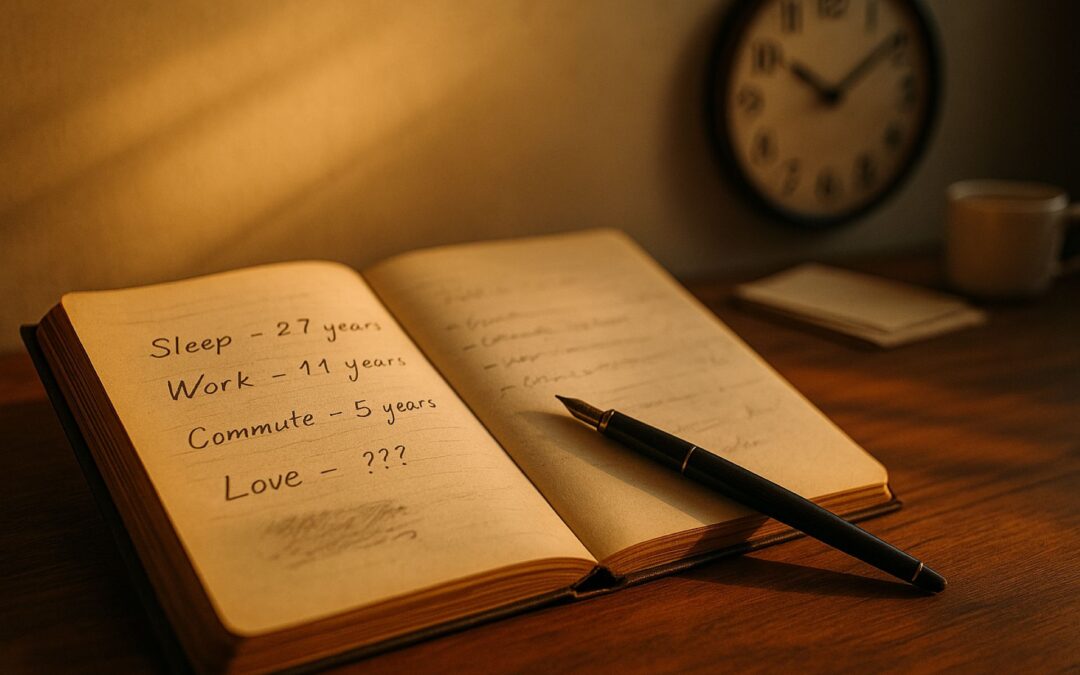
We talk about time as if it were infinite — something to be managed, optimized, filled. But life isn’t long; it’s just crowded. Between work, sleep, errands, and obligations, the years collapse into a blur, and the illusion of plenty becomes the quiet tragedy of waste. We tell ourselves there’s still time to start, to change, to live differently — yet the arithmetic doesn’t lie. What’s left for most of us isn’t decades of freedom, but a handful of deliberate years, scattered between responsibilities.
The truth is simple, but hard to face: time is the only wealth we truly own, and the only one we keep spending like it will replenish. To live wisely is to treat every hour as sacred — to choose pursuits that grow, relationships that deepen, and work that outlasts us. The question is no longer How much time do I have left? but What am I doing with the time that remains?
The Arithmetic of a Short Life
If you break life into numbers instead of years, it stops feeling infinite and starts feeling borrowed. Assume you live until eighty. You will spend twenty-seven of those years unconscious — asleep, dreaming, recovering, but absent from the world. Eleven more will vanish behind a desk or a counter, laboring for money to buy back slivers of leisure. Five are surrendered to traffic, the endless hum of engines and impatience. Six are consumed by the daily rituals of cooking and eating. Three dissolve into cleaning, laundry, and endless chores. Four go to errands and bureaucracy — renewing licenses, filing taxes, fixing things that break. One is lost to illness, another to the bathroom, and three simply evaporate before you even become self-aware.
When the calculation ends, what’s left is startling: roughly fifteen years of unclaimed time across a lifetime. Fifteen years to do something that feels freely chosen — to love, to create, to think, to wander. Fifteen years to make memories that outlast your heartbeat. And yet, most people will trade even those years for distractions — for glowing screens, for endless work, for social performances that feel like life but are only rehearsals for it.
Time is not a renewable resource; it’s a diminishing one. Every passing minute is a withdrawal from your only account. What makes it cruelly deceptive is how quietly it vanishes. You never feel yourself spending it — the clock ticks, the notifications chime, and another day slips away. We don’t lose time in great chunks; we lose it in tiny, habitual compromises.
There’s a reason philosophers and monks have always obsessed over mortality — not out of morbidity, but clarity. When you look at the finiteness of time, your values reorder themselves. The trivial shrinks. The essential shines through. The task, then, isn’t to “find more time.” It’s to stop treating your hours like pocket change.
The Paradox of More
Modern life is built on a dangerous illusion — that more of something automatically means better. More money, more comfort, more recognition. But most “more” comes at the cost of something sacred: time.
Take the 15% raise that demands an extra 30-minute commute each way. On paper, you’ve advanced. In practice, you’ve just traded ten days of your year to sit in traffic, staring at red taillights. Take the bigger house with the manicured lawn — the one that requires double the cleaning, triple the maintenance, and tenfold the mental load. You’ve upgraded your walls but downgraded your freedom.
The paradox is simple but brutal: in chasing the external symbols of success, we often impoverish our internal lives. Every new acquisition brings hidden fees — not in money, but in minutes. You pay for your lifestyle not once with cash, but repeatedly with your attention.
This is how society tricks the ambitious. It packages servitude as achievement, busyness as purpose, and burnout as dedication. You move faster, but not forward. You accumulate more, but feel lighter nowhere inside. The world keeps offering more things to buy, but never more time to live.
It’s not wrong to want comfort or success. But the pursuit of “more” must always be measured against what it subtracts. The luxury car might shave ten minutes off your commute, but at what cost to your peace of mind? The high-paying job might elevate your status, but does it deepen your sense of fulfillment?
Each decision, no matter how small, is an exchange rate between time and illusion. You can spend years optimizing the wrong variables — the salary, the square footage, the image — only to realize that the one variable that truly mattered, time, has been quietly drained away.
A wiser life begins when you stop asking, “Can I afford this?” and start asking, “Can I afford to give my time to this?” Because the first question measures your wealth in dollars; the second measures it in meaning.
The Real Scarcity: Time Itself
Everything in your life — every pleasure, pursuit, and possession — is ultimately a reflection of how you spend time. Time is the fundamental currency of existence; everything else is merely an exchange. Your health is the return on time spent moving, resting, and eating well. Your wealth is a byproduct of time leveraged in productive ways. Your relationships are time offered and received. Your knowledge, wisdom, even your sense of identity — all of it, shaped and sharpened by how you allocate your hours.
Strip life of its illusions, and you’ll see the same equation everywhere: value equals time, compounded through intention. It’s easy to forget this because modern life disguises time loss under the aesthetics of progress. Technology promises speed but consumes attention. Work promises fulfillment but demands constant availability. Entertainment offers relief but steals depth. We live under the delusion that time is abundant simply because we can measure it endlessly — hours, days, years — yet every tick of the clock erodes what’s left of our story.
This is why even the wealthiest people on earth, like Warren Buffett, acknowledge the futility of money in the face of mortality. He could surrender his entire fortune for a chance to be twenty again — and he wouldn’t hesitate. Because time is the one asset that can’t be traded, borrowed, or insured. The scarcity of everything else — money, status, health — is really just a shadow cast by the scarcity of time.
Once you see time as the ultimate denominator, the world reorganizes itself. The endless striving for accumulation begins to look like a kind of madness — a refusal to face impermanence. You start to recognize that the question isn’t How much can I earn? but How much can I experience before the clock runs out? The greatest tragedy is not dying early; it’s living long but never truly alive.
We talk endlessly about time management, but what we really need is time reverence. Management implies control — as if time were an obedient servant. Reverence reminds us it’s not. Time is the silent monarch of our lives: it rules, it withholds, it never negotiates. Every day is an offering to it. You decide what you give.
Ernest Becker and the Immortality Project
In the final months of his life, as cancer consumed his body, the anthropologist and philosopher Ernest Becker wrote what would become his defining work — The Denial of Death. It was not merely a book; it was a reckoning. Becker understood that beneath all human behavior — ambition, creativity, love, faith — lay a single, unspoken fear: the inevitability of death.
His insight was as haunting as it was liberating: everything meaningful we do is driven by our attempt to transcend mortality. We build legacies, write books, raise children, start movements — not just for the living, but for the persistence of our name, our influence, our echo. Becker called these “immortality projects” — efforts to ensure that some trace of us survives after our physical form disappears.
This perspective reframes the entire concept of meaning. It’s not pleasure that makes life rich, nor success, nor even happiness. It’s continuity — the sense that what we do has weight beyond the narrow borders of our lifespan. A parent’s love, an artist’s painting, a scientist’s discovery — these are all acts of defiance against oblivion. They say: I was here. I mattered.
Becker’s theory also exposes why so many modern pursuits feel hollow. Social status fades the moment you’re gone. Wealth dissolves into inheritance squabbles. Online fame disappears faster than it appeared. These are false immortality projects — simulations of meaning without endurance. They tether your sense of worth to validation rather than contribution.
But the true immortality projects are humbler and far more enduring. The mentor who shapes a student’s worldview. The friend who leaves behind memories of kindness. The writer whose words outlive their heartbeat. The act of creating something that continues to serve, inspire, or heal beyond your presence is the purest form of legacy.
There’s an old saying that a person dies twice — once when their body ceases, and again when their name is spoken for the last time. Becker’s work reminds us that the second death is the one worth fighting against. The purpose of life, then, is not to avoid death, but to live in such a way that something of you resists it.
The beauty of this understanding is that it doesn’t demand grandeur. You don’t have to be a philosopher, a CEO, or an artist to create meaning that outlasts you. Every sincere act of love, generosity, and creation participates in this quiet rebellion against impermanence. The legacy of a good life is not measured in monuments or medals, but in moments — the ones that echo long after you’re gone.
The Pursuit That Transcends You
There’s a paradox at the heart of meaning: the more your actions center on yourself, the emptier they feel. The more you give yourself away — to others, to creation, to something larger — the more significance life takes on. The moments that make life luminous are rarely about personal triumphs; they’re about connection and contribution.
This is why people who dedicate their time to raising children, mentoring others, building communities, or creating art often describe their work as fulfilling in a way that words struggle to capture. What they are feeling is transcendence — the awareness that their hours are being woven into something greater than their own narrative. These pursuits ripple beyond the self, and that ripple gives time its density.
Think of a teacher whose lessons spark curiosity long after they’re gone. Or a writer whose words continue to console the broken and embolden the dreamers. Or a doctor whose care outlasts his years through the lives he’s saved. In each case, meaning compounds — the effect of one moment grows into another, multiplying through the consciousness of others.
In contrast, pursuits driven solely by ego — the accumulation of status, the obsession with image, the need to be admired — quickly exhaust themselves. They promise immortality through recognition but deliver only fatigue and disillusionment. The applause fades, the followers drift, the trophies gather dust. And when all of that is gone, you’re left with a haunting question: What was it for?
True transcendence begins when you stop treating time as your private property and start treating it as a gift to be invested in the world. The great irony is that in giving your time away, you expand it. In working for something larger than yourself, you escape the claustrophobia of self-concern. You become, in a quiet way, timeless.
The ultimate freedom is not in how much you can consume, but in how much of yourself you can contribute. Because it’s not the duration of life that makes it meaningful — it’s the direction of your giving.
Compounding vs. Anti-Compounding
Every action you take either multiplies or diminishes the value of your future. Some investments in time grow richer with every repetition — they compound, like interest in a well-kept account. Others decay, eroding your potential with each indulgence. Understanding this difference is the foundation of wisdom.
Compounding behaviors are those that continue to enrich your life — physically, mentally, emotionally — long after the moment has passed. Exercise, for example, rewards you twice: once with health today, and again with resilience tomorrow. Learning compounds; the more you understand, the faster you can learn. Relationships compound; the more shared experience you invest, the deeper the trust and joy that follow.
These are time’s rarest miracles — actions that yield exponential returns. They make the future easier, richer, and more coherent. Compounding actions are self-reinforcing loops of meaning; they build momentum toward a better version of yourself.
Then there are anti-compounding behaviors — the habits that devalue with use. The first hour of gaming may delight you; the tenth leaves you hollow. The first drink relaxes you; the tenth erases your clarity. The first compliment on social media feels good; the hundredth post chasing more likes feels desperate. Anti-compounding behaviors are seductive because their rewards are instant, but shallow. They deliver a dopamine high today by borrowing happiness from tomorrow.
Mark Manson calls this the anti-economy of life: the more you do these things, the less they give back. The joy diminishes, the craving grows, and eventually you become trapped in the pursuit of diminishing returns. It’s not just addiction in the traditional sense — it’s spiritual debt. Every moment you waste on empty pleasures compounds negatively, eroding the value of all other moments.
As neuroscientist Andrew Huberman puts it, addiction is the narrowing of what brings you joy. Anti-compounding habits do exactly that — they shrink your world until only stimulation feels bearable. Meanwhile, compounding behaviors expand your world, making it richer, deeper, more varied. They teach you to find pleasure in progress, not escape.
Life, then, becomes an investment portfolio of moments. Some actions appreciate over time; others depreciate instantly. The wise investor learns to diversify — to choose experiences that build upon each other rather than cancel each other out. Every act of kindness, every hour spent in creation, every effort to learn is a deposit in your account of meaning. Every indulgence in vanity, every wasted evening of mindless scrolling, every lie you tell yourself is a withdrawal.
And the final balance? That’s the life you leave behind.
The Distraction from Death
Human beings are the only creatures who know they are going to die — and perhaps the only ones who spend their lives trying not to think about it. We bury mortality under layers of entertainment, busyness, and noise. The endless stream of notifications, the constant need to be seen, the fixation on achievement — all of it is an elaborate choreography to avoid sitting alone with the truth that our time is running out.
Ironically, the more you distract yourself from death, the more lifeless your days become. Because the fear of death is not really about dying — it’s about dying without having lived. When you distract yourself from mortality, you dull the urgency that gives life its sharpness. You settle for what is comfortable rather than what is meaningful. You drift.
The moments that confront us with mortality are often the ones that move us most deeply. Holding a newborn, standing at a funeral, watching a sunset — these experiences stir awe because they are mirrors of impermanence. They remind us, painfully and beautifully, that everything we love will end. But rather than despair, this awareness can become a form of awakening. When you remember that each encounter is finite, you show up more fully. You listen more carefully. You love without postponement.
We waste time because we assume there will always be more of it — another weekend, another summer, another chance to start again. But each delay is a small death. Every time you say “later,” a little part of “now” disappears forever. It’s easier to keep scrolling, to keep drinking, to keep chasing — because facing death demands an audit of your choices. It forces you to ask questions that shake the ground beneath your routine: Am I living as I wish to live? Am I using my time in a way that would still matter if I were gone tomorrow?
The philosopher Martin Heidegger called this being-toward-death — the idea that only by accepting our mortality can we live authentically. Avoiding death makes you anxious and restless; remembering death gives you clarity and peace. When you see that time is finite, you stop confusing motion for meaning. You realize that the point of life isn’t to outrun the clock — it’s to fill the moments you have with substance.
In the end, we do not need to escape death’s presence. We need to let it illuminate life’s value. The awareness of mortality is not the shadow over existence — it’s the light that defines its shape.
The Moral Duty of Consciousness
To be conscious is to be entrusted with the most extraordinary privilege in the universe: awareness. Against impossible odds, out of an endless void of silence and matter, you were born able to perceive, think, love, and create. You can reflect on your own existence — a gift so rare that, as far as we know, it exists nowhere else in the cosmos. That gift comes with a moral weight.
Your consciousness is not just a tool; it’s a responsibility. You have been given the ability to shape your reality, to affect others, to leave something behind that wasn’t there before. To waste that awareness — to numb it through distraction, to shrink it through fear, to use it only for consumption — is not just unwise. It’s unethical. It’s a betrayal of the miracle itself.
You don’t need to “do everything.” You just need to live awake. When you are truly conscious, every ordinary act becomes sacred: the way you listen to someone who’s hurting, the way you write, build, parent, teach, or simply sit in quiet gratitude. Every moment of presence is a small defiance against the void.
This is why time-wasting is not merely a practical problem — it’s a moral one. Each hour you spend in bitterness, envy, or mindless distraction is an hour of consciousness squandered. You were born with the power to think freely, to create beauty, to understand truth — and yet you hand those powers over to triviality because it feels easier than facing their potential.
There’s a line in Marcus Aurelius’ Meditations that distills this perfectly: “You could leave life right now. Let that determine what you do and say and think.” Awareness of mortality sharpens morality. When you know the clock is ticking, kindness becomes urgent. Creation becomes sacred. Love becomes necessary.
This is what Mark Manson means when he says we have a “moral duty” to use our time well. It’s not a sermon about productivity — it’s an appeal to consciousness itself. Because consciousness is not infinite, and neither is your chance to use it wisely.
One day, your mind will go silent, your hands will still, your breath will stop. But until then, you carry the rarest gift in existence — the ability to choose where your attention goes. Every moment of focus, gratitude, or courage adds something to the world that wasn’t there before.
That is the quiet purpose of being alive: not to last forever, but to leave behind traces of awareness that outlive your body — a thought, a kindness, a creation, a memory. The only real immortality is what your consciousness builds before it fades.
Conclusion
You will never control time — only your exchange rate with it. Every decision is a trade: attention for distraction, presence for performance, meaning for noise. You can spend your years chasing comfort, status, and applause, or you can spend them building something that endures — love, skill, wisdom, impact.
Life is painfully short, but that brevity is not a curse; it’s a compass. It points you toward what matters and away from what doesn’t. Once you understand that every breath is a countdown, you stop wasting air on trivialities. You start saying no more often, feeling more deeply, showing up more completely.
In the end, a well-lived life isn’t one that lasts the longest — it’s the one that echoes the farthest. The goal is not to beat time, but to leave something behind that makes its passing worthwhile.