
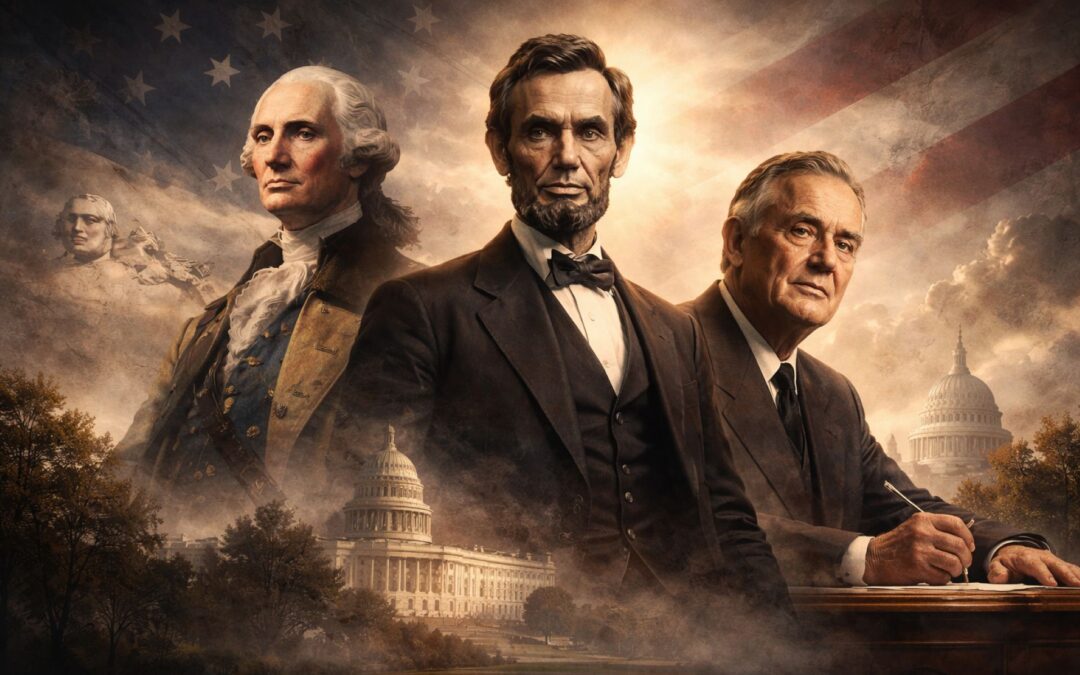
Introduction: What Makes a President “Great”?
Ranking presidents is a risky business. Every era produces its own heroes, and every generation reinterprets the past through the lens of its present concerns. Economic stability, wartime leadership, moral courage, territorial expansion, institutional reform—each offers a different metric for judging greatness. No single presidency excels in all of them.
Yet certain names consistently rise above the rest.
Some led the nation through existential crises. Others reshaped the economy, redefined executive power, or expanded the very map of the United States. A few did something rarer still: they surrendered power voluntarily and strengthened the republic in doing so.
This ranking considers several factors: the magnitude of the challenges faced, the scale of impact on American institutions, long-term national consequences, and the moral turning points that redefined the country’s trajectory. It does not claim perfection—many of the presidents on this list were deeply flawed—but it recognizes transformative leadership when history makes it undeniable.
From quiet stewardship during prosperity to bold action in moments of war and collapse, these ten presidents shaped the American experiment in ways that still echo today.
We begin with a man remembered more for his silence than his speeches—yet whose restraint helped define an era.
10. Calvin Coolidge: Prosperity Through Restraint
When Calvin Coolidge assumed office in 1923, the presidency was emerging from scandal. His predecessor, Warren G. Harding, had left behind an administration tainted by corruption, most infamously the Teapot Dome affair. Public confidence in the federal government had been shaken. What the country needed was not spectacle—but stability.
Coolidge provided it.
Known as “Silent Cal” for his famously minimal speaking style, Coolidge believed that government worked best when it restrained itself. He favored fiscal discipline, reduced federal spending, and significant tax cuts. During his tenure, the national debt declined, business investment surged, and the broader economy expanded at a remarkable pace.
The 1920s would come to be remembered as the Roaring Twenties—a decade of industrial growth, consumer culture, and rising markets. To supporters, Coolidge’s hands-off philosophy allowed American enterprise to flourish. He saw prosperity not as something engineered by Washington, but as something unleashed by limiting interference.
Later critics would argue that the era’s regulatory looseness helped lay groundwork for the Great Depression. That debate remains part of his legacy. Yet within the context of his presidency, Coolidge restored credibility to the executive branch and presided over a period of notable economic strength.
He did not seek to transform the nation with sweeping programs or grand rhetoric. Instead, his leadership was defined by steadiness, fiscal conservatism, and institutional repair. In a moment when the presidency required calm rather than charisma, Coolidge delivered precisely that.
9. James Madison: The Architect Who Defended His Creation
Before he ever entered the White House, James Madison had already secured his place in American history. Often called the “Father of the Constitution,” Madison played a central role in drafting the Constitution and later championed the Bill of Rights. Few presidents have entered office with a deeper understanding of the framework they were sworn to protect.
That understanding was tested almost immediately.
By the time Madison became president in 1809, tensions with Great Britain were escalating. British forces were interfering with American shipping, impressing American sailors into the Royal Navy, and challenging U.S. sovereignty on the high seas. The young republic faced a defining question: would it tolerate humiliation, or assert itself?
The result was the War of 1812.
The conflict was messy and, at times, humiliating. British troops burned Washington, including the White House itself. The American military struggled early on. Yet the war ended without territorial losses and with a renewed sense of national identity. Victories such as the Battle of New Orleans—though fought after the peace treaty was signed—fueled a surge of patriotism and confidence.
More importantly, the war signaled that the United States would not be treated as a subordinate power. The republic Madison had helped design proved resilient under fire.
Madison’s presidency demonstrated something rare: the ability not only to build institutions, but to defend them. He authored the constitutional playbook—and when the nation faced its first major test of sovereignty, he stood by the system he helped create.
8. Andrew Jackson: Populist Power and Its Dark Costs
Andrew Jackson was the first president who did not emerge from the traditional coastal elite. Born in poverty on the frontier, orphaned during the Revolutionary War, and largely self-made, Jackson embodied a new kind of political figure: the populist outsider who claimed to represent the “common man.”
His national fame began on the battlefield. During the War of 1812, Jackson’s decisive victory at the Battle of New Orleans transformed him into a military hero. Tough, defiant, and fiercely independent, he cultivated an image of strength that resonated with voters who felt excluded from entrenched political power.
Once in office, Jackson dramatically reshaped the presidency. He dismantled the Second Bank of the United States, viewing it as a corrupt institution that favored wealthy elites at the expense of ordinary citizens. He vetoed its recharter, redistributed federal deposits, and asserted executive authority more aggressively than most of his predecessors. Under his administration, the national debt was briefly eliminated—an unprecedented achievement in American history.
Jackson expanded democratic participation for white male voters and strengthened the role of the presidency as a direct voice of the people. In doing so, he permanently altered the balance between the executive branch and established political institutions.
But Jackson’s legacy carries a profound moral stain. His enforcement of the Indian Removal Act led to the forced relocation of Native American tribes from their ancestral lands, culminating in the Trail of Tears. Thousands died during the displacement. This policy remains one of the darkest chapters in presidential history.
Jackson’s greatness, therefore, is inseparable from controversy. He redefined political power and reshaped American democracy, but he also inflicted lasting human suffering. His presidency stands as a reminder that transformative leadership can carry both national impact and devastating consequences.
7. John F. Kennedy: Crisis Leadership in the Nuclear Age
John F. Kennedy entered office in 1961 as the youngest elected president in American history. Charismatic, articulate, and media-savvy, he symbolized generational change. But beneath the glamour of “Camelot” lay one of the most dangerous periods in modern history.
The defining test of his presidency came in October 1962.
When American intelligence discovered Soviet nuclear missiles stationed in Cuba—just 90 miles from Florida—the world edged toward catastrophe. The discovery triggered the Cuban Missile Crisis, a thirteen-day confrontation between the United States and the Soviet Union that brought humanity to the brink of nuclear war.
Kennedy’s military advisers urged immediate airstrikes or invasion. Instead, he opted for a naval blockade and backchannel negotiations with Soviet Premier Nikita Khrushchev. The strategy required patience, restraint, and an understanding of escalation dynamics. Ultimately, the Soviet Union agreed to withdraw its missiles in exchange for a U.S. pledge not to invade Cuba and the quiet removal of American missiles from Turkey.
No shots were fired. Nuclear war was avoided.
Beyond crisis management, Kennedy also reshaped America’s ambitions. In 1961, he challenged the nation to land a man on the Moon before the decade’s end, accelerating the Space Race and redefining technological competition during the Cold War. His presidency projected confidence, urgency, and forward-looking energy.
Yet Kennedy’s time in office was tragically brief. Assassinated in 1963, he never saw the Moon landing he had set in motion, nor the broader evolution of the civil rights movement unfolding during his administration.
Kennedy’s greatness rests not on length of service but on composure under existential threat. In a moment when a single miscalculation could have ended civilization, he chose caution over aggression—and in doing so, preserved the future.
6. James K. Polk: The President Who Delivered
James K. Polk entered the White House in 1845 with a clear, unapologetic agenda. Unlike many presidents who campaign broadly and govern cautiously, Polk laid out four specific objectives: acquire California, settle the Oregon boundary dispute, reduce tariffs, and establish an independent treasury system.
Remarkably, he accomplished all four—within a single term.
Polk’s presidency unfolded during the era of Manifest Destiny, the belief that the United States was destined to expand across the continent. Under his leadership, the annexation of Texas was formalized, the Oregon boundary dispute with Great Britain was settled peacefully at the 49th parallel, and the Mexican-American War resulted in the Mexican Cession. Through these actions, the United States acquired over one million square miles of territory.
The expansion included present-day California, Nevada, Utah, Arizona, New Mexico, and parts of several other states. No president before or since has added more land to the nation.
Polk was also disciplined in his ambitions. He pledged to serve only one term—and kept that promise. After four years of relentless focus, he stepped down voluntarily, exhausted by the demands of office.
Yet the consequences of his expansion were complex. The Mexican-American War remains controversial, criticized by some contemporaries as an aggressive conflict driven by territorial ambition. More significantly, the vast new territories reignited the national debate over slavery—deepening sectional tensions that would eventually lead to the Civil War.
Polk’s greatness lies in clarity and execution. He set ambitious goals, achieved them with precision, and permanently altered the map of the United States. Few presidents have governed with such focused determination—and fewer still have delivered so completely on their promises.
5. Franklin D. Roosevelt: Reinventing Government in Crisis
When Franklin D. Roosevelt took office in 1933, the United States was in economic freefall. The Great Depression had shattered banks, wiped out savings, and pushed unemployment to roughly 25 percent. Factories stood idle. Families lost homes. Confidence in capitalism itself was eroding.
Roosevelt responded with urgency—and scale.
Within his first hundred days, he launched a wave of legislation that fundamentally reshaped the federal government’s role in American life. The New Deal introduced programs designed to stabilize banks, regulate financial markets, and put millions back to work through public infrastructure projects. Agencies such as the Civilian Conservation Corps and the Works Progress Administration built roads, dams, schools, and public buildings across the country.
Social Security was established, creating a federal safety net for the elderly and unemployed. Financial reforms such as the Securities and Exchange Commission imposed new oversight on Wall Street. For better or worse, the presidency became the center of economic management.
Then came World War II.
After the attack on Pearl Harbor, Roosevelt transformed the United States into what he called the “arsenal of democracy.” American factories shifted to wartime production at unprecedented speed, supplying not only U.S. forces but also Allied nations. By 1945, the United States had become the most powerful industrial and military force on earth.
Roosevelt was elected four times—an unprecedented mandate that reflected both the severity of the crises he faced and the public’s trust in his leadership. His tenure permanently altered the scale and expectations of the federal government.
Yet his presidency was not without controversy. Critics argued that some New Deal programs expanded federal authority too far, and wartime decisions—including the internment of Japanese Americans—remain deeply troubling chapters.
Still, Roosevelt’s impact is undeniable. He guided the nation through economic collapse and global war, reshaped American governance, and positioned the United States as a global superpower. Few presidents have confronted challenges so immense—or left such a lasting imprint on the structure of the modern state.
4. Thomas Jefferson: Vision, Paradox, and Expansion
Thomas Jefferson was already immortal before he entered the presidency. As the principal author of the Declaration of Independence, he articulated the revolutionary ideal that “all men are created equal,” embedding liberty into the nation’s founding creed.
Yet Jefferson’s life was marked by contradiction. He championed limited government while expanding executive authority. He wrote eloquently about freedom while owning enslaved people. He was both a man of his time and, in many ways, centuries ahead of it.
His most consequential act as president came in 1803.
When France, under Napoleon Bonaparte, offered to sell the Louisiana Territory, Jefferson seized the opportunity. For $15 million, the United States acquired approximately 828,000 square miles of land—doubling the size of the nation overnight. The Louisiana Purchase stands as one of the most transformative deals in history, opening vast territory for exploration, settlement, and eventual statehood.
Jefferson then commissioned the Lewis and Clark expedition, sending explorers westward to map the land, document wildlife, and establish an American presence reaching to the Pacific. The expedition symbolized both curiosity and ambition—a young republic testing the limits of its horizon.
He also confronted challenges abroad, including the Barbary Wars against North African states that targeted American shipping. Rather than pay perpetual tribute, Jefferson authorized military action, signaling that the United States would defend its interests overseas.
Jefferson’s presidency expanded the nation geographically and philosophically. He believed in an agrarian republic of independent citizens, rooted in liberty and self-governance. At the same time, the moral contradictions of slavery cast a long shadow over his legacy.
His greatness lies in vision. Jefferson imagined a continental republic and took decisive action to make it real. But his life also reminds us that founding ideals and lived reality have not always aligned in American history—a tension that continues to shape the nation today.
3. Theodore Roosevelt: Energy, Reform, and the Modern Presidency
Theodore Roosevelt did not merely occupy the White House—he transformed it.
As a young man, Roosevelt was frail and frequently ill, but he rebuilt himself through relentless physical discipline. That same force of will defined his public life. Before becoming president, he led the Rough Riders during the Spanish-American War, charging up San Juan Hill and emerging as a national hero.
When he assumed the presidency in 1901, the United States was entering the age of industrial giants. Massive corporations dominated railroads, oil, and steel. Rather than dismantle capitalism, Roosevelt sought to regulate it. He filed dozens of antitrust lawsuits, including the landmark breakup of Standard Oil, signaling that no corporation stood above the law. The federal government, under Roosevelt, became an active referee in the economy.
He also redefined conservation policy. Roosevelt believed America’s natural landscapes were national treasures to be preserved, not merely exploited. During his presidency, he protected approximately 230 million acres of public land, establishing national parks, forests, and wildlife refuges. The modern conservation movement owes much to his vision.
Roosevelt expanded presidential power in other ways as well. He embraced what he called the “bully pulpit,” using the office as a platform to shape public opinion and push reform. The presidency became a dynamic center of national leadership rather than a restrained administrative role.
His approach was energetic, assertive, and unapologetically bold. Whether mediating international conflicts—such as brokering peace in the Russo-Japanese War—or confronting domestic monopolies, Roosevelt projected strength at home and abroad.
Theodore Roosevelt’s greatness lies in momentum. He modernized the presidency, strengthened federal authority, and left behind an enduring environmental legacy. In an era of rapid industrial change, he ensured that the federal government would not remain passive—but would actively shape the nation’s future.
2. Abraham Lincoln: Saving the Union and Redefining Freedom
When Abraham Lincoln took office in 1861, the United States was already fracturing. Seven Southern states had seceded before his inauguration. Within weeks, the nation descended into civil war—a conflict that would become the bloodiest in American history.
Lincoln faced a crisis unlike any president before him: the potential collapse of the Union itself.
Early in the war, the Union suffered repeated military setbacks. Generals failed. Political opposition mounted. Critics accused Lincoln of incompetence and overreach. Yet he persisted. He replaced ineffective commanders, expanded federal authority when necessary, and maintained an unwavering commitment to preserving the nation.
In 1863, Lincoln issued the Emancipation Proclamation, declaring enslaved people in Confederate-held territories free. Though limited in immediate scope, it fundamentally transformed the war. What began as a fight to preserve the Union became a moral struggle over slavery and freedom.
Later that year, after the devastating Battle of Gettysburg, Lincoln delivered a speech of just 272 words. The Gettysburg Address reframed the conflict as a test of whether a nation “conceived in liberty” could endure. Its brevity belied its power. Few presidential speeches have so clearly defined national purpose.
As the war drew to a close, Lincoln urged reconciliation rather than vengeance, calling for “malice toward none, charity for all.” He sought to rebuild a fractured nation without deepening its wounds.
Five days after Confederate General Robert E. Lee surrendered at Appomattox, Lincoln was assassinated. His death froze his image in sacrifice and martyrdom, but it was his leadership during the war that secured his place in history.
Lincoln preserved the Union, redefined the meaning of American freedom, and steered the nation through its darkest hour. His presidency proved that constitutional government could survive civil war—and that the promise of equality, though imperfectly realized, could be expanded through courage and resolve.
1. George Washington: Power Relinquished, Precedent Established
Before there was a presidency to rank, there was George Washington.
Washington first proved indispensable as commander of the Continental Army during the Revolutionary War. Facing the most powerful military in the world, he led an undertrained, undersupplied force through eight grueling years of conflict. He lost battles, endured brutal winters such as Valley Forge, and survived moments when the revolution seemed on the verge of collapse. Yet he refused to surrender, ultimately securing victory at Yorktown in 1781 and forcing British withdrawal.
His greatest act of leadership, however, may have come after the war.
At a time when military victors often seized power, Washington voluntarily resigned his commission and returned to private life. In doing so, he affirmed a revolutionary principle: that civilian government—not military authority—would rule the new republic. King George III reportedly remarked that if Washington truly relinquished power, he would be “the greatest man in the world.”
When the Constitution was ratified, Washington was the unanimous choice to serve as the nation’s first president—elected unanimously by the Electoral College not once, but twice. In office, he defined the role from scratch. He established the tradition of a cabinet, set norms for executive restraint, and carefully balanced authority with constitutional limits.
Most importantly, he stepped down after two terms, cementing the precedent of peaceful transfer of power. This voluntary limit on executive tenure endured for over a century before being codified in the 22nd Amendment.
In his Farewell Address, Washington warned against excessive partisanship, foreign entanglements, and regional division—concerns that remain strikingly relevant.
Washington did not merely serve as the first president; he shaped what the presidency would become. He proved that power could be exercised without becoming permanent, and that leadership could strengthen institutions rather than dominate them.
First in war, first in peace, and foundational to the republic itself—Washington’s legacy rests not just on victory, but on restraint.
Conclusion: Greatness, Memory, and the American Experiment
The presidents on this list differ in temperament, ideology, and era. Some governed quietly; others led with visible force. Some expanded the nation geographically; others reshaped it morally. Yet a pattern emerges.
Greatness often reveals itself in crisis.
George Washington defined civilian leadership after revolution. Abraham Lincoln preserved the Union during civil war. Franklin D. Roosevelt guided the country through economic collapse and global war. John F. Kennedy prevented nuclear catastrophe at the height of Cold War tension.
Others transformed the nation in quieter but equally permanent ways. Thomas Jefferson doubled its size. Theodore Roosevelt expanded federal authority and preserved natural landscapes. James K. Polk reshaped the map with relentless focus. Andrew Jackson redefined democratic participation—while leaving a deeply contested moral legacy. James Madison defended the constitutional system he helped design. Calvin Coolidge demonstrated that disciplined restraint can also shape history.
Presidential greatness is never simple. Many of these leaders carried contradictions, and several left behind painful chapters alongside their achievements. History does not offer perfect figures—only consequential ones.
What unites this group is scale. Each altered the trajectory of the United States in lasting ways—through war, reform, expansion, or precedent. They confronted moments when the future of the republic was uncertain and made decisions that still define the American experience.
In the end, greatness in the presidency is not about popularity or personality. It is about impact. And these ten presidents, for better and for worse, reshaped the nation in ways that continue to echo through its institutions, ideals, and identity.