
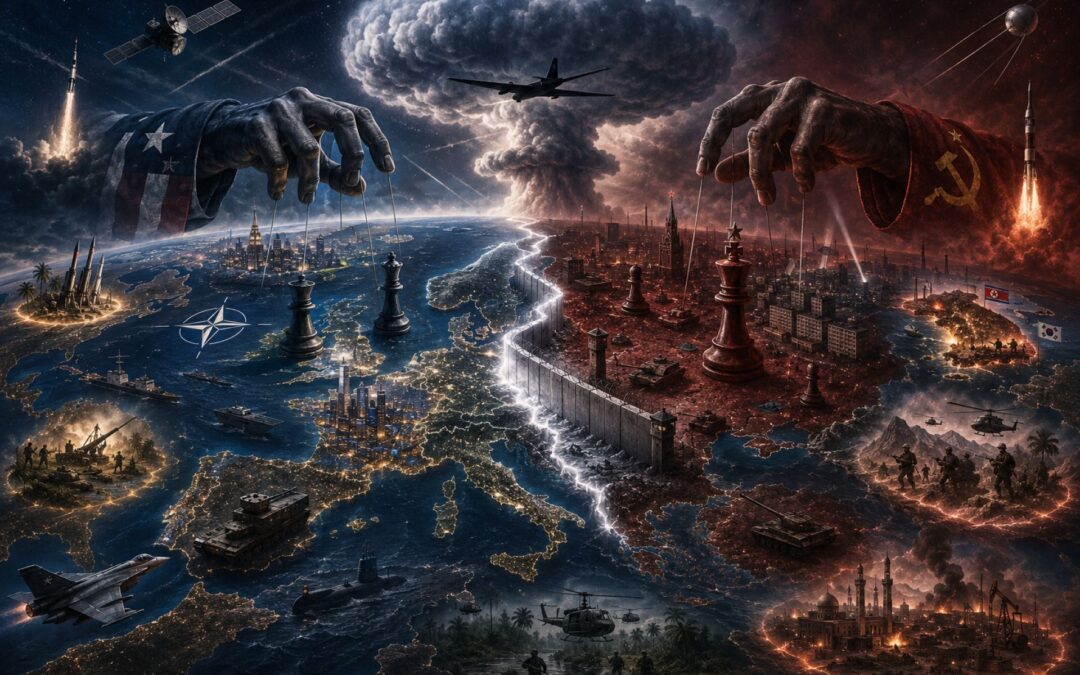
At the end of the Second World War, the world did not find peace. It found a new kind of conflict—one that would stretch across continents, infiltrate governments, reshape economies, and hang perpetually over humanity with the threat of annihilation. This was the Cold War.
Unlike the wars that came before it, this was not fought through direct confrontation between the two dominant powers. The United States and the Soviet Union never formally declared war on each other. Their armies never met in decisive battle. And yet, for nearly half a century, the entire world was organized around their rivalry.
At its core, the Cold War was an ideological struggle. On one side stood capitalism—market economies, political pluralism, and liberal democracy, at least in theory. On the other stood communism—state control, one-party rule, and a promise of economic equality. But ideology alone does not sustain a global conflict for decades. Beneath it lay something more enduring: fear.
Fear of invasion. Fear of encirclement. Fear of internal collapse. And above all, fear of nuclear war.
This fear shaped decisions at every level. It justified alliances, fueled propaganda, and turned distant civil conflicts into proxy wars backed by superpowers. It led to covert operations, political assassinations, and the quiet overthrow of governments. It drove an arms race so extreme that, by its peak, both sides possessed the capacity to destroy human civilization many times over.
And yet, the Cold War was not static. It evolved. What began as a postwar power struggle in Europe spread into Asia, Africa, and Latin America. It shifted from rigid confrontation to cautious coexistence, from proxy wars to diplomatic negotiations, and finally into a slow unraveling from within.
Understanding the Cold War, then, is not about memorizing a sequence of events. It is about tracing how a fragile alliance collapsed into suspicion, how that suspicion hardened into a global system, and how that system ultimately failed under the weight of its own contradictions.
For nearly fifty years, this conflict defined the modern world. And its consequences—political, economic, and psychological—have not disappeared. They have simply changed form.
The Origins Of The Conflict: Ideology Before The Cold War
The Cold War did not begin in 1945. By the time the guns of the Second World War fell silent, the foundations of the conflict had already been laid decades earlier—embedded not in borders or treaties, but in ideas.
The 19th century had transformed the world. Industrialization created immense wealth, but it also produced deep inequality. Factory owners accumulated capital at unprecedented rates, while workers endured long hours, dangerous conditions, and chronic instability. This imbalance did more than generate hardship—it produced a new way of interpreting society itself.
Enter Karl Marx.
Marx argued that capitalism was not simply an economic system but a historical phase—one defined by exploitation and destined to collapse. In his view, the tension between the bourgeoisie (owners) and the proletariat (workers) would inevitably lead to revolution. The end result would be communism: a system where private ownership of the means of production would be abolished, class distinctions erased, and economic equality achieved.
For much of the 19th century, these ideas remained theoretical. But the early 20th century provided the conditions for them to become reality.
The strain of the First World War pushed the Russian Empire to the brink. Economic collapse, military failure, and political dysfunction created an environment where radical change was no longer just possible—it was inevitable. In 1917, under the leadership of Vladimir Lenin, the Bolsheviks seized power, establishing the first communist state in history.
This was not merely a change in government. It was the creation of a fundamentally different political and economic model.
The new Soviet regime abolished private property, centralized economic control, and established a one-party state. Opposition was suppressed, often violently. The revolution was not only to be protected—it was to be exported. Communism, by its very logic, was international.
This immediately put it at odds with the capitalist world.
Western powers viewed the new system not just as an alternative, but as a threat. Communism rejected the legitimacy of private ownership, undermined traditional hierarchies, and openly called for global revolution. It was not content to coexist quietly—it aimed to replace the existing order.
This ideological incompatibility created a long-standing tension between the Soviet Union and the West. Even before the Cold War formally began, distrust ran deep. Western nations had intervened in the Russian Civil War against the Bolsheviks. The Soviet leadership, in turn, saw capitalist countries as hostile forces waiting for an opportunity to destroy their system.
By the time the Soviet Union formally emerged in 1922, the divide was already clear. Two fundamentally different visions of society now existed, each convinced of its own inevitability.
The Cold War would later give this divide its global stage. But the conflict itself—the clash of systems, the mutual suspicion, the belief that only one could ultimately prevail—was already in place long before the first Cold War crisis unfolded.
How World War II Created The Conditions For Superpower Rivalry
If ideology provided the tension, the Second World War provided the opportunity.
Before 1939, neither the United States nor the Soviet Union occupied the kind of dominant global position that would define the Cold War. That transformation was a direct consequence of the war itself. It did not just destroy regimes—it rearranged the entire hierarchy of power.
Europe, once the center of global politics, emerged shattered. Britain and France, though technically victorious, were economically drained, militarily weakened, and politically overstretched. Their empires—already strained—would begin to unravel in the years that followed. Germany was defeated and divided. The old multipolar world was gone.
What remained were two superpowers, shaped by radically different wartime experiences.
For the Soviet Union, the war had been existential. The Nazi invasion of 1941 devastated the country. Entire regions were destroyed, industries dismantled, and tens of millions of civilians and soldiers killed. The scale of the trauma was almost incomprehensible—around 27 million Soviet citizens died. Cities were reduced to rubble. Agricultural land was ravaged. Infrastructure collapsed.
From this perspective, security was not an abstract concern. It was survival.
Joseph Stalin emerged from the war determined to ensure that such a catastrophe could never happen again. His solution was strategic depth. Eastern Europe would not be allowed to exist as a neutral zone. It would become a buffer—controlled, loyal, and firmly within the Soviet sphere of influence. Poland, Hungary, Romania, East Germany—these were not just territories. They were protective barriers against future invasion.
The United States saw the war very differently.
Its homeland had been largely untouched, apart from the attack on Pearl Harbor. Its industrial capacity had expanded dramatically during the war, turning it into the world’s leading economic power. By 1945, American factories were producing at a scale unmatched by any other nation. Unemployment had plummeted. Technological advancement had accelerated.
The war had not weakened the United States. It had elevated it.
But it also changed how American leaders viewed the world. The attack on Pearl Harbor shattered the illusion of isolation. Distance was no longer protection. Global instability could reach American shores. If another war was to be prevented, the United States could not retreat inward again.
Instead, it would take an active role in shaping the international order.
This meant building institutions to stabilize the world: the United Nations to manage conflict, the World Bank and International Monetary Fund to support economic recovery, and a broader commitment to rebuilding global trade. Stability, in the American view, would come from interconnected economies and cooperative security structures.
This vision, however, directly conflicted with Soviet priorities.
Where the United States saw openness and integration, Stalin saw vulnerability. Western economic institutions appeared less like neutral mechanisms and more like tools designed to extend capitalist influence. Where the Americans sought a rebuilt and economically strong Germany, the Soviets wanted it weakened, divided, and incapable of future aggression.
Even during the war, these differences had begun to surface. Stalin had long been suspicious of the Western Allies, particularly their delay in opening a second front in Europe. From his perspective, the Soviet Union had borne the overwhelming burden of the war against Nazi Germany while the West hesitated. Whether justified or not, this belief reinforced his distrust.
By the time the war ended, the alliance between the United States, Britain, and the Soviet Union had already begun to fracture. It had always been a partnership of necessity, not of shared vision. Once the common enemy was gone, the underlying contradictions became impossible to ignore.
What emerged in 1945 was not peace, but a vacuum.
And into that vacuum stepped two powers with incompatible goals, opposing ideologies, and deeply rooted suspicions—each convinced that its own security depended on limiting the influence of the other.
The Cold War did not begin with a single event. It began because, after the Second World War, there was no longer a world capable of containing both visions at once.
The Postwar Settlement And The Division Of Europe
The end of the Second World War did not produce a stable settlement—it produced a fragile arrangement built on compromise, ambiguity, and growing mistrust. Nowhere was this more visible than in Europe, where the Cold War would first take physical shape.
The immediate question facing the victorious Allies was simple in theory and impossibly complex in practice: what should be done with Germany?
At the Potsdam Conference in July 1945, the Allies agreed to divide Germany into four zones of occupation, controlled by the United States, Britain, France, and the Soviet Union. Berlin, despite being located deep within Soviet-controlled territory, would also be divided into four sectors. This arrangement was meant to be temporary—a way to administer a defeated state until a long-term solution could be negotiated.
But the structure itself contained the seeds of division.
Each occupying power was allowed to extract reparations from its own zone. This seemingly practical decision had far-reaching consequences. The Soviet Union, devastated by the war, sought to strip its zone of industrial resources to rebuild. The Western Allies, by contrast, began to see economic recovery—especially in Germany—as essential to the stability of Europe as a whole.
The result was divergence.
In the eastern zone, political control tightened quickly. Communist parties, backed by Moscow, consolidated power, often through coercion and suppression of opposition. In Poland, Romania, Hungary, and elsewhere, governments were reshaped to align with Soviet interests. Elections, where they occurred, were tightly managed. What emerged was not a collection of independent states, but a coordinated bloc.
To the Soviet Union, this was security. A buffer zone against future invasion.
To the United States and its allies, it looked like expansion.
The tension was not just about territory—it was about control, legitimacy, and the future of Europe itself. Was Eastern Europe being liberated, or absorbed?
This question hardened into a political reality that would soon be captured in a single phrase.
In 1946, Winston Churchill declared that an “Iron Curtain” had descended across Europe. The metaphor was powerful because it described not just a division of land, but a division of systems. On one side: democratic governments, open markets, and political pluralism. On the other: one-party states, centralized economies, and restricted freedoms.
The line was not officially drawn on any map. But it was real.
Germany became the focal point of this divide. What had once been a unified nation was now drifting toward permanent separation. The western zones began to coordinate more closely, laying the groundwork for economic recovery and political stabilization. The Soviet zone moved in the opposite direction, integrating into the emerging Eastern Bloc.
Berlin, split within a split country, became a symbol of the broader conflict.
The postwar settlement had failed to create a unified vision for Europe. Instead, it institutionalized disagreement. What was meant to be temporary occupation became the foundation for long-term division.
By the late 1940s, the idea of a single, cooperative Europe had all but vanished. In its place stood two competing spheres of influence—each backed by a superpower, each convinced of its own legitimacy, and each increasingly unwilling to compromise.
The Cold War had not yet fully escalated. But the map of Europe had already been redrawn—not just in borders, but in ideology.
The Start Of Containment And The Institutionalization Of The Cold War
By the late 1940s, the Cold War was no longer an emerging tension—it was becoming a structured system. What had begun as disagreement over postwar Europe was now being translated into policy, doctrine, and institutions that would define global politics for decades.
The turning point came with a shift in American thinking.
Until this point, U.S. policy toward the Soviet Union had been reactive—responding to developments as they unfolded. But as Soviet influence expanded across Eastern Europe and pressure increased in regions like Greece and Turkey, American policymakers began to adopt a more proactive stance.
This shift was formalized in 1947 through the Truman Doctrine.
Under this doctrine, the United States committed itself to supporting governments threatened by communism, whether through external pressure or internal insurgency. It was a broad and deliberately flexible principle. The goal was not to roll back communism where it already existed, but to prevent its further spread.
This strategy became known as containment.
Containment was built on a simple assumption: that the Soviet system, if denied expansion, would eventually weaken under its own internal contradictions. It did not require immediate confrontation. It required patience, consistency, and global engagement.
But containment could not operate on military logic alone. It needed an economic dimension.
That came with the Marshall Plan, introduced in 1948. The plan provided massive financial aid—around $13 billion—to help rebuild Western Europe. The logic was straightforward but powerful: economic stability would reduce the appeal of communism. Prosperous societies were less likely to turn toward radical alternatives.
The impact was transformative. Western European economies recovered rapidly. Trade increased. Industrial output surged. Just as importantly, the plan helped bind these countries more closely to the United States, creating an economic bloc aligned with capitalist principles.
The Soviet Union saw this very differently.
To Moscow, the Marshall Plan was not simply aid—it was influence. Accepting it would mean opening Eastern European economies to Western oversight, undermining Soviet control. As a result, Stalin not only rejected the plan but also forbade Eastern European countries from participating.
This decision deepened the divide.
To consolidate its own sphere, the Soviet Union established the Cominform in 1947, designed to coordinate communist parties and enforce ideological conformity across the Eastern Bloc. Political autonomy within these states became increasingly limited, and dissent was systematically suppressed.
The conflict was no longer just ideological—it was institutional.
The tension reached its first major crisis in Berlin.
In 1948, in response to Western plans to unify and economically revive their zones of Germany, Stalin initiated the Berlin Blockade. All ground access to West Berlin was cut off in an attempt to force the Western Allies out of the city.
The response was immediate and unprecedented.
Rather than abandon the city or escalate militarily, the United States and its allies launched the Berlin Airlift. For nearly a year, supplies were flown into West Berlin, sustaining its population and demonstrating Western commitment. The blockade ultimately failed, but the message was clear: neither side would back down easily.
Soon after, the division of Germany became permanent.
In 1949, the western zones formed the Federal Republic of Germany, while the Soviet zone became the German Democratic Republic. What had once been a temporary administrative arrangement had solidified into a lasting geopolitical split.
The same year saw the creation of one of the most important institutions of the Cold War: NATO.
The North Atlantic Treaty Organization was a military alliance designed to provide collective security. An attack on one member would be considered an attack on all. It formalized the Western bloc and ensured that the United States would remain permanently engaged in European defense.
From the Soviet perspective, this confirmed their worst fears—a unified, militarized Western alliance positioned against them.
By the end of the 1940s, the Cold War had taken on a recognizable structure.
There were defined blocs, formal alliances, economic systems, and strategic doctrines. What had begun as uncertainty and mistrust had been transformed into an organized, enduring confrontation.
The Cold War was no longer just happening.
It had been built.
The Rise Of Fear: McCarthyism, Espionage, And Psychological Warfare
As the Cold War hardened abroad, it began to reshape life at home—especially in the United States. The conflict was no longer confined to borders, armies, or alliances. It moved inward, into institutions, careers, and everyday suspicion.
Containment required vigilance. But vigilance, in practice, often turned into fear.
The late 1940s and early 1950s saw a surge in anxiety over communist infiltration. This fear was not entirely unfounded. Several high-profile espionage cases confirmed that the Soviet Union had successfully placed spies within Western governments and scientific programs, including those connected to nuclear research.
But the response went far beyond targeted counterintelligence.
It evolved into a broad cultural and political phenomenon now known as McCarthyism, named after U.S. Senator Joseph McCarthy. McCarthy claimed that communists had infiltrated the American government at the highest levels. His accusations were often vague, unsupported, and shifting—but they were effective.
The atmosphere he helped create was one of suspicion without clear boundaries.
Investigations expanded rapidly. Government employees, journalists, academics, and entertainers were called to testify about their political beliefs and associations. In many cases, evidence was thin or nonexistent. But accusation alone could be enough to end a career.
Hollywood became a focal point. Writers, directors, and actors were blacklisted—excluded from work if they were suspected of communist sympathies or refused to cooperate with investigations. The logic was simple and ruthless: ideological purity became a prerequisite for participation in public life.
This was psychological warfare turned inward.
The Cold War blurred the line between external threat and internal dissent. Criticism of policy could be interpreted as disloyalty. Association could be treated as guilt. Fear became a tool—not just against enemies abroad, but within society itself.
At the same time, the Cold War was becoming more sophisticated behind the scenes.
In 1947, the United States established the Central Intelligence Agency, or CIA. Its role extended far beyond traditional intelligence gathering. It was designed to operate in the shadows—conducting covert operations, influencing foreign governments, and countering Soviet activities without direct attribution.
This introduced a new principle into international politics: plausible deniability.
Actions could be taken without official acknowledgment. Governments could intervene, destabilize, or manipulate events abroad while publicly denying involvement. This allowed the United States to engage in activities that would have been politically unacceptable if openly declared.
The Soviet Union operated in a similar manner through its own intelligence network, most notably the KGB.
Espionage became a defining feature of the Cold War. Information was power, and both sides invested heavily in acquiring it. Spy networks expanded. Double agents operated within governments. Scientific and military secrets were constant targets.
But beyond espionage lay something broader: the battle for perception.
Propaganda became a central weapon. Each side sought to present its system as superior—not just militarily, but morally, economically, and culturally. Media, education, and public messaging were all shaped by this competition. Successes were amplified. Failures were obscured. The goal was not only to influence foreign populations, but to reinforce belief at home.
The Cold War, in this phase, was as much about narrative as it was about strategy.
Fear of infiltration, fear of ideological subversion, fear of being outmatched—these anxieties drove decisions that reshaped societies. The conflict was no longer distant or abstract. It was embedded in institutions, reflected in policy, and felt in everyday life.
The battlefield had expanded.
It now included not just nations, but minds.
The Cold War Goes Global: Decolonization And Power Vacuums
Up to this point, the Cold War had been largely defined by Europe—its divisions, its reconstruction, and its political alignment. But Europe was no longer the center of the world it once had been.
The collapse of old empires changed everything.
The Second World War had exhausted the great colonial powers. Britain and France emerged victorious, but weakened beyond recovery. Their ability to maintain control over distant territories—economically, militarily, and politically—was rapidly diminishing. Across Asia, Africa, and the Middle East, independence movements surged.
Empires did not fall overnight. But they began to loosen their grip.
India gained independence. Indonesia broke free from Dutch rule. Former colonies across Southeast Asia, Africa, and the Middle East began asserting control over their own futures. These transitions were often unstable—new states had fragile institutions, uncertain economies, and unresolved internal divisions.
And into that instability stepped the superpowers.
For the United States and the Soviet Union, decolonization was not just a geopolitical shift—it was an opportunity. Each newly independent nation represented a potential ally, a potential resource partner, or a potential ideological convert.
The Cold War, in effect, found new ground.
These regions were not initially aligned with either bloc. Many leaders sought to remain independent, wary of replacing one form of external control with another. But neutrality was difficult to maintain. Economic aid, military assistance, and political support often came with expectations.
Alignment became a matter of survival.
The language of the Cold War evolved to reflect this new reality. Analysts began to divide the world into three broad categories. The “First World” referred to the United States and its allies—industrialized, capitalist, and politically aligned with the West. The “Second World” consisted of the Soviet Union, China, and their allies—communist and centrally planned. The “Third World” encompassed the rest: newly independent, often economically underdeveloped, and officially non-aligned.
But in practice, the Third World became the most contested space of all.
These countries were rich in something the superpowers needed—resources, strategic location, or influence. Oil in the Middle East, raw materials in Africa, population centers in Asia—control or access to these regions could shift the balance of global power.
The competition was rarely direct.
Instead, it took the form of influence. Economic aid packages. Trade agreements. Infrastructure projects. Military training. Political backing. Each superpower sought to position itself as the more reliable partner, the more legitimate model, the more appealing future.
But influence could also turn coercive.
When alignment was uncertain or threatened, both sides were willing to intervene—sometimes overtly, often covertly. Internal conflicts within these nations were increasingly shaped, prolonged, or intensified by external involvement. Local struggles became proxy battlegrounds, where global rivalries played out through regional actors.
What had once been a European-centered standoff was now a global system.
The Cold War was no longer defined by a single dividing line like the Iron Curtain. It became fluid, shifting across continents, embedding itself in revolutions, civil wars, and political transitions. It adapted to local conditions, but always carried the same underlying logic: expansion of influence, prevention of opposition.
Decolonization had opened the map.
The Cold War moved in to fill it.
Asia Becomes The First Battleground
If Europe was where the Cold War was defined, Asia was where it first turned violent.
The shift was not accidental. It was the result of overlapping transformations—decolonization, revolution, and the collapse of old power structures—all unfolding at once. Unlike Europe, where influence was consolidated through occupation and alliance, Asia presented a far more unstable environment. And instability invited intervention.
The most significant development came in China.
In 1949, after years of civil war, communist forces led by Mao Zedong defeated the nationalist government and established the People’s Republic of China. This was not just a regional shift. It was a geopolitical shock.
China was not a minor state. It was one of the largest countries in the world, with immense population and strategic weight. Its alignment with the Soviet Union transformed the balance of power in Asia almost overnight. For the United States, the “loss of China” raised urgent questions about the spread of communism and the effectiveness of containment.
At the same time, another transformation was underway in Japan.
Defeated in the war, Japan came under American occupation, led by General Douglas MacArthur. But unlike the punitive approach taken after the First World War, the United States pursued reconstruction rather than dismantlement. A new constitution was introduced, democratic institutions were established, and sweeping social reforms were implemented.
Japan was reshaped—not just as a stable nation, but as a strategic ally.
Its economic recovery became a priority. The logic mirrored the Marshall Plan in Europe: prosperity would reduce the appeal of communism. Over time, Japan would emerge as a key pillar of American influence in the region—a capitalist counterweight to China.
Further south, the situation was more volatile.
In French Indochina, nationalist movements were already challenging colonial rule. Among them was a communist-led movement under Ho Chi Minh. Initially, the conflict was framed as a struggle for independence. But as Cold War tensions intensified, it was reinterpreted through an ideological lens.
What might have remained a colonial conflict began to take on global significance.
The United States, wary of communist expansion, began supporting French efforts to retain control. China and the Soviet Union, in turn, supported revolutionary movements. The pattern was becoming clear: local conflicts were being absorbed into a larger global struggle.
Asia was no longer peripheral to the Cold War. It was central.
Unlike Europe, where boundaries had hardened quickly, Asia remained fluid. Governments were unstable, borders contested, and political systems in flux. This made it a region where influence could still be gained—or lost.
The stakes were high, and both superpowers understood it.
The logic of containment was now being tested in real time. And the first major test would come on the Korean Peninsula—where the Cold War would erupt into open war, not between superpowers directly, but through those caught between them.
The Korean War And The Logic Of Limited War
The Cold War had been building tension for years. In Korea, that tension finally broke.
At the end of the Second World War, the Korean Peninsula—once under Japanese control—was divided along the 38th parallel. The north fell under Soviet influence, the south under American supervision. The division was meant to be temporary, a holding arrangement until a unified government could be established.
It never was.
Instead, two separate states emerged, each claiming legitimacy over the entire peninsula. In the north, a communist regime led by Kim Il-sung aligned itself with the Soviet Union. In the south, an anti-communist government under Syngman Rhee was backed by the United States.
Both leaders wanted reunification. Neither was willing to compromise.
In June 1950, the deadlock ended. With Soviet approval, North Korean forces crossed the 38th parallel and launched a full-scale invasion of the south. The attack was swift and effective. Within weeks, South Korean forces were pushed to the brink of collapse.
For the United States, this was more than a regional conflict.
It was a direct test of containment.
If South Korea fell, it would signal that communist expansion could proceed unchecked. The implications extended far beyond the peninsula. Policymakers feared a chain reaction—what would later be formalized as the “domino theory”—where one country’s fall would lead to others.
The response was immediate.
Under the banner of the United Nations, a multinational force—led primarily by the United States—intervened. Commanded by General Douglas MacArthur, UN forces pushed back against the North Korean advance, eventually driving them all the way toward the Chinese border.
At this point, the war could have ended.
Instead, it escalated.
Fearing encirclement and the presence of hostile forces near its borders, China intervened. Hundreds of thousands of Chinese troops entered the conflict, pushing UN forces back south. The war, which had seemed on the verge of resolution, settled into a brutal stalemate.
The front stabilized near where it had begun.
For three years, the conflict dragged on. Battles were fierce, casualties high, and progress minimal. When an armistice was finally signed in 1953, the border between North and South Korea had barely changed.
No decisive victory. No clear resolution.
But the significance of the war lay not in its outcome, but in what it established.
The Korean War set the rules of the Cold War in practice.
It confirmed that the superpowers would avoid direct conflict, even while engaging militarily through allies and proxies. It demonstrated that wars would be fought to contain influence, not necessarily to achieve total victory. And most importantly, it set a precedent regarding nuclear weapons.
Despite facing setbacks and pressure from military leadership, President Harry S. Truman refused to authorize their use. The destructive potential of nuclear arms made them politically and strategically untenable in anything short of total war.
This restraint would define future conflicts.
The Korean War revealed the limits of power. It showed that even with overwhelming military force, outcomes could be constrained by political risk, global perception, and the ever-present shadow of escalation.
The Cold War had entered a new phase.
It was no longer just a standoff.
It was a system where war was possible—but only within limits.
Nuclear Weapons And The Balance Of Terror
If the Korean War defined how the Cold War would be fought, nuclear weapons defined how far it could go.
At the end of the Second World War, the United States held a decisive advantage. It was the only nation in the world with atomic weapons—and the only one to have used them. This monopoly created a brief moment where nuclear power seemed like a strategic tool rather than an existential threat.
That illusion did not last.
In 1949, the Soviet Union successfully tested its own atomic bomb. The balance shifted immediately. Nuclear capability was no longer exclusive—it was shared. And with that shift came a new kind of uncertainty.
From this point forward, any major conflict between the two powers carried the risk of escalation beyond control.
The response was not restraint, at least not initially. It was escalation.
Both sides accelerated their nuclear programs, seeking not just parity, but superiority. The next leap came with the development of thermonuclear weapons—hydrogen bombs—far more powerful than the atomic bombs dropped on Hiroshima and Nagasaki. These were not incremental improvements. They represented a qualitative shift in destructive capacity.
A single weapon could now devastate an entire city.
Tests reinforced the scale of the danger. In 1954, the United States detonated its most powerful device to date during the Castle Bravo test. The explosion was far larger than expected, spreading radioactive fallout across hundreds of miles and exposing both civilians and military personnel. The consequences extended beyond the immediate blast—into long-term environmental and health effects.
The implications were becoming impossible to ignore.
Nuclear weapons were not just bigger bombs. They were fundamentally different. Their use could not be contained. There was no clear distinction between military and civilian targets, no guarantee of control once escalation began.
And yet, the arms race continued.
Strategic thinking began to shift. If nuclear weapons could not be used rationally, then perhaps their value lay in not being used at all. This gave rise to the logic of deterrence.
The idea was stark: if both sides possessed enough nuclear weapons to guarantee devastating retaliation, neither would initiate a nuclear war. The cost would be too high. Victory, in any meaningful sense, would be impossible.
This logic would later be formalized as mutually assured destruction—often abbreviated as MAD.
It was a grim equilibrium.
Peace was maintained not through trust or cooperation, but through the certainty of catastrophic consequences. Stability depended on vulnerability. Each side needed to remain exposed enough to ensure that retaliation was always possible.
This created a paradox.
To prevent nuclear war, both sides had to prepare for it extensively. Stockpiles grew. Delivery systems improved—from bombers to intercontinental ballistic missiles. Submarines were equipped to launch nuclear weapons from hidden positions. The capacity for destruction expanded far beyond any conceivable military objective.
And yet, this very excess became the foundation of restraint.
The presence of nuclear weapons imposed limits on behavior. It discouraged direct confrontation. It forced leaders to consider not just immediate outcomes, but long-term survival. It introduced a constant calculation of risk—how far one could push without triggering escalation.
The Cold War, in this sense, was governed by fear.
Not the vague fear of an adversary, but the precise, measurable fear of annihilation.
Every crisis, every proxy conflict, every strategic decision existed under this shadow. Nuclear weapons did not end conflict—but they reshaped it, narrowing the space in which it could occur.
The balance of terror did not make the world safe.
It made it stable—just enough to avoid collapse.
Khrushchev, De-Stalinization, And Instability In The Eastern Bloc
The death of Joseph Stalin in 1953 marked a turning point—not in the end of repression, but in how it was managed.
For years, the Soviet system had been held together through centralized authority, fear, and absolute control. Stalin’s rule was defined by purges, forced labor, and a political culture where dissent was not merely suppressed—it was eliminated. His death created a vacuum, and with it, a question: could the system survive without terror at its core?
The answer, under Nikita Khrushchev, was an attempt at recalibration.
Khrushchev did not reject communism. He sought to stabilize it. In 1956, during a closed session of the Communist Party Congress, he delivered what would later be known as the “Secret Speech,” denouncing Stalin’s crimes and excesses. It was a remarkable moment—not because it introduced reform, but because it acknowledged failure.
This process became known as de-Stalinization.
Power was to be less centralized. The most extreme forms of repression were to be reduced. The state would maintain control, but without the constant reliance on mass terror. At least, that was the intention.
The effect was immediate—but not in the way Khrushchev intended.
Across Eastern Europe, the speech was interpreted as a signal. If Stalin’s methods were being condemned, perhaps the system itself could be questioned. Reform movements began to emerge, driven by a mix of nationalism, economic frustration, and political ambition.
In Poland, unrest forced the Soviet leadership to compromise. A previously purged leader was allowed to return to power, and limited autonomy was granted. It was a controlled adjustment—an attempt to release pressure without losing control.
Hungary was different.
There, reform escalated into open revolt. The government announced plans to withdraw from the Warsaw Pact and pursue neutrality. This crossed a line. For the Soviet Union, Eastern Europe was not negotiable. It was a strategic necessity.
The response was swift and brutal.
Soviet forces entered Hungary, crushing the uprising with overwhelming force. Thousands were killed. The reformist leadership was arrested and executed. The message was unmistakable: reform was permitted only within strict limits. Independence was not.
This contradiction defined Khrushchev’s leadership.
He sought to soften the system without weakening it. To reduce fear, but maintain control. To allow flexibility, but prevent fragmentation. It was a difficult balance, and one that exposed the underlying instability of the Eastern Bloc.
At the same time, Khrushchev worked to consolidate Soviet influence more formally.
In 1955, the Warsaw Pact was established—a military alliance binding the Soviet Union and its Eastern European satellite states. It was, in part, a response to NATO, but it also served an internal function: it institutionalized Soviet dominance over the region.
Membership was not optional in practice.
By the late 1950s, it was becoming increasingly clear that the Soviet bloc was not as stable as it appeared. Its unity was enforced, not organic. Its governments were aligned, but not necessarily supported. Beneath the surface, dissatisfaction persisted—economic, political, and national.
Khrushchev’s reforms had revealed something important.
The system could be adjusted. But it could not easily be transformed.
And any attempt to push it too far would be met with force.
The Space Race And Technological Rivalry
While the Cold War played out through armies, alliances, and ideology, it also unfolded in a far less traditional arena: space.
Technology became a battlefield—not because it directly conquered territory, but because it demonstrated capability. In a conflict where perception mattered as much as power, technological superiority carried enormous symbolic weight.
The turning point came in 1957.
That year, the Soviet Union launched Sputnik 1, the world’s first artificial satellite. It was a small, metallic sphere. Technically simple. But strategically, it was transformative.
Sputnik proved that the Soviets possessed rocket technology advanced enough to send objects into orbit. And if they could send a satellite into space, they could send nuclear weapons across continents.
The reaction in the United States was immediate—and alarmed.
The launch triggered what became known as the “Sputnik crisis.” It exposed a perceived technological gap. American policymakers feared they were falling behind in a domain that could determine military superiority. The issue was not just scientific—it was existential.
The response was institutional.
In 1958, the United States created the NASA, the National Aeronautics and Space Administration, to coordinate its space efforts. Investment surged. Education in science and engineering was prioritized. The space race was no longer an abstract competition—it became a national mission.
The Soviets continued to build momentum.
In 1961, Yuri Gagarin became the first human to orbit the Earth. It was a landmark achievement, celebrated globally and used by Soviet leadership as proof of the system’s superiority. The message was clear: communism could not only compete with capitalism—it could surpass it.
The United States responded in kind.
Later that year, Alan Shepard became the first American in space, followed by John Glenn, who successfully orbited the Earth. These milestones narrowed the gap, but the Soviets still appeared ahead.
The competition escalated.
In 1961, President John F. Kennedy made a bold commitment: the United States would land a man on the moon before the end of the decade. It was an ambitious goal, driven as much by political necessity as scientific ambition. The moon became a target not for exploration alone, but for prestige.
The race intensified through the 1960s.
The Soviets achieved further milestones—sending the first woman into space and conducting the first spacewalk. But the United States, through sustained investment and coordination, began to close the gap.
In 1969, that effort culminated in the Apollo 11 mission.
Neil Armstrong became the first human to set foot on the moon. The image of an American astronaut standing on the lunar surface, with the flag planted beside him, was more than a scientific achievement. It was a geopolitical statement.
The United States had won the race.
But the outcome did not end the competition—it transformed it.
With the primary objective achieved, the intensity of the space race diminished. The focus shifted from symbolic milestones to longer-term projects, including space stations and scientific research. More importantly, space became one of the first areas where cooperation between the superpowers became possible.
By the 1970s, joint missions like the Apollo-Soyuz Test Project brought American and Soviet astronauts together in orbit—a small but meaningful sign that the rigid divisions of the Cold War could, under certain conditions, be softened.
The space race revealed something essential about the Cold War.
It was not just a struggle for territory or influence. It was a contest over capability, progress, and the future itself. Each launch, each mission, each technological breakthrough carried a message: which system was more advanced, more effective, more worthy of global leadership.
In that sense, space was not separate from the Cold War.
It was one of its most visible stages.
Berlin As The Fault Line Of Europe
If the Cold War had a single physical point where its tensions were most visible, it was Berlin.
The city was an anomaly—deep inside Soviet-controlled East Germany, yet divided between East and West. It was not just a geographic contradiction. It was a living comparison between two systems placed side by side.
And that comparison was becoming increasingly dangerous for the Soviet Union.
By the late 1950s, the contrast between East and West Berlin was impossible to ignore. In the west, backed by the United States and its allies, economic recovery had taken hold. Living standards were rising. Infrastructure was improving. Opportunities were expanding.
In the east, conditions were far more restrictive. The economy lagged behind. Political control was tight. Freedom of movement and expression were limited.
People noticed.
And more importantly, they acted on it.
Between 1949 and 1961, millions of East Germans fled to the West—many of them young, educated, and skilled. The easiest route was through Berlin. Cross the city, and you crossed systems.
This posed a serious threat—not just economically, but politically.
A system that needs to prevent people from leaving is already struggling with legitimacy.
For Soviet leadership, and for the East German government, this flow could not continue. It drained talent, weakened the economy, and undermined the image of communism as a viable alternative.
At the same time, Berlin was a strategic problem.
From the Soviet perspective, a Western-controlled enclave sitting inside their sphere was a constant vulnerability. It provided a platform for intelligence operations, propaganda, and influence. It was a symbol of Western presence in territory the Soviets believed should be fully under their control.
These pressures converged under Nikita Khrushchev.
He had already attempted to force the Western powers out of Berlin through diplomatic ultimatums. These efforts failed. The United States made it clear that it would not abandon the city. For Washington, Berlin was not just strategic—it was symbolic. To withdraw would signal weakness and undermine credibility across Europe.
With neither side willing to yield, the solution came in a different form.
In August 1961, construction began on what would become the Berlin Wall.
Initially a crude barrier of barbed wire, it quickly evolved into a heavily fortified structure—concrete walls, guard towers, minefields, and armed patrols. It stretched for miles, physically dividing families, communities, and lives.
Its purpose was simple: to stop people from leaving.
The wall did not resolve the underlying conflict. It froze it.
For the East German regime, it stabilized the situation. The flow of refugees dropped dramatically. Economic and administrative control became more manageable. The immediate crisis was contained.
But the cost was visibility.
The wall became one of the most powerful symbols of the Cold War. Not because it divided territory, but because it revealed the nature of the division. It was not built to keep enemies out—it was built to keep citizens in.
For the West, this was a propaganda victory. The contrast was stark and easily communicated. Freedom on one side. Restriction on the other.
For the Soviet bloc, it was an admission—unspoken, but undeniable.
The Berlin Wall did not just mark a boundary.
It exposed it.
The Cuban Revolution And The Western Hemisphere Crisis
If Berlin was the fault line of Europe, Cuba became the pressure point of the Western Hemisphere.
For decades, Cuba had existed within the economic and political orbit of the United States. American businesses dominated key industries, particularly sugar and infrastructure, and successive Cuban governments maintained close ties with Washington. Stability, however, came at the cost of legitimacy.
That stability collapsed in 1959.
A revolutionary movement led by Fidel Castro overthrew the existing regime, promising to end corruption, reduce inequality, and restore Cuban sovereignty. At first, the revolution was not explicitly aligned with communism. But its direction became clear quickly.
Castro’s government began nationalizing industries, including those owned by American companies. Land reforms redistributed property. Political power was consolidated. What had begun as a nationalist revolution started to take on an ideological character.
The United States saw this as a direct threat.
Cuba was not distant. It sat just ninety miles off the coast of Florida. A hostile government—especially one aligned with the Soviet Union—in such proximity was unacceptable within the logic of containment.
The response was economic and covert.
Washington imposed a trade embargo, aiming to isolate the Cuban economy and pressure the new regime. At the same time, the Central Intelligence Agency began developing plans to remove Castro from power.
These efforts had an unintended consequence.
Facing economic pressure and political isolation, Cuba turned to the Soviet Union for support. What might have remained a regional issue became part of the global Cold War structure. Moscow, eager to expand its influence, provided economic aid, military support, and political backing.
Cuba was no longer just a revolutionary state.
It was a Soviet ally in the Western Hemisphere.
The situation escalated further with a direct attempt to reverse the revolution.
In 1961, under the administration of John F. Kennedy, the United States supported an invasion by Cuban exiles trained by the CIA. The operation, known as the Bay of Pigs invasion, aimed to spark an uprising against Castro’s government.
It failed—quickly and decisively.
The invading force was defeated within days. The expected internal revolt never materialized. Instead of weakening Castro, the invasion strengthened his position. It demonstrated the fragility of American intervention and reinforced Cuba’s need for Soviet protection.
The failure had consequences beyond the immediate.
For Castro, it confirmed that the United States would continue to seek his removal. For the Soviet leadership, it revealed both an opportunity and a responsibility—to defend a newly aligned ally and challenge American dominance in its own sphere.
For the United States, it was a strategic and political embarrassment.
More importantly, it shifted perceptions.
Cuba was no longer a peripheral concern. It became a focal point of Cold War tension, a place where the boundaries of influence were directly contested. The Western Hemisphere, long considered secure under American dominance, was now open to Soviet presence.
The stage was set for a confrontation that would push the Cold War closer to the brink than ever before.
The Cuban Missile Crisis: The World On The Edge
If the Cold War had a moment where it came closest to catastrophe, it was October 1962.
After the failed Bay of Pigs invasion, Cuba was no longer just an ally of the Soviet Union—it was a liability that needed protection. For Soviet leader Nikita Khrushchev, the situation presented both a risk and an opportunity.
The risk was clear: the United States might attempt another invasion, this time with overwhelming force. The opportunity was more strategic. If the Soviets could place nuclear missiles in Cuba, they could dramatically alter the balance of power.
At the time, the United States already had nuclear missiles positioned in Europe—particularly in Turkey and Italy—within striking distance of Soviet territory. From Khrushchev’s perspective, placing missiles in Cuba was not escalation. It was parity.
But geography changed everything.
Missiles in Cuba would place much of the continental United States within immediate range. The warning time for a nuclear strike would shrink to minutes. What had been a distant threat would become immediate.
In secret, the Soviet Union began installing nuclear missile sites on the island.
The operation remained undiscovered—until it wasn’t.
In October 1962, American reconnaissance flights detected the missile installations. The discovery triggered an immediate crisis. For President John F. Kennedy, the presence of Soviet nuclear weapons so close to American territory was unacceptable.
The question was how to respond.
Military leaders pushed for an airstrike, followed by a full-scale invasion of Cuba. The logic was straightforward: eliminate the threat before it became operational. But the risks were enormous. Unknown to the United States at the time, tens of thousands of Soviet troops were already stationed on the island, equipped with tactical nuclear weapons.
An invasion could trigger nuclear retaliation.
Kennedy chose a different approach.
Instead of immediate force, he ordered a naval blockade—referred to as a “quarantine”—to prevent further Soviet shipments from reaching Cuba. It was a calculated move: strong enough to signal resolve, but restrained enough to avoid immediate escalation.
The world entered a state of suspended tension.
Soviet ships approached the blockade line. American forces prepared for confrontation. Nuclear weapons on both sides were placed on high alert. At one point, the United States moved to DEFCON 2—the highest level of readiness short of war.
The margin for error disappeared.
Behind the scenes, negotiations began. Publicly, both sides maintained firm positions. Privately, they searched for a way out.
The breakthrough came through a combination of pressure and compromise.
The Soviet Union agreed to remove its missiles from Cuba. In return, the United States publicly pledged not to invade the island. More quietly, it also agreed to remove its own nuclear missiles from Turkey.
The crisis ended without war.
But it came closer than either side had intended.
One of the most striking moments occurred beneath the surface—literally. During the standoff, a Soviet submarine, cut off from communication and under pressure from American naval forces, prepared to launch a nuclear torpedo. The decision required agreement from three officers. One of them, Vasily Arkhipov, refused.
That refusal may have prevented nuclear war.
The Cuban Missile Crisis changed the Cold War fundamentally.
It exposed how quickly escalation could spiral beyond control. It revealed the limits of military solutions in a nuclear age. And it forced both sides to reconsider how they managed risk.
In its aftermath, new mechanisms were introduced—most notably a direct communication line between Washington and Moscow, designed to prevent future misunderstandings.
The logic of the Cold War did not change overnight.
But it became more cautious.
The world had come too close to the edge.
Proxy Wars, Coups, And The Dark Side Of Containment
If the Cuban Missile Crisis showed the danger of direct confrontation, it also reinforced a different approach—one that had already been taking shape beneath the surface.
The Cold War would not be fought head-on.
Instead, it would be fought indirectly—through proxy wars, covert operations, and political intervention. This allowed both the United States and the Soviet Union to compete globally without triggering nuclear war.
But this method came with its own consequences.
Nowhere was this more visible than in the activities of the Central Intelligence Agency.
Operating under the principle of plausible deniability, the CIA became a central instrument of American foreign policy. Its mission was not just to gather intelligence, but to shape outcomes—often by destabilizing governments perceived as hostile or vulnerable to communist influence.
The logic was simple: prevent alignment with the Soviet bloc before it happened.
In practice, this often meant intervening in the internal politics of other nations.
In 1953, the CIA helped orchestrate a coup in Iran, removing Prime Minister Mohammad Mossadegh after he nationalized the country’s oil industry. He was replaced with a pro-Western monarchy under Shah Mohammad Reza Pahlavi. The move secured Western access to oil and aligned Iran with American interests—but it also sowed long-term resentment that would resurface decades later.
A year later, in Guatemala, a similar operation unfolded.
President Jacobo Árbenz had introduced land reforms that threatened the interests of the U.S.-based United Fruit Company. Framed as a communist threat, his government was overthrown with CIA backing. A military regime took power, initiating years of instability and repression.
The pattern repeated elsewhere.
In the Congo, nationalist leader Patrice Lumumba was targeted after seeking Soviet assistance. Though direct involvement remains debated, pro-Western forces eventually removed and executed him. In Chile, the United States supported efforts to undermine the democratically elected government of Salvador Allende, culminating in a military coup that installed General Augusto Pinochet.
These interventions were not isolated incidents.
They reflected a broader strategy—one that prioritized geopolitical alignment over democratic principles. Governments were judged less by how they ruled and more by where they stood in the Cold War.
This created a fundamental contradiction.
The United States presented itself as a defender of democracy and freedom. Yet, in practice, it often supported authoritarian regimes if they were anti-communist. Stability and alignment took precedence over legitimacy.
The Soviet Union engaged in similar behavior, backing revolutionary movements and sympathetic governments across the developing world. Support ranged from financial aid to military training and direct involvement. The goal was not simply to expand influence, but to reshape political systems in ways that aligned with communist ideology.
In this environment, local conflicts rarely remained local.
Civil wars, political movements, and regional disputes became entangled in global rivalry. External support amplified these conflicts—providing resources, prolonging fighting, and raising the stakes. What might have been contained struggles evolved into prolonged and often devastating wars.
The Cold War, in this phase, revealed its most troubling dimension.
It was no longer just a contest between systems. It was a mechanism that reshaped other nations—often without their consent. Decisions made in Washington or Moscow could determine outcomes thousands of miles away, affecting millions who had little influence over the larger conflict.
Proxy warfare avoided nuclear catastrophe.
But it did not avoid suffering.
It displaced it.
The Middle East And Strategic Power Politics
If Asia demonstrated how the Cold War could turn into open conflict, the Middle East revealed something different—how it could be shaped by strategy, resources, and shifting alliances.
This region was not just another battleground. It was critical.
Oil had become the lifeblood of modern economies and militaries. Control over, or access to, Middle Eastern resources carried global implications. At the same time, the region was emerging from decades of colonial influence, leaving behind fragile states, contested borders, and unresolved political tensions.
For both the United States and the Soviet Union, influence here was not optional—it was essential.
One of the earliest examples of Cold War intervention in the region came in Iran.
As previously noted, the 1953 coup that removed Prime Minister Mohammad Mossadegh and restored the Shah aligned Iran firmly with Western interests. From Washington’s perspective, this secured a vital strategic partner and protected access to oil.
But it also planted the seeds of long-term instability.
The Shah’s rule, backed by American support, became increasingly authoritarian. Political opposition was suppressed, dissent grew, and resentment toward foreign influence deepened. What appeared as a short-term strategic success would later unravel in dramatic fashion.
Elsewhere, regional leaders began to navigate the Cold War with more agency.
In Egypt, President Gamal Abdel Nasser pursued a different strategy. Rather than aligning fully with either superpower, he sought to extract benefits from both. He secured American funding for development projects while simultaneously purchasing weapons from Soviet-aligned sources.
This balancing act worked—until it didn’t.
When the United States withdrew support for the construction of the Aswan High Dam, Nasser responded by nationalizing the Suez Canal, a critical international waterway previously controlled by British and French interests.
The reaction was immediate.
Britain and France, in coordination with Israel, launched a military intervention to regain control of the canal. From a traditional geopolitical perspective, it made sense. But the Cold War context changed everything.
Both superpowers opposed the invasion.
The United States, under President Dwight D. Eisenhower, condemned the action, unwilling to support a colonial-style intervention that could alienate emerging nations. The Soviet Union also opposed it, threatening retaliation.
Under pressure from both sides, the invading forces were forced to withdraw.
The outcome was significant.
The crisis marked the decline of traditional European powers as dominant actors in the region. It also signaled that the Middle East would no longer be shaped by colonial empires, but by superpower competition—and by regional leaders capable of navigating that competition to their advantage.
Nasser emerged stronger, not weaker.
The United States, recognizing the strategic importance of the region, formalized its approach through the Eisenhower Doctrine, promising economic and military support to governments resisting communist influence. This effectively legitimized American intervention in the Middle East under the framework of containment.
But alignment in the region remained fluid.
Unlike Europe, where alliances were relatively stable, Middle Eastern politics were shaped by shifting priorities—nationalism, economic development, regional rivalries, and internal power struggles. Superpower influence was significant, but not absolute.
This created a more complex dynamic.
The Cold War in the Middle East was not always about ideology. It was about leverage. Governments sought aid, weapons, and political backing, often playing the superpowers against each other to secure their own interests.
The region became a space where global strategy met local ambition.
And in that intersection, the Cold War took on a different form—less rigid, more unpredictable, and deeply tied to the evolving politics of a post-colonial world.
Vietnam And The Failure Of American Strategy
If Korea had defined the limits of war, Vietnam exposed the limits of strategy.
The conflict did not begin as a Cold War confrontation. It began as a struggle against colonial rule.
After the Second World War, France attempted to reassert control over its former colony in Indochina. But nationalist forces, led by Ho Chi Minh, resisted. What followed was a prolonged war that France ultimately lost in 1954. The settlement divided Vietnam along the 17th parallel—communist forces in the north, a Western-backed government in the south.
Like Korea, the division was meant to be temporary.
It became permanent.
For the United States, Vietnam quickly became a test case for containment. The fear was not just about Vietnam itself, but about what might follow. If one country fell to communism, others in the region might follow—a chain reaction later known as the domino theory.
Support for South Vietnam began cautiously.
Financial aid. Military advisors. Political backing.
But the situation on the ground was deteriorating.
The South Vietnamese government, led by Ngo Dinh Diem, proved ineffective and increasingly unpopular. Corruption, repression, and poor governance alienated large segments of the population. At the same time, a communist-backed insurgency in the south—the Viet Cong—began gaining strength.
The conflict was no longer just between two states.
It became a war within a society.
American involvement escalated.
Under President Lyndon B. Johnson, the United States transitioned from advisory support to full military engagement. Troop numbers surged. Bombing campaigns intensified. The objective was clear: defeat the insurgency, stabilize the south, and demonstrate that containment could succeed.
But the strategy was built on flawed assumptions.
It treated the conflict primarily as an external aggression rather than a complex internal struggle. It relied on conventional military superiority against an unconventional opponent. It measured success in territory and casualties, while the political foundations of the South Vietnamese state continued to erode.
The turning point came in 1968 with the Tet Offensive.
Communist forces launched coordinated attacks across South Vietnam, including in major cities and even the U.S. embassy in Saigon. Militarily, the offensive was repelled. But strategically, it had a profound impact.
It shattered the perception of progress.
The American public had been told that victory was near. Tet revealed a different reality—that the enemy remained capable, organized, and far from defeat. The gap between official statements and actual conditions became known as the credibility gap.
Trust began to collapse.
At home, protests intensified. The war became deeply unpopular, especially among younger generations. Media coverage brought the conflict directly into American living rooms, exposing its brutality and raising questions about its purpose.
Political consequences followed.
Johnson chose not to seek re-election. His successor, Richard Nixon, inherited a war that could not be easily won—but also could not be easily abandoned.
Nixon attempted a different approach.
He expanded the war into neighboring countries like Cambodia in an effort to disrupt supply lines, while simultaneously beginning a gradual withdrawal of American forces. The strategy aimed to shift responsibility to South Vietnam while maintaining pressure on the north.
It did not resolve the underlying problem.
American troops withdrew in 1973. Two years later, North Vietnamese forces captured Saigon. The south collapsed. Vietnam was unified under communist control.
The outcome was decisive.
More than 58,000 Americans had died. Millions of Vietnamese—soldiers and civilians—had been killed. Neighboring countries like Laos and Cambodia were drawn into the conflict, with devastating consequences, including the rise of the Khmer Rouge under Pol Pot.
Containment had failed in Vietnam.
More importantly, the war reshaped how the United States approached power. It exposed the limits of military force in ideological conflicts. It revealed the importance of legitimacy, not just strength. And it left a deep imprint on American society—politically, culturally, and psychologically.
The Cold War continued.
But Vietnam ensured it would be approached with far greater caution.
The Fragmentation Of The Communist World
For much of the Cold War, the communist bloc was often treated as a unified front—an organized counterweight to the United States and its allies. In reality, that unity was far more fragile than it appeared.
The most significant fracture emerged between the Soviet Union and China.
At first, the relationship had been close. After the Chinese Communist Revolution in 1949, Mao Zedong aligned with Moscow, signing agreements for economic and military cooperation. The partnership seemed to confirm fears in the West of a monolithic communist expansion.
But the alliance was built on uneasy foundations.
Ideological differences began to surface early. Mao viewed himself not as a subordinate, but as a revolutionary equal—if not a leader in his own right. He was deeply influenced by the model of Joseph Stalin and skeptical of any departure from it. When Soviet leader Nikita Khrushchev initiated de-Stalinization, Mao saw it not as reform, but as betrayal.
To him, it signaled weakness.
The divide deepened over strategy.
Khrushchev pursued a more cautious approach to the Cold War, emphasizing coexistence where possible and avoiding direct confrontation with the West. Mao, by contrast, was far more willing to embrace risk, even suggesting that nuclear war, while catastrophic, might ultimately advance the global communist cause.
These differences were not just theoretical.
They shaped policy, and policy shaped relations.
By the late 1950s, cooperation had begun to break down. Soviet advisors were withdrawn from China. Joint projects stalled. Public disagreements became more frequent. What had once been a partnership turned into rivalry.
China followed its own path.
Domestically, Mao launched radical campaigns to accelerate industrialization and reshape society. The most ambitious of these, the Great Leap Forward, aimed to transform China into a modern industrial power almost overnight. It failed catastrophically.
Poor planning, unrealistic targets, and flawed agricultural policies led to widespread famine. Tens of millions died. The scale of the disaster weakened China internally, but it did not bring it closer to the Soviet model. If anything, it reinforced Mao’s determination to pursue an independent course.
Tensions eventually escalated beyond rhetoric.
In 1969, border clashes between Soviet and Chinese forces brought the two countries to the brink of war. The idea of a unified communist bloc was no longer credible. Instead, the Cold War had taken on a more complex structure.
The United States recognized the opportunity.
Under Richard Nixon, Washington pursued a dramatic shift in policy. In 1972, Nixon visited China, opening diplomatic relations and signaling a willingness to engage with a former adversary.
This was not ideological alignment.
It was strategic calculation.
By improving relations with China, the United States could place additional pressure on the Soviet Union, complicating its position and reducing its influence. The Cold War was no longer a simple two-sided contest. It had become triangular.
The fragmentation of the communist world revealed an important truth.
Shared ideology did not guarantee unity.
National interests, leadership rivalries, and strategic priorities could override even the most fundamental similarities. The Cold War was not just a clash between two systems—it was a shifting landscape of alliances, where divisions could emerge even within blocs that appeared, from a distance, to be cohesive.
The world was becoming more complicated.
And the Cold War was evolving with it.
Soviet Stagnation And Internal Decay
While the Cold War appeared to be a global contest between two competing systems, its outcome would ultimately be shaped from within.
By the mid-1960s, the Soviet Union had achieved what it had long sought: strategic parity with the United States. It possessed a vast nuclear arsenal, a network of allied states, and global influence stretching across multiple continents.
On the surface, it looked stable.
Beneath that surface, it was beginning to slow.
After the removal of Nikita Khrushchev in 1964, power shifted to Leonid Brezhnev. His leadership would come to define what is often referred to as the era of stagnation—a period marked not by dramatic collapse, but by gradual decline.
The problem was not a single failure.
It was systemic.
The Soviet economy, built on central planning, had been effective in rapid industrialization and wartime mobilization. But it struggled in a different context—one that required innovation, efficiency, and responsiveness. Production targets were met on paper, but quality often suffered. Incentives were weak. Bureaucracy expanded.
Over time, growth slowed.
Resources continued to be allocated, but with diminishing returns. Technological advancement lagged behind the West, particularly in areas like computing and consumer industries. The system could maintain itself—but it struggled to improve.
At the same time, the political structure became increasingly rigid.
Under Brezhnev, leadership stabilized—but in a way that discouraged change. Officials remained in their positions for decades. Advancement was slow, often based on loyalty rather than performance. Corruption and nepotism became more visible. The system valued continuity over adaptation.
This created a paradox.
Stability, which had once been a strength, became a limitation.
Across Eastern Europe, the effects were similar. Economies stagnated. Living standards fell behind those of Western Europe. The contrast became increasingly visible—especially in places like Berlin, where the divide was physical and immediate.
Dissatisfaction grew.
But it did not always lead to reform.
When attempts were made to liberalize the system, they were often suppressed. In 1968, in Czechoslovakia, a reform movement known as the Prague Spring sought to introduce greater political freedom and economic flexibility. It was not an attempt to abandon communism, but to adapt it.
The response was decisive.
Soviet forces, along with troops from other Warsaw Pact countries, intervened to restore control. The reform movement was dismantled. The message was consistent with earlier interventions: change would be allowed only within limits defined by Moscow.
This approach was later formalized in what became known as the Brezhnev Doctrine—the idea that the Soviet Union had the right to intervene in any socialist country where communism was threatened.
Control was maintained.
But at a cost.
The reliance on intervention, surveillance, and centralized authority preserved the system in the short term. In the long term, it prevented adaptation. Economic inefficiencies accumulated. Political legitimacy weakened. Public trust eroded.
The Cold War, from the outside, still appeared balanced.
But internally, the Soviet system was becoming increasingly strained.
It had the power to compete.
It lacked the flexibility to evolve.
Détente And Arms Control
By the late 1960s, both superpowers had reached a point of exhaustion—not defeat, but recognition.
The Cold War had escalated across multiple fronts. Nuclear arsenals had grown to levels far beyond any rational use. Proxy conflicts had proven costly and inconclusive. And the risk of miscalculation, as seen during the Cuban Missile Crisis, remained uncomfortably high.
For both the United States and the Soviet Union, a new approach became necessary.
This shift became known as détente—a French term meaning the easing of tensions.
Détente was not an end to the Cold War. It was an attempt to manage it.
The logic was pragmatic. Neither side could eliminate the other. Neither could safely escalate without risking catastrophic consequences. Stability, therefore, required a degree of cooperation—particularly in areas where competition had become most dangerous.
The primary focus was nuclear weapons.
By this stage, both sides possessed thousands of warheads, along with increasingly sophisticated delivery systems. The arms race had produced not security, but mutual vulnerability. The challenge was not how to win a nuclear war—but how to prevent one.
This led to the first major arms control agreement: the Strategic Arms Limitation Talks, commonly referred to as SALT.
Negotiations began under Richard Nixon and culminated in the signing of SALT I in 1972. The agreement did not eliminate nuclear weapons. Instead, it froze the number of certain categories of missiles—particularly intercontinental ballistic missiles and submarine-launched systems.
It was a limitation, not a reduction.
But it marked an important shift.
For the first time, both sides formally acknowledged that unchecked expansion of nuclear arsenals was unsustainable. The goal was no longer superiority at any cost—it was stability within limits.
Alongside SALT I came another critical agreement: the Anti-Ballistic Missile Treaty.
This treaty restricted the development of missile defense systems. At first glance, this might seem counterintuitive—why limit defensive capabilities? But within the logic of deterrence, it made sense.
If one side could effectively defend against nuclear attack, it might be tempted to strike first, believing it could avoid retaliation. By limiting defenses, both sides remained vulnerable—and that vulnerability preserved the balance.
Détente extended beyond arms control.
Diplomatic communication increased. Trade agreements were explored. Cultural exchanges took place. There was a growing recognition that constant confrontation was not only dangerous, but inefficient.
At the same time, the internal conditions of both superpowers encouraged this shift.
The United States was dealing with the political and social fallout of the Vietnam War. Public confidence in government had been shaken. There was less appetite for prolonged conflict abroad.
The Soviet Union, under Leonid Brezhnev, faced economic stagnation and internal pressures. Reducing external tensions allowed for a focus on domestic stability.
Détente, then, was not just strategic—it was necessary.
But it was also fragile.
It depended on restraint, mutual recognition, and a shared interest in avoiding escalation. It did not resolve the underlying ideological conflict. It did not eliminate competition. It simply created a framework in which that competition could be managed more carefully.
For a time, it worked.
The Cold War did not end.
But it slowed.
Crisis, Scandal, And Renewed Cold War Tensions In The 1970s
Détente created the appearance of stability—but beneath it, tensions never fully disappeared. By the mid-to-late 1970s, that fragile balance began to crack.
Part of the shift came from within the United States itself.
The Vietnam War had already eroded public trust in government. That erosion deepened with the release of the Pentagon Papers in 1971, which exposed the gap between official statements and actual policy. Soon after, the Watergate scandal further damaged credibility.
President Richard Nixon, who had been central to détente, was forced to resign in 1974—the only U.S. president to do so. The consequences extended beyond domestic politics. Confidence in leadership declined, and Congress moved to reassert control over foreign policy, placing limits on executive power.
This had a direct impact on Cold War strategy.
Covert operations, once carried out with minimal oversight, came under scrutiny. Intelligence agencies faced investigation. Military interventions became politically harder to justify. The United States, while still powerful, was now constrained by internal skepticism.
At the same time, global events began to strain the logic of détente.
In 1973, the Yom Kippur War erupted in the Middle East. Egypt and Syria launched a surprise attack on Israel, drawing both superpowers into the conflict—Washington supporting Israel, Moscow backing the Arab states. The risk of escalation returned quickly, with nuclear forces placed on alert.
Though the war ended within weeks, it exposed how quickly regional conflicts could reignite superpower tension.
Efforts to stabilize relations continued.
In 1975, the Helsinki Accords were signed, bringing together the United States, the Soviet Union, and dozens of other nations. The agreement recognized existing European borders while committing signatories to respect human rights.
On paper, it reinforced détente.
In practice, it introduced new pressure.
Human rights provisions gave dissidents within the Soviet bloc a framework to challenge their governments. Activist groups emerged, holding leaders accountable to commitments they had publicly endorsed. What had been intended as a stabilizing agreement became, in part, a source of internal tension.
Meanwhile, the global environment was shifting.
In 1979, the Iranian Revolution overthrew the U.S.-backed Shah, replacing him with an anti-Western regime. The crisis deepened when American hostages were taken in Tehran, holding the United States in a prolonged and highly visible standoff.
That same year, a more direct challenge emerged.
The Soviet Union invaded Afghanistan, seeking to stabilize a friendly government facing internal rebellion. For Moscow, it was a strategic move to maintain influence in a neighboring region.
For Washington, it was a clear violation of the emerging rules of détente.
The response was swift. The United States imposed economic sanctions, boycotted the Moscow Olympics, and increased military spending. More importantly, it began supporting resistance forces within Afghanistan, turning the conflict into another prolonged proxy war.
Détente effectively ended.
What had been a period of cautious cooperation gave way to renewed suspicion and confrontation. The balance of the Cold War shifted again—away from managed stability and back toward escalation.
The underlying conflict had never been resolved.
It had only been contained.
Reagan’s Strategy And The Final Confrontation
By the end of the 1970s, the Cold War had entered another phase—not of balance, but of renewed intensity.
The election of Ronald Reagan in 1980 marked a decisive shift in American strategy. Where détente had sought to manage the Cold War, Reagan aimed to end it—on terms favorable to the United States.
His approach was built on a clear assumption: the Soviet Union was not a stable equal, but a system under strain.
If pressure increased—militarily, economically, and psychologically—it might not be able to keep up.
This strategy became known as “peace through strength.”
Reagan dramatically increased defense spending. The U.S. military expanded across multiple domains—new intercontinental missiles, advanced submarines, and expanded naval capabilities. The goal was not just readiness, but dominance.
The signal was intentional.
The United States was willing—and able—to outspend and outpace its rival.
But military buildup was only one part of the strategy.
Economic pressure played a critical role. Through coordination with key allies, particularly oil-producing nations, global oil prices were driven down. For the Soviet Union, which depended heavily on energy exports, this created significant financial strain.
At the same time, Reagan introduced one of the most ambitious—and controversial—initiatives of the Cold War: the Strategic Defense Initiative, often referred to as “Star Wars.”
The project aimed to develop a missile defense system capable of intercepting nuclear attacks, potentially from space. Whether technically feasible or not, its strategic impact was immediate.
If successful, it would undermine the logic of deterrence.
For the Soviet leadership, this posed a dilemma. Matching such a program would require enormous investment in technologies where they were already lagging. Ignoring it risked falling behind in a domain that could shift the entire balance of power.
The pressure mounted.
At moments, it came dangerously close to miscalculation.
In 1983, NATO conducted a military exercise known as Able Archer 83. Designed to simulate a nuclear conflict scenario, it included realistic elements such as communication silence and participation by senior leadership.
For the Soviets, already on edge, it appeared alarmingly real.
Fearing that the exercise might be a cover for an actual attack, Soviet forces were placed on high alert. Nuclear units prepared for possible retaliation. The situation echoed the Cuban Missile Crisis—not in scale, but in risk.
Once again, the Cold War approached the edge without fully realizing it.
And yet, even as tensions escalated, a shift was beginning on the other side.
The Soviet leadership was changing.
Years of economic stagnation, military pressure, and internal inefficiency had taken their toll. The system was not collapsing yet—but it was struggling to sustain itself under the weight of competition.
Reagan’s strategy did not create these weaknesses.
But it exposed them.
The Cold War, after decades of confrontation, was entering its final phase—not through a single decisive conflict, but through accumulated pressure that the Soviet system would increasingly find difficult to withstand.
Gorbachev And The Transformation Of The Soviet System
By the mid-1980s, the Soviet Union was no longer simply competing—it was struggling.
The pressures had been building for years. Economic stagnation, technological lag, and the immense cost of maintaining global influence had pushed the system toward a breaking point. Leadership, until then, had responded with caution and continuity.
That changed in 1985 with the rise of Mikhail Gorbachev.
Gorbachev was different from his predecessors. Younger, more pragmatic, and more willing to acknowledge failure, he recognized that the Soviet system could not continue as it was. Reform was no longer optional—it was necessary.
He introduced two major policies that would define his leadership.
The first was perestroika, or restructuring.
This aimed to reform the Soviet economy by introducing limited market mechanisms. Central planning would not be abandoned, but it would be adjusted. Enterprises would gain more autonomy. Some elements of private activity were permitted. The goal was to improve efficiency without dismantling the system entirely.
The second was glasnost, or openness.
This policy addressed the political side of the problem. It encouraged greater transparency, reduced censorship, and allowed for more open discussion of government actions. Criticism, once suppressed, was now tolerated—and in some cases, encouraged.
Together, these reforms were meant to revitalize the Soviet Union.
Instead, they exposed its weaknesses.
Perestroika struggled to produce immediate results. The economy, already inefficient, became unstable as old structures were loosened but not fully replaced. Shortages persisted. Growth remained sluggish.
Glasnost had an even more profound impact.
Once restrictions eased, criticism expanded rapidly. Historical injustices were revisited. Corruption was exposed. Public confidence in the system began to erode further. What had been contained dissatisfaction became visible—and difficult to control.
At the same time, Gorbachev shifted foreign policy.
He recognized that the ongoing arms race was unsustainable. Military spending was draining resources needed for domestic reform. Negotiation, not confrontation, became the priority.
Between 1985 and 1988, Gorbachev met multiple times with Ronald Reagan, building a relationship that would have been unthinkable in earlier decades. These meetings led to significant agreements, most notably the Intermediate-Range Nuclear Forces Treaty in 1987, which eliminated an entire class of nuclear weapons.
It was a breakthrough.
For the first time, both sides were not just limiting weapons—they were reducing them.
Gorbachev also began withdrawing Soviet forces from Afghanistan, signaling a retreat from costly external commitments. More importantly, he made a critical decision regarding Eastern Europe.
He would no longer enforce control through military intervention.
This effectively ended the logic behind the Brezhnev Doctrine. Reform movements in Eastern Europe, which had previously been suppressed, now faced a different reality. The Soviet Union would not step in to maintain the status quo.
The consequences were immediate.
Change, once contained, began to spread.
Gorbachev’s reforms were intended to preserve the Soviet system by making it more flexible and responsive. Instead, they accelerated forces that the system could no longer control.
The Cold War, for decades defined by rigid opposition, was now being reshaped from within one of its central pillars.
Not through defeat.
But through transformation that was beginning to exceed its original intent.
The Fall Of The Eastern Bloc
By the late 1980s, the structure that had defined Eastern Europe for decades was no longer being enforced—it was being tested.
For years, Soviet control over the region had depended on a clear understanding: reform could go only so far. Any attempt to break from the system would be met with force. That assumption had held firm through Hungary in 1956 and Czechoslovakia in 1968.
Under Mikhail Gorbachev, that assumption no longer applied.
His decision to abandon military enforcement in Eastern Europe changed the entire equation. Reform movements, once constrained by the threat of intervention, now faced a new reality. They could act—and potentially succeed.
The result was a chain reaction.
In 1989, change began to spread across the Eastern Bloc. It did not follow a single pattern, but the direction was consistent. Governments that had long appeared stable began to lose control. Opposition movements gained momentum. Public demonstrations grew in scale and confidence.
In Poland, negotiations between the government and opposition led to partially free elections. The result was a decisive rejection of the communist leadership. Power began to shift without large-scale violence.
In Hungary, reforms went further.
The government dismantled parts of its border with Austria, creating an opening between East and West. This had immediate consequences. East Germans, unable to leave directly through their own country, began traveling through Hungary to reach the West.
The barrier that had defined Europe for decades was beginning to break—not through direct confrontation, but through erosion.
The most visible symbol of that barrier was in Berlin.
By late 1989, pressure had built to a point where the East German government could no longer maintain control. Confusion over new travel regulations led to crowds gathering at border checkpoints. Faced with growing unrest and unclear orders, guards allowed people to pass.
On November 9, 1989, the Berlin Wall was effectively opened.
What followed was not a planned dismantling, but a spontaneous collapse. People crossed freely between East and West. Sections of the wall were broken apart. The division that had defined the Cold War in Europe—both physically and symbolically—was gone.
The implications were immediate.
Germany moved toward reunification, formalized in 1990. Other countries in Eastern Europe followed similar paths. Communist governments fell across the region—often peacefully, though not always.
In Romania, the transition turned violent.
Leader Nicolae Ceaușescu attempted to suppress protests, ordering the use of force against demonstrators. The effort failed. Within days, his regime collapsed, and he was captured and executed.
The Eastern Bloc, once tightly controlled, had unraveled in less than a year.
What made this transformation remarkable was not just its speed, but its nature.
There was no large-scale war. No coordinated overthrow led by external powers. The system collapsed largely from within, as political legitimacy gave way under sustained pressure.
Gorbachev did not intervene.
That decision, more than any single event, made the outcome possible.
The Cold War’s dividing line in Europe—so rigid for decades—had not been pushed back.
It had dissolved.
The Collapse Of The Soviet Union
The fall of Eastern Europe did not end the Cold War.
It exposed its final stage.
By 1990, the Soviet Union was facing pressures it could no longer contain. The external empire had begun to dissolve, but the deeper challenge lay within its own borders.
The problem was no longer reform.
It was survival.
Mikhail Gorbachev had attempted to stabilize the system through change—loosening control while preserving the structure of the Soviet state. But those changes had triggered forces that moved faster than the system could adapt.
One of the most powerful of these forces was nationalism.
The Soviet Union was not a single nation. It was a collection of republics—each with its own identity, language, and historical memory. For decades, these identities had been suppressed or managed within a centralized framework.
As that framework weakened, they re-emerged.
Republics began demanding greater autonomy. Some moved toward full independence. What had once been a unified state now faced fragmentation from within.
At the same time, political authority was shifting.
In Russia itself, the largest and most powerful republic, a new figure emerged: Boris Yeltsin. Elected as president of the Russian republic, Yeltsin became a direct rival to Gorbachev. Where Gorbachev sought to reform the union, Yeltsin increasingly positioned himself as a leader willing to move beyond it.
The power struggle intensified.
Gorbachev remained the head of the Soviet Union. Yeltsin controlled its largest component. The system now had overlapping centers of authority—each pulling in a different direction.
This instability reached a critical point in August 1991.
Hardline members of the government, military, and security services—fearful that reforms were dismantling the state—attempted a coup. Gorbachev was placed under house arrest. Tanks were deployed in Moscow. The intention was to restore central control and halt the process of change.
The attempt failed.
Public resistance emerged quickly. Yeltsin positioned himself at the center of that resistance, openly defying the coup leaders. Within days, the effort collapsed. The plotters were arrested. Gorbachev returned to power—but not to authority.
The damage had been done.
The coup exposed the weakness of the central government. It accelerated the very process it had sought to prevent. Republics moved more decisively toward independence. The idea of preserving the Soviet Union in its existing form became increasingly unrealistic.
Events moved rapidly.
By the end of 1991, several republics had declared independence. Russia, under Yeltsin, took the decisive step of withdrawing from the union structure itself. Without Russia, the Soviet Union could not function.
On December 25, 1991, Gorbachev resigned.
The following day, the Soviet Union formally ceased to exist.
The red flag was lowered from the Kremlin for the last time.
What had been one of the two defining superpowers of the 20th century dissolved into fifteen independent states.
The Cold War, which had dominated global politics for over four decades, ended not with a decisive victory in battle, but with the internal collapse of one of its central pillars.
There was no final confrontation.
No treaty that declared a winner.
Only the quiet conclusion of a system that could no longer sustain itself.
Conclusion
The Cold War did not unfold as a single, continuous confrontation. It evolved—shifting across regions, adapting to new realities, and changing its methods as the world itself changed.
What began as an ideological divide between the United States and the Soviet Union became a global system. It shaped alliances, redrew borders, influenced revolutions, and determined the fate of nations far beyond its original European center. It turned local conflicts into proxy wars, transformed technology into a measure of power, and made nuclear weapons the defining constraint on global politics.
At its core, the Cold War was sustained by a paradox.
Both sides sought security—but the actions taken to achieve it often increased insecurity. Military buildups triggered countermeasures. Alliances provoked rival alliances. Efforts to expand influence created resistance. The system fed on its own logic, maintaining tension even in periods of relative calm.
And yet, it did not end through direct confrontation.
There was no final war that settled the conflict. No decisive military victory that determined the outcome. Instead, the Cold War unraveled as one side lost the capacity to sustain the competition. The Soviet system, burdened by economic inefficiency, political rigidity, and mounting internal pressures, could no longer keep pace.
What followed was not a dramatic collapse in a single moment, but a rapid sequence of events—reform, instability, fragmentation, and dissolution.
By 1991, the structure that had defined global politics for nearly half a century was gone.
But the Cold War’s legacy did not disappear with it.
Its influence remains embedded in modern geopolitics—in alliances that still exist, in regions shaped by past interventions, in nuclear doctrines that continue to define strategic thinking. Even the idea of global power competition, though transformed, carries echoes of the Cold War framework.
Understanding the Cold War is not just about understanding the past.
It is about recognizing how a conflict built on ideology, fear, and power can reshape the world—and how its consequences can endure long after the conflict itself has ended.
