
In the middle of the third century BC, two powerful republics stood on opposite sides of the central Mediterranean. One was Rome, an aggressive and rapidly expanding land power that had just finished conquering the Italian peninsula. The other was Carthage, a wealthy maritime empire whose fleets and trade networks dominated the western Mediterranean. For years the two states had maintained a cautious coexistence, bound together by treaties and mutual convenience. Yet their political systems, economic interests, and geographic ambitions made conflict almost inevitable.
The breaking point came in 264 BC, when a small dispute on the island of Sicily pulled both powers into direct confrontation. What began as a local crisis involving mercenaries and city-states soon escalated into one of the longest and most destructive conflicts of the ancient world. Over the next twenty-three years, Rome and Carthage would fight a brutal struggle across land and sea—building enormous fleets, launching daring invasions, and suffering catastrophic losses in battle and storms alike.
The First Punic War transformed the Mediterranean world. Rome, originally a land-focused republic with limited naval experience, learned how to build and command massive fleets, eventually challenging and defeating the greatest maritime power of its age. Carthage, despite its wealth and naval expertise, found itself increasingly reacting to Roman initiatives while trying to protect its vast commercial empire. The war pushed both societies to the brink of exhaustion, draining their resources, devastating cities, and costing hundreds of thousands of lives.
When the conflict finally ended in 241 BC, Rome emerged victorious. It gained control of Sicily, imposed heavy financial penalties on Carthage, and began its expansion beyond Italy for the first time. Yet the victory also planted the seeds of future disaster. The harsh peace terms left Carthage humiliated and resentful, ensuring that the rivalry between the two great powers was far from finished.
The First Punic War was therefore more than a contest over territory. It was the opening act of a much larger struggle for dominance in the Mediterranean—a struggle that would eventually produce some of the most famous figures and battles in ancient history.
Rome Before Empire: A Rising Power in Italy
Before Rome became the vast imperial power that later dominated the Mediterranean, it was still a relatively young republic whose influence was largely confined to the Italian peninsula. Yet even at this early stage, the foundations of Rome’s future expansion were already visible. Its political structure, military organization, and cultural values combined to create a society uniquely suited for sustained warfare and territorial growth.
According to Roman tradition, the city was founded in 753 BC by the twin brothers Romulus and Remus. The story itself was legendary, involving divine ancestry and dramatic conflict between the brothers. Whether the details were myth or memory, the narrative captured something that would define Roman identity for centuries: conflict, ambition, and the willingness to fight for power. In the centuries that followed its founding, Rome gradually evolved from a monarchy into a republic, a transformation that profoundly shaped its political and military character.
By the late sixth century BC, the Romans had overthrown their kings and established a republican government designed to prevent any single individual from dominating the state. Instead of a monarch, executive authority was shared between two annually elected officials known as consuls. These consuls commanded the armies, presided over the government, and represented the state in foreign affairs. Their authority, however, lasted only one year before new elections were held.
This political structure was intended to prevent tyranny, but it had an important and unintended consequence. Because consuls served such short terms, they were under immense pressure to achieve something significant during their time in office. In Roman society, military success brought prestige, influence, and honor, while failure or inactivity brought embarrassment. As a result, ambitious politicians often sought opportunities for war, conquest, and glory. Victory in battle could elevate a politician’s reputation, strengthen his family’s standing, and earn him the admiration of the Roman people.
Rome’s military system reinforced these incentives. The Roman army was composed largely of citizen-soldiers, men who farmed their land in peacetime and served in the legions during war. This system meant that Rome could draw upon a large pool of manpower whenever conflict arose. It also fostered a strong connection between Roman society and the military. War was not the responsibility of a distant professional class; it was a collective effort undertaken by citizens themselves.
During the centuries leading up to the First Punic War, Rome used this system to expand steadily across Italy. At first, the republic struggled against neighboring peoples such as the Etruscans, Samnites, and Latins, all of whom posed serious threats to Roman survival. These wars were often long and bitter, but each victory strengthened Rome’s position. Gradually, the republic defeated or absorbed its rivals and extended its authority over most of the peninsula.
Rome did not rule these territories through simple conquest alone. Instead, it developed a flexible system of alliances and citizenship arrangements. Some conquered communities were granted partial or full Roman citizenship, while others remained allies obligated to provide troops and support. This network created a powerful military coalition centered on Rome, giving the republic access to far greater manpower than any single Italian city-state could muster.
By the early third century BC, Rome had become the dominant land power in Italy. Its armies were experienced, disciplined, and accustomed to victory. Its political culture rewarded aggression and expansion. Its alliances provided immense reserves of soldiers. To many Romans, the republic’s rise seemed unstoppable.
Yet despite its growing strength, Rome still had little experience operating beyond the Italian mainland. The republic’s wars had almost entirely been fought on land, and its naval capabilities were limited. Across the Mediterranean, however, another power had spent centuries mastering the sea. That power was Carthage.
Carthage: The Wealthy Maritime Superpower
While Rome was expanding across the Italian peninsula through relentless land warfare, another great power had been quietly building a very different kind of empire across the Mediterranean. That power was Carthage, a city whose wealth, influence, and naval dominance made it one of the most formidable states of the ancient world.
Carthage was founded around 814 BC by settlers from the Phoenician city of Tyre, located in the eastern Mediterranean. The Phoenicians were among the greatest traders and sailors of the ancient world. Their cities thrived on commerce, shipping goods across vast distances and establishing colonies along the coasts of the Mediterranean. Carthage began as one of these colonies, strategically located on the coast of North Africa in what is now modern-day Tunisia.
Its location proved extraordinarily advantageous. Positioned near the center of the Mediterranean trade network, Carthage became a hub linking Africa, Europe, and the eastern Mediterranean. Over time, the city grew wealthy through trade in goods such as gold, silver, ivory, textiles, and agricultural products, as well as through the control of important shipping routes. Carthaginian merchants established trading posts and settlements throughout the western Mediterranean, creating a commercial network that stretched from North Africa to Spain and beyond.
As its economic power increased, Carthage gradually developed into a political and military power as well. Like Rome, Carthage operated under a republican system of government, though its structure reflected its mercantile origins. The city was governed by powerful elites, including wealthy merchant families who dominated political life. Two chief magistrates, sometimes compared to Roman consuls, oversaw government affairs, while a council and senate of influential citizens managed policy and administration.
Despite these similarities to Rome, the priorities of the two republics were very different. Rome’s society was deeply tied to agriculture and land ownership, and its political culture emphasized military conquest. Carthage, by contrast, was fundamentally a commercial empire. Its wealth came from trade, shipping, and the protection of lucrative maritime routes.
To defend its interests, Carthage developed one of the most powerful navies in the ancient world. Carthaginian shipbuilders and sailors possessed generations of experience navigating the Mediterranean. Their fleets could patrol trade routes, protect colonies, and project power across vast distances. This naval superiority gave Carthage enormous influence over the islands and coastal regions of the western Mediterranean.
Carthage also controlled a number of important territories beyond its home city. In North Africa, it governed fertile agricultural lands that produced large quantities of grain and other resources. Carthaginian influence extended into Spain, where rich mineral deposits provided additional wealth, and across islands such as Sardinia, Corsica, and parts of Sicily. These territories were not always directly ruled in the same way Rome governed its allies, but they formed part of a broad sphere of Carthaginian influence.
Another key difference between the two powers lay in their military systems. While Rome relied heavily on citizen-soldiers drawn from its population and allies, Carthage often depended on mercenary forces. These armies included soldiers from many different regions, such as Iberians, Gauls, Libyans, and Numidians. Carthaginian commanders and officers typically led these forces, but the troops themselves came from diverse backgrounds.
This system had advantages and disadvantages. Carthage could assemble large armies quickly by hiring experienced warriors from across the Mediterranean. At the same time, reliance on mercenaries sometimes created issues of loyalty and coordination, particularly when campaigns went badly or payments were delayed.
Nevertheless, by the third century BC, Carthage stood as the dominant power of the western Mediterranean. Its fleets controlled the seas, its trade networks generated immense wealth, and its colonies extended its influence across vast regions. To many observers, Rome was still a regional power confined to Italy, while Carthage was a global player in Mediterranean terms.
For decades, the two states managed to coexist. Treaties regulated their spheres of influence and avoided direct confrontation. But as Rome’s power continued to grow and its ambitions expanded beyond Italy, this uneasy balance became increasingly fragile. Between them lay an island whose strategic importance neither side could ignore.
That island was Sicily.
Why Sicily Became the Flashpoint
Geography often determines the course of history, and in the case of the First Punic War, no place was more important than the island of Sicily. Positioned in the center of the Mediterranean, just off the southern tip of Italy and not far from North Africa, Sicily was a strategic crossroads connecting the western and eastern halves of the Mediterranean world. Whoever controlled the island possessed a powerful advantage over regional trade routes, naval movements, and military operations.
For centuries before the First Punic War, Sicily had been a contested region shaped by waves of colonization and rivalry. Greek settlers had established numerous prosperous city-states along its coasts, including powerful centers such as Syracuse, while Phoenician traders had created their own settlements in the western parts of the island. Over time, these Phoenician outposts fell under the influence of Carthage, turning western Sicily into a key component of the Carthaginian sphere of power.
By the third century BC, Sicily was effectively divided between different competing forces. Greek cities, particularly Syracuse, dominated the eastern side of the island, while Carthage held several strongholds in the west. The island’s rich farmland made it valuable not only as a strategic naval base but also as an agricultural resource capable of feeding large populations and armies.
For Carthage, maintaining influence over Sicily was vital. The island sat directly along the maritime routes that connected Carthage with its territories in Spain, Sardinia, and Corsica. Losing control of Sicily would expose Carthaginian shipping lanes and weaken its position across the western Mediterranean. For a state whose power depended heavily on trade and naval supremacy, this was an unacceptable risk.
From the Roman perspective, Sicily presented a different kind of concern. Although Rome had not traditionally looked beyond Italy for expansion, the presence of a powerful rival so close to the Italian mainland was increasingly alarming. If Carthage were ever to dominate the entire island, its fleets and armies would sit just across the narrow Strait of Messina, within easy striking distance of southern Italy.
Thus, Sicily represented both a threat and an opportunity for Rome. Allowing Carthage to consolidate its power there might endanger Roman security, while gaining influence over the island could provide Rome with its first foothold beyond the Italian peninsula. As Rome’s ambitions grew and Carthage remained determined to defend its commercial empire, the island became the most likely point of confrontation between the two rising powers.
For a time, however, open war was avoided. Treaties between Rome and Carthage attempted to maintain stability and define their respective spheres of influence. Neither side was eager to provoke a direct conflict with the other. Rome was still consolidating its control over Italy, while Carthage remained focused on protecting its trading networks and colonial holdings.
Yet this fragile balance was vulnerable to disruption. Sicily was politically fragmented, filled with independent cities, rival factions, and ambitious leaders. Any local conflict had the potential to draw outside powers into the struggle. In the end, it was not a grand strategy or deliberate invasion that triggered the war, but the actions of a group of opportunistic mercenaries whose decisions set events in motion.
Their name was the Mamertines, and their story would ignite one of the longest wars of the ancient world.
The Mamertines and the Road to War
Messana and the Crisis of Intervention
The First Punic War did not begin with a grand invasion or a calculated strategy by either Rome or Carthage. Instead, it started with a chaotic local crisis involving mercenaries, opportunism, and a city caught between rival powers. At the center of the story were a group known as the Mamertines.
The Mamertines were Italian mercenaries who had originally been hired by the ruler of Syracuse, one of the most powerful Greek cities in Sicily. Mercenary forces were common in the ancient world, and rulers often relied on them for military strength. However, mercenaries were also unpredictable, and when their employer died, their loyalty often died with him.
When the ruler who had hired the Mamertines passed away, the new leadership of Syracuse decided it no longer needed the services of these soldiers. The mercenaries were dismissed and expected to leave the island. Instead of returning home, however, the Mamertines decided to seize an opportunity for themselves.
They marched to the nearby city of Messana (modern Messina), located at the northeastern tip of Sicily directly across the narrow strait from Italy. The city occupied one of the most strategic positions in the region, controlling access between the Italian peninsula and the island. Once inside the city, the Mamertines carried out a brutal takeover. They killed many of the male inhabitants, seized their homes and property, and took control of the city.
From Messana, the Mamertines began raiding surrounding territories, including lands belonging to Syracuse. Their actions quickly made them enemies of the Syracusans, who were determined to stop the raids and restore order in the region. The ruler of Syracuse, Hieronymus, launched a campaign against them and began pressing the Mamertines militarily.
Facing the prospect of defeat, the Mamertines searched for outside help. In their desperation, they made a decision that would have enormous consequences. They appealed to Carthage, asking for protection and assistance against Syracuse.
Carthage had long sought greater influence in Sicily, particularly against the Greek cities that resisted its power. The situation in Messana offered a convenient opportunity. By responding to the Mamertines’ request, Carthage could establish a presence in a city that controlled the crucial strait between Sicily and Italy. Carthaginian forces soon arrived and stationed a garrison in Messana, effectively placing the city under their protection.
For Carthage, this seemed like a strategic gain. For Rome, however, it was a development that raised serious alarm.
Rome Chooses Escalation
Not all of the Mamertines were comfortable with the Carthaginian presence in their city. Some feared that the powerful maritime empire might simply replace them as the true rulers of Messana. Seeking an alternative, a faction within the city sent a second appeal—this time to Rome.
The request placed the Roman Senate in a difficult position. On the one hand, helping the Mamertines meant supporting a group that had seized a city through violence and treachery. On the other hand, refusing the appeal would allow Carthage to maintain a military foothold directly across the strait from Italy.
The strategic implications were obvious. If Carthage established a permanent base in Messana, its fleets and armies could operate just miles from the Italian mainland. For a state like Rome, which had spent centuries defending and expanding its control over Italy, this was an unsettling prospect.
Yet intervention carried enormous risks. Sending Roman forces into Sicily would almost certainly provoke conflict with Carthage, a far more experienced naval power. Rome had only recently completed its conquest of the Italian peninsula and had little experience fighting wars across the sea.
The Senate hesitated. Some members argued that the Mamertines were criminals unworthy of Roman assistance. Others warned that provoking Carthage could lead to a devastating war. But Roman politics and culture strongly favored bold action, especially when military glory and prestige were at stake.
Ultimately, the decision was taken out of the Senate’s hands and brought before the Roman popular assembly, where the people voted in favor of intervention. Roman leaders saw the situation not merely as a chance to help the Mamertines, but as an opportunity to prevent Carthaginian expansion and perhaps even extend Roman influence beyond Italy for the first time.
Roman forces were sent across the strait into Messana. Their arrival created immediate tension with the Carthaginian garrison already present in the city. Confusion and maneuvering followed, but eventually the Carthaginian forces withdrew from Messana, leaving the Romans in control.
This sudden shift was unacceptable to both Carthage and Syracuse. Although they had previously been rivals, the two powers now found themselves united by a common goal: removing the Romans from Sicily.
Soon their combined forces surrounded Messana and demanded that the Roman army leave the island.
Instead, the Romans marched out to fight.
With the Battle of Messana, the fragile peace between Rome and Carthage collapsed. What had begun as a dispute involving mercenaries had now escalated into a direct war between the two greatest powers of the western Mediterranean.
The Early War in Sicily
Roman Momentum After Messana
The Roman victory at Messana marked the moment when the conflict between Rome and Carthage transformed from a localized dispute into a full-scale war. Although neither side had initially set out to launch such a massive confrontation, events now pushed both powers deeper into the struggle for control of Sicily.
After securing Messana, Roman forces quickly demonstrated that they intended to remain on the island. Their success in pushing back the combined Carthaginian and Syracusan forces sent a powerful signal to the cities of Sicily. Many local communities had long lived under the shadow of larger powers, shifting alliances whenever necessary to ensure their survival. When it became clear that Rome was capable of defeating its opponents in open battle, several Sicilian cities began reconsidering their loyalties.
Most notably, the ruler of Syracuse, Hiero II, recognized the changing political landscape. Initially hostile to the Roman presence, he soon realized that continuing the fight might place his city in a vulnerable position. Rather than risk destruction, Hiero negotiated peace with Rome and switched sides, becoming an ally of the Roman Republic. This alliance proved extremely valuable. Syracuse was one of the most powerful and wealthy Greek cities in Sicily, and its support provided Rome with supplies, logistical support, and a friendly base of operations on the island.
With Syracuse no longer an enemy, Rome suddenly found itself in a much stronger strategic position. Roman armies were now able to move more freely across eastern Sicily, while Carthaginian forces were pushed back toward their traditional strongholds in the western part of the island. What had once been a relatively balanced situation began to tilt in Rome’s favor.
Encouraged by these developments, Roman commanders began planning larger operations aimed at weakening Carthaginian influence across Sicily. Their goal was not merely to defend Messana but to gradually drive Carthage out of the island altogether.
The Siege of Agrigentum
One of the first major confrontations of the war occurred at the city of Agrigentum (modern Agrigento) in 262 BC. Located in southern Sicily, Agrigentum was an important Carthaginian base and a key stronghold for maintaining their presence on the island. Recognizing its importance, the Carthaginians concentrated their forces there in preparation for a major confrontation.
The Romans responded aggressively. Two Roman consuls led a large army to Agrigentum and began laying siege to the city. Siege warfare was one of the defining features of ancient conflict, especially in regions filled with fortified towns. Rather than attempting an immediate assault, the Romans hoped to starve the defenders into submission by cutting off their supply lines.
The siege quickly turned into a long and grueling ordeal. Carthaginian troops held out inside the city while Roman forces camped outside its walls, attempting to maintain the blockade. Months passed as both sides struggled with shortages of food and resources.
For the Romans, the situation became particularly difficult because they were fighting outside their normal sphere of operations. Campaigning across the sea created logistical challenges that Rome had not previously faced. Supplying an army in Sicily required transporting food and equipment across the strait from Italy, a task made more complicated by the presence of Carthaginian naval forces.
As supplies ran low, Roman soldiers were forced to forage for food in the surrounding countryside, exposing themselves to ambushes from Carthaginian relief forces. Eventually, Carthage sent an army to break the siege, creating a dangerous situation in which the Roman army found itself caught between the defenders inside Agrigentum and the reinforcements approaching from outside.
The resulting battle was chaotic and costly. Both sides suffered heavy casualties, and the outcome remained uncertain for some time. In the end, however, the Romans managed to defeat the Carthaginian relief force. With their support gone, the defenders inside Agrigentum abandoned the city during the night.
When Roman troops entered Agrigentum, they treated it according to the brutal customs of ancient warfare. Many inhabitants were killed, while tens of thousands of survivors were captured and sold into slavery. Such actions were not unusual for the time, but they demonstrated the harsh realities of the conflict.
Despite the victory, the siege revealed a major weakness in Rome’s war effort. Although Roman armies could defeat Carthaginian forces on land, maintaining prolonged campaigns in Sicily was extremely difficult without control of the surrounding seas. Carthage’s powerful navy could still move supplies and reinforcements freely, while Rome struggled to sustain its forces across the water.
If Rome hoped to win the war and drive Carthage out of Sicily, it would have to solve this problem.
The solution would require something Rome had never attempted before: building a massive navy and challenging Carthage on the sea itself.
Rome Learns to Fight at Sea
The Naval Problem
By the early stages of the war, the Romans had proven that their legions could compete with Carthaginian forces on land. Victories such as the capture of Agrigentum demonstrated that Roman armies were capable of pushing Carthage back across Sicily. Yet despite these successes, the war was far from decided.
The fundamental obstacle facing Rome was geography. Sicily was an island, and fighting on an island meant that the sea was just as important as the land. Carthage possessed overwhelming naval superiority, allowing it to move troops, supplies, and reinforcements across the Mediterranean with relative ease. Carthaginian fleets could deliver aid to their garrisons, intercept Roman supply routes, and maintain contact with their territories in North Africa and beyond.
Rome, by contrast, had little experience in naval warfare. Its military tradition had been built around infantry combat on land, and although it possessed some ships for coastal defense, these vessels were insignificant compared to the professional fleets of Carthage. Without a navy capable of challenging Carthage at sea, Rome would always struggle to maintain its armies in Sicily.
The Roman leadership quickly recognized the problem. If they wanted to defeat Carthage and secure control of Sicily, they would need to fight on the sea as well as on land. That realization led to one of the most extraordinary military transformations in ancient history.
Building a Fleet From Scratch
At some point during the early years of the war, the Romans obtained a stroke of unexpected fortune. A Carthaginian warship, a large vessel known as a quinquereme, ran aground along the Italian coast and was captured by the Romans. Rather than simply destroying the ship, Roman engineers carefully examined its design.
The quinquereme was one of the most advanced warships of the ancient Mediterranean. It was large, fast, and built for battle, with multiple rows of rowers and a heavy bronze ram at the front designed to smash into enemy ships. By studying the captured vessel, the Romans gained a model for constructing their own fleet.
Roman shipbuilders quickly began replicating the design. Despite having little previous experience with such vessels, they launched an enormous shipbuilding effort. According to ancient sources, Rome constructed a fleet of around 120 warships in a remarkably short time—possibly only a few months. Whether the exact numbers are exaggerated or not, the scale and speed of the effort were extraordinary.
Equally impressive was the way the Romans trained their crews. Because many of the new rowers had never served aboard warships before, they practiced rowing techniques on land. Wooden benches were arranged in rows to simulate the layout of a ship, allowing crews to coordinate their movements before ever setting sail.
This rapid mobilization demonstrated a characteristic strength of the Roman Republic: its ability to organize large-scale projects quickly and efficiently when the state demanded it. The same system that allowed Rome to raise massive armies could now be applied to building fleets.
Yet constructing ships was only the first step. The Romans still faced a major disadvantage when it came to actual naval combat.
The Corvus and Roman Innovation
Traditional ancient naval warfare depended heavily on manoeuvrability and seamanship. Warships attempted to ram one another using their bronze prows, smashing holes into enemy hulls or disabling their oars. Success required skilled crews who could maneuver their vessels quickly and precisely.
In this domain, Carthage had a clear advantage. Its sailors had generations of maritime experience, and its fleets were accustomed to fighting at sea. If the Romans attempted to fight purely according to these rules, they would likely lose.
Instead of trying to match Carthage’s expertise directly, the Romans chose to change the nature of naval combat itself.
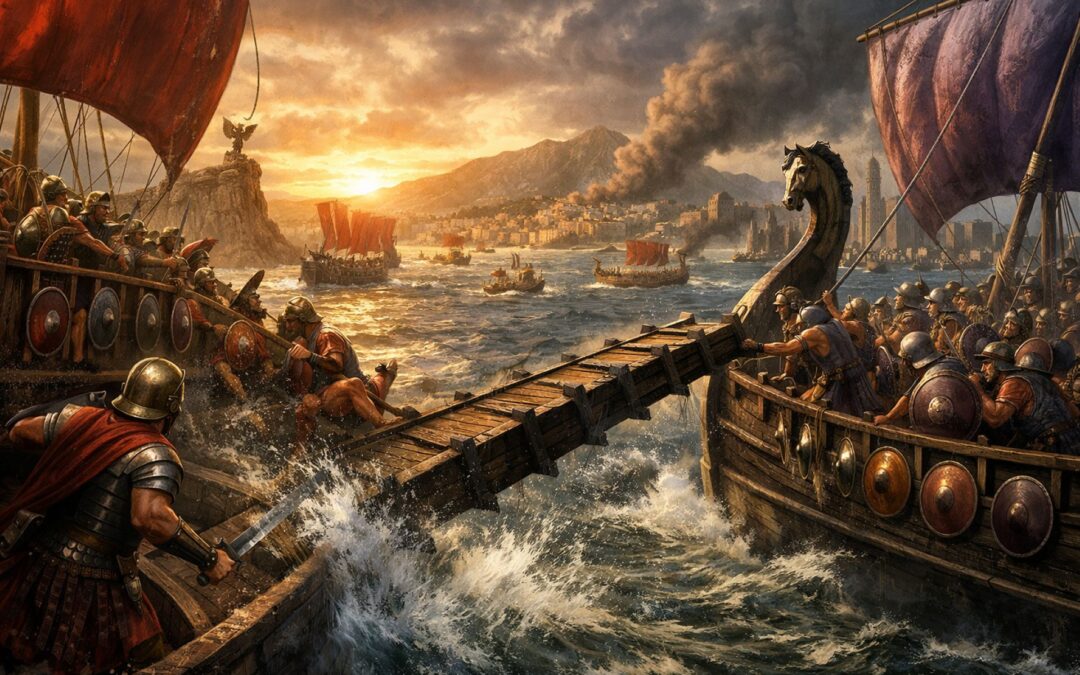
Roman engineers developed a device known as the corvus, meaning “crow.” The corvus was a large wooden boarding bridge mounted on the front of Roman warships. At the end of the bridge was a heavy metal spike designed to slam into and hook onto an enemy vessel.
When a Roman ship approached a Carthaginian vessel, the corvus could be dropped onto the enemy deck, locking the two ships together. Once the bridge was secured, Roman soldiers would rush across and engage the enemy in close combat.
This innovation effectively turned a naval battle into something resembling a land battle, where Roman infantry excelled. Instead of relying on complex naval maneuvers, Roman commanders could bring their disciplined soldiers into direct combat with enemy crews.
The corvus proved to be a brilliant adaptation. It neutralized much of Carthage’s advantage in naval skill and allowed Rome to apply its greatest strength—its heavily armed infantry—to warfare at sea.
With their new fleet and their new weapon, the Romans were finally ready to challenge Carthage on the Mediterranean itself.
The results would reshape the war.
Rome Seizes the Initiative at Sea
Early Setbacks and Rapid Learning
Rome’s sudden transformation into a naval power was impressive, but it did not immediately produce flawless results. Building ships was one thing; mastering naval combat was another. Carthage had spent centuries refining its maritime skills, and Roman crews were still inexperienced.
One of the earliest demonstrations of this inexperience came when the Roman consul Gnaeus Cornelius Scipio attempted to capture the small Sicilian port of Lipara. Believing that the city might defect to Rome, Scipio sailed into its harbor with part of the newly constructed Roman fleet. Instead of finding willing allies, he encountered a Carthaginian naval force that quickly trapped the Roman ships.
The result was a humiliating defeat. Roman vessels, poorly maneuvered and caught in a confined harbor, were overwhelmed by the more experienced Carthaginian sailors. Scipio himself was captured during the engagement, and the incident served as a harsh reminder that naval warfare required skills Rome had not yet fully developed.
Despite this early embarrassment, the Romans adapted quickly. Their commanders studied their failures, improved their tactics, and relied increasingly on the corvus to offset Carthage’s superior seamanship. The boarding device allowed Roman ships to engage their opponents in a way that favored Roman soldiers rather than Carthaginian sailors.
Soon the balance at sea began to shift.
A New Balance of Power
Once Roman fleets began employing the corvus effectively, naval battles increasingly turned into brutal close-quarter struggles fought on the decks of ships. Carthaginian crews, who had previously relied on speed and maneuverability to ram or outflank their enemies, suddenly found themselves grappling with Roman infantry boarding their vessels.
This change reduced Carthage’s long-held advantage. Roman soldiers were highly disciplined and well-trained in close combat, and once they crossed onto enemy ships, they often dominated the fighting.
A series of Roman naval victories followed, demonstrating that the new fleet could compete with Carthage’s once-unquestioned maritime supremacy. For the first time in the war, Rome was capable not only of defending its supply routes but also of threatening Carthaginian naval operations across the region.
These victories had important strategic consequences. Control of the sea made it easier for Rome to supply its armies in Sicily, transport reinforcements, and isolate Carthaginian strongholds along the coast. Carthage could no longer assume that its fleets would dominate every naval encounter.
The psychological effect was equally significant. Carthage had long relied on its naval superiority as the cornerstone of its power. Seeing Roman fleets challenge—and sometimes defeat—its ships undermined that confidence and forced Carthaginian commanders to reconsider their strategy.
Carthage Adapts to a Changing War
Faced with Rome’s unexpected naval success, the Carthaginians began shifting toward a more cautious approach. Rather than seeking decisive battles in open combat, they increasingly relied on fortified coastal cities and defensive positions across Sicily.
These strongholds allowed Carthaginian forces to resist Roman advances while maintaining supply lines by sea. Even if Roman fleets were improving, Carthage still possessed deep experience in maritime logistics and could often reinforce or resupply its garrisons.
As a result, the war entered a difficult phase for both sides. Rome had gained new capabilities at sea, but conquering the island remained slow and costly. Carthage could still rely on its fortified positions and naval mobility to prolong the conflict.
Instead of quick victories, the struggle for Sicily became a long and grinding campaign, marked by sieges, shifting alliances, and repeated attempts by each side to gain the upper hand.
The War Becomes a Grind
By the middle years of the conflict, it was becoming clear that the First Punic War would not be a short or decisive struggle. Both Rome and Carthage had entered the war expecting that victory might come quickly once the balance of power shifted in their favor. Instead, the war in Sicily turned into a prolonged and exhausting contest that tested the endurance of both states.
Although Rome had gained new confidence after its naval successes, the realities of campaigning across Sicily proved frustrating. The island was dotted with fortified cities, many of which were strongly defended and supplied by sea. Even when Roman armies defeated Carthaginian forces in open battle, capturing these cities required lengthy sieges that drained time, manpower, and resources.
Carthage quickly realized that direct confrontation with Roman legions on land often favored Rome. Instead of risking large-scale battles, Carthaginian commanders increasingly relied on a strategy of defensive attrition. They withdrew into heavily fortified strongholds and forced the Romans to attack them city by city. This approach slowed Roman progress and stretched the war across years rather than months.
Siege warfare in the ancient world was notoriously difficult. Armies had to surround a city, block all supply routes, and wait for hunger or exhaustion to force surrender. The defenders, meanwhile, could hold out behind walls while waiting for relief forces or resupply by sea. Such campaigns often dragged on for months or even years.
For Roman soldiers, these sieges were grueling. Camps had to be maintained through harsh conditions, and food supplies were frequently uncertain. Disease, exhaustion, and constant skirmishing wore down the army even when major battles did not occur. Yet Roman commanders rarely abandoned their efforts, determined to capture one Carthaginian stronghold after another.
Carthage, meanwhile, was equally determined not to surrender Sicily easily. The island had long been central to its strategic position in the Mediterranean. Losing it would weaken Carthage’s influence and expose its maritime routes to Roman interference. As a result, Carthaginian leaders continued to send reinforcements, supplies, and naval support to their remaining bases.
The fighting therefore became a slow back-and-forth struggle. Roman forces would gradually advance, capturing towns and territories, only for Carthaginian counterattacks to reclaim lost ground in other areas. Neither side was able to deliver a decisive blow that would end the war.
Meanwhile, the cost of the conflict continued to grow. Armies had to be supplied, ships had to be built and maintained, and soldiers had to be recruited year after year. The financial and human burden on both societies was immense.
For Rome, this grinding stalemate created growing frustration. The republic had become accustomed to decisive victories during its expansion across Italy. The slow pace of the Sicilian war felt unsatisfying and wasteful. Many Roman leaders began searching for a more dramatic strategy—one that could bring the war to a quicker and more decisive conclusion.
Their solution was bold, risky, and unprecedented.
Instead of continuing to fight across Sicily, Rome would attempt to carry the war directly to Carthage itself.
The African Gamble
Regulus and the Invasion Plan
By the mid-250s BC, the war in Sicily had become frustratingly slow for the Romans. Despite years of fighting, enormous expenditures, and significant victories, Carthage still held important strongholds on the island. The Romans had gained ground, but they had not delivered the decisive blow needed to end the war.
Many Roman leaders began to believe that the problem was the location of the conflict itself. As long as the war remained confined to Sicily, Carthage could continue supplying its garrisons and prolonging the struggle. The solution, some argued, was to attack the enemy at its source. Instead of fighting endlessly across Sicily, Rome would bring the war directly to Carthage’s homeland in North Africa.
This was an extraordinarily ambitious plan. No Roman army had ever attempted such an invasion. The republic would need to transport thousands of soldiers across the Mediterranean, defeat Carthaginian fleets along the way, and establish a foothold on foreign soil. Yet Roman confidence had grown alongside their naval capabilities, and the leadership believed the risk was worth taking.
In 256 BC, Rome assembled one of the largest fleets the ancient world had ever seen. The expedition included hundreds of warships and transports carrying soldiers, supplies, and cavalry horses. Among the commanders leading the operation was the consul Marcus Atilius Regulus, an ambitious Roman determined to secure a decisive victory that would immortalize his name.
Before the invasion fleet could reach Africa, however, it would have to face the Carthaginian navy.
The Battle of Cape Ecnomus
The Carthaginians fully understood what the Roman fleet intended to do. Allowing an enemy army to land in North Africa would place Carthage itself in immediate danger. To prevent this, they assembled a massive fleet to intercept the Romans before they could reach their destination.
The two armadas met near the southern coast of Sicily at the Battle of Cape Ecnomus, one of the largest naval battles ever fought in the ancient world. Ancient sources claim that the battle involved hundreds of ships and possibly around 300,000 men, though the exact numbers remain debated by historians. Regardless of the precise figures, the scale of the confrontation was enormous.
The Romans arranged their fleet in a distinctive formation designed to protect their transports and break through the Carthaginian line. The Carthaginians attempted a more complex maneuver, hoping to lure the Roman center forward while their flanking forces surrounded and attacked the sides of the Roman formation.
In theory, the Carthaginian plan was clever. In practice, the sheer size of the fleets created chaos. Ships collided, formations broke apart, and the battle devolved into several smaller engagements scattered across the water. Once again, the Roman corvus played a critical role. When Carthaginian ships approached to ram or maneuver around the Roman fleet, Roman soldiers used the boarding bridges to lock ships together and fight hand-to-hand.
In these brutal close-quarter battles, Roman infantry proved decisive. Gradually, the Roman center broke through the Carthaginian line and then turned back to assist the portions of the fleet that were under pressure. One by one, the Carthaginian squadrons were pushed back.
By the end of the day, the Romans had won a major victory. The Carthaginian fleet was forced to withdraw, leaving the route to Africa open. For the first time in the war, a Roman army was free to cross the Mediterranean and threaten Carthage directly.
Early Success in Africa
Following their victory at Cape Ecnomus, the Roman fleet sailed south and landed on the North African coast. The invasion force quickly captured the city of Aspis, establishing a base of operations from which they could launch further attacks.
From there, Roman troops began raiding the surrounding countryside. Farms were plundered, settlements were attacked, and thousands of captives were taken as slaves. The sudden appearance of Roman armies so close to Carthage created widespread panic among the local population. Refugees flooded into the city as news spread of Roman forces advancing through the region.
At first, it appeared that the Roman gamble might succeed. Carthage had not faced an enemy invasion of this scale in its homeland for generations. If the Romans could maintain their position and continue advancing, they might force the Carthaginians to surrender and end the war quickly.
Yet events were about to take an unexpected turn. The Roman commander Regulus, confident after his early successes, made a decision that would dramatically change the course of the campaign—and ultimately give Carthage the chance to recover.
Regulus Overreaches and Carthage Recovers
The Failure of Harsh Demands
After landing in North Africa and securing early successes, the Roman campaign initially appeared to be heading toward a decisive victory. Roman forces had captured the city of Aspis, raided the surrounding countryside, and spread panic among the population. Refugees flooded into Carthage itself, and the sudden threat to the city created a sense of crisis within the Carthaginian leadership.
At this stage of the war, Carthage was vulnerable. Its armies had been fighting for years in Sicily, its political leadership was divided, and the Roman invasion had brought the war directly to its homeland. In theory, Rome could have tightened the pressure gradually, laying siege to cities, consolidating territory, and forcing Carthage into submission over time.
Instead, the Roman commander Marcus Atilius Regulus made a crucial strategic mistake.
Confident in his success and eager to secure a decisive triumph before the end of his term as consul, Regulus demanded that Carthage accept extremely harsh surrender terms. These terms reportedly included abandoning large territories, paying heavy financial penalties, and effectively submitting to Roman dominance.
Rather than forcing the Carthaginians to surrender, the demands had the opposite effect. The Carthaginian leadership realized that surrender would destroy their power entirely. Faced with such humiliating conditions, they resolved to continue the fight at any cost.
This moment transformed the situation. Instead of collapsing under Roman pressure, Carthage began reorganizing its defense.
Xanthippus Changes the War
In its desperation, Carthage turned to a solution that it had often relied upon in the past: hiring experienced military specialists from abroad. Among those brought in to help was a Spartan mercenary commander named Xanthippus.
Spartans carried a legendary reputation in the ancient world for military discipline and battlefield skill. When Xanthippus arrived in Carthage, he quickly assessed the situation and recognized several problems with the Carthaginian army’s organization and tactics.
Carthage possessed powerful military assets that had not been used effectively. Among these were war elephants, which were capable of terrifying and disrupting enemy infantry formations, and Numidian cavalry, widely considered some of the best horsemen in the Mediterranean world. Yet Carthaginian commanders had repeatedly placed these forces in unfavorable positions, often fighting on terrain that limited their effectiveness.
Xanthippus reorganized the army and proposed a new strategy. Instead of fighting on rough ground where Roman infantry excelled, the Carthaginians would seek battle on flat, open terrain where their cavalry and elephants could operate freely. The elephants would be placed at the front of the army to smash into Roman formations, while cavalry units would maneuver around the Roman flanks.
This plan represented a dramatic shift from earlier Carthaginian tactics and prepared the army for a decisive confrontation.
The Battle of the Bagradas River
The two forces finally met near the Bagradas River in North Africa. This time the battlefield favored the Carthaginians. The open terrain allowed their cavalry and elephants to operate effectively, while the Roman army found itself exposed to threats it was not accustomed to facing.
At the beginning of the battle, the Carthaginian war elephants charged directly into the Roman lines. For many Roman soldiers, the sight of these massive animals was terrifying. The elephants disrupted the tightly organized Roman infantry formations, creating confusion and breaking the cohesion that normally made the Roman legions so formidable.
At the same time, Carthaginian cavalry forces swept around the Roman flanks. Once the Roman infantry became disorganized by the elephant attack, the cavalry struck from the sides and rear, surrounding large portions of the Roman army.
The result was a devastating defeat for Rome. The Roman invasion force was shattered, with many soldiers killed or captured during the battle. Marcus Atilius Regulus himself was taken prisoner, bringing the ambitious African campaign to an abrupt and disastrous end.
The victory completely reversed the momentum of the war in North Africa. Carthage, which had seemed on the verge of collapse only months earlier, had successfully repelled the Roman invasion and restored confidence in its ability to resist.
For Rome, the defeat was a major setback. Yet even after losing an entire army and its commander, the republic refused to abandon the struggle.
The war would continue—and the Mediterranean itself was about to become one of Rome’s greatest enemies.
The Sea Turns Against Rome
After the disaster in North Africa, the Romans faced a difficult situation. The army that had invaded Carthaginian territory had been largely destroyed, and many survivors were stranded across the Mediterranean. Despite the crushing defeat at the Bagradas River, Rome still possessed powerful fleets and remained determined to recover its remaining forces and continue the war.
To rescue the survivors, the Roman government assembled another fleet and sent it to North Africa. The operation was initially successful. Roman ships managed to retrieve the surviving soldiers and repel a Carthaginian naval force that attempted to intercept them. With the rescued troops aboard, the fleet began the return journey toward Sicily.
At that moment, however, a new and devastating enemy appeared—the forces of nature.
As the fleet sailed through the Mediterranean, it encountered a massive storm. Ancient warships were vulnerable to rough seas, and Roman commanders had limited experience navigating such conditions with large fleets. When the storm struck, hundreds of ships were thrown into chaos.
The results were catastrophic.
Ancient sources report that around 284 Roman ships were lost, representing nearly eighty percent of the fleet. Tens of thousands of sailors and soldiers drowned as their vessels broke apart or were driven onto rocks and coastlines. Some estimates suggest that as many as 100,000 men may have perished in the disaster, making it one of the worst naval catastrophes of the ancient world.
For most states, such a loss would have been crippling. Losing an entire fleet and such an enormous number of men in a single incident could easily have forced a government to seek peace or abandon the war entirely. The scale of the tragedy shocked even Roman observers.
Yet the Roman response revealed one of the defining characteristics of the republic: an extraordinary refusal to give up.
Instead of suing for peace, the Romans simply began building another fleet.
Within a remarkably short period—ancient sources suggest only a few months—the Romans constructed around 220 new warships to replace those destroyed by the storm. Once again they demonstrated their ability to mobilize manpower, resources, and industrial effort on a massive scale.
The rebuilt fleet soon returned to sea, continuing operations against Carthage.
Unfortunately for the Romans, the Mediterranean was not finished with them. During subsequent naval operations, another powerful storm struck the Roman fleet. Once again ships were wrecked and thousands of men were lost. The republic had now suffered two enormous maritime disasters within a short span of time.
At this point, Rome had lost hundreds of thousands of men and hundreds of ships in naval catastrophes alone. The financial and human cost of the war was becoming staggering.
Even so, Rome did not withdraw from the conflict.
The republic’s determination baffled its enemies. Many in Carthage assumed that after such repeated disasters Rome would eventually accept defeat or negotiate a compromise. Instead, the Romans continued rebuilding their fleets and preparing for further campaigns.
Gradually, however, the focus of the war began shifting once again. After the costly failures at sea, both sides increasingly returned their attention to the struggle on land in Sicily, where the conflict had first begun.
There, the war was about to enter its longest and most exhausting phase.
Roman Endurance and Carthaginian Opportunity
The enormous disasters at sea might have ended the war for almost any other state. Rome had lost multiple fleets, hundreds of ships, and staggering numbers of men to storms and naval defeats. The financial strain was immense, and many Romans must have wondered whether the war had become too costly to continue.
Yet the Roman Republic possessed a political culture that made surrender extraordinarily difficult. Roman society placed enormous value on perseverance, honor, and the refusal to accept defeat. To abandon the war after so many sacrifices would not only have been humiliating but would also have signaled weakness to Rome’s allies and enemies alike.
Instead of retreating, Rome temporarily shifted its strategy. Rather than risking further catastrophic naval operations immediately, Roman leaders began focusing once again on land campaigns in Sicily, where the war had originally begun. Roman armies continued pressing against Carthaginian positions, capturing towns and expanding their influence across the island.
This determination became one of Rome’s greatest strategic advantages. Even when disasters struck—whether military defeats or natural catastrophes—the Roman system proved capable of recovering and continuing the fight. The republic could raise new armies, gather resources from its network of Italian allies, and reorganize its military efforts repeatedly.
For Carthage, Rome’s persistence created both an opportunity and a dilemma.
On one hand, the recent Roman losses had weakened their naval strength and drained their resources. If Carthage could exploit the situation effectively, it might regain the initiative and push the Romans back from Sicily entirely. The Carthaginian fleet still possessed deep maritime experience, and their commanders had opportunities to strike Roman supply routes or reinforce their remaining strongholds.
On the other hand, Carthage’s strategic approach remained cautious. Rather than launching bold offensives, Carthaginian leadership often focused on protecting key positions and responding to Roman actions. This reactive strategy allowed them to preserve their strength but sometimes prevented them from taking advantage of Roman setbacks.
The contrast between the two powers became increasingly clear as the war dragged on. Rome tended to pursue aggressive and ambitious plans, even when they carried enormous risks. Carthage, by contrast, often acted defensively, seeking to preserve its forces and protect its interests rather than gamble everything on a decisive confrontation.
Neither strategy was inherently superior. Rome’s aggressiveness had already led to catastrophic losses, while Carthage’s caution allowed the war to continue far longer than many had expected. Yet as the years passed, the difference in approach would begin to matter more and more.
While both sides struggled with exhaustion and financial strain, the Romans continued pushing forward. The next phase of the conflict would see the war settle once again into a slow and grinding struggle across Sicily, where fortified cities and determined commanders would prolong the fighting for nearly a decade more.
The Long Deadlock in Sicily
Panormus, Lilybaeum, and Attrition
After the disasters at sea and the failed Roman invasion of North Africa, the focus of the war shifted firmly back to Sicily, where the struggle had originally begun. By this stage of the conflict, the island had already endured years of warfare, and both Rome and Carthage had invested enormous resources into controlling it.
Rome held much of the island, particularly in the east and center, thanks to earlier victories and the alliance with Syracuse. However, the Carthaginians still controlled several powerful coastal strongholds in western Sicily. These fortified cities were extremely difficult to capture and allowed Carthage to maintain a presence on the island despite Roman advances.
One of the most significant Roman successes during this phase occurred near the city of Panormus (modern Palermo). Carthaginian forces attempted to regain territory in the region and relied heavily on their feared war elephants, hoping to break Roman infantry formations.
The Romans, however, adapted quickly. Instead of allowing themselves to be overwhelmed by the elephants, they used missile weapons—javelins, stones, and other projectiles—to frighten and wound the animals. As the elephants panicked, they turned back toward their own lines, causing confusion among the Carthaginian troops. The Roman forces then advanced and defeated the enemy army.
The victory at Panormus helped secure Roman control over much of northern Sicily and opened the path toward the final major Carthaginian stronghold on the island: Lilybaeum.
Lilybaeum was one of the strongest fortified cities in the Mediterranean. Located on the western tip of Sicily, it possessed formidable defenses and a harbor that allowed Carthaginian ships to supply the city even while Roman armies surrounded it. In 250 BC, the Romans began what would become one of the longest and most difficult sieges of the entire war.
Despite their determination, the Romans struggled to capture the city. Carthaginian sailors proved remarkably skilled at slipping past Roman blockades, delivering food, troops, and supplies into the harbor under cover of darkness or bad weather. As long as these supply routes remained open, the defenders could continue resisting.
The siege dragged on for years, draining Roman manpower and resources. Roman siege engines were built and destroyed, defensive walls were attacked and repaired, and both sides endured constant skirmishes around the city’s fortifications. Progress was painfully slow.
What had once been a dynamic conflict now resembled a stalemate. The Romans had the advantage on land across most of Sicily, but they could not easily capture the final Carthaginian strongholds. Carthage, meanwhile, could still reinforce its positions but lacked the strength to drive the Romans off the island entirely.
Hamilcar Barca Enters the Scene
During this prolonged deadlock, Carthage sent one of its most capable commanders to Sicily: Hamilcar Barca.
Hamilcar would later become famous as the father of Hannibal, the general who would terrorize Rome during the Second Punic War. At this stage, however, he was already known as a skilled and energetic leader.
Arriving in Sicily around 247 BC, Hamilcar adopted a different approach to the war. Instead of confronting the Romans directly in large-scale battles, he relied on mobility, raids, and guerrilla-style tactics. Operating from fortified positions in the mountains and coastal areas, he launched sudden attacks against Roman forces, supply lines, and outposts.
These operations prevented the Romans from concentrating all their efforts on the siege of Lilybaeum. Roman armies were forced to spread their forces across the island, guarding against unexpected strikes and responding to Hamilcar’s raids.
Although Hamilcar did not have the resources to defeat Rome outright, his campaign demonstrated remarkable resilience. He kept Carthaginian resistance alive in Sicily and ensured that the war would continue far longer than many Romans had hoped.
By the late 240s BC, the First Punic War had already lasted more than two decades. Both sides were exhausted, financially strained, and weary of the endless fighting. Yet neither Rome nor Carthage had achieved the decisive victory needed to bring the conflict to an end.
Eventually, however, one final effort would break the deadlock—and determine the fate of the Mediterranean.
Roman Failures at Drepana and More Naval Disaster
Even as the long siege of Lilybaeum dragged on and Hamilcar Barca harassed Roman forces across Sicily, Roman commanders continued searching for a decisive breakthrough. One such attempt came in 249 BC, when the Roman consul Publius Claudius Pulcher decided to attack the Carthaginian fleet stationed at the nearby port of Drepana.
If the Romans could destroy the Carthaginian navy in the region, they would isolate Lilybaeum completely and remove the last major obstacle preventing total Roman control of Sicily. Pulcher therefore prepared a surprise naval attack, hoping to catch the Carthaginian fleet off guard.
Before major battles, Roman commanders often performed religious rituals intended to determine whether the gods favored the coming engagement. One common practice involved observing the behavior of sacred chickens, which were offered food before battle. If the chickens ate eagerly, it was considered a good omen. If they refused to eat, it was taken as a warning that the gods disapproved of the coming action.
According to ancient accounts, when Pulcher attempted this ritual, the chickens refused to eat. Interpreting the omen as unfavorable, the priests advised caution. Pulcher, however, was impatient and determined to proceed with the attack. In frustration, he reportedly threw the chickens overboard, declaring that if they would not eat, they could at least drink.
Ignoring the warning signs—whether religious or practical—Pulcher launched his assault on the Carthaginian fleet.
The battle quickly turned into a disaster for the Romans. The Carthaginian admiral, Adherbal, commanded experienced crews who were far more skilled at naval maneuvering than the Roman sailors. Without the corvus boarding device—likely removed because it made ships unstable in rough seas—the Romans were forced to fight a more traditional naval battle.
In these conditions, the Carthaginians held a decisive advantage.
Roman ships struggled to maintain formation, while the Carthaginian fleet used its superior speed and maneuverability to outflank and ram the Roman vessels. One by one, Roman ships were captured or destroyed. The Roman fleet suffered a crushing defeat, losing the majority of its ships while the Carthaginians escaped with relatively light losses.
The defeat at Drepana was one of the worst naval disasters Rome had suffered in the entire war. Pulcher returned to Rome disgraced, and the defeat temporarily restored Carthaginian confidence at sea.
Yet the Romans were about to suffer an even greater calamity.
Shortly after the battle, another Roman fleet was dispatched to deliver supplies to the besieging army at Lilybaeum. As the ships approached the Sicilian coast, Carthaginian forces moved to intercept them. Observing signs of an approaching storm, the Carthaginians chose to withdraw and seek shelter.
The Romans, however, pressed onward.
Once again, the Mediterranean unleashed its fury. A powerful storm struck the Roman fleet, scattering ships across the sea and smashing them against rocks and coastlines. The result was another catastrophic loss. Dozens of ships were destroyed, and around 50,000 men are believed to have perished in the disaster.
By this point, Rome had lost enormous numbers of ships and sailors not only in battle but also in storms. The repeated disasters placed immense strain on the Roman treasury and manpower reserves. For several years after these losses, the republic largely abandoned large-scale naval operations.
The war therefore returned once again to the slow struggle on land in Sicily. But while Rome temporarily stepped back from naval warfare, it had not abandoned the conflict.
In time, the republic would make one final and decisive effort to regain control of the sea—and end the war once and for all.
The Final Roman Effort
Carthaginian Miscalculation
By the late 240s BC, the First Punic War had already lasted more than two decades. Both Rome and Carthage were exhausted. Years of fighting had drained their treasuries, consumed vast numbers of soldiers, and stretched their political systems to the limit. The once energetic campaigns across Sicily had slowed into a weary stalemate.
From the Carthaginian perspective, the situation seemed manageable. Although Rome controlled much of Sicily, Carthage still held important positions such as Lilybaeum and maintained the presence of Hamilcar Barca, whose guerrilla-style campaign continued to trouble Roman forces. More importantly, Rome’s repeated naval disasters had crippled its fleets.
After the crushing defeat at Drepana and the catastrophic storms that followed, Roman naval operations had largely ceased. Building and losing fleets repeatedly had imposed enormous financial costs on the republic. To many Carthaginian observers, it seemed unlikely that Rome would be able—or willing—to rebuild yet another navy.
Believing the Romans were nearing the limits of their endurance, the Carthaginian government made a critical decision. Much of its navy was scaled back or reassigned to commercial purposes, and fewer resources were devoted to maintaining a powerful wartime fleet. Carthage expected that the war would soon wind down, either through negotiation or simple exhaustion.
This assumption would prove to be a serious miscalculation.
A Fleet Funded by Determination
Despite years of setbacks, Rome had not lost its determination to win the war. The republic’s leadership understood that without naval control, the conflict in Sicily would never truly end. Carthaginian strongholds such as Lilybaeum could continue receiving supplies by sea indefinitely.
Once again, Rome resolved to rebuild its fleet.
This time, however, the Roman state faced severe financial limitations. The treasury had been strained by decades of warfare, and funding another massive naval construction project was difficult. Instead of abandoning the effort, the Roman leadership turned to an alternative solution.
Wealthy Roman citizens and members of the elite contributed funds voluntarily to finance the construction of a new fleet. This patriotic effort allowed Rome to build a powerful navy without relying entirely on state finances. The new fleet consisted of approximately 200 warships, and unlike earlier Roman fleets, it was designed with the lessons of the war in mind.
The Romans also improved their naval training and tactics. Earlier in the conflict they had relied heavily on the corvus, the boarding bridge that turned sea battles into infantry fights. While effective, the device had also made Roman ships top-heavy and more vulnerable in storms. In the new fleet, the corvus was largely abandoned in favor of better seamanship and improved maneuvering.
By 242 BC, the Romans had once again assembled a formidable naval force and were ready to challenge Carthage at sea.
The Battle of the Aegates Islands
The final decisive confrontation came in 241 BC near the Aegates Islands, located off the western coast of Sicily. The Carthaginians had assembled a fleet to transport supplies and reinforcements to their remaining forces on the island, including the army of Hamilcar Barca.
However, this fleet was hastily prepared and crewed by sailors who lacked the experience of earlier Carthaginian crews. The Roman navy, by contrast, was now better trained and commanded after decades of wartime experience.
As the Carthaginian fleet approached Sicily, the Romans intercepted it.
The resulting battle was swift and decisive. Roman ships, lighter and more maneuverable without the corvus, outperformed the Carthaginian vessels. The Carthaginian fleet was heavily burdened with supplies, making their ships slower and less capable of fighting effectively.
Roman crews exploited these weaknesses, ramming and capturing numerous enemy ships. The Carthaginian fleet suffered devastating losses, and the surviving vessels fled the battlefield.
The Battle of the Aegates Islands proved to be the decisive turning point of the entire war. Without a fleet capable of supplying their armies in Sicily, the Carthaginians could no longer sustain the conflict. Their remaining forces on the island were effectively cut off.
After twenty-three exhausting years of warfare, Carthage had little choice but to seek peace.
The First Punic War was finally coming to an end.
Peace, Punishment, and the Shape of the Future
The Roman victory at the Battle of the Aegates Islands finally broke the stalemate that had defined the later years of the war. With their fleet destroyed and their supply lines cut, the Carthaginian forces in Sicily were effectively stranded. The army under Hamilcar Barca could continue resisting for a time, but without naval support there was no realistic way to sustain the war.
For the Carthaginian government, the situation was clear. After more than two decades of fighting, the state’s finances were strained, its resources depleted, and its people weary of conflict. Carthage had entered the war as the dominant naval power of the western Mediterranean, but the long struggle had eroded that advantage.
Recognizing that further resistance would likely bring only greater losses, the Carthaginian leadership authorized negotiations with Rome.
Hamilcar Barca, still commanding the remaining Carthaginian forces in Sicily, was instructed to reach a settlement if possible. Although he personally felt betrayed by political leaders who had failed to support the war effort fully, the strategic reality was unavoidable. Carthage could no longer continue the fight.
The peace terms imposed by Rome were severe.
First, Carthage was required to abandon Sicily entirely, leaving the island under Roman control. This was a historic shift in power. For centuries Sicily had been contested territory influenced by Greek cities and Carthaginian interests. Now it became Rome’s first overseas possession, marking the beginning of Roman expansion beyond the Italian peninsula.
Second, Carthage agreed to return all Roman prisoners of war without ransom.
Third, the Carthaginians were forced to pay a massive financial indemnity. According to ancient accounts, Rome initially demanded 2,200 talents of silver, to be paid over twenty years. The Roman assembly later increased the amount to 3,200 talents, payable over a shorter period of ten years. The sum represented an enormous financial burden that would weigh heavily on the Carthaginian economy.
Although these conditions ended the war, they also left Carthage deeply humiliated and financially weakened. The treaty not only stripped Carthage of Sicily but also limited its ability to challenge Rome in the near future.
Rome, meanwhile, moved quickly to consolidate its victory. Sicily was reorganized into Rome’s first province, governed by Roman officials and integrated into the republic’s growing sphere of influence. The island’s fertile agricultural lands soon became an important source of grain for the expanding Roman population.
In the years that followed, Rome took advantage of Carthage’s weakened position even further. When internal conflicts destabilized Carthaginian territories, Rome seized the islands of Corsica and Sardinia, expanding its control across more of the western Mediterranean.
To Roman leaders, the outcome of the First Punic War appeared to secure their dominance in the region. Carthage had been defeated, forced to pay enormous reparations, and pushed out of Sicily. Rome had proven that it could challenge even the greatest naval power of its time and emerge victorious.
Yet the peace settlement carried a dangerous consequence.
The harsh terms imposed on Carthage left deep resentment among its leaders and citizens. Many Carthaginians believed the Romans had exploited their weakness and imposed humiliating conditions. The anger and frustration created by the treaty would not disappear.
Instead, it would simmer for years—especially within the powerful Barcid family, led by Hamilcar Barca.
One day, that anger would return to the battlefield.
And when it did, it would produce one of the most famous commanders in history: Hannibal Barca.
Conclusion
The First Punic War was one of the most transformative conflicts of the ancient world. What began as a local crisis in the Sicilian city of Messana grew into a massive struggle between two republics whose ambitions and strengths were fundamentally incompatible. Over twenty-three years of warfare, Rome and Carthage fought across Sicily, the Mediterranean Sea, and even the North African homeland of Carthage itself.
At the beginning of the war, the two powers appeared dramatically different. Carthage was the established superpower of the western Mediterranean, wealthy from trade and protected by one of the most formidable navies in existence. Rome, by contrast, was still primarily a land-based power whose influence had only recently expanded across the Italian peninsula.
Yet the conflict revealed strengths within the Roman system that would define its rise to dominance. Rome demonstrated an extraordinary capacity for adaptation, organization, and persistence. It learned naval warfare from its enemies, built massive fleets from scratch, developed new technologies like the corvus, and repeatedly recovered from devastating setbacks. Even after losing entire fleets and tens of thousands of men, the Roman Republic refused to abandon the struggle.
Carthage, despite its wealth and maritime expertise, ultimately fought a more reactive war. Its strategy focused largely on defending existing positions and responding to Roman initiatives rather than delivering a decisive counterstroke. Skilled commanders such as Hamilcar Barca prolonged the conflict and kept Carthaginian resistance alive, but the state’s political leadership never fully matched Rome’s relentless determination.
When the war finally ended in 241 BC, Rome emerged as the victor. It gained control of Sicily, imposed heavy financial penalties on Carthage, and secured its first overseas province. More importantly, the conflict pushed Rome onto a new path. The republic had proven it could project power beyond Italy, build powerful navies, and compete for dominance across the Mediterranean.
At the same time, the harsh peace imposed on Carthage ensured that the rivalry between the two powers was far from finished. The humiliation and resentment created by the treaty lingered within Carthaginian society, particularly within the family of Hamilcar Barca.
In the years that followed, Hamilcar would begin building a new Carthaginian power base in Spain. There, he would raise and train his son—a boy who would grow up hearing stories of Roman aggression and Carthaginian defeat.
That boy was Hannibal.
And within a generation, the conflict between Rome and Carthage would erupt again in an even more famous and terrifying struggle: the Second Punic War.