
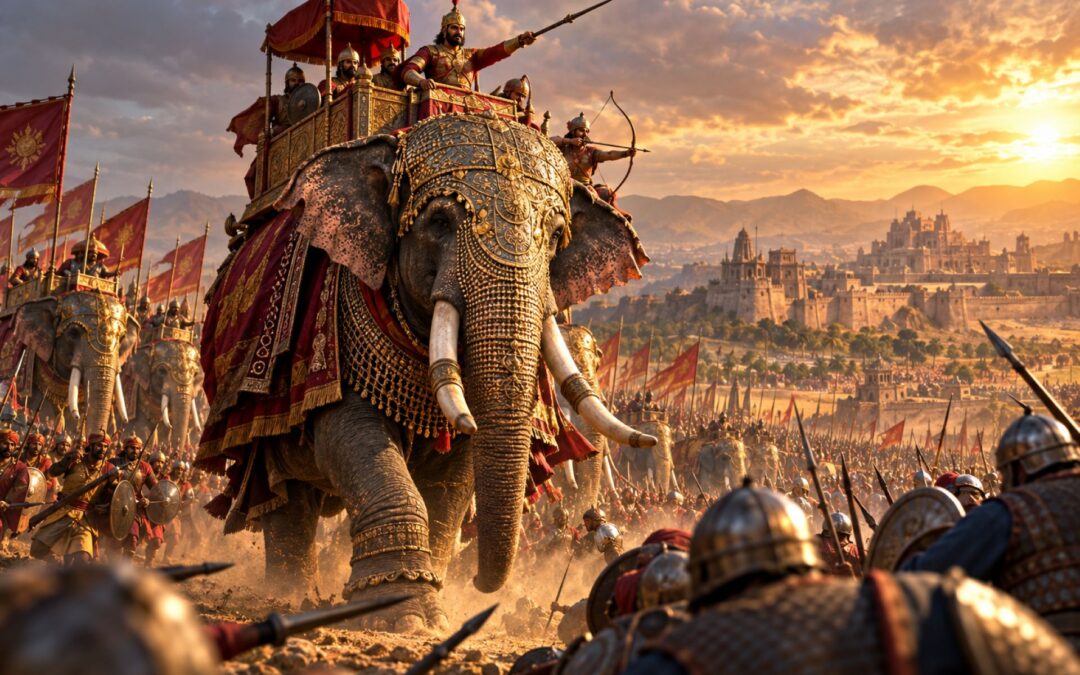
For centuries, Indian kings took some of their most powerful and conspicuous weapons onto the battlefield: elephants trained to charge enemy formations, carry armed soldiers and terrify opposing cavalry. A fully equipped war elephant could tower over the soldiers surrounding it, its body protected by armour and its back supporting a fighting platform. Against an unprepared opponent, its physical strength and intimidating presence could be devastating.
Yet this enormous military asset had a weakness that no amount of armour could entirely eliminate. An elephant was a living animal, vulnerable to pain, fear and exhaustion, and its size made it difficult to conceal from enemy archers and artillery. A wounded elephant might lose control, while a commander who rode one became an unmistakable target. In several important battles, the deaths of commanders mounted on elephants had consequences far greater than the loss of the animals themselves.
Indian rulers understood many of these dangers, but they continued investing in elephant corps even as cavalry, mounted archers and gunpowder weapons transformed warfare. The explanation lies in the complicated relationship between military effectiveness and political authority. War elephants were not invincible engines of destruction, but neither were they merely expensive traditions that kings refused to abandon. They were versatile military resources whose importance extended well beyond what happened during a charge.
Where India’s War Elephants Came From
Elephants became part of Indian warfare long before the medieval period. Their military importance developed in regions where rulers could obtain suitable animals from forests and sustain the people and resources necessary to manage them. Unlike horses, which could be bred in large numbers under human management, military elephants generally had to be captured from wild populations and individually trained. Access to elephant-rich territories therefore offered an advantage that was difficult for competing kingdoms to reproduce.
Ancient Indian military thought recognised elephants as one of the principal components of an army, alongside infantry, cavalry and chariots. This fourfold organisation, traditionally known as the chaturanga, reflected the different functions that each type of force could perform. Elephants offered exceptional physical power, could carry armed men above the surrounding battlefield and could be used in situations where ordinary infantry or cavalry faced serious difficulties. Their value depended on how commanders combined them with the rest of the army.
The kingdom of Magadha, which emerged as a major power in the eastern Gangetic plain, benefited from fertile agricultural territory, waterways and access to elephants. Those resources contributed to the military foundations of the Mauryan Empire. Chandragupta Maurya’s expansion in the late fourth century BCE demonstrated the significance of military organisation on an imperial scale, while the subsequent exchange of elephants between the Mauryan court and the Seleucid kingdom showed that these animals had diplomatic as well as military value.
The importance of elephants also appears in Greek accounts of Alexander’s Indian campaign. At the Battle of the Hydaspes in 326 BCE, Alexander encountered the elephants of King Porus. Ancient narratives describe the confusion and danger they created, although the details of these accounts must be read critically rather than treated as precise battlefield records. The encounter nevertheless demonstrates that Indian elephant warfare was already sufficiently developed to challenge an experienced army unfamiliar with fighting such animals.
The broader history of India’s kingdoms and empires reveals that political authority repeatedly shifted between dynasties, regions and military traditions. Elephant warfare survived these changes because it was not dependent on one ruling house or a single method of fighting. Successive states inherited, modified and adapted practices of capturing, training and deploying elephants.
By the medieval period, elephants had become part of an elaborate military institution. Their continued importance depended not simply on their strength but on the systems that selected them, trained them, maintained them and placed them within increasingly complex armies.
How an Elephant Was Turned Into a War Machine
A useful war elephant was not simply a large elephant. Military service demanded an animal capable of responding to commands amid unfamiliar sounds, crowded formations, weapons and physical danger. Size and strength mattered, but temperament, health, endurance and responsiveness to training were equally important. An animal that could not be controlled reliably might endanger the soldiers it was supposed to support.
Indian states developed specialised systems for capturing and managing elephants. The Arthashastra, a Sanskrit treatise associated with the political tradition of Kautilya, describes the administration of elephant forests, the classification of animals and their preparation for different duties. Its prescriptions concerning elephant management and training show how seriously ancient political thinkers treated the subject. The text developed through a complicated history of composition and transmission, however, so it should not be mistaken for a literal description of every Indian army in every later century.
The central figure in an elephant’s training and battlefield management was the mahout, the person responsible for directing and handling the animal. A skilled mahout learned to interpret its behaviour and communicate commands through voice, touch and specialised equipment. The relationship between handler and elephant required sustained familiarity, making an experienced mahout a valuable military specialist rather than an ordinary driver.
Training had to prepare elephants for activities far removed from their natural behaviour. They were expected to move through crowded groups of people, tolerate the presence of weapons, respond to directional commands and remain manageable when frightened or injured. Some were trained to push, strike, seize or otherwise attack objects and opponents. The goal was not to eliminate an elephant’s instincts, which was impossible, but to develop dependable responses under conditions that could become extremely stressful.
Armour added another layer of protection. Indian military elephants could be equipped with combinations of cloth, leather, chainmail and metal plates, depending on the period, the resources of their owners and the animal’s intended role. Protection was particularly valuable around the head and other exposed areas, although heavy armour inevitably increased the burden an animal had to carry.
Physical evidence confirms that Indian rulers invested considerable resources in such equipment. The Royal Armouries collection in Leeds includes an exceptionally extensive surviving Indian elephant armour, probably dating from the late seventeenth or eighteenth century and weighing approximately 118 kilograms. Its survival demonstrates the sophistication of elephant protection, although it would be misleading to assume that every medieval elephant wore a similarly complete set of armour.
Elephants also carried soldiers. A howdah, or mounted platform, could support armed men who fought from a height that infantry on the ground could not easily match. Depending on the circumstances, these riders might use bows, spears or other weapons to attack opponents while the animal itself threatened anyone approaching too closely. The combination of an elevated fighting position and the elephant’s physical power gave such a unit capabilities that ordinary cavalry lacked.
Some elephants carried additional offensive equipment attached to their tusks. The Metropolitan Museum of Art preserves a steel elephant sword from India, dated to the fifteenth through seventeenth centuries, demonstrating that tusk-mounted weapons were not merely products of popular imagination. Such blades could extend the danger posed by the tusks, although a surviving weapon establishes the existence of a practice rather than its frequency across Indian armies.
Descriptions of elephant equipment sometimes go much further, mentioning elaborate flails, poisoned blades and other spectacular additions. These claims require greater caution because isolated anecdotes do not establish normal military practice. Equipment varied considerably across periods and regions, and commanders would have needed to balance offensive improvements against the practical difficulty of controlling an animal burdened with additional weapons.
The result was a military unit that depended on several forms of expertise working together. Its effectiveness came from the elephant’s strength, the mahout’s skill, the equipment supplied by the state and the soldiers who operated around or upon it. The animal was formidable, but the system supporting it was what turned that strength into organised military force.
How Elephants Changed a Battle
The most immediate advantage of a war elephant was the difficulty it presented to soldiers accustomed to fighting other human beings or horses. An elephant could approach an infantry formation with enough weight and momentum to threaten men who remained directly in its path. Its height allowed it to dominate the space around it, while its trunk, tusks, head and feet could all become dangerous at close range.
The psychological effect could be almost as important as the physical threat. A soldier facing an advancing elephant had to overcome the fear of being trampled or struck by an animal far larger than anything normally encountered in close combat. Noise, movement, armour and the presence of armed riders could intensify that impression. Even before contact, the threat might encourage an enemy formation to withdraw or lose its cohesion.
This mattered because organised infantry depended heavily on maintaining its formation. Soldiers fighting together could support one another, protect vulnerable positions and resist attacks that might overwhelm isolated individuals. If the threat of an elephant charge caused them to scatter, the resulting gaps could be exploited by other troops. An elephant did not necessarily need to kill large numbers of men personally to contribute to a successful attack.
The relationship between elephants and cavalry was equally important. Horses unfamiliar with elephants could become alarmed by their appearance, smell, movement and noise. An elephant positioned near a vulnerable section of an army might discourage opposing horsemen from closing the distance, especially if their mounts had not been conditioned to tolerate such encounters.
That advantage was not automatic. Experienced cavalry forces could train horses to become more familiar with elephants, and commanders could avoid engagements in which their mounted troops were disadvantaged. The effectiveness of elephants against cavalry therefore depended on the experience of both armies rather than an unchanging instinct that guaranteed horses would flee.
Indian military commanders could exploit elephant power in several ways. Elephants might advance before infantry, operate alongside cavalry, guard important positions or support attacks against fortified places. Their strength made them useful for pushing heavy obstacles, moving equipment and assisting with tasks that demanded more physical force than individual soldiers could provide.
The Arthashastra assigns elephants a range of battlefield and military-engineering functions. Its discussion of elephant deployment in warfare reflects an understanding that these animals could support military operations in several different capacities. Such prescriptions are evidence of historical military thinking, although the actual organisation of medieval armies differed from the circumstances in which the treatise was compiled.
The most effective use of elephants often depended on cooperation with other troops. An elephant formation that disrupted enemy infantry could create opportunities for cavalry to advance through weakened positions. Archers and other missile troops might exploit the confusion while opposing soldiers attempted to reorganise. Conversely, infantry could protect elephants from attackers who tried to approach their vulnerable sides or legs.
This cooperation helps explain why elephants remained useful even when their enemies understood how to resist them. An elephant charge was only one possible component of an engagement. A commander could use elephants to threaten an enemy flank, hold ground, protect an important position or create uncertainty about where the main attack would fall.
Elephants could also function as elevated command platforms. A ruler or general mounted on one could observe more of the surrounding battlefield than a soldier standing among infantry. In an environment filled with dust, noise and moving formations, that additional height offered an obvious attraction.
However, visibility worked in both directions. A commander riding high above his soldiers could be more easily identified by the enemy. The elephant that provided a better view of the battle also advertised the position of the person directing it, creating a vulnerability that became particularly serious when enemy troops could concentrate missile attacks on one prominent target.
War elephants were therefore not simply substitutes for heavy cavalry or machines designed to trample infantry. They influenced the movement, confidence and organisation of entire armies. Their value lay in the choices they imposed on opponents and the opportunities they created for other units, provided the commander understood their limitations.
What Could Stop a Charging Elephant
The enormous size of a war elephant made it threatening at close range but also exposed it to enemy weapons. Unlike a smaller and faster-moving target, an elephant was difficult to conceal and could attract concentrated attacks. Armour might reduce the danger of some blows, but it could not make the animal invulnerable.
Archers could direct their fire toward exposed parts of the body or toward the men riding the animal. The eyes, trunk and other less protected areas were particularly vulnerable, although accurately striking them during combat was not necessarily easy. Heavy missile fire could also interfere with the animal’s movement, injure its handlers or prevent its riders from fighting effectively.
Mounted archers presented a different problem. Their mobility allowed them to approach, discharge arrows and retreat without necessarily accepting a direct confrontation. Such tactics were especially useful when opposing troops could maintain enough distance to avoid the elephant’s immediate reach. However, terrain, the protection provided by other soldiers and the relative mobility of the armies all affected whether this approach could succeed.
Disciplined infantry also had ways to resist elephants. Soldiers equipped with suitable spears or other long weapons could attempt to prevent an animal from closing with their formation. Others might attack its legs or trunk if they could approach safely, although doing so exposed them to substantial danger. A successful close-range counter required coordination and nerve, not merely the possession of a particular weapon.
Terrain could be just as important as equipment. Narrow passages, ditches, steep ground and obstacles restricted the movement of large animals. An elephant could not manoeuvre through every battlefield environment as readily as infantry, and obstacles could interrupt an advancing formation or separate an animal from its supporting troops.
Trenches and prepared defensive positions therefore offered commanders ways to reduce the effectiveness of an elephant charge. The practical challenge was to force the animals toward those obstacles while preventing the opposing army from bypassing them. An elephant trapped or immobilised in unsuitable ground could become vulnerable to soldiers who would otherwise have struggled to approach it.
A more unpredictable danger arose when elephants became frightened, injured or separated from their handlers. An animal attempting to escape could move through friendly troops, disrupting formations that depended on remaining organised. Because elephants were exceptionally powerful, even an unintended movement might have consequences far beyond those caused by a frightened horse.
Yet the popular assumption that war elephants routinely panicked and inflicted greater damage on their owners than their enemies deserves scrutiny. In his study Alexander and the Elephants, historian Thomas Trautmann challenges influential interpretations that present elephant warfare as inherently unreliable. His work raises questions about how historians have selected and interpreted ancient accounts of battlefield disorder.
This distinction matters because spectacular failures are more likely to survive in historical narratives than ordinary examples of effective deployment. A chronicler describing an elephant turning against friendly soldiers provides a memorable story, but the episode does not establish how frequently such events occurred. The existence of countermeasures likewise does not prove that those measures worked consistently.
Elephants possessed real vulnerabilities, and competent commanders attempted to exploit them. Nevertheless, the persistence of elephant warfare across many centuries suggests that military leaders continued finding uses for these animals despite the dangers. The more useful question is not whether elephants could be defeated, but under what circumstances their strengths outweighed the risks of employing them.
The Chola Battles That Exposed a Commander’s Risk
Two battles involving the Cholas illustrate the particular danger faced by commanders who fought from elephants. Both involved the death of an important royal leader, but their consequences differed significantly. Together, they demonstrate that the loss of a conspicuous commander could disrupt an army without always determining the final result.
The first was the Battle of Takkolam, generally dated to 949 CE. The conflict formed part of the struggle between the Cholas and the Rashtrakutas, whose rivalry shaped the political balance of southern India. Chola prince Rajaditya confronted an opposing coalition associated with Rashtrakuta king Krishna III and his allies, including the Western Ganga ruler Butuga II.
Rajaditya was killed during the battle, and his death became one of its decisive events. The Atakur inscription, associated with the Western Ganga side, celebrates Butuga’s role in killing the Chola prince. Accounts connect Rajaditya’s death with his position on an elephant, making the episode a particularly important example of the danger faced by commanders who occupied highly visible positions.
The surviving evidence does not establish every detail found in later dramatic retellings. Precisely how the fatal attack unfolded, what happened to the elephant and whether enemy soldiers physically climbed onto its back cannot all be reconstructed with certainty. What matters for understanding the battle is that a prominent Chola commander was killed and that the conflict ended in a serious reverse for his side.
Rajaditya’s death exposed a fundamental problem with concentrating battlefield leadership around a conspicuous individual. A ruler or prince could use an elephant to maintain visibility over his army, but that visibility also made him an obvious target. When soldiers saw or learned that their commander had fallen, the psychological and organisational consequences could be severe.
More than a century later, a similar danger appeared at the Battle of Koppam in 1054 CE, fought between the Cholas and the Western Chalukyas. Chola king Rajadhiraja I took the field against the forces of Someshvara I during another phase of the prolonged struggle for influence in the Deccan. As at Takkolam, the king’s position on an elephant became central to the account of his death.
Chola inscriptions describe Rajadhiraja being killed amid the fighting while mounted on his elephant. The episode became sufficiently memorable that the king was associated with the description of having died upon an elephant. The relevant inscriptional accounts preserved in South Indian Inscriptions provide a basis for understanding the battle, although royal inscriptions must also be read as political records written to celebrate dynastic achievements.
The crucial difference was what happened next. Rajadhiraja’s brother, Rajendra II, continued the battle and assumed leadership after the king’s death. Chola records present the subsequent fighting as a successful recovery that resulted in victory over the opposing forces.
Koppam therefore complicates the idea that killing a commander mounted on an elephant automatically caused his army to collapse. The death of Rajadhiraja created an immediate crisis, but the presence of another capable leader allowed the army to continue fighting. Military organisation, succession arrangements and the ability of surviving officers to maintain cohesion proved as important as the initial shock.
Takkolam and Koppam reveal both sides of the same vulnerability. A commander on an elephant could be dangerously exposed, and his death could transform a battle. Yet armies were not entirely dependent on the fate of one man or animal; their response depended on the wider command structure and the circumstances in which the loss occurred.
War Elephants in the Age of Horse Archers and Gunpowder
By the medieval period, Indian warfare was changing in ways that challenged the traditional advantages of elephants. Mounted archers, increasingly sophisticated cavalry organisations and new military technologies altered how armies moved, attacked and defended themselves. Elephant corps remained important, but they had to operate within military systems that differed considerably from those of earlier centuries.
The rise of powerful Turkic and Afghan military establishments in northern India gave cavalry a particularly prominent role. Armies associated with the Ghaznavids and later the Delhi Sultanate relied on mounted forces capable of travelling quickly, manoeuvring across large areas and striking opponents from a distance. These capabilities created problems for slower formations that could be threatened without being approached directly.
The importance of horses also shaped the politics of southern India. Suitable military horses were difficult to breed and maintain in adequate numbers across many parts of the subcontinent, making imports from Arabia, Persia and Central Asia strategically valuable. Control over ports, merchants and trade routes could therefore affect the strength of an army operating far inland.
These changes formed part of the wider transformation produced by the Delhi Sultanate’s expansion into the Deccan. Conquest brought military traditions into contact, encouraged the movement of experienced soldiers and changed the resources available to regional rulers. Elephants were increasingly employed alongside cavalry and other specialised forces rather than forming an independent answer to every battlefield problem.
The military history of Vijayanagara demonstrates this process particularly clearly. Its rulers possessed substantial elephant forces but also invested in imported horses, mounted soldiers, archers and eventually gunpowder weapons. Deva Raya II, for example, strengthened the recruitment of soldiers experienced in the cavalry and archery practices used by neighbouring states.
The result was not a simple replacement of elephants by horses. Different units offered different advantages, and commanders had to combine them according to the enemy, terrain and available resources. Elephants could still support military operations, but their effectiveness depended increasingly on their integration with other forces.
Gunpowder introduced additional challenges. Cannon fire and other firearms could threaten large, conspicuous targets and disrupt concentrated formations. Nevertheless, artillery was not an automatic guarantee of victory against armies that employed elephants. Early gunpowder weapons varied in mobility, accuracy and effectiveness, while their successful use depended on positioning, protection and coordination with supporting troops.
The Battle of Talikota in 1565, when a coalition of Deccan Sultanates defeated Vijayanagara, illustrates the complexity of this changing military environment. Both sides possessed substantial forces, and Vijayanagara’s army included elephants alongside infantry and cavalry. The confrontation involved military organisation, command decisions and weapons whose effectiveness depended on far more than their technological novelty.
The death of Vijayanagara’s dominant political leader, Aliya Rama Raya, became one of the battle’s decisive events. He was captured and executed after the opposing forces gained the advantage. Some dramatic retellings describe an elephant seizing him with its trunk and carrying him to his captors, but that particular episode cannot be treated as an established reconstruction. Historical accounts differ over the precise circumstances of his capture.
The battle’s political consequences were enormous. Vijayanagara’s defeat was followed by the devastation of its capital, although the dynasty’s successors continued ruling elsewhere. The broader rise and fall of the Vijayanagara Empire demonstrates that military setbacks could undermine the financial, administrative and political relationships supporting an imperial system.
Talikota should therefore not be reduced to a story in which artillery simply defeated elephants. It was a confrontation between complex armies whose effectiveness depended on leadership, morale, alliances, battlefield coordination and available military resources. Elephants remained part of that environment without necessarily determining its outcome.
Their roles continued evolving as firearms became more influential. In early-modern India, elephants could still contribute to transport, ceremonial duties, command and some combat operations. Their declining importance as instruments of direct battlefield shock did not mean that they disappeared immediately or lost every practical military function.
The Cost of an Elephant Army
Maintaining an elephant corps required far more than acquiring the animals themselves. Elephants consumed substantial quantities of food and water, needed specialised handling and demanded appropriate facilities for their care. Their upkeep continued during periods of peace, making them a permanent financial and administrative responsibility rather than an expense incurred only during campaigns.
The supply of suitable animals presented another challenge. Capturing elephants required access to particular environments, experienced personnel and methods for bringing large wild animals under control. Transporting them to military establishments and preparing them for service added further costs before they could contribute to an army.
Training was a long-term investment. The animal had to become familiar with its handlers, respond to commands and develop the behaviours expected of it. A trained elephant represented the accumulated work of specialists whose expertise could not easily be replaced. Losing such an animal meant losing not only its physical strength but also the time and resources devoted to preparing it.
The problem became more demanding when elephants were deployed on campaign. Armies had to provide fodder, water, attendants and suitable routes for animals whose logistical needs differed from those of ordinary soldiers. Large elephant corps could display the resources of a powerful state, but they could also place considerable pressure on its supply arrangements.
Historian Simon Digby’s research on horses and elephants in the Delhi Sultanate shows how closely military power depended on systems of acquisition, provisioning and political control. Elephants were valuable assets that rulers obtained through several channels, including capture, tribute and the redistribution of resources following military campaigns.
Tribute was particularly significant because it connected elephants to political relationships. A subordinate ruler required to supply elephants to a more powerful monarch surrendered valuable military resources while acknowledging the superior authority of the recipient. The arrangement could therefore strengthen the imperial centre while placing financial and military burdens on those beneath it.
Such demands were not merely ceremonial. Elephants could contribute to the armed strength of the receiving ruler, and the obligation to provide them could limit the resources available to a subordinate kingdom. The political advantage depended on the wider circumstances, however, and cannot be reduced to a universal rule that every ruler surrendered a fixed number of elephants.
An elephant corps consequently represented several kinds of investment at once. It required money, territory, skilled labour and administrative organisation, while potentially producing both battlefield capabilities and political advantages. Its cost was substantial, but rulers assessed that cost within a system of imperial competition in which military resources and visible demonstrations of authority were closely connected.
Why Elephants Remained Symbols of Imperial Power
The continued importance of elephants becomes easier to understand when their political meaning is considered alongside their military value. Across much of Indian history, elephants were associated with kingship, wealth and the ability of rulers to command extraordinary resources. Their presence could communicate power even when no battle was taking place.
A large elephant establishment demonstrated that a ruler possessed access to valuable animals, sufficient revenue to maintain them and the administrative capacity to employ specialised personnel. Elephants could appear in royal processions, court ceremonies and displays of military strength. Their visibility made them effective instruments for presenting imperial authority to subjects, visitors and rival rulers.
This association was not confined to one religious or dynastic tradition. As different states rose to prominence, elephants continued to appear within changing systems of royal representation. Turkic, Afghan and Mughal rulers encountered established Indian traditions of elephant ownership and incorporated these animals into their own military and political institutions.
Historian Ali Anooshahr explores this continuity in The Elephant and Imperial Continuities in North India, 1200–1600 CE. The relationship between elephants and sovereignty helps explain why successive rulers adopted practices that carried political significance beyond their immediate tactical usefulness. Maintaining elephants could reinforce claims to imperial legitimacy as well as provide material military resources.
The distinction matters because military efficiency is not the only consideration governing a ruler’s decisions. A state might maintain an expensive institution partly because it offered capabilities that remained useful and partly because abandoning it would weaken an established language of authority. The political and military purposes could reinforce one another rather than compete as entirely separate explanations.
Elephants also possessed diplomatic value. Their transfer as gifts or tribute expressed relationships between rulers, while their appearance in ceremonies displayed the wealth and standing of the court. An animal capable of terrifying soldiers on the battlefield could serve in a different setting as an impressive symbol of disciplined royal power.
These functions became increasingly important as military technologies changed. The development of more effective firearms, artillery and mobile armies altered the circumstances in which elephants could be deployed successfully. Yet their association with sovereignty and royal magnificence did not disappear simply because some battlefield roles became less advantageous.
The early-modern history of elephant use therefore reflects adaptation rather than an immediate collapse of an obsolete military tradition. Elephants continued to serve in transport, ceremonial and other functions even as their relative importance in direct combat changed. Their political significance could persist beyond the military circumstances that had originally helped establish their prestige.
The central explanation for their longevity is that elephants belonged to an entire system of power. They were expensive to acquire, difficult to train and vulnerable under certain battlefield conditions, but they could also influence fighting, support military operations, demonstrate imperial wealth and reinforce political hierarchies. The decision to maintain them involved all these considerations.
War elephants were never unbeatable weapons, and their history includes serious failures as well as successful deployments. Their continued use does not prove that commanders ignored their weaknesses; it demonstrates that those weaknesses existed alongside capabilities that rulers still considered valuable. The same elephant that exposed a king to enemy fire could also provide his army with strength, mobility support, an elevated command position and a visible symbol of authority.
Ultimately, the history of Indian war elephants is not simply a story about military animals gradually defeated by better weapons. It reveals how warfare depends on the interaction of technology, training, geography, logistics and political institutions. Elephants endured because their place in Indian military and imperial life was more complicated than the outcome of any single charge or battle.
Last Updated on October 25, 2026 by Aseem Gupta