
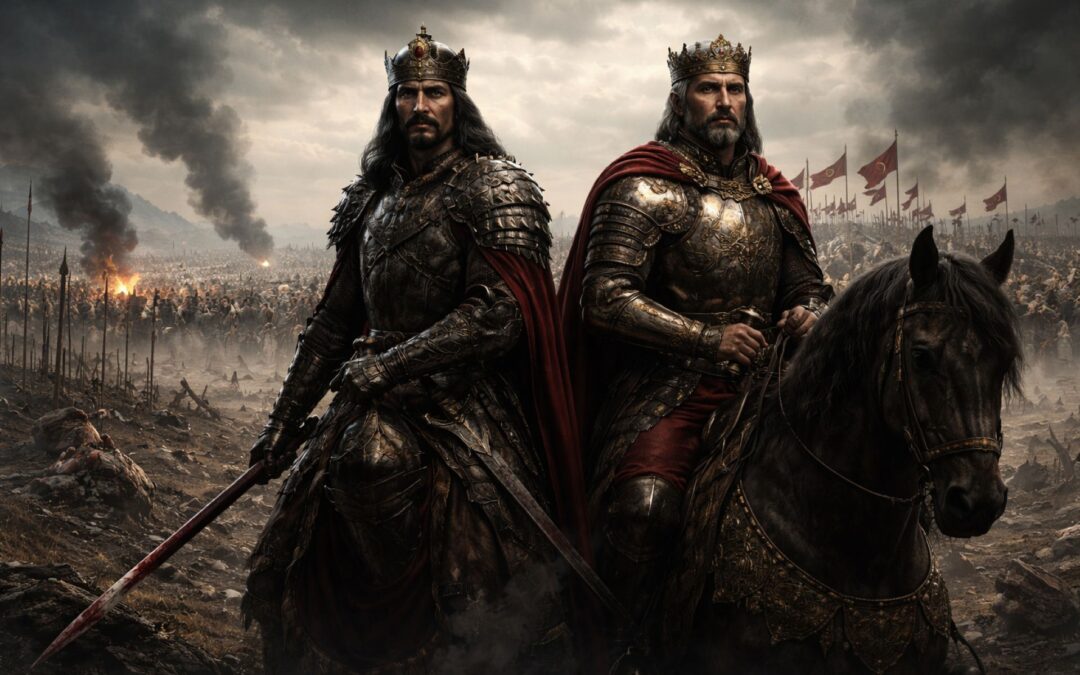
The fall of Constantinople in 1453 did not merely end a thousand-year-old empire—it erased the illusion that the Ottoman advance could be contained. What followed was not a question of if Europe would be challenged, but how far the challenge would reach.
The Ottomans were no longer probing the edges of Christendom. They were reshaping it.
Across the Balkans, kingdoms hesitated, fragmented, or turned inward. Alliances faltered. Crusades were promised but rarely delivered. In theory, Europe had the numbers, the wealth, and the legacy of power. In practice, it lacked cohesion—and against an empire that thrived on momentum, that weakness was fatal.
And yet, the advance did not unfold as cleanly as it should have.
On the volatile frontier along the Danube, two small principalities—Moldavia and Wallachia—stood directly in the path of expansion. They were not strong enough to confront the Ottomans head-on. Not rich enough to sustain prolonged war. Not stable enough to guarantee internal unity.
But they had something far more dangerous.
Leaders who understood that survival was not about winning decisive battles—it was about controlling time.
Stephen of Moldavia and Vlad of Wallachia would go on to wage a war defined not by conventional victories, but by disruption. They burned their own lands to starve invading armies. They weaponized fear to destabilize superior forces. They shifted alliances when necessary and broke them when survival demanded it.
Individually, they were formidable. Together—whether aligned or at odds—they forced the most powerful empire of their age into a prolonged, exhausting struggle along a frontier that refused to break.
They did not defeat the Ottomans.
They made sure the Ottomans could not move fast enough to win.
The Ottoman Tide After Constantinople
When Constantinople fell to Sultan Mehmed II, it did more than eliminate the Byzantine Empire—it removed the last meaningful buffer between the Ottoman war machine and the heart of Europe.
The city had not just been symbolic. It was strategic. Its walls had absorbed centuries of pressure. Its existence had slowed expansion, complicated logistics, and forced the Ottomans to operate around a persistent obstacle. Once it was gone, the map changed overnight.
What replaced it was momentum.
The Ottomans now controlled a continuous stretch of territory linking Anatolia to southeastern Europe. Supply lines became more efficient. Troop movements accelerated. Campaigns that once required careful staging could now be executed with confidence and speed. The empire was no longer pushing outward in fragments—it was advancing as a unified force.
The Balkans became the immediate theater of expansion.
From Mehmed’s perspective, the logic was simple. Secure the Danube. Subdue the frontier states. Convert them into vassals or eliminate them entirely. With each step, resistance would weaken, and the road into Central Europe would open further.
And crucially, the Ottomans had the advantage of consistency.
Where European powers were divided—caught in dynastic conflicts, territorial disputes, and internal instability—the Ottomans operated with clarity of purpose. Their campaigns were not reactive. They were part of a long-term imperial strategy that did not depend on fragile alliances or shifting loyalties.
This is what made them so dangerous.
They did not need to win quickly. They only needed to keep moving.
And for most of Europe, there was no clear way to stop them.
Two Fragile States On The Edge Of Collapse
On the map, Moldavia and Wallachia barely registered as meaningful powers. They were not kingdoms in the traditional sense. They were frontier principalities—exposed, contested, and perpetually unstable.
Geography had placed them in the worst possible position.
To the south lay the Ottoman Empire, expanding with relentless precision. To the west, the Kingdom of Hungary, powerful but politically inconsistent. To the north, Poland, ambitious and opportunistic. These were not allies in any reliable sense. They were competing influences, each willing to interfere, support rival claimants, or exploit weakness when it suited their interests.
For Moldavia and Wallachia, survival was not about choosing sides. It was about constantly recalibrating between them.
The Danube was not just a river—it was a fault line. Beyond it stood an empire that could field armies far larger than anything these principalities could muster. Between the river and the Carpathians lay lands that would be fought over, raided, taxed, and reshaped again and again.
Stability, in this environment, was almost impossible.
Rulers did not inherit secure thrones. They fought for them. And even after securing power, they faced a continuous cycle of internal revolts, foreign-backed pretenders, and shifting allegiances. A prince could be installed one year and overthrown the next, often by forces funded or supported by neighboring powers.
This constant churn created a brutal political reality.
Loyalty was temporary. Power was conditional. And survival required compromise.
One of the most common compromises was tribute.
Pay the Ottoman Sultan, and you might retain a degree of autonomy. Refuse, and you risk invasion, devastation, or replacement by a more compliant ruler. It was not a choice between independence and submission—it was a calculation of timing.
How long could you pay before resisting? How long could you resist before breaking?
This was the environment that shaped both Stephen and Vlad.
They did not inherit stable states. They inherited pressure.
And in that pressure, they learned the only lesson that mattered—adapt, or disappear.
Exile, Betrayal, And The Making Of Two Rulers
Neither Stephen nor Vlad began their journey as secure heirs to power. Their early lives were defined not by rule, but by loss—violent, abrupt, and deeply instructive.
For Vlad III, the lessons came early and without mercy.
As the son of Vlad II Dracul, he was sent—along with his younger brother Radu—to the Ottoman court as a political hostage. This was not unusual. It was a guarantee of loyalty, a living insurance policy in a world where promises meant little without leverage.
But for Vlad, it became something more.
He was exposed to the inner workings of the very empire he would later fight. He observed its discipline, its hierarchy, its expectations. He learned its language, its customs, and, perhaps most importantly, its methods of control.
Power, in the Ottoman world, was not abstract. It was enforced. Publicly. Decisively.
That understanding would stay with him.
Then came the rupture.
In 1447, his father and older brother were murdered in a political coup backed by rival factions and external interests. Vlad was suddenly not a prince in waiting—but a displaced claimant with no throne, no army, and no guarantee of survival.
He returned from Ottoman lands not as a ruler, but as a man forced to reclaim what had been taken.
Stephen’s path mirrored this instability.
In 1451, his father, Bogdan II of Moldavia, was assassinated by his own brother, Peter Aaron. It was not a battlefield defeat. It was betrayal—swift, intimate, and final.
Stephen was forced into exile.
Like Vlad, he became a wanderer in a political landscape where protection came at a cost. He moved between courts, seeking support, navigating alliances, and learning how power actually functioned behind ceremonial titles.
There was no illusion left.
Thrones were not inherited—they were seized. And once seized, they had to be defended constantly.
This shared experience of dispossession did more than shape their individual strategies. It aligned them.
Both were products of the same brutal system. Both understood that legitimacy meant nothing without force. And both knew that survival required more than courage—it required calculation.
Before they became rulers, they became survivors.
And that distinction would define everything that followed.
A Brotherhood Forged In Exile
Exile does something unusual to men of ambition. It strips away illusion and replaces it with clarity. Titles mean nothing. Bloodlines offer no protection. What remains is instinct—the ability to read power, anticipate betrayal, and recognize opportunity before it disappears.
It was in this environment that Stephen and Vlad found each other.
Not as princes, but as claimants.
Both had lost their fathers to violence. Both had been pushed out of their rightful domains. Both were navigating a world where alliances were temporary and survival depended on constant recalibration. They were not bound by ceremony or obligation. They were bound by circumstance.
And that made their connection practical.
Each understood the other’s position without explanation. Each knew that reclaiming a throne was not a matter of entitlement—it was a campaign. One that required timing, backing, and force. Alone, their chances were limited. Together, they could create leverage.
This was not friendship in the romantic sense. It was an alignment.
They shared resources, intelligence, and, more importantly, intent. Their goals were parallel: regain control, stabilize their rule, and resist becoming pawns in a larger geopolitical struggle. Supporting one another was not an act of loyalty—it was a strategic necessity.
The presence of powerful figures like John Hunyadi further shaped this dynamic.
Hunyadi was one of the few leaders in the region capable of organizing meaningful resistance against the Ottomans. His influence extended across Hungary and into the frontier states, and both Stephen and Vlad operated within his sphere at different points. His campaigns, victories, and eventual death would create openings that neither prince could ignore.
Timing, once again, became everything.
They were not yet in power. But they were no longer drifting.
They were watching. Waiting. Positioning themselves for the moment when instability would create opportunity—and when it did, they would move not as isolated claimants, but as coordinated actors in a much larger game.
Seizing Power In A World Without Stability
Opportunity, in this region, did not arrive cleanly. It came wrapped in chaos—power vacuums, sudden deaths, and shifting alliances that could reverse within months.
In 1456, one such moment appeared.
John Hunyadi, the dominant military force in the region and a stabilizing influence for both Hungary and the frontier states, died unexpectedly. His absence did not just leave a gap in leadership—it fractured the balance that had held competing interests in check.
For men like Vlad and Stephen, this was not a crisis.
It was an opening.
Vlad moved first.
No longer the displaced claimant, he returned to Wallachia with a clear objective—to eliminate his rival and secure the throne before external powers could intervene. With Hungarian backing and the advantage of timing, he confronted Vladislav II and killed him in battle. The message was unmistakable.
This was not a negotiated transition. It was a decisive seizure of power.
Once established, Vlad did not hesitate. He understood that holding Wallachia required more than internal control—it required securing the frontier. A hostile or unstable Moldavia to the north would expose him. A friendly ruler would reinforce his position.
So he acted on the alliance forged in exile.
Vlad committed military support to Stephen’s cause, providing an army—reportedly around 6,000 strong—to help him reclaim Moldavia. This was not a symbolic gesture. It was a calculated investment in regional stability on his terms.
Stephen moved quickly.
With Wallachian support forming a critical component of his force, he entered Moldavia and confronted Peter Aaron. The campaign was swift and effective. His rival was defeated and forced to flee, and Stephen was installed as ruler.
Two thrones. Two rulers. One shared foundation.
For a brief moment, the Danube frontier had something it rarely possessed—alignment.
But stability in this region was never permanent. It was a temporary condition, sustained only as long as interests remained aligned and external pressures did not force divergence.
And those pressures were already building.
Diverging Strategies Against The Ottoman Empire
With power secured, the question was no longer how to take a throne—but how to keep it.
And here, the alignment between Stephen and Vlad began to fracture.
Stephen approached the problem as a strategist managing constraints. Moldavia was surrounded, exposed on multiple fronts, and in no position to sustain a prolonged war against the Ottomans. To the north and west, Poland and Hungary remained unpredictable. Opening a southern front at the same time would stretch his resources beyond recovery.
So he chose time.
Stephen continued paying tribute to the Ottoman Sultan, maintaining a fragile peace while consolidating internal control. This was not submission—it was delay. Every year of stability allowed him to strengthen administration, secure borders, and build the kind of military foundation that could eventually support resistance.
His priority was survival first, confrontation later.
Vlad saw the situation differently.
For him, tribute was not a tool—it was a threat. Having grown up within the Ottoman system, he understood exactly what vassalage meant. It was not a temporary arrangement. It was a gradual erosion of autonomy, one payment at a time, until resistance became impossible.
So he chose rupture.
By 1460, Vlad stopped paying tribute altogether. The decision was immediate, irreversible, and openly defiant. It transformed Wallachia from a compliant buffer state into an active enemy of the Ottoman Empire.
This was not a defensive move.
It was a declaration of war.
The contrast between the two approaches could not have been sharper. Stephen delayed conflict to build strength. Vlad accelerated it to preserve independence. One managed pressure. The other confronted it head-on.
Both strategies had logic.
But they carried different risks.
Stephen risked being slowly absorbed.
Vlad risked being immediately destroyed.
And as events unfolded, those risks would begin to materialize in ways neither could fully control.
Vlad’s War: Terror As A Weapon
When Vlad chose confrontation, he did not do so cautiously. He escalated with precision and brutality, fully aware that he could not match the Ottoman Empire in numbers, resources, or sustained military capacity.
So he changed the nature of the fight.
Instead of defending territory in conventional terms, Vlad turned the war into a campaign of disruption. His raids into Ottoman-controlled regions south of the Danube were not aimed at holding ground—they were designed to cripple infrastructure, destabilize supply lines, and project fear deep into enemy territory.
Villages were burned. Garrisons were annihilated. Thousands were killed.
But the violence was not random.
It was deliberate, theatrical, and calculated to send a message. Vlad understood that fear, when applied correctly, could function as a force multiplier. If the Ottomans could not predict his movements, could not secure their rear, and could not trust the safety of their own territory, their numerical advantage would begin to erode.
War, in his hands, became psychological.
This strategy reached its peak during the campaign of 1462.
Furious at Vlad’s defiance, Sultan Mehmed II personally led a massive army into Wallachia, intent on removing him and replacing him with a more compliant ruler—his own brother, Radu. Against such a force, direct confrontation would have been suicidal.
So Vlad chose disruption again.
The most famous example was the Night Attack at Târgoviște. Under the cover of darkness, Vlad’s forces infiltrated the Ottoman camp, attempting to strike directly at the Sultan himself. The attack created chaos—confusion, panic, and widespread casualties—but ultimately failed to eliminate Mehmed.
Even so, it achieved something significant.
It demonstrated that the Ottoman army, despite its size and discipline, was not untouchable.
But Vlad’s most enduring weapon was not a single battle.
It was fear made visible.
Fields of impaled bodies—thousands of them—were left deliberately in the path of advancing Ottoman forces. These were not just acts of cruelty. They were signals. A warning of what awaited anyone who crossed into his domain.
For an army accustomed to imposing terror, this reversal was destabilizing.
It forced them to confront an opponent who did not merely resist—but mirrored and amplified their own methods.
And yet, terror alone could not win the war.
It could slow an army. It could unsettle it. But it could not replace allies, reinforce numbers, or sustain long-term resistance.
Vlad had made his stand.
Now he would have to survive the consequences.
Collapse And Captivity
The strategy had worked—up to a point.
Vlad had disrupted the Ottoman advance, shaken its confidence, and forced even Mehmed II to proceed with caution. But disruption is not the same as endurance. And as the campaign stretched on, the imbalance in resources began to assert itself.
The Ottomans adapted.
They avoided overextension, stabilized their supply lines, and advanced methodically. More importantly, they brought with them a political solution to Vlad’s resistance—his younger brother, Radu, who had remained within the Ottoman sphere and was prepared to rule as a compliant vassal.
This changed the nature of the conflict.
It was no longer just an external invasion. It became an internal fracture.
Support within Wallachia began to shift. Some nobles, exhausted by constant warfare and drawn by the promise of stability under Ottoman protection, started to align with Radu. Vlad’s position, already strained by the scale of the conflict, began to erode from within.
He was no longer fighting a single front.
He was being outmaneuvered.
Faced with mounting pressure, dwindling support, and an advancing Ottoman force, Vlad was eventually forced to retreat. The campaign that had begun with bold defiance was now collapsing under the weight of isolation.
His only viable option was to seek refuge.
He fled toward Transylvania, expecting support from Matthias Corvinus of Hungary—the very power that had previously backed his rise. On paper, this made sense. Hungary had every reason to support an anti-Ottoman ruler on its frontier.
But politics, once again, proved decisive.
Instead of receiving aid, Vlad was arrested.
Matthias Corvinus, navigating his own diplomatic pressures and unwilling to provoke a larger conflict with the Ottomans, chose containment over confrontation. Vlad was imprisoned—removed from the board not by his enemies, but by his supposed ally.
For over a decade, he remained in captivity.
And just like that, Wallachia’s most aggressive opponent of Ottoman expansion was gone.
The frontier shifted.
Radu was installed as ruler, firmly aligned with the Ottomans. Wallachia, once a source of resistance, became a controlled buffer state. The momentum that Vlad had disrupted began to rebuild.
But the story did not end there.
Because while Vlad’s campaign collapsed, Stephen was watching.
And he was learning.
Stephen’s Calculated Expansion
Where Vlad had chosen confrontation, Stephen chose positioning.
He had watched the consequences unfold in Wallachia—the speed of Ottoman retaliation, the fragility of internal support, the cost of isolation. And instead of rushing into the same trap, he adjusted his approach with precision.
Stephen did not abandon resistance.
He delayed it.
His first priority was consolidation. Moldavia needed stability—internally and along its borders—before it could withstand external pressure. That meant neutralizing threats not just from the Ottomans, but from Hungary and Poland as well, both of whom had a history of interfering in Moldavian succession.
So he moved north.
In 1458, Stephen launched a campaign to deter Polish involvement in Moldavian affairs, specifically targeting any support for his rival, Peter Aaron. This was not a war of expansion. It was a preemptive strike to eliminate external leverage over his rule.
It worked.
By asserting military credibility early, Stephen established a reputation that made future interference more costly. He was no longer a vulnerable claimant—he was a ruler capable of defending his position.
But his most significant move came later.
While Wallachia was being consumed by Ottoman intervention, Stephen turned his attention to Kilia, a critical port on the Danube. Strategically, it was invaluable. It controlled access to trade routes, strengthened Moldavia’s economic base, and provided a fortified position along a key frontier.
Timing, once again, was everything.
Stephen launched his first attempt during the height of Vlad’s conflict with the Ottomans. The move was risky—and controversial. Attacking a target connected to Hungarian and Wallachian interests while Vlad was under pressure exposed a divergence in priorities that could not be ignored.
The campaign failed, and Stephen was wounded.
But failure did not deter him.
Two years later, in 1464, he returned—and this time, he succeeded. Kilia fell under Moldavian control, giving Stephen a strategic asset that would shape the next phase of his rule.
And with that success came consequences.
From the Ottoman perspective, this was no longer a passive frontier state paying tribute. This was a ruler expanding influence along critical trade and military routes—one who was beginning to act independently of imperial expectations.
Tension escalated.
Stephen had not yet declared open war. But he had begun to reshape the balance of power in a way that made conflict inevitable.
He was no longer buying time.
He was preparing to use it.
The Turning Point: Open War With The Ottomans
By the early 1470s, the balance Stephen had carefully maintained began to collapse under its own weight.
Tribute had bought him time. Strategic expansion had strengthened his position. But the Ottoman Empire was not a passive observer. It was advancing—steadily, systematically—tightening its grip on the Black Sea and reinforcing its influence over Wallachia.
The buffer was eroding.
And Stephen understood the implication.
If he waited any longer, resistance would no longer be a choice. It would be impossible.
So he made the same decision Vlad had made years earlier—but under very different conditions.
He stopped paying tribute.
This was not an impulsive act of defiance. It was the culmination of years of preparation. Moldavia was more stable, its military more organized, and its leadership more cohesive. Stephen was not reacting to pressure—he was choosing the moment to confront it.
The declaration was clear.
Moldavia would no longer operate within the Ottoman system.
War followed almost immediately.
But unlike Vlad, Stephen did not isolate himself entirely. His strategy extended beyond direct confrontation. He sought to influence Wallachia, understanding that control over that territory would determine whether the Ottomans could project power efficiently across the region.
This proved to be his most persistent challenge.
Wallachia remained unstable, its throne repeatedly shifting between pro-Ottoman and anti-Ottoman rulers. Each time Stephen intervened to install a favorable prince, Ottoman forces would return and reverse the outcome. It became a cycle—gain control, lose it, repeat.
The frontier was not fixed.
It was contested ground, constantly shifting under pressure from both sides.
Stephen needed something more than incremental advantage.
He needed a decisive moment—one that would not just disrupt the Ottomans, but force them to reconsider the cost of continued expansion into Moldavia.
That moment came in 1475.
And it would change everything.
The Battle Of Vaslui: Defying The Empire
Stephen did not wait for the Ottomans to dictate the terms of engagement.
He chose the battlefield.
In early January 1475, an Ottoman army led by Hadım Suleiman Pasha advanced into Moldavia, expecting a campaign defined by superiority—more troops, more resources, more momentum. On paper, the outcome seemed predictable.
Stephen made sure it wouldn’t be.
Near Vaslui, he engineered a confrontation that neutralized the very advantages the Ottomans relied on. The terrain was narrow and restrictive. Movement was limited. Visibility, on that winter morning, was reduced by dense fog. This was not accidental.
It was designed.
Stephen positioned his forces to manipulate perception. Signals, horns, and coordinated movements created the illusion of a larger, more dynamic army. Ottoman units, advancing into unfamiliar ground, struggled to orient themselves. Communication faltered. Cohesion began to break.
And then the attack came.
What followed was not a conventional battle. It was an ambush executed with precision. Moldavian forces struck at the moment of maximum confusion, collapsing sections of the Ottoman formation and preventing effective regrouping. The fog, which had obscured vision, now amplified panic.
The Ottoman army unraveled.
Losses were severe—tens of thousands killed, captured, or scattered. What had begun as a punitive expedition ended as one of the most decisive defeats the Ottomans had suffered in the region.
The impact was immediate.
Stephen’s victory resonated across Europe. He was hailed as Athleta Christi—the Champion of Christ—by Pope Sixtus IV. In theory, this was the moment Europe had been waiting for: proof that the Ottoman advance could be checked, even reversed.
In practice, nothing changed.
No unified response followed. No sustained coalition formed. The same divisions that had weakened Europe before remained intact. The victory, as significant as it was, stood largely alone.
And Stephen understood what that meant.
He had won the battle.
But he had not changed the balance of power.
Because the Ottomans would return.
And next time, they would come with greater force, led by the one man who could not ignore defeat—Mehmed II himself.
Reuniting The Cousins Against A Common Enemy
Victory at Vaslui bought Stephen something invaluable—time. But it also brought clarity.
Mehmed II would not ignore the defeat. He would respond personally, with overwhelming force, and when he did, Moldavia would stand alone unless Stephen reshaped the strategic landscape.
That meant one thing.
Wallachia had to change.
As long as it remained under pro-Ottoman control, it functioned as a gateway for invasion—a staging ground that allowed Ottoman forces to project power directly into Moldavia. Without securing that flank, even the most decisive victory would only delay the inevitable.
Stephen needed a ruler in Wallachia who would resist, not comply.
He needed Vlad.
By this point, Vlad III had spent over a decade in captivity under Matthias Corvinus of Hungary. Removed from power, sidelined by politics, and largely absent from the broader conflict, he remained—despite everything—the most experienced and uncompromising opponent of the Ottomans in the region.
Stephen moved to bring him back.
Through diplomatic pressure and strategic alignment with Hungary, he secured Vlad’s release in 1475. The conditions were political—conversion to Catholicism, formal alignment with Hungarian interests—but the outcome was clear.
Vlad was free.
And he returned to the fight immediately.
There was no gradual reintegration, no cautious testing of alliances. Vlad joined Hungarian campaigns against the Ottomans in Bosnia, proving that time had not softened his resolve. If anything, it had sharpened it.
For the first time in years, the two cousins were once again aligned.
Not as displaced claimants. Not as rulers navigating separate strategies. But as coordinated actors facing a common, unavoidable threat.
This alignment mattered.
Stephen brought stability, resources, and strategic depth. Vlad brought experience in asymmetric warfare and a willingness to escalate without hesitation. Together, they represented a combination the Ottomans had already struggled to contain once before.
But the timing was critical.
Because even as this alliance reformed, Mehmed II was already preparing his response.
And this time, he would come not to punish—but to finish what had been left incomplete.
Scorched Earth And Survival Against Mehmed II
The response came exactly as Stephen had anticipated—massive, direct, and led by Mehmed II himself.
In the summer of 1476, the Ottoman army entered Moldavia not as a probing force, but as a decisive instrument. This was not a raid. It was an attempt to eliminate Stephen entirely and bring the region under firm control.
The scale alone changed the equation.
Stephen could not repeat Vaslui. The conditions were different. The Ottomans were prepared, cautious, and advancing with overwhelming strength. A direct confrontation, under these circumstances, would risk total collapse.
And so, he adapted.
Stephen did not try to stop the invasion at the border. He let it in.
As the Ottoman army advanced, Moldavia began to disappear in front of it. Crops were burned. Wells were poisoned. Villages were abandoned or destroyed. Supplies—anything that could sustain an invading force—were systematically removed.
This was not a retreat.
It was a strategy.
The deeper the Ottomans pushed, the weaker they became. Their supply lines stretched thin across hostile territory. Foraging yielded nothing. Movement slowed. Fatigue set in. What had begun as a demonstration of power gradually transformed into a logistical burden.
But Stephen did not avoid battle entirely.
At Valea Albă (Războieni), he was forced into direct engagement—and the result was harsh. The Moldavian army was defeated, and Stephen barely escaped with his life. On the surface, it appeared that the Ottoman campaign had achieved its objective.
The capital was burned. The army had been beaten. The ruler had fled.
But the war was not over.
Because the Ottomans could not finish it.
Every mile they advanced made their position worse. Supplies dwindled further. Resistance, though fragmented, remained constant—skirmishes, harassment, and the persistent threat of counterattack. At the same time, the possibility of Hungarian intervention from Transylvania added another layer of uncertainty.
Mehmed II faced a familiar problem.
He could win battles. But he could not secure control.
Without supplies, without stable lines of communication, and without the ability to decisively eliminate Stephen or capture key strongholds, the campaign began to stall. Momentum—the very thing that had defined Ottoman expansion—was gone.
And without momentum, the empire’s advantage weakened.
Eventually, Mehmed withdrew.
Not because he had been decisively defeated, but because the cost of continuing outweighed the benefit. Moldavia had been devastated—but it had not been conquered.
Stephen’s strategy had worked.
He had absorbed the blow, stretched the enemy, and turned strength into liability. The Ottoman army left behind a burned landscape, but also an unbroken state.
And in this kind of war, that was enough.
Because survival meant the fight could continue.
The Final Gamble In Wallachia
Stephen understood the outcome of Mehmed’s campaign with absolute clarity.
Moldavia had survived—but only just. Another invasion of that scale, under slightly different conditions, could tip the balance. Survival could not depend on repeating the same defensive strategy indefinitely.
The problem was structural.
As long as Wallachia remained under Ottoman influence, Moldavia would always be exposed. Every invasion route, every supply line, every staging ground pointed back to that single vulnerability.
So Stephen moved to eliminate it.
In the aftermath of the Ottoman withdrawal, he coordinated with Hungarian forces and his cousin Vlad III to launch a joint campaign into Wallachia. The objective was simple, but decisive—remove the pro-Ottoman ruler and reinstall a hostile, independent prince.
Control the buffer. Control the war.
The campaign succeeded.
Basarab Laiotă, the Ottoman-backed ruler, was driven out. Vlad III was placed on the throne for the third time, restoring—at least temporarily—an anti-Ottoman Wallachia. For a brief moment, the frontier realigned in Stephen’s favor.
It was the strongest strategic position he had achieved.
Moldavia to the north, Wallachia to the south—both under rulers committed to resisting Ottoman expansion. The corridor that had enabled repeated invasions was, for the first time, disrupted.
But the success was fragile.
Alliances in this region were never permanent. Hungarian forces, having achieved their immediate objective, withdrew. Transylvanian support receded. What remained was Vlad—once again in power, but this time with limited resources and a far weaker military position.
The structure was in place.
But it could not sustain itself.
The Ottomans moved quickly.
They understood the significance of what had just happened. An independent Wallachia, aligned with Moldavia, threatened their entire strategic framework in the region. Allowing it to stabilize was not an option.
So they acted before it could.
The counterattack came with overwhelming force, targeting Vlad before he could consolidate power. Isolated, outnumbered, and with no time to rebuild, he was forced into a final confrontation under conditions that mirrored his earlier downfall.
The gamble had worked.
But only briefly.
And now, the cost of that brief success was about to be paid.
The Death Of Vlad The Impaler
Vlad’s return to power had achieved its immediate objective—but it came without the foundation needed to sustain it.
He had a throne.
He did not have time.
With Hungarian and Transylvanian forces withdrawn, Vlad was left to hold Wallachia with a small, loyal core of troops. The broader political structure remained unstable. Nobles were divided. External pressure was mounting. And the Ottomans were already moving to reverse what had just been done.
This time, there would be no drawn-out campaign.
The response was swift, targeted, and overwhelming.
Ottoman-backed forces advanced into Wallachia with a singular goal—remove Vlad before he could consolidate power again. There would be no prolonged disruption, no space for psychological warfare to reshape the battlefield. The window for that kind of strategy had already closed.
Vlad was forced into a final stand.
Details of his death remain fragmented, but the outcome is clear. Sometime in late 1476 or early 1477, he was killed—either in battle or through betrayal, likely by agents operating within the Ottoman sphere of influence.
It was not a dramatic end.
It was a decisive one.
His body was lost to the chaos of the battlefield. But his head—his identity, his symbol—was taken.
It was sent to Mehmed II.
In Constantinople, it was displayed publicly, mounted on a stake for all to see. The message was unmistakable. The empire had eliminated its most infamous opponent. The man who had turned fear into a weapon had become an example of imperial power.
Psychological warfare, once again—but this time, not in Vlad’s favor.
With his death, Wallachia’s resistance collapsed. A pro-Ottoman ruler was quickly reinstated, restoring the region to its function as a controlled buffer state. The brief realignment Stephen had achieved was undone almost immediately.
The frontier shifted back.
And just like that, the balance changed again.
Vlad’s war had ended—not with victory, but with elimination.
But even in death, his role in the larger conflict remained significant.
Because while he did not survive the struggle, he had altered its tempo.
And in a war defined by time, that mattered.
Holding The Line Alone
With Vlad gone, the strategic equation simplified—and became far more dangerous.
There was no longer a second front.
Wallachia had reverted to its role as an Ottoman-aligned buffer. The corridor for invasion was open again. The pressure that had once been divided between two resistant rulers now focused entirely on one.
Stephen stood alone.
But he was not unprepared.
Years of conflict had reshaped his approach. He no longer sought decisive, war-ending victories. He understood that against an empire like the Ottomans, survival depended on continuity—not conquest.
So he adjusted, again.
Where possible, he fought. Where necessary, he negotiated.
Stephen continued to resist Ottoman incursions, using the same principles that had preserved Moldavia before—mobility, terrain advantage, disruption of supply lines, and calculated engagements that avoided unnecessary risk. He did not expose his forces to destruction unless the conditions favored him.
At the same time, he reintroduced tribute as a political tool.
This was not a reversal of principle. It was an extension of strategy. Paying tribute, when necessary, bought stability. Stability created space. And space allowed him to maintain internal control, reinforce defenses, and choose when—and if—to escalate conflict again.
It was a balance few rulers could maintain.
Too much resistance, and he risked annihilation.
Too much compliance, and he risked absorption.
Stephen navigated that line for decades.
Moldavia remained independent—not in the absolute sense, but in the only sense that mattered. It retained its leadership, its internal structure, and its ability to make decisions outside direct Ottoman control. It was not conquered. It endured.
And endurance, in this context, was victory.
By the time of his death in 1504, Stephen had outlasted not only his cousin, but also Mehmed II himself. The empire remained powerful. Its expansion continued. But it had been slowed—forced to invest time, resources, and attention into a frontier that refused to collapse.
This was the final outcome of the strategy.
Not triumph. Not domination.
Survival—sustained long enough to change the shape of the larger conflict.
Conclusion
In the grand sweep of history, empires are often measured by what they conquer. But just as important—though far less visible—are the moments when conquest is delayed.
That is where Stephen of Moldavia and Vlad of Wallachia left their mark.
They did not command vast coalitions. They did not lead unified crusades. In fact, they often operated in isolation, navigating fractured alliances, internal instability, and overwhelming external pressure. By every conventional metric, they were outmatched.
And yet, they changed the outcome.
Not by defeating the Ottoman Empire outright, but by forcing it to slow down. By turning rapid expansion into prolonged struggle. By transforming a straightforward advance into a contested, exhausting frontier war.
Vlad did it through escalation—weaponizing fear, disrupting logistics, and confronting the empire with its own methods. Stephen did it through endurance—balancing war and diplomacy, choosing his battles carefully, and preserving his state over decades of sustained pressure.
Different approaches. Same effect.
Together—sometimes aligned, sometimes at odds—they imposed friction on an empire that relied on momentum. And in doing so, they bought something that Europe, at that moment, desperately needed.
Time.
Time to stabilize.
Time to reorganize.
Time to survive.
Their story is not one of victory in the traditional sense. It is something more precise, and arguably more important.
They held the line just long enough to change what came next.