
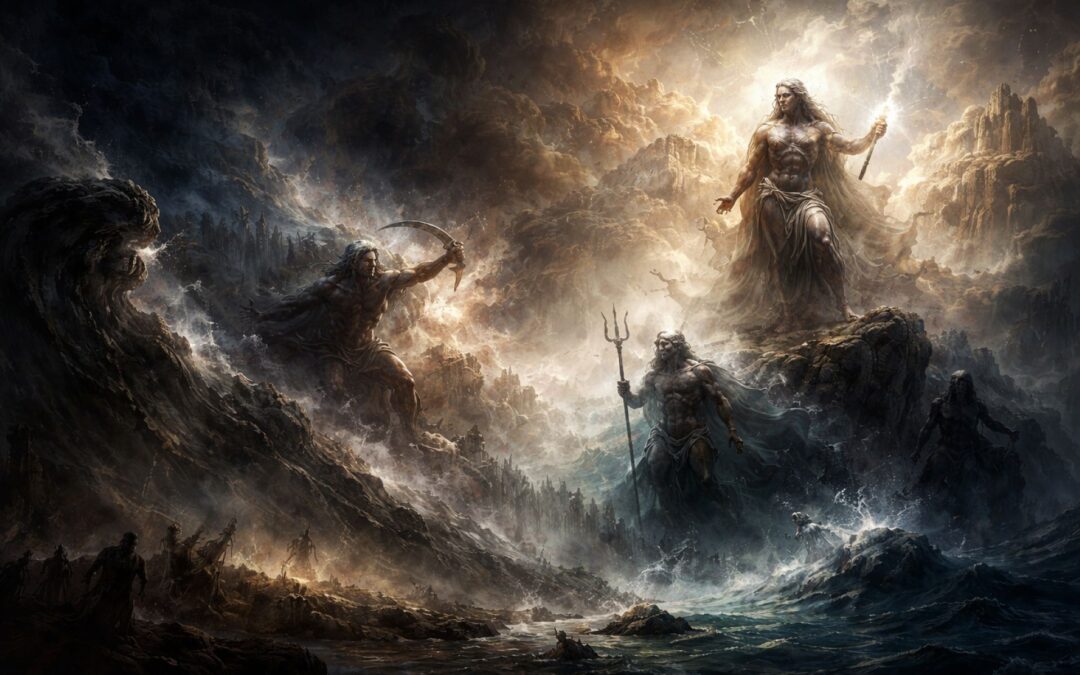
Before there were gods, before there were heavens to rule or seas to command, there was only Chaos. Not chaos in the modern sense of disorder, but something far more unsettling—a vast, formless void where nothing had shape, meaning, or direction. From that emptiness emerged the first forces of existence, and with them began a story that is less about divine perfection and more about conflict, fear, ambition, and control.
Greek mythology is often remembered as a gallery of powerful figures—Zeus with his thunderbolt, Poseidon with his trident, Hades ruling the dead—but beneath these familiar images lies a far more intricate system. This is not a world governed by harmony. It is a world built on rebellion, sustained by uneasy alliances, and constantly threatened by the same fear that sparked its creation: the fear of being overthrown.
At its core, the mythology of the Greeks is not simply about gods. It is about power—how it is gained, how it is maintained, and how it inevitably invites challenge. The cycle begins with creation itself, quickly turns into betrayal, and eventually settles into a fragile order that is never truly stable. Each generation rises by destroying the one before it, and even the most powerful ruler is never entirely secure.
What makes these myths endure is not just their scale, but their familiarity. The gods, despite their immortality, are driven by impulses that feel unmistakably human—jealousy, desire, pride, vengeance. They do not exist above human nature; they magnify it. In doing so, they transform abstract forces like love, war, and death into personalities that act, react, and clash with one another in ways that mirror the human condition.
To understand the Greek gods, then, is not simply to memorize their names or domains. It is to understand the system they inhabit—a system born from chaos, shaped by violence, and sustained by a delicate balance of power that is always on the verge of collapse.
The Beginning: Chaos, Gaia, and the First Gods
Everything begins without structure. No sky, no earth, no separation—just Chaos, a boundless void that contains the potential for everything but the form of nothing. From this emptiness emerges the first act of order: differentiation. Existence begins to take shape, not through design, but through emergence.
The first of these forms is Gaia, the Earth. Unlike Chaos, Gaia is tangible, grounding the abstract into something stable. She is not merely land; she is the foundation upon which all future existence will depend. With her comes the possibility of creation that can sustain itself.
From Gaia comes Uranus, the sky—a counterpart that completes the first structure of the universe. Together, they form a closed system: earth below, sky above, enclosing reality in a defined space. This pairing is not just symbolic; it establishes the first hierarchy. Uranus does not simply exist alongside Gaia—he dominates, covering her entirely, asserting control over the very source that brought him into being.
From their union come the Titans, along with other primordial beings. These are not yet the refined gods of Olympus, but raw, powerful entities representing fundamental forces. However, their existence introduces the first tension in the system. Creation has produced not harmony, but overcrowding—too many powerful beings within a structure that cannot accommodate them.
Uranus responds not as a creator, but as a ruler threatened by his own offspring. Instead of allowing his children to exist freely, he forces them back into Gaia, imprisoning them within the earth itself. This act is more than cruelty; it is the first expression of a pattern that will define Greek mythology: power fearing what it has created.
Gaia, both mother and prison, endures this strain until it becomes unbearable. Her response is not passive. She does not appeal to balance or reconciliation—she engineers rebellion. From within herself, she creates a weapon, a sickle, and turns to her children, asking one of them to act.
Only one answers: Cronus.
With this, the world shifts from creation to conflict. The first generation of existence does not give way peacefully. It is overthrown.
The First Rebellion: Cronus and the Fall of Uranus
The first transfer of power in Greek mythology is not negotiated—it is executed.
Cronus does not challenge Uranus openly. He waits. Hidden within Gaia, he becomes both her instrument and her rebellion, a child shaped by the very oppression he is about to end. When Uranus descends once more to assert his dominance, Cronus strikes—not to weaken, but to permanently remove his father from power.
The act itself is brutal and symbolic. By severing Uranus, Cronus does more than overthrow him; he ends his ability to control creation. The sky is separated from the earth, and for the first time, space opens between them. What began as violence becomes, paradoxically, the first true act of structural order. The world expands because of destruction.
From the aftermath, new forms of life emerge. Even in defeat, Uranus contributes to creation, reinforcing a central idea in these myths: power cannot be eliminated—it transforms. But while the world evolves, its underlying dynamic does not.
Cronus frees his siblings, the Titans, and assumes control. On the surface, this appears to be liberation—a successful rebellion against tyranny. But the shift is more superficial than it seems. Cronus does not dismantle the system that allowed Uranus to dominate. He inherits it.
And with that inheritance comes something far more dangerous than strength: awareness.
Unlike Uranus, Cronus understands what it means to be overthrown. He knows that power is not secure simply because it is held. It must be protected. And that knowledge changes everything.
Where Uranus acted out of instinctive control, Cronus rules with anticipation. The fear that defined the previous generation does not disappear—it becomes more calculated, more deliberate. The cycle has not been broken. It has evolved.
The rebellion succeeds. The structure remains.
The Tyranny of Cronus and the Fear of Prophecy
If Uranus ruled through suppression, Cronus rules through anticipation.
He does not wait for rebellion to take shape. He prevents it from existing at all.
A prophecy emerges—one that feels less like a warning and more like inevitability: Cronus will be overthrown by his own child, just as he overthrew his father. Unlike Uranus, who acted blindly, Cronus understands exactly what this means. Power is not lost through weakness; it is lost through succession. The next generation is not just a continuation—it is a threat.
His solution is as direct as it is horrifying. Each time his wife, Rhea, gives birth, Cronus takes the child and swallows it whole. Not imprisonment, not exile—erasure. His children are not allowed to grow, to exist independently, or even to be seen. They are contained entirely within him, frozen potential, neutralized before it can take form.
It is the most extreme expression of control in Greek mythology: a ruler who quite literally absorbs the future to preserve the present.
But in doing so, Cronus exposes the flaw at the heart of absolute power. Control at this level cannot be shared, negotiated, or softened. It isolates. Rhea is not just a witness to this cycle—she is forced to participate in it. And unlike Cronus, she does not accept it as necessary.
Her resistance begins quietly, but it is decisive. When her final child is born, she refuses to surrender him. With the help of Gaia, she devises a deception—subtle, but powerful enough to break the pattern. Instead of handing over her son, she gives Cronus a stone wrapped in cloth. He consumes it without question, so complete is his belief in his own control.
The child she saves is Zeus.
Hidden away and raised in secret, Zeus represents something that Cronus cannot account for: the failure of total control. No system, no matter how absolute, can eliminate every variable. There is always something that escapes—something small, overlooked, or underestimated.
And that is all it takes.
The prophecy does not disappear. It waits.
The Rise of Zeus and the Titanomachy
Zeus does not inherit power. He earns it by dismantling the system that tried to prevent him from existing.
Raised in secrecy, away from the reach of Cronus, Zeus grows not just in strength, but in awareness. Unlike his father and grandfather, he enters the struggle with knowledge of the pattern he is stepping into. He is not simply another successor—he is the product of a system that has already revealed its flaws.
When Zeus returns, he does not attack blindly. His first move is strategic: he forces Cronus to undo his own control. Through deception or force—depending on the version—Cronus is made to release the children he had swallowed. One by one, Zeus’s siblings emerge: Hera, Poseidon, Demeter, Hestia, and Hades. The future that Cronus tried to contain is suddenly restored.
What follows is not a brief uprising, but a prolonged and defining conflict—the Titanomachy.
For twelve years, the Titans and the emerging Olympians battle for control of the universe. This is not a symbolic war. It is total. The old order, represented by Cronus and the Titans, is not willing to yield. And the new order, led by Zeus, cannot exist unless the old one is removed entirely.
At first, the conflict is evenly matched. Raw strength alone is not enough to secure victory. Zeus recognizes this, and in doing so, makes the decision that ultimately defines the outcome of the war.
He expands the system.
Deep within the earth, imprisoned by Cronus, are beings even more formidable than the Titans—the Cyclopes and the Hundred-Handed Giants. Where Cronus saw threats to be contained, Zeus sees potential allies. He frees them, not out of compassion, but out of necessity. Power, in this new phase, is no longer about suppression. It is about alignment.
The shift is immediate.
The Cyclopes forge weapons that redefine the balance of power: the thunderbolt for Zeus, the trident for Poseidon, and the helm of darkness for Hades. These are not just tools—they are symbols of authority, extensions of the domains the brothers will come to rule. The Hundred-Handed Giants bring overwhelming force, turning the tide of battle through sheer scale.
With these alliances, Zeus does what Cronus could not. He builds a coalition instead of ruling in isolation.
The Titans are defeated. Not negotiated with, not absorbed—defeated and removed. They are cast into Tartarus, a prison far deeper and more secure than the one Uranus or Cronus had used. This time, the new rulers ensure that the old order cannot return.
But the most important shift is not the victory itself. It is how that victory was achieved.
Zeus does not rely solely on strength. He relies on strategy, alliances, and the redistribution of power. For the first time, rule is not concentrated in a single figure—it is prepared to be shared.
The cycle has not ended. But it has changed form.
Dividing the Universe: Zeus, Poseidon, and Hades
Victory does not automatically create order. It only removes opposition.
After the Titanomachy, the world is no longer contested—but it is also not yet governed. Zeus stands as the clear leader of the Olympians, but unlike Uranus or Cronus, he does not attempt to consolidate all power within himself. Whether out of strategy, necessity, or awareness of what unchecked control leads to, he makes a different choice.
Power is divided.
Zeus, Poseidon, and Hades—the three brothers who emerged from Cronus—draw lots to determine their domains. This is not a symbolic gesture of fairness; it is a structural decision designed to stabilize a system that has already proven how easily it collapses under concentrated authority.
Zeus takes the sky, the most visible and dominant realm. From above, he governs weather, lightning, and the atmosphere that surrounds all life. His position places him closest to Olympus and, by extension, closest to influence over both gods and mortals.
Poseidon claims the sea, a domain just as vast but far less predictable. The ocean is not governed with consistency—it shifts, reacts, and lashes out. Poseidon reflects this instability. His power is immense, but it is volatile, driven as much by temperament as by control.
Hades receives the underworld, the realm of the dead. Unlike his brothers, his domain is not expansive in the traditional sense, but it is absolute. Everything that lives eventually falls under his authority. His rule is not loud or visible, but it is final.
What emerges from this division is not equality, but balance.
Each brother governs a domain that the others cannot easily dominate. The sky cannot fully control the sea. The sea cannot reach into the underworld. And the underworld, though inevitable, does not interfere with the living world unless necessary. This separation creates a system where power is distributed across boundaries, reducing the risk of a single point of failure.
At the center of this structure sits Mount Olympus, the shared space of the gods. It is here that authority becomes collective. Zeus may be king, but he is not alone. The Olympian system is not a monarchy in the traditional sense—it is a hierarchy supported by multiple powerful figures, each with their own influence and agency.
This is the first true attempt at stability in Greek mythology.
Not because conflict has ended, but because it has been contained.
Zeus: King of Gods and the Nature of Absolute Power
Zeus does not eliminate the problems of power. He manages them.
As ruler of the sky and king of the gods, Zeus occupies a position no one before him held successfully—authority that is both dominant and sustained. Unlike Uranus, who relied on suppression, or Cronus, who relied on prevention, Zeus governs through a more complex balance of control, influence, and calculated restraint.
His domain reflects this. The sky is not a fixed realm; it is dynamic, constantly shifting between calm and violence. Zeus commands lightning, storms, and weather itself—forces that can nurture or destroy depending on how they are used. This duality defines his rule. He is not simply a protector or a tyrant. He is both, often within the same moment.
To mortals, Zeus represents order. He enforces laws, protects guests and strangers, and upholds a sense of justice that keeps human society from descending into chaos. Hospitality, oaths, and basic moral conduct fall under his watch. In this sense, Zeus is not just powerful—he is necessary.
But that necessity does not make him consistent.
Zeus’s greatest strength—his absolute authority—is also what makes him unpredictable. There are no higher checks on his decisions, no system that can truly oppose him once he chooses to act. His judgments can be fair, but they can also be driven by impulse, desire, or personal interest. The same ruler who protects order can just as easily disrupt it.
Nowhere is this contradiction more visible than in his relationships.
Zeus’s marriage to Hera establishes a formal structure of divine royalty—king and queen of Olympus. Together, they represent the ideal of unity and stability at the highest level of power. But in practice, that unity is fractured. Zeus’s numerous affairs, both with goddesses and mortal women, introduce constant tension into the system he is meant to stabilize.
From these unions come some of the most important figures in Greek mythology—Athena, Apollo, Artemis, Hermes, Persephone, Dionysus, and many others, along with heroes like Perseus and Hercules. These births expand Zeus’s influence, but they also create new sources of conflict, particularly with Hera, whose response is rarely directed at Zeus himself, but at those caught in the aftermath.
This dynamic reveals something fundamental about Zeus’s rule.
He is not a perfect king maintaining a flawless order. He is a ruler navigating contradictions—between justice and impulse, authority and desire, stability and disruption. His power is real, but it is not clean. It carries consequences that ripple through both the divine and mortal worlds.
And yet, despite all of this, Zeus endures.
Not because he eliminates conflict, but because he contains it better than those who came before him.
Poseidon and Hades: Power Beyond Olympus
If Zeus represents visible authority, Poseidon and Hades embody something more unsettling—power that operates outside immediate reach, yet cannot be ignored.
Both brothers rule domains that are essential, vast, and fundamentally uncontrollable. But unlike Zeus, their influence is not constant. It is felt in moments—sudden, decisive, and often destructive.
Poseidon governs the sea, a realm that resists stability by its very nature. The ocean does not hold a consistent shape or mood. It shifts, surges, and reacts, sometimes without warning. Poseidon mirrors this volatility. He is powerful not just because of the scale of his domain, but because of how unpredictably that power can manifest.
To ancient societies, especially those dependent on travel and trade, the sea was both opportunity and threat. A calm passage could mean prosperity; a storm could mean death. Poseidon stood at the center of that uncertainty. Sailors did not simply respect him—they feared him. Offerings and prayers were not acts of devotion alone, but attempts at survival.
And Poseidon does not forget.
Unlike Zeus, whose authority often resets with each decision, Poseidon is known for his grudges. Cross him once, and the consequences may not be immediate—but they will come. His punishments are rarely proportionate; they are instructive. They exist to remind both mortals and gods that his domain is not to be challenged lightly.
The story of King Minos and the Minotaur illustrates this perfectly. When Minos refuses to honor his promise to Poseidon, the god does not strike him directly. Instead, he disrupts his household, causing a chain of events that leads to something far more enduring than a single act of punishment. The message is clear: Poseidon’s power is not just force—it is manipulation of consequence.
Hades, by contrast, rules the underworld, a domain defined not by volatility, but by inevitability.
Where Poseidon’s power is feared because it might strike, Hades’s power is feared because it will. Every mortal life ends in his realm. There is no negotiation, no escape, no exception. And yet, unlike his brothers, Hades is not chaotic or impulsive. His rule is structured, almost administrative.
The underworld operates with a logic that Olympus often lacks. There are boundaries, processes, and outcomes. Souls arrive, are judged, and are assigned their place. The system does not bend to emotion or favor—it functions.
This makes Hades a different kind of ruler.
He is not loved, but he is respected. Not because he seeks worship, but because he enforces something no other god can: finality.
His relationship with Persephone adds complexity to this otherwise rigid system. Her presence introduces cycles into a domain that would otherwise be static, linking the underworld to the living world through the changing seasons. Even here, in the realm of the dead, the influence of the other gods is felt—but it does not override Hades’s authority.
Together, Poseidon and Hades represent the limits of Zeus’s rule.
The sky may sit above all things, but it does not control everything. Beneath it lie forces that operate on their own terms—forces that remind both gods and mortals that power is not singular, and never entirely contained.
The Olympian System: Order Built on Conflict
If the division of the universe created structure, the Olympians themselves ensure that structure is never truly stable.
Olympus is not a peaceful council of perfectly aligned gods. It is a concentration of power—multiple strong personalities, overlapping domains, and competing interests, all operating within the same space. Zeus may sit at the top, but the system beneath him is anything but unified. It functions not because conflict is absent, but because it is constantly negotiated.
At the center of this internal tension stands Hera.
As queen of the gods and goddess of marriage, Hera represents legitimacy. She is not just Zeus’s wife; she is the formal counterpart to his authority. In theory, she embodies order within relationships, reinforcing the very structure Zeus is meant to uphold. But in practice, her role becomes one of reaction.
Zeus’s repeated infidelity transforms Hera’s position into something more volatile. She cannot challenge Zeus directly—his authority is too absolute—but she redirects her power toward those connected to his actions. Mortals and demigods become the targets of her anger, punished not for their own ambition, but for their proximity to Zeus’s choices.
Her story reveals an important flaw within the Olympian system: power does not always flow in straight lines. When direct opposition is impossible, it finds indirect expression. Conflict does not disappear—it shifts direction.
If Hera represents the political tension of Olympus, Athena represents its intelligence.
Born not through traditional means but emerging fully formed from Zeus himself, Athena exists as an extension of his authority, but refined. Where Zeus is unpredictable, Athena is calculated. She governs strategic warfare, wisdom, and disciplined thought—the kind of power that wins not through force, but through understanding.
Her presence introduces a new dimension to conflict. Not all battles are won through strength alone. Planning, restraint, and clarity can be just as decisive. This is why she aligns herself with heroes like Odysseus, guiding rather than commanding, shaping outcomes without overt domination.
In direct contrast stands Ares.
If Athena represents the mind of war, Ares embodies its chaos. He is not concerned with strategy, honor, or outcome—only with the experience of conflict itself. Violence, bloodshed, and raw aggression define him. Even among the gods, he is not widely respected. His form of power is seen as necessary, but not admirable.
This contrast between Athena and Ares is not accidental. It reflects a broader truth within the Olympian system: power exists in multiple forms, and not all of them are valued equally.
What emerges on Olympus is not harmony, but a managed imbalance.
Each god represents a force that can either support or destabilize the system. Hera’s resentment, Athena’s calculation, Ares’s aggression—none of these can be removed. They must coexist. Zeus does not eliminate these tensions; he presides over them, ensuring that no single force becomes dominant enough to fracture the entire structure.
The Olympian system works, not because it is perfect, but because it absorbs conflict instead of collapsing under it.
Gods of Influence: Love, Beauty, and Manipulation
Not all power on Olympus is exercised through force or authority. Some of the most disruptive forces operate quietly—through attraction, desire, and the subtle ability to influence decisions without appearing to control them.
At the center of this is Aphrodite.
As the goddess of beauty and love, her domain might seem softer compared to war or rulership, but its impact is no less significant. Aphrodite governs attraction—the force that draws individuals toward one another, often against logic or consequence. In a system already strained by competing interests, this kind of influence is destabilizing.
Unlike Zeus, who commands, or Athena, who advises, Aphrodite alters motivation itself. She does not need to issue orders. She makes others want things they might otherwise resist.
This is most clearly seen in the events that lead to the Trojan War. When Prince Paris is asked to choose the fairest among Hera, Athena, and Aphrodite, each offers him a different form of power—political dominance, military success, or personal desire. Paris chooses Aphrodite, and with that choice, sets off a chain reaction that leads to one of the most destructive conflicts in Greek mythology.
A single decision, driven by desire, destabilizes entire kingdoms.
Aphrodite’s power reveals a critical vulnerability in the Olympian system: even the most structured hierarchies can be undone by human impulse. Strategy, authority, and balance can all be bypassed if desire is strong enough.
Her relationship with Ares reinforces this dynamic. The god of chaotic war and the goddess of love form a pairing that seems contradictory, yet it makes perfect sense within this framework. Together, they represent two forces that often operate together in human experience—passion and destruction. Their affair, conducted in secret despite Aphrodite’s marriage to Hephaestus, adds another layer of tension to Olympus.
Hephaestus, by contrast, represents a very different kind of power.
As the god of smithing and craftsmanship, his influence is not immediate or emotional—it is constructive. He builds the weapons, tools, and structures that enable both gods and heroes to act. His creations are enduring, functional, and essential. And yet, despite this, he is often marginalized within the social hierarchy of Olympus.
His story introduces a quieter but equally important theme: value is not always aligned with status.
When Hephaestus traps Ares and Aphrodite in an invisible net, exposing their betrayal to the other gods, the reaction is not outrage—but laughter. Even acts of humiliation become spectacle. Olympus, for all its power, is not immune to pettiness.
Together, these figures expand the definition of power within Greek mythology.
It is not only about who rules or who fights. It is also about who influences, who creates, and who reshapes outcomes without ever appearing to be in control.
Gods Among Mortals: Interaction, Favor, and Punishment
The Olympian system does not remain confined to Olympus. Its influence extends constantly into the mortal world, shaping lives not through distant observation, but through direct and often unpredictable intervention.
Some gods govern from afar. Others involve themselves intimately in human affairs.
Apollo stands at the intersection of order and insight. As a god of light, music, and prophecy, his influence is both cultural and directional. He does not simply act—he reveals. Through oracles, particularly at Delphi, Apollo provides glimpses into the future. But these glimpses are rarely clear. They guide, but they do not guarantee. Mortals are left to interpret, and in that interpretation lies both opportunity and downfall.
Apollo’s power reflects a different kind of control: not over events themselves, but over understanding. Knowing what might happen does not mean being able to prevent it.
Beside him stands Artemis, his twin, whose authority lies in the wilderness.
Artemis governs the boundary between civilization and the natural world. She protects both hunter and prey, maintaining a balance that humans cannot fully control. Unlike many of the Olympians, she is not drawn to human society. Her interactions with mortals are often triggered by intrusion—when boundaries are crossed.
The story of Actaeon illustrates this clearly. A single moment of violation—seeing what was not meant to be seen—results in swift and irreversible punishment. Artemis does not negotiate. Her domain is not subject to human logic, and her responses are absolute.
Where Apollo and Artemis represent structured and natural boundaries, Hermes operates between them.
As the messenger of the gods, Hermes moves freely across worlds—Olympus, earth, and even the underworld. His role is not tied to a single domain, but to connection itself. Communication, movement, and exchange fall under his influence. He carries messages, guides souls, and navigates spaces others cannot.
But Hermes is not purely functional. He is also a trickster.
His actions often blur the line between assistance and mischief, reminding both gods and mortals that not all interactions are predictable or fair. In a system built on power, Hermes introduces flexibility—sometimes helpful, sometimes disruptive.
At the far end of this spectrum stands Dionysus.
Where other gods reinforce structure—through law, nature, or communication—Dionysus disrupts it entirely. As the god of wine, ecstasy, and ritual frenzy, he represents the release of control. His followers abandon order, social norms, and restraint, entering states where identity and hierarchy dissolve.
This is not simply indulgence. It is transformation.
Dionysus exposes what lies beneath structured society—the impulses that are usually contained. In doing so, he reveals that order is not permanent. It must be constantly maintained, because the alternative is always present.
Together, these gods define how Olympus interacts with humanity.
Not as distant rulers, but as active forces—guiding, punishing, misleading, and occasionally empowering. Mortals are not outside the system. They are part of it, subject to the same unpredictability that governs the gods themselves.
The Underworld and the Fate of the Dead
If Olympus represents power in motion, the underworld represents power at its most final.
There is no negotiation here. No rebellion. No second attempt.
Every mortal life, regardless of status, strength, or favor with the gods, eventually arrives at the same threshold. Death does not disrupt the system—it completes it. And once that boundary is crossed, the rules change entirely.
The journey begins at the edge of the River Styx, a boundary that separates the living from the dead. This is not just a physical barrier, but a point of no return. Souls do not drift freely into the underworld; they must be taken across. The ferryman, Charon, controls that passage, and he does not act out of compassion or obligation.
He requires payment.
This detail, small on the surface, reveals something significant about how the Greeks viewed death. Even in the afterlife, systems persist—rules, transactions, requirements. Burial rites, including placing coins with the dead, are not symbolic gestures. They are practical necessities. Without them, a soul is stranded, left to wait indefinitely on the shores of the Styx, unable to proceed, unable to return.
Beyond the river lies the gate, guarded by Cerberus, the three-headed hound.
Cerberus does not exist to keep souls out, but to ensure they do not leave. The underworld is not a place one escapes from. Entry is difficult. Exit is nearly impossible. This reinforces the absolute nature of Hades’s domain—once inside, the system closes around you.
From there, the dead are not simply left to wander. They are judged.
Three figures—Minos, Rhadamanthus, and Aeacus—determine where each soul belongs. This is where the underworld reveals its internal structure. It is not a uniform space, but a divided one, shaped by the life that preceded it.
For those who lived with exceptional virtue or achieved greatness, there is Elysium—a place of peace, reward, and continuation without suffering. It is not indulgent or excessive; it is stable, calm, and earned.
Most, however, do not fall into this category. They pass into the Asphodel Meadows, a neutral existence reserved for ordinary lives. There is no punishment here, but no reward either. It is a continuation without distinction, reflecting a life that left no strong imprint in either direction.
And then there is Tartarus.
Deeper than the rest of the underworld, Tartarus is not just a place—it is a condition. Here, those who defied the gods or committed severe transgressions are subjected to eternal punishment. This includes not only mortal offenders, but the Titans themselves. The same prison that marked the end of one era now serves as a warning within the next.
What emerges from this system is not chaos, but classification.
The underworld does not operate on impulse, emotion, or favor. It processes. It evaluates. It assigns. In a mythology where the living world is filled with unpredictability, the afterlife is defined by structure.
And in that structure lies a final truth.
No matter how complex the system of the gods may be, it ends the same way for everyone.
Demeter and Persephone: Explaining the Natural World
Not all myths exist to explain power. Some exist to explain loss.
Among the Olympians, Demeter stands apart. While others are concerned with control, war, or influence, her domain is far more fundamental—the growth of life itself. Crops, harvests, and the stability of food supply all fall under her authority. In a world dependent on agriculture, this makes her one of the most essential gods, even if she is not the most visibly dominant.
But her story is not about authority. It is about disruption.
When Hades abducts her daughter, Persephone, the balance Demeter maintains collapses. This is not a political conflict or a calculated act of rebellion. It is deeply personal. For the first time, the consequences of divine action are felt not as power struggle, but as grief.
Demeter’s response is immediate and absolute.
She withdraws.
Unlike Zeus, who manages conflict, or Poseidon, who reacts with force, Demeter simply stops. She refuses to fulfill her role. Crops fail. The land becomes barren. Famine spreads. The system that sustains human life begins to break down—not because it is attacked, but because it is abandoned.
This introduces a different kind of vulnerability into Greek mythology.
The world does not only depend on strength or authority. It depends on participation. When a single essential force disengages, everything else begins to unravel.
Zeus is forced to intervene, not out of concern for Demeter alone, but because the consequences extend beyond Olympus. Without harvests, mortals cannot survive. Without mortals, the structure of worship and influence that supports the gods weakens. What begins as a personal loss becomes a systemic threat.
The solution is not complete restoration, but compromise.
Persephone cannot be fully returned. Having eaten the food of the underworld, she is bound to it. Instead, her existence is divided. Part of the year, she remains with Hades. The rest, she returns to Demeter.
From this arrangement emerges one of the most enduring explanations in Greek mythology—the cycle of the seasons.
When Persephone is with Demeter, the earth flourishes. Growth returns. Life resumes. But when she descends back into the underworld, Demeter’s grief resurfaces, and the world reflects it. Crops wither. The land grows cold. Life retreats.
This myth does more than explain seasonal change.
It reframes it.
Winter is not just a natural phase—it is an emotional one. A reflection of absence, of waiting, of something essential temporarily lost. Spring, in turn, is not just renewal, but reunion.
Through Demeter and Persephone, Greek mythology shifts from power and conflict to something quieter, but no less significant: the idea that even gods are shaped by attachment, and that the world itself responds to it.
What the Greek Gods Represent: Humanity in Divine Form
Strip away the grandeur, the lightning bolts, the monsters, and the wars, and something far more familiar begins to emerge.
The Greek gods are not distant, incomprehensible forces. They are reflections—amplified versions of human behavior, placed in a system where consequences unfold on a cosmic scale. Their immortality does not make them better than humans. It makes their flaws harder to escape.
Every major pattern in their world traces back to something deeply human.
The cycle of overthrow—Uranus, Cronus, Zeus—is not just mythological succession. It is the anxiety of power fearing replacement, the instinct to suppress what might one day take its place. It is the same tension that exists in families, institutions, and societies where authority is never entirely secure.
Jealousy, too, is not abstract. In Hera, it becomes relentless, redirected, and often unfair. She cannot challenge Zeus directly, so she punishes those within reach. It is not justice—it is displacement. A familiar pattern, elevated to divine consequence.
Desire, through Aphrodite, operates without regard for structure or logic. It overrides alliances, disrupts plans, and leads to outcomes that no amount of strategy could fully anticipate. The Trojan War is not just a conflict—it is the result of a single decision driven by attraction rather than reason.
Even intelligence, embodied by Athena, reflects a human truth: that thought and strategy can shape outcomes, but cannot eliminate uncertainty. Her guidance helps heroes survive, but it does not guarantee their success without struggle.
And then there is chaos—Ares, Dionysus, the unpredictable forces that exist alongside order. They are not anomalies within the system. They are necessary parts of it. Without them, the structure would be rigid, incapable of adapting. With them, it is unstable, but alive.
What makes these gods compelling is not their perfection, but their contradictions.
They enforce laws they do not always follow. They punish behaviors they themselves exhibit. They protect and destroy, often within the same narrative. Their actions are not guided by a consistent moral framework, but by impulses that shift depending on circumstance.
This is why Greek mythology endures.
It does not present an ideal world. It presents a recognizable one.
A world where power is contested, emotions shape decisions, and no system—no matter how carefully constructed—is ever entirely free from disruption.
Conclusion
The world of the Greek gods begins in chaos, but it never truly leaves it behind.
What changes over time is not the presence of conflict, but how it is managed. Uranus suppresses it and is overthrown. Cronus tries to eliminate it and fails. Zeus contains it—dividing power, building alliances, and creating a system that can absorb tension without collapsing entirely.
And yet, even under Zeus, stability is never absolute.
Olympus is filled with rivalries, contradictions, and forces that constantly test its balance. Desire disrupts strategy. Jealousy redirects power. Chaos exists alongside order, never fully removed. The system works not because it is perfect, but because it is flexible enough to endure its own imperfections.
This is what gives Greek mythology its lasting relevance.
It does not offer a clean narrative of good versus evil, or order triumphing over disorder. Instead, it presents a world where both exist simultaneously—where structure is always provisional, and power is always under pressure.
The gods, for all their immortality, are not beyond these dynamics. They are shaped by them.
In the end, the myths are not just about how the universe was created or who controls it. They are about something far more enduring: the realization that even at the highest level of power, the same forces that govern human life—fear, ambition, desire, and conflict—never disappear.
They simply become larger.