
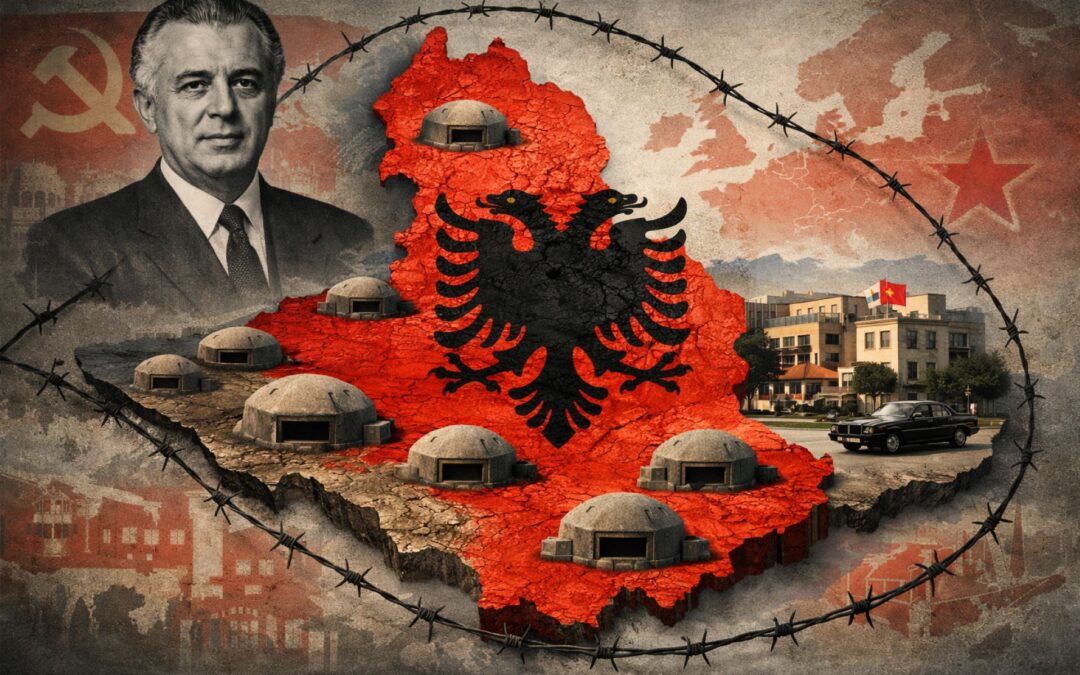
Today, Albania sits quietly on the edge of Europe—poor, politically turbulent, often overlooked. It is not a country that commands global attention. And yet, within living memory, it was something far stranger than a struggling Balkan state. It was a sealed experiment. A nation cut off not just from the West, but from reality itself.
To understand how extreme that isolation was, it helps to start with a simple comparison. During the Cold War, even the most rigid communist regimes maintained some form of alignment—whether with Moscow, Beijing, or each other. Albania did the opposite. It broke with the Soviet Union. Then it broke with China. Then it retreated into a position so insular that it effectively declared the entire world an enemy.
This was not accidental policy drift. It was the deliberate construction of a system shaped by one man: Enver Hoxha.
Under his rule, Albania became something uniquely severe in the European context—a totalitarian state defined less by ideology alone and more by paranoia as governing principle. Political rivals were not merely sidelined; they were erased. Foreign influence was not regulated; it was treated as contamination. Even history itself was rewritten to remove those who had fallen out of favor, as if dissent could be eliminated not just from society, but from memory.
What emerged from this mindset was a country that behaved like it was under permanent siege. Not metaphorically—literally. Hundreds of thousands of concrete bunkers were constructed across the landscape. Citizens were taught to expect invasion at any moment. Resources that might have improved daily life were instead redirected toward defense against enemies that largely existed in the imagination of the regime.
And yet, this was only one layer of the story.
Beneath the surface of enforced equality, a different Albania existed—hidden, insulated, and deeply contradictory. In the heart of the capital, a forbidden district housed the political elite in relative comfort, complete with access to luxuries and foreign goods that ordinary citizens could never touch. The same system that outlawed Western influence depended on it in private. The same leadership that preached sacrifice lived apart from it.
This tension—between ideology and reality, austerity and privilege, fear and control—defined Albania under Hoxha.
But perhaps the most revealing aspect of the regime is what happened after it ended.
When Hoxha died in 1985, the system he had spent four decades constructing did not endure. It faltered. Then it unraveled. Within a few years, the isolated fortress he had built opened to the world, and the structures that had seemed so rigid proved to be alarmingly fragile without the man who held them together.
This is the story of that system.
Not just how it functioned, but how it was built—how paranoia became policy, how isolation became identity, and how an entire nation was shaped in the image of one man’s fear.
The Making of an Unlikely Dictator
Enver Hoxha was not supposed to become the most powerful man in Albania.
Unlike many revolutionary leaders, he did not rise to prominence through charisma, intellectual authority, or battlefield legend. By most contemporary accounts, he was an unremarkable figure—neither particularly brilliant nor especially influential within the early Communist movement. His ascent was not the result of overwhelming merit. It was the product of timing, positioning, and a ruthless instinct for survival.
To understand how he emerged, you have to look at Albania in the early 1940s—not as a functioning state, but as a vacuum.
The country had been invaded by Fascist Italy in 1939, then occupied by Nazi Germany after Italy’s collapse. By the time German forces began retreating from the Balkans in late 1944, Albania was fractured into competing factions: monarchists, nationalists, collaborationists, and communist partisans. There was no clear successor, no stable center of power—only opportunity for whoever could seize it fastest.
Hoxha positioned himself at the heart of the one group that had both organization and momentum: the Communist-led National Liberation Movement. Within it, he rose to lead the Party of Labour of Albania, the political structure that would ultimately define the post-war state.
Even this rise is murky. Historians have long debated how he secured such a position in the first place. One widely cited theory is almost absurd in its simplicity: he may have been elevated partly to satisfy internal representation concerns. Many early party members were Christian, and Hoxha, as a Muslim, helped present the movement as more broadly representative of Albania’s population. Whether this was decisive or merely incidental, it underscores how contingent his early prominence was.
But once he had a foothold, contingency gave way to calculation.
As German forces withdrew, Hoxha and his allies moved quickly—not just to liberate territory, but to reshape it politically. The advancing communist forces shadowed the retreating occupiers, entering newly vacated areas and systematically eliminating anyone who might oppose them. This was not post-war consolidation; it was preemptive domination.
Former collaborators were targeted, but so were rival resistance groups. Monarchists, nationalists, and even fellow leftists who did not align perfectly with Hoxha’s vision were neutralized. In these early campaigns, the logic that would define his rule became clear: power was not to be negotiated—it was to be secured absolutely, before alternatives could emerge.
What distinguished Hoxha, even at this stage, was not just his willingness to use violence, but the breadth of his suspicion. He did not limit himself to obvious enemies. Allies were expendable. Reputation offered no protection. Personal grievances could become political death sentences.
One early example captures this dynamic. Llazar Fundo, a prominent communist intellectual and envoy, was accused of ideological deviation—specifically Trotskyism, a label often used loosely across the communist world to justify purges. In reality, the charge was less about doctrine and more about utility. Fundo had stature, influence, and a history of conflict with Hoxha. That was enough.
He was captured, tortured, and killed.
But the act itself was only part of the strategy. Hoxha sought not just to eliminate individuals, but to extract networks. Under torture, Fundo was forced to name associates—real or imagined—who could then be branded similarly and removed. Suspicion became contagious. One accusation could justify a chain of purges.
This approach would become a defining feature of Hoxha’s rule: the use of fear not just as punishment, but as a mechanism for expansion. Every enemy created the possibility of more enemies. Every purge reinforced the logic of the next.
By the time the war formally ended, the outcome was already decided.
There was no meaningful opposition left to contest the communists’ claim to power. And within the communist structure itself, Hoxha had positioned himself at the apex—not because he was the most capable leader in a traditional sense, but because he was the most willing to do what the moment demanded.
He had entered the post-war era not as one contender among many, but as the only one who remained.
From that point forward, Albania would not simply be a communist state. It would be Hoxha’s state—shaped, controlled, and increasingly defined by the instincts that had brought him to power in the first place.
Power Through Fear: Purges, Paranoia, and Political Survival
If Enver Hoxha’s rise to power revealed his opportunism, his rule revealed something far more defining: an almost pathological need to eliminate uncertainty.
In most authoritarian systems, repression serves a clear purpose—neutralizing opposition, enforcing compliance, maintaining order. Under Hoxha, it went further. Repression was not just a tool. It became a reflex. A permanent condition of governance.
From the earliest days of his leadership, purges were not occasional events tied to crises. They were continuous. Systematic. Expected.
Those who had helped build the Communist movement were among the first to fall. Senior party members—individuals whose revolutionary credentials might have given them influence or legitimacy independent of Hoxha—were gradually removed. Their experience, their history, even their loyalty became liabilities. In a system built on absolute control, seniority implied potential rivalry.
So they were eliminated.
What made Hoxha’s purges particularly destabilizing was their unpredictability. There was no stable definition of disloyalty. Ideological deviation, personal disagreement, perceived ambition, or even vague suspicion could all lead to arrest. The criteria shifted constantly, which ensured that no one could ever feel secure—not even those closest to the regime.
In this environment, survival depended less on conviction and more on submission.
Even that was no guarantee.
Hoxha’s inner circle, the very people tasked with helping him run the country, lived under constant scrutiny. Relationships were fragile. Trust was provisional. A colleague today could become an enemy tomorrow, often without warning or explanation. The result was a political culture defined not by cooperation, but by quiet vigilance—everyone watching everyone else, waiting for signs of deviation.
At the center of this system was Hoxha himself, increasingly consumed by the logic he had created.
Like Joseph Stalin before him, Hoxha did not simply remove political opponents—he erased them. Individuals who had fallen out of favor were stripped from official records. Photographs were altered. Names disappeared from histories. It was not enough to defeat opposition; it had to be retroactively nullified, as if it had never existed.
This manipulation of memory served a dual purpose. It reinforced Hoxha’s image as the unchallenged architect of the state, and it denied future generations any evidence that alternatives had ever existed.
But if early purges could be framed as consolidation, later actions revealed something more personal.
The case of Mehmet Shehu, Hoxha’s longtime ally and presumed successor, stands as the most striking example. Shehu had been unwaveringly loyal for decades. By most accounts, he never publicly challenged Hoxha’s authority and remained deeply embedded in the structure of the regime.
And yet, in 1981, he died under what was officially declared a suicide.
Almost immediately, Hoxha announced that Shehu had been a traitor all along—an agent not just for one foreign power, but for multiple, mutually hostile ones. The claim was so implausible that it bordered on absurdity. But plausibility was never the point. The accusation served to justify his removal and reinforce the narrative that enemies could exist anywhere, even at the highest levels of power.
The events leading up to Shehu’s death suggest a more calculated pressure. He had recently come under criticism for allowing his son to form ties with a family connected to the West. He was publicly humiliated, forced into self-criticism, and placed under intense scrutiny. Whether he took his own life or was pushed to it, the outcome aligned perfectly with the regime’s pattern.
Loyalty, it seemed, was conditional. And conditions could change without notice.
By this stage, Hoxha’s paranoia had evolved into a closed loop. The more he purged, the more isolated he became. The more isolated he became, the more he relied on suspicion to navigate the system. Every removal confirmed his worldview. Every imagined threat justified another act of repression.
There was no mechanism left to correct this trajectory.
No independent institutions. No trusted advisors. No space for dissent, even in private.
The state had become an extension of one man’s perception of reality. And in that reality, threats were everywhere.
This is what made Albania under Hoxha uniquely suffocating. It was not just that the regime was brutal—it was that its brutality had no stable boundary. There was no point at which the purges ended, no threshold beyond which loyalty guaranteed safety.
Fear was not a consequence of the system.
It was the system.
Manufacturing Enemies: Isolation as State Doctrine
For most communist states of the 20th century, survival depended on alignment.
The Soviet Union anchored one pole of the ideological world; China, at times, another. Smaller socialist nations typically attached themselves to one of these centers, trading autonomy for security, economic support, and political legitimacy. Even regimes that emphasized independence rarely abandoned alliances altogether.
Albania did something far more radical.
Under Enver Hoxha, it severed ties with nearly everyone.
At first, the country followed a familiar trajectory. In the immediate post-war years, it aligned with Joseph Stalin’s Soviet Union, adopting its political structure, economic planning, and ideological framework. But this relationship began to fracture after Stalin’s death, when Nikita Khrushchev initiated a process of de-Stalinization and opened limited dialogue with the West.
To Hoxha, this was not reform. It was betrayal.
Khrushchev’s policies were seen as a dilution of Marxist purity—a dangerous compromise with capitalism that threatened the ideological foundation of socialism itself. Albania responded by breaking with the Soviet Union, rejecting both its leadership and its evolving direction.
In isolation, however, Albania could not sustain itself. So it turned to a new patron: China.
For a time, this relationship held. Mao Zedong’s China, particularly during the Cultural Revolution, projected a revolutionary fervor that resonated with Hoxha’s worldview. It appeared to offer an alternative center of ideological gravity—one that still upheld the rigidity Albania demanded.
But this alliance, too, proved temporary.
When China began opening diplomatic relations with the United States in the early 1970s, Hoxha interpreted it as yet another act of ideological surrender. The pattern repeated. Albania cut ties again.
By this point, the logic had become unmistakable.
It was not that Albania had been abandoned by its allies. It had rejected them—one after another—because no external power could remain ideologically pure enough to satisfy Hoxha’s expectations. Every shift in global politics, every attempt at cooperation or reform elsewhere, reinforced his belief that Albania stood alone as the last true defender of Marxist orthodoxy.
This belief was not simply rhetorical. It became state doctrine.
The outside world was no longer a complex landscape of allies, rivals, and neutral actors. It was flattened into a single hostile entity. Capitalist nations were obvious enemies, but even socialist countries were reclassified as “revisionist” threats—corrupted systems that had strayed from the correct path.
In Hoxha’s framing, Albania was surrounded.
Not geographically, but ideologically.
This worldview was carefully cultivated and disseminated through propaganda. With virtually no exposure to foreign media, the Albanian population had little means of verifying or challenging the narratives presented to them. The regime controlled the flow of information so completely that it could construct an alternate version of global reality—one in which external powers were constantly conspiring to undermine or invade the country.
There were fragments of truth embedded within this narrative.
In the early years after World War II, Western intelligence agencies did attempt to destabilize Hoxha’s government through covert operations. These efforts failed, but they provided a lasting point of reference—an anchor for the regime’s claims of external hostility. Over time, these isolated events were amplified and reinterpreted as evidence of a permanent, coordinated threat.
The distinction between past actions and present danger blurred.
And eventually, it disappeared entirely.
Isolation, then, was not just a defensive posture. It was a self-reinforcing system. By cutting off external contact, the regime ensured that its version of reality went unchallenged. And by portraying the outside world as inherently dangerous, it justified further isolation.
This closed loop had profound consequences.
Economic stagnation became inevitable without trade or cooperation. Cultural life narrowed under strict censorship. Scientific and technological development lagged behind neighboring countries. But within the framework of the regime, these outcomes were not failures—they were necessary sacrifices.
Because in Hoxha’s Albania, engagement with the world was not an opportunity.
It was a risk.
And risk, in a system built on fear, could never be tolerated.
A Nation Under Siege: Propaganda, Fear, and the Bunker State
Once isolation became doctrine, it needed reinforcement.
A country cut off from the world cannot remain stable on ideology alone. Over time, questions emerge. Why are we poorer than others? Why are we alone? Why does no one come, and why can we not leave? For Hoxha’s system to endure, isolation had to be transformed from a condition into a necessity—something not just tolerated, but internalized.
The answer was fear.
Not occasional fear, triggered by crises or external threats, but a permanent atmosphere of siege. Albanians were not simply told that the world was hostile; they were conditioned to believe that invasion was imminent, that enemies were always preparing, always watching, always waiting for weakness.
This was not framed as speculation. It was presented as certainty.
In official narratives, Albania stood as the final outpost of true socialism, surrounded by enemies on all sides—capitalist powers, revisionist communists, hostile neighbors. The logic was simple and effective: if the entire world is against you, then hardship is not a failure of the system, but proof of its righteousness.
Suffering became validation.
But propaganda alone was not enough. Hoxha’s regime gave this abstract threat a physical form—something that could not be ignored, something that would embed itself into the daily lives of citizens.
It built bunkers.
Not a few defensive structures along borders, not strategic fortifications in key areas, but an astonishing network of concrete domes scattered across the entire country. By the late stages of Hoxha’s rule, roughly 170,000 bunkers had been constructed across Albania’s landscape—on hillsides, in fields, along coastlines, even within cities.
They were everywhere.
These bunkers were not merely defensive installations. They were psychological instruments. Their presence turned the idea of invasion into a constant visual reality. Every road, every village, every stretch of countryside carried the same message: danger is near, and it is permanent.
The country began to resemble a fortified mind.
The scale of this project came at a staggering cost. A significant portion of Albania’s already limited national budget—close to a tenth by some estimates—was directed toward defense, with much of it absorbed by bunker construction. Resources that might have improved housing, food supply, infrastructure, or industry were instead poured into preparing for a war that never came.
The trade-off was not hidden.
It was justified.
In the logic of the regime, survival outweighed comfort. Security outweighed prosperity. If Albania was truly surrounded by enemies, then every sacrifice made in the name of defense was not only acceptable, but necessary.
This prioritization filtered down into everyday life. Citizens were expected to be ready—not just mentally, but physically. The idea that every individual had a role to play in national defense was reinforced repeatedly. Society was framed as a collective shield, where vigilance was both duty and identity.
Living normally was not enough.
One had to live as if under threat.
This constant tension reshaped the way people understood their place in the world. It discouraged curiosity about life beyond Albania’s borders. It made isolation feel rational, even protective. And it redirected frustration inward, away from the system and toward the imagined forces that justified it.
At its most effective, this strategy blurred the line between external reality and internal belief. The enemy no longer needed to act to be feared. Its existence, as defined by the regime, was sufficient.
And so the bunkers remained—silent, immovable reminders of a war that never arrived, but was never allowed to feel distant.
In the end, they stood as monuments not to military strength, but to something far more revealing:
A system so deeply shaped by paranoia that it needed to build its fears into the ground itself.
Poverty by Design: When Survival Took a Back Seat to Control
By the time Albania had fully withdrawn from the world, the consequences were no longer abstract.
Isolation, paranoia, and militarization did not exist in separate spheres. They converged into something far more tangible: a steady, grinding decline in everyday life. What made this decline particularly revealing was that it was not simply the byproduct of mismanagement or limited resources. It was, in many ways, a direct outcome of the regime’s priorities.
Hoxha’s Albania did not fail to provide prosperity.
It chose not to pursue it.
In a conventional system, economic hardship tends to trigger reform—new policies, external partnerships, or at the very least, attempts to stabilize living conditions. But reform requires openness, and openness was precisely what Hoxha feared most. Any engagement with the outside world carried the risk of ideological contamination, of exposure to alternative ways of organizing society.
So the system remained closed.
Trade was minimal. Foreign investment was nonexistent. Technological exchange—one of the key drivers of development in the 20th century—was almost entirely absent. As neighboring countries, even those under communist rule, gradually modernized and adapted, Albania remained frozen in an earlier era.
The effects were visible everywhere, but perhaps most starkly in the capital.
Tirana, which should have embodied the country’s progress, instead reflected its stagnation. Infrastructure lagged decades behind the rest of Europe. Mechanization was limited. In some sectors, tools and equipment in use were relics from the early 20th century. Even basic systems—communication, transportation, industrial production—operated at a level that felt increasingly disconnected from the outside world.
But the deeper impact was felt inside people’s homes.
Housing was cramped and overcrowded. Families of four, six, sometimes even ten people lived in spaces that barely accommodated them. Privacy was scarce. Comfort was secondary. The concept of upward mobility, of materially improving one’s condition over time, was almost nonexistent.
Consumption, in general, was tightly constrained.
Private property was heavily restricted. Ownership of personal vehicles was extremely rare, to the point that most citizens would go through life without ever driving a car. Consumer goods were limited, often outdated, and distributed through controlled systems that prioritized uniformity over choice.
Scarcity became normal.
And yet, this scarcity existed alongside a state that was not incapable of allocating resources—it simply directed them elsewhere.
A substantial portion of national expenditure was absorbed by defense. The same economy that struggled to provide adequate housing or modern infrastructure found the means to construct an extensive network of bunkers, maintain a standing military posture, and prepare for hypothetical invasions. The imbalance was not subtle. It was structural.
Security, as defined by the regime, consistently outweighed the welfare of the population.
This imbalance was even acknowledged, at times, from within the system itself. There were moments when officials admitted, almost matter-of-factly, that material needs had been deprioritized in favor of military readiness. Bread could wait. Weapons could not.
That logic reveals something essential about Hoxha’s Albania.
The regime did not measure success in terms of prosperity, efficiency, or even stability in the conventional sense. It measured success in terms of control—how effectively it could preserve its ideological purity, maintain internal discipline, and insulate itself from perceived threats.
From that perspective, poverty was not necessarily failure.
It was a tolerable consequence.
In some ways, it was even functional. A population focused on basic survival has less capacity to question, organize, or resist. Scarcity narrows horizons. It limits comparison. It reinforces dependence on the state.
The result was a society where material deprivation and political control reinforced each other.
People lived with less—not because there was no alternative, but because the system had decided that alternatives were too dangerous to pursue.
The Bllok: Privilege, Hypocrisy, and the Communist Elite
For a system that preached equality, Albania under Hoxha was defined by a quiet but unmistakable divide.
It was not visible in official rhetoric. The language of the state remained firmly rooted in collectivism—shared sacrifice, shared struggle, shared destiny. But in practice, a separate reality existed just beneath the surface, carefully hidden and tightly controlled.
At the center of that reality was the Bllok.
Located in the heart of Tirana, this restricted district functioned as the private enclave of the regime’s inner circle—the Politburo, senior party officials, and those considered indispensable to the machinery of power. It was not simply a residential area. It was a boundary. A line between two versions of Albania.
Entry was forbidden to ordinary citizens.
The neighborhood was sealed off by checkpoints, patrolled by security personnel, and monitored continuously. Those who had once lived there before its designation were expelled, making way for the new political aristocracy. Within its perimeter, the rules that governed the rest of the country began to loosen—sometimes subtly, sometimes completely.
While most Albanians lived in cramped, modest apartments, the Bllok offered spacious residences, better infrastructure, and access to amenities that bordered on luxury by national standards. Restaurants, private clinics, exclusive stores—facilities that would have been unimaginable elsewhere in the country—were concentrated within this small, heavily guarded zone.
It was, in effect, a different country.
But the most revealing aspect of the Bllok was not its material comfort. It was what that comfort represented.
Everything the regime publicly rejected—foreign goods, cultural influences, indulgence—found its way into this enclave. Imported products circulated quietly. Banned films were screened behind closed doors. The same leadership that enforced ideological purity on the population permitted itself a degree of exposure and privilege that directly contradicted its own doctrine.
This was not accidental hypocrisy.
It was structured.
The Bllok existed because the system required it. Absolute control depends on loyalty, and loyalty at the highest levels is rarely sustained through ideology alone. It must be reinforced with access, privilege, and proximity to power. By concentrating the elite in one controlled environment, the regime could both reward and monitor them simultaneously.
The neighborhood became a mechanism of cohesion.
And a mechanism of surveillance.
Within the Bllok, relationships were tightly interwoven. Families of party officials intermarried, social circles overlapped, and influence circulated within a closed loop. On the surface, this created a sense of unity. But beneath it, tension persisted. The same paranoia that defined the broader regime did not disappear at the top—it intensified.
Everyone had something to lose.
Everyone had reason to watch everyone else.
Even leisure spaces were not entirely free from this dynamic. Clubs and gathering places within the Bllok, where officials relaxed and interacted, doubled as informal arenas of observation. Attendance, behavior, associations—these details mattered. Absence could raise suspicion. Casual remarks could be interpreted as deviation.
In a system built on distrust, even privilege came with conditions.
The Bllok, then, was not merely a symbol of inequality. It was a concentrated expression of the regime’s core contradictions. A state that outlawed class distinctions had created its own insulated class. A leadership that condemned foreign influence consumed it in private. A system that demanded absolute loyalty could never fully trust those it depended on.
From the outside, Albania appeared uniformly austere.
From the inside, it was sharply divided.
And nowhere was that divide more visible—or more carefully concealed—than in the streets of the Bllok.
Watching the Inner Circle: Control Within the Regime
If the Bllok represented privilege, it also represented something far less comfortable: proximity to power without security.
In most political systems, reaching the inner circle brings a degree of stability. Access to leadership, influence over decisions, and distance from the hardships faced by ordinary citizens typically translate into protection. Under Hoxha, the opposite was true.
The closer one moved to power, the more exposed one became.
This was not a side effect of the system. It was by design.
Hoxha understood that the greatest threat to his rule would not come from the general population—isolated, controlled, and fragmented—but from within the elite itself. These were the individuals with access, networks, and the ability to coordinate. If opposition were ever to take shape, it would begin here.
So the inner circle had to be managed differently.
Not through trust, but through constant observation.
Within the Bllok, surveillance operated on multiple levels. Formal mechanisms existed—security services, informants, structured reporting—but the more effective system was informal. It relied on behavior, presence, routine. Who attended gatherings. Who avoided them. Who spoke freely. Who remained silent.
Even absence could be interpreted as intent.
One of the more revealing aspects of this system was the expectation that senior officials maintain a visible, consistent presence in shared spaces—particularly elite clubs and social venues. These were not merely places of relaxation. They functioned as controlled environments where loyalty could be assessed indirectly.
Participation signaled alignment.
Deviation, even in small ways, invited scrutiny.
Over time, this created a peculiar rhythm within the elite. Daily life became performative. Conversations were measured. Interactions were calculated. Individuals learned to project conformity, not just in policy but in demeanor. It was not enough to be loyal. One had to appear loyal at all times, in all contexts.
The effect was corrosive.
Relationships within the inner circle were shaped less by genuine trust and more by mutual caution. Friendships were conditional. Alliances were fragile. Every interaction carried the implicit risk of misinterpretation or betrayal. In a system where accusations could emerge suddenly and consequences were severe, self-preservation took precedence over solidarity.
And yet, the structure held.
Partly because there was no alternative. The same isolation that defined Albania externally applied internally as well. There were no independent institutions to appeal to, no parallel centers of authority, no safe spaces for dissent. The regime was closed not just to the outside world, but within itself.
But more importantly, it held because Hoxha maintained unpredictability.
He did not establish clear boundaries for acceptable behavior. He did not allow patterns of safety to emerge. By keeping the criteria for suspicion fluid, he ensured that no one could ever fully relax into their position. Stability, in this context, would have been dangerous. It might have allowed coordination. It might have created confidence.
Instead, uncertainty prevailed.
This uncertainty extended even to the highest levels. As seen with figures like Mehmet Shehu, long-standing loyalty offered no immunity. The system did not reward consistency. It merely postponed consequence.
In this environment, control became self-sustaining.
Officials monitored themselves, adjusted their behavior preemptively, and avoided any action that might be construed as deviation. Surveillance no longer required constant enforcement. It had been internalized.
The regime did not need to watch everyone all the time.
It had created a structure where everyone assumed they were being watched.
And acted accordingly.
Selective Isolation: The Contradictions of Hoxha’s Rule
On the surface, Albania’s isolation appeared absolute.
Foreign influence was denounced as dangerous. Western goods were banned. Cultural imports were treated as ideological threats. The state presented itself as a sealed system—self-reliant, disciplined, and untouched by the corrupting forces of the outside world.
But like many systems built on rigid doctrine, the reality was far more selective.
Isolation, in practice, was not universal.
It was controlled.
For the average Albanian, the restrictions were real and suffocating. Access to foreign media was virtually nonexistent. Art, literature, and music were tightly regulated, with even subtle traces of external influence considered grounds for punishment. Individuals who deviated from approved cultural norms could face severe consequences—not because their work was inherently subversive, but because it suggested openness to ideas beyond the state’s control.
The case of artists punished for “foreign influence” illustrates how far this logic extended. It was not necessary to advocate dissent. It was enough to reflect something unfamiliar, something that hinted at a world outside the ideological boundaries of the regime.
Exposure itself was treated as a threat.
Yet within the upper layers of the system, these restrictions softened—sometimes quietly, sometimes openly.
The leadership did not fully insulate itself from the outside world. It curated its access.
In private, foreign goods circulated among the elite. Imported products—often from the very capitalist nations the regime condemned—found their way into restricted spaces like the Bllok. These were not luxuries available to the public. They were privileges reserved for those who upheld the system.
The same pattern extended beyond consumption.
Hoxha himself embodied the contradiction.
Despite his relentless hostility toward foreign influence, he relied on it when it served him. His personal medical care, for instance, was supported by expertise and resources drawn from outside Albania. Foreign-trained doctors were brought in. Western medicines were used. The benefits of global knowledge were not rejected outright—they were selectively absorbed.
But only at the top.
This selective openness reveals something important about the nature of the regime. The rejection of foreign influence was not rooted in a consistent philosophical stance. It was strategic. Exposure was restricted not because it was inherently harmful, but because it was destabilizing when uncontrolled.
For the population, access to the outside world introduced comparison. Comparison introduced doubt. And doubt threatened the coherence of the system.
For the leadership, however, controlled access was useful.
It improved their quality of life. It provided tools, knowledge, and comfort that could not be produced domestically. And crucially, it did so without undermining their authority—because it remained hidden, contained within spaces that ordinary citizens could not enter.
This dual structure—total restriction below, selective access above—allowed the regime to maintain its ideological narrative while quietly bypassing its limitations.
But it also exposed its fragility.
A system that truly believed in its own self-sufficiency would not need to rely on external inputs, even in private. The fact that it did suggests an underlying recognition—unspoken, but evident—that isolation came at a cost the leadership was unwilling to bear personally.
That cost was transferred downward.
To the public, isolation was framed as strength. To the elite, it was negotiable.
And in that gap, between what was preached and what was practiced, the contradictions of Hoxha’s Albania became impossible to ignore—even if they could never be openly acknowledged.
The Cult of Hoxha: Building a God Among Men
Power sustained through fear can endure for a long time.
But fear alone is unstable. It creates obedience, not belief. And obedience, if left unreinforced, can eventually erode—especially in a system that demands not just compliance, but total alignment.
Hoxha understood this.
So alongside repression and isolation, he built something more enduring: a cult.
Not in the casual sense of propaganda or political branding, but in the deeper, more systematic construction of a figure who existed above ordinary scrutiny. A leader whose authority was not just political, but almost existential—woven into the identity of the state itself.
From early in his rule, Hoxha positioned himself as the central force behind Albania’s transformation. The liberation from Fascist occupation, the establishment of the communist state, the defense against foreign threats—these were not presented as collective achievements. They were attributed, directly or indirectly, to him.
He was not simply the leader of the system.
He was the reason it existed.
This narrative was reinforced continuously. Official publications, speeches, and educational materials emphasized his role, often to the exclusion of others. Figures who had contributed meaningfully to the revolution or the state were gradually minimized or erased—especially if they had later fallen out of favor. Their absence left a vacuum, and that vacuum was filled with Hoxha’s image.
History became singular.
Over time, this process extended beyond political achievements into something more personal. Hoxha wrote extensively about his own life and work, documenting events in a way that elevated his foresight, his decisions, and his indispensability. Without an independent biographical tradition to challenge or contextualize these accounts, his version of events became the dominant one.
The line between record and narrative blurred.
For the average citizen, exposure to alternative perspectives was virtually nonexistent. Information flowed in one direction—from the state to the public. Within that framework, Hoxha’s image solidified not just as a leader, but as a constant presence—someone whose influence touched every aspect of national life.
This presence intensified in moments of collective ritual.
Public displays of loyalty, organized commemorations, and carefully choreographed ceremonies reinforced the emotional dimension of the cult. Participation was not optional. It was expected. Over time, repeated engagement with these rituals created a kind of performative belief—an outward expression of devotion that, for many, became internalized.
Others remained skeptical.
But skepticism had to remain private. The cost of open dissent was too high, and the boundaries of acceptable expression were too narrow. Even those who did not believe in the constructed image of Hoxha were compelled to behave as if they did.
This dynamic blurred the distinction between genuine reverence and enforced conformity.
The culmination of this system became visible at the moment of Hoxha’s death in 1985.
The public reaction was immediate and intense. Across the country, scenes of mourning unfolded—crowds gathering, individuals weeping openly, expressions of grief that mirrored those seen in other highly controlled regimes. The rituals were extensive, structured, and unmistakably deliberate.
For those who had lived their entire lives within the system, the response was not entirely artificial. Decades of exposure to a single narrative had shaped their understanding of the world. Hoxha was not just a political figure—he was a point of reference, a constant in a closed environment.
His absence created uncertainty.
For others, the reaction was performative. Mourning was not just an emotional act, but a political one. To grieve publicly was to affirm loyalty. To hesitate was to invite suspicion.
In either case, the effect was the same.
The image of Hoxha, carefully constructed over four decades, held firm even in death.
But beneath the surface, the very intensity of that reaction hinted at something else. A system that requires such elaborate reinforcement of a single figure is, by definition, dependent on that figure. Its stability is tied not just to institutions or ideology, but to the continued presence of the individual at its center.
And when that individual disappears, the question is no longer how strong the system appears.
It is how much of it can survive without him.
Death of a Dictator, Death of a System
When Enver Hoxha died in 1985, the transition should have been straightforward.
The state had institutions. It had a party structure, a security apparatus, an established ideology, and a clear hierarchy. On paper, there was no reason to expect immediate instability. Systems like this are designed to outlive individuals.
Albania did not.
What Hoxha left behind was not a resilient state—it was a tightly wound structure that depended on his constant presence to function. For over four decades, decision-making, authority, and legitimacy had been concentrated in a single figure. The institutions that existed were not independent actors. They were extensions.
And without him, they began to drift.
His successor, Ramiz Alia, inherited a system that appeared intact but was internally brittle. The mechanisms of control still existed—censorship, surveillance, centralized planning—but they no longer operated with the same certainty. The underlying assumptions that had sustained them were beginning to weaken.
The most immediate pressure came from outside.
By the late 1980s, the global context that had shaped Hoxha’s worldview was collapsing. Communist regimes across Eastern Europe were reforming or falling. The Soviet Union itself was undergoing transformation under Mikhail Gorbachev. Isolation, which had once been framed as ideological strength, was becoming increasingly untenable.
Albania could no longer ignore the world without consequence.
Gradually, the regime began to loosen its grip. Restrictions on foreign media were eased. Limited diplomatic engagement resumed. Small openings appeared—controlled, cautious, but significant in a system that had once rejected all external contact outright.
These changes were not driven by conviction.
They were driven by necessity.
Internally, the situation was just as fragile. The population, long conditioned to accept scarcity and control, began to experience something unfamiliar: comparison. As information from outside trickled in, the disparity between Albania and the rest of Europe became harder to rationalize. The narrative of siege lost some of its force.
Fear, while still present, was no longer absolute.
And once fear weakens, so does compliance.
The elite, too, began to shift. Under Hoxha, loyalty had been enforced through proximity and surveillance. Without his constant oversight, the cohesion of the inner circle began to erode. Personal interests resurfaced. Alignment became less rigid. The tight, controlled network that had once held the system together started to loosen.
What followed was not a sudden collapse, but a gradual unraveling.
Protests emerged. Opposition, once unthinkable, began to organize. The state responded, but without the same decisiveness or unity that had characterized Hoxha’s rule. Each concession made further concessions inevitable. Each opening created pressure for more.
By the early 1990s, the transformation was complete.
The People’s Socialist Republic of Albania ceased to exist. The country transitioned—unevenly, turbulently—into a different political and economic system. Isolation ended. Borders opened. The structures that had once defined everyday life were dismantled or abandoned.
What remained was the aftermath.
Decades of enforced isolation had left Albania economically underdeveloped and institutionally fragile. The sudden shift exposed these weaknesses. The transition was not smooth. It was marked by instability, uncertainty, and, in some cases, crisis.
But the system itself did not survive.
And that, more than anything, reveals its true nature.
Hoxha had built a state that appeared rigid, disciplined, and ideologically unwavering. But its strength was not structural—it was personal. It relied on his presence, his decisions, his perception of the world. Remove that center, and the system lost coherence.
It did not adapt.
It dissolved.
In the end, Albania’s transformation was not just the collapse of a regime. It was the collapse of a worldview—one that had defined itself through isolation, sustained itself through fear, and ultimately proved unable to exist without the man who created it.
Conclusion
Enver Hoxha did not just rule Albania.
He reshaped it—systematically, relentlessly—until the country reflected his worldview in almost every dimension. Politics became an extension of suspicion. Foreign policy became an exercise in withdrawal. Society itself was reorganized around the idea that danger was constant, and trust was a liability.
What makes Hoxha’s Albania so striking is not simply its severity, but its consistency.
The purges were not isolated excesses—they were part of a broader logic of eliminating uncertainty. The isolation was not forced—it was chosen, reinforced again and again as alliances collapsed under the weight of ideological rigidity. The bunkers were not just defensive structures—they were physical manifestations of a mindset that saw threats everywhere. Even the contradictions at the top, the privileges of the Bllok, the selective use of foreign expertise, all fit into a system where control mattered more than coherence.
Everything aligned around a single principle:
Maintain power by controlling reality itself.
For a time, it worked.
The system held together. It suppressed opposition, limited exposure, and shaped perception so effectively that it created a closed loop—one where the absence of alternatives reinforced belief in the system’s necessity. But that same closure carried within it a fundamental weakness.
It could not evolve.
Without external input, without internal flexibility, and without mechanisms for self-correction, the system became rigid to the point of fragility. It depended on continuity—on the uninterrupted presence of the individual who had constructed and maintained it.
When Hoxha died, that continuity broke.
And with it, the illusion of permanence.
What followed was not just political change, but exposure. Exposure to the outside world, to different systems, to different standards of living. The narratives that had sustained isolation became harder to maintain. The structures that had enforced control began to lose their grip.
The system did not fail gradually.
It failed once it could no longer sustain the conditions that made it possible.
Today, Albania’s past as Europe’s most isolated dictatorship can feel distant, almost surreal. The bunkers remain scattered across the landscape, remnants of a time when fear was built into the ground itself. The Bllok, once forbidden, is now just another part of a city that has reconnected with the world.
But the story endures because it illustrates something larger.
Not just how authoritarian systems operate, but how far they can go when driven by a single, uncompromising vision. How control can be maintained not only through force, but through perception. And how, in the end, even the most tightly sealed systems are vulnerable—not to external invasion, but to the absence of the one force holding them together.
Hoxha built a state designed to withstand the world.
It just wasn’t built to survive without him.