
Chuck Blazer did not become the symbol of FIFA corruption because he stole quietly.
He became the symbol because he stole absurdly.
For years, Blazer was one of the most powerful men in global football. He helped run CONCACAF, the body responsible for football across North America, Central America and the Caribbean. He sat on FIFA’s executive committee. He helped decide where World Cups would be played.
He also rented an apartment in Trump Tower for his cats.
Not metaphorically. Literally.
Blazer had one apartment for himself and another for his cats, while investigators later found that he had misappropriated millions from the football organization he was supposed to serve. His story became cartoonish because the details were cartoonish. But that is also what made it useful. It exposed something deeper than personal greed.
FIFA’s problem was never just that a few men took money.
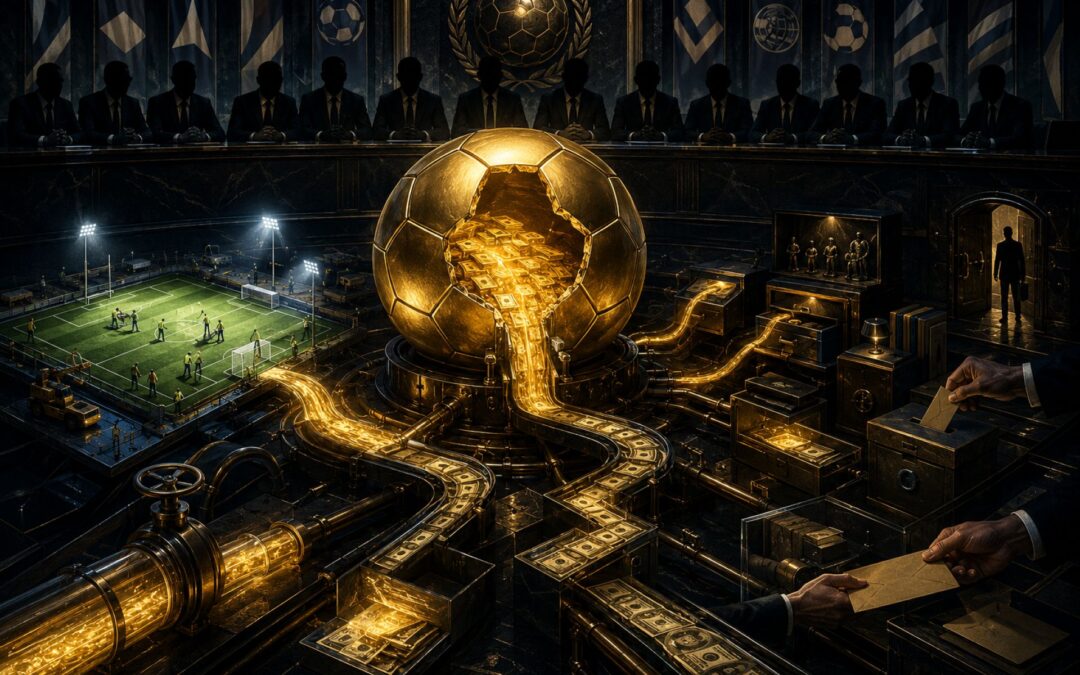
The real problem was that football had built an institution where money, power, votes, development funds, and personal loyalty all flowed through the same closed system.
That system still matters.
FIFA now expects to generate around $13 billion in revenue during the 2023–2026 cycle. Officially, much of that money exists for one noble purpose: developing football around the world.
And some of it does.
But the harder question is not whether FIFA spends money on football. It does.
The harder question is what else that money buys.
The World Cup Makes FIFA Rich Before Anyone Kicks a Ball
The World Cup is not just a tournament. It is FIFA’s money engine.
Every four years, FIFA sells the world the same irresistible product: national pride, global attention, scarce tickets, broadcast rights, sponsorship slots, hospitality packages, licensing deals, and the dream of seeing your country win the biggest prize in football.
By the time the first match begins, much of the commercial work has already been done.
Broadcasters have paid. Sponsors have signed. Cities have prepared. Fans have booked flights, hotels, and tickets. Host governments have built or upgraded infrastructure. Local organizers have absorbed enormous operational burdens.
FIFA sits above all of it.
That is why the World Cup is such a strange business. It looks like a shared global celebration, but the economic structure is highly concentrated. FIFA owns the event. It controls the brand. It sells the rights. It decides the rules of participation. It receives the revenue.
The 2022 World Cup in Qatar showed the scale. FIFA reported record revenue and reserves at the end of that cycle, with total revenue of $7.6 billion across 2019–2022 and reserves reaching nearly $4 billion.
For 2026, the numbers are expected to be even larger.
This is the part of the story most fans understand instinctively. The World Cup has become bigger, more expensive, more commercial, and more controlled. The fan pays more. The host city gives more. The tournament expands. The hospitality tier grows. The whole machine becomes more sophisticated.
But the money story does not end when FIFA collects the cash.
That is only the first half.
The more revealing question is what happens after the money enters FIFA.
FIFA Is Not a Normal Company
If FIFA were a normal corporation, its behavior would be easier to understand.
It would be a sports entertainment giant. It would own a valuable media property. It would maximize revenue. It would pay tax like a business. It would report to shareholders, regulators, and markets.
But FIFA is not that.
FIFA is formally organized as an association under Swiss law. It presents itself as the global guardian of football, not merely the owner of a commercial product. It is not supposed to exist only to make profit. It is supposed to govern, protect, promote, and develop the game.
That gives FIFA an unusual moral shield.
When FIFA makes money, it is not described simply as profit. It is money for football. Money for pitches. Money for youth programs. Money for women’s football. Money for poorer federations. Money for countries that could never build football infrastructure on their own.
There is truth in that.
There is also danger in it.
Because FIFA combines three roles that would normally be separated.
It is the regulator of global football.
It is the owner of global football’s most valuable event.
It is also the distributor of development money to the same national federations that vote in FIFA elections.
That structure creates a permanent conflict of incentives. FIFA can say, with some accuracy, that it funds football development. But the same spending can also strengthen the political position of the people who control FIFA.
The money is not just financial.
It is institutional power.
The Official Answer: FIFA Says the Money Develops Football
FIFA’s official explanation is simple: the World Cup funds the global game.
The flagship program is FIFA Forward, a development scheme that channels money to FIFA’s member associations. Through the program, FIFA says it supports infrastructure, competitions, equipment, administration, governance, youth football, women’s football, and technical development.
On paper, this is exactly what a global football body should do.
Many countries do not have the resources of England, Germany, Brazil, Spain, France, or Argentina. If football is supposed to be global, then smaller and poorer associations need support. They need pitches. They need coaching structures. They need competitions. They need administrative capacity. They need help building the basic machinery of the sport.
FIFA’s own Forward report points to thousands of projects and billions in development funding across its member associations. The official story is not imaginary. FIFA does fund real football activity.
That is what makes the system harder to criticize honestly.
It is too simplistic to say all the money disappears.
It does not.
Some of it builds facilities. Some of it supports national teams. Some of it pays for competitions. Some of it helps federations that would otherwise struggle to function.
But the existence of real development spending does not settle the question.
It raises the next one.
Who gets the money, who approves the projects, who checks the spending, and what political loyalty does that money create?
The Real Question Is Who Controls the Money
FIFA has 211 member associations.
Each of them has a vote.
That one fact explains more about FIFA than almost anything else.
In ordinary football terms, the difference between Germany and a tiny island federation is enormous. One may have millions of registered players, world-class stadiums, elite clubs, huge broadcast markets, and a long football history. The other may have a small population, limited infrastructure, semi-professional players, and a federation office running on a modest budget.
But in FIFA politics, both have one vote.
That sounds democratic. In theory, it protects smaller countries from being dominated by richer football powers. It gives global football a universal structure. It makes FIFA more than a European and South American club.
But it also creates a powerful incentive.
If every federation has one vote, then every federation matters. And if every federation receives development money, then development spending becomes politically meaningful.
A small federation may receive money that is transformational by local standards. That money can fund staff, projects, facilities, travel, and operating costs. In a rich football nation, FIFA money may be helpful. In a small football nation, it may be existential.
That changes the relationship between FIFA leadership and member associations.
FIFA is not merely asking federations for votes.
It is also funding them.
The same leadership that distributes money also depends on the recipients for political survival. That does not automatically make every payment corrupt. But it does mean the structure is vulnerable to loyalty politics.
When money and votes move through the same network, the line between development and patronage becomes thin.
Development Funding Can Become a Loyalty System
The most important thing to understand about FIFA is that corruption does not need to look like a suitcase full of cash.
Sometimes it looks like a development grant.
Sometimes it looks like an infrastructure project.
Sometimes it looks like administrative support.
Sometimes it looks like a federation president knowing exactly which side of the room his future funding depends on.
That is the genius and danger of the system. It can be defended in the language of fairness while operating through the logic of political loyalty.
FIFA can say: we are helping small football nations.
That may be true.
But the president of FIFA can also understand that small football nations vote.
That is also true.
This is why development funding sits at the heart of FIFA’s power. The program does not have to be fake to be politically useful. It can fund real projects and still create loyalty. It can build real pitches and still strengthen the people who control the money. It can help football and protect FIFA’s leadership at the same time.
That is the uncomfortable part.
The system does not require everyone inside it to be a villain. It only requires the incentives to point in the wrong direction.
A national federation that depends on FIFA funding may be less likely to challenge FIFA leadership. A confederation with many votes may become a crucial electoral bloc. A president who increases development money can present himself as a reformer, benefactor, and patron all at once.
This is why FIFA’s corruption problem has always been bigger than individual scandals.
Bad people matter.
But bad incentives last longer.
FIFAgate Showed the Old System in Public
In May 2015, Swiss police entered a luxury hotel in Zurich and arrested FIFA officials just before a FIFA presidential election.
It was one of the most dramatic mornings in modern sports history.
The arrests were part of a sprawling U.S. corruption case that accused football officials and sports marketing executives of turning global football into a bribery network. The U.S. Department of Justice alleged that officials had accepted more than $150 million in bribes and kickbacks over decades, especially around media rights, marketing rights, and tournament contracts.
The scandal became known as FIFAgate.
What made it so damaging was not only the amount of money involved. It was the simplicity of the scheme.
Sports marketing companies wanted rights. Football officials controlled access. Bribes helped secure deals. Votes, contracts, and influence moved through personal networks. The game on the pitch remained beautiful. The business around it was something else.
Chuck Blazer became central to the story because he cooperated with U.S. authorities. Once one of the insiders, he became an informant. His cooperation helped expose how deeply corruption had penetrated football administration in the Americas and beyond.
But Blazer was not an exception to an otherwise clean system.
He was a product of the system.
For years, football officials operated in a world where global attention was enormous, commercial money was growing, accountability was weak, and internal power networks were difficult for outsiders to penetrate. FIFA looked like a public institution when it spoke about the good of the game, but it often behaved like a private club when it came to accountability.
That is why FIFAgate hit so hard.
It revealed that football’s governing class had been selling pieces of the game to itself.
The Garcia Report Showed FIFA’s Accountability Problem
The 2018 and 2022 World Cup bidding process created another test of FIFA’s credibility.
Russia won 2018. Qatar won 2022. Both decisions triggered intense scrutiny, especially because of the politics, money, and lobbying surrounding the bids.
FIFA commissioned an investigation led by former U.S. prosecutor Michael Garcia. The result was a lengthy report on the bidding process. But FIFA did not initially publish the full report. It released a shorter summary instead.
Garcia objected, saying the summary misrepresented his findings. He eventually resigned from FIFA’s ethics process.
That episode matters because it showed the limits of internal accountability. FIFA could commission an investigation, control the release of information, shape the public narrative, and move on while the tournaments remained in place.
For an ordinary organization, a damaged investigation might create external consequences. For FIFA, the consequences were largely internal. The people being scrutinized belonged to the same world as the people managing the scrutiny.
This is the central problem with self-policing.
An institution can create ethics committees, reports, procedures, panels, and reform language. But if the institution ultimately controls the process, controls the publication, controls the appointments, and controls the consequences, accountability becomes fragile.
It exists until it becomes inconvenient.
The Garcia Report did not just raise questions about Russia and Qatar. It raised a larger question about FIFA itself.
Can a closed institution investigate the source of its own power honestly?
Even the Reform Era Repeated the Same Pattern
After the 2015 scandal, FIFA had to reform.
The old world had become indefensible. Sepp Blatter was gone. Public trust was damaged. Sponsors were nervous. Governments were watching. Fans had seen too much.
So FIFA introduced reforms. It created term limits. It strengthened ethics and governance structures. It promised a cleaner era under Gianni Infantino.
For a moment, the story sounded familiar: scandal, reform, renewal.
But FIFA’s deeper pattern soon reappeared.
In 2017, FIFA chose not to reappoint key independent ethics officials, including figures who had been involved in banning senior football officials. The ousted ethics leaders said the move had damaged hundreds of pending investigations, with one describing FIFA’s decision as a blow to its anti-corruption work. The Guardian reported that hundreds of cases had still been open when the ethics chiefs were removed.
That moment was revealing.
Reform was acceptable as long as it did not threaten the new leadership too much.
This is how institutions preserve themselves. They change enough to survive the scandal, but not enough to surrender control. The faces change. The language changes. The committees change. The incentive structure remains.
Infantino’s FIFA has not looked identical to Blatter’s FIFA. That would be too simple. FIFA today is more media-conscious, more polished, more legally careful, and more sophisticated in its public messaging.
But the core tension remains.
FIFA still controls enormous money. FIFA still distributes that money through member associations. FIFA still depends on those associations for political legitimacy. FIFA still operates with limited outside accountability. FIFA still expands tournaments and revenue streams while presenting itself as the servant of the global game.
Even executive pay tells part of the story. In 2026, the Associated Press reported that Infantino’s compensation had risen to about $6 million, helped by bonuses linked to FIFA’s expanded commercial calendar.
The reform era did not end FIFA’s money machine.
It professionalized it.
The Saudi 2034 and Club World Cup Era Shows the Machine Has Not Stopped
The next phase of FIFA’s power is not only about corruption in the old sense.
It is about expansion.
More tournaments. More matches. More markets. More broadcast deals. More political partnerships. More global positioning.
The expanded Club World Cup is one example. FIFA has pushed to create a larger club tournament with a massive prize fund, placing itself more directly into the commercial space long dominated by clubs, leagues, and UEFA. The tournament is not just a sporting idea. It is a power move.
It gives FIFA another premium property.
It gives clubs another source of money.
It gives broadcasters and investors another global football product.
And it gives FIFA a way to reduce its dependence on one tournament every four years.
The politics around this expansion are just as important as the economics. The Guardian has reported on the complicated relationship between FIFA’s new Club World Cup, DAZN’s broadcast deal, and Saudi-linked investment in the wider football economy. Whether one sees that as smart commercial strategy or another example of football’s political entanglement, the direction is clear: FIFA is building a larger global business around the game.
Then there is Saudi Arabia 2034.
FIFA’s own page states that Saudi Arabia was appointed host of the 2034 World Cup after a process that left it as the uncontested candidate. Human-rights groups and critics questioned how such a major decision could move so smoothly, especially after the controversies surrounding Qatar 2022. The Guardian reported that Saudi Arabia became the sole bidder after Australia decided not to bid.
This does not mean every criticism of FIFA is automatically correct. Nor does it mean every partnership is corrupt.
But it does show how FIFA’s modern machine works.
The organization expands the calendar. It creates new commercial properties. It deepens relationships with states, broadcasters, sponsors, clubs, and federations. It presents every move as development, inclusion, growth, or global access.
Again, some of that may be true.
But the result is also a stronger FIFA.
The more money FIFA controls, the more valuable its approval becomes. The more tournaments it creates, the more stakeholders depend on it. The more development funds it distributes, the more political loyalty it can generate. The more global football expands, the more central FIFA becomes to the entire system.
The machine does not need to stop.
It only needs to keep justifying itself.
The Problem Is Not Just Corruption. It Is Incentives.
It is tempting to tell the FIFA story as a morality play.
There were bad men. They took bribes. They got caught. Reforms followed. Football moved on.
But that version is too comforting.
The deeper problem is structural. FIFA built a system where enormous commercial revenue flows into an institution with limited external accountability, then moves outward through a political network of national associations that also vote on FIFA leadership.
That is not a side detail.
That is the machine.
In such a system, money does many things at once. It funds football. It rewards loyalty. It builds infrastructure. It protects incumbents. It pays for competitions. It creates dependency. It supports small federations. It strengthens the president. It allows FIFA to present itself as both commercial genius and global benefactor.
This is why scandals keep returning in different forms.
The names change.
The pattern survives.
Blazer, Warner, Havelange, Blatter, the Garcia Report, Qatar, Russia, ethics committees, development funds, Saudi 2034, the Club World Cup — these are not all the same story, but they all orbit the same question.
Who controls football’s money, and who controls the people who control it?
FIFA’s answer is always that the money serves the game.
The more honest answer is more complicated.
The money serves the game, but it also serves FIFA.
Conclusion: Football Gets Developed, But FIFA Gets Stronger
FIFA is not a cartoon villain.
That would be easier.
A cartoon villain only steals. FIFA does something more durable. It funds real football while building a system that protects its own power.
That is why the development argument works. Pitches are built. Competitions are funded. Smaller federations receive support. Football does reach places that the richest leagues and clubs would otherwise ignore.
But that is also why the system is so hard to challenge.
The same money that develops football also creates dependency. The same federations that receive support also vote. The same institution that earns the money also distributes it, audits it, explains it, and benefits politically from it.
This is where FIFA’s money really goes.
Some of it goes to the game.
Some of it goes to the people who run the game.
And some of it goes into preserving a structure where those two things are almost impossible to separate.
Last Updated on June 29, 2026 by Aseem Gupta