
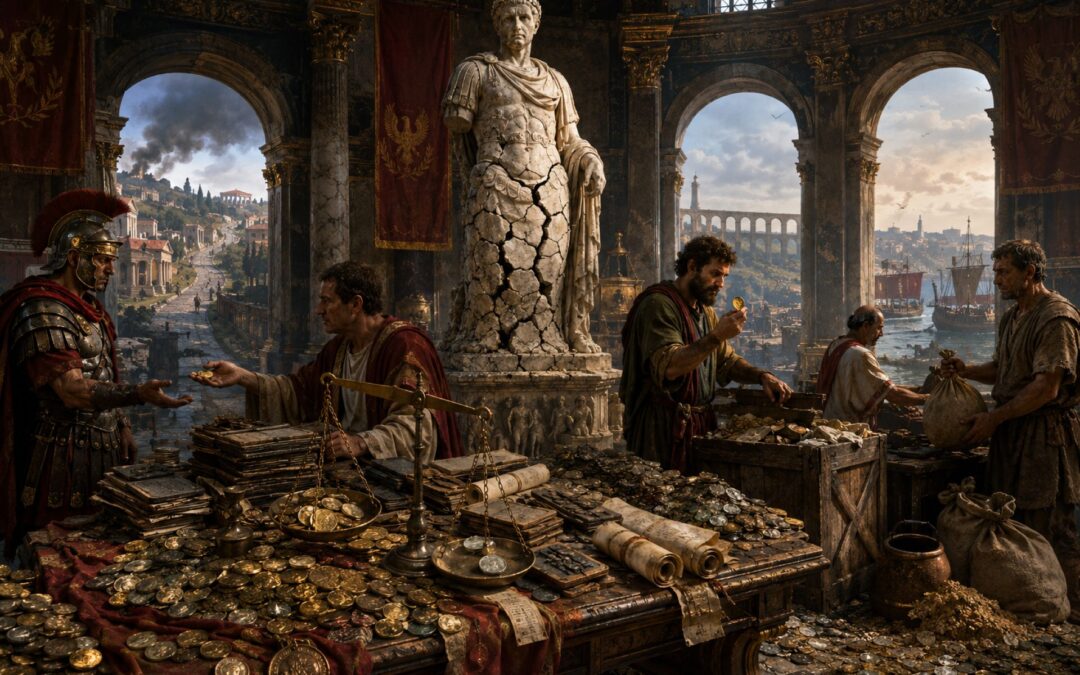
Rome did not collapse because one thing went wrong.
That is what makes its story so unsettling.
The Roman Empire was not a fragile state waiting for one bad emperor, one barbarian invasion, or one financial mistake to bring it down. It was one of the most durable political systems the ancient world had ever seen. It built roads across continents, moved grain across seas, collected taxes from dozens of provinces, maintained huge armies, minted coins recognized across the Mediterranean, and governed cities from Britain to Egypt.
For centuries, Rome worked.
Then, slowly, the same system that had made the empire powerful began to turn against itself.
The army that protected Rome became impossibly expensive. The taxes that funded the state became heavier and more damaging. The money that connected the empire lost credibility. Trade became harder to sustain. Reforms meant to restore order often made ordinary economic life more rigid.
Rome was not simply destroyed from the outside.
It also weakened the economic foundations that allowed it to survive.
This does not mean that economics alone explains the fall of Rome. The empire faced civil wars, invasions, plagues, political instability, administrative division, and military disasters. But beneath those dramatic events was a deeper problem: Rome increasingly solved its political and military problems by damaging its own economy.
That is the story worth understanding.
Rome Was Not an Economic Backwater
It is easy to imagine the ancient world as simple, local, and primitive. Rome was anything but.
The empire had a vast, connected economy. Grain from Egypt fed Rome. Wine, olive oil, pottery, metals, textiles, and luxury goods moved across provinces. Merchants used sea lanes, river routes, roads, ports, warehouses, and credit networks. Coins circulated widely. Contracts, taxes, prices, rents, and wages all tied people into a larger imperial system.
The Roman economy was not modern in the way a capitalist economy is modern. It depended heavily on slavery, conquest, landownership, hierarchy, and state power. But it was still far more sophisticated than a loose collection of villages.
Economic historian Peter Temin argued in The Roman Market Economy that the early Roman Empire had a surprisingly integrated market system by ancient standards. Prices, trade, shipping, and money connected distant regions in ways that allowed the empire to function at scale.
That scale mattered.
Rome could not feed its capital, pay its soldiers, or supply its cities without economic coordination. Its power was not just military. It was logistical.
Stanford’s ORBIS project helps show how large and complex this world was. It maps the cost of moving people and goods across the Roman Empire by road, river, and sea. The lesson is clear: Rome’s economy depended on connectivity. The empire was not just territory on a map. It was a system of movement.
That system made Rome rich.
It also made Rome vulnerable.
When coinage lost trust, when roads became unsafe, when sea routes were disrupted, when taxes became crushing, and when the state demanded more from a weakening base, the empire’s economic machine did not simply slow down. It began to fracture.
The Empire Was Built on Expansion
Rome’s economy grew alongside conquest.
Expansion brought land, slaves, tribute, mines, taxes, loot, and new markets. Victorious generals returned with treasure. Provinces supplied grain, metals, manpower, and revenue. Conquered elites were gradually absorbed into the Roman order. Roads and cities followed armies. Trade followed roads and cities.
For a long time, conquest made the empire richer.
This created a dangerous habit.
Rome’s state structure was built during centuries when expansion could solve problems. Need land? Conquer it. Need money? Defeat a wealthy rival. Need slaves? Capture them. Need political glory? Win a war. Need loyalty? Distribute spoils.
The system was brutally effective while expansion continued.
But no empire can expand forever.
At a certain point, Rome’s borders became more expensive to defend than to extend. Conquest slowed. The empire still had wealth, but it could no longer rely on constant new inflows of treasure and slaves in the same way. The frontiers hardened. The military shifted from expansion to defense. The state’s costs remained enormous, but one of its great sources of surplus became less dependable.
This is one of the central tensions in Rome’s economic history.
The empire had built institutions, expectations, and military commitments during the age of expansion. But it then had to fund them during an age of consolidation, crisis, and defense.
The economy was no longer being fed by conquest in the same way.
Yet the empire still had to pay the bills.
The Army Became the Empire’s Biggest Bill
Rome’s army was the backbone of the empire.
It defended borders, suppressed revolts, built infrastructure, projected power, and made the imperial system believable. Without the army, Rome was just a claim. With the army, it was a fact.
But that fact was expensive.
Soldiers had to be paid. Forts had to be maintained. Roads, supply chains, weapons, animals, ships, and logistics had to be funded. Veterans expected rewards. Emperors depended on military loyalty. In times of civil war, rival claimants promised even more money to the troops in exchange for support.
The army protected the empire, but it also became the empire’s largest recurring burden.
This mattered because Rome’s political system made military spending hard to control. Emperors who underpaid soldiers risked rebellion. Emperors who needed the army’s support often bought it. Emperors facing invasions or rivals had little choice but to spend more.
A modern state can run deficits, issue bonds, centralize monetary policy, and borrow in deep capital markets. Rome did not have that kind of financial system. Its options were more limited. It could tax more. It could confiscate. It could demand payments in kind. It could debase its coinage. It could impose controls.
All of these solved immediate problems.
All of them carried long-term costs.
The empire’s military needs kept rising just as its economic foundations became less stable. The result was a vicious cycle: more instability required more military spending, and more military spending required policies that created more instability.
Rome needed the army to survive.
But paying for survival helped weaken the economy that made survival possible.
Currency Debasement Was Rome’s Hidden Tax
Money is a social agreement.
A coin is not valuable only because it has an emperor’s face on it. It is valuable because people believe it can be exchanged for goods, services, taxes, wages, and savings. Once that belief weakens, the economy becomes harder to govern.
Rome learned this the hard way.
For centuries, Roman coinage helped connect the empire. The denarius, one of Rome’s most famous silver coins, became a symbol of imperial stability. But over time, emperors facing fiscal pressure reduced the precious metal content of coins while still trying to pass them at official value.
This was currency debasement.
In simple terms, the state stretched its money.
If the government had less silver but still needed to pay soldiers and officials, it could mint more coins using less silver per coin. On paper, this created more money. In practice, it quietly transferred value from everyone who trusted the currency to the state that weakened it.
That is why debasement can be understood as a hidden tax.
The state did not always need to announce a new tax. It could reduce the value of the money people already used.
The problem is that people eventually notice.
As the silver content of coins declined, trust declined with it. Sellers demanded more coins for the same goods. Soldiers wanted higher pay. Tax collectors and merchants became more suspicious of official money. Prices became harder to compare. Saving became riskier. Long-distance exchange became more uncertain.
The history of the Roman denarius shows this long deterioration. What began as a respected silver coin gradually lost weight and purity across the imperial period. Kenneth Harl’s Coinage in the Roman Economy is useful precisely because it shows coinage not as a technical detail, but as part of the empire’s larger fiscal and commercial system.
Rome did not debase its currency because emperors were stupid.
It did so because the state needed resources and had few painless ways to get them.
That is what makes the story more tragic.
Debasement was not irrational in the short term. It helped emperors pay bills, especially military bills. But in the long term, it damaged the trust that made imperial money useful in the first place.
Rome used money to solve a state problem.
Then the money became part of the state problem.
Inflation Made the System Harder to Govern
Inflation was not just an inconvenience for Rome.
It was a political problem, a military problem, and a social problem.
When prices rise unpredictably, the state cannot easily plan. Soldiers demand more pay because their wages buy less. Officials become harder to satisfy. Tax burdens become harder to calculate. Merchants protect themselves by raising prices or avoiding uncertain exchanges. Ordinary people lose confidence in money.
In an empire as large as Rome, that uncertainty was dangerous.
Rome depended on predictable extraction. The state had to collect taxes, move supplies, pay troops, and maintain order across enormous distances. If money lost credibility, every part of that process became harder.
A coin that people distrust does not simply lose economic value. It loses administrative value.
The state may declare that a coin is worth a certain amount, but markets do not always obey imperial confidence. If people believe the coin contains less value than before, they adjust. They charge more. They hoard better coins. They refuse bad ones. They move into barter or payments in kind. They become less willing to participate in formal exchange.
This is why inflation can weaken a state even when the state still exists.
The laws remain. The emperor remains. The tax collectors remain. The army remains.
But the invisible trust that allows money to move smoothly through the system begins to break down.
The Roman economy did not become impossible overnight. There were reforms, recoveries, regional differences, and long periods of adaptation. The Eastern Empire, in particular, would survive long after the Western Empire’s collapse. That alone should warn us against any simple “inflation destroyed Rome” explanation.
But inflation still mattered because it made every other problem harder.
Military spending became harder. Taxation became harsher. Trade became riskier. Political loyalty became more expensive. Reform became more desperate.
Inflation did not single-handedly end Rome.
It made Rome more difficult to hold together.
Taxation Became Heavier and Less Productive
When a state cannot get enough from growth, it gets more from extraction.
That is what happened to Rome.
As military costs rose and the currency became less reliable, taxation became more important. The empire needed revenue to pay soldiers, maintain administration, supply cities, and defend borders. But the heavier the demands became, the more they strained the productive base of society.
This is one of the oldest traps in political economy.
A strong state can collect taxes because the economy produces enough surplus. But if the state extracts too aggressively, it can weaken the very economy it depends on. Farmers hide output. Landowners seek exemptions. Local elites evade responsibility. Smallholders fall into dependency. Cities struggle under obligations. Tax collection becomes coercive rather than cooperative.
The Roman state increasingly needed more from people who had less reason to trust it.
This did not affect everyone equally. Wealthy landowners often had more ways to protect themselves. Ordinary farmers, laborers, tenants, and small producers had fewer options. As conditions worsened, the burden of maintaining the state could fall heavily on those least able to escape it.
Britannica’s overview of the Roman Empire notes the combination of commercial disruption, oppressive taxation, inflation, and military pressures that marked the empire’s difficulties. Those problems reinforced one another.
Taxation was not separate from inflation.
If money was unreliable, the state increasingly demanded payments in kind: grain, animals, labor, supplies. This could make sense administratively. Armies needed real goods, not just coins. But it also made economic life more rigid. Producers were tied more directly to state demands. Local communities became responsible for delivering what the imperial system required.
A flexible economy slowly became a more commanded one.
Again, this was not because Roman officials had no intelligence. They were trying to keep an enormous state alive during repeated crises. But the tools they used often shifted the burden downward and reduced the freedom of economic actors.
The more Rome struggled, the more it demanded.
The more it demanded, the more the economy struggled.
Trade Networks Became More Fragile
Rome was powerful because it connected distant places.
That connection was not automatic.
A merchant shipping grain across the Mediterranean needed safe seas, working ports, predictable rules, usable money, and customers who could pay. A landowner selling olive oil needed containers, transport, roads, market access, and enough stability to make the journey worthwhile. A city depending on imported food needed ships to arrive regularly. Soldiers on the frontier needed supplies moved across long distances.
The Roman economy was a network.
Networks can be strong, but they can also be fragile.
When the state was stable, Rome’s trade routes helped bind the empire together. When instability rose, those same routes became harder to maintain. Civil wars disrupted movement. Invasions threatened roads and frontiers. Piracy and insecurity raised costs. Debased currency made exchange less trustworthy. Heavy taxation reduced incentives. Local production and regional self-sufficiency became more important as long-distance trade became harder.
The empire did not simply “lose trade” in one dramatic moment.
Trade became more difficult, more expensive, and less reliable.
That distinction matters.
The Roman world had always contained local economies. Not every village depended on global trade. But the imperial system as a whole depended on large-scale movement: grain to cities, taxes to the state, supplies to armies, luxury goods to elites, and money across provinces.
Stanford’s ORBIS model helps make this visible. Transport in the Roman world was shaped by distance, season, terrain, route, and mode of travel. Sea transport could be far cheaper than land transport, but it depended on ports, ships, timing, and security. Land transport was expensive. Rivers mattered. Geography mattered.
Rome’s infrastructure lowered the cost of empire.
When the empire weakened, those costs rose again.
This is also where Rome’s long-distance luxury trade becomes relevant. Roman elites imported goods from far beyond the empire, including from India. Your existing article on Greeks and Romans in Ancient India explores that world of Roman trade with India, including coins, ports, and luxury exchange. In the context of Rome’s economic decline, this trade is not the whole story, but it reveals something important: Rome’s economy was tied into networks far beyond Italy.
The empire was not isolated.
Its wealth depended on movement, trust, and exchange.
Once those weakened, Rome became harder to finance, harder to supply, and harder to govern.
Diocletian Tried to Command the Economy Back Into Order
By the late third century, the empire had been through a brutal period of crisis.
There had been civil wars, short-lived emperors, frontier attacks, inflation, military pressure, and administrative strain. The Roman state needed order. Diocletian, who became emperor in 284 CE, tried to provide it.
He was one of the most important reformers in Roman history.
Diocletian reorganized imperial rule, strengthened administration, changed taxation, restructured the military, and tried to stabilize the empire after decades of chaos. Some of his reforms helped the Roman state survive. But one of his most famous economic interventions shows how severe the crisis had become: the Edict on Maximum Prices.
Issued in 301 CE, Diocletian’s price edict attempted to set maximum prices for a vast range of goods and services. A surviving reconstruction of the Edict on Maximum Prices lists prices for food, clothing, transport, wages, animals, and many other items.
The ambition was staggering.
The state was trying to command economic reality back into order.
The logic was understandable. If prices were rising, if soldiers and civilians were suffering, if merchants were accused of greed, and if money had become unstable, then fixing prices by law might look like justice. It promised control. It promised fairness. It promised an end to chaos.
But prices are not just numbers.
They are signals.
They reflect scarcity, transport costs, risk, trust, supply, demand, and expectations. A state can punish people for charging above a legal maximum, but it cannot easily force goods to appear at a price sellers consider unrealistic. If official prices are too low, goods disappear, black markets grow, quality falls, or enforcement becomes brutal.
Diocletian’s edict was not the cause of Rome’s economic problems.
It was evidence of them.
A healthy economy does not need an emperor to publish a massive list of maximum prices across the empire. The edict shows that the state was trying to fight symptoms created by deeper problems: monetary instability, fiscal pressure, military demands, and a strained productive base.
This is the pattern that makes Rome’s economic decline so important.
The empire faced real problems. It responded with stronger control. Some control was necessary. But too much control made economic life more rigid, more fearful, and less adaptive.
Rome was trying to restore order.
But order imposed on a weakened economy can become another form of weakness.
Rome’s Economy Did Not Collapse Overnight
The phrase “the fall of Rome” makes the story sound cleaner than it was.
Rome did not wake up one morning and stop being an empire.
Its economy did not collapse everywhere at the same time. Some regions suffered more than others. Some reforms helped. Some cities declined while others adapted. The Eastern Roman Empire remained a major power long after the Western Empire fell in 476 CE. Trade continued. Coins continued. Taxes continued. People farmed, sold, bought, paid, moved, and survived.
Economic decline is not the same as disappearance.
This matters because simple explanations are tempting.
“Rome fell because of inflation.”
“Rome fell because of taxes.”
“Rome fell because of barbarians.”
“Rome fell because of decadence.”
Each explanation captures something, but none captures enough.
The better way to understand Rome’s economic decline is as a chain of reinforcing pressures.
Expansion slowed, but costs remained.
The army became more expensive, but the state could not easily reduce it.
The state debased currency, but debasement weakened trust.
Inflation rose, making administration and exchange harder.
Taxes became heavier, weakening incentives and local economies.
Trade networks became more fragile, reducing integration.
The state imposed controls, but controls could not recreate lost confidence.
No single link explains everything.
Together, they show how a powerful empire can become trapped by its own survival mechanisms.
Rome’s economy was not destroyed by one foolish policy. It was weakened by repeated choices that made sense in emergencies but became destructive when emergencies never ended.
That is the deeper lesson.
The Roman state became very good at extracting resources.
But extraction is not the same as renewal.
An empire can take grain, collect taxes, mint coins, command prices, and move soldiers. But if the people producing, trading, saving, and investing lose trust in the system, the state is left managing decline rather than generating strength.
Rome survived for centuries because it was adaptable.
It weakened when adaptation increasingly meant coercion.
The Real Lesson of Rome’s Economic Decline
Rome’s economic decline is not a simple morality tale about bad emperors or greedy citizens.
It is a warning about systems under pressure.
When a state becomes desperate, it reaches for tools that bring immediate relief. It raises taxes. It weakens money. It controls prices. It demands more from local communities. It prioritizes military survival over economic flexibility. It treats trust as something that can be commanded rather than earned.
For a while, this can work.
Soldiers get paid. Grain gets collected. Borders get defended. Officials keep governing. The empire continues.
But the cost accumulates beneath the surface.
Money loses credibility. Producers lose incentives. Trade loses reliability. Taxpayers lose trust. Local economies turn inward. The state must use more force to get the same result. What once looked like strength becomes a sign of fragility.
Rome’s tragedy was not that it had no economy.
It was that it had a remarkable economy, and slowly made it harder for that economy to breathe.
The empire had roads, ports, coins, laws, markets, farms, cities, soldiers, and administrators. It had the machinery of power. But power is not enough. A state also needs a productive base that believes participation is worth it.
Rome kept trying to save the empire by demanding more from that base.
Eventually, in the West, the base could no longer support the structure above it.
That is how Rome destroyed its own economy: not in one dramatic act, but through a long series of decisions that traded future resilience for present survival.
Last Updated on June 29, 2026 by Aseem Gupta