
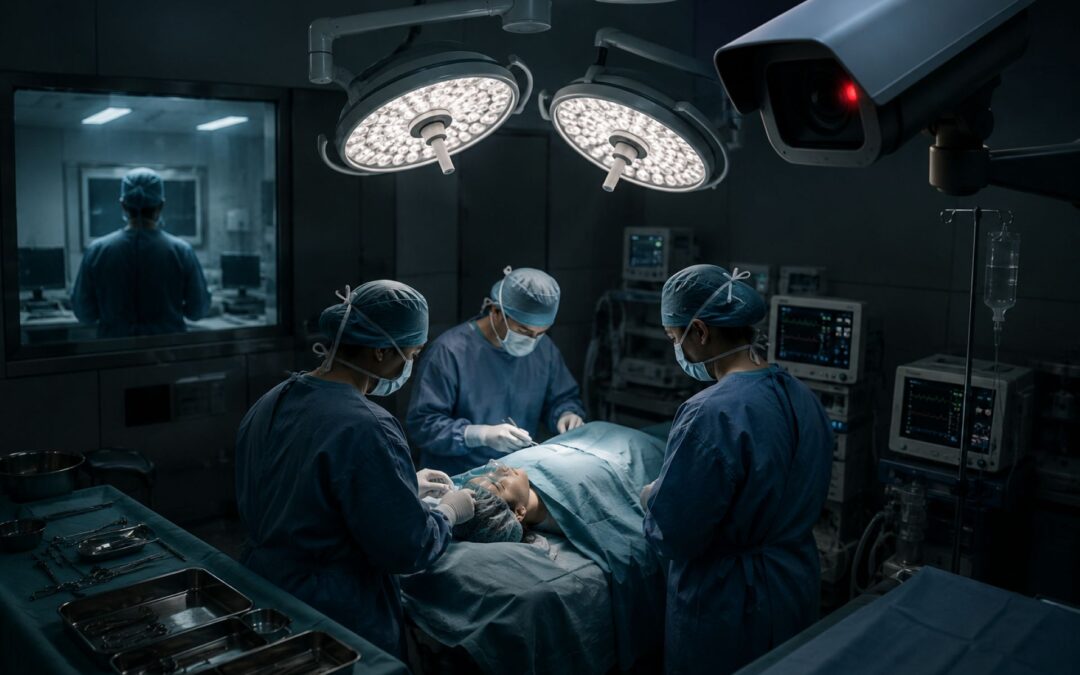
In 2016, a 24-year-old university student named Kwon Dae-hee walked into a plastic surgery clinic in Seoul for jawline surgery.
He never came home.
The procedure was supposed to reshape his chin and jaw. It was not emergency surgery. It was not a life-saving operation. It was the kind of cosmetic procedure that South Korea’s beauty industry had made almost ordinary: a young person paying to change the structure of his face in one of the world’s most advanced plastic surgery markets.
But inside the operating room, something went terribly wrong.
According to Reuters’ reporting on Kwon’s case, CCTV footage later showed that the chief surgeon left the operating room while Kwon was still under anesthesia. Other staff members continued the procedure. Kwon bled heavily. Nurses were seen mopping blood from the floor again and again.
He died weeks later.
His mother, Lee Na-geum, did not accept the clinic’s version of events. She obtained the operating-room footage and watched it repeatedly, frame by frame, trying to understand what had happened to her son while he was unconscious and unable to speak for himself.
What she found turned Kwon’s death into a national scandal.
The issue was not only surgical negligence. It was something more disturbing: the fear that patients were consenting to one surgeon, being put under anesthesia, and then being operated on by someone else.
South Korea came to know this as “ghost surgery.”
And Kwon Dae-hee’s case helped force the country to confront a terrifying question.
When you are unconscious on an operating table, how do you know who is holding the scalpel?
The Surgery Kwon Dae-hee Never Came Back From
Kwon Dae-hee’s death became one of the most important patient-safety cases in modern South Korea because it revealed what patients normally cannot see.
Surgery depends on trust. A patient chooses a doctor, signs consent forms, enters the operating room, receives anesthesia, and disappears from their own experience. From that moment until they wake up, they have no memory, no control, and no way to verify what happened.
That is why consent matters so much.
The patient is not merely agreeing to a procedure. The patient is agreeing to a particular professional relationship: this doctor, this role, this responsibility.
In Kwon’s case, that trust appears to have broken down. Reuters reported that his mother alleged the surgery was partly performed by an unqualified nursing assistant and an intern doctor rather than the chief plastic surgeon he believed would handle the procedure. The head surgeon was later found guilty of involuntary manslaughter and sentenced to prison.
But the reason the case became larger than one clinic was the video.
Without CCTV footage, Kwon’s family may have had almost no way to prove what happened inside the operating room. Medical records could be incomplete. Staff testimony could conflict. The patient, of course, could say nothing.
He had been unconscious.
That is the cruelest part of ghost surgery. The person most violated by it is the person least able to witness it.
Kwon’s mother understood this. Her campaign was not only about justice for her son. It was about every patient who enters an operating room believing one thing, only to have something else happen behind closed doors.
Her fight eventually helped inspire what many Koreans called the “Kwon Dae-hee law”: a legal push to require cameras in operating rooms.
It was an extraordinary response.
But the scandal behind it was extraordinary too.
What Is Ghost Surgery?
Ghost surgery means a patient agrees to be operated on by one surgeon, but another person performs part or all of the operation without the patient’s informed consent.
That substitute may be another doctor. It may be a junior doctor. In the worst cases, it may be someone who is not qualified to perform the procedure at all.
The ethical violation is simple.
The patient consented to one surgeon.
Someone else did the work.
The patient was never told.
A medical paper in the Annals of Surgical Treatment and Research described ghost surgery in Korea as a serious breach of informed consent and professional ethics. The article noted that while Korea’s Medical Service Act required patients to be informed about the main surgeon, there had been legal gaps around directly punishing ghost surgery itself.
That legal gap matters.
If a patient agrees to surgery from a famous plastic surgeon, but the actual cutting is done by someone else, the problem is not only poor service. It is not like receiving the wrong brand at a store or being assigned a different waiter at a restaurant.
Medicine is different because consent is specific.
You are not just buying an outcome. You are trusting a person with your body.
In cosmetic surgery, this becomes especially complicated because reputation is part of the product. Patients may choose a clinic because of a well-known surgeon’s name, skill, marketing, media presence, or before-and-after portfolio. The “star surgeon” is often the selling point.
Ghost surgery turns that reputation into bait.
The patient pays for the expert, but the expert may not be the one performing the operation.
In an ordinary consumer market, that would be deception.
In an operating room, it can be fatal.
Why Ghost Surgery Is So Hard to Prove
Ghost surgery is difficult to prove for one obvious reason: the patient is unconscious.
That makes it different from many other forms of malpractice. If a doctor says something offensive during a consultation, the patient hears it. If a clinic overcharges, there may be a bill. If a prescription is wrong, there may be paperwork.
But in surgery, the most important events happen when the patient has disappeared from their own memory.
They cannot see who enters the room.
They cannot know who leaves.
They cannot track who makes the incision.
They cannot confirm who closes the wound.
They cannot judge whether the person doing the work is qualified.
Afterward, the patient may only have a result: pain, scars, complications, dissatisfaction, or in the worst cases, death.
That is why documentation becomes so important. But documentation is also controlled by the medical institution. If records are vague or misleading, the patient faces an enormous evidentiary problem.
This is the core reason operating-room CCTV became such a powerful idea in South Korea.
For patients and families, cameras offered something the system had denied them: proof.
Kwon Dae-hee’s case showed why. His mother did not have to rely only on statements from the clinic. She had footage. She could see who was in the room, who left, who stayed, and what happened while her son was helpless.
That kind of evidence is rare.
It is also deeply uncomfortable.
Nobody wants to imagine surgery as a crime scene that needs surveillance. A hospital is supposed to be a place of trust. An operating room is supposed to be a sacred professional space where expertise, discipline, and ethics guide every movement.
But ghost surgery breaks that ideal.
Once patients believe the room may hide deception, privacy starts to look less like protection and more like concealment.
That is why the debate became so heated. South Korea was not only arguing about cameras.
It was arguing about whether medical trust had already failed.
How South Korea’s Cosmetic Surgery Industry Became Vulnerable
Ghost surgery can happen in many medical fields. It is not limited to plastic surgery, and it would be unfair to pretend every South Korean surgeon is suspect.
But South Korea’s cosmetic surgery industry had special conditions that made the scandal especially explosive.
The country is one of the world’s major centers for plastic surgery. Seoul’s Gangnam district became famous for its dense concentration of clinics, aggressive marketing, medical tourism, and highly competitive beauty services. In that environment, famous surgeons could become brands.
That created a dangerous incentive.
If patients come for one doctor’s name, a clinic can increase volume by having that doctor consult, advertise, or appear briefly — while less experienced staff perform more of the actual work. The more procedures a clinic can process, the more revenue it can generate.
This does not mean every clinic behaves this way.
But it shows why the temptation exists.
Cosmetic surgery also occupies a strange space between medicine and consumer aspiration. The patient is vulnerable like any surgical patient, but the industry often markets itself like luxury retail: transformation, confidence, perfection, prestige.
That mixture can blur priorities.
A clinic may present itself as a place of artistry and self-improvement. But under the surface, it is still a medical institution performing invasive procedures under anesthesia. The risks are real. The consent must be real. The accountability must be real.
In ghost surgery, all three become uncertain.
The patient may believe they are choosing a particular surgeon’s hands. In reality, they may be entering a system designed to distribute labor behind the scenes.
That is what made the scandal so frightening. It suggested that the problem was not only one rogue doctor or one negligent clinic.
It suggested a business model where the patient’s trust could be monetized before anesthesia and ignored afterward.
The Mother Who Turned CCTV Into Evidence
Lee Na-geum became central to the ghost surgery debate because she did something institutions often hope grieving families will not do.
She kept looking.
She reportedly watched the CCTV footage of her son’s surgery more than a thousand times. That detail is almost unbearable. A mother replaying the final hours of her child’s life, not because she wanted to, but because the truth was hidden inside the footage.
Her persistence changed the case.
It transformed Kwon from another victim of a medical accident into the face of a national patient-rights movement. His death became proof that operating rooms were not always transparent, that informed consent could be violated behind closed doors, and that families needed evidence to challenge powerful medical institutions.
The legal outcome mattered. The head surgeon was convicted of involuntary manslaughter. But Lee’s campaign reached beyond the courtroom.
She argued that other families might never know what happened to their loved ones because they had no video. If her son’s surgery had not been recorded, the truth may have remained buried under medical jargon, institutional silence, and the natural confusion that follows an unexpected death.
That is what made her campaign so powerful.
It was not only grief.
It was grief turned into evidence.
Evidence turned into public pressure.
Public pressure turned into law.
The South Korean public responded strongly. Reuters reported that a poll by the Anti-Corruption and Civil Rights Commission found overwhelming support for operating-room cameras, with 97.9% of nearly 14,000 respondents backing the measure.
That level of support reveals something important. The public was not merely angry about one death. People recognized a broader vulnerability.
Anyone can become powerless under anesthesia.
Anyone can be asked to trust.
And if that trust is broken, anyone may need proof.
The Law That Put Cameras in Operating Rooms
In 2021, South Korea’s National Assembly passed a law requiring hospitals to install cameras in operating rooms where patients undergo surgery while unconscious. The measure came after years of public pressure over medical accidents, ghost surgery accusations, and cases involving unqualified substitutes.
Reuters described South Korea as the first developed country to require closed-circuit cameras to record surgical procedures under such a law.
The law did not mean every operation would automatically become a public video record. The more accurate point is that hospitals must have cameras installed, and patients undergoing surgery while unconscious can request that their procedure be recorded, subject to specific legal conditions and exceptions.
A later ethics analysis of Korea’s amended Medical Service Act explained that Article 38-2 went into effect in September 2023 and created a new legal framework around CCTV cameras in operating rooms. The article framed the issue around a patient’s postsurgical right to know who did what to them while they were unconscious.
That phrase is important: the right to know.
In ordinary medical ethics, informed consent focuses heavily on what happens before surgery. The patient should know the risks, benefits, alternatives, and identity of the surgeon.
But ghost surgery creates a second problem after surgery.
The patient may have consented properly before the operation, only for the actual events to deviate from that consent while they were unconscious. In that case, the patient does not only need information beforehand. They need a way to verify what happened afterward.
CCTV became the legal answer to that gap.
It was a radical answer because it brought surveillance into one of medicine’s most private spaces. But supporters argued that the operating room was already private in a way that favored institutions over patients. The cameras did not create mistrust, they argued.
They responded to mistrust that already existed.
Why Doctors Fought the Camera Law
The camera law had massive public support, but many doctors strongly opposed it.
Their concerns should not be dismissed.
Operating rooms are sensitive spaces. Patients are exposed. Medical staff perform high-pressure work where decisions must be made quickly. Surgeries can involve blood, complications, emergencies, mistakes, teaching moments, and deeply private bodily realities. Recording all of that creates serious ethical risks.
The Korean Medical Association argued that operating-room cameras could damage trust between doctors and patients, violate privacy, and discourage doctors from taking difficult risks during surgery. Reuters reported that the association also warned that young doctors might avoid surgical specialties if they felt constantly surveilled.
A paper in the Journal of Korean Medical Science laid out several concerns around mandatory operating-room CCTV, including privacy leaks, violations of medical personnel’s rights, defensive medicine, increased legal disputes, and possible damage to surgical training.
These are real concerns.
A leaked surgical video could be devastating for a patient. A surgeon worried about litigation might become overly cautious in a crisis. Residents may learn less if teaching hospitals fear every imperfect training moment will be judged out of context. A camera may capture images, but not always the full complexity of surgical judgment.
There is also a deeper professional concern: doctors do not want to be treated like suspects by default.
Medicine depends on trust from both sides. Patients must trust doctors, but doctors also need an environment where they can act decisively without feeling that every movement is being watched by future prosecutors, journalists, or angry families.
That is the strongest argument against the law.
But it runs into a painful counterargument.
Patients were already being asked to trust completely. In ghost surgery cases, that trust was allegedly abused. If professional self-regulation had been enough, the public may not have demanded cameras in the first place.
The debate, then, is not really between trust and surveillance.
It is between two damaged forms of trust: doctors who fear being recorded, and patients who fear being deceived.
What the Scandal Reveals About Patient Trust
The ghost surgery scandal reveals a brutal truth about modern medicine.
Trust is not created by asking for it.
It is created by systems that deserve it.
For years, patients were expected to believe that the surgeon they selected would be the surgeon who operated. They were expected to believe that hospitals and clinics would accurately document what happened. They were expected to believe that if something went wrong, the truth would emerge through proper channels.
But ghost surgery attacked each layer of that belief.
It made patients wonder whether consent forms meant anything once anesthesia began. It made families wonder whether medical records could be trusted. It made the public wonder whether professional associations were protecting patients or protecting doctors.
That is why the operating-room camera law became so symbolically powerful.
The camera was not just a device. It was a confession that the old trust system had failed.
In an ideal medical culture, no patient should need a video to know who performed their surgery. No family should have to investigate a loved one’s death by replaying operating-room footage. No mother should have to become a forensic examiner to prove that her son’s consent was violated.
But once those things happen, asking patients to “just trust the system” becomes impossible.
This is the larger lesson of South Korea’s ghost doctor scandal. It is not only about plastic surgery. It is not only about one clinic or one surgeon. It is about what happens when a profession’s internal rules are no longer enough to reassure the people most vulnerable to its power.
A patient under anesthesia has no agency.
That is why the system around them must be unusually honest.
Cameras Can Expose the Problem. They Cannot Fix the Culture Alone.
South Korea’s operating-room camera law may help expose ghost surgery. It may deter some clinics from substituting surgeons. It may give patients and families evidence when something goes wrong.
But cameras alone cannot fix the deeper problem.
A camera can record who entered the room. It cannot automatically create ethical culture. It cannot guarantee that patients understand their rights. It cannot ensure that footage is easy to access, safely stored, or interpreted fairly. It cannot replace strong consent rules, medical accountability, licensing enforcement, and a professional culture that treats surgical substitution as a grave betrayal rather than an operational shortcut.
There are already signs that implementation matters as much as legislation. Reporting from ChosunBiz in 2026 suggested that some patients may still be missing the option to request operating-room CCTV recording, which shows that a right is only meaningful if people know they have it and can actually use it.
That is why the ghost surgery scandal should not be remembered only as the story of a camera law.
It should be remembered as a warning about invisible power.
The operating room is one of the few places where a person gives up total control over their body and trusts strangers to act with skill, honesty, and restraint. That trust is sacred because the patient cannot defend it in the moment.
Kwon Dae-hee could not ask who was operating on him.
He could not object when the surgeon left.
He could not call for help when he was bleeding.
He could not testify afterward.
His mother had to speak for him.
And because she did, South Korea was forced to confront a truth that extends far beyond one country’s plastic surgery industry: consent means little if no one can prove whether it was honored.
Cameras may now watch some operating rooms.
But the real goal should be a medical system where patients do not need cameras to know they were not betrayed.
Last Updated on June 9, 2026 by Aseem Gupta