
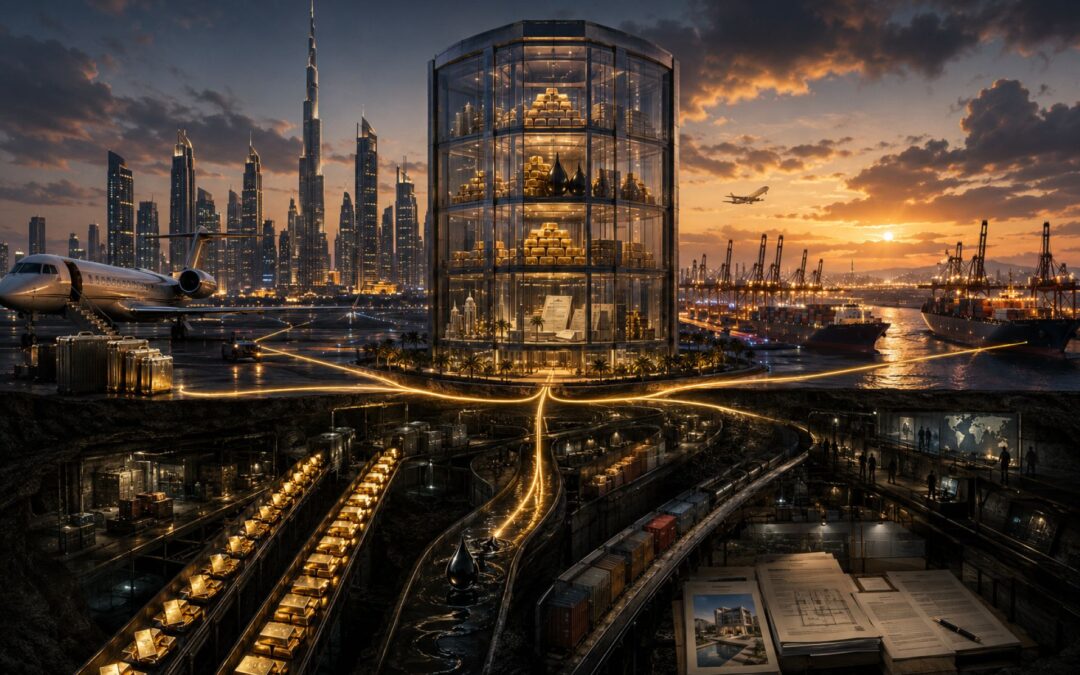
Introduction: The Suitcases of Gold
In November 2020, two Canadians boarded a private jet at Yaoundé International Airport in Cameroon.
Their destination was Dubai.
Before the plane could take off, Cameroonian police searched the aircraft. Inside ten large suitcases, they reportedly found more than 250 kilos of gold bars. At today’s prices, that would be worth tens of millions of dollars.
The strange part was not simply that the gold was being smuggled.
The strange part was where it was going.
Dubai is not where most of the world’s gold is mined. It is not the final destination for most of the gold that passes through it either. Much of that demand comes from places like India and China, where gold is bought, worn, stored, and traded on a vast scale.
Dubai’s role is different.
It is the place in the middle.
Over the last few decades, Dubai has built one of the most successful middleman economies in the world. It connects East and West, rich and poor countries, oil exporters and oil buyers, banks and traders, tourists and property developers, legitimate companies and people who would rather not answer too many questions.
That is the brilliance of Dubai.
It is also the problem.
The same system that made Dubai a global business hub has also made it a global grey-zone hub: a place where smuggled gold, sanctioned oil, offshore property money, and questionable fortunes can move with unusual ease.
Dubai did not become this kind of city by accident. It was built to be open, fast, low-tax, and business-friendly.
But when a city is designed to move money and goods quickly, it does not always stop to ask where they came from.
Dubai Was Built to Be a Middleman
The modern image of Dubai is so familiar that it almost feels artificial: skyscrapers, supercars, luxury malls, artificial islands, influencers, finance conferences, crypto events, and glass towers rising out of the desert.
But this version of Dubai is extremely recent.
Before oil wealth transformed the Gulf, the area that became the United Arab Emirates was poor, sparse, and difficult to develop. Much of the country was desert. Infrastructure was limited. Abu Dhabi had the largest oil reserves. Dubai did not.
That mattered.
Abu Dhabi could rely on oil. Dubai had to build something else.
So it became a service economy.
Dubai invested in ports, airlines, airports, free zones, tourism, finance, and real estate. It positioned itself as a place where foreign companies could set up quickly, pay little tax, trade across borders, and access markets in Asia, Africa, Europe, and the Middle East.
Jebel Ali became one of the great shipping hubs of the region. DP World describes Jebel Ali Port as the largest man-made harbour in the world and a major link to more than 150 ports. Dubai International Airport became one of the world’s busiest airports for international passengers, reinforcing the city’s role as a global crossroads.
Then came the free zones.
Dubai’s free zones offered foreign ownership, tax advantages, simplified regulation, and sector-specific business environments. The Dubai Multi Commodities Centre, the Dubai International Financial Centre, JAFZA, and other zones helped turn the city into a place where companies could incorporate, trade, finance deals, and route goods through one of the world’s most connected locations.
This was not fake success.
Dubai really did build a powerful legitimate economy. It became a hub for aviation, tourism, logistics, property, finance, commodities, and professional services. It gave businesses something they wanted: speed, convenience, infrastructure, and access.
The pitch was simple.
Come here. Do business. Keep more of your money. Ask fewer questions. Move faster.
For legitimate companies, that was attractive.
For less legitimate money, it was irresistible.
The Same System That Moves Legal Trade Can Move Dirty Trade
There is a mistake people often make when they think about illicit finance.
They imagine a hidden underworld separate from the clean economy. Secret rooms. Criminal banks. Shadowy men moving suitcases through back doors.
That world exists, but it is only part of the story.
The modern hidden economy usually does not need a separate infrastructure. It uses the same infrastructure as the legitimate economy.
The same ports that move legal cargo can move suspicious cargo.
The same company registries that help entrepreneurs can help shell companies.
The same real estate market that attracts investors can absorb stolen wealth.
The same banks and trade-finance networks that support global commerce can help sanctioned goods reach buyers.
The same political neutrality that makes a country useful as a diplomatic bridge can make it useful as a sanctions workaround.
Dubai’s genius is that it sits in the middle of everything.
It is connected enough to be useful to the global economy, but flexible enough to serve people and companies that face tighter scrutiny elsewhere. It is modern, wealthy, and legitimate enough to attract respectable capital, but permissive enough to attract money that would struggle in London, New York, Geneva, or Frankfurt.
That is why Dubai’s grey economy is not a contradiction of its business model.
It is an extension of it.
The city became a hub because it reduced friction. But friction is sometimes what keeps dangerous money from moving.
Case Study 1: African Gold and the Problem of Origin
Gold is almost perfectly designed for the hidden economy.
It is valuable, compact, easy to melt, easy to transport, and difficult to trace once it enters the refining system. A small quantity can represent enormous wealth. Unlike oil, it does not need pipelines, tankers, or complex infrastructure. Unlike bank transfers, it can cross borders physically.
That makes it ideal for smugglers.
A major 2024 report by SWISSAID, covered by Reuters, estimated that hundreds of tonnes of gold worth tens of billions of dollars are smuggled out of Africa each year, with the United Arab Emirates receiving the largest share. The report found that in 2022, around 435 tonnes of gold were smuggled out of Africa, and around 405 tonnes went to the UAE.
The problem is not simply that gold reaches Dubai.
The problem is that official records often do not match.
A country may officially report exporting a certain amount of gold. The UAE may report importing much more gold from that same country. The gap suggests that gold is leaving without being declared, taxed, or properly documented.
This matters because a large share of African gold comes from fragile and high-risk environments. In some countries, artisanal and small-scale mining is tied to dangerous working conditions, child labour, armed groups, corruption, and local violence. Organizations such as The Sentry have documented how conflict gold can be linked to armed networks, money laundering, and political corruption in parts of Africa.
Once that gold enters a major trading and refining hub, its origin can become harder to see.
That is where Dubai matters.
Dubai is not necessarily the final buyer. It is the point where gold can be aggregated, refined, documented, and re-exported into global markets. By the time it reaches jewellery buyers, investors, or industrial users, the dirty origin story may have disappeared.
This is the central trick of the grey economy.
It does not always make illegal goods vanish.
It makes them look ordinary.
Gold that begins in an informal mine, passes through smugglers, avoids tax authorities, and moves through opaque trading networks can eventually reappear as clean gold in the global market.
Dubai did not invent this system. Switzerland has long played a huge role in the global gold trade. But Dubai’s combination of location, permissive regulation, commodities infrastructure, and access to Asian demand has made it a natural hub for gold that does not move through the most transparent channels.
The suitcase full of gold is dramatic.
The paperwork that follows is where the real magic happens.
Case Study 2: Russian Oil and Sanctions Whack-a-Mole
Gold shows how Dubai can help obscure origin.
Russian oil shows how Dubai can help reroute power.
After Russia’s full-scale invasion of Ukraine in 2022, the United States, the European Union, the United Kingdom, and other Western allies tried to limit Moscow’s oil revenue without crashing the global energy market. The goal was not simply to ban all Russian oil everywhere. That would have risked a price shock.
Instead, the G7 and its partners created a price-cap system.
Russian oil could still flow to non-Western buyers, but Western shipping, insurance, and financial services were supposed to be available only if the oil was sold at or below the cap.
In theory, this was a clever compromise.
In practice, it created a massive incentive to build new trading routes outside the Western system.
Before the war, a large amount of Russian oil trading was handled through Switzerland, especially Geneva. But as sanctions pressure increased, Russian-linked trading activity began moving elsewhere. A Public Eye investigation argued that Dubai rapidly gained market share as a hub for Russian oil trading after Switzerland became less convenient.
The mechanism was simple.
Russian oil still had buyers, especially in Asia. India and China were willing to buy large volumes. But moving oil is not just a matter of finding a buyer and seller. It requires traders, shipping, insurance, finance, letters of credit, corporate entities, and risk management.
When the old channels became politically or legally risky, new intermediaries appeared.
Dubai was well placed to host them.
One example is Lukoil. Before the war, the Russian oil major’s trading arm operated heavily through Switzerland. But after sanctions pressure increased, Dubai-linked entities became more important. Reuters later reported that Lukoil set up Alghaf Marine DMCC in Dubai after pressure on its earlier trading structure.
This is the sanctions whack-a-mole problem.
A company is sanctioned. A new entity appears.
That entity is scrutinized. Another one emerges.
The oil keeps moving.
The trader changes. The route changes. The paperwork changes. But the underlying commercial reality remains: Russia has oil to sell, India and China have demand, and middlemen can make money connecting the two.
Dubai is not the only node in this system. Hong Kong, Turkey, Singapore, and other jurisdictions also matter. The Russian “shadow fleet” of tankers has become its own complex world of obscure ownership, reflagged vessels, insurance workarounds, and ship-to-ship transfers. Research by the Centre for Research on Energy and Clean Air has shown how non-Western shipping networks have helped Russia reduce its dependence on Western maritime services.
But Dubai’s role is distinctive because it combines several advantages at once.
It is politically neutral enough not to fully align with Western sanctions.
It is financially connected enough to support major commodity trading.
It is geographically well placed between Russia, Asia, Africa, and the Middle East.
It has business zones where companies can be created and operated with relative ease.
And it has no desire to surrender its role as a global middleman just because Washington, Brussels, or London wants a cleaner sanctions regime.
That does not mean every Russian oil trade routed through Dubai is illegal. Some trades may comply with the letter of sanctions law. Others may exploit gaps. Others may violate rules outright.
That ambiguity is the point.
Dubai thrives in the grey area between what is banned, what is allowed, what is tolerated, and what is simply too complicated to police.
Case Study 3: Dubai Property as a Vault for Offshore Wealth
If gold and oil show how money moves through Dubai, real estate shows how money stays there.
Luxury property has always been useful to the wealthy. It offers status, comfort, rental income, and capital appreciation. But in offshore finance, property can do something even more important.
It can store wealth.
A bank account can be frozen. A shell company can be investigated. A political scandal can expose a suspicious transfer. But a villa, penthouse, or apartment in a booming international city can quietly hold millions of dollars in value.
That is why Dubai real estate has become so attractive to foreign wealth.
Dubai offers low taxes, high-end property, political stability, global connectivity, a luxury lifestyle, and in many cases, residency advantages. It also has historically offered limited transparency about who owns what.
That combination is powerful.
The Dubai Uncovered investigation, coordinated by OCCRP and partners, found that Dubai property had attracted criminals, sanctioned figures, officials, and politically exposed persons from around the world. The later C4ADS Dubai Property Database reinforced the same concern: Dubai real estate has become a haven for people trying to park questionable wealth in hard assets.
The examples are striking.
A Carnegie Endowment investigation found that Nigerian politically exposed persons and their families were linked to hundreds of Dubai properties worth more than $400 million. For a country struggling with poverty, corruption, and underfunded public services, that is not just a real-estate story. It is a governance story.
Similar investigations have identified property linked to politically connected families, sanctioned individuals, criminal networks, and elites from countries where public wealth and private fortunes are often difficult to separate.
Again, the point is not that every foreign buyer in Dubai is corrupt.
Many are ordinary investors, businesspeople, professionals, retirees, or expatriates looking for a tax-friendly and globally connected place to live or invest.
But a property market does not need every buyer to be suspicious to become useful to suspicious money. It only needs enough opacity, enough luxury supply, enough foreign demand, and enough weak enforcement to make questions easy to avoid.
Research by the EU Tax Observatory found that Dubai has an unusually high share of residential real estate owned by non-resident foreigners. It estimated that foreign-owned property in Dubai represented tens of billions of dollars and that non-resident ownership was far higher than in many other major global cities.
That makes Dubai property different from ordinary real estate.
It is not just housing.
It is a global wealth-storage system made of towers, villas, shell companies, and title deeds.
For kleptocrats, tax evaders, sanctioned elites, and politically exposed families, that is extremely useful. Money that might look suspicious in a bank account can look normal when converted into a luxury apartment.
The building is visible.
The owner is not.
Why Dubai Replaced the Old Offshore Hubs
Dubai did not invent the hidden economy.
It inherited and modernized it.
For much of the twentieth century, Switzerland was the great symbol of offshore secrecy. Swiss banks offered discretion, prestige, and legal protection. London became another kind of magnet, especially through property, lawyers, private schools, banks, and elite respectability. Caribbean and Central American jurisdictions offered shell companies and low-tax structures. Panama, the Cayman Islands, the British Virgin Islands, Luxembourg, Singapore, and others all played different roles in the offshore world.
Dubai belongs in that family.
But it is not just another tax haven.
It represents a newer model.
Switzerland’s old appeal came from institutional age and exclusivity. Dubai’s appeal comes from speed, openness, infrastructure, and flexibility. It is less about quiet mahogany offices and more about free zones, skyscrapers, private banking, commodity trading, luxury property, and global aviation.
It is offshore finance for a multipolar world.
This matters because global power is changing.
For decades, the Western financial system had enormous leverage. Dollars, London banks, Swiss traders, European insurers, American sanctions, and Western-dominated institutions shaped how global money moved. If the West wanted to squeeze a country, company, or oligarch, it could use that infrastructure as a weapon.
That system still matters enormously.
But it is no longer the only game in town.
Russia can sell more oil to Asia. African gold can move through Dubai. Wealthy families from politically unstable countries can buy Gulf property. Commodity traders can shift entities from Switzerland to the UAE. Companies can use alternative banks, shipping networks, and corporate structures.
Dubai’s rise shows that the hidden economy is adapting to a world where money does not have to pass through Western chokepoints in the same way.
The irony is that Dubai is not really anti-Western.
It is deeply integrated into Western capitalism. Western banks, lawyers, consultants, developers, tourists, investors, and luxury brands all benefit from Dubai’s growth. The city’s towers, ports, airports, and financial districts are built to plug into the same global economy that New York, London, Zurich, and Singapore serve.
Dubai is not outside the system.
It is where the system sends things it does not want to look at too closely.
The UAE’s Defense: Reform, Regulation, and the FATF Grey List
A fair article about Dubai’s grey economy has to acknowledge one important point: the UAE is not standing still.
The country knows its reputation is under scrutiny.
In 2022, the Financial Action Task Force placed the UAE on its grey list, increasing pressure on the country to improve its anti-money-laundering and counter-terrorist-financing controls. In February 2024, the FATF removed the UAE from increased monitoring, citing progress on reforms.
The UAE government also presents itself as committed to fighting illicit finance. Its Ministry of Economy has an official anti-money-laundering framework covering businesses and professions vulnerable to financial crime.
That matters.
It would be lazy to pretend the UAE has no regulations, no enforcement, and no interest in cleaning up its reputation. Dubai wants to be seen as a respectable global financial centre, not merely a parking lot for dirty money.
But reform on paper and enforcement in practice are not the same thing.
The criticism from investigative journalists, transparency groups, and financial-crime researchers is that Dubai’s model still creates major structural risks. Real estate transparency remains a concern. Beneficial ownership can be difficult to trace. Commodity flows are hard to verify. Gold origin can be obscured. Sanctions enforcement depends on political will. Free-zone companies can appear and disappear quickly.
And the incentives are complicated.
Dubai benefits from being clean enough for respectable capital and flexible enough for grey capital. If it becomes too opaque, it risks international pressure. If it becomes too strict, some of the money and trade that made it powerful may move elsewhere.
That is the balancing act.
Dubai does not need to be lawless.
It only needs to be easier, faster, and less demanding than the alternatives.
The Bigger Point: Dubai Is Not a Threat to the System. It Is Part of the System.
It is tempting to describe Dubai as a rogue city.
That would be too simple.
Dubai’s hidden economy is not the opposite of globalization. It is one of globalization’s products.
For decades, the world encouraged capital to move freely. Countries competed for foreign investment. Wealthy people were offered tax advantages, residency schemes, private banking, secrecy structures, and luxury property. Commodity traders built global networks that could move resources from unstable regions into polished markets. Financial centres profited from serving money that came from somewhere else.
Dubai learned the game and played it brilliantly.
The West cannot honestly pretend this system was invented in the Gulf. Swiss banks, London property, Caribbean shell companies, American tax loopholes, European commodity traders, and global consulting firms all helped build the architecture of offshore wealth.
What Dubai has done is capture the next phase.
It offers a place where Russian oil can find new intermediaries, African gold can enter global markets, foreign elites can buy property, and money from unstable or sanctioned places can be stored in a city that looks modern, safe, glamorous, and legitimate.
That is why Dubai is so important.
It is not just a city of excess.
It is a mirror.
It shows what happens when global capitalism wants openness without transparency, speed without scrutiny, and neutrality without accountability.
The result is not a black market in the old sense.
It is a grey market embedded inside the legal one.
Conclusion: The Grey City
Dubai’s rise is one of the most remarkable economic stories of the modern world.
A small desert trading city turned itself into a global hub for aviation, tourism, property, finance, and commodities. It built infrastructure where there had been little. It created opportunity where geography seemed to offer limits. It understood that in a connected world, the middleman can become more powerful than the producer.
But that same success created a darker role.
Dubai became the city where gold can be cleaned of its origin, oil can be rerouted around sanctions, wealth can be parked in towers, and the world’s powerful can enjoy the benefits of openness without the burden of too many questions.
That does not make Dubai unique.
It makes Dubai revealing.
The hidden economy does not live in some separate criminal universe. It lives inside the same ports, airports, banks, property markets, free zones, and legal structures that move the official economy.
Dubai’s story is not simply about corruption, sanctions, or dirty money.
It is about the grey spaces that modern globalization depends on.
The city shines because it is open.
It troubles the world for the same reason.
Last Updated on June 29, 2026 by Aseem Gupta