
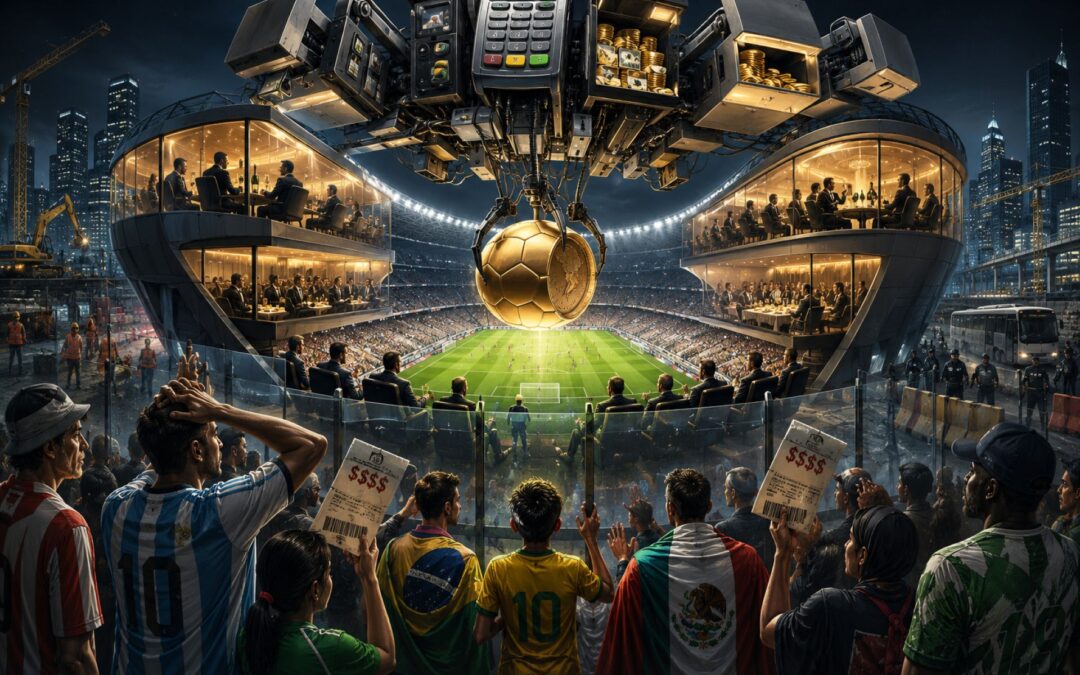
The World Cup is supposed to be football’s great democratic ritual.
For one month, the sport belongs to everyone. Not just to club owners, broadcasters, sponsors, betting companies, luxury-box guests, or executives in tailored suits. It belongs to the kid watching in Lagos, the family gathering in Buenos Aires, the taxi driver in Mexico City, the office worker in Mumbai, the immigrant café owner in Paris, the village that stays awake through the night because its national team has somehow made it to the knockouts.
That is the mythology of the World Cup.
It is the one sporting event that can still make the world feel shared.
But the 2026 World Cup is testing that myth.
The tournament will be bigger than ever: 48 teams, 104 matches, three host countries, and a final at MetLife Stadium outside New York. It will also be one of the most commercially aggressive World Cups ever staged.
For many fans, the first shock has been the price of simply getting into a stadium. FIFA’s official ticketing system for the 2026 World Cup has used dynamic pricing, meaning prices can rise based on demand. Some tickets began at relatively accessible levels, but many fans quickly found themselves facing prices that felt less like a people’s game and more like a luxury entertainment product.
Then come the extra costs: flights, hotels, visas, food, transport, parking, and the general price of traveling across the United States, Canada, and Mexico during peak summer.
And while fans are paying more, host cities are also taking on huge obligations. Security, stadium changes, transport, public events, policing, fan zones, road closures, and public services all come with a bill. FIFA, meanwhile, controls the tournament’s most valuable commercial assets: broadcasting, sponsorship, hospitality, licensing, and ticketing.
That is the strange thing about the modern World Cup.
One team will lift the trophy.
But financially, FIFA has already designed the tournament so that it wins before the first whistle.
The World Cup Was Supposed to Belong to Everyone
Football became the world’s game partly because it is simple.
You do not need much to play. A ball helps, but even that can be improvised. You do not need expensive equipment, a specialized court, or a private club membership. You need space, feet, and people.
That accessibility is part of football’s emotional power. It is why the World Cup feels different from almost every other sporting event. It is not just a tournament. It is a global gathering built on memory, identity, rivalry, migration, history, and childhood.
People do not merely watch their national team. They inherit it.
That is why ticket pricing matters so much.
A World Cup ticket is not just a seat at a sporting event. It is access to a moment that may never happen again in a fan’s lifetime. For many families, attending a World Cup is the kind of experience passed down through generations. Parents remember one tournament, children dream of another, and the event becomes part of family history.
But 2026 has exposed a growing tension inside the tournament.
The World Cup still sells itself as a global celebration. But its business model increasingly resembles a premium event designed around what wealthier consumers, corporations, and hospitality buyers are willing to pay.
That does not mean FIFA invented expensive tickets. Major global events have always had premium pricing. Finals have always been expensive. Scarcity has always mattered.
What feels different now is the scale and structure of the commercial machine.
The 2026 World Cup is not just expensive because demand is high. It is expensive because FIFA has become very good at turning global passion into monetizable inventory.
Every seat, every sponsorship zone, every broadcast right, every hospitality package, every host-city promise, every public celebration around the event becomes part of a wider financial ecosystem.
The result is uncomfortable.
The sport may still belong to everyone.
The tournament increasingly does not.
The 2026 World Cup Ticket Shock
For many fans, the first sign of this shift came when they tried to buy tickets.
FIFA’s own ticketing page presents the process as a structured official sale, with phases, categories, and access routes for fans. On paper, this looks orderly enough. But once prices began appearing, the reality felt very different for many supporters.
The 2026 tournament introduced dynamic pricing, a system where ticket prices can change according to demand. According to reporting by The Guardian, FIFA confirmed that 2026 World Cup tickets would use a dynamic pricing model, with prices moving according to market demand.
That matters because a World Cup is not like an ordinary entertainment product.
If a concert ticket is too expensive, you may skip the concert. If a league match is overpriced, you may go another week. But the World Cup is rare, emotionally loaded, and nationally significant. It creates a kind of demand that is difficult to compare with normal sports pricing.
FIFA’s defense is straightforward: this is the biggest football tournament in the world, staged in some of the most expensive markets in global sports. In the United States especially, high prices for major sporting events are normal. College football games, NBA playoffs, NFL games, and the Super Bowl all show what American audiences are willing to pay for scarce live sports experiences.
But that comparison only goes so far.
The World Cup is not a domestic U.S. sports property. It is a global tournament. Its audience includes fans from countries where median incomes are far lower than in the United States, Canada, or Western Europe. The tournament may be hosted in North America, but it is not culturally owned by North America.
That is where the pricing shock becomes more than a complaint about expensive entertainment.
A tournament that claims to represent the world cannot be priced as if the world has American purchasing power.
Supporter groups have made exactly this point. Football Supporters Europe and Euroconsumers filed a complaint with the European Commission over FIFA’s 2026 ticketing practices, arguing that the pricing model and the scarcity of genuinely affordable tickets raised serious concerns.
That is an important development. It shifts the debate from “fans are upset” to something bigger: whether FIFA’s control over World Cup ticket access allows it to push prices beyond what would be acceptable in a normal competitive market.
Fans do not have an alternative World Cup to attend.
There is only one.
And FIFA controls the gate.
Dynamic Pricing Changed the Meaning of a World Cup Ticket
Dynamic pricing is not complicated in theory.
When demand rises, prices rise. Airlines do it. Hotels do it. Ride-hailing apps do it. Concert platforms do it. Sports teams do it.
But when FIFA applies it to the World Cup, the meaning changes.
A fixed-price system at least suggests that access is being managed according to categories, phases, allocations, and some idea of broad fan participation. The prices may still be high, but the logic is visible.
Dynamic pricing shifts the logic toward extraction.
It asks: what is the maximum price this moment can command?
That is a very different question from: how do we make the world’s biggest football tournament accessible to the world’s fans?
This is why the controversy around 2026 is not only about the absolute price of a ticket. It is about what kind of event FIFA is choosing to build.
If tickets become priced like financial assets, fans begin to feel less like participants and more like customers being tested for willingness to pay. The lottery becomes less romantic. The category system becomes less reassuring. The idea of “winning” access starts to feel strange when the prize is the opportunity to spend far more than many families can reasonably afford.
And once dynamic pricing enters the picture, every emotional attachment becomes monetizable.
Your country qualified? Demand rises.
Your team has a superstar? Demand rises.
Your group-stage match is in a major city? Demand rises.
Your knockout path looks promising? Demand rises.
The more meaningful the match becomes, the more expensive access can become.
That may be logical from a revenue perspective.
But football has never survived on logic alone. It survives on belonging. It survives because people feel that, in some small way, the game is theirs.
Dynamic pricing weakens that feeling.
It tells fans that the event belongs most to whoever can pay at the moment demand peaks.
Hospitality Is Where the World Cup Becomes a Luxury Product
The clearest sign of the World Cup’s commercial direction is not the ordinary ticket.
It is hospitality.
Hospitality packages are not new. Major sporting events have long offered premium experiences: better seats, private entrances, food, lounges, networking spaces, and corporate entertainment. There is nothing inherently wrong with that. A global event will always have sponsors, executives, wealthy fans, and companies willing to pay for comfort and exclusivity.
But when hospitality becomes central to the event’s architecture, the tournament starts to feel different.
For the 2026 World Cup, On Location is the official hospitality provider. Premium packages can include match tickets, food, drinks, lounge access, and exclusive experiences. Some packages are merely expensive. Others enter a different universe entirely. Reports on 2026 World Cup hospitality have described high-end offerings reaching enormous sums, including elite packages designed for luxury buyers rather than ordinary supporters.
This matters because hospitality is not just an add-on. It affects the whole access structure.
The best seats in a stadium are not just seats. They are inventory. FIFA and its partners can sell that inventory in layers: standard tickets, premium tickets, hospitality, corporate packages, private suites, and exclusive experiences.
The more valuable the premium layer becomes, the greater the temptation to reserve desirable inventory for buyers who will pay far more than normal fans.
This is where fans begin to feel displaced.
Not formally excluded. Not told they cannot attend.
Just quietly priced away from the best parts of the event.
That is a subtle but important distinction. The World Cup can still point to cheaper tickets and say access exists. But if affordable tickets are scarce, difficult to obtain, badly located, or overwhelmed by demand, then “access” becomes more symbolic than practical.
Meanwhile, the luxury version of the tournament expands.
That is how a people’s game slowly becomes a premium product.
Not all at once.
Seat by seat.
Package by package.
Lounge by lounge.
The Real Cost Is Bigger Than the Ticket
Even if a fan manages to buy a ticket, that is only the beginning.
The 2026 World Cup is spread across three large countries. Travel distances are significant. Many venues are in expensive metropolitan areas. The tournament takes place during peak summer travel season. For international fans, the total cost can quickly become overwhelming.
A ticket may be the emotional purchase.
The trip is the real bill.
Flights can rise as demand concentrates around match cities. Hotels can become expensive or scarce. Food, local transport, rideshares, parking, and city taxes add more. In some U.S. cities, even getting to the stadium can be costly or inconvenient. Recent reporting from Houston, for example, noted that some World Cup parking passes were priced close to or above $100, with oversized vehicles far higher.
Then there are visa and entry costs.
For fans from visa-waiver countries entering the United States, travel authorization is not free. For fans who need a full visitor visa, the cost and process can be much heavier. The financial burden is not evenly distributed across the world. A supporter from a high-income country may see these expenses as painful but possible. A supporter from a lower-income football nation may find the same trip almost absurd.
This is the hidden inequality of a global tournament hosted in expensive markets.
The World Cup invites the world.
But it charges North American prices.
That creates a strange emotional contradiction. A fan in Argentina, Brazil, Morocco, Ghana, India, Mexico, or Croatia may feel deeply connected to the tournament. Their country may have shaped World Cup history. Their players may be among the reasons the event is valuable in the first place.
Yet the live experience can be priced around an entirely different economic reality.
This is where FIFA’s commercial model begins to clash with football’s cultural meaning.
Football is global because billions of people care.
But the live World Cup experience increasingly belongs to the fraction of those people who can afford the full package: ticket, travel, hotel, transport, food, paperwork, and time away from work.
The stadium may be full.
That does not mean it is accessible.
Host Cities Pay for the Privilege of Hosting
The burden does not fall only on fans.
Host cities also pay.
A World Cup match is not just a game that happens inside a stadium. It is a major public operation. Cities must plan for security, transport, emergency services, crowd control, fan festivals, training sites, road closures, communications, policing, and public-space management.
The 2026 tournament is especially complex because of its scale. It includes 104 matches across the United States, Canada, and Mexico. In the U.S. alone, 11 cities are hosting 78 matches. As Axios reported, American host cities have had to prepare for security, infrastructure, transportation, fan engagement, and public services, with federal aid supporting enhanced security needs.
The public does not always see these costs clearly.
Fans see the match. Broadcasters show the stadium. Sponsors show the celebration. Politicians show the visitor numbers. FIFA shows the spectacle.
But behind the spectacle is a city doing expensive work.
Police departments must staff events. Transit systems must adjust. Roads may be closed. Construction schedules may be altered. Fan zones must be created and managed. Emergency plans must be built. Airports, hotels, public agencies, and local businesses all have to coordinate around the tournament.
Some of this spending may be worthwhile. A city can benefit from global attention. Local businesses may see extra demand. Hotels, restaurants, bars, and transport providers may earn more during match periods.
But the deal is not as simple as “the World Cup brings money.”
It brings money to some places.
It brings costs to others.
And it gives FIFA extraordinary leverage because cities are competing for the privilege of being part of the world’s biggest sporting event.
That leverage matters. Host cities often accept conditions they would never accept from an ordinary private event organizer. They make security commitments. They adjust public spaces. They accommodate branding rules. They create controlled commercial zones. They manage disruption.
The prestige is real.
So is the bill.
FIFA Captures the Upside
FIFA’s genius is that it controls the most valuable parts of the World Cup without carrying many of the heaviest public burdens of hosting it.
Its revenue model is built around assets that scale beautifully: broadcast rights, sponsorships, licensing, ticketing, and hospitality. According to Investopedia’s breakdown of FIFA’s business model, FIFA earns heavily from television rights, marketing rights, licensing, hospitality, and ticket sales. Its 2023–2026 cycle has been tied to an expected $11 billion in revenue, with ticketing and hospitality forming a major part of the total.
That is a staggering number.
But what makes the model so powerful is not just the size of the revenue. It is the structure of the risk.
FIFA sells the global event. Host countries and cities prepare the ground on which that event takes place.
FIFA does not need to permanently run the local transit system. It does not need to justify policing costs to local residents. It does not have to live with an underused stadium after the tournament. It does not have to compensate every business disrupted by road closures or commercial restrictions. It does not have to answer every taxpayer who wonders why public money is being spent to support a private global sports event.
FIFA gets the event.
Cities get the obligations.
This is not unique to FIFA. Many mega-events work this way. The Olympics have long faced similar criticism. The promise is global attention, tourism, soft power, national pride, and long-term benefits. The concern is that public authorities often overestimate the upside and underestimate the costs.
But FIFA’s position is especially strong because the World Cup is so emotionally powerful. Hosting it is not just an economic decision. It is a status symbol. It tells the world that a city has arrived, that a country matters, that a government can stage something historic.
That makes it easier to sell the costs as investment.
It also makes it easier to overlook who captures the most reliable revenue.
FIFA’s income is built into the tournament.
The host city’s payoff is hoped for.
That difference is everything.
The Economic Impact Argument Is Less Simple Than It Sounds
Whenever a city or country hosts a major sporting event, the same argument appears.
Yes, it costs money. But look at the benefits.
Tourists will come. Hotels will fill. Restaurants will boom. Workers will earn wages. The city will appear on television. The country will gain prestige. Infrastructure will improve. The event will generate economic impact.
Some of that is true.
But “economic impact” is one of those phrases that can sound more precise than it is.
A headline number may include spending that would have happened anyway, spending that is merely shifted from one city to another, or revenue that goes to private businesses rather than public budgets. It may count gross activity without fully accounting for public costs, tax exemptions, displacement, or opportunity cost.
Imagine someone in Canada planned to take a summer holiday in one city but instead travels to Vancouver for a World Cup match. From Vancouver’s perspective, that may look like new tourism spending. From the national economy’s perspective, it may simply be spending moved from one place to another.
Or imagine a local resident avoids downtown during match week because prices are higher and crowds are worse. Some World Cup spending may replace normal local spending rather than add to it.
Then there is the question of who earns and who pays.
A hotel may benefit from higher rates. A restaurant near a fan zone may benefit from foot traffic. A private transport provider may benefit from demand. But if the public pays heavily for security, transit, planning, and infrastructure, the government still has to ask whether the tax return justifies the cost.
That is why one-time mega-events are so difficult to evaluate.
If a government spends money on an airport, rail line, or port, the asset may generate economic value for decades. A World Cup match is different. It is intense, glamorous, and temporary. Once the tournament leaves, the city cannot sell the same World Cup match again next year.
The best version of the argument is that the event accelerates useful investment, improves global visibility, and creates a memorable civic moment.
The worst version is that it socializes costs while privatizing gains.
The truth depends on the city, the spending, the contracts, and the honesty of the accounting.
But one thing is clear: the economic impact argument should not be accepted just because the number is large.
Large numbers can impress.
They can also obscure.
Football’s Biggest Event Is Becoming Less Like Football
The tragedy of all this is that the World Cup does not need help feeling valuable.
Its value comes from the game itself.
A ball crossing a line. A goalkeeper guessing correctly. A teenager announcing himself to the world. A veteran refusing to disappear. A country that has suffered too much finding two hours of joy. A small nation defeating a giant. A missed penalty that becomes national memory. A goal that children imitate for the next 20 years.
That is the product.
Not the lounge.
Not the package.
Not the commercial zone.
Not the dynamic pricing curve.
FIFA understands football’s emotional power better than anyone. That is why it can monetize it so effectively. The organization does not have to manufacture demand from nothing. The demand already exists. It was built over generations by players, fans, clubs, communities, and national histories.
FIFA’s role is to organize the tournament.
But increasingly, it feels like FIFA’s greater skill is enclosing the emotion around the tournament and selling access back to the people who created its meaning.
That is the heart of the 2026 controversy.
Fans are not shocked that the World Cup makes money. Of course it makes money. A tournament of this scale needs sponsors, broadcasters, ticketing systems, and commercial partners. Nobody serious expects a global event to run on nostalgia alone.
The problem is balance.
How much commercialization can the World Cup absorb before it begins to betray the thing that makes it special?
If regular fans feel priced out, if host cities feel burdened, if public money supports private gain, if the best experiences drift toward corporate hospitality, and if affordability becomes a slogan rather than a reality, then the tournament changes.
It may still look like the World Cup.
It may still sound like the World Cup.
It may still produce unforgettable football.
But around the pitch, something else is happening.
The people’s game is being reorganized around the logic of maximum revenue.
Conclusion: The Trophy Is Not the Only Prize
At the end of the 2026 World Cup, the cameras will focus on the winning captain.
There will be confetti, medals, tears, flags, speeches, and one country that feels, for a moment, like the center of the world.
That is the image everyone will remember.
But the tournament will have another winner too.
FIFA will have sold the tickets, the hospitality, the sponsorships, the licensing, and the broadcast rights. It will have staged the world’s greatest football spectacle while host cities managed much of the public burden and fans stretched themselves to be part of the moment.
That does not make the World Cup meaningless.
It makes it conflicted.
The beauty of football is still real. The goals will still matter. The memories will still last. For millions of people, the tournament will still feel magical.
But the business around that magic is becoming harder to ignore.
The 2026 World Cup may crown a champion on the field.
Off the field, FIFA has already shown who the tournament is really built to reward.
Last Updated on June 7, 2026 by Aseem Gupta