
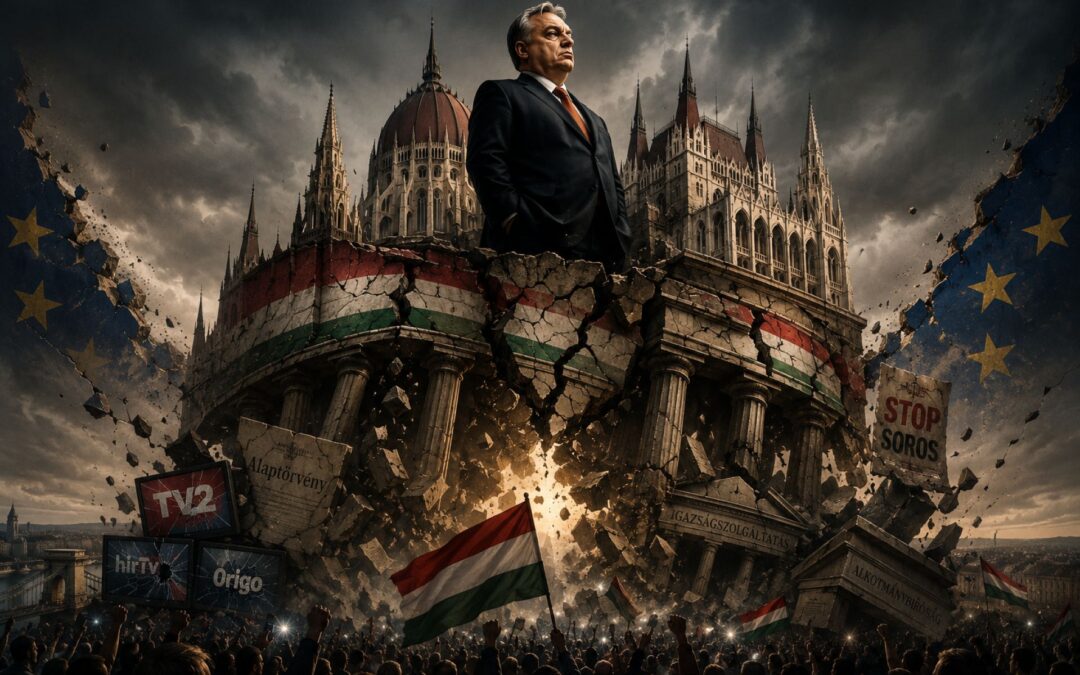
The Election That Ended More Than a Government
When Viktor Orbán lost power, Hungary did not simply change prime ministers.
It changed the meaning of an era.
For 16 years, Orbán had not governed Hungary like an ordinary democratic leader. He had built a political machine around himself: a ruling party with deep institutional reach, a friendly media ecosystem, loyal business elites, constitutional advantages, culture-war narratives, and a permanent confrontation with Brussels.
That system was often described by Orbán himself as “illiberal.” To his supporters, it meant national sovereignty, Christian identity, border control, and resistance to liberal elites. To his critics, it meant something more dangerous: elections without fair competition, institutions without independence, media without pluralism, and democracy without the spirit of democracy.
For a long time, Orbán seemed to prove that such a system could endure.
Then Péter Magyar arrived.
A former insider of the ruling world, Magyar did what Hungary’s fragmented opposition had struggled to do for years. He turned private disgust into public momentum. He gave anti-Orbán voters a credible vehicle. And in Hungary’s 2026 parliamentary election, his Tisza party won a landslide, ending Orbán’s 16-year rule and securing a commanding parliamentary majority.
The Associated Press reported that Magyar was sworn in as Hungary’s new prime minister after Tisza won a two-thirds majority in parliament.
That is why Orbán’s defeat matters beyond one election.
The question is not only how he lost.
The deeper question is how a man who had spent more than a decade bending the political system around himself could still be defeated by it.
From Anti-Soviet Rebel to Architect of Illiberal Rule
The strange thing about Viktor Orbán’s career is that he did not begin as the face of Europe’s nationalist right.
He began as a young liberal dissident.
In 1989, as communist rule was collapsing across Eastern Europe, Orbán became famous for demanding the withdrawal of Soviet troops from Hungary. He was young, confrontational, anti-authoritarian, and aligned with the democratic hopes of the post-communist transition.
His party, Fidesz, began as a liberal youth movement. Hungary itself seemed to be part of a broader European story: dictatorship had ended, democracy had arrived, and integration with the West would secure the country’s future.
But the post-1989 story did not feel equally triumphant to everyone.
The transition to capitalism brought opportunity, but it also brought insecurity. Old industries collapsed. Inequality widened. Many Hungarians felt humiliated by foreign investors, Western lectures, and domestic elites who seemed to speak the language of Europe better than the language of ordinary citizens.
Orbán learned from this mood.
Over time, he moved Fidesz away from liberalism and toward nationalism. He increasingly framed politics as a struggle between the authentic Hungarian nation and hostile forces: post-communist elites, foreign capital, liberal intellectuals, Brussels bureaucrats, migrants, George Soros, NGOs, and globalist institutions.
This was not just opportunism. It became a worldview.
By the time Orbán returned to power in 2010, he had a different political project. He was no longer trying to deepen liberal democracy. He was trying to replace it with something he believed was better suited to national power.
In a 2014 speech, Orbán famously argued for building an “illiberal state,” pointing to countries such as Russia, Turkey, China, and Singapore as examples of states that were not liberal democracies but were, in his view, successful. That phrase became the label for his entire political experiment.
Orbán’s genius was not that he abolished democracy.
He kept elections. He kept parliament. He kept courts. He kept parties. He kept constitutional language.
But he changed the conditions under which all of them operated.
That distinction is crucial.
A dictatorship announces itself by closing the system. Orbán’s model worked by tilting the system so heavily that the opposition was always playing uphill.
How Orbán Turned Power Into a System
Orbán returned to office in 2010 with a two-thirds parliamentary majority. That majority was the key.
It allowed Fidesz to rewrite Hungary’s constitution, redesign institutions, change electoral rules, reshape the judiciary, and place loyalists in powerful positions. These changes were legal in the narrow sense that they passed through parliament. But legality was part of the strategy.
Orbán did not need tanks in the street.
He had votes in parliament.
The new constitutional order entrenched Fidesz’s power in ways that outlasted ordinary election cycles. Key offices were filled with long-term appointees. Independent oversight bodies became more politically aligned. The boundaries between state, party, and government became harder to see.
This is how illiberal democracy works at its most effective.
It does not usually destroy institutions overnight. It colonizes them.
A court still exists, but it becomes less willing to challenge the government. A media regulator still exists, but it becomes less neutral. Elections still happen, but the rules increasingly favor the ruling party. Public funds still flow through official channels, but they help build a loyal economic class around the government.
International observers repeatedly warned about this imbalance. The OSCE’s assessment of Hungary’s 2022 election said the vote was well administered but marred by the absence of a level playing field, with the ruling party benefiting from overlap between state and party messaging, media bias, and opaque campaign financing. That was the Orbán system in miniature: elections that could be technically functional while still being structurally unfair.
The European Parliament went further in 2022, declaring that Hungary could no longer be considered a full democracy and had become a “hybrid regime of electoral autocracy.”
That label sounds technical, but the reality is easy to understand.
People could vote.
But power was no longer genuinely open.
Orbán’s political machine rested on a simple principle: win elections, then use those victories to change the system in ways that make future defeats less likely.
For years, it worked.
The Media Machine, the Courts, and the Managed Democracy
The most visible part of Orbán’s system was the media.
In any democracy, media power matters. But in Hungary, media became one of the central pillars of political control. Pro-government businessmen acquired outlets. State advertising favored friendly media. Public broadcasting became heavily aligned with government messaging. Critical voices still existed, especially online and in parts of independent journalism, but the overall information environment was deeply uneven.
This mattered because Orbán’s politics depended on permanent storytelling.
Hungary was always under threat.
Migrants were coming. Brussels was attacking. Liberals were corrupting children. NGOs were serving foreign interests. George Soros was plotting against the nation. Ukraine policy, EU law, LGBTQ rights, and migration could all be folded into one larger narrative: only Orbán stood between Hungary and chaos.
In that kind of system, propaganda does not have to convince everyone.
It only has to shape the atmosphere.
It gives loyal voters a moral universe. It keeps wavering voters anxious. It makes the opposition seem alien, dangerous, or incompetent. It turns ordinary policy disagreements into civilizational threats.
This is why control over media was so important. A government can survive corruption scandals if its supporters do not hear about them clearly. It can survive economic pain if it can blame outsiders. It can survive institutional criticism if it can frame critics as enemies of the nation.
But media was only one part of the machine.
The courts, prosecutors, universities, civil society organizations, and watchdog bodies all faced pressure in different ways. Freedom House has described Hungary as only “Partly Free,” arguing that Fidesz used legal and constitutional changes to consolidate control over independent institutions and restrict the work of opposition groups, journalists, universities, and NGOs.
The point was not always to ban opposition.
Often, the point was to exhaust it.
Make fundraising harder. Make legal compliance more burdensome. Make media access narrower. Make court challenges slower. Make public institutions less responsive. Make opposition politics feel futile.
That is managed democracy.
The appearance of competition remains, but the ruling party decides the terrain.
And yet, this system had one vulnerability Orbán could not fully remove.
It still depended on public consent.
Not pure consent. Not perfectly free consent. But enough consent.
As long as enough Hungarians believed Orbán protected them, represented them, or at least offered stability, the system could endure. Once that belief began to crack, all the machinery built to preserve power could start to look like evidence of guilt.
Why Brussels Became Orbán’s Favorite Enemy
Orbán’s conflict with the European Union was not a side issue.
It was central to his power.
Hungary joined the EU in 2004 as part of the great eastward expansion that followed the Cold War. For many Hungarians, membership represented prosperity, mobility, security, and a return to Europe after decades of Soviet domination.
Orbán understood the emotional power of Europe. But he also understood the political usefulness of opposing it.
Brussels became the perfect enemy: powerful enough to blame, distant enough to caricature, and liberal enough to fit Orbán’s ideological story. Whenever EU institutions criticized Hungary over courts, media freedom, corruption, migration, or rule of law, Orbán could present those criticisms as attacks on Hungarian sovereignty.
This gave him a powerful double game.
Hungary benefited from EU membership, including access to markets and funds. But Orbán built domestic legitimacy by attacking the EU as an overreaching empire of bureaucrats and liberals.
The conflict escalated over time. The European Commission’s rule-of-law concerns included corruption, judicial independence, media pluralism, civil society pressure, emergency powers, and the use of public resources. In 2025, the EU’s annual rule-of-law cycle continued to highlight unresolved problems in Hungary.
That created a problem for Orbán.
Conflict with Brussels was politically useful.
But blocked EU funds, investor anxiety, and economic frustration were politically costly.
The same confrontation that made him look strong to supporters also made Hungary feel stuck. The government could blame Brussels, and often did. But after many years, blame loses some of its force. People begin to ask why the same leader who promised strength keeps producing stalemate.
Orbán’s foreign policy also became more controversial as Russia’s war in Ukraine reshaped European politics. While most EU and NATO countries rallied around Ukraine, Orbán repeatedly positioned himself as a skeptic of sanctions, military aid, and Brussels consensus. That made him useful to some anti-establishment movements abroad, but it isolated Hungary inside Europe.
For years, Orbán had turned isolation into proof of courage.
By the end, it increasingly looked like exhaustion.
The Weaknesses Hidden Inside the System
Orbán’s system looked strongest when viewed from the outside.
From within, it carried several weaknesses.
The first was corruption fatigue.
Fidesz had built a loyal economic class around public contracts, state resources, and political access. To supporters, this could be framed as building a national bourgeoisie after years of foreign domination. To critics, it looked like a patronage machine.
Over time, the distinction mattered less than the perception. When ordinary people struggle while politically connected businessmen grow rich, resentment accumulates. It may stay quiet for years, especially when the opposition is weak. But it does not disappear.
After Orbán’s defeat, The Guardian reported that Hungary’s new government was preparing a wealth tax aimed at the country’s richest individuals, many of whom had become wealthy through public contracts during the Orbán era. Whether one supports that policy or not, its political symbolism is obvious. The post-Orbán moment was immediately framed around accountability, wealth, and the old ruling class.
The second weakness was economic fatigue.
Orbán’s early years benefited from growth, EU money, and a sense of national recovery. But inflation, cost-of-living pressures, strained public services, and disputes with Brussels weakened the bargain. The promise of stability is powerful only when life feels stable.
The third weakness was generational and emotional.
Orbán had been in power so long that for many Hungarians he had become less a leader than an atmosphere. His politics shaped the news, the language of public life, the enemies of the week, the moral boundaries of belonging.
That kind of dominance creates loyalty.
It also creates suffocation.
After 16 years, even people who once accepted the system could begin to feel trapped by it. The opposition did not need every voter to become a liberal democrat. It needed enough voters to decide that the country needed air.
The fourth weakness was overcentralization.
Orbán’s system was built around loyalty to him. That gave it discipline, but it also meant that failures traveled upward. When everything is controlled by one political machine, the machine owns everything: the propaganda, the corruption, the arrogance, the stagnation, the scandals, the fatigue.
A pluralistic democracy can distribute blame.
A personalized regime concentrates it.
That is why the strongest systems can collapse faster than expected. They suppress alternatives for so long that when one credible alternative finally appears, discontent rushes toward it.
Péter Magyar and the Danger of an Insider Revolt
Péter Magyar was dangerous to Orbán because he did not come from the usual opposition script.
He was not easily dismissed as a foreign-backed liberal. He was not a marginal activist. He was not an old opposition figure carrying the baggage of past defeats. He had been close enough to the ruling world to speak its language and expose its weaknesses.
That mattered.
Outsider criticism can be dismissed as hostility. Insider criticism feels like confirmation.
Magyar’s rise turned Orbán’s own system against him. He could speak to voters who disliked Fidesz but did not fully trust the old opposition. He could attack corruption without sounding like a detached liberal technocrat. He could promise change without making every voter feel they had to reject national identity, conservatism, or Hungarian sovereignty.
This was crucial because Orbán’s power had always depended on polarizing the country into two moral camps: the national side and its enemies.
Magyar complicated that map.
He positioned himself as a challenger from within the national camp, but against the corruption and suffocation of Orbánism. That made him harder to demonize in the usual way.
His party, Tisza, became not just an opposition party but a vehicle for regime fatigue. It gathered voters who wanted many different things: cleaner government, better EU relations, less propaganda, more accountability, economic relief, institutional repair, and simply an end to the same faces ruling everything.
The danger of an insider revolt is that it tells voters something they may have suspected but not fully acted upon:
The system is not as strong as it looks.
Once that spell breaks, fear weakens. People who were privately dissatisfied become publicly dissatisfied. People who thought change was impossible begin to imagine it. People who tolerated the system because everyone else seemed to tolerate it discover they were not alone.
That is when politics accelerates.
Why Orbán Finally Lost
Orbán lost because the forces that had protected him began to turn against him.
His media system could still shape reality, but it could not completely erase lived experience. His attacks on Brussels could still mobilize loyalists, but they could not fully explain away economic frustration. His institutional advantages still mattered, but they could not prevent a large enough wave from breaking through. His nationalist language still had power, but Magyar found a way to challenge him without sounding like the old opposition.
Most importantly, Orbán lost because his system became too visibly self-serving.
Illiberal democracy often survives by claiming that liberal constraints are obstacles to national renewal. Independent courts are elitist. Critical media is foreign-influenced. NGOs are political agents. Brussels is imperial. Opposition parties are traitorous or incompetent.
This argument can work when people believe the leader is delivering something larger than himself.
But when the system appears to serve the ruling party, its oligarchs, and its loyalists more than the nation, the moral claim weakens.
Then the language of sovereignty begins to sound like cover.
The language of stability begins to sound like fear.
The language of national unity begins to sound like one-party rule.
That is the deeper story of Orbán’s fall. It was not only an electoral defeat. It was a loss of narrative control.
For years, Orbán had convinced enough Hungarians that he alone could defend the country from external and internal enemies. Magyar’s victory suggested that many voters had reached a different conclusion: the system itself had become the problem.
The aftermath showed how deeply Orbán’s power had been institutionalized. Reuters reported that Magyar’s government moved to abolish the Orbán-era Sovereignty Protection Office, which critics had viewed as a tool against journalists, NGOs, and opposition figures.
That is what happens when a political system is built around power rather than resilience.
Once power changes hands, the structure shakes.
What Hungary’s Result Means Beyond Hungary
Orbán was never just the prime minister of Hungary.
He was a model.
For many on the global right, he represented a working example of how to win elections and then remake the state: control the courts, discipline the media, fight universities and NGOs, use family policy and migration as identity markers, attack liberal elites, and present nationalism as democracy purified of liberal weakness.
His admirers saw him as a defender of civilization.
His critics saw him as a warning.
Either way, he mattered because he appeared to have solved a problem that many populist leaders face: how to keep the legitimacy of elections while weakening the uncertainty that makes elections dangerous.
That is why his defeat carries symbolic weight.
It does not mean illiberal democracy is finished. It does not mean European populism is dead. It does not mean Hungary has automatically restored liberal democracy. Those would be easy conclusions, and they would be wrong.
Hungary after Orbán still faces enormous challenges. Institutions shaped over 16 years do not become independent overnight. Media ecosystems do not rebalance instantly. Oligarchic networks do not vanish because a new party wins. Constitutional power can be used to repair democracy, but it can also create new temptations.
Magyar’s own mandate is powerful enough to raise questions about restraint. AP News reported that his government moved to amend the constitution to remove President Tamás Sulyok, an Orbán-appointed figure, arguing that institutional reform was necessary, while critics warned of a constitutional crisis.
That tension matters.
Undoing a captured system is not simple. If the old regime filled institutions with loyalists, reformers must decide how aggressively to remove them. Move too slowly, and the old system blocks change. Move too quickly, and the new government risks reproducing the same majoritarian logic it promised to end.
This is the paradox after illiberal rule.
Democracy must be rebuilt using power.
But power is exactly what damaged it.
So Hungary’s result should be understood carefully. It is not proof that institutions automatically self-correct. It is proof that even tilted systems can remain vulnerable when voters coordinate around a credible challenger.
Orbán showed how democracies can be hollowed out from within.
His defeat showed that hollowed-out democracies are not always dead.
Conclusion: The Fragility of Illiberal Democracy
Viktor Orbán’s great political achievement was to make domination look democratic.
He did not abolish elections. He made them less fair. He did not abolish media. He surrounded citizens with loyal media. He did not abolish institutions. He filled them with allies. He did not reject Europe completely. He used Europe as both resource and enemy.
For years, this system looked durable because it was disciplined, centralized, and ruthless.
But its strength concealed its weakness.
It depended on Orbán remaining the author of Hungary’s story. It depended on voters believing that his power served the nation rather than itself. It depended on the opposition remaining fragmented, the economy remaining tolerable, corruption remaining survivable, and Brussels remaining a useful villain.
Once those conditions changed, the system that had protected him became a burden.
Orbán’s fall does not offer a simple lesson that democracy always wins. History is not that comforting.
But it does offer a sharper lesson.
Illiberal democracy can last a long time. It can bend institutions, capture narratives, reward loyalists, and make opposition feel impossible.
Yet it still contains a contradiction.
It wants the legitimacy of democracy without the risk of real competition. It wants the energy of the people without the uncertainty of the people’s will. It wants elections to confirm power, not challenge it.
Eventually, that contradiction can break open.
In Hungary, it did.
Last Updated on June 9, 2026 by Aseem Gupta