
The Question of Control Revisited
What do you truly control in this world?
It’s a question that sounds simple on the surface but becomes unsettling the longer you sit with it. We like to believe that our lives are shaped by our plans, our efforts, and our intentions. That if we try hard enough, we can bend reality in our favor. But Stoicism cuts through that illusion with uncomfortable precision.
Very little is actually within our control.
Not the economy. Not other people. Not outcomes. Not even whether our efforts succeed or fail. Life unfolds as a continuous stream of events—most of which arrive uninvited and leave without asking for permission.
What, then, is left?
According to the Stoics, the answer is surprisingly narrow: our actions, our choices… and our judgment.
Judgment is the lens through which we interpret everything that happens to us. It’s how we decide whether something is good or bad, desirable or undesirable, worth pursuing or worth avoiding. It quietly shapes our emotional world without announcing itself. And because it operates in the background, we rarely question it.
But here’s where things become interesting.
While events themselves are outside our control, the way we judge them is not. A traffic jam, a financial loss, a random inconvenience—none of these come with meaning attached. They simply occur. It is our judgment that assigns them value, turning neutral moments into sources of frustration, anxiety, or even joy.
This makes judgment one of the most powerful tools we possess.
But like all powerful tools, it comes with a cost.
Used unconsciously, it binds us to things we cannot control. It ties our peace of mind to outcomes that are inherently unstable. And without realizing it, we begin to live reactively—pulled up and down by circumstances we were never meant to control in the first place.
Understanding judgment, then, is not just a philosophical exercise.
It’s the difference between a life that feels constantly disturbed… and one that remains steady, even when everything else is not.
Life Is Neutral—Until We Judge It
Life does not arrive labeled.
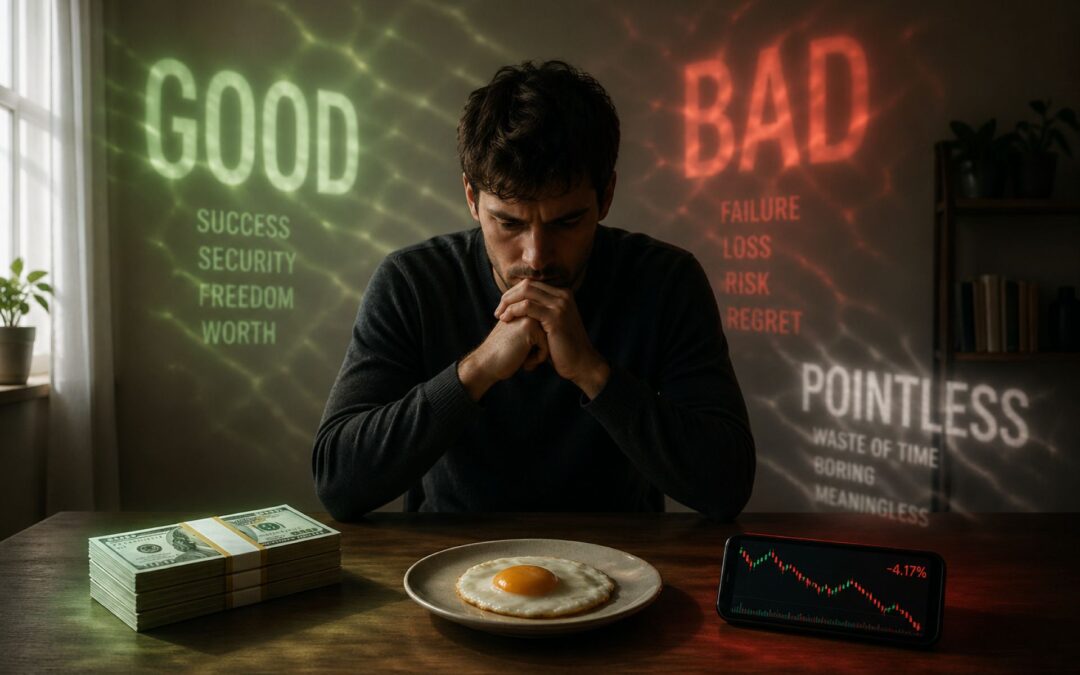
Events don’t announce themselves as good or bad, fortunate or unfortunate. They simply happen. A plate of food is just a plate of food. A delay is just a delay. A gain is just a gain. There is no inherent emotional weight built into these moments.
And yet, almost instantly, we assign one.
The moment something occurs, our mind steps in to interpret it. This is good. This is bad. This is unfair. This is exciting. Before we even realize it, we’ve transformed a neutral event into a meaningful experience—one that now has the power to affect how we feel.
This is the subtle but profound role of judgment.
It doesn’t just describe reality; it shapes it.
Take something ordinary like a traffic jam. On its own, it’s simply a collection of cars moving slowly or not at all. But the moment we judge it as “wasting our time” or “ruining our day,” frustration begins to build. The event hasn’t changed—but our experience of it has.
Or consider something more desirable, like money. At its core, it’s a tool—nothing more. But once we judge it as “good,” “important,” or “necessary for happiness,” it gains emotional weight. It becomes something we chase, something we depend on, something that can now influence our sense of security and self-worth.
In both cases, the pattern is the same.
We take neutral events and assign them value. And that value determines how we respond—not just externally, but internally.
The Stoics recognized this as a fundamental truth: it’s not things themselves that disturb us, but our opinions about them. Our judgments act as a filter between reality and experience, and that filter is rarely neutral.
Once something is labeled as good, we move toward it. Once something is labeled as bad, we move away from it. And in doing so, we unknowingly set ourselves up for a cycle of attachment and resistance.
The world remains as it is—unpredictable, uncontrollable, indifferent.
But through judgment, we turn it into something personal.
How Judgment Creates Desire and Aversion
The moment we label something as “good” or “bad,” we set a chain reaction in motion.
A simple judgment doesn’t stay simple for long. It begins to shape our behavior, our expectations, and eventually, our emotional state. What starts as a quiet mental classification quickly turns into something much more powerful—desire and aversion.
When we judge something as good, we naturally move toward it. We want more of it. We begin to crave it. Whether it’s money, recognition, comfort, or success, the label “good” transforms it from a neutral object into something we feel we need.
And once that need takes hold, our peace becomes conditional.
We feel good when we have it. We feel anxious when we might lose it. We feel frustrated when we don’t get enough of it. Our emotional state becomes tied to something outside our control, even if we don’t consciously realize it.
Aversion works in the same way, just in the opposite direction.
When we judge something as bad, we begin to resist it. We try to avoid it at all costs. Discomfort, failure, rejection, loss—these become things we fear, things we structure our lives around escaping. And the stronger the judgment, the stronger the resistance.
But here’s the problem.
The things we crave and the things we avoid are often not up to us.
We can pursue wealth, but we cannot guarantee it. We can try to avoid hardship, but we cannot eliminate it. Life doesn’t bend to our preferences. It continues to unfold on its own terms.
This creates a tension that is difficult to sustain.
We chase what we may never fully secure, and we run from what we may inevitably face. And in that constant push and pull, we become restless. Uneasy. Dependent on outcomes that were never ours to control.
This is why strong preferences—especially when tied to external things—are so dangerous.
They turn life into a gamble.
If things go our way, we feel temporary satisfaction. If they don’t, we feel disappointment, frustration, or even despair. Either way, we remain at the mercy of circumstances.
All of this begins with a single act: judgment.
A quiet decision that something is either good or bad… which then decides how we live.
The Trap of External Attachments
Once judgment labels something as “good,” it rarely stays an abstract idea.
It becomes personal.
We begin to attach ourselves to it—not just in thought, but in expectation. What was once a neutral part of life now feels like something we must have, protect, or increase. And without noticing it, our sense of stability starts to depend on it.
Money is a clear example.
At a basic level, money is practical. It allows us to meet our needs and navigate the world. But the moment we judge wealth as “good” and poverty as “bad,” something shifts. Money is no longer just a tool—it becomes a measure of success, security, even identity.
From there, attachment follows naturally.
We start wanting more than we need. We begin to compare. We measure our progress not by what we control, but by outcomes that fluctuate constantly. And slowly, our emotional state becomes tied to numbers that rise and fall beyond our command.
This is where the trap tightens.
Because once you’re attached, you’re no longer neutral. You’re invested. When things move in your favor, you feel uplifted. When they don’t, you feel the drop just as sharply. The same thing that once promised stability becomes a source of instability.
And it doesn’t stop with money.
Status, relationships, reputation, success—anything we judge as inherently “good” can become something we cling to. And the more we cling, the more fragile we become. Our peace depends on maintaining conditions that are, by their very nature, unpredictable.
The Stoics warned against this not because these things are worthless, but because they are unreliable.
They can be pursued, appreciated, even enjoyed—but not depended on.
The moment we depend on them, we hand over control.
And in doing so, we build our inner world on something that can shift without warning.
The Emotional Rollercoaster of Misplaced Judgment
Once our well-being becomes tied to external things, emotional stability becomes almost impossible.
Because external things don’t stay still.
They fluctuate. They rise and fall, often without warning. And when our judgments have already labeled these things as “good” or “bad,” every movement begins to feel personal. Every change feels like a gain or a loss—not just in circumstance, but within us.
This is how the emotional rollercoaster begins.
You see it clearly in situations like financial markets. When prices go up, there’s excitement, optimism, even a sense of validation. When they drop, that same person can feel anxious, frustrated, or defeated. The numbers themselves are just numbers—but the judgment attached to them turns them into emotional triggers.
The experience feels real, but the cause is subtle.
It’s not the rise or fall that disturbs us. It’s what we’ve decided those movements mean.
The same pattern plays out everywhere.
A compliment lifts your mood. A criticism ruins your day. A small success energizes you. A minor setback drains you. Each time, the external event acts like a switch—but the wiring behind that switch is your judgment.
And the more you rely on external validation or outcomes, the more frequent these swings become.
You’re no longer steady—you’re reactive.
Pulled upward by what you gain, pushed downward by what you lose. Life becomes a series of emotional spikes and drops, dictated by things you never fully controlled in the first place.
This is the cost of misplaced judgment.
It doesn’t just influence how you think—it destabilizes how you feel. It turns life into a constant negotiation between hope and fear, gain and loss, satisfaction and disappointment.
And the worst part is that it feels normal.
So normal, in fact, that most people never question it.
They assume that emotional instability is just part of being human—when in reality, it’s often the result of judging the wrong things.
Why Non-Judgment Feels So Difficult
If judgment is the root of so much disturbance, the obvious solution seems simple: stop judging.
But in practice, this is one of the hardest things to do.
Because judgment isn’t just a habit—it’s how the mind has learned to navigate the world.
From a very early age, we are conditioned to categorize everything. Good grades are rewarded. Failure is discouraged. Success is admired. Discomfort is avoided. Over time, these patterns become automatic. We don’t consciously decide to judge—we simply do.
And the more often we repeat these patterns, the more deeply they settle in.
Preferences begin to feel like facts.
We don’t say, “I prefer this.” We say, “This is better.” We don’t think, “I don’t like this.” We conclude, “This is bad.” The line between subjective judgment and objective reality starts to blur, and eventually disappears.
This is why letting go of judgment feels unnatural.
It’s not just about changing how we think—it’s about undoing years of conditioning. It requires us to pause in moments where we would normally react. To question interpretations that feel obvious. To resist the urge to immediately label an experience.
And that creates discomfort.
Because without judgment, there’s a kind of uncertainty. If something isn’t clearly good or bad, where does it stand? How should we respond to it? The mind, which is used to clear categories, struggles with this ambiguity.
There’s also another layer.
Our judgments are often tied to identity.
What we value says something about who we are. What we reject reinforces our sense of self. Letting go of these judgments can feel like losing a part of that identity—as if we’re no longer grounded in anything solid.
So we hold on.
Even when those judgments create stress, even when they lead to cycles of craving and fear, we cling to them because they feel familiar. Predictable. Safe.
This is what makes non-judgment so difficult.
Not because it’s complicated, but because it goes against the way we’ve trained ourselves to see the world.
Amor Fati: A Stoic Antidote to Misjudgment
If judgment pulls us into cycles of craving and aversion, the Stoics offer a counterbalance that feels almost radical: amor fati—the love of fate.
Not just acceptance. Not tolerance. Love.
At first glance, this sounds unrealistic. How can you love outcomes you don’t want? How can you embrace events that go against your preferences?
But this is precisely where the shift happens.
Amor fati doesn’t ask you to pretend that everything is pleasant. It asks you to stop resisting what already is. It removes the extra layer of judgment—the label that turns an event into something “wrong” or “unfair.”
And in doing so, it frees you.
Because resistance is what amplifies suffering.
When something happens that you’ve already judged as bad, your mind doesn’t just experience the event—it fights it. It replays it. It questions it. It tries to rewrite reality in a way that aligns with your preferences. And that internal struggle often hurts more than the event itself.
Amor fati dissolves that struggle.
It reminds you that outcomes were never yours to control. That life unfolds according to forces far beyond your influence. And once you accept that fully, there is nothing left to resist.
This doesn’t mean passivity.
You still act. You still make decisions. You still pursue goals. But you do so without attaching your peace of mind to the result. You focus on what is yours—your effort, your intention, your response—and leave everything else where it belongs.
Outside.
There’s a quiet stability that comes with this shift.
When things go your way, you don’t cling to them. When they don’t, you don’t collapse. You remain grounded, not because life has become predictable, but because your judgment no longer depends on it.
In that sense, amor fati is not about controlling life.
It’s about correcting how you relate to it.
Turning Judgment Inward
If judging external events leads to instability, the Stoics propose a simple but powerful redirection:
Judge yourself instead.
Not in the harsh, self-critical way we often associate with judgment—but in a deliberate, constructive sense. A way of evaluating your own actions, choices, and responses against a higher standard.
Because unlike external outcomes, this is something you actually control.
When you stop labeling events as good or bad, your attention naturally shifts. You’re no longer preoccupied with what happened—you become concerned with how you responded to what happened. The focus moves from circumstance to character.
Did you act with patience?
Did you respond with clarity?
Did you let emotion take over, or did you remain composed?
These are the questions that matter.
And they lead to a very different kind of growth.
Instead of chasing better outcomes, you start refining your behavior. Instead of reacting to events, you begin to understand your role within them. Each situation becomes an opportunity—not to get what you want, but to become someone better equipped to face whatever comes next.
This is where judgment regains its value.
When directed outward, it traps you. When directed inward, it sharpens you.
It allows you to reflect without becoming entangled. To recognize mistakes without being defined by them. To adjust your approach without losing your sense of stability.
Over time, this creates a subtle but important shift.
You stop measuring your life by what happens to you, and start measuring it by how you handle it.
And that changes everything.
The Stoic Standard: Judging by Virtue Alone
If judgment is to be used at all, the Stoics place a clear boundary on where it belongs.
Not on events. Not on outcomes. Not on external conditions.
Only on virtue.
For the Stoics, virtue is the only true good. Everything else—wealth, status, comfort, success—is secondary. Not because these things are meaningless, but because they are unstable. They can appear and disappear without warning. They are influenced by factors far beyond our control.
Virtue, on the other hand, is internal.
It lives in how we act, how we think, how we respond. It is expressed through qualities like wisdom, discipline, courage, and fairness. And unlike external circumstances, it is entirely within our reach.
This is why the Stoics redefine what it means to live well.
A good life is not one filled with favorable outcomes. It is one guided by good actions.
When you adopt this standard, judgment becomes precise.
Instead of asking, “Did things go my way?” you ask, “Did I act well?”
Instead of measuring success by results, you measure it by intention and execution.
Instead of reacting to what happens, you evaluate how you handled it.
This removes a tremendous amount of unnecessary suffering.
Because once “good” is tied only to your own conduct, the outside world loses its ability to disturb you. A setback is no longer “bad” in itself. It becomes a situation in which you either acted with virtue—or you didn’t.
And if you didn’t, that’s something you can improve.
This perspective restores control in the only place it was ever meant to exist.
Within you.
It doesn’t make life easier. It doesn’t guarantee comfort or success. But it does something far more valuable—it makes your inner state independent of things you were never meant to control.
And in that independence, there is stability.
Conclusion
Judgment is unavoidable.
You cannot move through life without interpreting what happens to you. The mind will always try to label, categorize, and make sense of the world. The problem is not that we judge—it’s that we judge the wrong things.
We take what we don’t control and turn it into something personal. We call it good or bad, desirable or undesirable, and then wonder why our peace feels fragile. We chase what we’ve labeled as good. We fear what we’ve labeled as bad. And in doing so, we tie our emotional state to a world that was never ours to control in the first place.
This is where the shift begins.
Not by eliminating judgment, but by refining it.
When you stop judging external events and start judging your own actions, everything changes. The focus moves inward. Stability replaces reactivity. Life no longer feels like something happening to you, but something you are actively participating in—through how you choose to respond.
The Stoics understood this clearly.
You don’t control what happens.
But you do control how you meet it.
And that is where judgment belongs.