
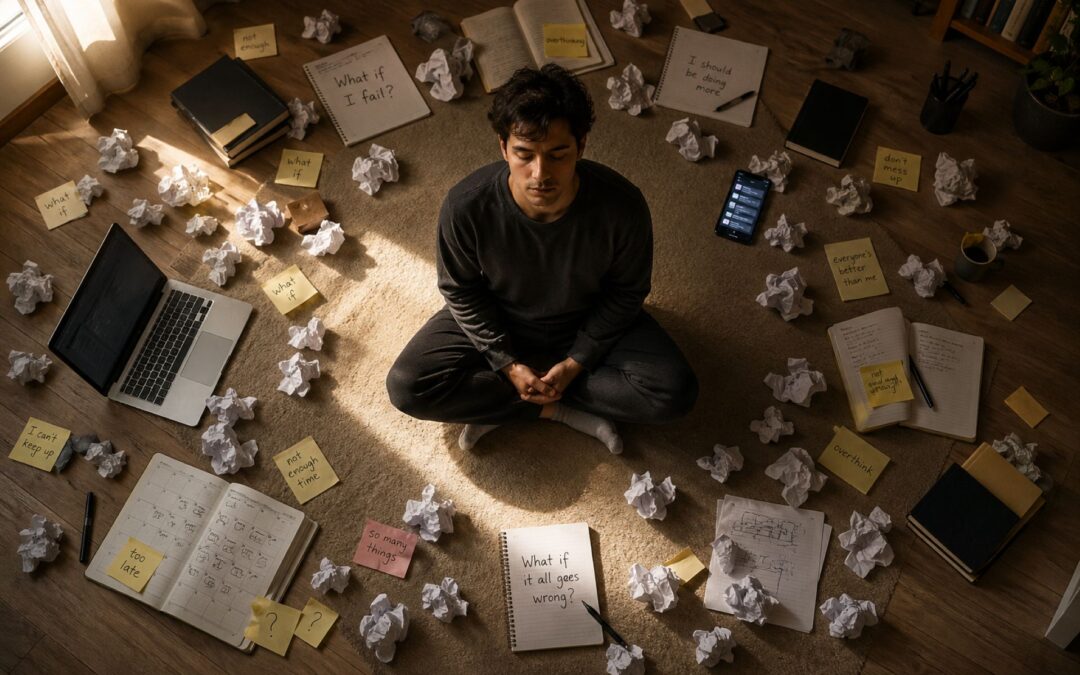
The Modern Epidemic of Anxiety
Anxiety is no longer an occasional disturbance—it has become a background condition of modern life. It hums quietly beneath everything we do. Whether we notice it or not, it shapes our decisions, our habits, and even our sense of self.
We live in a world that constantly suggests we are falling short. Not safe enough. Not attractive enough. Not successful enough. There is always something missing, something to fix, something to chase. And so the mind stays alert, restless, scanning for problems even when none are immediately present.
This isn’t accidental. Entire systems are built around this feeling of insufficiency. We are told to worry about our future, our finances, our health, our image. We measure ourselves against others—against their achievements, their lifestyles, even their curated online personas. Social media turns comparison into a daily ritual, reinforcing the idea that everyone else is doing better, living better, being better.
The result is a subtle but persistent tension. A sense that we must keep up, improve, optimize—at all times. This is what the philosopher Alain de Botton describes as status anxiety: the fear of not measuring up in a world that constantly ranks and evaluates us.
But beneath all these external pressures lies something more fundamental. Anxiety doesn’t actually come from the world itself. It comes from how the mind interprets the world.
Two people can face the same situation—one remains calm, the other spirals into worry. The difference isn’t the situation. It’s the mental process behind it.
And yet, when anxiety appears, most of us instinctively look outward. We try to fix our environment, control outcomes, eliminate uncertainty. We assume that if we can just arrange things correctly—earn more, achieve more, secure more—the anxiety will disappear.
But it rarely does.
Instead, it adapts. It finds new objects. New fears. New scenarios to latch onto. Because the real source was never outside to begin with.
This is where Buddhism begins its inquiry—not with the world, but with the mind that experiences it.
The First Mistake: Trying to Fight Anxiety
When anxiety shows up, the instinct is immediate and almost universal—we try to get rid of it.
We distract ourselves. We suppress it. We argue with it. We look for ways to control it or eliminate it as quickly as possible. On the surface, this seems reasonable. Anxiety is uncomfortable, sometimes overwhelming. Of course we want it gone.
But this instinct hides a deeper problem.
The moment you decide that anxiety should not be there, you begin to resist it. And resistance creates tension. You are no longer just experiencing anxiety—you are now fighting it. You’ve turned a single problem into two: the feeling itself, and your reaction to it.
This is where things begin to spiral.
Because anxiety is not like an external enemy you can overpower. It’s a mental state. When you fight it, you are essentially fighting your own mind. And that conflict doesn’t resolve anything—it amplifies it.
Think about what happens when you become anxious. Your heart rate increases, your thoughts accelerate, your body becomes alert. Then, almost immediately, another layer appears: Why am I feeling this? What if it gets worse? What if I lose control?
Now you’re no longer just anxious—you’re anxious about being anxious.
This is the paradox Buddhism points to: the more you try to push anxiety away, the more attention and energy you give it. And what we give attention to tends to grow.
In this sense, fighting anxiety is like trying to calm ripples in water by striking the surface. Every attempt to force stillness only creates more disturbance.
Buddhist teachings approach this differently. Instead of resistance, they suggest acceptance. Not because anxiety is desirable, but because it already exists in that moment. Resisting it is like denying reality—and that denial creates friction.
Acceptance, in this context, doesn’t mean surrendering or giving up. It means allowing the feeling to be there without immediately reacting to it. Without turning it into a problem that needs urgent fixing.
It’s a subtle shift, but a powerful one.
Instead of saying, “This shouldn’t be happening,” the perspective becomes, “This is happening.”
And that simple acknowledgment begins to dissolve the struggle.
The Mind as the Source of Anxiety
If anxiety isn’t coming from the world itself, then where does it come from?
Buddhism points inward—to the mind.
At first, this can feel counterintuitive. Anxiety feels like a reaction to real circumstances. Deadlines, relationships, finances, health—these are not imaginary. But what turns these situations into anxiety is not their existence, but the way the mind engages with them.
The mind doesn’t simply observe reality. It interprets, predicts, exaggerates, and distorts. It constantly constructs narratives—about what might happen, what could go wrong, what this means for the future. And these narratives often carry more emotional weight than reality itself.
This is what Buddhist teachings refer to as the “monkey mind.” A restless, hyperactive stream of thoughts that jumps from one concern to another without pause. It rarely stays in the present moment. Instead, it lives in imagined futures and reconstructed pasts.
And that’s where anxiety thrives.
The mind projects a future scenario—something uncertain, something potentially negative. It fills in the gaps with worst-case outcomes. It repeats these thoughts, refines them, builds on them. Over time, the body begins to respond as if these imagined events are actually happening.
Your heart races. Your breathing changes. Muscles tense. The body reacts to a mental simulation as though it were real.
This is how thought turns into feeling.
But there’s another layer to this. The mind is not just active—it’s persuasive. It presents its thoughts as truth. It tells convincing stories about danger, failure, rejection, loss. And most of the time, we believe it without question.
We assume that because a thought appears in the mind, it must be valid.
This is a critical mistake.
Because the mind is not a neutral observer. It’s a generator of possibilities—many of which are exaggerated, distorted, or completely unfounded. It creates fears about the future, rewrites the past, and colors the present with interpretation.
In other words, it fabricates.
When we take these fabrications seriously, anxiety follows naturally. Not because the world is inherently threatening, but because the mind continuously presents it as such.
Understanding this changes everything.
It shifts anxiety from being something that happens to us to something that is produced within us. And once we see that clearly, a different kind of response becomes possible—not one of control, but of awareness.
The Vicious Cycle of Worrying About Anxiety
At some point, anxiety stops being about the original trigger altogether.
What began as a reaction to a situation slowly turns inward. The focus shifts from what you’re anxious about to the fact that you are anxious in the first place. And that’s where a deeper, more stubborn cycle begins.
You notice the feeling—tightness in the chest, restless thoughts, unease. Then comes the interpretation: This isn’t good. Something is wrong. Why can’t I calm down?
That reaction adds a second layer to the experience.
Now it’s not just anxiety. It’s anxiety plus resistance, anxiety plus judgment, anxiety plus fear of what the anxiety might become. The mind starts predicting consequences: What if this gets worse? What if I can’t control it? What if this never stops?
This is often where panic begins.
The original feeling may have been manageable. But the moment you start worrying about the feeling itself, it intensifies. The mind feeds on its own output, looping back into itself. Each thought reinforces the next, creating a feedback loop that is difficult to interrupt.
It’s a self-reinforcing system.
The more you monitor anxiety, the more sensitive you become to it. The more sensitive you become, the more frequently you notice it. And the more you notice it, the more you react to it. Over time, even small fluctuations in mood or bodily sensations can trigger the entire cycle again.
This is why anxiety can feel so persistent. Not because the original cause is always present, but because the mind has learned to sustain it on its own.
Buddhism places great importance on recognizing this pattern.
Not to eliminate it immediately, but to see it clearly.
Because once you understand that you are caught in a loop—one where thoughts generate feelings, and feelings generate more thoughts—you begin to step outside of it, even if only slightly. That small gap between awareness and reaction is where change becomes possible.
Without that awareness, the cycle continues unnoticed, repeating itself automatically.
With it, the process starts to lose its grip.
A Buddhist Insight: Most Worrying Is Pointless
Once you begin to see how the mind generates and sustains anxiety, a natural question arises: what is all this worrying actually achieving?
From a Buddhist perspective, the answer is often—nothing.
One of the clearest expressions of this comes from the Buddhist philosopher Shantideva, who offered a simple but striking observation: if a problem can be solved, there is no need to worry. If it cannot be solved, worrying is useless.
At first glance, this sounds almost too obvious. But when applied honestly, it exposes how much of our mental activity is unnecessary.
Consider the first case. If a problem has a solution, then the only meaningful response is action. Thinking about it endlessly doesn’t bring you any closer to solving it. In fact, excessive worrying often delays action by keeping you stuck in analysis instead of moving toward resolution.
Now consider the second case. If a problem cannot be solved—if it lies outside your control—then no amount of thinking will change the outcome. You can replay scenarios, imagine alternatives, anticipate consequences, but none of it alters reality. It only prolongs discomfort.
In both situations, worrying fails to serve a useful purpose.
And yet, the mind continues to do it.
Part of the reason is that worrying creates an illusion of control. It feels like engagement, like preparation, like you are doing something about the problem. But in most cases, it’s just mental repetition—running the same loops without producing a different result.
The mind treats these thoughts as puzzles that need solving. But many of them are not real problems at all. They are projections, hypotheticals, exaggerated possibilities. They don’t require solutions because they don’t exist in any concrete sense.
Still, they demand attention.
This is why simply understanding that worrying is pointless doesn’t immediately stop it. The habit runs deeper than logic. It’s automatic, conditioned, almost reflexive.
But the insight still matters.
Because each time you recognize that a thought is leading nowhere—that it neither solves a problem nor changes an outcome—you weaken its authority. You begin to see it not as something you must follow, but as something you can observe.
And that subtle shift is where freedom begins.
Letting Go of What You Cannot Control
If most anxiety is fueled by worrying about things that may or may not happen, the next question becomes unavoidable: how much of what we worry about is actually within our control?
The honest answer is—very little.
We cannot control how others perceive us. We cannot fully control outcomes, timing, or circumstances. We cannot guarantee success, prevent loss, or predict the future with certainty. Yet the mind continuously tries to do exactly that.
It reaches outward, trying to manage what is inherently unstable.
This is where much of our tension comes from.
We attach ourselves to results—wanting things to go a certain way, needing situations to unfold according to our expectations. When reality doesn’t align with those expectations, anxiety appears. Not because something has gone wrong in an absolute sense, but because it has gone wrong according to the mind’s script.
Buddhist thought invites a different approach.
Instead of trying to control everything, it asks us to clearly distinguish between what we can influence and what we cannot. Our actions, our attention, our effort—these lie within our domain. Outcomes, other people’s reactions, the unfolding of events—these do not.
But the mind resists this distinction.
It clings to outcomes because it wants certainty. It wants guarantees. It wants to eliminate the unknown. And when it fails to do so, it compensates by worrying—running scenarios, predicting possibilities, trying to stay one step ahead of uncertainty.
Yet this effort never resolves the problem.
It only keeps the mind occupied.
Letting go, in this context, does not mean indifference. It doesn’t mean you stop caring about your life, your work, or your relationships. It means you stop trying to control what cannot be controlled.
You still act. You still make decisions. You still pursue what matters to you. But you release the need for everything to unfold exactly as planned.
This shift is subtle but powerful.
When attention moves away from uncontrollable outcomes and returns to present action, the mind becomes quieter. Not because uncertainty disappears, but because you are no longer trying to eliminate it.
And without that constant struggle, anxiety begins to lose one of its main sources of fuel.
From Resolving Thoughts to Dissolving Them
When faced with anxious thinking, the default response is to treat every thought as a problem that needs solving.
A worry appears, and the mind immediately engages with it. It analyzes, evaluates, searches for answers. It tries to reach a conclusion that will finally bring relief. But with anxiety, that conclusion rarely comes. Instead, one thought leads to another, then another, forming a chain that never quite ends.
This is where the mistake lies—not in thinking itself, but in assuming that every thought deserves resolution.
Many of the thoughts that drive anxiety are not grounded in reality. They are hypothetical scenarios, exaggerated risks, or vague possibilities without clear boundaries. Trying to resolve them is like trying to solve a puzzle that keeps changing shape. No matter how much effort you put in, it never settles into something final.
Buddhist practice suggests a different approach.
Instead of resolving thoughts, we learn to dissolve them.
Dissolving doesn’t mean suppressing or ignoring. It means allowing a thought to arise without engaging with it, without following it, without building on it. The thought appears, lingers briefly, and then fades—because it is not being sustained by attention.
This changes the entire dynamic.
When you stop treating thoughts as commands or problems, they lose their urgency. They become events in the mind rather than instructions you must act on. You begin to see that thoughts are not fixed realities—they are temporary occurrences, constantly appearing and disappearing.
But this shift requires practice.
The mind is used to involvement. It wants to engage, to analyze, to figure things out. Letting thoughts pass without interference can feel unnatural at first, even uncomfortable. There may be a strong pull to return to familiar patterns of problem-solving.
Yet over time, something begins to change.
You notice that many thoughts dissolve on their own when they are not reinforced. The intensity of anxiety decreases, not because the thoughts are eliminated, but because they are no longer being amplified.
Instead of being caught in a continuous stream of thinking, there are moments of space. Moments where the mind is not actively constructing problems.
And in those moments, anxiety has less to hold onto.
Meditation: Training the Mind to Let Go
Understanding anxiety is one thing. Changing your relationship with it is another.
This is where Buddhist practice becomes practical. Not as an abstract philosophy, but as a method you can apply directly to your experience. And at the center of that method is meditation.
Meditation is often misunderstood as a way to “clear the mind” or eliminate thoughts. In reality, it’s the opposite. It’s a way to observe the mind as it is—restless, active, unpredictable—without trying to control it.
You sit, you focus, usually on something simple like the breath. And almost immediately, the mind begins to wander. Thoughts appear. Plans, memories, worries, random fragments. The same patterns that fuel anxiety show up here as well.
But instead of following them, you watch them.
A thought arises. You notice it. And then, instead of engaging, you gently return your attention to the present moment. Not forcefully. Not with frustration. Just a quiet redirection.
Over time, this practice reveals something important.
Thoughts are not as solid as they seem. They don’t demand action. They don’t need to be completed. When left alone, they pass—just like clouds moving across the sky.
This is the shift meditation trains.
Instead of being pulled into every thought, you begin to stand at a distance from them. You see them come and go without becoming entangled. The “monkey mind” is still active, but it no longer controls your attention in the same way.
And with that distance, anxiety changes.
It may still arise, but it doesn’t escalate as easily. Because the mechanism that feeds it—continuous engagement with thought—is gradually weakened. You are no longer adding layers of interpretation, fear, and resistance on top of the initial feeling.
The mind begins to settle, not because it has been forced into silence, but because it is no longer being constantly stimulated by its own activity.
This is why meditation is not about achieving a perfect state. It’s about training a different relationship with the mind—one where thoughts are seen, but not automatically believed or followed.
And in that space, anxiety starts to loosen its grip.
Acceptance as the End of Inner Conflict
At the core of Buddhist teaching on anxiety lies a simple but difficult truth: the real suffering is not just the anxiety itself, but the resistance to it.
We don’t just feel anxious—we fight the feeling. We label it as a problem, something that shouldn’t be there, something that must be removed. And in doing so, we create a second layer of tension on top of the first.
This is where inner conflict begins.
One part of the mind is experiencing anxiety. Another part is trying to eliminate it. The result is a kind of psychological friction—an ongoing struggle that keeps the state alive. The more you push against anxiety, the more present it becomes.
Acceptance interrupts this process.
Not as a passive surrender, but as a clear acknowledgment of what is already happening. Anxiety is here. The body feels it. The mind reacts to it. That much is real. But beyond that, there is a choice—whether to continue resisting or to allow the experience without adding more to it.
When you stop resisting, something subtle shifts.
The feeling is still there, but the struggle around it begins to dissolve. There is no longer an urgent need to escape it, fix it, or suppress it. Without that pressure, the intensity often decreases on its own.
This is what makes acceptance so powerful.
It removes the extra layer—the tension created by rejection. What remains is just the original experience, which is usually far more manageable than the compounded version we create through resistance.
But acceptance is often misunderstood.
It doesn’t mean liking anxiety. It doesn’t mean giving up or resigning yourself to suffering. It means recognizing that fighting the present moment is what sustains the problem.
When you allow anxiety to exist without immediately reacting to it, you step out of the cycle that feeds it. You stop turning it into something bigger than it is.
And in that absence of conflict, the mind finds a kind of quiet.
Not because everything has been solved, but because nothing is being forced anymore.
This is where peace begins—not in controlling the mind, but in no longer being at war with it.
Conclusion
Anxiety, when seen through the lens of Buddhism, is no longer just an external problem to be fixed. It becomes something far more revealing—a pattern created and sustained by the mind itself.
This changes the entire approach.
Instead of trying to eliminate anxiety by controlling the world, the focus shifts inward. You begin to see how thoughts generate fear, how resistance amplifies it, and how constant engagement keeps it alive. What once felt overwhelming starts to make sense.
And with that clarity, a different response becomes possible.
Not fighting. Not suppressing. Not endlessly analyzing.
But observing.
Allowing.
Letting things arise and pass without turning them into something more than they are.
This doesn’t mean anxiety disappears overnight. It may still arise, just as thoughts continue to appear. But its power weakens when it is no longer fed by resistance and overthinking.
The shift is simple, but not easy: from trying to control the experience to allowing it.
And in that shift, something opens up.
A space between you and the mind.
A space where thoughts are no longer commands, where feelings are no longer threats, and where anxiety, instead of dominating your experience, becomes just another passing state.
Not something to fight.
But something to understand.