
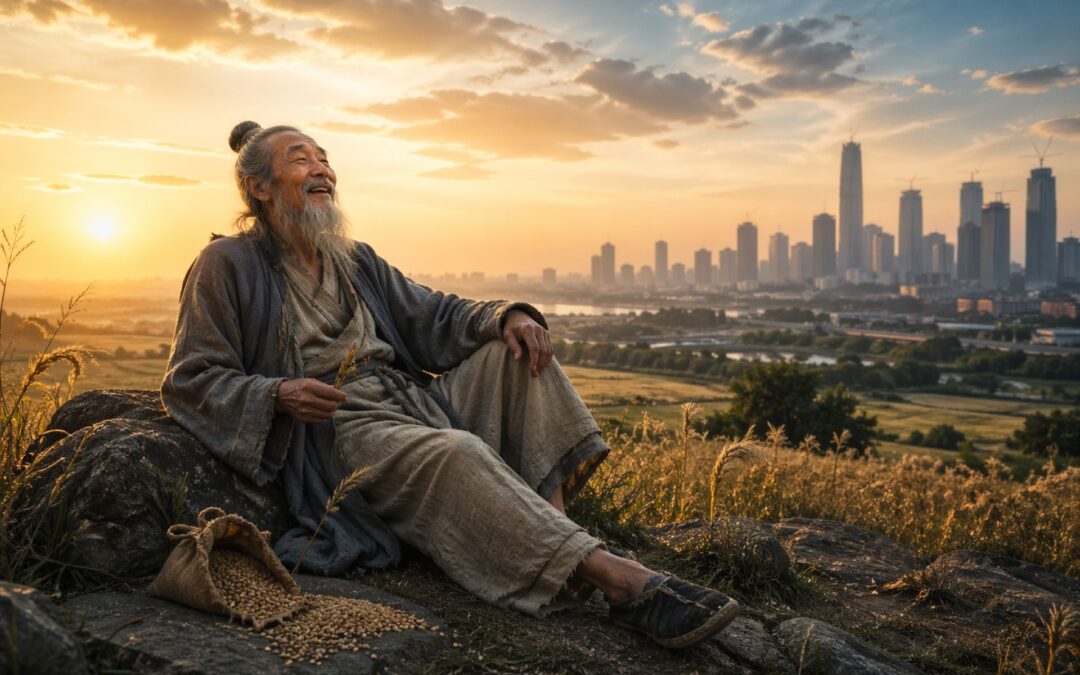
Introduction: The Hermit Who Had Nothing—And Needed Nothing
A long time ago, as Confucius and his students walked toward the kingdom of Wei, they came across a man who seemed, at first glance, like someone life had forgotten.
He was old—perhaps impossibly old. Bent over in a field, he gathered leftover grains that farmers had dropped during harvest. His clothes were worn, his work humble, and by any conventional measure, his life appeared to be one of quiet failure.
And yet, he was singing.
Not just humming absentmindedly, but singing with a kind of lightness that didn’t belong to someone in his condition. It unsettled one of Confucius’ students, Tzu-Kung, who couldn’t reconcile the image before him. How could someone so poor, so alone, be so at ease?
Moved by what he assumed was compassion, Tzu-Kung approached the old man and spoke to him as one would speak to the unfortunate. He inferred a life of missed opportunities—a man who hadn’t worked hard enough, who hadn’t achieved success, who had no family to care for him in old age.
In short, a man who had lost.
The hermit listened, then smiled—not bitterly, not defensively, but almost with amusement.
“Why do you feel sorry for me?” he asked. “Am I that pathetic in your eyes?”
Then he answered the question that Tzu-Kung hadn’t truly asked but had already assumed.
If he had spent his youth competing, striving, exhausting himself for status and recognition, perhaps he would not have lived long enough to reach such an age in good health. If he had a family, he would now carry the weight of worry for their lives. Instead, he had something far rarer: peace.
“I laugh and sing,” he said, “because I feel happy.”
This story, drawn from the Taoist text Liezi, does something subtle but powerful. It doesn’t argue against success, nor does it glorify poverty. Instead, it quietly dismantles the assumptions we carry about both.
The old man has what the world dismisses—and lacks what the world celebrates. Yet he is content in a way that many who “have everything” are not.
And that tension is difficult to ignore.
Because if his life can be joyful without the things we chase, then what exactly are we chasing? And more importantly—why does it feel so necessary?
In a world that constantly demands more from us—more ambition, more productivity, more proof of worth—this kind of perspective feels almost alien. We are trained to measure ourselves against standards we didn’t choose, to care deeply about opinions we barely respect, and to pursue goals that, once achieved, rarely satisfy for long.
Distractions multiply. Expectations tighten. And somewhere along the way, life begins to feel heavier than it should.
This is where Taoist philosophy enters—not as a rigid system, but as a quiet counterpoint.
It suggests that much of what we take seriously isn’t as important as we think. That what we call “loss” may carry hidden freedom. And that caring less—not out of indifference, but out of clarity—might be the most radical shift we can make.
The sages of Taoism, particularly Zhuangzi, spent their lives observing this strange human tendency: our habit of complicating what could be simple, of chasing what cannot satisfy, and of overlooking what is already enough.
Their insights remain just as relevant today.
Perhaps even more so.
Why We’re Trapped by What the World Values
Long before social media, advertising, and the modern obsession with “success,” Zhuangzi noticed something peculiar about human behavior.
People were restless.
They chased after fine clothes, luxurious food, and distant experiences—not because these things were necessary, but because they were admired. Wealth, status, and recognition became the invisible currency through which people measured not just success, but worth itself.
And once that equation is accepted, everything changes.
Life stops being something you live and becomes something you perform.
Today, the stage is simply bigger. The pressure hasn’t evolved—it has intensified. We are surrounded by carefully curated lives, constant comparison, and an unspoken demand to prove that we are doing well. Not just financially, but socially, aesthetically, even spiritually.
You’re not just expected to succeed. You’re expected to be seen succeeding.
And so the pursuit begins.
A better job leads to the desire for a better title. A higher salary quietly reshapes your expectations. The house you once dreamed of becomes normal the moment you move in. What once felt like arrival quickly turns into a new starting point.
The satisfaction doesn’t last—but the pressure does.
Zhuangzi observed this cycle with remarkable clarity. Once you commit yourself to chasing what the world celebrates, it is never enough. There is always something slightly out of reach, something better, something more refined, more impressive, more admired.
And in chasing it, you begin to trade something far more valuable.
Your ease.
Because the more you invest your sense of worth in external things, the more fragile that worth becomes. It depends on factors you cannot fully control—markets, trends, opinions, luck. You start managing your life not for how it feels, but for how it appears.
This is where the trap tightens.
What begins as a desire slowly turns into a requirement. What once felt optional becomes necessary. And over time, you’re no longer pursuing these things freely—you’re maintaining them. Protecting them. Paying for them, not just financially, but mentally.
The car isn’t just a car anymore. It’s an identity.
The career isn’t just work. It’s validation.
The lifestyle isn’t just comfort. It’s proof.
And the cost of losing any of it begins to feel unbearable.
Zhuangzi didn’t see this as success. He saw it as exhaustion.
From his perspective, this way of living wears people down. It binds them to a cycle of striving and dissatisfaction, where rest becomes difficult and contentment feels temporary at best. It’s not that these things are inherently bad—but the attachment to them is what creates tension.
Because when your happiness depends on what you have, you are never truly at ease.
There’s always something to gain—or something to lose.
At the same time, society quietly reinforces the opposite side of this equation. If wealth and status are admired, then their absence becomes something to avoid. Poverty, obscurity, irrelevance—these are not just conditions, but labels we learn to fear.
Nobody wants to be a “nobody.”
And so, even when we feel the strain of chasing, we hesitate to step away. Not because we don’t see the cost—but because we’re afraid of what it might mean to stop.
Afraid of being overlooked.
Afraid of falling behind.
Afraid of becoming insignificant.
But this fear rests on an assumption that Taoist thinkers challenge at its core.
That the world’s standards are the right standards to begin with.
Zhuangzi questioned this relentlessly. He argued that we cannot measure what is truly good or bad based solely on what society happens to value. The majority may agree on something—but agreement does not equal truth.
And once you begin to see that, something shifts.
The race loses some of its urgency. The opinions of others lose some of their weight. The things you once chased begin to look… optional.
Not meaningless—but no longer necessary for your peace.
And that realization opens the door to a very different way of living.
One that doesn’t begin with striving—but with stepping back.
The First Insight: The More You Chase, the Less You Have
At the heart of Taoist philosophy lies a paradox that feels almost counterintuitive in a world built on ambition:
The harder you try to have more, the more you end up losing.
Zhuangzi saw clearly what many of us only begin to notice after years of striving—that desire, when left unchecked, doesn’t lead to fulfillment. It multiplies.
You don’t arrive. You escalate.
What begins as a simple want slowly transforms into a chain reaction. You achieve something, and for a brief moment, there is satisfaction—a sense of completion. But it doesn’t last. The mind adjusts. What once felt extraordinary becomes ordinary. And almost without noticing, a new desire takes its place.
A better version. A higher level. A more refined outcome.
This isn’t accidental. It’s built into how we pursue things.
Because when happiness is tied to acquisition, it can never be stable. It depends on movement—on getting, improving, upgrading. And the moment movement stops, so does the feeling we’ve come to rely on.
So we keep moving.
But the cost of this constant chasing isn’t just physical effort. It’s psychological weight.
Every desire creates a subtle tension. A gap between where you are and where you think you should be. And the more desires you accumulate, the more gaps you carry. Your life becomes filled with unfinished equations—things to achieve, things to fix, things to prove.
Even rest begins to feel uneasy, because there’s always something left undone.
Zhuangzi saw this as a fundamental mistake.
From his perspective, we exhaust ourselves not because life demands it, but because we insist on it. We create unnecessary burdens by believing that more will finally be enough. But “enough” keeps moving. It’s never a fixed point.
And so, in trying to gain everything, we lose something far more essential.
We lose the ability to simply be at ease.
This is why Taoism often speaks of “doing nothing”—not in the sense of laziness, but in the sense of non-striving. Of allowing life to unfold without constantly interfering, optimizing, and forcing outcomes.
“Heaven does nothing, and yet everything is accomplished,” Zhuangzi suggested.
At first, this sounds impractical. Even irresponsible. How can you not strive in a world that demands results?
But the insight isn’t about abandoning action. It’s about abandoning the compulsive need to control everything.
Because much of what we chase isn’t necessary for a good life—it’s necessary for a certain image of a good life.
And when you begin to loosen that image, something unexpected happens.
You create space.
Space to enjoy what you already have without immediately turning it into a stepping stone for something else. Space to experience moments without evaluating whether they’re “enough.” Space to exist without constantly measuring your progress.
In that space, a different kind of satisfaction emerges.
Not the sharp, fleeting pleasure of getting something new—but a quieter, more stable contentment. One that doesn’t depend on what comes next.
This is the paradox Zhuangzi points to.
By chasing less, you don’t end up with less. You end up needing less.
And in needing less, you become far harder to disturb.
The Second Insight: The Power of Being Useless
If there is one idea in Taoist philosophy that directly challenges modern thinking, it is this:
What we call “useless” may be the very thing that protects us.
To a world obsessed with productivity, usefulness is everything. You are valued for what you produce, how efficient you are, how much you contribute. From early on, we are trained to justify our existence through output—to be good for something.
And if you’re not?
Then you risk being ignored, dismissed, or worse—seen as a failure.
But Taoist thinkers like Zhuangzi saw something deeply flawed in this way of thinking. They noticed that usefulness often comes with a hidden cost: exposure, exploitation, and eventual exhaustion.
To illustrate this, Zhuangzi tells the story of a carpenter and a tree.
A massive oak stood near a village shrine, so large that it could shelter hundreds of oxen beneath its branches. People gathered around it in admiration. It was impressive, even awe-inspiring. But when the carpenter saw it, he dismissed it instantly.
“This tree is worthless,” he said.
Its wood was too crooked to be used for construction. It couldn’t make strong boats or durable furniture. By all practical standards, it had no value.
That night, the tree appeared to the carpenter in a dream.
And it spoke.
It pointed out something that had gone unnoticed. Other trees—the ones that produced fruit or straight, strong wood—were constantly exploited. Their branches were broken, their fruits taken, their bodies shaped and cut to serve human needs. And when they stopped being useful, they were discarded.
Their usefulness made their lives difficult—and short.
But this tree, precisely because it was useless, had been left alone. It had grown vast, old, and undisturbed. Its uselessness had become its protection.
Its freedom.
This flips the entire logic of modern life.
We assume that the more useful we are, the better our lives will be. But often, the opposite happens. The more you are valued for what you can do, the more demands are placed on you. The more responsibilities you accumulate, the less room you have to simply exist.
You become needed—but also burdened.
You become important—but also replaceable.
And slowly, your life fills with obligations that you didn’t consciously choose, but feel unable to escape.
The Taoist perspective invites a different question:
What if not all forms of “uselessness” are failures?
What if some of them are freedoms in disguise?
This doesn’t mean abandoning all responsibility or rejecting effort entirely. It means recognizing that not everything in your life needs to be optimized, monetized, or justified.
Not every interest has to become a skill.
Not every skill has to become a career.
Not every moment has to be productive.
There is value in things that serve no external purpose.
Time spent doing nothing in particular.
Activities that don’t lead anywhere.
Moments that aren’t shared, posted, or evaluated.
These are the spaces where life is no longer being shaped for an outcome—but experienced for what it is.
And yet, these are often the first things we sacrifice.
We fill our schedules. We turn hobbies into side hustles. We measure even our rest—how effective it is, how restorative, how well it prepares us to return to work.
In doing so, we remove the very qualities that made those things meaningful in the first place.
Zhuangzi’s story of the tree isn’t asking you to become irrelevant. It’s asking you to reconsider what relevance costs.
Because sometimes, being a little “useless” means being left alone.
It means fewer expectations, fewer pressures, fewer invisible contracts tying your worth to your output.
And in that space, much like the tree, you may find something rare.
The ability to grow in your own way, at your own pace—without being constantly cut down to fit someone else’s purpose.
The Third Insight: Luck, Fate, and Letting Go
There is one final illusion that keeps us tightly bound to the game of striving—the belief that life unfolds fairly.
That effort guarantees results.
That virtue leads to recognition.
That success is something we earn in a clean, predictable way.
It’s a comforting idea.
Because if the world is fair, then everything is within reach. If we just work hard enough, choose wisely enough, and persist long enough, things should eventually fall into place.
But Taoist stories rarely support this belief.
In one such story, two old friends meet again after many years apart. One has become wealthy, respected, and widely admired. The other has fallen into poverty, dressed in worn clothes, living in poor conditions, and largely disregarded by society.
The contrast is painful.
The poorer man, unable to make sense of it, points out that they started from similar circumstances. They worked together, farmed together, traded together. And yet, while one prospered in every endeavor, the other seemed to fail at every turn.
“How is this fair?” he asks.
The successful friend, perhaps unconsciously, responds in the way society often does—by attributing his success to his own superiority. His intelligence. His virtue. His worthiness.
It’s a familiar narrative.
Success becomes proof of character.
Failure becomes evidence of deficiency.
But when the matter is brought before a sage, the explanation shifts entirely.
The difference between the two men, the sage suggests, is not virtue. It is not wisdom. It is not even effort.
It is luck.
One has it. The other does not.
This idea is unsettling.
Because it removes the sense of control we like to believe we have. It challenges the notion that life can be mastered through discipline alone. And perhaps most importantly, it disrupts the quiet arrogance that often accompanies success.
From a Taoist perspective, much of what happens to us lies beyond our control. Outcomes are shaped by countless factors—timing, circumstance, chance—many of which we neither see nor influence.
And yet, we build our entire emotional world around these outcomes.
We celebrate ourselves when things go well.
We blame ourselves when they don’t.
We compare, compete, measure—and suffer.
But if outcomes are not entirely ours to command, then tying our happiness to them becomes a fragile strategy.
This is where letting go becomes essential.
Not as resignation, but as clarity.
Letting go of the need for life to be fair.
Letting go of the idea that everything must make sense.
Letting go of the belief that your worth is reflected in your results.
When the poorer man in the story hears the sage’s words, something shifts. His situation hasn’t changed. His life remains the same. But the weight he carries begins to lift.
Because he is no longer interpreting his life as a personal failure.
He stops resisting what is.
And in that acceptance, he finds a form of peace that had been unavailable to him while he was still comparing, still judging, still asking “why me?”
This is the quiet strength of the Taoist approach.
It doesn’t promise control over life—it offers freedom from the need to control it.
You still act. You still make choices. You still move through the world. But you loosen your grip on how things must turn out.
Because the tighter you hold onto outcomes, the more life feels like a constant negotiation.
And the more you let go, the more it begins to feel like something you can simply move through.
Not everything will go your way.
But not everything needs to—for you to be at ease.
What Taoism Gets Right About Modern Anxiety
If there is one thing that defines modern life, it is this persistent, low-level tension that never quite leaves.
Even when nothing is wrong, something feels off.
You finish your work, but your mind keeps running. You achieve a goal, but it doesn’t land the way you expected. You rest, but part of you feels like you should be doing something else. There’s always a quiet pressure in the background—a sense that you’re falling behind in a race you never fully agreed to join.
This is the atmosphere many people live in today.
And it’s precisely the kind of condition Taoist thinkers would recognize immediately.
Because from a Taoist perspective, anxiety isn’t just a personal issue. It’s a structural one. It emerges from the way we relate to life itself—how tightly we try to control it, how seriously we take the roles we’ve adopted, and how deeply we attach our identity to things that are constantly changing.
Much of modern anxiety can be traced back to three habits.
First, the habit of constant striving.
We rarely allow ourselves to simply exist without moving toward something. Even moments of stillness are often framed as preparation—rest so we can work better, relax so we can perform more efficiently later. Life becomes a sequence of means rather than ends.
There is always a next step. And if there isn’t, we feel uneasy.
Second, the habit of comparison.
We measure ourselves against others in ways that are both subtle and relentless. Not just in wealth or status, but in lifestyle, relationships, experiences, even personal growth. There is always someone ahead, someone doing better, someone who seems to have figured things out more completely.
And this comparison doesn’t motivate as much as it destabilizes.
Because no matter where you are, it suggests that you are not quite enough yet.
Third, the habit of control.
We try to manage not just our actions, but our outcomes. We plan, optimize, strategize, and anticipate. And while some degree of control is necessary, the problem arises when we expect life to follow those plans precisely.
When it doesn’t—and it often doesn’t—we experience frustration, uncertainty, and stress.
These three habits reinforce each other.
Striving creates pressure.
Comparison intensifies it.
Control fails to contain it.
And the result is a state of chronic mental agitation.
What Taoism offers is not a technique to eliminate anxiety instantly, but a shift in orientation.
It suggests that much of this tension is self-created—not in a blaming sense, but in a structural sense. It arises from the way we engage with the world, not just from the world itself.
And if that’s the case, then it can be approached differently.
Instead of constantly striving, Taoism points toward moments of non-striving—allowing things to unfold without immediate intervention. Not everything needs to be improved or directed.
Instead of constant comparison, it invites a return to your own experience. Your life, as it is, without placing it inside a hierarchy.
Instead of control, it emphasizes alignment—moving with circumstances rather than against them, adapting rather than forcing.
These shifts may seem small, but their effect is significant.
Because anxiety thrives on resistance—on the gap between how things are and how we think they should be.
And when that gap narrows, even slightly, the tension begins to ease.
This is why the Taoist approach often feels like a kind of release.
Not because it solves every problem, but because it changes how problems are held.
The world remains complex. Life remains unpredictable. But your relationship to both becomes lighter.
Less rigid.
Less reactive.
Less burdened by the need to get everything right.
In a time where seriousness has become almost automatic—where everything feels urgent, important, and consequential—Taoism offers something rare.
The permission to loosen your grip.
To care—but not too much.
Conclusion: A Different Kind of Success
If you step back and look at the stories we’ve explored—the singing hermit, the useless tree, the two friends divided by luck—they all point toward a quiet but radical idea:
What we call success may not be worth the cost.
Not because success is inherently wrong, but because the way we define it is narrow, fragile, and often disconnected from how life actually feels when lived.
We are taught to aim for more—more recognition, more security, more achievement. And in doing so, we build lives that look impressive from the outside but feel increasingly heavy from within.
The Taoist perspective doesn’t ask you to reject the world. It asks you to see through it.
To recognize that many of the things we take seriously are based on assumptions we’ve inherited, not truths we’ve discovered. That the race we’re running may not have a meaningful finish line. And that constantly trying to secure your place in it comes at the expense of something far more immediate.
Your peace.
The hermit had none of the things we’re told to pursue—and yet he sang.
The tree had no practical use—and yet it thrived.
The man without success found contentment the moment he stopped measuring himself against another.
None of them changed their external circumstances. What changed was their relationship to them.
And that’s the essence of what Taoism offers.
Not control over life, but freedom within it.
A way of moving through the world without being constantly pulled by its expectations. A way of engaging with things—work, ambition, relationships—without letting them define your worth.
It’s a subtle shift, but a powerful one.
Because when you stop needing life to look a certain way, you begin to experience it more directly. Without the constant filter of comparison, expectation, and judgment.
And in that space, something surprising happens.
You don’t become indifferent.
You become lighter.
You still act, still care, still participate—but without the same tension, without the same urgency to prove something, without the same fear of falling short.
This is a different kind of success.
Not one that can be easily measured or displayed, but one that is felt in the quiet moments. In the absence of pressure. In the ability to sit, like the old hermit, with very little—and still find a reason to sing.
It doesn’t mean abandoning ambition or rejecting the world entirely.
It simply means remembering that your peace doesn’t have to depend on it.