
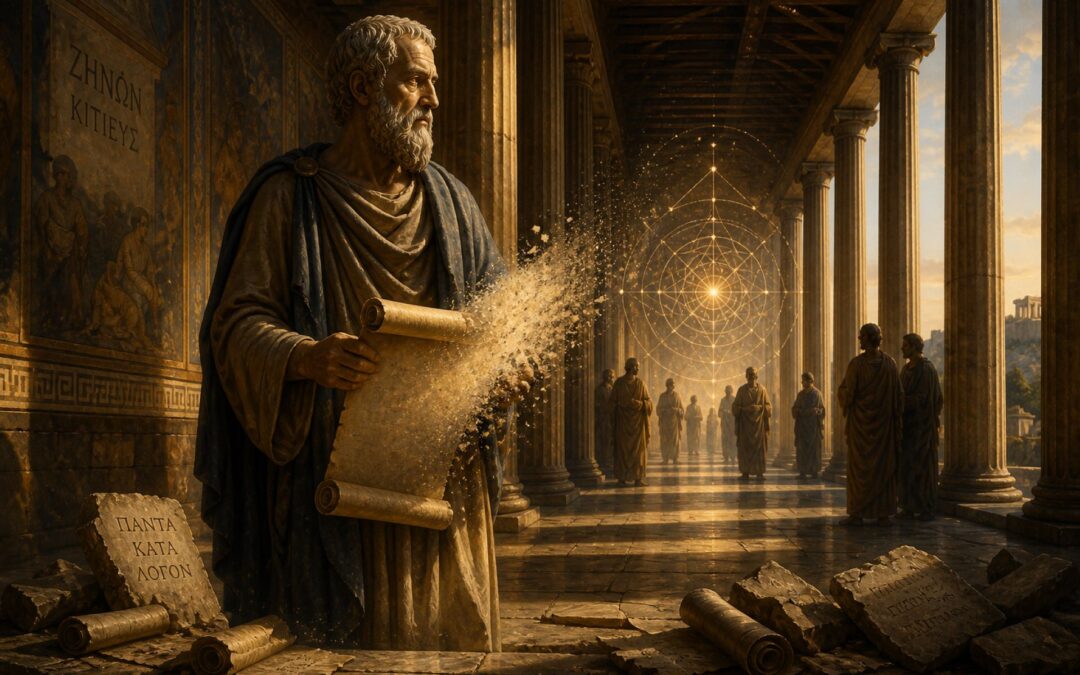
The Philosopher We Know Through Fragments
There is something almost paradoxical about Zeno of Citium. He founded one of the most enduring philosophical traditions in human history, and yet, not a single word of his original writings survives. No dialogues, no treatises, no carefully constructed arguments in his own voice. What remains of him comes secondhand—echoes preserved by others, fragments carried through time by historians and philosophers who found his ideas too important to let disappear.
Much of what we know about Zeno comes from Diogenes Laërtius, who documented the lives of philosophers centuries later, and from thinkers like Cicero, who quoted and interpreted Stoic ideas within their own works. These sources do not give us Zeno in full clarity, but they offer something perhaps just as valuable: a glimpse into how his ideas were understood, transmitted, and transformed over time.
This makes Zeno an unusual figure in philosophy. Most great thinkers are studied through their own words. Zeno, on the other hand, is studied through absence. His philosophy must be reconstructed, pieced together from references, interpretations, and philosophical descendants. And yet, despite this limitation, his influence is unmistakable.
Around 300 BC, Zeno established what would become known as Stoicism—a system of thought concerned with logic, ethics, and the nature of the universe. It is a philosophy that has outlived empires, shaped Roman thought, and continues to guide modern discussions about resilience, virtue, and the human condition. The fact that it all traces back to a man whose works are lost only deepens the intrigue.
There is also a certain philosophical irony here. Stoicism teaches acceptance of what is beyond our control, including loss and impermanence. And in a way, Zeno himself has been subject to this principle. His writings are gone, but his ideas remain—not in their original form, but in a distilled, evolving tradition that others carried forward.
So, to understand Zeno is not to read him directly, but to follow the traces he left behind. It is to engage with a philosophy that was never fully preserved, yet somehow refused to vanish.
From Merchant’s Son to Philosopher
Zeno’s journey into philosophy did not begin in an academy or under the guidance of a master thinker. It began, rather unexpectedly, through trade. Born in Citium, a city on the island of Cyprus, Zeno was the son of a merchant. His early life was shaped not by abstract inquiry, but by the practical realities of commerce and travel.
It was through his father’s profession that Zeno first encountered philosophy. His father, returning from journeys, brought back books—among them writings about Socrates. These texts seem to have had a profound effect. They did not merely inform Zeno; they altered the direction of his life. What began as exposure soon turned into obsession.
There is a well-known story—likely embellished but symbolically fitting—that Zeno lost his cargo in a shipwreck and found himself in Athens. Stripped of his previous life, he wandered into a bookstore and encountered philosophical works once again. When he asked where he could find men like Socrates, he was directed to Crates of Thebes, a prominent Cynic philosopher known for his radical rejection of social conventions.
Under Crates, Zeno began his formal philosophical education. The Cynics emphasized a life of austerity, rejecting wealth, comfort, and societal expectations. For a time, Zeno immersed himself in this way of thinking. But he did not stop there. His intellectual curiosity led him to study under other teachers as well, including Polemo of the Platonic Academy and Stilpo, known for his sharp dialectical skills.
This diversity of influences is crucial to understanding Zeno. He was not a disciple who simply adopted a single doctrine. Instead, he absorbed ideas from multiple traditions—Cynic ethics, Academic philosophy, and Megarian logic—and gradually began to synthesize them into something new.
At some point, Zeno transitioned from student to independent thinker. Rather than continuing within an established school, he began teaching in a public colonnade in Athens known as the Stoa Poikile. It was here, in this open and accessible space, that his philosophy started to take shape—not as a rigid system handed down from a master, but as a living framework built from experience, reflection, and adaptation.
What began as a merchant’s life had, through a series of chance events and intellectual encounters, transformed into the foundation of a philosophical movement.
Teaching in the Stoa: The Birth of Stoicism
When Zeno began teaching, he did not establish a formal school in the traditional sense. There were no enclosed academies or exclusive circles of elite students. Instead, he chose a public space—the Stoa Poikile, or “Painted Porch,” in Athens. It was a place where people passed by, gathered, and engaged in everyday life. Philosophy, in this setting, was not hidden away. It was exposed to the world.
This choice was not accidental. It reflected something essential about Zeno’s approach. His philosophy was not meant to be abstract speculation detached from reality. It was meant to be lived, practiced, and tested in the midst of ordinary human experience.
Those who gathered around him were initially known as “Zenonians,” named after their teacher. But over time, they came to be called Stoics—derived directly from the place where they learned. The name itself carries meaning: this was a philosophy rooted not in a person alone, but in a shared space, a public engagement with ideas.
In this environment, Zeno began laying the groundwork for what would become Stoicism. Unlike the Cynics, who often rejected society outright, Zeno’s philosophy did not require withdrawal from the world. And unlike the more abstract traditions of the Academy, it did not remain confined to theoretical inquiry. Instead, it sought a balance—an understanding of how to live well within the structure of reality.
Zeno’s teachings covered a wide range of subjects. He did not limit himself to ethics alone, though that would later become the most emphasized part of Stoicism. He explored logic, asking how we can reason correctly. He examined epistemology, questioning how we come to know what is true. And he investigated the nature of the universe itself, forming a view of reality that would shape all Stoic thought that followed.
What makes this moment significant is not just that Zeno taught philosophy, but that he began to organize it into a coherent system. Philosophy, in his hands, became something structured yet practical—a way of understanding the world that directly informed how one should live.
The Stoa Poikile, then, was more than a location. It was the birthplace of a worldview. From that open colonnade, a philosophy emerged that would go on to influence generations—carried forward by students who refined, expanded, and preserved what Zeno had begun.
The Universe as Reason: Understanding Logos
At the heart of Zeno’s philosophy lies a striking and, at first glance, almost unsettling idea: the universe itself is rational. Not metaphorically, not symbolically—but literally governed by reason.
For Zeno, reality was not divided into separate realms of matter and spirit. Everything that exists is material, including what we would typically call “divine.” But this material universe is not chaotic or random. It is structured, ordered, and guided by an underlying principle—what the Stoics called Logos.
This idea survives through a fragment preserved by Cicero, where Zeno argues that that which exercises reason is superior to that which does not. Since nothing is more excellent than the universe, it follows that the universe itself must exercise reason. It is a bold conclusion, but one that forms the backbone of Stoic thought.
In this framework, God is not something external to the world. There is no distant creator standing apart from creation. Instead, the divine is immanent—it exists within the universe as its organizing force. Logos is both the structure and the intelligence of reality. It is what gives form to matter, what ensures that events unfold according to a coherent order.
This has profound implications. If the universe is rational, then everything that happens within it follows a certain logic—even if that logic is not immediately visible to us. What we often perceive as chaos, misfortune, or randomness may simply be our limited perspective encountering a larger order we do not fully understand.
From this idea emerges one of the central Stoic principles: to live according to reason is to live according to nature. Human beings, as rational creatures, are not separate from the Logos—we are expressions of it. Our ability to think, to reflect, to understand is not accidental; it is a direct participation in the rational structure of the universe.
To live well, then, is not about imposing our will on the world, but aligning ourselves with how the world already works. It is about recognizing the patterns of reality and adjusting our expectations, desires, and actions accordingly.
This is where Stoicism begins to shift from abstract philosophy to a practical guide for life. If the universe operates through reason, then resisting its nature is, in a sense, irrational. And much of human suffering can be understood as a kind of misalignment—a refusal to accept what is, or an insistence that reality should be otherwise.
Zeno’s concept of Logos reframes this entirely. It suggests that peace does not come from controlling the world, but from understanding it.
Virtue as the Only Good
If the universe is governed by reason, then the question naturally follows: how should a human being live within it? Zeno’s answer is both simple and demanding—virtue is the only true good.
This idea stands at the center of Stoic ethics. Unlike common views that place value on wealth, status, pleasure, or even health, Zeno draws a sharp line between what is truly good and what merely appears to be. Only virtue—our capacity to think, act, and choose in accordance with reason—has genuine value. Everything else is secondary.
This is not to say that external things are meaningless, but they do not define the quality of a life. A person can possess wealth and still live poorly. Another can face hardship and still live well. What determines the difference is not circumstance, but character.
The goal, then, is to reach a state the Greeks called Eudaimonia—a condition often translated as happiness, but better understood as a life that is fully aligned, stable, and flourishing. For Zeno, this state is not achieved through pleasure or success, but through the consistent practice of virtue.
He described happiness as “a good flow of life,” a phrase that captures something subtle. It suggests movement without resistance, a life that unfolds smoothly not because nothing goes wrong, but because the individual is not internally at odds with reality. There is no constant friction between expectation and experience.
To live virtuously, in this sense, is to live in accordance with both human nature and the nature of the universe. As rational beings, our role is to use reason well—to make judgments that reflect reality, to act with integrity, and to maintain consistency between thought and action.
This perspective also removes the instability that comes from depending on external outcomes. If happiness depends on things outside our control, it will always be fragile. But if it depends on how we think and act—on something internal and stable—then it becomes far more resilient.
Zeno’s ethical framework is demanding because it shifts responsibility entirely inward. It does not allow us to blame circumstances for a lack of fulfillment. At the same time, it offers a kind of freedom. If virtue is the only good, then nothing external has the power to take a good life away from us.
What remains is the challenge of living up to that standard—a challenge that would define Stoic philosophy for generations to come.
The Role of Indifferents
If virtue is the only true good, then what do we make of everything else—health, wealth, comfort, status, even pain and illness? Zeno’s answer introduces one of the most subtle and often misunderstood aspects of Stoic philosophy: the concept of indifferents.
At first glance, calling these things “indifferent” seems counterintuitive. After all, most people clearly prefer health over sickness, wealth over poverty, and safety over danger. Zeno did not deny this. Instead, he made a careful distinction. These things are not good or bad in a moral sense, but they still have practical value.
Indifferents are, quite simply, things that do not determine whether a life is virtuous or not. They exist outside the core domain of ethics. However, within this category, Zeno recognized an important difference between what later Stoics would call “preferred” and “dispreferred” indifferents.
Health, for example, is preferable because it supports self-preservation and allows us to function more effectively. Wealth can provide stability and resources that make certain actions easier. On the other hand, sickness and poverty are dispreferred because they hinder our natural inclination toward self-preservation.
But here is the key: none of these things, on their own, make a person virtuous or vicious. A wealthy person is not automatically good, and a sick person is not automatically bad. These external conditions may influence the context of our lives, but they do not define our character.
This distinction is what separates Stoicism from the more radical stance of the Cynics. Thinkers like Crates of Thebes rejected external goods almost entirely, viewing them as obstacles to a virtuous life. Zeno, having studied under the Cynics, moved away from this extreme position. He acknowledged that external things have value—but only as tools, not as ends in themselves.
The Stoic approach, then, is not to reject indifferents, but to engage with them wisely. We can pursue health, wealth, and other advantages, but we must not become dependent on them. They are to be used, not clung to.
This creates a subtle but powerful shift in perspective. Instead of organizing life around acquiring and protecting external things, the focus remains on maintaining virtue regardless of circumstances. Indifferents become part of the landscape of life—factors we navigate, not foundations we rely on.
In practice, this means appreciating what we have without fearing its loss. It means working toward better conditions without believing they will complete us. And it means understanding that even when circumstances turn against us, the possibility of living well remains intact.
Zeno’s concept of indifferents preserves a balance that is easy to lose. It allows for engagement with the world without dependence on it—a middle path between rejection and attachment.
Emotions and the Problem of Judgment
Zeno’s approach to emotions is often one of the most misunderstood aspects of Stoicism. It is easy to assume that Stoics aimed to suppress or eliminate feelings altogether—but that is not quite accurate. What Zeno actually challenged was not emotion itself, but the way emotions arise from our judgments about the world.
According to Zeno, what we call “bad feelings” are disturbances of the mind—states that are out of alignment with reason. They are not random or unavoidable forces. They are the result of how we interpret events.
Take grief, for example. The death of a loved one is undeniably painful. But Zeno would argue that the intensity of our suffering is tied not just to the event itself, but to our belief that something unnatural or unjust has occurred. If we come to understand that death is a fundamental part of life—something embedded in the structure of the universe—then our response, while still human, becomes less chaotic and overwhelming.
The same applies to frustration, anger, or resentment. We often react as if life has violated an expectation we were entitled to. We believe things should have gone differently—that people should have behaved better, that circumstances should have been more favorable. When reality contradicts these expectations, emotion follows.
For Zeno, this is where the problem lies. Not in the event, but in the assumption behind it.
If the universe operates according to reason, then everything that happens is part of that rational order—even if we do not fully understand it. This does not mean that everything feels good or desirable, but it does mean that reacting with outrage or despair may reflect a misunderstanding of how reality works.
Emotions, in this sense, become signals of misalignment. They reveal where our thinking has diverged from the nature of things. To correct the emotion, we do not need to force it away—we need to examine the judgment that produced it.
This is a demanding idea because it places responsibility on the individual. It suggests that peace is not something granted by favorable circumstances, but something cultivated through clarity of thought. By refining our understanding of the world, we gradually reduce the intensity of disruptive emotions.
Zeno’s view does not strip away humanity. It does not deny that loss hurts or that hardship is difficult. What it offers instead is a path toward stability—a way of experiencing life without being constantly thrown off balance by it.
In the Stoic framework, emotional resilience is not about becoming cold or detached. It is about becoming aligned—with reason, with nature, and with the reality we are part of.
Living in Agreement with Nature
All of Zeno’s ideas—Logos, virtue, indifferents, and the role of judgment—ultimately converge on a single guiding principle: to live in agreement with nature.
At first, this phrase can sound vague, almost poetic. But for Zeno, it carries a precise meaning. Nature is not just the physical world of trees, rivers, and seasons. It is the underlying order of reality—the rational structure governed by Logos. To live according to nature, then, is to live in alignment with that structure.
This has two dimensions. The first is living in accordance with the nature of the universe itself. If reality unfolds according to reason, then resisting what happens—mentally or emotionally—is a form of conflict with that order. It is, in a sense, irrational. Acceptance, on the other hand, becomes an act of understanding. It reflects a recognition that events follow a pattern larger than our individual desires.
The second dimension is living in accordance with our own human nature. As rational beings, our defining characteristic is the ability to think, reflect, and make judgments. To live well is to use this capacity properly—to align our thoughts with reality, rather than distort reality to fit our expectations.
When these two dimensions come together, something interesting happens. Life begins to feel less like a struggle against circumstances and more like a process of participation. Instead of trying to control everything, we focus on responding well to whatever arises.
This is where the Stoic attitude often described as amor fati—the love of fate—finds its roots. It is not merely about tolerating what happens, but about embracing it as part of the natural order. Not because everything is pleasant, but because everything belongs.
Zeno’s philosophy does not promise comfort in the traditional sense. It does not suggest that life will become easier or more predictable. What it offers instead is a different relationship with reality—one where resistance gives way to understanding, and frustration is replaced by a kind of quiet acceptance.
To live in agreement with nature is not to withdraw from life, but to engage with it more honestly. It is to stop demanding that the world be different, and instead learn how to move within it with clarity and purpose.
The Uncertain Legacy of Zeno
For someone who founded an entire philosophical tradition, Zeno leaves behind a surprisingly uncertain legacy. Not only are his original works lost, but even the details of his life—and death—are subject to disagreement.
Different sources offer conflicting accounts of how Zeno died. Some suggest he took his own life after a minor injury, interpreting it as a sign that his time had come. Others present different variations, each shaped by the storyteller’s perspective. What remains consistent, however, is the sense that Zeno’s life, much like his philosophy, was interpreted through the lens of those who came after him.
This uncertainty extends beyond biography into philosophy itself. Because we rely on fragments and secondhand reports, it is difficult to know exactly how much of what we call “Stoicism” originates directly from Zeno. His ideas were not preserved in a fixed form; they were carried forward, adapted, and expanded by later thinkers.
Figures like Cleanthes and Chrysippus played a crucial role in shaping Stoicism into the system we recognize today. In fact, some scholars argue that Chrysippus, in particular, was responsible for developing the logical and structural depth of the philosophy. Without him, Stoicism might not have endured in the way it did.
This raises an interesting question: was Zeno’s role truly foundational, or more symbolic?
On one hand, he established the core direction—the emphasis on reason, virtue, and alignment with nature. He created the framework within which later Stoics would operate. On the other hand, the philosophy as it is commonly understood today is the result of generations of refinement, clarification, and expansion.
But perhaps this distinction misses something important. Founders are not always the most detailed thinkers. Their role is often to initiate—to bring together influences, articulate a vision, and set something in motion. Zeno did exactly that. He took ideas from multiple traditions and shaped them into a coherent starting point.
In that sense, his legacy is less about precise doctrines and more about orientation. He defined the direction Stoicism would take, even if others built the road.
There is a certain fittingness to this ambiguity. A philosophy that emphasizes acceptance of uncertainty and impermanence is itself rooted in a figure whose own story cannot be fully recovered. Zeno’s legacy, like the fragments that preserve it, resists complete clarity—but it continues to influence, nonetheless.
Why Zeno Still Matters Today
It might seem strange that a philosopher whose writings are entirely lost continues to hold relevance today. In most fields, the absence of original work would mean fading into obscurity. But Zeno’s influence has moved in the opposite direction. Over time, it has become more visible, not less.
Part of this is due to the nature of what he started. Stoicism was never just a set of abstract ideas—it was a practical philosophy, concerned with how to live. That practicality allowed it to survive beyond its origins. Even as the original texts disappeared, the core principles were carried forward, refined by later thinkers, and applied to new contexts.
More importantly, the problems Zeno addressed have not changed. Human beings still struggle with uncertainty, loss, frustration, and the desire to control what cannot be controlled. We still look for stability in unstable things. We still confuse external success with internal fulfillment.
Zeno’s framework cuts through these patterns with a kind of clarity that feels surprisingly modern. His insistence that virtue is the only true good challenges the way we measure success. His idea that emotions arise from judgment invites us to examine how we interpret our experiences. And his emphasis on living in accordance with nature offers an alternative to the constant tension between expectation and reality.
What makes his philosophy endure is not its historical significance, but its applicability. It does not depend on a specific time, culture, or set of circumstances. It speaks to something more fundamental—the structure of human experience itself.
There is also something compelling about the way Zeno’s ideas have survived. Without a definitive text to anchor them, they have remained flexible. They have been interpreted, adapted, and re-expressed by different generations, each finding new relevance in them. In a sense, the absence of his original works has allowed the philosophy to remain alive rather than fixed.
Zeno’s importance, then, is not tied to what he wrote, but to what he initiated. He set in motion a way of thinking that continues to resonate because it addresses enduring questions: What is within our control? What truly matters? How should we respond to the world as it is?
These questions do not lose relevance. And as long as they remain, so does Zeno’s philosophy.