
Introduction: The Forgotten Maritime Empire of India
When most people think of the great empires of Indian history, a familiar list tends to emerge: the Mauryas, the Guptas, the Mughals, and eventually the British Raj. These empires dominate textbooks and popular imagination alike, forming a tidy narrative that stretches from antiquity to modern independence. Yet this story leaves out some of the most fascinating and dynamic powers the subcontinent ever produced.
Among the most remarkable of these overlooked empires were the Cholas, a Tamil dynasty that rose from the fertile Kaveri River delta in southern India. At their height during the medieval period, the Cholas controlled vast territories across South India and Sri Lanka, commanded one of the most powerful navies in the premodern world, and projected their influence across the seas into Southeast Asia. Their ships sailed along the great commercial highways of the Indian Ocean, connecting distant markets from Arabia to China.
The Chola Empire was not simply a land-based kingdom expanding across neighboring regions. It was a maritime power that understood the strategic value of trade routes, ports, and naval supremacy. Through a combination of administrative innovation, military conquest, and commercial ambition, the Cholas positioned themselves at the center of a thriving international trading system known as the Maritime Silk Road.
No ruler embodied these ambitions more clearly than Rajendra Chola I. Ascending the throne in 1014 CE, Rajendra inherited an already formidable empire from his father, the famous Raja Raja Chola I. Rather than merely maintaining his inheritance, Rajendra expanded it dramatically. His armies marched across the Indian subcontinent, reaching the sacred waters of the Ganges in northern India. His fleets dominated the seas, capturing strategic islands and coastal territories that allowed the Cholas to control maritime commerce.
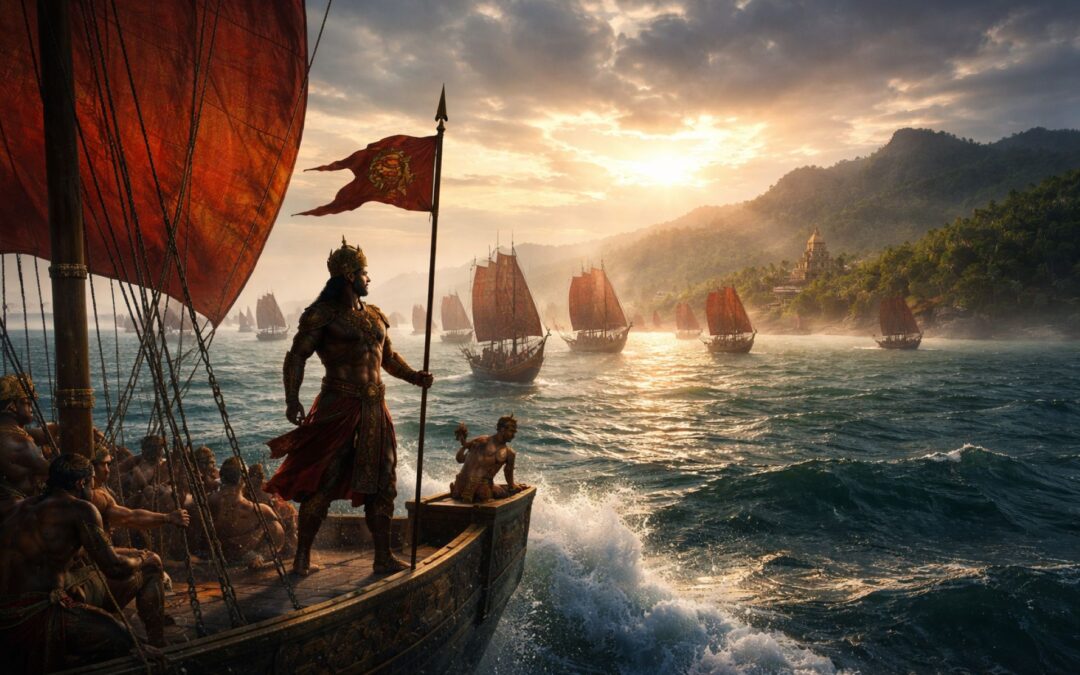
Rajendra’s most extraordinary achievement came in 1025 CE, when he launched a massive naval expedition across the Bay of Bengal against the powerful Southeast Asian kingdom of Srivijaya. In a campaign that stunned contemporaries, the Chola navy struck deep into the Malay Archipelago, sacked major ports, captured the Srivijayan king, and reshaped the political landscape of maritime Southeast Asia.
This was not a simple raid driven by ambition or glory. It was part of a much larger geopolitical struggle for control over one of the most valuable economic systems of the medieval world. The Indian Ocean trade network linked distant civilizations and generated enormous wealth for the states that controlled its chokepoints. By projecting power across the sea, the Cholas were attempting to dominate that system.
For nearly a century after the invasion, the Chola Empire maintained a powerful presence in Southeast Asia. Through alliances, trade guilds, military garrisons, and dynastic marriages, they exerted influence far beyond the shores of India. Their reach extended into the political affairs of kingdoms across the Malay Peninsula, Sumatra, and even parts of mainland Southeast Asia.
Today, the Cholas remain relatively unknown outside specialized historical circles. Yet their story challenges many assumptions about the nature of Indian power in the medieval world. Far from being isolated from global affairs, the Cholas were active participants in an interconnected maritime system that spanned half the globe.
The rise of the Chola Empire—and Rajendra Chola’s dramatic invasion of Southeast Asia—reveals a moment when an Indian kingdom became a major force in international politics, trade, and naval warfare. It is a story of ambition, innovation, and global influence that deserves to be remembered alongside the greatest empires of world history.
The Origins of the Chola Dynasty
The story of the Cholas stretches far deeper into antiquity than the dramatic events of Rajendra Chola’s reign. Long before they became a powerful maritime empire, the Cholas were one of the ancient Tamil dynasties that dominated southern India. Their origins can be traced back to at least the early centuries before the Common Era, when the fertile plains of the Kaveri River delta supported a network of prosperous settlements and trading ports.
Tamil literary traditions, particularly the Sangam poems composed roughly between 300 BCE and 300 CE, contain some of the earliest references to the Cholas. These texts describe a vibrant political landscape in southern India where three major Tamil powers—the Cholas, the Cheras, and the Pandyas—competed for dominance. Known collectively as the “Three Crowned Kings” of Tamilakam, these dynasties controlled strategic agricultural regions and coastal trade routes that linked the Indian subcontinent with distant markets across the seas.
The Chola heartland lay in the Kaveri delta, one of the most fertile regions in South India. The river’s seasonal flooding enriched the soil and made the region ideal for rice cultivation. Agricultural prosperity provided the economic foundation upon which early Chola power was built. Control of this productive landscape allowed the dynasty to support urban centers, maintain armies, and participate in long-distance trade.
Equally important was the Cholas’ access to the sea. The eastern coast of southern India opened directly onto the Bay of Bengal, providing maritime routes that connected Tamil ports to Southeast Asia, Sri Lanka, and the wider Indian Ocean world. Archaeological evidence and historical records indicate that merchants from distant civilizations—including the Roman Empire and later Chinese dynasties—visited ports in Tamil country to acquire spices, precious stones, textiles, and other luxury goods.
Despite these advantages, the Cholas were not always the dominant force in the region. In the centuries following the Sangam era, their power declined and the dynasty gradually faded from political prominence. By the early medieval period, the Cholas had been reduced to the status of a minor regional kingdom, overshadowed by stronger neighbors.
One of these rivals was the Pallava dynasty, which controlled much of northern Tamil Nadu and wielded significant influence over the region. For a time, the Cholas existed as subordinate rulers under Pallava authority. This subordinate position forced them to operate carefully within a complex political environment dominated by more powerful states.
Yet this period of relative weakness also laid the groundwork for their later resurgence. The Cholas maintained control over their core territories in the Kaveri delta and preserved their dynastic identity even while serving as vassals. When opportunities arose during moments of instability among their overlords, the Cholas were well positioned to reclaim their independence.
That opportunity arrived in the ninth century. As the Pallavas became embroiled in conflicts with other regional powers, the Cholas seized the chance to reassert themselves. Under the leadership of Vijayalaya Chola in the mid-ninth century, the dynasty captured the strategic city of Thanjavur and began rebuilding its political strength.
This event marked the beginning of the Chola revival. Over the following decades, the dynasty steadily expanded its influence across southern India, gradually transforming itself from a modest regional power into one of the most formidable empires of the medieval Indian world.
The Chola Golden Age and Administrative Innovations
The revival of Chola power in the ninth century marked the beginning of a remarkable period of growth and stability that would eventually develop into one of the most sophisticated states in medieval India. Over the next century and a half, the Cholas transformed themselves from a regional dynasty into a highly organized imperial power. This transformation was not driven by conquest alone. Equally important were the administrative reforms, economic management, and institutional structures that allowed the empire to govern large territories effectively.
At the heart of the Chola state was an unusually efficient system of administration. The rulers of the dynasty placed great emphasis on record keeping, taxation, and local governance. Surviving inscriptions carved into temple walls and copper plates reveal a bureaucracy that maintained detailed documentation of land ownership, tax obligations, legal disputes, and administrative decisions. Palm leaves were commonly used as writing material, allowing officials to store extensive records that could be consulted when necessary.
One of the key foundations of Chola administration was the careful management of land and agricultural production. Since the Kaveri delta was the empire’s economic core, accurate land surveys were essential. Officials conducted systematic assessments of land holdings and productivity, which allowed the state to determine tax obligations more precisely. These surveys helped create a relatively standardized system of revenue collection, ensuring that the central government received a steady flow of resources without relying entirely on local feudal intermediaries.
The Chola rulers also introduced mechanisms to monitor officials and prevent abuses of power. Administrative posts were often subject to periodic review, and records show that misconduct by local officials could lead to investigations or penalties. These systems were designed to strengthen central authority and reduce the influence of local power holders who might otherwise challenge imperial control.
Perhaps the most distinctive feature of Chola governance was the role of local councils. Village assemblies played an active part in managing community affairs, including irrigation systems, taxation, and public works. These councils were not simply informal gatherings but structured institutions with defined procedures and responsibilities. In some regions, council members were selected through elaborate systems that resembled elections, with eligibility rules and mechanisms designed to ensure fairness and accountability.
The existence of these local institutions did not weaken imperial authority. Instead, they functioned as part of a layered administrative system that connected villages to regional officials and ultimately to the royal court. Local councils handled everyday governance, while the central state maintained oversight and coordinated large-scale policies such as military campaigns and infrastructure development.
Temples also played a significant role in the administrative and economic life of the Chola Empire. Beyond their religious importance, temples functioned as centers of economic activity, land management, and cultural patronage. Wealthy individuals and rulers donated land, livestock, and precious goods to temples, which in turn managed agricultural estates and employed large numbers of workers. Temple complexes became hubs of local economies and helped integrate different regions of the empire.
The prosperity generated by agriculture, trade, and efficient administration fueled a flourishing cultural life. Tamil literature, art, and architecture reached new heights during this period. The Cholas became famous for their monumental temple constructions, many of which still stand today as masterpieces of South Indian architecture. Bronze sculptures produced during the Chola era, particularly depictions of Hindu deities such as Shiva in his cosmic dancing form, remain among the most celebrated works of Indian art.
These administrative, economic, and cultural achievements laid the foundation for the empire’s later expansion. By the late tenth century, the Chola state possessed the resources, infrastructure, and institutional strength necessary to support large armies and powerful fleets. The empire was no longer merely a regional kingdom; it was a sophisticated political machine capable of projecting power across vast distances.
It was within this framework of stability and prosperity that the Cholas would soon produce one of their greatest rulers—a king whose ambitions would transform the empire into a dominant force across the Indian Ocean world.
Raja Raja Chola and the Rise of Imperial Power
The transformation of the Chola state into a true empire began under the reign of Raja Raja Chola I, one of the most formidable rulers in South Asian history. Ascending the throne in 985 CE, Raja Raja inherited a kingdom that was already stable and prosperous, but he possessed the ambition and military ability to expand it dramatically. Over the course of his reign, he reshaped the political landscape of southern India and laid the foundations for the vast imperial ambitions that his son Rajendra Chola would later pursue.
Raja Raja understood that lasting power required both territorial expansion and administrative consolidation. His first priority was to neutralize rival powers in southern India that threatened Chola dominance. Among the most persistent of these rivals were the Pandyas and the Cheras, two ancient Tamil dynasties that had long competed with the Cholas for regional influence. Through a series of military campaigns, Raja Raja defeated both powers and brought large portions of their territories under Chola control.
These victories allowed the Cholas to dominate the southern tip of the Indian subcontinent. Control of this region was strategically important not only because of its agricultural wealth but also because of its proximity to major maritime trade routes. Ports along the southern coast connected merchants from India with traders from the Middle East, Southeast Asia, and China, and securing these ports strengthened the economic base of the empire.
Raja Raja’s ambitions soon extended beyond the mainland. One of his most significant achievements was the conquest of large parts of Sri Lanka. The island had long been a wealthy and strategically important neighbor, positioned along key shipping lanes in the Indian Ocean. By launching successful military expeditions against the Sri Lankan kingdom, Raja Raja brought much of the island under Chola rule and established it as an important provincial center within the empire.
These conquests greatly expanded Chola territory and dramatically increased the resources available to the imperial state. Yet Raja Raja was not content to rely solely on military strength. Like his predecessors, he invested heavily in strengthening the administrative structures that governed his growing empire. Land surveys were refined, tax systems were improved, and imperial officials were appointed to oversee newly conquered regions.
At the same time, Raja Raja embarked on a massive program of temple construction and cultural patronage that helped legitimize Chola authority. The most famous of these projects was the Brihadisvara Temple in Thanjavur, a monumental structure dedicated to the Hindu god Shiva. Completed in the early eleventh century, the temple stood as a powerful symbol of royal authority, religious devotion, and imperial wealth. Its towering architecture and intricate sculptures demonstrated both the artistic sophistication of the Chola state and the immense resources that the empire could command.
The temple also served practical purposes beyond its spiritual significance. As with many religious institutions during the Chola period, it functioned as an administrative and economic center. Donations of land and wealth to the temple helped integrate local communities into the imperial system while reinforcing the legitimacy of the ruling dynasty.
Raja Raja also recognized the growing importance of naval power. As maritime trade across the Indian Ocean expanded, control of coastal territories and sea lanes became increasingly valuable. Under his leadership, the Cholas began to develop a powerful navy capable of transporting troops, protecting merchant vessels, and projecting military power across the Bay of Bengal.
By the time Raja Raja Chola died in 1014 CE, the Chola Empire had become the dominant power in southern India. Its armies controlled vast territories, its administration governed efficiently, and its economy benefited from thriving trade networks that connected the subcontinent to distant markets. Perhaps most importantly, Raja Raja had prepared his heir for the responsibilities of empire.
That heir was his son, Rajendra Chola I—a prince who had already proven himself on the battlefield and who would soon take the Chola Empire to unprecedented heights of power and influence.
Rajendra Chola I and the Expansion of the Empire
When Rajendra Chola I ascended the throne in 1014 CE, he inherited one of the most powerful kingdoms in India. His father, Raja Raja Chola I, had already transformed the Chola state into a formidable empire stretching across much of southern India and into Sri Lanka. Yet Rajendra was not content merely to maintain what his father had built. From the beginning of his reign, he pursued an ambitious program of expansion that would extend Chola influence across the Indian subcontinent and far beyond its shores.
Rajendra had spent much of his early life preparing for this role. As crown prince, he served as a trusted military commander under his father and personally led several campaigns against rival kingdoms. These early experiences gave him both military expertise and familiarity with the complex political landscape of southern India. By the time he became emperor, he was already an experienced strategist with a reputation for decisive action.
One of Rajendra’s first priorities was to secure the empire’s western and southern frontiers. Along the Malabar Coast, rebellious local rulers and rival powers threatened the stability of Chola authority. Rajendra used the navy to blockade strategic ports and suppress resistance along the coast, ensuring that maritime trade routes remained firmly under Chola control.
At the same time, the empire continued to expand inland. Rajendra launched campaigns against the Western Chalukyas, a powerful dynasty that controlled large parts of the Deccan plateau. Though the conflict between the Cholas and the Chalukyas would persist for decades, Rajendra succeeded in capturing important territories and weakening his rival’s position in the region.
Rajendra also completed and consolidated his father’s earlier conquests. In Sri Lanka, the Cholas strengthened their hold over the island, integrating it more fully into the imperial system. The island’s strategic location made it an essential base for controlling shipping routes in the Indian Ocean, and its wealth contributed significantly to the empire’s revenues.
Beyond the mainland and Sri Lanka, Rajendra expanded Chola influence across the surrounding seas. The Maldives fell under Chola authority, and the empire established dominance over the Andaman and Nicobar Islands. These islands served as valuable forward bases for naval operations and trade, extending the reach of Chola maritime power deeper into the Bay of Bengal.
Rajendra also reinforced imperial control by reorganizing the administration of conquered territories. In several regions he appointed members of the royal family as viceroys, ensuring that trusted representatives governed distant provinces. This system helped maintain loyalty within the empire while allowing the central government to monitor regional affairs more closely.
Yet Rajendra’s ambitions did not stop with the consolidation of southern India. In one of the most dramatic campaigns of his reign, he led an expedition deep into northern India. Marching his armies across the subcontinent, Rajendra defeated the rulers of Kalinga and eventually confronted the powerful Pala dynasty in Bengal.
The campaign culminated at the banks of the Ganges River. Rajendra’s victory over the Palas was celebrated throughout the empire as a remarkable achievement. To commemorate the triumph, water from the sacred Ganges was transported back to the Chola heartland. This symbolic act served as both a religious gesture and a political statement, demonstrating that the Chola ruler had extended his authority to the very limits of the subcontinent.
Rajendra also commemorated the victory by founding a new capital city called Gangaikonda Cholapuram, meaning “The City of the Chola Who Conquered the Ganges.” At its center he constructed an enormous temple dedicated to Shiva, echoing the monumental temple that his father had built at Thanjavur. The new capital became both a ceremonial and administrative center of the empire, reflecting the grandeur and confidence of Chola rule.
By the early eleventh century, Rajendra Chola I presided over a vast and powerful empire that stretched across southern India, controlled key islands in the Indian Ocean, and had demonstrated its military reach across the subcontinent. Yet even these achievements did not represent the full extent of his ambitions.
The greatest challenge—and perhaps the most daring venture of his reign—lay across the waters of the Bay of Bengal, where control of international trade routes would soon draw the Cholas into conflict with one of the most powerful maritime kingdoms of Southeast Asia.
The Maritime Silk Road and the Economics of Power
To understand why the Cholas were willing to wage war across the sea, it is necessary to look beyond the battlefield and examine the economic system that connected India to the wider world. At the center of this system was the vast network of maritime trade routes that historians often refer to as the Maritime Silk Road.
For thousands of years, the Indian Ocean had functioned as one of the most important commercial highways on Earth. Ships carried goods across enormous distances, linking the ports of East Africa, the Arabian Peninsula, India, Southeast Asia, and China. Unlike overland trade routes, which were often interrupted by mountains, deserts, and hostile territories, maritime routes allowed merchants to move large quantities of cargo relatively efficiently between distant regions.
The Indian subcontinent occupied a particularly advantageous position within this network. Located roughly in the middle of the Indian Ocean trade system, Indian ports served as natural hubs where goods from different parts of the world could be exchanged and redistributed. Merchants from Arabia and East Africa arrived carrying horses, metals, and luxury goods, while ships from Southeast Asia brought spices, aromatic woods, and rare forest products. Meanwhile, Chinese traders exported silk, ceramics, and manufactured goods that were highly prized across Asia and the Middle East.
Tamil ports on the southeastern coast of India played an especially important role in this exchange. For centuries, traders from distant lands had visited these ports, attracted by the region’s thriving markets and access to valuable goods produced in the interior of the subcontinent. Written sources and archaeological evidence reveal bustling port cities where warehouses, marketplaces, and merchant guilds managed a steady flow of international commerce.
By the early medieval period, the scale of this maritime trade had grown dramatically. In China, the Tang and later Song dynasties developed extensive systems for regulating overseas commerce through licensed ports. Records from Chinese officials indicate that taxes collected from maritime trade represented a significant source of government revenue. Similarly, powerful states throughout the Indian Ocean region increasingly recognized that controlling trade routes could generate enormous wealth.
For rulers like the Cholas, dominance over these routes was therefore not simply a matter of prestige—it was a central pillar of imperial strategy. Military victories along the coast allowed the empire to secure major ports, protect merchant vessels, and ensure that trade flowed through territories under Chola influence. The more control the Cholas exercised over key maritime centers, the greater their ability to shape the economic landscape of the region.
This logic explains why the Cholas invested so heavily in naval power and coastal expansion. Conquering inland territories certainly increased the empire’s resources, but controlling maritime trade offered even greater long-term benefits. By positioning themselves at strategic points along the Indian Ocean network, the Cholas could facilitate the movement of goods while also collecting customs duties and strengthening alliances with merchant communities.
The economic importance of this system became even clearer in the eleventh century, when global trade patterns began to shift. Political changes in the Middle East and China created new opportunities for commercial exchange. The rise of powerful trading states at both ends of the Maritime Silk Road generated a surge in maritime activity that transformed the central regions of the Indian Ocean into a zone of intense competition.
As trade increased, so did the strategic importance of controlling the routes that connected India to Southeast Asia and China. For the Chola Empire, this meant that events unfolding across the Bay of Bengal could directly affect their economic prosperity. Rival states that interfered with trade or diverted shipping away from Chola-controlled ports threatened not only merchant profits but also the financial foundations of the empire itself.
In this environment, maritime commerce became inseparable from politics and warfare. Kings, merchants, and naval commanders all recognized that the prosperity of their states depended on access to the trade routes of the Indian Ocean. It was within this interconnected world of commerce and power that the Chola Empire began to pursue an increasingly ambitious strategy—one that would soon bring them into direct conflict with the dominant maritime power of Southeast Asia.
Tamil Trade Guilds and the Commercial Engine of the Empire
Behind the military strength and political ambitions of the Chola Empire stood a powerful and highly organized commercial class. Tamil merchant guilds were among the most influential economic institutions of the medieval Indian Ocean world, and their activities played a central role in the expansion of Chola influence across Asia.
These guilds were not simply loose associations of traders. They were complex organizations with extensive networks that stretched across the Indian subcontinent and far beyond its shores. Merchant guilds coordinated long-distance trade, financed large commercial ventures, and maintained connections with foreign markets that allowed Tamil merchants to operate across multiple regions.
Several guilds became particularly famous for their reach and influence. Among the most prominent were the Ainnurruvar, often translated as the “Five Hundred Lords of Ayyavole,” as well as the Manigramam and the Nanadesi guilds. Each guild maintained its own structure, traditions, and commercial specialties, but all were deeply embedded in the economic life of the Chola Empire.
Historical inscriptions provide vivid descriptions of the power these guilds possessed. Merchant groups were known to maintain their own banners, symbols, and corporate identities that distinguished them from other organizations. They also developed networks that connected numerous cities and ports across different parts of Asia. Tamil traders traveled by land and sea through regions stretching from the Middle East to Southeast Asia, carrying valuable commodities that were highly sought after in global markets.
The goods handled by these guilds reflected the extraordinary diversity of the Indian Ocean trade system. Merchants dealt in luxury items such as pearls, gemstones, and precious metals, as well as spices, aromatic woods, perfumes, textiles, and medicinal substances. Animals such as horses and elephants were also traded, along with everyday goods needed by growing urban populations. These products flowed through major commercial hubs where merchants negotiated prices, arranged transport, and organized further distribution.
What made the guilds particularly powerful was their ability to operate independently of local rulers while still cooperating with imperial authorities. Merchant organizations often possessed their own resources, including armed escorts, ships, and even small private military forces that protected caravans and merchant fleets. In some cases, guilds could field enough strength to defend their commercial interests against pirates or hostile local powers.
The relationship between the merchant guilds and the Chola state was mutually beneficial. On one hand, the empire relied heavily on the wealth generated by trade. Taxes, customs duties, and commercial revenues provided important financial support for the imperial administration and military campaigns. Encouraging merchant activity therefore strengthened the overall prosperity of the state.
On the other hand, the merchant guilds depended on political stability and secure trade routes. A powerful empire that could protect ports, suppress piracy, and ensure safe passage for ships made international commerce far more reliable. By cooperating with the Chola rulers, merchants gained access to stable markets and government support that enhanced their commercial reach.
In some cases, the influence of these guilds extended directly into politics. Historical records indicate that merchants sometimes lent money to kings, including prominent Chola rulers. Financial support from wealthy trading groups could help fund military campaigns or large public works projects. At the same time, rulers who ignored the interests of merchants risked losing valuable economic support.
As trade networks expanded across the Bay of Bengal, Tamil guilds established communities in foreign ports throughout Southeast Asia and even southern China. These overseas merchant settlements helped facilitate the movement of goods while also spreading Tamil cultural influence abroad. Temples, trade offices, and commercial warehouses built by these communities served as hubs for both economic and social interaction.
In many ways, these merchant guilds formed the commercial backbone of the Chola Empire. Their networks connected distant markets, generated enormous wealth, and provided the economic momentum that allowed the empire to pursue ambitious projects of expansion. Yet their success also created new challenges.
As competition intensified along the maritime trade routes, rival powers began to interfere with these commercial networks. When foreign kingdoms threatened the operations of Tamil merchants and disrupted the flow of trade, the Chola state had strong incentives to respond. Protecting the interests of these merchant communities would soon become one of the driving forces behind the empire’s most daring military expedition across the sea.
Rivalry with Srivijaya and the Struggle for Maritime Dominance
By the early eleventh century, the Chola Empire had secured dominance over most of the major ports along the southern coast of India. Their naval power protected merchant fleets, Tamil trade guilds operated across the Bay of Bengal, and the empire stood at the center of one of the most active trading systems in the medieval world. Yet despite this growing influence, the Cholas did not control the entire maritime network. Across Southeast Asia stood another powerful state whose interests increasingly clashed with theirs: the Srivijaya Empire.
Srivijaya was a thalassocratic, or sea-based, empire centered in the Malay Archipelago, with its core located on the island of Sumatra. From this strategic position, the kingdom controlled some of the most important maritime chokepoints in Asia, particularly the Strait of Malacca. This narrow passage between the Malay Peninsula and Sumatra served as one of the primary gateways connecting the Indian Ocean with the South China Sea.
Any ship traveling between India and China was likely to pass through this region. As a result, the rulers of Srivijaya were able to exercise enormous influence over maritime commerce by regulating the flow of trade through these waters. For centuries, they had built a powerful commercial empire by offering safe harbors, resupply ports, and administrative oversight to merchant fleets moving between the great markets of Asia.
During earlier periods, the Cholas and Srivijaya had coexisted within the same trading system without direct conflict. Merchants often stopped at both South Indian and Southeast Asian ports along their journeys, creating a mutually beneficial flow of commerce. However, changes in global trade patterns during the eleventh century began to disrupt this balance.
The political landscape at both ends of the Maritime Silk Road was shifting. In the Middle East, the rise of the Fatimid Caliphate in Egypt created new demand for Asian goods, particularly luxury products from India and China. At the same time, the Song Dynasty in China presided over an era of extraordinary economic growth and commercial expansion. Chinese markets were booming, and merchants from across Asia sought to participate in this flourishing trade.
Advances in shipbuilding technology also began to transform maritime travel. Larger and more durable ships made it possible for merchants to undertake longer voyages with fewer stops along the way. Where ships had once relied on multiple intermediate ports for resupply, they could now travel directly between distant destinations. This shift reduced the importance of some traditional trade hubs while increasing competition among others.
For Srivijaya, maintaining control over the Strait of Malacca remained essential to preserving its economic dominance. For the Cholas, however, these developments presented both opportunities and threats. If maritime trade could bypass certain Southeast Asian ports, Indian merchants might gain a greater share of the profits generated by long-distance commerce. But if Srivijaya managed to tighten its control over the trade routes, it could redirect commerce away from Chola ports entirely.
Tensions escalated as Srivijaya took increasingly aggressive steps to assert its authority over shipping passing through its territory. One of the methods used by the Srivijayan rulers involved cooperation with maritime communities often described as “sea nomads” or coastal raiders. These groups possessed deep knowledge of local waters and could be both valuable allies and dangerous adversaries.
For years, Srivijaya had paid these maritime groups to discourage piracy and maintain stability along key routes. However, as competition with the Cholas intensified, these same communities were encouraged to interfere with shipping in ways that benefited Srivijaya’s interests. Merchant vessels were forced to dock at Srivijayan ports, where they were required to pay customs duties, purchase supplies, and conduct business under the supervision of local authorities.
This strategy effectively redirected trade toward Srivijayan-controlled markets while weakening the commercial position of Chola ports. Tamil merchants operating in Southeast Asia also faced increasing restrictions and pressure from local authorities aligned with Srivijaya. These measures threatened the vast commercial networks that Tamil trade guilds had spent decades building.
For Rajendra Chola, such interference was unacceptable. The Chola Empire had invested enormous effort in establishing control over Indian Ocean trade routes. Allowing a rival state to undermine those efforts would jeopardize both the empire’s economy and its strategic position in the region.
The situation was rapidly evolving into a direct confrontation between two maritime powers. On one side stood the Chola Empire, backed by powerful merchant guilds and a growing navy capable of projecting force across the Bay of Bengal. On the other stood Srivijaya, an established trading empire that had dominated Southeast Asian sea lanes for centuries.
Conflict between these two powers was becoming increasingly difficult to avoid. Soon, events in Southeast Asia would provide Rajendra Chola with the opportunity he needed to strike decisively against his rival and reshape the balance of power across the maritime world.
Diplomacy and Alliances in Southeast Asia
By the early eleventh century, the growing rivalry between the Chola Empire and Srivijaya had become deeply intertwined with the political landscape of Southeast Asia. The region was not dominated by a single power but instead consisted of multiple kingdoms competing for influence across the mainland and the islands of the Malay Archipelago. These states formed shifting alliances that could quickly transform regional conflicts into broader geopolitical struggles.
Among the most important players in this environment were the kingdoms of Srivijaya, Tambralinga, and Angkor. Each controlled strategically valuable territories and maintained connections to the maritime trade routes that linked India and China.
Srivijaya, as the dominant maritime empire of the Malay Archipelago, had long been the most powerful state in the region. Its rulers controlled key ports and sea lanes, allowing them to regulate commerce flowing through the Strait of Malacca and surrounding waters. This position gave Srivijaya both wealth and diplomatic leverage, enabling it to build alliances with neighboring kingdoms that benefited from its trading networks.
One such ally was the kingdom of Tambralinga, located on the Malay Peninsula in what is now southern Thailand. Tambralinga played an important role in regional trade and maintained close political and economic ties with Srivijaya. The alliance between these two states created a formidable bloc capable of influencing events across the Malay world.
Opposing this partnership was the rising mainland kingdom of Angkor, based in present-day Cambodia. During the early eleventh century, Angkor was expanding its power across mainland Southeast Asia and increasingly found itself in competition with neighboring states. The Angkorian rulers sought allies who could help counterbalance the influence of Srivijaya and its partners along the maritime trade routes.
It was within this context that the Chola Empire entered the diplomatic landscape of Southeast Asia. The Cholas had already developed commercial ties with many ports across the Bay of Bengal, and Tamil merchant communities were active throughout the region. These connections provided both economic incentives and political opportunities for deeper involvement in regional affairs.
Angkor and the Chola Empire found common ground in their opposition to Srivijaya and Tambralinga. Both powers had interests in limiting Srivijaya’s ability to dominate maritime commerce, and both stood to gain from weakening the alliances that supported Srivijayan authority.
Religious and cultural affinities may also have played a role in shaping these alliances. The Chola Empire was a major center of Hindu Shaivite worship, while the Angkorian kingdom maintained strong Hindu traditions alongside other religious influences. In contrast, Srivijaya and Tambralinga were primarily associated with Buddhist traditions. While political and economic interests were likely the primary drivers of diplomacy, shared cultural connections could reinforce cooperation between allied states.
Tensions between these rival blocs eventually escalated into open conflict. In the early eleventh century, Angkor became embroiled in a struggle with Tambralinga, threatening the stability of the region. Seeking support against its rival, the Angkorian kingdom turned to the Chola Empire for assistance.
For Rajendra Chola, this request presented a strategic opportunity. A military intervention on behalf of Angkor would not only strengthen ties with a valuable ally but also create a direct confrontation with Srivijaya, the very power that had been interfering with Chola trade interests across Southeast Asia.
Once the Cholas agreed to support Angkor, the chain reaction of alliances unfolded quickly. When war was declared against Tambralinga, Srivijaya stepped in to defend its ally, transforming what might have been a regional dispute into a larger conflict involving several major powers.
The stage was now set for one of the most remarkable naval campaigns of the medieval world. Rajendra Chola began preparing a massive fleet capable of crossing the Bay of Bengal and striking directly at the heart of Srivijaya’s maritime empire. The coming invasion would test not only the strength of Chola diplomacy but also the technological and strategic capabilities of its navy.
The Chola Navy and Medieval Naval Technology
The success of the Chola Empire across the Bay of Bengal would not have been possible without one crucial advantage: naval power. While many medieval kingdoms focused primarily on land warfare, the Cholas invested heavily in building a capable and technologically advanced navy. This maritime strength allowed them to protect trade routes, transport armies across great distances, and project military power far beyond the shores of India.
Naval warfare in the Indian Ocean had existed for centuries, but by the eleventh century shipbuilding and navigation had advanced significantly. The Cholas were quick to recognize the importance of these developments. Their empire depended heavily on maritime trade, and maintaining control over sea routes required ships capable of operating in difficult conditions across open waters.
One of the key factors behind Chola naval development was their willingness to adopt foreign expertise. Historical accounts suggest that during the reign of Raja Raja Chola, shipbuilders and maritime specialists from both China and the Arab world were invited to assist in improving the empire’s naval technology. These craftsmen brought with them valuable knowledge about ship construction, navigation techniques, and maritime engineering.
As a result, Chola shipbuilders developed vessels that were stronger and more seaworthy than many earlier ships operating in the region. Innovations such as improved hull construction and watertight compartments allowed ships to withstand rough seas more effectively. These improvements were especially important for voyages across the Bay of Bengal, where seasonal monsoon winds and powerful ocean currents could make travel dangerous.
Navigation techniques were also evolving during this period. Mariners relied on knowledge of seasonal wind patterns, ocean currents, and celestial navigation to guide their journeys. The monsoon system of the Indian Ocean created predictable wind cycles that allowed ships to travel in one direction during certain months and return during others. Skilled navigators who understood these patterns could plan long-distance voyages with surprising precision.
Evidence also suggests that the Chola navy employed advanced weaponry for maritime combat. Accounts from the period describe the use of incendiary weapons—flame-based devices similar in concept to the famous Greek fire used by Byzantine fleets. These weapons could be deployed against enemy ships during close combat, creating chaos and destruction among opposing fleets.
Beyond technology, the Cholas also demonstrated impressive organizational capability in maintaining their naval forces. Building ships was only one part of the challenge; the empire also needed trained sailors, soldiers, and logistical systems capable of supporting large maritime expeditions. Ports along the Tamil coast served as naval bases where fleets could be assembled, supplied, and repaired.
These ports were often located near major commercial centers, allowing the Chola navy to operate alongside merchant shipping. The close relationship between military and commercial maritime activity ensured that the empire’s fleets were familiar with the trade routes they were tasked with protecting.
The ability to move large numbers of troops by sea gave the Cholas a strategic advantage over many of their rivals. While land armies often required long and difficult marches through hostile territory, naval forces could transport soldiers rapidly across the Bay of Bengal, striking distant targets with little warning.
By the time Rajendra Chola began preparing for his campaign against Srivijaya, the Chola navy had become one of the most formidable maritime forces in the Indian Ocean. Its ships were capable of traveling across vast distances, its sailors were experienced in navigating dangerous waters, and its commanders had developed strategies for coordinated naval warfare.
These capabilities would soon be put to the test in a bold military expedition that few states of the medieval world could have attempted. In 1025 CE, Rajendra Chola assembled his fleet and launched one of the most ambitious naval invasions in premodern history, sending his forces across the Bay of Bengal to strike directly at the heart of Srivijaya’s empire.
The 1025 CE Invasion of Southeast Asia
By the year 1025 CE, tensions between the Chola Empire and Srivijaya had reached a breaking point. For decades the Cholas had expanded their influence across southern India and secured dominance over the key ports along the Indian coast. Their merchants operated widely throughout the Indian Ocean world, and their navy had become one of the most capable maritime forces of the age. Yet Srivijaya’s interference with trade across Southeast Asia threatened to undermine this carefully built system.
Rajendra Chola I decided that the only lasting solution was decisive military action.
Rather than limiting himself to defensive measures or coastal raids, Rajendra planned a full-scale naval campaign aimed directly at the heart of Srivijaya’s power. The objective was not merely to disrupt trade but to break the authority of the Srivijayan state itself, forcing it to abandon policies that harmed Chola commercial interests.
Preparing such an expedition required careful planning. The fleet had to cross the Bay of Bengal, one of the largest stretches of open water in the region, and operate in unfamiliar territory far from the Chola heartland. Troops, supplies, and naval vessels had to be organized in a coordinated force capable of conducting amphibious assaults on multiple targets.
Rajendra assembled a large fleet and divided it into separate formations designed to strike different parts of the Srivijayan realm. This strategy allowed the Cholas to attack quickly and unpredictably, preventing their enemy from concentrating its defenses.
The campaign targeted several key cities and ports under Srivijayan control across the Malay Archipelago. Among the most important objectives was Palembang in Sumatra, one of the main centers of Srivijayan power and administration. By attacking such strategic locations, the Cholas hoped to cripple the network that allowed Srivijaya to dominate maritime trade.
The speed of the Chola advance appears to have caught their opponents by surprise. Naval forces moved rapidly through Southeast Asian waters, striking major ports before local authorities could organize effective resistance. One by one, Srivijayan strongholds fell to the invading fleet.
In addition to seizing ports and destroying naval forces, the Cholas captured large quantities of treasure and valuable goods from the conquered cities. These spoils of war demonstrated the immense wealth that had accumulated in the trade centers of the Malay world.
Perhaps the most dramatic moment of the campaign came with the capture of the Srivijayan ruler himself. The king, Maharaja Sangrama Vijayottungavarman, was taken prisoner by Chola forces. This was a devastating blow to the prestige and authority of the Srivijayan state.
With its leadership captured and its key ports devastated, Srivijaya’s power was severely weakened. The once-dominant maritime empire could no longer effectively control the trade routes that connected Southeast Asia to India and China.
For the Cholas, the invasion represented a remarkable demonstration of imperial reach. A South Indian empire had launched a massive naval expedition across the Bay of Bengal, defeated one of the most powerful maritime states in Asia, and reshaped the political balance of the region.
The campaign also revealed the sophistication of Chola strategy. The invasion was not simply a raid for plunder; it was a calculated effort to secure economic and political advantages in one of the most important trading systems in the medieval world.
Within this dramatic campaign, one maneuver in particular proved decisive—a bold naval strategy that allowed the Chola fleet to outmaneuver Srivijaya’s defenses and strike with devastating effect.
The Surprise Strategy at Sumatra
The success of the Chola invasion was not only the result of overwhelming force but also of clever strategy. Rajendra Chola’s commanders understood that defeating Srivijaya required more than simply sailing into hostile waters and confronting the enemy fleet head-on. Instead, they relied on a bold maneuver that exploited both geography and technological advantages.
At the start of the campaign, the Chola fleet was divided into two separate forces. One group served as an auxiliary fleet positioned near the entrance to the Strait of Malacca. This region was the most obvious approach to Srivijaya’s core territories and therefore the area where the Srivijayan navy expected to encounter an invasion.
As anticipated, Srivijaya deployed its fleet in the strait, preparing to intercept what it assumed would be the main Chola assault. The narrow passage between the Malay Peninsula and Sumatra had long been one of the most strategically important waterways in Asia. Controlling it allowed Srivijaya to monitor and regulate maritime traffic, and its fleet was well accustomed to defending this critical chokepoint.
What the Srivijayan commanders did not realize was that the Chola fleet they faced was only part of the invading force.
The main Chola invasion fleet had taken a far more daring route. Instead of approaching directly through the Strait of Malacca, Rajendra’s commanders sailed south of Sumatra, moving around the island through open waters that were widely considered too dangerous for large fleets. The southern seas were notorious for rough conditions, especially during the monsoon season, and most naval powers avoided them whenever possible.
However, the Chola ships had been designed to handle these difficult conditions. Improvements in hull construction and maritime engineering allowed the fleet to navigate waters that would have been nearly impossible for earlier vessels. By taking advantage of these technological advances, the Cholas were able to attempt a maneuver that their opponents believed to be impossible.
After sailing around Sumatra, the main Chola fleet approached the Srivijayan capital of Palembang from an unexpected direction. Because the defenders were focused on the fleet stationed in the Strait of Malacca, the southern approach was left largely unprotected.
The Chola forces seized the opportunity. Arriving with the element of surprise, they launched an attack on Palembang before the city could organize an effective defense. The capital was quickly overwhelmed and plundered by the invading forces, delivering a devastating blow to Srivijaya’s administrative and economic center.
Meanwhile, the auxiliary Chola fleet continued to engage the Srivijayan navy near the strait. Once the main invasion fleet had completed its assault on Palembang, the two Chola forces moved to converge on the Srivijayan fleet. Caught between them, the defenders were unable to regroup or escape.
The resulting battle ended in a decisive Chola victory. Srivijaya’s naval forces were defeated, and their ability to control the crucial waterways of Southeast Asia collapsed.
This carefully coordinated maneuver demonstrated the remarkable strategic planning behind the Chola campaign. By dividing their fleet, exploiting unexpected routes, and striking key targets in rapid succession, the Cholas were able to dismantle the power of their maritime rival in a matter of months.
With the fall of Palembang and the destruction of Srivijaya’s fleet, the Chola forces were now free to pursue the final phase of their campaign: the capture of the remaining centers of Srivijayan authority.
The Fall of Palembang and the Collapse of Srivijaya’s Power
The attack on Palembang marked the decisive turning point of the entire campaign. As one of the main capitals of the Srivijaya Empire, Palembang functioned as a crucial administrative and commercial center. From this city, Srivijayan rulers managed the network of ports, trade routes, and alliances that allowed their kingdom to dominate maritime Southeast Asia for centuries.
When the Chola fleet appeared unexpectedly along the coast of Sumatra, the defenders were caught almost completely off guard. With the bulk of Srivijaya’s naval forces deployed near the Strait of Malacca to confront what they believed to be the main invasion fleet, Palembang was left dangerously exposed.
The Chola assault moved quickly and decisively. Landing forces overwhelmed the city’s defenses and seized control of the port before an organized resistance could be mounted. Once inside the city, Chola troops plundered its immense wealth. As a major hub of international trade, Palembang held large reserves of valuable goods brought by merchants from across Asia. These treasures were seized as spoils of war, further enriching the victorious invaders.
Even more damaging to Srivijaya was the capture of its ruler. The reigning king, Maharaja Sangrama Vijayottungavarman, was taken prisoner during the campaign. In the political culture of the time, the capture of a monarch was a profound humiliation and a severe blow to the legitimacy of the state. Without its ruler and with its capital devastated, Srivijaya’s authority across the region quickly began to unravel.
The Chola forces did not stop at Palembang. After securing the southern capital, they continued their campaign against other key centers of Srivijayan power. One of the most important of these was Kedah, known in historical sources as Kadaram, located on the Malay Peninsula. Kedah had long served as another major trading hub and administrative center within the Srivijayan sphere of influence.
Chola forces laid siege to the city and eventually captured it as well, further weakening Srivijaya’s ability to control trade routes through the region. With both Palembang and Kedah in Chola hands, the empire that had once dominated the maritime trade of Southeast Asia found itself shattered.
The collapse of Srivijaya’s power did not necessarily mean that the kingdom disappeared entirely. In many cases, medieval empires survived devastating defeats by reorganizing under new rulers or relocating their political centers. However, the invasion severely disrupted the structure that had allowed Srivijaya to dominate regional trade for generations.
For the Cholas, the results of the campaign were extraordinary. In a matter of months, they had defeated one of the most powerful maritime states in Asia, captured its ruler, and seized control of some of the most strategically important ports in Southeast Asia. The balance of power across the Bay of Bengal had shifted dramatically.
Yet Rajendra Chola’s ambitions extended beyond a single victorious campaign. The destruction of Srivijaya’s dominance opened the door for a new phase of Chola involvement in Southeast Asia—one that would combine military power, diplomacy, and economic influence to shape the region’s politics for decades to come.
Consolidation of Power in Southeast Asia
The defeat of Srivijaya in 1025 CE marked the climax of Rajendra Chola’s naval campaign, but it did not end Chola involvement in Southeast Asia. Instead, the victory opened the door for a new phase of imperial strategy. Having shattered the dominance of their principal rival, the Cholas moved to consolidate their influence across the region and reshape the political order of the maritime world.
Unlike some empires that sought to annex conquered territories directly, the Cholas appear to have pursued a more flexible approach in Southeast Asia. Rather than establishing permanent colonial administrations across distant lands, they focused on securing favorable political conditions that would benefit their economic interests and maritime networks.
One of the most important tools in this strategy was the establishment of military garrisons in key locations. Chola forces maintained a presence in several strategic ports and territories that had previously fallen within Srivijaya’s sphere of influence. These garrisons allowed the Cholas to project power quickly if local rulers attempted to challenge their authority or disrupt trade routes.
The presence of these forces also sent a clear signal to regional kingdoms. The Cholas had demonstrated that they were capable of launching large-scale naval expeditions across the Bay of Bengal, and the memory of the 1025 invasion served as a powerful deterrent against potential resistance.
At the same time, the Cholas cultivated diplomatic relationships with various Southeast Asian states. Alliances with friendly kingdoms allowed them to maintain influence without the need for direct rule. These partnerships helped stabilize the region after the collapse of Srivijaya’s dominance while ensuring that trade continued to flow through networks favorable to Tamil merchants.
Commercial influence expanded rapidly in the wake of the invasion. Tamil trade guilds increased their presence in the major ports of Southeast Asia and southern China. Merchant communities established warehouses, trading houses, and religious institutions that served both economic and cultural functions. Through these networks, Tamil merchants played a major role in facilitating commerce between India, Southeast Asia, and China.
Diplomatic contact with China also intensified during this period. The Chola Empire began sending regular envoys to the court of the Song Dynasty, strengthening political and commercial relations between the two regions. Chinese records from the period note the arrival of these missions, which carried gifts and tribute while also representing the interests of Tamil merchants operating across the maritime trade system.
Within Southeast Asia itself, the Cholas became increasingly involved in local political affairs. By supporting certain rulers and factions over others, they could influence succession disputes and regional conflicts in ways that aligned with their strategic goals. This involvement allowed the empire to shape the political environment without necessarily imposing direct control.
In many ways, this approach resembled what might be called a form of indirect imperialism. Rather than ruling the region outright, the Cholas used a combination of military pressure, diplomatic alliances, and economic networks to ensure that the balance of power remained favorable to their interests.
The influence of the Chola Empire therefore extended far beyond the battlefield victories of 1025. Over the following decades, their presence in Southeast Asia became deeply embedded in the region’s political and commercial systems.
Yet perhaps the most enduring form of Chola influence came not through armies or trade guilds, but through the personal relationships that emerged between royal families across the Bay of Bengal. Dynastic marriages and cultural exchanges would soon bind the Cholas to Southeast Asian rulers in ways that shaped regional politics for generations.
Political Influence and Intermarriage Across the Region
Following their dramatic victory over Srivijaya, the Cholas did not simply withdraw from Southeast Asia after securing their economic objectives. Instead, they became deeply involved in the political life of the region. Through diplomacy, strategic alliances, and dynastic marriages, the Chola rulers established relationships with Southeast Asian kingdoms that extended their influence far beyond the battlefield.
One of the most effective tools of medieval diplomacy was intermarriage between royal families. Marriage alliances created bonds of kinship that could legitimize political cooperation and strengthen claims to power. The Chola Empire made extensive use of these alliances to reinforce its position in Southeast Asia.
A striking example of this strategy occurred after the defeat of Srivijaya. Historical accounts suggest that Rajendra Chola arranged for his son to marry the daughter of the captured Srivijayan king. Such a union symbolized the transformation of a former enemy into a political partner and helped integrate the defeated kingdom into a broader network of alliances connected to the Chola court.
These marital ties had long-term consequences. In several Southeast Asian dynasties, claims of Chola ancestry became part of royal identity. Some Malay rulers adopted titles and names associated with the Chola dynasty, preserving the memory of these connections for generations. Even centuries later, certain royal traditions in the region referred to these historic links as a source of prestige.
Intermarriage also served a more practical political purpose. By establishing family relationships with Southeast Asian rulers, the Cholas could support friendly claimants to thrones and influence succession disputes. In times of instability, these connections allowed Chola rulers to intervene in regional politics with a degree of legitimacy that purely military action might not have provided.
One notable example occurred in the late eleventh century when a succession dispute emerged in Kadaram, the important trading center on the Malay Peninsula. Rajendra’s grandson, Kulothunga Chola, intervened in the conflict and helped place a claimant with Chola lineage on the throne. This intervention effectively created a ruler who was closely aligned with Chola interests, strengthening the empire’s influence over one of the most important ports in the region.
These political connections sometimes extended beyond formal diplomacy. Members of mixed Tamil and Southeast Asian heritage played roles in regional politics and military campaigns. One intriguing episode involves a prince of both Tamil and Malay descent who was sent with a Chola expeditionary force to the Philippines to scout potential territories.
During the mission, however, the prince saw an opportunity to pursue his own ambitions. Rather than continuing to serve Chola interests, he defected from the expedition and established his own kingdom in the region. According to later traditions, he founded a ruling dynasty in Cebu that would persist for generations.
Although such events demonstrate that alliances could sometimes produce unpredictable outcomes, they also reveal the extent of Chola engagement across Southeast Asia. Political, familial, and cultural ties linked the Tamil world with kingdoms scattered across the Malay Archipelago and mainland Southeast Asia.
Through these connections, the Cholas maintained a presence in regional affairs long after the initial invasion. Their influence was visible not only in political alliances but also in cultural exchange, trade networks, and shared historical memory.
Over time, however, the balance of power in Southeast Asia would continue to evolve. New kingdoms emerged, trade patterns shifted, and the direct influence of the Chola Empire gradually diminished. Even so, the impact of Rajendra Chola’s expedition and the relationships it created would leave lasting marks on the history of both India and Southeast Asia.
The Long-Term Impact of Chola Expansion
The Chola invasion of Southeast Asia in 1025 CE did more than deliver a dramatic military victory. It fundamentally altered the balance of power across the Bay of Bengal and reshaped the political and commercial dynamics of the region for decades to come. The consequences of Rajendra Chola’s campaign were felt not only in the immediate aftermath of the war but throughout the eleventh and twelfth centuries as Southeast Asia adjusted to a new geopolitical reality.
One of the most immediate effects of the invasion was the weakening of Srivijaya’s dominance over maritime trade. For centuries, Srivijaya had controlled the vital sea lanes connecting the Indian Ocean with the South China Sea, allowing it to regulate shipping and collect wealth from merchants passing through its ports. The Chola attack shattered this system by striking directly at the empire’s political and economic centers.
Although Srivijaya continued to exist after the invasion, it never fully regained the level of influence it had previously enjoyed. The destruction of key ports, the capture of its ruler, and the disruption of its administrative networks undermined the structure that had sustained its authority across the region. As a result, the monopoly Srivijaya had held over Southeast Asian trade began to break apart.
This shift created new opportunities for other regional powers. Kingdoms along the Malay Peninsula, the Indonesian archipelago, and mainland Southeast Asia began to assert greater independence and expand their influence over local trade networks. Ports that had once operated under the shadow of Srivijayan authority gained new importance as alternative centers of commerce.
For the Chola Empire, the campaign reinforced its reputation as one of the great maritime powers of the medieval world. The ability to project military force across the Bay of Bengal demonstrated that the Cholas possessed both the naval capacity and the logistical organization necessary for long-distance warfare. Few other states of the time were capable of launching such a complex overseas expedition.
The invasion also strengthened the position of Tamil merchants throughout Southeast Asia. With Srivijaya’s control weakened, Tamil trade guilds found greater freedom to operate in regional markets. Merchant communities expanded their presence in major ports, establishing trading houses and commercial networks that linked Southeast Asia more closely with the economic centers of South India.
Cultural exchanges between India and Southeast Asia intensified during this period as well. The movement of merchants, diplomats, and religious figures facilitated the spread of artistic styles, architectural ideas, and religious practices across the Bay of Bengal. Temples, inscriptions, and artistic motifs reflecting South Indian influence appeared in various parts of Southeast Asia, illustrating the depth of these connections.
At the same time, the Chola Empire continued to maintain diplomatic relations with powerful states across Asia. Envoys traveled regularly between the Chola court and the Song Dynasty in China, strengthening commercial ties between the two regions. These diplomatic missions helped ensure that the maritime trade system remained vibrant and profitable for all participants.
Despite these achievements, the Chola Empire would eventually face its own challenges. Conflicts with rival dynasties in India, shifting trade patterns, and the rise of new regional powers gradually reduced Chola dominance over the centuries that followed. By the thirteenth century, the empire had entered a period of decline, and its influence beyond the Indian subcontinent diminished.
Nevertheless, the legacy of Rajendra Chola’s expansion endured long after the empire itself faded. The campaign demonstrated that South Asian powers could operate as major players in the wider maritime world, shaping events across vast distances through a combination of naval strength, diplomacy, and commercial networks.
In this sense, the Chola Empire represented a remarkable example of early globalization—an interconnected system of trade, politics, and culture that linked India with Southeast Asia and beyond. The consequences of that system would continue to influence the history of the region long after the Chola fleets had disappeared from its waters.
Legacy of the Chola Empire in India and Southeast Asia
Although the Chola Empire eventually declined, its legacy continued to shape the history and culture of both India and Southeast Asia for centuries. At its height, the empire demonstrated that a South Indian kingdom could wield enormous political, economic, and maritime influence across a vast region stretching from the Indian subcontinent to the islands of Southeast Asia.
Within India, the Cholas left behind a powerful legacy of administration, architecture, and cultural achievement. Their system of governance—characterized by detailed record keeping, organized taxation, and active local institutions—remains one of the most sophisticated administrative models in medieval Indian history. The inscriptions left behind by Chola officials continue to provide historians with remarkable insight into how a large empire functioned at both the local and imperial levels.
Perhaps the most visible monuments to Chola greatness are their temples. Structures such as the great temples at Thanjavur and Gangaikonda Cholapuram stand as masterpieces of South Indian architecture. Their towering stone structures, intricate carvings, and monumental scale reflect the immense wealth and artistic sophistication of the Chola period. These temples were not only religious centers but also hubs of economic and cultural life that connected communities across the empire.
The Chola period also produced some of the finest works of bronze sculpture in Indian history. The famous bronze images of Hindu deities—particularly the graceful depiction of Shiva as Nataraja, the cosmic dancer—remain among the most celebrated achievements of Indian art. These works demonstrate the extraordinary craftsmanship and aesthetic vision that flourished under Chola patronage.
Beyond the borders of India, the Cholas helped strengthen long-standing connections between South Asia and Southeast Asia. Cultural exchange across the Bay of Bengal had existed for centuries, but the Chola era intensified these interactions through trade, diplomacy, and political alliances. Tamil merchant communities established themselves in major Southeast Asian ports, contributing to the spread of Indian cultural practices, languages, and religious traditions.
These exchanges were not one-sided. Southeast Asian kingdoms also influenced the broader cultural world connected by maritime trade. Through commerce and migration, ideas, artistic styles, and political traditions flowed in multiple directions, creating a vibrant and interconnected regional culture.
The memory of Chola involvement in Southeast Asia persisted in local traditions and historical narratives. Some Southeast Asian royal lineages traced their ancestry to the Cholas, and elements of South Indian political culture were incorporated into regional courts. These connections illustrate how the Chola Empire became woven into the historical identity of parts of Southeast Asia.
At a broader level, the Cholas represent one of the clearest examples of India’s maritime heritage. Modern discussions of Indian history often emphasize land-based empires and continental politics, yet the Chola experience reveals that the subcontinent also played a major role in shaping the maritime world of the Indian Ocean.
Their fleets crossed vast distances, their merchants operated in global markets, and their rulers understood the strategic importance of controlling the sea lanes that connected distant civilizations. In many ways, the Chola Empire anticipated patterns of maritime influence that would later be pursued by other global powers.
Today, historians increasingly recognize the Cholas as one of the great imperial powers of the medieval world. Their achievements in governance, trade, naval warfare, and cultural patronage place them alongside the most influential dynasties of their era.
The story of Rajendra Chola’s invasion of Southeast Asia is therefore not just a dramatic episode in military history. It is a reminder that the medieval Indian Ocean was a dynamic and interconnected world—and that the Cholas were among the most ambitious and influential actors within it.
Conclusion
The story of Rajendra Chola and the Chola invasion of Southeast Asia reveals a side of Indian history that is often overlooked. Far from being confined to the subcontinent, the Chola Empire emerged as a powerful maritime state capable of projecting influence across the vast waters of the Indian Ocean. Through a combination of military strength, naval innovation, and commercial ambition, the Cholas positioned themselves at the center of one of the most dynamic trade systems of the medieval world.
Rajendra Chola’s campaign against Srivijaya in 1025 CE stands as one of the most remarkable naval expeditions of the premodern era. By launching a coordinated fleet across the Bay of Bengal and striking at the heart of a powerful Southeast Asian empire, the Cholas demonstrated both strategic foresight and technological capability. The campaign shattered Srivijaya’s dominance over regional trade and opened the way for greater Tamil commercial and political influence across Southeast Asia.
Yet the importance of the Chola Empire extends beyond a single military victory. The dynasty developed sophisticated systems of administration, fostered thriving cultural and artistic traditions, and maintained complex networks of trade and diplomacy that connected India to distant parts of Asia. Their merchant guilds, naval forces, and diplomatic alliances helped shape the political and economic landscape of the Indian Ocean world.
For nearly a century after the invasion, the Cholas continued to influence the politics of Southeast Asia through trade networks, alliances, and dynastic connections. These relationships created lasting links between South India and the kingdoms of the Malay Archipelago and mainland Southeast Asia, contributing to a broader pattern of cultural and economic exchange across the region.
Although the empire eventually declined, the legacy of the Cholas remains visible in the historical and cultural ties that bind India and Southeast Asia. Their temples, inscriptions, and artistic achievements continue to stand as monuments to a period of extraordinary political ambition and cultural vitality.
Perhaps most importantly, the Chola story reminds us that medieval India was deeply connected to the wider world. The Indian Ocean was not a distant frontier but a vibrant arena of trade, diplomacy, and warfare in which Indian powers played a major role. The rise of the Chola Empire—and Rajendra Chola’s bold expedition across the sea—offers a powerful example of how a kingdom from the southern shores of India once shaped the course of history across an entire region.