
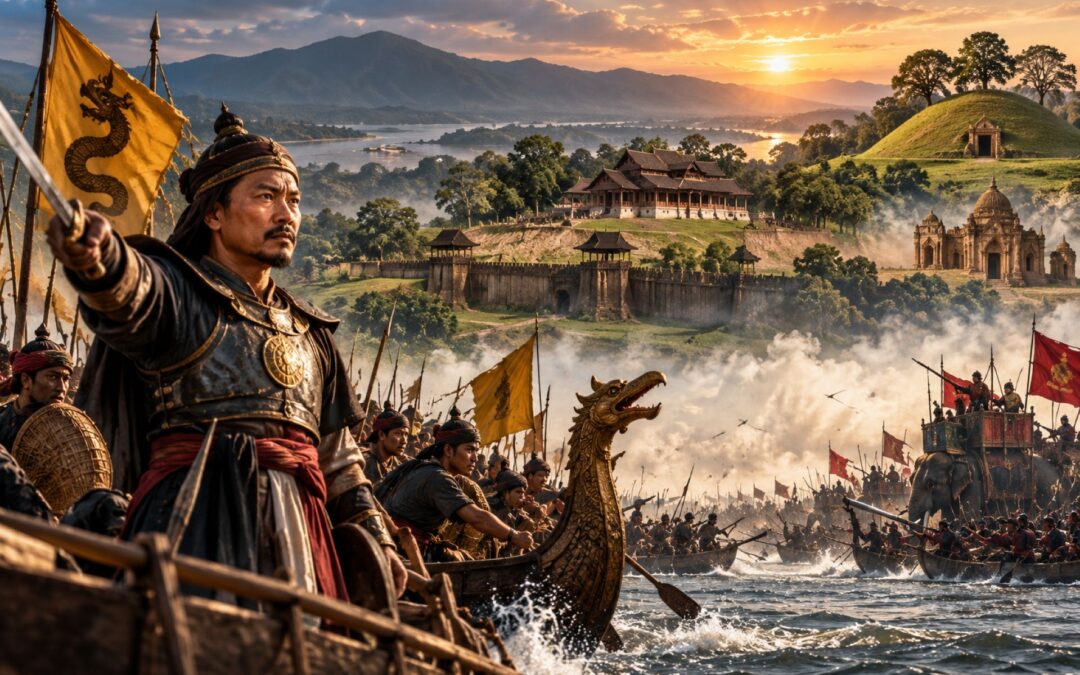
In 1671, an army representing one of the world’s most powerful empires confronted a kingdom on the banks of the Brahmaputra River. The Mughal Empire had conquered enormous territories across the Indian subcontinent, but its attempts to dominate Assam repeatedly encountered resistance. At the Battle of Saraighat, the Ahoms defeated a major Mughal expedition, securing one of the most celebrated victories in the history of Northeast India.
Yet the Ahom Kingdom’s greatest achievement was not a single military triumph. Its ruling dynasty had arrived in the Brahmaputra Valley during the thirteenth century, originating from a Tai-speaking political world beyond India’s eastern frontier. Over the following centuries, the Ahoms transformed themselves from a relatively small migrant community into the rulers of a powerful, culturally diverse kingdom.
From the traditional founding date of 1228 until the loss of independent rule in 1826, the Ahom monarchy survived for nearly six centuries. Its longevity depended on a remarkable combination of diplomacy, agriculture, military organization, administrative institutions, and cultural adaptation. Understanding how these forces worked together also explains why the kingdom eventually collapsed under the combined pressures of internal rebellion, Burmese intervention, and British expansion.
From Mong Mao to the Brahmaputra Valley
The origins of the Ahom Kingdom lie beyond the eastern borders of present-day India, in the Tai-speaking societies of mainland Southeast Asia and southwestern China. These communities shared linguistic and cultural connections across territories that now belong to China, Myanmar, Thailand, and neighbouring countries. Among their political centres was Mong Mao, a kingdom associated with the borderlands of present-day Yunnan and northern Myanmar.
According to traditional Ahom accounts, the future founder of the dynasty, Sukaphaa, belonged to Mong Mao’s ruling family. He had initially been considered a possible successor to the throne, but a change in the succession arrangements deprived him of that opportunity. Rather than contest the throne, he resolved to establish his authority elsewhere.
The details of this succession dispute come from traditions preserved in later historical accounts and cannot all be independently confirmed. Nevertheless, they reveal how the Ahoms remembered their foundation: not simply as an accidental migration, but as a deliberate attempt to establish a new political order.
Sukaphaa is traditionally said to have begun his journey in 1215, accompanied by followers who included warriors, priests, cultivators, and members of allied households. The migrants travelled westward through the mountainous frontier, crossing territories inhabited by communities with their own political authorities. Their movement required negotiation, strategic alliances, and, at times, armed confrontation.
The migration was not merely the movement of a royal household seeking refuge. A ruler hoping to establish a lasting kingdom needed people capable of cultivating land, supplying an army, maintaining religious traditions, and administering settlements. The presence of different occupational and social groups helped provide the foundations for the political community Sukaphaa intended to build.
In 1228, according to the accepted traditional chronology, Sukaphaa and his followers entered the Brahmaputra Valley after crossing the Patkai region. The valley offered extensive agricultural possibilities, abundant water, forests, and connections to wider trade networks. Its surrounding hills also created natural obstacles to invasion, although the same geography could make travel and communication difficult.
The region was not an empty territory awaiting settlement. The earlier political authority associated with Kamarupa had fragmented, creating a landscape of competing kingdoms, chiefdoms, and local communities. This fragmentation formed part of the wider history of India’s regional kingdoms, in which political authority repeatedly shifted between established dynasties and emerging powers.
Among the communities already established in the valley were the Morans and Barahis, while the Chutiya and Dimasa Kachari kingdoms exercised influence over other territories. Numerous Naga communities occupied the surrounding hills and maintained their own systems of political and social organization. The newcomers therefore had to secure a place within an existing and complicated political landscape.
Sukaphaa’s approach combined diplomacy with the possibility of military force. Traditional accounts describe alliances with Moran and Barahi leaders, strengthened through marriage and cooperation. These arrangements helped the migrants secure land, resources, and local support while reducing the risk of confrontation with every neighbouring community.
Relations with the surrounding hill populations were not uniformly peaceful. Disputes over territory, security, and political authority produced recurring conflicts with different groups, including Naga communities. These encounters should not be understood as a single war against a unified Naga people, since the region contained numerous independent communities whose relationships with the Ahoms varied considerably.
The early Ahoms gradually established settlements and expanded their agricultural activities. Rather than immediately controlling a large, centralized state, they developed a territorial foothold through successive settlements, alliances, and the extension of cultivation. Their political authority grew alongside their ability to maintain a dependable population and food supply.
Around 1253, Sukaphaa established Charaideo as an important royal centre. Situated in the foothill region of present-day Assam, it became closely associated with the dynasty’s origins and eventually developed into a sacred landscape of royal burials and ancestral remembrance.
By the time Sukaphaa died, traditionally dated to 1268, the foundations of the future kingdom had been established. Its territory remained limited compared with the state that later emerged, but it possessed an enduring ruling lineage, agricultural settlements, and relationships with neighbouring populations. The transformation from migrant community to regional kingdom would continue over many generations.
How a Migrant Dynasty Became an Assamese Kingdom
The Ahoms could not have maintained political power for centuries simply by preserving the identity and institutions of their original migrant community. They were surrounded by populations that greatly outnumbered them, occupied different ecological environments, and followed diverse customs. Their expansion therefore depended on their ability to incorporate people and territory into a functioning political order.
Agriculture provided one of the most important foundations for that expansion. The Brahmaputra Valley contained fertile floodplains, extensive wetlands, and forests that could be cleared or adapted for cultivation. Its rivers deposited rich sediments, but seasonal floods also threatened settlements and agricultural production.
The early Ahoms placed considerable emphasis on organized wet-rice cultivation. Rice agriculture already existed in the wider region, so it would be misleading to claim that the migrants introduced it to a previously unfamiliar population. Their importance lay partly in developing and expanding particular systems of cultivation, settlement, and agricultural organization.
Wet-rice cultivation could support relatively dense populations when sufficient labour and suitable land were available. As settlements expanded, the kingdom gained a more reliable agricultural surplus with which to support officials, soldiers, craftsmen, and the royal household. The ability to mobilize labour for clearing land, building irrigation works, and maintaining settlements strengthened the connection between agricultural development and political authority.
Political integration was equally important. The Ahom rulers gradually incorporated local communities through alliances, intermarriage, political appointments, and the extension of royal authority. Some influential local families obtained positions and privileges within the emerging state, providing incentives to cooperate with the dynasty.
This process is commonly described as Ahomisation, although it was neither uniform nor entirely peaceful. Communities entering the political order could adopt elements of Ahom identity, language, custom, and social organization. At the same time, military conquest, compulsory service, and unequal political relationships also shaped incorporation.
The process did not necessarily erase earlier identities. Different communities could participate in the kingdom’s administration and economy while preserving distinctive customs, religious practices, and social relationships. Integration developed through negotiation and accommodation as well as domination.
Over time, the kingdom expanded beyond its original settlement area. The rulers competed with neighbouring powers for agricultural land, trade routes, tributary relationships, and strategic positions along the Brahmaputra. Expansion frequently involved conflict, but victory on the battlefield was only the beginning of the challenge of governing conquered territories.
A major turning point came under Suhungmung, who ruled during the early sixteenth century. In 1523, Ahom forces conquered the Chutiya kingdom, extending their authority over important territories in the eastern Brahmaputra Valley. Subsequent conflicts and political arrangements also altered the balance of power between the Ahoms and the Dimasa Kacharis.
These conquests substantially changed the kingdom’s population and cultural environment. The dynasty increasingly ruled communities whose religious traditions, languages, and political practices differed from those of the original Tai-speaking settlers. Some populations possessed longstanding connections to Sanskritic religious and political traditions, while others maintained distinctive indigenous beliefs and institutions.
The growing kingdom could no longer be organized solely around the customs of its original ruling community. Instead, Ahom political identity became increasingly connected to the administration of a diverse population living within the Brahmaputra Valley.
This transformation worked in both directions. The rulers influenced the societies incorporated into their kingdom, but those societies also changed the culture, language, and institutions of the rulers themselves. The eventual development of a more broadly Assamese political and cultural environment was therefore not simply the replacement of one civilization by another.
The kingdom’s strength emerged from this capacity for adaptation. Its rulers did not need every subject to share the same ancestry or customs, but they did need mechanisms through which different communities could contribute to agricultural production, administration, and military defence.
Those mechanisms eventually became central to the political system that sustained Ahom power.
The Paik System and the Machinery of Ahom Power
The Ahom Kingdom’s longevity becomes easier to understand when its military achievements are placed alongside the institutions that sustained them. Rulers needed soldiers for defence, cultivators to produce food, craftsmen to manufacture equipment, and workers to construct roads, fortifications, and reservoirs. Maintaining these resources across a large and diverse territory required an organized relationship between the state and its population.
One of the kingdom’s most distinctive institutions was the Paik system, which combined compulsory service with access to agricultural land. Rather than maintaining a permanent salaried workforce for every public function, the state organized sections of its population into groups that could be mobilized for specific obligations.
A paik was generally a man enrolled for service to the state, although the precise obligations and exemptions changed over time. Paiks could be assigned agricultural, military, construction, transport, or other duties according to the needs of the government. Their labour provided a fundamental resource for the kingdom’s administration and economy.
A familiar arrangement organized paiks into groups called gots, often consisting of four men. Under the rotational system, one member performed a period of state service while the others continued cultivating land and supporting their households. When the assigned period ended, another member could take his place.
This arrangement allowed the state to obtain labour without completely removing every household’s agricultural workforce at once. The men who remained at home could continue producing food, helping sustain both their families and those temporarily engaged in royal service.
The obligations were connected to access to land. Many paiks possessed rights to cultivate land associated with their service position, providing a means of subsistence while remaining available for mobilization. These arrangements should not be confused with unrestricted private ownership, however, because the state retained substantial authority over service assignments, movement, and the allocation of labour.
The system was more complicated than a single universal rule applied identically throughout the kingdom’s history. Service arrangements, group sizes, exemptions, and administrative practices evolved, while nobles, religious specialists, officials, and different occupational groups could possess distinct privileges and obligations. As explained in historical research on the organization and obligations of the Paik system, compulsory labour was connected to both the productive resources of the countryside and the hierarchical structure of the state.
Paiks were also organized into administrative and occupational formations known as khels. These helped the government coordinate groups with particular functions and skills, including agricultural work, construction, military service, and specialized crafts. The organization of labour therefore supported activities extending well beyond farming.
When the state required boats, skilled workers could be mobilized for construction and maintenance. When a fortress needed strengthening, labour could be directed toward earthworks, defensive structures, or the transport of building materials. When a military expedition was planned, manpower and supplies could be drawn from a system already integrated into the kingdom’s administration.
This arrangement helps explain how the Ahoms maintained substantial military capacity without relying entirely on a vast standing army. Their ability to mobilize people and resources was embedded in institutions that operated during both peace and war.
The same system supported public works. Ahom rulers invested in reservoirs, embankments, roads, bridges, fortified settlements, and royal buildings. Water management could improve agricultural production, while transport routes connected administrative centres and helped officials move people, goods, and military supplies.
These achievements carried significant human costs. Compulsory service restricted personal freedom and could expose cultivators to demanding labour obligations, separation from their households, and official coercion. The advantages of the system were distributed unequally, with privileged groups often enjoying protections unavailable to ordinary workers.
The Paik system was therefore both a source of state capacity and a mechanism of social control. Its effectiveness depended partly on the ability of the monarchy and its officials to maintain an acceptable relationship between the services demanded and the resources available to the population.
Ahom government also depended on powerful political officers who helped administer the kingdom and constrain the king’s authority. Among the principal offices were the Burhagohain and Borgohain, associated with important aristocratic lineages and longstanding advisory functions. The office of Barpatragohain was added during the kingdom’s development, further shaping the balance among senior nobles.
Other major positions included the Borbarua and the Borphukan. The Borbarua exercised important administrative and military responsibilities in the central territories, while the Borphukan became especially significant in the western region, where defence against external powers required considerable authority.
These positions should not be imagined as five interchangeable ministers exercising identical responsibilities. Their powers, areas of jurisdiction, and relationships with the monarchy differed. Some were connected closely to hereditary aristocratic traditions, while others developed as the administrative demands of the expanding state changed.
The monarchy consequently operated within a political structure containing influential nobles, commanders, administrators, and competing interests. Royal authority was substantial, but the king depended on these individuals to raise forces, collect resources, maintain order, and govern distant territories.
Such arrangements could prevent excessive concentration of authority in one official’s hands, but they could also create rival factions. Powerful officers were capable of supporting a ruler, influencing succession disputes, or resisting policies they considered threatening to their position.
By the seventeenth century, the Ahom Kingdom possessed institutions capable of organizing agricultural production, mobilizing military forces, constructing substantial public works, and governing a culturally diverse population. These systems were crucial to its strength, although they contained inequalities and political tensions that would become increasingly important in its later history.
Religion, Language, and the Changing Ahom Court
The Ahoms’ political expansion produced equally significant cultural changes. The dynasty originated in a Tai-speaking world with religious traditions centred on ancestral reverence, sacred powers, and ritual relationships with the spiritual world. As the kingdom grew, its rulers encountered the religious institutions and cultural practices of the many communities they governed.
Early Tai-Ahom religious life placed considerable importance on ancestors and rituals performed by traditional specialists. Ceremonies connected the royal lineage and the wider community to the spiritual forces believed to influence human affairs. These traditions helped reinforce dynastic legitimacy and preserve connections to the community’s origins.
The growth of the kingdom brought increasing interaction with Brahmanical religious traditions. Hindu deities, rituals, priests, and concepts of kingship gradually acquired influence within the royal court. The adoption of new religious practices did not occur through a single decisive conversion, nor did it immediately eliminate older customs.
Different Ahom rulers supported different religious institutions and traditions. Shaiva and Shakta practices became influential in royal religious life, while Vaishnavism also developed an important presence in the wider Assamese cultural landscape. The relationship between the monarchy and these traditions changed according to political circumstances, individual rulers, and the influence of religious communities.
By the early seventeenth century, Hindu religious forms were increasingly prominent at court. Susenghphaa, better known by his Hindu royal name Pratap Singha, ruled during an important period of administrative and cultural development. Nevertheless, it would be inaccurate to describe his reign as the moment when the entire kingdom abruptly adopted one uniform state religion.
The process of religious change had begun earlier and continued under later rulers. Traditional Tai-Ahom practices persisted alongside Hindu forms of worship, while different communities maintained their own religious customs. Religious identity in the kingdom remained layered rather than completely standardized.
The changing language of the court reflected a similar development. The early Ahoms spoke a Tai language, which also possessed an important written tradition. As the kingdom expanded and interacted with larger Assamese-speaking populations, Assamese became increasingly significant in administration, literature, and public life.
The original Tai-Ahom language gradually lost its position in many everyday administrative functions. It nevertheless survived in ritual contexts, specialized knowledge, and historical manuscripts, preserving evidence of the dynasty’s cultural origins.
Among the most important products of Ahom historical culture were the Buranjis, chronicles that recorded events connected with the monarchy, political administration, warfare, diplomacy, and succession. Early chronicles were associated with the Tai-Ahom literary tradition, while later historical writing also developed extensively in Assamese.
The Buranjis provide important evidence for understanding the kingdom’s past, including political decisions and relationships with neighbouring powers. At the same time, they were produced within particular political and cultural settings, and their accounts must be interpreted alongside other historical evidence rather than treated as perfectly neutral records.
These developments illustrate why the kingdom cannot be understood through a simple opposition between foreign settlers and local inhabitants. Across generations, its rulers became deeply connected to the Brahmaputra Valley while continuing to preserve elements of their Tai heritage.
The result was a distinctive political culture in which different traditions interacted, sometimes comfortably and sometimes in conflict. That capacity for cultural adaptation contributed to the kingdom’s stability, even as religious institutions and competing claims to authority created tensions that would later become politically consequential.
The Mughal Wars Before Saraighat
By the beginning of the seventeenth century, the Ahom Kingdom had developed into an important regional power. Its territory, agricultural resources, and position along the Brahmaputra made it increasingly significant to other states seeking influence in Northeast India.
The most formidable external challenge came from the Mughal Empire, whose expansion into Bengal brought imperial power closer to the western territories of the Ahom Kingdom. The Brahmaputra Valley offered strategic access, economic resources, and opportunities to extend political influence. For the Ahoms, however, the same region formed a vital part of their defensive frontier.
The territories between Mughal Bengal and the Ahom heartland were politically complicated. Koch rulers, local chiefs, hill communities, and regional military leaders possessed interests that did not always align permanently with either imperial power. Control of the frontier depended as much on negotiation and shifting alliances as on direct confrontation.
Conflict intensified during the 1610s as the Mughal and Ahom states competed for influence in the western Brahmaputra Valley. The fighting involved raids, fortified positions, military campaigns, and changing territorial arrangements. Neither side was able to establish an uncontested settlement that permanently removed the other from the region.
For the Ahoms, the challenge was to prevent Mughal forces from penetrating their core territories. Fortifications, difficult terrain, local knowledge, and the ability to mobilize resources offered defensive advantages. For the Mughals, control of important river routes and strongholds could create opportunities for further expansion.
The confrontation took place during a period when the spread of gunpowder warfare in India was changing the organization of armies and the demands placed on governments. Firearms, artillery, fortifications, and military engineering mattered, but their effectiveness depended on logistics, training, geography, and the ability to coordinate different kinds of forces.
The struggle reached a particularly dangerous stage under the Mughal commander Mir Jumla, who launched a major invasion in 1662 during the reign of Emperor Aurangzeb. The invading army moved into Assam with substantial military resources, including forces capable of operating along the Brahmaputra.
Initially, the campaign proved highly successful. Mughal troops advanced through Ahom territory, overcoming defensive positions and forcing the ruling court to abandon Garhgaon, the kingdom’s capital. Mir Jumla’s forces occupied the city and seized considerable resources.
For the Ahom monarchy, the fall of its capital represented a severe political and military setback. The invaders had demonstrated that the kingdom’s eastern heartland was not beyond the reach of a determined imperial expedition.
Yet occupying territory was different from maintaining effective control over it. As the monsoon approached, heavy rain, flooding, difficult communications, and disease created serious problems for the Mughal army. The Brahmaputra’s changing conditions complicated movement and the transport of supplies.
Ahom forces exploited these difficulties through attacks on vulnerable positions and supply connections. The defenders understood the local environment and could continue resistance even after losing important settlements. The Mughal army increasingly struggled to convert its initial military success into a sustainable political conquest.
The campaign ended in a settlement in 1663 under which the Ahom ruler Jayadhwaj Singha accepted severe conditions. These included territorial concessions, substantial payments, and arrangements involving members of the royal family. Although the kingdom survived, the agreement represented a humiliating restriction on its independence.
The settlement did not resolve the underlying conflict. Chakradhwaj Singha, who succeeded Jayadhwaj, rejected the idea that the kingdom should remain permanently subordinate to Mughal demands. His government began preparing to recover the lost western territories.
An important figure in this effort was Lachit Borphukan, appointed to command Ahom forces on the western frontier. The position of Borphukan carried considerable responsibility for military operations and administration in a region where the Mughal threat was most immediate.
In 1667, the Ahoms successfully recaptured Guwahati, restoring their control over a strategically important part of the Brahmaputra corridor. The victory demonstrated that the kingdom remained capable of organizing effective offensive operations despite its earlier defeat.
Aurangzeb’s government responded by sending a major expedition under Ram Singh, a Rajput commander associated with the Mughal imperial establishment. The resulting confrontation involved military manoeuvres, defensive preparations, negotiations, and attempts by both sides to exploit regional alliances.
The fighting was not an uninterrupted succession of Ahom victories. At Alaboi in 1669, Ahom forces suffered a serious defeat with heavy losses. The battle demonstrated the danger posed by Mughal military strength, particularly when the defenders were drawn into conditions that favoured their opponents.
These campaigns also revealed the complexity of frontier politics. Different chiefs and communities could negotiate with either side according to local interests, rivalries, and expectations. Neither the Mughal nor the Ahom cause commanded the automatic loyalty of every population within the contested region.
By 1671, the conflict had reached a decisive stage. The Mughals still sought to reverse the loss of Guwahati, while the Ahoms needed to protect the approaches to their kingdom. The confrontation would culminate in a battle in which the Brahmaputra itself became central to the outcome.
Saraighat and the Fight for the Brahmaputra
The Battle of Saraighat in 1671 was one of the most important military encounters in the history of the Ahom Kingdom. Fought along the Brahmaputra near present-day Guwahati, it brought the army commanded by Ram Singh into conflict with Ahom forces directed by Lachit Borphukan.
The circumstances differed from those of a conventional battle fought across open ground. The Brahmaputra was a broad, powerful river shaped by channels, currents, islands, and changing water levels. Military operations required an understanding of these conditions, particularly when large numbers of troops and supplies needed to move between different positions.
The Mughals possessed significant military resources and considerable experience in imperial warfare. Their forces included cavalry, infantry, artillery, and riverine capabilities, and they were supported by an administrative system accustomed to organizing major campaigns. Nevertheless, these strengths did not guarantee victory in terrain where movement and communication imposed distinctive constraints.
The Ahoms had spent considerable time preparing their defences around the approaches to Guwahati. Their forces used fortified positions and the natural advantages of the surrounding landscape to restrict Mughal movement. This defensive strategy aimed to prevent the invaders from employing all their resources under favourable conditions.
Lachit Borphukan’s role was especially important because he understood that the Ahoms could not rely on numerical strength alone. Success required coordinating troops, protecting strategically important positions, and preventing the enemy from exploiting weaknesses in the defensive system.
The ability to operate effectively on the river gave the defenders an important advantage. Smaller vessels could manoeuvre through difficult channels, approach vulnerable positions, and support rapid changes in deployment. Local knowledge of currents and river conditions helped the Ahoms coordinate their movements.
This did not mean that the Mughals lacked boats or experience with river warfare. Rather, the conflict exposed differences in how the opposing forces could apply their capabilities under the particular geographical circumstances of Saraighat. The balance of advantage depended on where and how the fighting occurred.
The battle developed through attacks and counterattacks involving forces operating on and around the river. Ahom troops used their defensive preparations, coordinated movements, and knowledge of the waterways to challenge the Mughal advance. Their success depended on organized resistance rather than on any single extraordinary weapon or trick.
Lachit’s leadership became an enduring part of the battle’s memory. Traditional accounts describe him continuing to direct the defence despite serious illness, inspiring his forces at a moment when the fighting threatened to turn against them. While individual dramatic episodes have been retold in different forms, his central command role and the importance of the victory are firmly established.
The Ahoms ultimately defeated the Mughal expedition, securing Guwahati against the immediate attempt at reconquest. The victory established Saraighat as a major turning point in the long struggle for control of the western Brahmaputra Valley.
The confrontation followed earlier engagements, including the costly fighting at Alaboi, as reflected in the Government of Assam’s historical account of the battles of Alaboi and Saraighat. Taken together, these encounters show why the Ahom victory was not inevitable or easily achieved.
Saraighat demonstrated the effectiveness of combining fortifications, military organization, leadership, and a practical understanding of geography. The Ahoms had faced a formidable opponent but succeeded in limiting the conditions under which Mughal strength could be employed most effectively.
The outcome also needs to be placed in its proper historical context. Saraighat did not immediately end every Mughal-Ahom confrontation, nor did it eliminate the possibility of renewed imperial pressure. The struggle over the western frontier continued after 1671.
A more lasting territorial settlement followed the Ahom victory at Itakhuli in 1682, during the reign of Gadadhar Singha. Ahom forces recovered Mughal positions around Guwahati, and Mughal authority was pushed westward from the disputed region. The frontier subsequently became more stable, reducing the threat of another sustained Mughal advance into the Ahom heartland.
Together, Saraighat and Itakhuli helped secure the kingdom’s political survival against one of the most powerful empires of its age. They demonstrated that imperial expansion could be resisted by a regional state capable of mobilizing resources and adapting its military strategy to the environment.
Lachit Borphukan consequently became one of Assam’s most celebrated historical figures. His reputation rests on an achievement that was both military and political: helping preserve the independence of a kingdom whose institutions and society had developed over several centuries.
The Kingdom at Its Height: Capitals, Architecture, and Cultural Legacy
The Ahom Kingdom’s history cannot be understood entirely through its wars. Political stability, agricultural resources, and the mobilization of labour also supported the construction of capitals, religious buildings, reservoirs, and other structures that expressed royal authority.
As the kingdom developed, its principal administrative centres changed. Charaideo retained particular significance because of its association with the dynasty’s foundation, while later capitals reflected the growth of the state and its changing strategic requirements.
Garhgaon became an important royal centre during the kingdom’s expansion. Its palaces, defensive works, and administrative surroundings represented the authority of a monarchy that had grown far beyond the early settlements established by Sukaphaa.
Rangpur, associated with the later Ahom period, became another major centre of political and architectural activity. The rulers invested in substantial buildings and public works that reflected both the resources available to the state and the importance of royal ceremonial life.
Among the best-known surviving structures are the Rang Ghar and the architectural complexes associated with the later Ahom kings. These buildings illustrate the development of royal architecture using durable materials and increasingly elaborate construction techniques. Their surviving forms also reflect eighteenth-century developments rather than an unchanged architectural tradition extending directly from the kingdom’s foundation.
Large reservoirs and tanks formed another important part of the built landscape. They supported water management, supplied settlements, and became associated with royal patronage and public religious life. The ability to undertake such projects depended on the state’s capacity to mobilize workers and materials over extended periods.
Royal religious patronage contributed to the construction and maintenance of temples and other sacred institutions. These structures reflected the growing influence of Hindu traditions within the kingdom while existing alongside older religious practices.
The Ahoms also maintained relationships with neighbouring kingdoms that involved warfare, diplomacy, tribute, and changing spheres of influence. Their power extended over significant parts of the Brahmaputra Valley, but it would be misleading to suggest that every surrounding polity was permanently absorbed into the kingdom.
The Dimasa Kachari and Jaintia kingdoms retained distinct political histories, even when Ahom rulers exercised influence or fought campaigns affecting their territories. The political landscape of Northeast India remained more complicated than the boundaries of a single expanding monarchy.
Perhaps the most distinctive surviving connection to the dynasty’s early identity is found at Charaideo. The site contains the Moidams, royal burial mounds associated with Ahom funerary traditions. These structures reflect the importance of ancestral reverence and the belief that royal authority continued to possess sacred significance beyond an individual ruler’s lifetime.
The Charaideo Moidams were inscribed on the UNESCO World Heritage List in 2024, recognizing their exceptional cultural importance. Their earthen mounds, underlying burial chambers, and ritual landscape preserve evidence of a tradition that developed across several centuries.
Charaideo is therefore more than the location of an early royal capital. It connects the kingdom’s political beginnings to the ancestral beliefs and ceremonial practices that remained important even as Ahom court culture changed.
The continuing significance of these sites illustrates the kingdom’s lasting influence on Assam’s historical identity. Its legacy survives not only in accounts of military victories, but also in architecture, place names, chronicles, ceremonial traditions, and communities that maintain connections to Tai-Ahom heritage.
Rebellion, Burmese Invasion, and the End of Ahom Rule
Despite its military achievements and sophisticated institutions, the Ahom Kingdom entered a period of severe instability during the eighteenth century. The threats that eventually destroyed its independence were not confined to invading armies. They also arose from tensions within the political and social system that had sustained the kingdom for generations.
The Paik system had enabled the monarchy to mobilize labour and military resources, but it also imposed burdens on ordinary cultivators. As demands increased and powerful officials accumulated privileges, inequalities and grievances could become more difficult to contain. Political factionalism within the ruling establishment created additional opportunities for conflict.
Religious relationships also became increasingly important. The spread of Vaishnava religious institutions created communities whose loyalties and social organization did not always align comfortably with the monarchy’s expectations. These tensions varied considerably between religious groups, and the relationship between the Ahom court and Vaishnava institutions was not uniformly hostile.
Among the most consequential conflicts were those associated with the Mayamara, also commonly called Moamoria, religious tradition. Its followers included communities whose social position and relationship with the monarchy contributed to growing dissatisfaction. Religious persecution and disputes over authority became intertwined with broader grievances concerning social hierarchy and compulsory service.
In 1769, these tensions erupted into a major rebellion. The conflict challenged royal authority and developed into a series of prolonged struggles rather than a brief uprising that could be decisively suppressed. Different factions attempted to gain control of the kingdom, and the monarchy faced repeated threats from forces operating within its own territory.
The rebellions inflicted severe damage on the state’s political and economic foundations. Warfare disrupted cultivation, displaced populations, damaged settlements, and weakened administrative authority. Large numbers of people suffered through violence, insecurity, and the breakdown of ordinary agricultural life.
The scale of the devastation was considerable, although precise claims about the loss of a fixed percentage of the kingdom’s population cannot be accepted without dependable demographic evidence. Contemporary and later accounts establish that the disturbances were catastrophic, but they do not justify treating every dramatic numerical estimate as a verified statistic.
The political consequences extended beyond the immediate damage. A government that had depended on organized labour service and administrative coordination became increasingly unable to maintain those arrangements consistently. Resources that might otherwise have supported defence, construction, or economic recovery were consumed by internal struggles.
The rebellions also exposed divisions among nobles and competing factions within the royal establishment. Succession disputes, rival political interests, and attempts to restore authority complicated efforts to stabilize the kingdom. Although royal power survived periods of rebellion, its institutional foundations had been seriously weakened.
This weakening created opportunities for neighbouring powers. During the early nineteenth century, the Burmese kingdom expanded its involvement in Assam, encouraged in part by regional political conflicts and opportunities to influence the Ahom succession.
Burmese military intervention occurred in several phases beginning in 1817. As factions within Assam struggled for power, Burmese forces became increasingly involved in the kingdom’s internal affairs. Their military presence developed into an occupation that further undermined the surviving Ahom monarchy.
The invasions brought widespread suffering. Military violence, displacement, economic disruption, and insecurity devastated communities already weakened by decades of conflict. The disruption of agriculture and local administration made recovery increasingly difficult.
By the early 1820s, the Ahom state no longer possessed the effective independence and administrative stability that had enabled it to resist earlier external threats. Burmese influence extended over Assam, while the political institutions of the old kingdom struggled to function.
British involvement followed as the East India Company confronted Burmese expansion along its eastern frontier. The First Anglo-Burmese War began in 1824 and eventually ended with the Treaty of Yandabo, signed on 24 February 1826.
Under the treaty, Burma renounced its claims to Assam, allowing the British to establish control over territories formerly associated with the Ahom Kingdom. This marked the end of the kingdom’s independent political existence.
The outcome was not simply a direct British military conquest of an otherwise unified and powerful Ahom state. Decades of internal rebellion, factional struggles, and Burmese intervention had already transformed the political circumstances of Assam. British expansion succeeded within a landscape profoundly altered by those earlier conflicts.
The transition also did not immediately eliminate every possibility of limited Ahom dynastic authority. In 1833, the British restored Purandar Singha to a restricted, tributary position in part of Upper Assam. This arrangement allowed a measure of dynastic rule under British supervision rather than the restoration of full sovereignty.
The arrangement ended in 1838, when British authorities removed Purandar Singha and brought the remaining territory under direct colonial administration. The Government of Assam’s account of the transition from Ahom rule to British administration records this final stage of the monarchy’s political decline.
By then, the institutions that had maintained Ahom independence for centuries had lost their governing authority. The dynasty’s rule had survived numerous external invasions and political challenges, but the combination of internal conflict and the expanding power of neighbouring states proved overwhelming.
The end of the monarchy did not mean the disappearance of the people and cultures associated with it. Tai-Ahom communities continued to preserve elements of their language, religious practices, historical memory, and identity. The kingdom’s monuments, chronicles, and political legacy also remained part of the broader history of Assam.
The Ahom Kingdom endured for nearly six centuries because its rulers built more than an army. They developed agricultural systems, institutions for mobilizing labour, political relationships capable of incorporating diverse communities, and military strategies adapted to the Brahmaputra Valley. These achievements enabled a dynasty of Tai origin to become deeply rooted in the society it governed.
Its eventual collapse also reveals the limits of that system. Institutions that could organize enormous resources were vulnerable to inequality, coercion, and political rivalry, while decades of internal conflict weakened the kingdom’s ability to respond to external threats. The history of the Ahoms is therefore neither an uninterrupted story of triumph nor a simple tale of decline.
Their enduring significance lies in the distinctive society and political order that emerged from centuries of migration, adaptation, conflict, and cultural exchange. Long after the monarchy disappeared, its influence remained visible in Assam’s historical landscape and in the traditions of the communities whose lives had shaped the kingdom.
Last Updated on October 26, 2026 by Aseem Gupta