
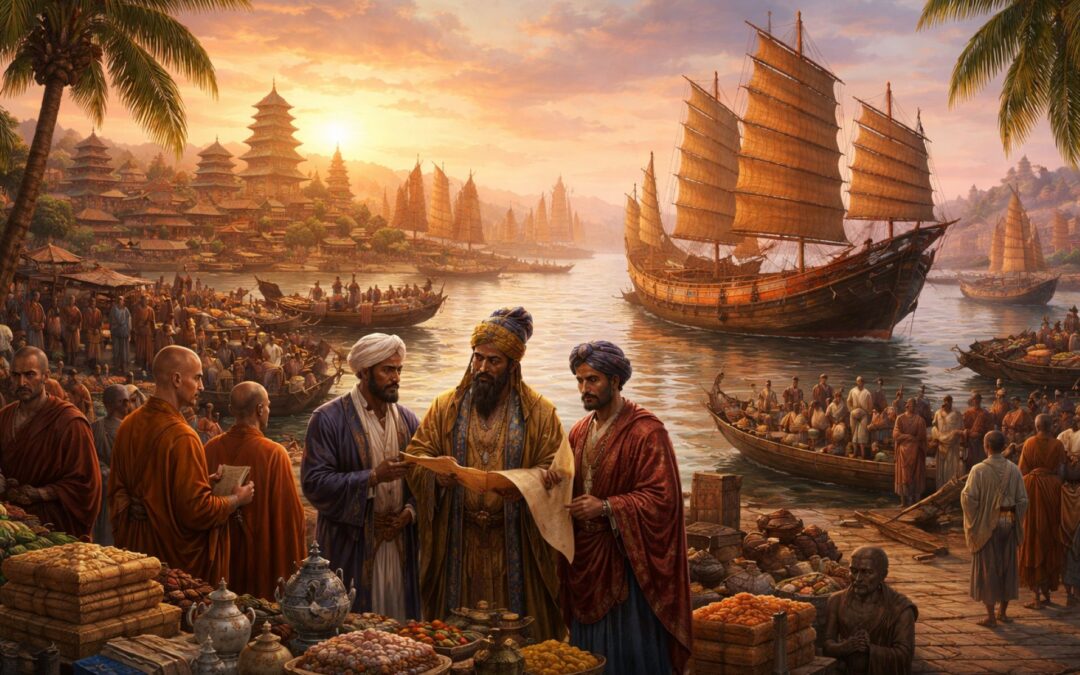
Long before European ships began mapping the world’s oceans, Asia was already bound together by an intricate web of maritime routes. Across the Indian Ocean and the South China Sea, merchants, monks, and diplomats moved between distant shores with remarkable regularity, creating one of the earliest examples of a truly interconnected world.
This network—known today as the Maritime Silk Road—was not simply a trade route. It was a living system of exchange, where goods, ideas, religions, and political models flowed continuously between India, Southeast Asia, and China. Spices and silk may have been the most visible cargo, but beneath them traveled something far more enduring: culture.
At the center of this system stood India, whose merchants and scholars carried languages, scripts, and religious traditions far beyond its shores. At the other end stood China, a vast and prosperous market that drew traders from across continents. Between them, Southeast Asia became a dynamic meeting ground—absorbing, adapting, and reshaping influences from both worlds.
What makes the Maritime Silk Road remarkable is not just its scale, but its nature. Unlike later global systems driven by conquest and colonization, this network was largely sustained by trade, migration, and cultural exchange. Influence spread not through armies, but through ideas, relationships, and economic opportunity.
To understand this maritime world is to uncover a forgotten chapter of history—one where Asia was not divided into isolated regions, but functioned as a deeply connected civilizational space.
A Forgotten Highway of Civilization
For most people, the phrase “Silk Road” still conjures images of camel caravans inching across deserts, linking China to the Mediterranean. Yet this overland route, while important, was only one half of a much larger system. Running parallel to it—and eventually surpassing it in scale and importance—was a vast maritime network that connected the Indian Ocean to the South China Sea.
The Maritime Silk Road was not a single route but a web of sea lanes linking ports across India, Southeast Asia, and China. From the western coast of India, ships sailed to Sri Lanka, moved through the straits of Southeast Asia, and continued onward to the bustling ports of southern China. These journeys were made possible by a deep understanding of seasonal monsoon winds, which allowed sailors to travel long distances with surprising regularity.
But what truly set this network apart was not just its geography—it was its function. Unlike the overland Silk Road, which was often fragmented and vulnerable to political instability, the maritime routes were more flexible and scalable. Ports could rise and fall, but the sea lanes endured. As long as ships could sail and markets demanded goods, the system continued to function.
More importantly, these routes carried far more than trade goods. They enabled the steady movement of people—merchants seeking profit, monks pursuing knowledge, envoys negotiating alliances, and adventurers exploring unknown worlds. With them traveled languages, scripts, religious beliefs, artistic traditions, and systems of governance.
In this sense, the Maritime Silk Road functioned less like a trade route and more like a circulatory system of civilizations. It connected distant societies into a shared space of interaction, where influence was not imposed but exchanged. Over time, this constant flow would reshape entire regions, leaving behind a legacy that still echoes across Asia today.
The Rise of a Maritime Network (2nd Century BCE – 4th Century CE)
The Maritime Silk Road did not emerge fully formed. Its origins stretch back to at least the 2nd century BCE, when small-scale coastal trade began linking the shores of India, Southeast Asia, and southern China. In these early centuries, however, the network was fragmented and limited in scope. Trade was often localized, ships were smaller, and long-distance voyages were relatively rare and risky.
What changed everything was knowledge—specifically, the growing mastery of the monsoon wind system.
Sailors gradually learned to harness the predictable seasonal winds of the Indian Ocean. During one part of the year, winds would carry ships eastward from India toward Southeast Asia and China; months later, the pattern would reverse, allowing for a reliable return journey. This discovery transformed maritime travel from a gamble into a system. Suddenly, long-distance sea trade became not only possible, but efficient and repeatable.
By the early centuries of the Common Era—and especially by the 4th century CE—this knowledge had laid the foundation for a far more organized and expansive network. Ports began to develop into permanent hubs of exchange. Merchants planned voyages with increasing precision. Trade routes extended deeper into Southeast Asia, linking previously isolated regions into a broader economic system.
This period marked the transition from sporadic exchange to sustained connectivity. Goods were no longer just moving occasionally—they were flowing continuously. More importantly, the sea routes began to support not just commerce, but communities. Foreign merchants started establishing semi-permanent settlements in distant ports, creating early nodes of cultural interaction.
Geography also played a crucial role in shaping this network. India’s long coastline, positioned between the Middle East and East Asia, made it a natural intermediary. Southeast Asia, with its narrow straits and island chains, became a critical gateway controlling access between the Indian Ocean and the South China Sea. And southern China, with its navigable rivers and dense population, provided a powerful economic anchor at the eastern end of the system.
By the 4th century CE, the Maritime Silk Road had evolved into something far greater than a collection of trade routes. It had become a structured network—one capable of sustaining large-scale exchange of goods, people, and ideas across vast distances.
What Moved Across the Seas
At its core, the Maritime Silk Road was driven by a simple force: demand. But the scale and diversity of goods moving across these sea lanes reveal just how sophisticated and interconnected this system had become.
At the eastern end of the network stood China—one of the largest and most prosperous consumer markets in the pre-modern world. Foreign merchants were eager to tap into this demand, and in return, China exported goods that were prized across continents. Silk remained the most iconic, but it was far from the only commodity. Fine ceramics, copper, jade, and silver flowed outward from Chinese ports, reaching markets thousands of miles away.
Yet China was not just an exporter—it was also a voracious importer. To sustain its economy and satisfy elite tastes, it relied heavily on goods from abroad. From India and Southeast Asia came sandalwood, black pepper, and a wide range of spices—luxury items that carried both economic and cultural value. Indian textiles, known for their quality and craftsmanship, were also in high demand.
The network extended even further than these three regions. Glassware from the Mediterranean, tin from Southeast Asia, and other specialized goods moved through intermediary ports before reaching China. This was not a closed regional system—it was part of a wider Afro-Eurasian exchange, with India acting as a crucial bridge between distant worlds.
What makes this system particularly fascinating is that China, despite being central to demand, did not initially dominate the shipping itself. For much of this period, maritime trade was largely conducted by Indian, Middle Eastern, and Southeast Asian merchants. These traders controlled the movement of goods, the logistics of voyages, and the networks of exchange that connected distant markets.
In effect, the Maritime Silk Road operated as a multi-layered economic system. China functioned as the primary economic magnet, drawing in goods and traders. India served as both a supplier and an intermediary, linking different regions together. Southeast Asia acted as a transit zone and redistribution hub, facilitating the movement of goods across critical choke points.
But ships did not sail with cargo alone. Alongside spices, silk, and ceramics traveled something far more transformative—people carrying ideas, beliefs, and cultural practices. And it was this invisible cargo that would ultimately reshape entire civilizations.
India: The Beating Heart of Maritime Trade
If China was the economic magnet of the Maritime Silk Road, India was its operational core.
Stretching along the Indian Ocean, the subcontinent’s coastline was dotted with thriving ports that acted as gateways to the wider world. The western shores—particularly the Konkan and Malabar coasts—connected India to the Middle East and Africa, while the eastern seaboard—the Coromandel coast, along with the regions of Kalinga and Bengal—linked it to Southeast Asia and China. This geographical positioning made India not just a participant in the network, but its central pivot.
Unlike China, which for long periods restricted its merchants from overseas trade, Indian traders actively took to the seas. They built ships, mastered navigation, and established enduring trade routes that connected distant regions into a single economic system. Indian merchant-sailors became the backbone of maritime commerce, moving goods across thousands of miles with remarkable consistency.
But their role extended far beyond logistics.
Indian merchants often settled in foreign ports, forming vibrant expatriate communities across Southeast Asia—from coastal Thailand to the islands of Indonesia. These were not isolated enclaves. They were deeply integrated into local societies, engaging in trade, politics, and social life. Over time, these communities became powerful conduits of cultural exchange.
Trade itself was highly organized. Powerful merchant guilds—some of them originating in South India—coordinated commercial activity across regions. These guilds maintained networks of trust, financed voyages, and even invested in infrastructure abroad. Inscriptions from Southeast Asia, for instance, record Indian guilds building water tanks and supporting local settlements—evidence of their long-term presence and influence.
This combination of mobility and settlement gave Indian merchants a unique advantage. They were not just passing through—they were embedding themselves within the very fabric of the regions they traded with.
As a result, India’s influence along the Maritime Silk Road was not enforced through conquest or political domination. It spread organically, carried by merchants who brought with them languages, scripts, religious ideas, and social norms. In many ways, they acted as agents of cultural transmission, shaping societies not by force, but through sustained interaction.
It is this dual role—economic and cultural—that makes India the true beating heart of the Maritime Silk Road.
The Indianization of Southeast Asia
As ships moved steadily across the Maritime Silk Road, they carried more than goods—they carried entire cultural worlds. Nowhere is this more visible than in Southeast Asia, where centuries of interaction with Indian merchants, priests, and scholars led to a profound process historians call Indianization.
From roughly the 3rd or 4th century CE onward, many Southeast Asian polities began adopting elements of Indian culture in ways that reshaped their societies. This transformation was not superficial. It penetrated language, religion, governance, art, and social organization.
Sanskrit, the classical language of India, became a marker of prestige and power across Southeast Asia. Royal inscriptions, court rituals, and administrative systems increasingly drew upon Indian models. Even writing systems in the region were influenced by Indian scripts—most notably those derived from the Pallava script, which would go on to shape several Southeast Asian alphabets.
Religion formed the most visible layer of this cultural exchange. Hinduism and Buddhism spread widely, often becoming the ideological foundation of emerging states. Local rulers adopted Hindu deities and Buddhist cosmology to legitimize their authority, presenting themselves as divine or semi-divine figures in accordance with Indian traditions. Temples, rituals, and myths rooted in Indian thought became central to cultural life.
But this was not a simple case of cultural imposition. Southeast Asian societies did not passively receive Indian ideas—they actively adapted them. Indian concepts were blended with local traditions, creating unique cultural expressions rather than direct replicas of the subcontinent. The result was a rich synthesis, where Indian influence was unmistakable, yet distinctly localized.
The agents of this transformation were diverse. Indian merchants played a crucial role by establishing long-term communities in foreign ports. Brahmins and scholars provided religious and political frameworks that appealed to local elites. Buddhist monks carried texts, teachings, and intellectual traditions across the seas. Together, they created a network of influence that extended far beyond trade.
What makes Indianization particularly striking is that it occurred largely without military conquest. Unlike later empires that spread their influence through force, India’s cultural reach in Southeast Asia expanded through exchange, prestige, and voluntary adoption. Local rulers chose Indian models because they offered tools for state-building, legitimacy, and connection to a broader world.
Over time, this process transformed Southeast Asia into a region deeply intertwined with Indian civilization—linguistically, religiously, and politically. And it all began with the steady movement of ships along the Maritime Silk Road.
Why Southeast Asia Chose India Over China
Given China’s immense wealth, population, and technological sophistication, it might seem inevitable that Southeast Asia would fall under its cultural influence. Yet history tells a different story. While Chinese goods were highly valued, it was Indian ideas—religious, political, and cultural—that took root across the region.
The reasons for this divergence lie not just in geography, but in the fundamentally different ways India and China engaged with the world.
For much of its history, China approached its neighbors through a framework of hierarchy and control. Powerful dynasties frequently projected military force into surrounding regions—most notably into northern Vietnam and Korea. These expansions, combined with a tributary worldview that placed China at the center of civilization, created a sense of caution among Southeast Asian rulers. Engagement with China often came with the implicit risk of political subordination.
India, by contrast, projected influence without empire.
Until the rise of the medieval Chola Empire, no major Indian power attempted to invade or directly control Southeast Asian kingdoms. Indian merchants arrived as traders, not conquerors. Brahmins offered rituals and political frameworks, not demands for submission. Buddhist monks shared teachings, not imperial directives. This created a very different dynamic—one based on attraction rather than coercion.
As a result, Southeast Asian elites found Indian models easier—and safer—to adopt. Hindu concepts of kingship, for example, provided a powerful ideological tool for legitimizing rule. The adoption of Sanskrit and Indian legal traditions allowed rulers to position themselves within a broader, prestigious cultural sphere without sacrificing political independence.
China’s own policies also played a role in limiting its cultural reach. At various points in history, Chinese authorities restricted overseas trade or discouraged private merchants from engaging in foreign commerce. These policies reduced the presence of Chinese traders abroad and, by extension, limited the spread of Chinese cultural practices in Southeast Asia.
Indian merchants, on the other hand, were deeply embedded in maritime trade. They settled in foreign ports, intermarried with local populations, and became part of the social and economic fabric of the region. Their influence was continuous and personal—built through relationships rather than state-driven initiatives.
In essence, Southeast Asia did not reject China—it engaged with it economically. But when it came to shaping political identity, religious life, and cultural expression, Indian models offered something more flexible, less threatening, and ultimately more adaptable.
This was a triumph of soft power long before the term existed—a reminder that influence does not always follow strength, but often follows trust.
Monks, Manuscripts, and the Spread of Buddhism
While merchants carried goods across the Maritime Silk Road, monks carried something far more enduring—ideas.
Among the most powerful of these ideas was Buddhism, a religion that originated in India but would go on to transform much of Asia. Its spread was not the result of conquest or imperial mandate, but of sustained intellectual and spiritual exchange. Monks traveled vast distances by land and sea, driven by curiosity, devotion, and the desire to preserve and transmit knowledge.
The Maritime Silk Road played a crucial role in this process.
Chinese monks, in particular, undertook perilous journeys to India—the birthplace of Buddhism—in search of authentic scriptures and deeper understanding. Some traveled overland, but many relied on maritime routes that connected southern China to Southeast Asia and the Indian subcontinent.
One of the most remarkable figures in this exchange was the 7th-century monk Yijing. Inspired by earlier travelers, he sailed from China to Southeast Asia, stopping in the powerful Srivijaya Empire, a major hub of maritime trade and learning. There, he spent months studying Sanskrit and preparing for his journey to India. He would later travel to Nalanda, the great Buddhist university, where he spent over a decade studying and collecting texts.
On his return journey, Yijing once again passed through Southeast Asia, where he collaborated with fellow monks to translate the scriptures he had gathered. His writings offer invaluable insights into the intellectual networks that connected India, Southeast Asia, and China. Notably, he described Srivijaya as an ideal place for Chinese monks to prepare before traveling to India—evidence of how deeply integrated these regions had become.
The exchange was not one-sided. Indian monks also made their way eastward, leaving a lasting impact on Chinese and East Asian religious life. Figures like Bodhidharma, traditionally credited with founding Zen Buddhism in China, became legendary. Others, such as Vajrabodhi and Amoghavajra, rose to positions of influence within the Tang court, shaping both religious practice and political culture.
These monks were more than spiritual teachers—they were translators, scholars, and cultural ambassadors. They carried manuscripts across oceans, translated texts into new languages, and adapted teachings to local contexts. Through their efforts, Buddhism evolved as it spread, taking on new forms while retaining its core philosophy.
The importance of these journeys cannot be overstated. They created a shared intellectual and religious space that stretched across Asia, linking distant societies through a common tradition of learning and inquiry.
In a world without printing presses or instant communication, the movement of a single monk could reshape entire regions. And along the Maritime Silk Road, such journeys were not the exception—they were the norm.
Merchant Guilds and Cultural Colonies
Behind the steady flow of ships across the Maritime Silk Road stood a highly organized and influential force: merchant guilds. These were not loose associations of traders, but powerful institutions that coordinated commerce across vast distances, linking ports, financing voyages, and maintaining networks of trust.
Among the most prominent were South Indian merchant guilds such as the Manigramam and others like it. These guilds operated across the Indian Ocean world, extending their presence deep into Southeast Asia. Their influence was so significant that they left behind inscriptions and physical evidence of their activities in foreign lands—clear proof that they were not just passing traders, but long-term stakeholders in the regions they operated in.
One such inscription from southern Thailand, dating to the 8th century, records the construction of water tanks by a Tamil merchant guild. These were not built solely for commercial use, but also for the benefit of local residents and nearby military establishments. The project itself had been commissioned under the authority of a South Indian ruler, demonstrating the close links between political power and merchant activity.
These guilds functioned almost like transnational corporations of their time. They organized trade, pooled resources, reduced risk, and ensured continuity across generations. More importantly, they created stable communities abroad. Indian merchants did not simply arrive, trade, and leave—they settled. They built temples, funded infrastructure, and integrated themselves into local societies.
Over time, these settlements evolved into what can be described as cultural colonies—not colonies in the imperial sense, but hubs of sustained cultural presence. Within them, Indian languages, religious practices, and social norms were preserved and transmitted. Through intermarriage and everyday interaction, these elements gradually blended with local traditions, reinforcing the broader process of Indianization.
What made these communities particularly effective as agents of cultural exchange was their permanence. Unlike monks, who often traveled onward, or diplomats, who came and went, merchant communities stayed. They became part of the local fabric, influencing not just trade, but society itself.
In many ways, these guilds were the invisible architects of the Maritime Silk Road. They provided the structure that allowed the network to function smoothly and the stability that enabled ideas to take root. Through commerce, they built connections. Through settlement, they built continuity.
And through both, they helped transform distant ports into interconnected worlds.
Crisis and Collapse (8th–10th Century)
For all its strength and reach, the Maritime Silk Road was not immune to disruption. Like any interconnected system, it was deeply vulnerable to political instability—and when major powers faltered, the effects rippled across the entire network.
Between the late 8th and early 10th centuries, both India and China experienced significant upheaval. In India, a combination of factors destabilized the subcontinent: the early waves of Islamic incursions in the northwest, the prolonged tripartite struggle between major kingdoms over control of northern India, and the gradual disintegration of powerful southern dynasties like the Pallavas. These shifts weakened established political and economic structures that had supported long-distance trade.
At the same time, China’s Tang Dynasty was entering a period of decline. Military defeats against Central Asian powers, coupled with devastating internal rebellions, eroded imperial stability. In response to this turmoil, the Tang state turned inward. Trade became more restricted, foreign merchants faced increasing barriers, and official links with the outside world were severed or weakened.
The consequences were immediate and far-reaching.
Trade along the Maritime Silk Road declined sharply. Ports that once thrived on steady commercial traffic saw reduced activity. Merchant networks fractured. The flow of goods—and with it, the movement of people and ideas—slowed dramatically.
Nowhere were these effects felt more acutely than in Southeast Asia.
The powerful Srivijaya Empire, which had long dominated key maritime choke points, began to weaken. As trade revenues declined, central authority eroded. Local rulers and feudal lords competed for control over diminishing resources, leading to political fragmentation. With weakened oversight, critical sea lanes became increasingly vulnerable.
Piracy surged.
The narrow straits that once facilitated trade—especially those around the Malay Peninsula—became dangerous waters. Merchant ships faced constant threats, and the risks of maritime travel rose sharply. In response, traders began seeking alternatives. One such solution involved transporting goods overland across the Isthmus of Kra, bypassing pirate-infested waters altogether.
This period serves as a powerful reminder of how deeply interconnected the Maritime Silk Road had become. Instability in one region did not remain isolated—it cascaded across the network, disrupting economies and reshaping political landscapes far beyond its point of origin.
What had once been a vibrant and fluid system entered a phase of contraction and uncertainty. But this was not the end of the Maritime Silk Road—only a temporary fracture before its most dynamic phase was yet to come.
The Medieval Revival: A Globalized Boom
Just as the Maritime Silk Road seemed to be unraveling, a powerful resurgence began to take shape by the late 10th century. What followed was not merely a recovery—but a transformation into one of the most vibrant and expansive phases of pre-modern global trade.
This revival was driven by the simultaneous rise of three trade-friendly powers across different regions.
In South India, the Chola Empire consolidated its control over key coastal regions, bringing stability and administrative efficiency to major ports along the Coromandel coast. The Cholas actively supported maritime trade, projecting their influence across the Bay of Bengal and ensuring that sea routes remained open and secure.
In the western Indian Ocean, the Fatimid Caliphate established itself in Egypt, creating a stable and commercially oriented regime that facilitated trade between the Mediterranean and the Indian Ocean world. This strengthened the western links of the maritime network.
But the most dramatic changes occurred in China under the Song Dynasty.
The Song period marked what historians often describe as a commercial revolution. Population in southern China surged, urban centers expanded, and economic activity intensified. To support this growth, the Song state introduced a range of innovations—an expanded money supply, the use of paper currency, bills of exchange, and new forms of credit. These developments made trade more fluid, efficient, and scalable than ever before.
Equally important was a shift in policy. Unlike earlier dynasties that had restricted overseas trade, the Song actively encouraged it. The state established maritime trade supervisorates to regulate and facilitate commerce, moving away from rigid tribute systems toward a more flexible, market-driven approach. Foreign merchants were welcomed, and private trade flourished.
The results were extraordinary.
Chinese ports expanded rapidly to accommodate the surge in maritime activity. Cities like Guangzhou became bustling hubs of international exchange, hosting diverse merchant communities from across Asia. Archaeological evidence even points to the presence of Indian religious structures in these cities—clear signs of the deep integration of foreign traders into Chinese society.
For the Maritime Silk Road as a whole, this period marked a shift from recovery to expansion. Trade volumes increased, routes became busier, and the network grew more interconnected than ever before. Goods moved faster and in greater quantities, but so did people, ideas, and cultural influences.
What had once been a fragile system now evolved into a robust, self-reinforcing network—one capable of sustaining a level of economic and cultural exchange that closely resembles early globalization.
The Maritime Silk Road was no longer just surviving. It was thriving at an unprecedented scale.
When the Sea Became Safer Than Land
By the early 11th century, a decisive shift had taken place in the balance between land and sea. The overland Silk Road, once the primary artery of Eurasian trade, had become increasingly dangerous and unreliable. Political fragmentation, the rise of hostile powers across Central Asia, and the constant threat of banditry made long-distance caravan travel risky and expensive.
In contrast, the Maritime Silk Road was entering its golden age.
Sea routes, though never without danger, offered greater efficiency and scalability. A single ship could carry far more cargo than a caravan, and with established knowledge of monsoon winds, voyages could be planned with a level of predictability that overland routes could no longer match. The economics of trade began to favor the sea decisively.
Recognizing this shift, Chinese authorities themselves began to actively discourage the use of overland routes. By the 1020s, official advisories warned diplomats and merchants against traveling through Central Asia, urging them instead to use maritime pathways. This was not just a practical recommendation—it was an acknowledgment of a broader transformation in the structure of global trade.
As a result, traffic along the Maritime Silk Road surged.
Ports across India, Southeast Asia, and China grew busier than ever before. Merchant communities expanded, new trade hubs emerged, and the network deepened its reach into regional economies. What had once been one option among many had now become the dominant channel of long-distance exchange.
This transition also had important cultural implications. With more people traveling by sea, the intensity of interaction between regions increased. Ideas, religions, and technologies spread more rapidly and more widely. The maritime routes did not just replace the land routes—they amplified the scale of connectivity.
In many ways, this moment marks a turning point. The center of gravity in Eurasian exchange shifted from the deserts of Central Asia to the waters of the Indian Ocean and the South China Sea. The world of caravans gave way to the world of ships.
And in that world, the Maritime Silk Road stood unrivaled.
Chinese Expansion and the Age of Zheng He
By the late medieval period, the balance of participation along the Maritime Silk Road began to shift. For much of its history, Chinese merchants had remained relatively limited in overseas trade, with Indian, Arab, and Southeast Asian sailors dominating the sea lanes. But this dynamic began to change as Chinese engagement with the maritime world grew more active.
During the Yuan period, Chinese authorities showed a renewed interest in extending their influence beyond their borders. Diplomatic missions were sent to maritime regions, including the coasts of South India, where smaller kingdoms were encouraged to acknowledge Chinese overlordship. While these efforts were not always successful, they marked a clear shift toward outward engagement.
This trend reached its peak under the Ming Dynasty, particularly during the early 15th century, with the famous expeditions of Admiral Zheng He.
Commanding massive fleets, Zheng He led a series of voyages across Southeast Asia, the Indian Ocean, and beyond. His ships visited major ports along the Indian coastline, including powerful trading centers on the Malabar Coast. These expeditions were not designed for conquest or colonization. Instead, they served political and economic objectives—establishing diplomatic ties, securing tribute relationships, and promoting trade with China.
The nature of Ming engagement was distinctly strategic. Rather than imposing direct control, the Chinese court sought to influence regional dynamics through diplomacy and prestige.
A striking example of this can be seen in the politics of the Malabar Coast. The rival port cities of Calicut and Cochin were on the brink of conflict. Recognizing an opportunity, the Ming court extended special recognition and favor to Cochin. This diplomatic intervention shifted the balance of power, allowing Cochin to rise in prominence as a key trading hub—one that enjoyed privileged relations with China.
At the same time, Chinese merchants became increasingly active participants in maritime trade. They established seasonal trading communities in ports across India and Southeast Asia, embedding themselves within the very networks that had long been dominated by others.
These developments marked a new phase in the Maritime Silk Road—one in which China was no longer just a destination, but an active player shaping the system.
Yet even at its most assertive, Chinese expansion during this period relied more on soft power than military force. The goal was not territorial conquest, but influence—achieved through diplomacy, economic incentives, and symbolic authority.
In this sense, the voyages of Zheng He represent both a culmination and a transformation of the Maritime Silk Road. They demonstrated the full potential of maritime connectivity, while also signaling a shift in who wielded power within it.
The Political Impact of Trade Networks
By the height of its development, the Maritime Silk Road was no longer just an economic system—it had become a powerful political force. Trade did not simply connect regions; it reshaped the balance of power within them.
Control over key ports and sea lanes translated directly into political influence. Rulers who could attract merchants, secure trade routes, and maintain stable harbors gained not only wealth, but strategic importance. Ports were no longer peripheral outposts—they were centers of power.
Nowhere was this more evident than in coastal India and Southeast Asia.
On the Malabar Coast, rival port cities such as Calicut and Cochin competed fiercely for dominance over maritime trade. Their fortunes rose and fell not just on military strength, but on their ability to integrate into broader trade networks. External actors, particularly the Chinese during the Ming period, could tip this balance through diplomatic recognition and economic engagement, as seen in their support for Cochin.
In Southeast Asia, entire kingdoms were built around their position within the Maritime Silk Road. Control over narrow straits and critical choke points allowed certain polities to dominate regional trade. The Srivijaya Empire, for instance, owed much of its power to its command over key maritime routes. When trade flourished, so did its authority. When trade declined, its political structure weakened.
Merchant communities themselves also became political actors.
As foreign traders settled in port cities, they formed influential networks that could shape local decision-making. Their economic importance gave them leverage, allowing them to negotiate favorable conditions, influence policy, and even affect succession disputes. In some cases, rulers actively courted these communities, recognizing that their presence could transform a modest port into a thriving commercial hub.
Trade networks also created a form of interdependence between distant regions. Political instability in one area could disrupt commerce across the entire system, forcing rulers elsewhere to adapt. This interconnectedness meant that local decisions often had far-reaching consequences.
In effect, the Maritime Silk Road blurred the line between economics and politics. Wealth generated from trade funded states, while political stability enabled trade to flourish. Each reinforced the other in a continuous cycle.
What emerged was a new kind of geopolitical landscape—one not defined solely by territorial control, but by access, connectivity, and participation in a shared economic system.
In this world, power flowed not just through armies, but through ports.
A Pre-Modern Globalized World
By the late medieval period, the Maritime Silk Road had evolved into something remarkably familiar to the modern observer—a deeply interconnected system where economies, cultures, and political developments were tightly linked across vast distances.
This was, in many ways, an early form of globalization.
Goods produced in one region were consumed in another thousands of miles away. Indian spices flavored Chinese cuisine. Chinese ceramics appeared in distant markets across Asia and beyond. Southeast Asian ports became redistribution hubs, channeling products from multiple regions into a single, integrated network. No region operated in isolation—each was embedded within a larger system of exchange.
But what truly defined this interconnected world was not just the movement of goods, but the transmission of ideas.
Religions such as Buddhism spread across continents, carried by monks who traversed these maritime routes. Languages, scripts, and artistic traditions flowed alongside trade, shaping the cultural landscapes of entire regions. Political systems, too, were influenced by this exchange, as rulers adopted foreign models to strengthen their authority and legitimacy.
At the same time, this interconnectedness came with vulnerabilities.
As seen during periods of crisis, disruptions in one part of the network could trigger widespread consequences. Political instability in India or China could reduce trade flows, weaken distant kingdoms, and open the door to piracy and fragmentation. The system’s strength—its connectivity—was also its weakness.
Yet despite these challenges, the Maritime Silk Road endured for centuries, adapting to changing political and economic conditions. Its resilience lay in its decentralized nature. No single empire controlled it entirely. Instead, it was sustained by a web of merchants, ports, and communities that continued to operate even as individual powers rose and fell.
In many respects, this maritime world offers a striking parallel to our own. It was a system driven by trade, shaped by cultural exchange, and constantly influenced by shifting political realities. It connected diverse societies into a shared space, where interaction was not the exception, but the norm.
Long before the modern age, the waters of the Indian Ocean and the South China Sea had already given rise to a world that was unmistakably global.
Conclusion
The Maritime Silk Road was far more than a network of sea routes—it was a system that bound together the civilizations of Asia into a shared world of exchange.
Across its waters, goods moved in vast quantities, but it was the movement of people and ideas that left the deepest imprint. Indian merchants carried not just spices and textiles, but languages, scripts, and religious traditions that would reshape Southeast Asia. Chinese demand powered the system economically, turning its ports into magnets for global trade. Between them, Southeast Asia emerged as a dynamic zone of synthesis, where influences were absorbed, adapted, and transformed.
What makes this system particularly remarkable is how it functioned. Unlike later global networks built on conquest and colonization, the Maritime Silk Road operated largely through cooperation, trade, and cultural attraction. Influence spread not through force, but through presence—through merchants who settled, monks who traveled, and rulers who chose what to adopt.
At the same time, this interconnected world was not without its fragility. Political instability, shifting policies, and disruptions in key regions could ripple across the entire network, reminding us that connectivity always comes with risk. Yet despite these challenges, the system endured, evolving over centuries into one of the most sophisticated trade networks of the pre-modern world.
In understanding the Maritime Silk Road, we uncover a powerful historical insight: globalization is not a modern invention. Long before the rise of European empires, Asia had already built a connected world—one shaped not just by commerce, but by the continuous exchange of culture, knowledge, and ideas.
And at the heart of that world flowed the sea.