
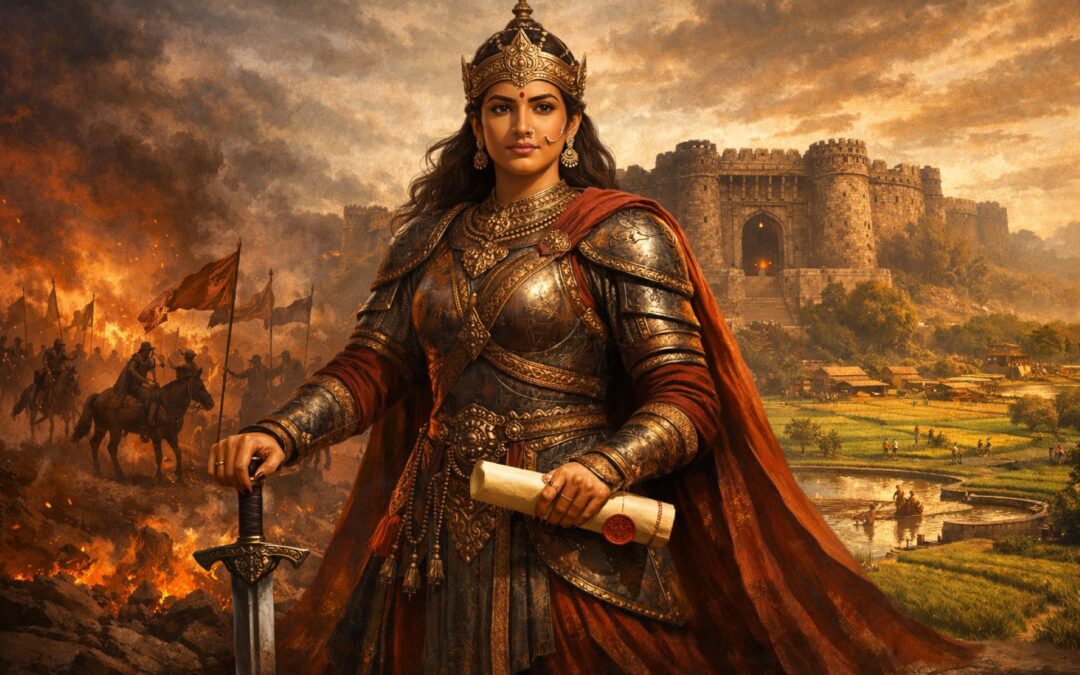
History is not short on powerful rulers—but it is remarkably short on women who ruled in their own right. Across centuries and civilizations, power has overwhelmingly been concentrated in male hands, with women often confined to the margins of political life. When a woman did rise to the throne, she was typically treated as an anomaly—a temporary exception rather than a force capable of reshaping the system itself.
Rudrama Devi was no such exception.
In the 13th century, in the heart of the Deccan, she did something far more radical than simply rule—she redefined what it meant to hold power. Born into the Kakatiya dynasty at a time when succession crises could destroy empires, she was not just elevated to the throne; she was transformed into a king in both law and perception. And once she took power, she did not merely defend it—she expanded, consolidated, and reinvented it.
Her reign was forged in crisis. She inherited a kingdom weakened by war, threatened by powerful neighbors, and fractured by internal dissent. Rivals dismissed her as a young woman unfit to lead. Her own relatives challenged her legitimacy. And yet, time and again, she answered these challenges not with compromise—but with decisive action. She defeated invading armies, crushed rebellions, and established herself as an unquestioned sovereign in a world that was not built to accept her.
But Rudrama Devi’s story is not just one of survival or even dominance—it is one of transformation.
She presided over a period of deep structural change within the Kakatiya kingdom. She invested in irrigation and infrastructure, turning barren lands into productive economic centers. She encouraged migration, trade, and cultural exchange, knitting together diverse regions into a more cohesive state. She loosened rigid social hierarchies, allowing talent—not birth—to shape opportunity. And she expanded the role of women in economic life in ways that were rare for her time.
All of this unfolded within a broader social revolution sweeping across South India—a world in which traditional hierarchies were being questioned, and new ideas about equality and merit were taking root. Rudrama Devi did not merely exist in this world—she harnessed it, shaped it, and left it permanently altered.
In the end, she died as she had lived—on the battlefield, sword in hand, confronting rebellion head-on. It was a fitting end for a ruler who had spent her entire life proving that power was not something she had inherited—it was something she had earned.
Rudrama Devi was not just one of the few women to rule in Indian history. She was one of the most remarkable rulers—period.
The Problem of Succession in the Kakatiya Empire
By the mid-13th century, the Kakatiya Empire was not a fragile kingdom waiting to collapse—it was an expanding power at the height of its ambition.
At its center stood Ganapati Deva, a king whose reign was defined by relentless territorial expansion. Under his leadership, the Kakatiyas had pushed their influence across large parts of the Telugu-speaking regions, consolidating power over both the dry inland plateaus and the fertile coastal plains. This was not just territorial growth—it was a complex political project that required constant military vigilance and administrative control.
But expansion creates its own problems.
The more territory Ganapati Deva acquired, the more stretched his resources became. Borders grew longer. Enemies multiplied. And among those enemies, the most dangerous were the Pandyas to the south—an aggressive and capable force that was already eyeing Kakatiya lands.
The situation was precarious. War was not a distant possibility; it was an inevitability.
And that is when the most critical weakness of the Kakatiya state became impossible to ignore.
Ganapati Deva had no male heir.
In a medieval political system where legitimacy was deeply tied to lineage—and specifically male lineage—this was not a minor inconvenience. It was a structural vulnerability. A king without a son did not just face uncertainty at home; he invited opportunism from every rival watching from the outside. Any prolonged military campaign, any sudden death, could trigger a succession crisis that would fracture the empire from within.
This is what made the problem of succession so dangerous.
If Ganapati Deva were to die while campaigning—especially against a formidable enemy like the Pandyas—the Kakatiya Empire could descend into chaos. Feudatories might declare independence. Rivals could invade. Internal factions could tear the state apart in a scramble for power.
In other words, the issue was not just who would rule next.
It was whether the empire would survive at all.
Ganapati Deva understood this. He was not just a conqueror—he was a strategist. And like all effective strategists, he began planning not for the best-case scenario, but for the worst.
What he needed was not merely an heir.
He needed a solution that could stabilize the empire, preserve continuity, and command legitimacy in a system that did not recognize daughters as successors.
And that solution would fundamentally challenge the very rules of power itself.
The Putrika Ceremony: Turning a Daughter into a King
Faced with a succession crisis that could unravel everything he had built, Ganapati Deva chose a solution that was as radical as it was pragmatic.
If the system demanded a son, then the system itself would have to be bent.
The answer came in the form of an ancient but rarely invoked ritual known as the putrika ceremony—a legal and cultural mechanism that allowed a daughter to be formally recognized as a son for the purposes of inheritance. It was not symbolic. It was transformative. Through this ritual, the rules of succession could be rewritten without openly breaking them.
And so, Rudrama Devi was no longer just a princess.
She was redefined as the heir.
This transformation went far beyond ritual formalities. It marked the beginning of a deliberate political project—one that required reshaping not only her legal identity but also her public image, training, and role within the state. Rudrama Devi was given a male political persona, a necessary adaptation in a world where authority was inseparable from masculinity.
This was not about disguising her identity. It was about making her rule acceptable within the existing framework of power.
Shortly after, she was elevated to the position of co-ruler, governing alongside her father at the age of just fourteen. This was not a ceremonial title. It was a calculated move to ensure continuity—an apprenticeship in governance conducted under real conditions of power, conflict, and administration.
At the same time, her marriage to Veerabhadra further reinforced her position. This alliance was not driven by personal considerations; it was another strategic decision designed to anchor her legitimacy within the broader political network of South Indian dynasties.
What emerges from all this is a striking insight.
The Kakatiya court did not reject the rules of its time—it worked within them, bending them just enough to produce a viable successor. The putrika ceremony was, in essence, a workaround. It allowed a deeply patriarchal system to preserve itself while quietly accommodating an exception.
But exceptions come with a cost.
By the time Rudrama Devi was positioned as heir, expectations were already stacked against her. She was not stepping into power as a natural successor. She was stepping into a role that had been engineered—one that would be tested at every stage, questioned at every turn, and challenged the moment she showed weakness.
The ritual had solved the problem of succession on paper.
Now came the harder part—proving that this “constructed king” could actually rule.
Baptism by Fire: War, Defeat, and a Fragile Throne
The transition from heir to ruler did not happen in a moment of stability.
It happened in crisis.
Even before Rudrama Devi could fully establish herself, the Kakatiya Empire was thrown into one of its most dangerous confrontations—with the Pandyas to the south. The result was the Battle of Muttukur, and it was nothing short of a disaster.
The Kakatiyas suffered a near-catastrophic defeat.
Territory was lost. Authority was shaken. And perhaps most dangerously, the perception of Kakatiya strength—carefully built over years of expansion—began to fracture. In medieval politics, perception was often as important as reality. A weakened king invited rebellion. A weakened state invited invasion.
And now, the state was both.
Although Ganapati Deva eventually managed to stabilize the situation and recover some lost ground, the damage had already been done. The aura of invincibility was gone. Feudatories began to reconsider their loyalties. Rivals began to sense opportunity.
It was at this exact moment—when the empire was at its most vulnerable—that Ganapati Deva made his final move.
In 1261 CE, worn down by war and perhaps disillusioned by the setbacks, he withdrew from active rule and handed full control of the kingdom to his daughter.
Rudrama Devi was sixteen.
This was not a gradual transition. There was no extended period of preparation or consolidation. One day, she was a co-ruler learning under her father. The next, she was the sole authority in a kingdom that had just suffered a major military defeat.
The stakes could not have been higher.
A fragile empire. A shaken nobility. Watchful enemies on all sides. And at the center of it all—a teenage ruler whose legitimacy was already under quiet scrutiny.
In theory, the putrika ceremony had solved the problem of succession.
In practice, it had only delayed the real test.
Now, every rival—internal and external—would be watching for a single sign of weakness. Every decision she made would be judged not just as a ruler’s choice, but as proof of whether a woman—constructed as a king—could actually command power.
This was Rudrama Devi’s true beginning.
Not in ceremony.
But in crisis.
Proving Legitimacy Through War
If Rudrama Devi’s rise to power invited doubt, it did not take long for her enemies to act on it.
Among the first to test her rule was Mahadeva of the Yadava kingdom. Watching the situation unfold in the Kakatiya Empire—a recent military setback, a young ruler, and most importantly, a woman on the throne—Mahadeva saw what he believed was a perfect opportunity.
His assumption was simple.
A kingdom led by a young woman would be easy to break.
It was a miscalculation that would define his campaign.
In 1263 CE, Mahadeva launched an invasion into Kakatiya territory, expecting a quick victory. But instead of hesitation or defensive retreat, he was met with something entirely different—a decisive and aggressive response.
Rudrama Devi did not merely repel the invasion.
She counterattacked.
What followed was not just a defensive success but a demonstration of strategic intent. After forcing the Yadava forces into retreat, she pursued them deep into their own territory—an act that flipped the psychological dynamic of the conflict. The battlefield was no longer Kakatiya land under threat; it was Yadava territory under siege.
The campaign culminated at Devagiri, the Yadava capital itself.
Here, Rudrama Devi laid siege to the city, pushing the conflict to its logical conclusion. The message was unmistakable: this was not a ruler who would simply defend her borders—this was a ruler willing to carry war into the heart of her enemy’s domain.
Mahadeva had no choice but to yield.
The terms of submission were as symbolic as they were material. He agreed to pay a massive tribute—reportedly in the form of millions of gold coins. More importantly, these coins were struck in a way that emphasized his subordination, bearing his name alongside the Kakatiya emblem.
It was not just payment.
It was a public acknowledgment of defeat.
With this victory, Rudrama Devi achieved something far more valuable than territorial security.
She established legitimacy.
In a political environment where her right to rule was already under suspicion, this campaign served as undeniable proof of competence. It silenced critics, discouraged opportunists, and signaled to allies and enemies alike that the Kakatiya throne was not weakened—it was in capable hands.
War, in this case, was not just about defense or expansion.
It was about identity.
And in a single campaign, Rudrama Devi transformed herself—from a ruler whose authority was questioned into one whose power was recognized.
Crisis and Rebellion: The Fight for the Throne
Just as Rudrama Devi began to secure her position through military success, her world was shaken by a far more personal—and far more dangerous—crisis.
In 1266 CE, tragedy struck in quick succession.
Her father, Ganapati Deva, died. Soon after, her husband Veerabhadra also passed away.
For any ruler, this would have been a moment of emotional devastation. For Rudrama Devi, it was also a political disaster.
Because with their deaths, the fragile balance that had supported her rule began to unravel.
The question of legitimacy—temporarily suppressed after her victory against the Yadavas—returned with renewed force. She had no male heir. The symbolic authority derived from her father’s endorsement was gone. And in a system that already viewed her position as an exception, this created an opening that her rivals were quick to exploit.
The most immediate threat came not from foreign enemies, but from within her own family.
Her cousins, Harihara and Murari, rose in rebellion. Their claim was rooted in a familiar argument: that a woman, regardless of ritual transformation or prior victories, was inherently unfit to rule.
This was not just a power struggle.
It was a direct challenge to the very idea of her kingship.
If they succeeded, it would not only remove her from the throne—it would reaffirm the traditional rules of succession that her rise had disrupted. In many ways, this rebellion was an attempt to restore the old order.
But Rudrama Devi was no longer the uncertain ruler who had inherited a fragile kingdom.
She had already proven herself in war.
And more importantly, she had begun to build alliances.
She did not face this rebellion alone. Among her strongest supporters were figures like Gona Ganna Reddy, a skilled and loyal military commander, and Jaganni Deva, a powerful feudatory who controlled key territories in the south.
With their backing, Rudrama Devi moved decisively.
The rebellion was crushed.
Order was restored.
And in doing so, she achieved something even more important than victory—she demonstrated that her authority was not dependent on lineage alone, but on the loyalty she could command and the power she could exercise.
This moment marked a turning point.
Up until now, Rudrama Devi had been fighting to prove that she could rule.
Now, she began to establish that she would rule—regardless of who challenged her.
The difference was subtle, but profound.
And it set the stage for her final step toward unquestioned sovereignty.
Coronation and the Making of a Sovereign
By the late 1260s, Rudrama Devi had done what few rulers are ever forced to do in such a short span of time.
She had inherited a weakened kingdom, repelled a major external invasion, and crushed an internal rebellion that directly challenged her right to rule.
But military success and political survival, while necessary, were not enough.
In a world where legitimacy was deeply tied to ritual, symbolism, and public recognition, power had to be formally affirmed.
And so, in 1269 CE, Rudrama Devi underwent a coronation ceremony—a carefully orchestrated event that marked her transition from a contested ruler to an undisputed sovereign.
This was not merely ceremonial theater.
It was a strategic act.
Up until this point, her authority had been built through circumstance and performance—through inheritance, war, and political maneuvering. The coronation transformed that authority into something more permanent. It sent a clear message to feudatories, rivals, and subjects alike: her rule was no longer provisional or conditional.
It was official.
The significance of this moment lies in what it resolved.
For years, questions had lingered—about her gender, her legitimacy, and the unconventional path that had brought her to the throne. The coronation did not erase those questions entirely, but it reframed them. It shifted the conversation from “Can she rule?” to “She is the ruler.”
That distinction mattered.
Because in medieval politics, perception often shaped reality. A ruler who appeared legitimate attracted loyalty. A ruler who appeared uncertain invited challenge. By formalizing her position, Rudrama Devi stabilized the internal dynamics of the Kakatiya state.
Feudatories who might have hesitated now had clarity.
Allies had a central authority to rally around.
And potential rebels had a stronger, more consolidated target—one that was no longer easy to undermine.
This period also marked the beginning of a subtle but important transformation in her rule.
Until now, Rudrama Devi had been reacting—to invasions, rebellions, and crises.
After her coronation, she began to build.
The urgency of survival gave way, at least temporarily, to the opportunity for long-term governance. With her position secured, she could turn her attention from defending the kingdom to reshaping it.
And it is here that her legacy begins to extend beyond the battlefield.
Because what she did next would not just strengthen the Kakatiya Empire.
It would redefine it from within.
A Kingdom Reimagined: Economic and Agricultural Reforms
With her authority firmly established, Rudrama Devi turned her attention to a challenge that was less dramatic than war—but far more transformative.
The structure of her kingdom itself.
The Kakatiya Empire was not a uniform landscape. It was divided—geographically, economically, and culturally—into two very different worlds.
On one side was the interior plateau: a harsh region defined by red sandy soil, rocky terrain, and scarce water resources. Agriculture here was difficult, populations were sparse, and economic output was limited. This was a land of pastoralists, artisans, and peasant-warriors—resilient, but constrained by nature.
On the other side was the coastal region: fertile, water-rich, and densely populated. This was where agriculture flourished, where surplus wealth accumulated, and where more structured social and cultural systems had developed.
Most rulers would have treated these regions as separate realities.
Rudrama Devi saw them as an opportunity.
Her vision was simple, but ambitious: integrate the two worlds.
The problem was not just one of geography—it was one of imbalance. The coast was overpopulated and resource-rich. The interior was underutilized and resource-poor. If this imbalance could be corrected, the entire kingdom could be transformed.
And so, she began with water.
Recognizing that the primary limitation of the interior was irrigation, she invested heavily in the construction of water tanks and artificial lakes—large-scale infrastructure projects designed to store and distribute water across dry regions. These were not isolated efforts; they were part of a broader strategy to make previously unproductive land viable for agriculture.
But infrastructure alone was not enough.
People had to move.
To encourage this, Rudrama Devi introduced tax incentives for settlers from the coastal regions, effectively nudging populations to migrate inland. This was a calculated move—by relocating skilled cultivators and communities accustomed to agricultural production, she could accelerate the development of these newly irrigated lands.
The results were rapid and profound.
Regions that had once been sparsely populated and economically marginal began to transform into revenue-generating centers. Agricultural output increased. Settlements expanded. Trade routes began to connect these new hubs with established markets.
In essence, Rudrama Devi was not just managing her kingdom.
She was redesigning its economic geography.
What makes this particularly remarkable is the level of foresight involved. These were long-term investments, the kind that did not yield immediate political rewards but created sustained prosperity over time. In a period where many rulers focused primarily on conquest and defense, she chose to invest in systems that would outlast her.
And in doing so, she shifted the foundation of power.
Because a kingdom strengthened by infrastructure and economic integration is far more resilient than one held together by force alone.
Trade, Wealth, and Cultural Flourishing
As the internal structure of the kingdom began to stabilize, the effects of Rudrama Devi’s reforms started to ripple outward.
Agriculture improved. Settlements expanded. Previously underutilized regions began producing surplus.
And with surplus comes trade.
The Kakatiya economy, once uneven and regionally fragmented, began to evolve into a more interconnected system. Internal trade networks expanded, linking the newly developed interior regions with the already prosperous coastal zones. Goods, people, and ideas moved with greater frequency, creating a sense of economic cohesion that had not existed before.
But what made this transformation particularly powerful was not just the increase in wealth—it was how that wealth was used.
Unlike many medieval economies where surplus was hoarded by elites or spent on continuous warfare, the Kakatiya system under Rudrama Devi displayed a different pattern. Historical records—especially temple inscriptions—suggest that a significant portion of elite wealth was redistributed into productive sectors of society.
Temple grants, in particular, played a central role.
These were not merely religious donations. Temples functioned as economic hubs, channeling resources into land development, irrigation projects, and even business loans. Artisans, merchants, and agriculturalists benefited directly from this system, gaining access to capital and opportunities that allowed them to expand their activities.
In effect, wealth was being circulated rather than concentrated.
This had two major consequences.
First, it accelerated economic growth. By reinvesting resources into productive ventures, the kingdom created a cycle of expansion—more production led to more trade, which led to more wealth, which was again reinvested.
Second, it broadened participation in that growth. Economic success was no longer confined to a narrow elite. A wider segment of society became involved in trade, craftsmanship, and agriculture, contributing to—and benefiting from—the kingdom’s prosperity.
And where economic activity flourishes, culture often follows.
The Kakatiya period witnessed a remarkable cultural expansion, particularly in the Telugu-speaking world. Poets, playwrights, and scholars found patronage either directly from the royal court or from regional feudatories who had themselves benefited from the expanding economy.
Literature thrived.
Creative expression expanded.
And the cultural identity of the region deepened.
What is especially striking is how interconnected all of this was. Economic reform was not isolated from cultural development—it enabled it. Trade networks facilitated the movement of ideas. Wealth redistribution supported artistic and intellectual pursuits. Social mobility created new audiences and contributors to cultural life.
Rudrama Devi’s reign, therefore, was not just a period of stability.
It was a period of expansion across multiple dimensions—economic, social, and cultural.
And this expansion was not accidental.
It was the result of a system that had been carefully designed to grow.
Breaking Barriers: Meritocracy, Mobility, and Women’s Rights
If Rudrama Devi’s economic reforms reshaped the material foundations of her kingdom, her social policies went even further—they challenged the structure of power itself.
Medieval Indian society, like most societies of its time, was deeply hierarchical. Birth determined opportunity. Caste dictated profession. And access to authority was tightly controlled by lineage and status.
Rudrama Devi did not dismantle this system entirely.
But she loosened it in ways that were both practical and transformative.
One of the most striking features of her administration was the emergence of a more merit-based system of advancement. Instead of limiting military and administrative roles to established elites, she opened pathways for individuals from non-noble backgrounds.
There are records of peasant soldiers being elevated to the rank of Nayaka—a title that signified military command and authority. This was not a symbolic gesture. It was a structural shift. It meant that competence in service—especially in warfare—could translate into real power, regardless of one’s origins.
This had a cascading effect.
When opportunities expand beyond traditional elites, the pool of talent widens. Loyalty becomes tied not just to birthright, but to opportunity. And the state gains access to individuals who might otherwise have remained invisible within rigid hierarchies.
The same logic extended into the economic sphere.
Guilds—powerful institutions that controlled trade and craftsmanship—began to show signs of increased inclusivity. There are documented cases of adoption practices where high-status merchants and artisans brought individuals from lower social strata into their networks, effectively granting them access to economic mobility.
This was not equality in the modern sense.
But it was movement.
And movement, in a rigid system, is revolutionary.
Perhaps even more remarkable was the shift in the status of women.
Historical records from this period—especially temple grants—indicate a significant increase in female participation in economic life. Women were not just passive recipients of wealth; they were active contributors. They owned land. They made donations. They engaged in transactions that were formally recorded and recognized.
This was a clear departure from earlier norms, where women’s economic agency was often limited or mediated through male relatives.
Under Rudrama Devi’s rule, that constraint began to weaken.
What ties all of this together is a consistent pattern.
Power was being redistributed—not in a chaotic or disruptive way, but in a controlled and purposeful manner. The goal was not to overturn society overnight, but to make it more flexible, more responsive, and ultimately, more productive.
Because a system that allows talent to rise, that enables broader participation, and that recognizes contributions from previously excluded groups is a system that can grow faster and adapt better.
In this sense, Rudrama Devi’s reforms were not just progressive.
They were strategic.
She understood that the strength of a kingdom did not lie solely in its armies or its rulers—but in the range of people who had a stake in its success.
And by expanding that range, she made her kingdom stronger.
The World That Made Her Possible: The Lingayat Revolution
To understand how a ruler like Rudrama Devi could emerge—and more importantly, be accepted—you have to look beyond her individual brilliance.
You have to look at the world she inherited.
Because while her rise was extraordinary, it was not entirely accidental. It was made possible, in part, by a deeper transformation unfolding across South India during the 12th and 13th centuries—a transformation driven by the rise of the Veerashaiva Lingayat movement.
This movement was not a minor religious shift.
It was a social upheaval.
The Lingayats rejected many of the foundational elements of traditional society. They opposed rigid caste hierarchies, challenged the authority of Brahminical ritualism, and distanced themselves from both Vedic orthodoxy and the Jain elite that had long dominated the Deccan’s intellectual and political life.
But their challenge went further.
They promoted ideas that were, for their time, deeply radical—especially regarding social equality and gender roles. Men and women, in their view, were equally capable. Spiritual and social worth was not determined by birth, but by devotion and conduct. Education was encouraged. Hierarchies were questioned.
This was not reform in the mild sense.
It was disruption.
The spread of Lingayat ideas altered the cultural landscape of South India in subtle but powerful ways. Even for those who did not fully adopt its beliefs, the movement shifted the boundaries of what was considered acceptable. It created space—ideological space—for alternatives to traditional norms.
And it is within this space that Rudrama Devi’s rule becomes more intelligible.
Her coronation, her authority, her reforms—these were not operating in a vacuum. They were interacting with a society that was already in the process of rethinking its structures. A society that, while still hierarchical, was becoming more open to the idea that power and capability might not be strictly tied to birth or gender.
This does not diminish her achievements.
If anything, it highlights her ability to align with the currents of her time.
Great rulers do not just impose change.
They recognize when change is already underway—and position themselves at its center.
Rudrama Devi did exactly that.
Her policies on meritocracy, social mobility, and women’s participation were not isolated innovations. They resonated with a broader cultural shift, reinforcing it while also benefiting from it. This created a feedback loop—her rule strengthened these emerging ideas, and those ideas, in turn, made her rule more sustainable.
In this sense, she was not just a product of her time.
She was a catalyst within it.
And it is this interplay—between individual leadership and societal transformation—that explains how a “constructed king” could not only survive, but thrive.
Warangal and the Military State
Even as Rudrama Devi invested in economic growth and social restructuring, she never lost sight of a fundamental reality:
Her kingdom existed in a hostile geopolitical environment.
The Kakatiya Empire was surrounded by ambitious powers—the Pandyas to the south, the Yadavas to the west, and the Gajapati rulers to the northeast. Internal rebellions had already tested her authority. External invasions were a constant threat.
In such a world, prosperity without protection was temporary.
And so, alongside reform, Rudrama Devi strengthened the military foundations of her state.
At the heart of this effort stood Warangal—the capital of the Kakatiya Empire and a city that would come to symbolize the defensive strength of her reign. While earlier rulers had begun its fortifications, it was under Rudrama Devi that the Warangal fortress reached completion.
This was not a simple defensive wall.
It was a layered system of protection—massive stone fortifications, strategically designed gateways, and multiple defensive perimeters that made direct assault extremely difficult. The design reflected both engineering skill and strategic foresight, ensuring that the capital could withstand prolonged sieges.
Warangal was more than a city.
It was a statement.
A statement that the Kakatiya state was not just administratively capable, but militarily prepared. That its center of power was secure. That any enemy seeking to dismantle the kingdom would face not just an army, but a fortified system designed to resist them.
This focus on defense also reflected a broader shift in Rudrama Devi’s later years.
If the early phase of her reign was defined by proving legitimacy and initiating reforms, the later phase was increasingly shaped by preservation. The threats around her had not disappeared. If anything, they had adapted, forming alliances and waiting for opportunities to exploit weaknesses.
The state, therefore, had to be resilient.
Fortifications like Warangal were part of that resilience. They bought time in war. They protected administrative continuity. They ensured that even if battles were lost in the field, the core of the kingdom could endure.
In this sense, Rudrama Devi’s military strategy was not purely offensive or reactive.
It was structural.
She was building a state that could absorb shocks—military, political, or economic—and continue functioning.
And that kind of durability is often what separates a strong kingdom from a lasting one.
The Final Rebellion: Ambadeva and the Last Campaign
After years of consolidating power, reforming her kingdom, and strengthening its defenses, Rudrama Devi faced one final challenge—one that would test everything she had built.
It began with the death of a trusted ally.
Jaganni Deva, the loyal feudatory who had supported her during earlier crises, died in 1273 CE. In his place rose his brother, Ambadeva.
Unlike his predecessor, Ambadeva had no intention of remaining loyal.
At some point—whether gradually or decisively—he chose to break away from Kakatiya authority and declare independence. This was not a minor act of defiance. Nellore was a strategically important region, and its loss threatened both the territorial integrity and political cohesion of the empire.
Worse, Ambadeva was not acting alone.
He secured the support of external powers, including the Yadavas and the Pandyas—the very forces that had long contested Kakatiya dominance. What had begun as a regional rebellion now evolved into a broader conflict, with multiple enemies aligned against a single target.
For Rudrama Devi, the situation was dangerously familiar.
A fragile balance. Opportunistic rivals. The risk of fragmentation.
But this time, she approached the crisis with the experience of a seasoned ruler.
She understood the stakes—and the risks.
Campaigning against a coalition of enemies was not without danger. She had seen firsthand how quickly fortunes could change in war. And so, before fully committing to the campaign, she made a critical decision.
She secured the future of the dynasty.
Recognizing the possibility that she might not return, Rudrama Devi designated her grandson, Prataparudra, as her heir. This was a move rooted in the same strategic thinking that had defined her father’s actions decades earlier. Succession, once again, was treated not as a personal matter, but as a political necessity.
With that safeguard in place, she turned to the battlefield.
The conflict with Ambadeva and his allies was not resolved quickly. It stretched over years, marked by continued resistance and shifting dynamics. This was not a single decisive battle, but a prolonged struggle—one that demanded persistence, resources, and leadership.
And at its center was a ruler who had spent her entire reign confronting crises.
But this time, the outcome would be different.
Because this campaign would not just test her rule.
It would define its end.
Death in Battle: The Warrior’s End
The final chapter of Rudrama Devi’s life unfolded not in a palace, but on the battlefield.
Her campaign against Ambadeva and his allies dragged on for years, reflecting the complexity of the conflict. This was no simple rebellion—it was a sustained challenge backed by powerful external forces, including the Yadavas and the Pandyas. The war demanded constant engagement, strategic maneuvering, and personal leadership.
Rudrama Devi did not retreat from it.
True to the pattern of her reign, she led from the front.
In 1289 CE, during one such military confrontation at Chandupatla, she met her end.
For a long time, historians believed that she had died a natural death years later, in relative obscurity. It was a version of events that, while plausible, felt strangely disconnected from the life she had lived—a life defined by conflict, resilience, and direct engagement with power.
But more recent discoveries tell a different story.
Inscriptions and carvings found at Chandupatla depict a striking scene: a ruler, armed and armored, locked in combat, with the figure of death itself appearing opposite. These findings have led historians to reinterpret her death—not as a quiet passing, but as a warrior’s fall in the midst of battle.
The symbolism is hard to ignore.
A ruler who rose in crisis, who proved herself through war, and who spent her reign defending and reshaping her kingdom, did not fade away in the background.
She died as she had ruled—actively, decisively, and at the center of events.
There is a certain coherence to this ending.
It completes the arc of her life in a way that few rulers experience. Many inherit power. Many exercise it. But only a handful carry it all the way to the battlefield, accepting the same risks as the soldiers they command.
Rudrama Devi was one of them.
Her death did not immediately resolve the conflict. The struggle with Ambadeva and his allies would continue under her successor. But the manner of her passing ensured that her legacy would not be defined by uncertainty or decline.
It would be defined by strength.
Because in the end, she did not just rule like a king.
She died like one.
Legacy: The Queen Who Became a King
By the time Rudrama Devi died, she had already secured something far more enduring than victory in any single battle.
She had reshaped the Kakatiya state.
Her reign left behind a kingdom that was stronger, more integrated, and more adaptable than the one she had inherited. The economic reforms she initiated continued to sustain agricultural expansion. Trade networks remained active. Social mobility, though not absolute, had widened enough to leave a lasting imprint on the administrative and military structure of the state.
Even contemporaries recognized her impact.
The Venetian traveler Marco Polo, who visited the region around the time of her death, wrote admiringly of her rule. He described a monarch who governed with justice, balance, and restraint—a ruler who was not only effective, but deeply respected by her people.
That reputation carried forward.
Her chosen successor, Prataparudra, inherited not a collapsing kingdom, but a functioning system. He continued many of her policies and managed to reclaim territories that had been lost during the final phase of her reign, including regions controlled by her old adversary Ambadeva.
For a time, the Kakatiya state endured.
But like many medieval powers, it eventually faced forces beyond its control. In 1323 CE, after years of sustained pressure, the capital at Warangal fell to the expanding Delhi Sultanate. The dynasty that Rudrama Devi had helped stabilize and strengthen came to an end.
And yet, endings in history are rarely absolute.
Because what survives is not just the state—but the systems it created.
Rudrama Devi’s legacy lived on in the administrative practices that outlasted her, in the cultural traditions that continued to flourish in the Telugu-speaking regions, and in the memory of a ruler who had expanded the boundaries of what was considered possible.
Most importantly, she altered the perception of power.
She demonstrated that authority did not have to be confined to inherited norms—that competence, strategy, and vision could redefine legitimacy. In doing so, she did not just succeed within the system.
She changed it.
And that is why her story stands apart.
Not because she was a woman who ruled in a man’s world.
But because she ruled so effectively that the distinction began to lose its meaning.
Conclusion
Rudrama Devi’s story begins as an exception.
A daughter turned into a son. A woman placed on a throne that was never meant for her. A ruler forced to justify her authority at every step.
But it does not end there.
Because what she achieved went far beyond simply surviving in a system stacked against her.
She fought wars and proved her legitimacy in the only language her world respected—power. She crushed rebellions that questioned her right to rule. She secured her kingdom not just through force, but through foresight. And once stability was achieved, she did something even more remarkable—she rebuilt the system itself.
She invested in infrastructure when others would have focused only on conquest. She expanded economic participation instead of concentrating wealth. She loosened rigid hierarchies and created pathways for mobility in a deeply stratified society. She governed not just as a warrior, but as an architect of long-term stability.
In doing so, she redefined what effective rule looked like.
Most rulers are remembered for what they conquered.
Rudrama Devi is remembered for what she constructed.
And that distinction matters.
Because it is easy to win power in moments of strength. It is far harder to sustain and expand it in moments of vulnerability. It is even harder to reshape the structures that determine who gets access to that power in the first place.
She did all three.
Today, her name does not dominate popular narratives in the way many other rulers’ names do. She is often treated as a footnote—a rare female ruler in a long line of kings.
But that framing misses the point.
Rudrama Devi was not significant because she was rare.
She was significant because she was exceptionally effective.
Her reign offers a different model of power—one that blends military strength with institutional thinking, immediate action with long-term vision, and authority with adaptability.
And in that sense, her story is not just about the past.
It is a reminder that the most enduring leaders are not those who simply inherit systems or dominate within them—but those who understand them well enough to change them.
Rudrama Devi did exactly that.
And that is why she deserves to be remembered—not just as a queen who ruled like a king, but as a ruler who expanded the very definition of power.