
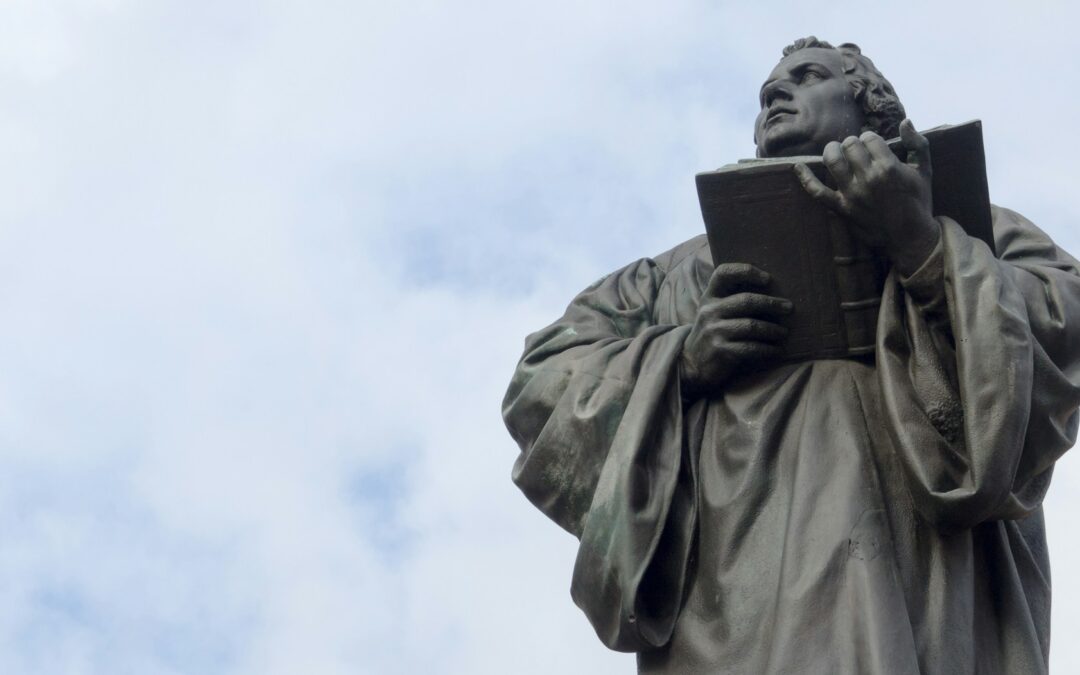
Welcome to an era when religion dominated hearts, minds, and kingdoms. Picture Martin Luther, the German monk whose simple act of defiance—a list nailed to a church door—would ignite a conflagration that would last over a century. His “95 Theses” were no mere grievances; they struck at the very core of the Catholic Church’s authority and corruption. This was the spark that shattered Europe’s religious unity and launched the Reformation, eventually leading to one of the most labyrinthine and devastating conflicts in European history: the Thirty Years’ War.
The Reformation: A Schism that Split Christendom
The Reformation was not simply a theological quarrel; it was a seismic upheaval that shattered the centuries-old religious monopoly of the Catholic Church and altered the very fabric of European society. Martin Luther, a relatively obscure monk in Wittenberg, ignited this transformation with his “95 Theses,” which questioned the legitimacy and practices of the Church. At the heart of Luther’s challenge was the critique of indulgences—payments made to the Church to reduce punishment for sins—which epitomized the corruption and moral decay he perceived within the institution.
Catholicism, as the dominant faith, upheld a complex system of belief and ritual. The pope was seen as God’s vicar on Earth, the supreme authority whose pronouncements were infallible in matters of faith and morals. Salvation, the ultimate human concern, was understood to require not only faith but also participation in seven sacred sacraments: baptism, Eucharist, confirmation, penance, marriage, holy orders, and anointing of the sick. These rites, performed by the clergy, were seen as essential conduits of grace, intertwining spiritual welfare with social order.
In stark contrast, Protestant reformers like Luther and John Calvin advocated for sola fide—justification by faith alone—and sola scriptura, the idea that the Bible alone was the authoritative source of divine truth. This shift dismantled the Church’s hierarchical control and offered believers direct access to God without mediation. The Reformation thus not only reframed theology but also democratized religious authority, empowering individuals and local rulers alike.
This ideological rupture resonated strongly in German-speaking lands, where a patchwork of principalities and free cities provided fertile ground for religious and political experimentation. The invention of the printing press accelerated the spread of Protestant writings, sermons, and pamphlets, making religious ideas more accessible to the masses than ever before. What had started as a call for reform snowballed into a full-blown movement that fractured Europe into competing confessions, each backed by its own political and military interests.
Meanwhile, in places like England, Scotland, the Netherlands, and Scandinavia, Protestantism gained institutional footholds, often intertwined with emerging national identities. Conversely, southern and western European powers—Spain, Italy, France, Portugal, Austria, and Poland—clung fiercely to Catholicism, sometimes brutally suppressing Protestant dissent. This polarization sowed the seeds of decades-long conflict, where religious conviction and political power were inextricably linked.
The Counter-Reformation and the Brewing Storm
The Catholic Church’s response to this existential challenge was multifaceted and uncompromising. Known as the Counter-Reformation, it aimed both to reform internal corruption and to reclaim lost spiritual territory. The Council of Trent (1545–1563) was the cornerstone of this revival, convening bishops, theologians, and cardinals in a concerted effort to address Protestant critiques.
The Council condemned the sale of indulgences and other abuses, reaffirmed the importance of the seven sacraments, upheld the authority of the pope, and insisted that faith without works was insufficient for salvation. It also standardized the Mass and promulgated the Roman Catechism to ensure doctrinal consistency. These measures revitalized Catholic identity and clarified teachings challenged by Protestants, aiming to both reform the faithful and reassert ecclesiastical authority.
Parallel to these doctrinal reforms, the Catholic Church intensified its campaign against heresy. The Spanish Inquisition, already notorious, escalated efforts to root out Protestants and other dissenters through interrogation, imprisonment, and execution. The Society of Jesus (Jesuits) was founded as an elite order dedicated to education, missionary work, and defending the faith. Jesuit colleges produced generations of learned clergy and intellectuals who contested Protestantism on theological and political fronts.
Despite these efforts, tensions between Protestant and Catholic states and communities escalated. The fragmented political landscape of the Holy Roman Empire became a battleground of religious identity and political sovereignty. The Protestant Union, formed in 1608, consolidated Protestant princes and cities into a defensive alliance. In response, the Catholic League was established under the leadership of Bavaria and supported by the Habsburg emperor.
These alliances transformed confessional disputes into militarized political blocs. The religious divisions ran so deep that they fragmented families, strained social relations, and destabilized centuries-old alliances. The stage was set for inevitable and protracted conflict.
John George: The Drunky Duke of Saxony
John George I of Saxony inherited far more than territorial lands; he inherited the heavy burden of navigating one of the most volatile periods in European history. Born into the illustrious House of Wettin, he became Duke at a time when Saxony was the crucible of the Reformation, centered around Wittenberg, where Martin Luther had famously challenged the Church’s authority.
This position was a double-edged sword. On one hand, Saxony had become synonymous with Protestantism’s birth and advancement; on the other, it was embroiled in the religious and political maelstrom engulfing the Holy Roman Empire. John George was thrust into a world where religious identity dictated alliances, enmities, and survival, and where the lines between spiritual conviction and political expediency were blurred beyond recognition.
The pressures were relentless. Saxony suffered repeated invasions, shifting allegiances, and economic devastation as the Thirty Years’ War ebbed and flowed across its territory. For a ruler tasked with safeguarding his people amid such chaos, the psychological toll was immense.
John George’s response was tragically human. He sought solace in alcohol, reportedly consuming prodigious amounts—up to 20 liters of beer in a single day, a volume equivalent to roughly eighty modern beers. This extraordinary consumption earned him the mocking nickname “Beer Yoga,” a bitter jest among contemporaries that masked deeper concerns.
His wife, Magdalena Sibylla, recognized the dangers of his drinking, worrying about both his mental and physical health. The Duke’s addiction became emblematic of a ruler overwhelmed by the insurmountable forces swirling around him, caught between faith, loyalty, survival, and despair.
Despite his personal struggles, John George remained a pivotal figure in the war’s shifting alliances, balancing between Catholic and Protestant camps in a bid to preserve Saxony’s precarious position. His life and reign underscore how individual frailty and historical tumult often intersect in unpredictable ways.
The Defenestration of Prague: When Protestants Threw Catholics Out the Window
The Defenestration of Prague in 1618 was a moment charged with symbolism, fury, and historical resonance—an act that plunged Europe deeper into the abyss of religious war. Bohemia, the kingdom where this explosive event occurred, was predominantly Protestant, with a populace increasingly disillusioned by the Catholic Habsburg rulers who dominated the political elite. Though the common people and many nobles embraced Protestantism, the ruling class clung to Catholicism, enforcing religious policies that suppressed Protestant freedoms and stirred resentment.
On that fateful day, tensions erupted when a group of Protestant nobles stormed Prague Castle in a dramatic show of defiance. In an act that echoed centuries of Bohemian resistance, they seized two Catholic regents and their secretary and violently cast them out of a high castle window. The men survived the fall—a fact Catholics later attributed to divine protection, while Protestants saw it as a daring statement against oppression.
This wasn’t a spontaneous act of violence but the culmination of mounting grievances over religious intolerance, political disenfranchisement, and economic pressures. It reignited the long-simmering Hussite legacy—a 15th-century movement born from similar religious and nationalist dissent.
The Defenestration was effectively the match that lit the powder keg of the Bohemian Revolt, the first phase of the Thirty Years’ War. Though Protestant forces initially rallied, they were decisively crushed by the Catholic League and Habsburg armies. The rebellion’s failure reinforced imperial authority but deepened animosities that would fuel decades of conflict, turning what began as a regional uprising into a sprawling continental war.
The Habsburgs: Masters of Power Through Blood and Strategy
The Habsburg dynasty was the imperial juggernaut of early modern Europe—its power sprawling across vast territories, from the Iberian Peninsula to the heartlands of Central Europe. Their dominance was no accident; it was the result of centuries of meticulous political maneuvering, dynastic marriages, and an iron will to consolidate influence.
Strategic matrimonial alliances were the Habsburgs’ most potent weapon. By marrying into influential noble houses across Europe, they amassed a patchwork of crowns and lands that created one of the largest and most complex empires in history. This approach ensured not only territorial expansion but also the consolidation of claims that were difficult to contest.
Their policy of inbreeding, while biologically detrimental, was a calculated risk intended to preserve the purity and continuity of their lineage. The resulting genetic legacy was controversial, producing both notable rulers and infamous cases of mental and physical infirmities, yet it cemented the family’s grip on power across generations.
The Habsburgs’ political clout was matched by their military might. Their armies, funded by sprawling imperial revenues, were well-equipped and professionally maintained. This made the dynasty a daunting adversary to the increasingly fragmented Protestant states, whose divided loyalties and limited resources hampered sustained resistance.
Within the Holy Roman Empire, the Habsburgs were not just rulers but emperors, wielding authority that blended religious sanctity with temporal power. Their ability to mobilize resources and orchestrate alliances made them the linchpin of the Catholic League and a force to be reckoned with in the Thirty Years’ War.
The Danish and Swedish Phases: The War Escalates
The Thirty Years’ War evolved in stages, with each phase escalating in intensity, complexity, and devastation. After the Bohemian revolt’s suppression, Denmark entered the conflict, seeking to defend Protestant interests and assert its influence in Northern Europe. King Christian IV, confident and ambitious, deployed his forces into the Holy Roman Empire, hoping to check Habsburg expansion.
However, the Danish intervention faltered disastrously. The Catholic League, under the leadership of the skilled general Johann Tserclaes, Count of Tilly, delivered crushing defeats. The Danes lacked the military innovation and resources to sustain a protracted campaign, forcing Christian IV to retreat and cede ground.
John George of Saxony aligned fully with the Catholic emperor during this Danish phase, providing critical support that helped repel the Protestant incursion. For his loyalty and service, he was elevated to Elector, becoming one of the seven princes empowered to choose the Holy Roman Emperor—an immense political elevation that increased Saxony’s influence despite the ongoing chaos.
Yet, the war’s dynamic shifted again with the arrival of the Swedes under King Gustavus Adolphus. Unlike the Danish, the Swedes brought revolutionary military tactics, including the extensive use of muskets, lighter artillery, and coordinated infantry maneuvers that transformed battlefield engagements. Their discipline, firepower, and mobility made them a formidable force against the Catholic armies.
John George saw an opportunity in this shift and switched allegiances to support the Swedish campaign, aligning Saxony with the Protestant cause. Early battles under Gustavus Adolphus’ leadership were resounding victories, rekindling Protestant hopes.
Tragically, the death of Gustavus Adolphus at the Battle of Lützen in 1632 was a turning point. His loss dealt a severe blow to Protestant morale and military effectiveness. Disillusioned, John George reverted to the Catholic side, attempting to preserve Saxony amid mounting setbacks.
Throughout these phases, Saxony bore the brunt of warfare—its towns burned, fields ravaged, and population decimated. The constant flux of alliances and betrayals exemplified the era’s brutal realpolitik, where survival often dictated decisions more than ideology.
France’s Entrance: The War Becomes a Game of Power, Not Faith
As the Thirty Years’ War dragged on, it morphed from a primarily religious conflict into a sprawling contest for European dominance. France’s entry into the fray marked a decisive turning point in this transformation. Under the guidance of Cardinal Richelieu, the French monarchy made a strategic decision to oppose the Habsburgs—not on theological grounds but to curtail their overwhelming political and territorial power.
Though France was a Catholic nation, Richelieu prioritized raison d’état—the reason of state—over religious solidarity. This realpolitik calculus meant that France was willing to support Protestant forces if it weakened the Habsburg dynasty, which encircled France from Spain to the Holy Roman Empire and controlled critical trade routes and territories.
In 1635, France declared war on Spain, thereby entering the broader conflict that included the Holy Roman Empire and Habsburg allies. This expansion of the war brought fresh devastation to central Europe, as French armies clashed with Habsburg forces in a brutal, attritional struggle.
For John George of Saxony, this development spelled disaster. His duchy, already ravaged by previous campaigns, became a battleground once again as French, Swedish, and imperial armies swept across his lands. His earlier shifting allegiances left Saxony vulnerable, unable to fully secure protection or stable alliances.
The incessant warfare shattered Saxony’s economy, decimated its population, and tore apart its infrastructure. Faced with these pressures, John George’s reliance on alcohol deepened, a personal coping mechanism amid overwhelming stress and despair. His wife Magdalena’s attempts to intervene—enlisting the local pastor to admonish the duke from the pulpit—highlight the human toll of political chaos. Despite the pastor’s warnings, John George’s drinking persisted, and his ironic donation of barrels of wine to the church reflected the tragic mixture of defiance, humor, and addiction.
France’s entrance effectively internationalized the war and transformed it into a complex, multi-front struggle for hegemony, signaling the decline of purely religious motivations and the rise of secular state interests as the primary drivers of conflict in Europe.
The Treaty of Westphalia: An End to the Bloodletting
After three decades of relentless warfare, destruction, and suffering, Europe was exhausted and desperate for peace. The Treaty of Westphalia, signed in 1648, brought an end to the Thirty Years’ War and laid the groundwork for a new political order.
This series of treaties was revolutionary in several respects. It recognized the sovereignty of individual states within the fragmented Holy Roman Empire, effectively curbing imperial power and decentralizing authority. The principle of cuius regio, eius religio—meaning “whose realm, his religion”—was reaffirmed and extended, granting rulers the right to determine the religion of their own territories. Importantly, the treaties acknowledged the legal existence of Calvinism alongside Catholicism and Lutheranism, expanding the religious tolerances of the time.
Switzerland and the Dutch Republic had their independence formally recognized, signaling the rise of nation-states beyond imperial control. Sweden gained territorial concessions within the empire, bolstering its status as a significant power in Northern Europe. France emerged as the continent’s new hegemon, its influence strengthened by the weakening of Habsburg dominance.
While these political realignments reshaped Europe, the human cost was staggering. Germany, the primary battlefield, was ravaged by famine, disease, and continuous military campaigns. It’s estimated that up to half of its population perished, one of the greatest demographic catastrophes in European history. Towns were destroyed, agriculture collapsed, and societal structures crumbled.
The Treaty of Westphalia marked the end of an era of religious wars and the beginning of a state-centric international system. It laid the foundations for modern diplomacy, sovereignty, and the balance of power politics that would define Europe for centuries.
The Drunky Duke’s Fate
John George I’s personal story amidst the cataclysm of the Thirty Years’ War is both tragic and strangely resilient. Despite his notorious alcohol consumption—legend has it he could consume the equivalent of 80 beers in a single day—he survived the relentless pressures of war, politics, and personal despair to live until the age of 71, an advanced age for the period.
His nickname, “Beer Yoga,” while a source of mockery, underscores the tragic coping mechanism of a ruler besieged by the unrelenting horrors of his time. His excessive drinking was both a symptom of the overwhelming chaos engulfing Saxony and a humanizing detail in a narrative often dominated by grand historical forces.
Despite the devastation inflicted on his lands and people, John George remained a significant political actor, navigating the shifting alliances of the war with opportunism and pragmatism. His shifting loyalties—between Catholic and Protestant camps—reflect the complex realities of leadership amid a fractious and fluid political landscape.
Upon his death, his eldest son inherited a duchy battered by war and economic decline. The Holy Roman Empire itself was beginning a slow decline, its cohesion weakened irreparably by the war’s aftermath.
John George’s story is a poignant reminder that history’s grand events are inseparable from the flawed and fragile individuals who shape—and are shaped by—them. His life encapsulates the intersection of personal struggle and epochal upheaval, the man behind the myth, the duke behind the devastation.
Conclusion
The Thirty Years’ War stands as a haunting testament to the devastating consequences of religious division intertwined with political ambition. It reshaped the European landscape—politically, socially, and spiritually—leaving scars that would linger for generations. Through the turmoil, figures like John George I reveal the deeply human dimension of history: leaders overwhelmed by forces beyond their control, struggling to maintain order while grappling with their own vulnerabilities. The war’s end, marked by the Treaty of Westphalia, heralded a new era of state sovereignty and diplomatic balance, yet came at a tragic cost to countless lives. Reflecting on this tumultuous chapter reminds us how fragile peace is and how the collision of ideology and power can unleash chaos, making the pursuit of understanding and reconciliation ever more vital in our own times.