
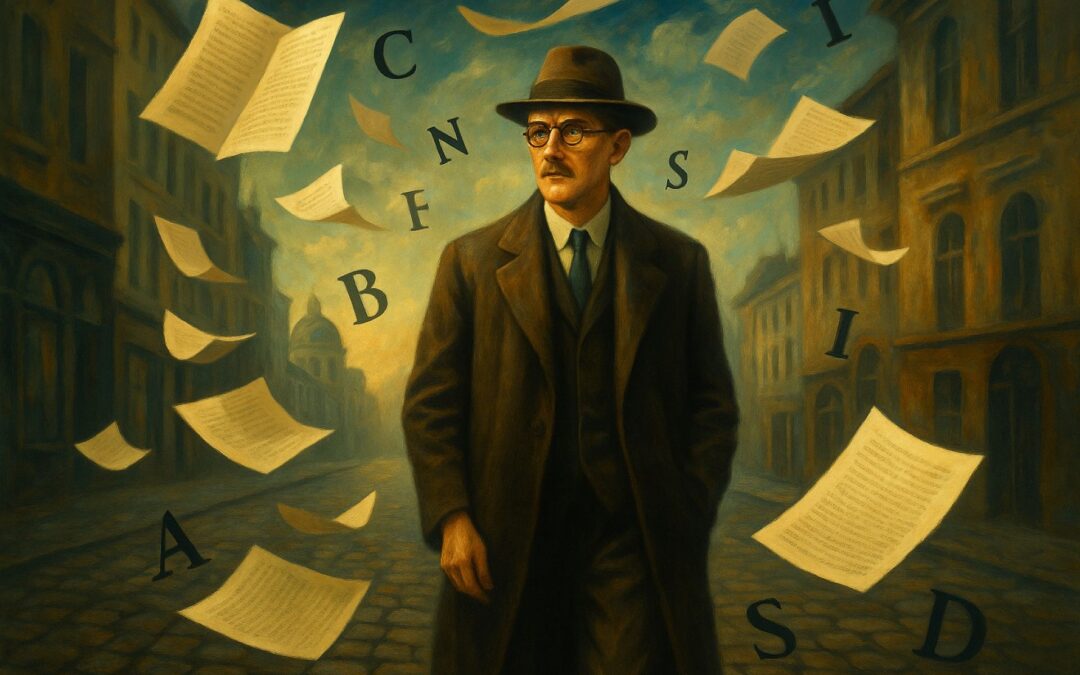
James Joyce’s Ulysses stands as a towering monument of twentieth-century literature, a work once deemed incendiary and indecent by the authorities, yet today revered as a sublime artistic triumph. When an early excerpt of Ulysses appeared in an American literary magazine, it sparked such outrage that U.S. officials ordered that every copy be seized and burned. Printers and publishers recoiled in fear of legal prosecution, wary of disseminating Joyce’s audacious and controversial text.
But in 1922, Sylvia Beach, a daring bookseller and owner of the iconic Shakespeare and Company bookshop in Paris, took an extraordinary gamble. Against all odds, she published Ulysses, unleashing a novel that would not only endure but revolutionize literature for generations. The hundred years since have seen Ulysses transcend censorship and scorn to become one of the most celebrated works of art in the twentieth century.
Unlike grand epics such as Moby Dick or the tragic scope of King Lear, Ulysses eschews traditional narrative in favor of an intricate, kaleidoscopic exploration of a single day’s events. Its genius lies not in plot, but in Joyce’s unparalleled storytelling, his linguistic inventiveness, his sly humor, and an expansive generosity of spirit that embraces the vastness of human experience.


The Cultural and Historical Context of Ulysses
The early 1920s in Paris represented a seismic shift in the cultural landscape of the Western world, a crucible where art, literature, and philosophy collided in explosive innovation. Post-World War I, Paris emerged as the beating heart of modernism, a place where boundaries were not just challenged but obliterated. The city’s cafés, salons, and bookshops became sanctuaries for the disillusioned and the visionary alike—a haven for artists and writers grappling with the fractured realities of a world forever altered by unprecedented violence and upheaval.
This cultural ferment was characterized by a fervent rejection of Victorian morality and traditional aesthetics. Salvador Dalí and the surrealists sought to delve into the unconscious mind, exposing dreams, desires, and fears beneath the veneer of rationality. Pablo Picasso deconstructed form and perspective with Cubism, fracturing visual reality into multifaceted planes that defied comprehension. Literary figures such as Gertrude Stein championed experimental prose, while Ernest Hemingway’s terse, unadorned style emerged as a stark contrast to the ornate writing of the past. Josephine Baker, with her electrifying stage presence, challenged racial and cultural norms, embodying a new kind of freedom.
In this heady atmosphere, James Joyce found himself among peers who were actively redefining what it meant to create. Yet, the shadow of the Great War loomed large. The unprecedented carnage—millions of lives lost, empires shattered—had left a profound psychological scar on the collective consciousness. The war’s devastation was not merely physical but existential, shaking faith in progress, civilization, and human nature.
T.S. Eliot captured this zeitgeist with his phrase “the immense panorama of futility and anarchy,” a bleak vision of modern history marked by chaos and disillusionment. While Ulysses does not overtly dwell on wartime imagery or politics, the novel is suffused with the sense of fragmentation and uncertainty that defined the postwar period. The modernist movement, with its kaleidoscopic narratives and fractured perspectives, sought to mirror this fractured reality, refusing simplistic or linear explanations.
The year 1922 stands as a watershed moment in modernist literature. In that single year, Ulysses, T.S. Eliot’s The Waste Land, and Virginia Woolf’s Jacob’s Room were published—works that collectively signaled the dawn of a new literary era. Joyce was at the epicenter of this revolution, residing in Paris, absorbing its energy, and contributing to its ferment. His work not only embraced the experimental impulses of the time but expanded them, pushing the boundaries of narrative, language, and consciousness to new and dizzying heights.
Joyce’s decision to situate Ulysses within this cultural nexus allowed him to engage with the intellectual currents swirling around him—freedom from convention, the quest for authentic voice, and the exploration of interiority. The novel is both a product of its time and a timeless exploration of the human condition, born from a moment of crisis and creative possibility.
Joyce’s Dublin: The Crucible of a Literary Vision
James Joyce’s relationship with Dublin was paradoxical and deeply complex—both a place of roots and imprisonment, affection and critique. Born in 1882 into a city under British colonial domination, Joyce’s early life was shaped by a society rife with political tension, cultural constraint, and economic hardship. He was the eldest of ten children in a family that spiraled from relative comfort into near destitution during his adolescence, a descent exacerbated by his father’s struggle with alcoholism and erratic behavior.
This family dynamic—marked by instability, loss, and fractured paternal authority—would resonate throughout Joyce’s writing, casting long shadows across the pages of Ulysses. Fatherhood, absence, and the search for identity become powerful leitmotifs, reflecting not only Joyce’s personal history but universal human concerns. The figure of the father looms large, not as a benign protector but as a complex symbol of both security and alienation.
Although Joyce left Dublin at the age of twenty-two and spent most of his adult life as an expatriate moving between European cultural capitals like Paris, Zurich, and Trieste, his literary imagination never abandoned the city. Dublin is more than a setting; it is a living organism within his work—its streets, pubs, landmarks, and inhabitants mapped with microscopic precision and emotional intensity.
This meticulous rendering of Dublin served multiple purposes. On one hand, it was an act of defiance and preservation—asserting the city’s significance amid colonial neglect and the rapid changes of the twentieth century. On the other, it was an exploration of the human condition through the lens of a specific place, capturing the rhythms, voices, and contradictions of urban life.
In a nation renowned for its rich storytelling heritage, where oral tradition and linguistic dexterity were cultural hallmarks, Joyce emerged as both inheritor and innovator. His work does not merely continue Irish literary traditions but transforms them. By focusing on the intricacies of everyday life, the interiority of his characters, and the subtext of language itself, Joyce forged a new path that positioned Dublin as a microcosm of the universal human experience.
His unwavering commitment to Dublin’s topography and psyche reflects a broader theme of exile and belonging. Joyce’s physical distance from Ireland contrasts with his psychological and artistic proximity. Through Ulysses, he invites readers to traverse Dublin’s labyrinthine streets, entering the minds and hearts of its inhabitants. The city becomes a stage where history, memory, myth, and mundane reality intersect, reflecting the complexities of identity, nationality, and modernity.
Ultimately, Joyce’s Dublin is not a static backdrop but a dynamic crucible where personal trauma, political tensions, and artistic ambition converge. It is the fertile ground from which one of the most ambitious literary projects in history would emerge—one that would challenge, confound, and ultimately redefine the possibilities of narrative art.
Reinventing the Novel and Language
James Joyce’s Ulysses stands as a radical reinvention of the novel form, an audacious experiment that redefines both what a story can be and how it can be told. Traditional novels prior to Ulysses often relied on clear, linear narratives, coherent plots, and consistent stylistic voices. Joyce shattered these conventions. Instead of a straightforward tale, Ulysses is a sprawling, multifaceted tapestry woven from the innermost thoughts, fragmented memories, and sensory impressions of its characters. The novel mimics the chaotic, non-linear nature of human consciousness, embodying the modernist ethos of reflecting the complexity and fragmentation of modern life.
Joyce’s linguistic innovation is one of the most remarkable aspects of Ulysses. He transforms the English language into a playground for endless verbal experimentation. His prose is densely layered with puns, neologisms, multilingual references, and allusions spanning classical mythology, religion, history, and contemporary culture. This linguistic bricolage challenges readers to actively decode, interpret, and immerse themselves in a living, breathing text that constantly evolves in tone, style, and rhythm.
The novel’s stylistic elasticity is also a hallmark of its innovation. Each episode adopts a distinct narrative mode—ranging from the stream-of-consciousness to pastiche, parody, and even catechism-like dialogue. Joyce’s playful manipulation of language is not mere ornamentation; it serves as a vehicle to explore the depths of human thought and emotion in ways never before attempted. His prose oscillates between poetic lyricism and raw colloquial speech, blending the sacred with the profane, the sublime with the banal.
This reinvention was also ideological. Joyce sought to dismantle the hierarchies of literary subject matter that excluded the quotidian, the bodily, and the intimate from serious art. In Ulysses, the private becomes epic; a man’s journey to buy soap or his reflections on bodily functions are as worthy of attention as any heroic quest. By embracing the full spectrum of human experience and linguistic possibility, Joyce expanded the horizons of the novel, opening it up to new realms of psychological and cultural exploration.
Ulysses thus emerges as a celebration of language’s capacity to capture the ineffable nuances of life—its contradictions, ambiguities, and vibrant flux. Reading it requires patience, curiosity, and a willingness to engage with its complexity. But the rewards are immense: a transformative literary experience that reshapes how we perceive narrative, identity, and the written word itself.
The Humor and Humanity of Leopold Bloom
Leopold Bloom is the beating heart of Ulysses, an everyman whose ordinariness paradoxically renders him extraordinary. Unlike the classical heroes of epic literature—demigods, warriors, or kings—Bloom is a modest advertising canvasser, navigating the streets of Dublin with a mixture of curiosity, vulnerability, and quiet resilience. His character embodies the modern human condition: flawed, conflicted, marginalized, but profoundly humane.
Joyce’s portrayal of Bloom is suffused with compassion and wry humor. Bloom’s Jewish identity in a predominantly Catholic Ireland situates him as a social outsider, a man constantly negotiating his place amid prejudice and alienation. This outsider status deepens his sensitivity and introspection, while also exposing him to mockery and subtle acts of bigotry. Yet, rather than succumbing to bitterness, Bloom navigates these challenges with an understated dignity.
The humor that Joyce infuses into Bloom’s character is often gentle but incisive. One iconic moment is the unabashed depiction of Bloom kissing his wife’s bottom as they prepare for bed—a scene simultaneously intimate, absurd, and refreshingly honest. Such candidness about bodily realities and private moments was scandalous to early readers but also humanizes Bloom, breaking down barriers between literary artifice and everyday life.
Bloom’s heroism is not found in grand gestures or mythic battles but in small acts of kindness and moral courage. He stands up against anti-Semitic insults, assists a blind man across the street, cares for the drunken Stephen Dedalus, and endures personal betrayals with a mix of woundedness and forgiveness. These quotidian deeds compose a modern epic of empathy, resilience, and human connection.
Through Bloom, Joyce challenges the notion of heroism itself. The novel suggests that heroism can be quiet, imperfect, and embedded in daily life’s ordinary struggles. Bloom’s internal monologues reveal a rich inner world—his doubts, desires, and reflections paint a portrait of a man deeply engaged with the complexity of existence.
His flaws—his infidelities, insecurities, and moments of self-pity—make him relatable rather than idealized, inviting readers to see themselves in his struggles. In doing so, Bloom becomes a vessel for exploring universal themes of identity, alienation, love, and the search for meaning in a fragmented modern world.
Ultimately, Leopold Bloom’s humanity and humor render him an enduring literary figure—a hero for the modern age whose journey through a single day resonates far beyond its Dublin setting.
The Triumvirate of Protagonists
At the core of Ulysses lies a delicate interplay among three richly drawn protagonists—Leopold Bloom, Stephen Dedalus, and Molly Bloom—each embodying distinct yet interwoven facets of human experience, identity, and existential quest. Their intertwined narratives form a complex triangulation of personal, cultural, and psychological themes that elevate the novel from a mere day-in-the-life story to a profound meditation on the human condition.
Leopold Bloom, as the titular “Ulysses,” is the wandering everyman. His status as a Jewish man in the deeply Catholic, nationalist milieu of early twentieth-century Dublin situates him in the position of the social and cultural outsider. This marginalization shapes much of Bloom’s experience, coloring his interactions with suspicion, prejudice, and alienation. Yet Bloom’s humanity shines through his perseverance, kindness, and introspective depth. His mundane journey through Dublin’s streets becomes emblematic of a broader voyage—a quest for belonging, meaning, and reconciliation with the fractures within and around him.
Stephen Dedalus, the intellectual and spiritual foil to Bloom, represents youthful rebellion, artistic ambition, and a tortured search for identity. Based loosely on Joyce himself, Stephen is a symbol of exile—both physical and psychological. Haunted by his fraught relationship with his Irish Catholic heritage and burdened by an absent or ineffective father figure, Stephen grapples with questions of faith, creativity, and selfhood. His cynicism and misanthropy contrast with Bloom’s more empathetic disposition, yet both share an underlying yearning for connection and understanding.
Molly Bloom, Leopold’s wife, emerges as the novel’s third axis—a figure of sensuality, complexity, and raw emotional honesty. As a celebrated singer and unabashedly frank woman, Molly subverts early twentieth-century norms around female sexuality and voice. Her presence challenges patriarchal and literary conventions, asserting female subjectivity with vigor and nuance. Molly’s candid reflections in the novel’s final soliloquy reveal layers of desire, memory, and vulnerability that humanize her beyond the archetype of the “unfaithful wife.”
Together, these three characters create a dynamic equilibrium. Stephen’s spiritual exile finds a counterpart in Bloom’s social marginalization; Molly’s passionate affirmation of life completes the triad, grounding the novel in corporeal and emotional reality. Their interactions—fleeting and subtle—reflect larger themes of generational conflict, cultural identity, and the tensions between tradition and modernity.
The triadic structure also mirrors Homer’s Odyssey, from which Ulysses draws inspiration: Bloom as Odysseus, Stephen as Telemachus (the son searching for his father), and Molly as Penelope. Yet Joyce reimagines these roles, infusing them with psychological complexity and modern sensibilities that resonate beyond myth, reflecting the fractured and multifaceted nature of contemporary life.
A Single Day: The Microcosm of Life
The entire narrative of Ulysses unfolds within the compressed timeframe of a single day—June 16, 1904. This deliberate temporal constriction is one of Joyce’s most ingenious narrative strategies. By focusing on one ordinary day in the lives of Dubliners, he elevates the quotidian to epic proportions, transforming the mundane into a profound meditation on existence, time, and consciousness.
June 16th holds personal significance for Joyce; it was the day he first went out with Nora Barnacle, his future wife. The choice of this date imbues the novel with an autobiographical undercurrent, grounding its experimental narrative in intimate history.
The narrative meticulously traces Bloom’s meanderings through Dublin’s labyrinthine streets, charting his encounters, errands, thoughts, and bodily functions with exhaustive detail. From the seemingly trivial—buying scented soap, preparing a breakfast of kidneys—to the intimate and private—moments of reflection on his wife’s infidelity, his own desires, and even his hemorrhoids—Joyce leaves no aspect of human experience untouched.
This radical attention to detail was revolutionary and controversial. Early critics recoiled at the frankness with which bodily functions, sexual thoughts, and private anxieties were depicted, condemning the work as obscene or “the curse of too muchness.” Yet this “excess” is precisely the novel’s strength. By cataloging the full spectrum of human experience, Joyce challenges literary elitism that relegated the everyday to the realm of the insignificant.
The novel’s panoramic scope within this single day allows Joyce to explore time itself—not as a linear, objective flow but as a subjective, multifaceted experience shaped by memory, perception, and emotion. The ordinary day becomes a prism through which the complexities of modern life are refracted, revealing the interplay between internal consciousness and external reality.
Ulysses thus reframes the novel’s traditional scope, replacing epic journeys and grand narratives with an intimate, immersive portrayal of lived experience. The novel’s structure invites readers to recognize the profundity in their own daily lives—the extraordinary lurking within the ordinary—and to appreciate the interconnectedness of moments that shape identity and meaning.
Experimental Narrative Styles and Thematic Ambition
One of Ulysses’ most defining and revolutionary features is its relentless experimentation with narrative style and form. Joyce transforms the novel into a literary laboratory, where each of the eighteen episodes functions as a distinct experiment in voice, structure, and language. This stylistic heterogeneity is not mere display of virtuosity; it is integral to the novel’s thematic richness and its quest to encapsulate the multiplicity of human experience.
Joyce consciously aligns each episode with an episode from Homer’s Odyssey, yet he reinterprets these classical parallels through radically different literary modes. The episodes shift from dense stream-of-consciousness interiority to pastiches of other genres, from parodies of popular writing to highly symbolic, theatrical scripts. This kaleidoscopic approach forces readers to continually recalibrate their expectations, engaging with the text on multiple, sometimes contradictory levels.
For instance, the “Nausicaa” episode parodies sentimental women’s magazines, employing clichés and melodramatic tones to simultaneously critique and embody early twentieth-century popular culture’s treatment of female desire. This ironic stance complicates the narrative, blending empathy with satire. Another chapter unfolds entirely as a catechism-like series of questions and answers, evoking religious ritual while interrogating faith, knowledge, and authority.
Perhaps the most linguistically ambitious episode is “Oxen of the Sun,” set in a maternity hospital. Here, Joyce charts the historical evolution of the English language in a single narrative arc. The episode begins with archaic, Latinate medieval prose and gradually accelerates through Renaissance styles, eighteenth-century prose, and culminates in a torrent of irreverent modern slang. This linguistic evolution mirrors both the birth taking place in the hospital and the birth of new literary forms, underscoring themes of creation, transformation, and continuity.
“Circe,” the penultimate episode, is a surreal, hallucinatory play within the novel. Written as a script filled with stage directions and dramatic effects, it plunges into dream logic, erotic fantasy, and symbolic violence. Bloom undergoes bizarre transformations, including a temporary gender shift and the fantastical birth of eight children. Historical and fictional characters—from Shakespeare to Sherlock Holmes—appear and vanish in rapid succession. This episode breaks down distinctions between reality and hallucination, conscious and unconscious, reflecting the fragmented psyche of modern man.
Joyce’s restless stylistic experimentation serves as a mirror to the novel’s thematic preoccupations: identity as fluid and multifaceted, language as a living, evolving force, and the quest for meaning amid chaos. Each episode’s unique style invites readers to experience different modes of perception and cognition, challenging passive reading and fostering active engagement.
Through this polyphonic, protean approach, Ulysses transcends conventional narrative, becoming a meta-literary meditation on the possibilities and limitations of language and storytelling. It demands intellectual agility and emotional openness, rewarding readers with a richly textured experience that simultaneously dazzles, confounds, and enlightens.
Molly Bloom’s Monologue: The Final Yes
The final episode of Ulysses is a tour de force of literary innovation and emotional intensity—a sprawling, unpunctuated monologue delivered by Molly Bloom as she lies awake in bed. This stream-of-consciousness soliloquy strips away formal constraints to reveal the raw, unfiltered workings of her mind, traversing memories, desires, fears, and reflections with breathtaking candor.
Molly’s narrative voice is strikingly immediate and sensuous, marked by a flowing rhythm that captures the natural cadence of thought. The absence of punctuation invites readers to immerse themselves in the seamless flow of associations and emotions, evoking the intimate privacy of consciousness. This technique was groundbreaking, pushing the boundaries of what prose could achieve and expanding literary possibilities for representing interiority.
Her monologue contrasts sharply with the more structured, external narratives of earlier episodes, bringing the novel to a deeply personal and human close. Molly recounts episodes from her past—childhood experiences, lovers, family dynamics—interwoven with reflections on her relationship with Leopold Bloom and her acceptance of his marriage proposal. Her thoughts oscillate between vulnerability, defiance, humor, and yearning, painting a multifaceted portrait of a woman who defies simplistic characterization.
By ending Ulysses with Molly’s “yes,” Joyce offers an emphatic affirmation of life and love. This single, simple word resonates as a triumph over fragmentation, uncertainty, and alienation, encapsulating the novel’s ultimate message of hope and connection. It is a powerful counterpoint to the novel’s earlier complexities, grounding the work in the enduring human capacity for affirmation and renewal.
Molly Bloom’s soliloquy also reclaims female subjectivity within a literary tradition often dominated by male voices. Her candid exploration of sexuality, memory, and emotion breaks taboos and asserts the legitimacy of women’s interior lives. Through Molly, Joyce expands the novel’s emotional and psychological range, granting space to voices marginalized in both society and literature.
The final passage, with its lyrical intensity and unabashed honesty, invites readers into the intimate sanctum of Molly’s consciousness, offering a profound meditation on identity, desire, and the passage of time. It stands as one of the most celebrated and influential passages in modern literature, embodying the innovative spirit and humanistic depth that define Ulysses as a whole.
Conclusion
Ulysses remains an unparalleled achievement in literary history—a work that defies easy categorization, challenges conventions, and expands the very definition of the novel. Through its intricate exploration of language, identity, and the ordinary moments that compose human life, Joyce crafts a vivid, multifaceted portrait of existence that continues to resonate across generations. Its experimental styles, richly drawn characters, and profound humanity invite readers not just to witness a day in Dublin, but to engage deeply with the complexities of consciousness and connection. More than a century after its publication, Ulysses endures as a timeless testament to the power of storytelling to illuminate the extraordinary woven into the fabric of the everyday.