
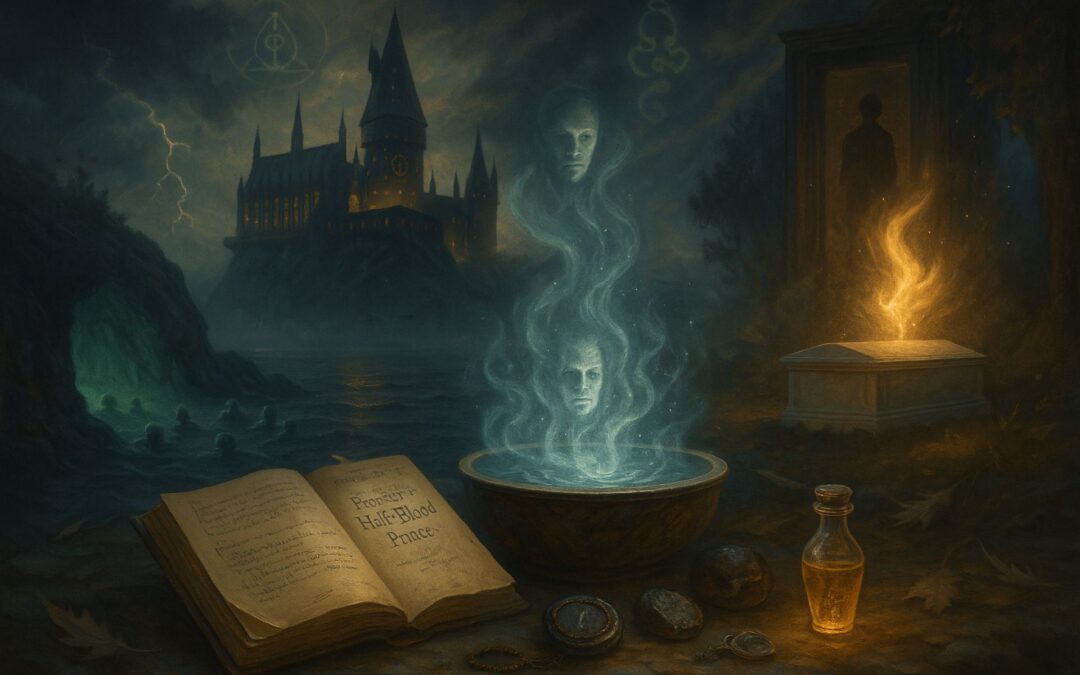
Overview: The Calm Before the Storm
Harry Potter and the Half-Blood Prince opens in a world dimmed by fear and fractured trust. The return of Lord Voldemort, once dismissed as myth, is now an inescapable reality. Both wizard and Muggle worlds tremble under his growing power — bridges collapse, disappearances mount, and whispers of betrayal infect every institution.
At Hogwarts, the sense of safety that once defined the castle has thinned to a fragile illusion. Dumbledore, older and graver, begins to reveal long-guarded truths to Harry, preparing him for a destiny that can no longer be deferred. Even as lessons continue, the tone of the year is different: death has become an expectation, and love — fragile and fleeting — becomes an act of rebellion.
Yet amidst the gloom, the book pulses with humanity. The blossoming of love between Ron and Hermione, Harry’s quiet feelings for Ginny, and the bittersweet laughter of friendship offer fleeting warmth in a darkening world. Rowling balances the political and the personal with masterful restraint: the war outside mirrors the war within, and every act of affection feels like defiance.

Full Plot Summary: The Education of a Chosen One
At the end of Harry Potter and the Order of the Phoenix, the world finally awakens to the truth Harry had been carrying alone — Voldemort is back. The Ministry’s denial has crumbled; Fudge is disgraced; and Dumbledore’s Army, once a secret act of rebellion, stands vindicated. Yet the victory is hollow.
Sirius Black is dead, Harry’s innocence has vanished, and the prophecy revealed that either he or Voldemort must die at the hand of the other—the boy who once longed for belonging now shoulders a destiny of isolation. As The Half-Blood Prince opens, this weight begins to shape him — molding a soldier from the remains of a son and a friend.
The War Escalates: A World in Shadows
The opening of The Half-Blood Prince marks a profound tonal shift — the point at which the magical and Muggle worlds fully converge in chaos. Gone is the comforting illusion of separation that once defined the series. Now, London itself becomes a silent casualty of Voldemort’s return. Bridges collapse without explanation. A raging storm swirls through the city skies. Disappearances multiply. The front page of The Daily Prophet has become a roll call of the missing and the dead. Fear, not secrecy, is the new order.
This atmosphere of dread is reinforced by the unexpected perspective that opens the novel: that of the Muggle Prime Minister. In his office, he receives an uneasy visit from Cornelius Fudge, the recently ousted Minister for Magic, who now arrives not to deceive but to confess. Fudge, humbled and defeated, introduces his successor — Rufus Scrimgeour, a lionlike figure whose manner blends military resolve with political calculation. Their exchange reveals the scale of Voldemort’s campaign: kidnappings, deaths, giants joining his ranks, Dementors abandoning Azkaban to serve him directly. The wizarding world’s defenses are collapsing from within.
Even here, Rowling demonstrates her narrative precision — she widens the scope of the war while maintaining intimacy. The reader sees the consequences of Voldemort’s rise through human fear, not abstract politics. The Prime Minister’s helplessness mirrors the entire society’s paralysis: a civilization facing evil but unable to comprehend it.
Meanwhile, away from government chambers, the Dark Lord’s strategy unfolds in secrecy. In a hidden house in Spinner’s End, Narcissa Malfoy and Bellatrix Lestrange arrive at the doorstep of Severus Snape. Bellatrix, fervent and derisive, questions Snape’s loyalty to Voldemort, accusing him of serving Dumbledore. But Narcissa — driven by maternal desperation — pleads for his protection. Her son Draco has been chosen for a mission by Voldemort himself: to kill Dumbledore. The assignment is both punishment and test, designed to destroy the Malfoys if it fails.
Snape listens calmly, his composure unbroken even as Bellatrix mocks him. Then, in a moment thick with foreboding, he agrees to assist Draco. Together, he and Narcissa seal the Unbreakable Vow — a magical contract bound by life itself. If Draco fails, Snape must complete the task in his stead. If he breaks his word, he dies. The vow fuses deception, duty, and doom into one act.
This early sequence encapsulates the book’s central shift: the war is no longer about sides, but about choices. Every allegiance becomes dangerous, every promise fatal. In a world losing its moral compass, Snape’s vow becomes the hinge upon which tragedy will turn.
Dumbledore’s Return and the Gathering Storm
The focus turns then to Harry — no longer a boy, but a young man marked by grief. The trauma of the Department of Mysteries still lingers; Sirius’s death has hollowed him out. He spends his summer at Privet Drive, isolated yet restless, when an unexpected knock at the door changes everything. Albus Dumbledore, the man who once seemed untouchable, appears on the Dursleys’ doorstep.
The moment is striking for its reversal of tone: the great wizard, serene and dignified, steps into the banal discomfort of Number Four, Privet Drive. His presence fills the room with quiet power, rendering the Dursleys speechless. For the first time, Harry witnesses Dumbledore in direct confrontation with the pettiness of his Muggle guardians — a symbolic act bridging Harry’s two worlds. The boy who began this saga beneath a cupboard is now being summoned by destiny itself.
Dumbledore reveals to Harry that he has arranged for him to spend the rest of the summer with the Weasleys after completing an errand together. Their destination: the small, cluttered home of Horace Slughorn, a retired Potions Master who has been hiding from both Death Eaters and Ministry recruiters alike.
Slughorn’s character is painted with deliberate complexity. A genial, vain man with a fondness for comfort and prestige, he represents a subtler corruption — not evil, but complacency. Dumbledore, however, sees value in him: Slughorn once taught Tom Riddle, and within his memories lies a clue essential to understanding Voldemort’s immortality.
To persuade him, Dumbledore uses Harry’s presence like a catalyst. Slughorn, dazzled by the prospect of adding the famous “Chosen One” to his social circle, agrees to return to Hogwarts. It is a recruitment veiled as nostalgia, and it succeeds not through magic but through the manipulation of vanity — a reminder that the war will be won as much through human weakness as through power.
Afterward, Dumbledore escorts Harry to the Burrow, home of the Weasleys. The warmth of the household offers a fragile refuge. The atmosphere, though affectionate, is tinged with unease. The Order of the Phoenix is stretched thin; its members vanish on missions from which some do not return. Bill Weasley’s engagement to Fleur Delacour creates familial friction, particularly with Mrs. Weasley and Ginny, whose teasing veils genuine tension. Tonks appears withdrawn and pale, her once-bright personality dimmed by unspoken sorrow.
In the midst of it all, Harry experiences a quieter transformation. The boy who once admired Ginny as Ron’s spirited sister now finds himself watching her differently — noticing the small, unguarded moments that make her seem both stronger and more real. It’s an emotional thread that Rowling weaves carefully, using love as a subtle antidote to the pervasive fear that grips the world.
By the time Harry departs for Hogwarts, both he and the reader sense a deep shift in the story’s rhythm. The innocence of school life is ending. The days of Quidditch and pranks are giving way to lessons in mortality and duty. Dumbledore’s blackened hand, which he deflects with evasive humor, stands as a silent omen of decay. The world is bracing for war, and Harry, for the first time, is not just its target — he is its necessary participant.
Return to Hogwarts: The Prince and His Book
The return to Hogwarts, once synonymous with warmth and continuity, now feels shadowed and uncertain. The journey aboard the Hogwarts Express carries not only students but whispers of fear and suspicion. The war outside has seeped into every compartment; even the laughter of students feels brittle, performative. Aurors patrol the train station, parents linger anxiously on the platform, and for the first time, the castle at the journey’s end no longer promises safety but temporary refuge.
Upon arrival, the changes are immediate. The great gates are guarded, security charms hum in the air, and visitors are screened for Dark magic. Inside, Hogwarts feels both familiar and foreign — a sanctuary surrounded by invisible siege walls. Dumbledore’s insistence on reopening the school reflects not naïveté but strategy: as the world fractures, education becomes an act of resistance.
The staff table bears its own surprise. Severus Snape, long confined to teaching Potions, has finally ascended to the coveted post of Defense Against the Dark Arts professor. His expression during Dumbledore’s announcement is one of quiet triumph, though it chills the hall. The irony is not lost on anyone — the man Harry most distrusts now holds the position that has doomed every one of its predecessors. The appointment is both fulfillment and curse, a silent foreshadowing of what’s to come.
In contrast, Horace Slughorn assumes Snape’s old position as Potions Master, immediately reviving his old habits of collecting gifted or well-connected students into his “Slug Club.” Harry, Ron, and Hermione attend their first class under him, and it is here that chance — or perhaps fate — intervenes. Out of spare textbooks at the start of the lesson, Harry receives an old, battered copy of Advanced Potion-Making, once belonging to a former student known only as The Half-Blood Prince.
The pages are scrawled with notes — corrections to recipes, innovative spellwork, and cryptic instructions written in the margins. What begins as curiosity soon turns into advantage. Following the Prince’s annotations, Harry effortlessly outperforms his classmates, creating potions of precision and brilliance that astonish even Slughorn. As a reward, he earns a vial of Felix Felicis, the coveted “Liquid Luck.”
But beneath this success lies a subtler thread: temptation. The book becomes an extension of power — seductive, mysterious, and unearned. Hermione, ever cautious, distrusts it immediately, sensing danger in its darkly creative suggestions. Harry, however, is enthralled. The handwritten notes feel personal, intimate, almost like mentorship from beyond time. Unaware of the author’s identity, he feels guided — and, in a way, chosen again.
Outside the classroom, life continues in awkward fragments of normalcy. Quidditch trials, gossip, and the faint pulse of romance coexist uneasily with dread. Ron becomes Keeper for the Gryffindor team, fueling both pride and friction with Hermione. She hides her affection behind sharp remarks; he hides his confusion behind bluster. Ginny, meanwhile, shines with independence and quiet confidence, her laughter cutting through the gloom of the castle.
Still, not all is routine. Draco Malfoy, pale and withdrawn, spends his time alone, vanishing from the Great Hall and slipping into forbidden corridors. Harry grows convinced that Draco has been branded as a Death Eater, his paranoia intensifying into obsession. Even his friends dismiss his suspicions, seeing them as echoes of childish rivalry. Yet Harry’s instincts — sharpened by pain — are right. Draco has indeed been given a mission: to assassinate Albus Dumbledore and restore his family’s honor.
Throughout the term, tension builds like pressure in a sealed cauldron. Small mysteries — Filch’s inspections, secret passages, erratic behavior — accumulate without release. The old rhythms of Hogwarts are still there, but the innocence is gone. Where there was once play, there is now preparation; where there was study, there is now strategy. The school has become both a fortress and a waiting ground for destiny.
Secrets of the Past: The Lessons in Memory
As the term progresses, Dumbledore begins a series of lessons with Harry that go beyond magic — lessons in history, morality, and mortality. For the first time, Dumbledore shares his private knowledge of Voldemort’s evolution, using the Pensieve to explore the memories of those who once crossed paths with Tom Riddle.
The sessions are unlike anything Harry has experienced. They pull him out of the immediacy of the present war and into the architecture of evil itself — showing him that Voldemort’s strength lies not in spells but in understanding and exploiting human weakness.
They begin with Riddle’s early years in the orphanage, where the young boy revealed both his brilliance and his cruelty. Even as a child, he collected trophies from those he hurt, deriving satisfaction from control. When Dumbledore visited to deliver his Hogwarts letter, Riddle’s fascination with power was already evident — he wanted to know why others couldn’t do what he could, and how to make them obey. It was not magic he sought to learn, but dominance.
The next memory shows Riddle as a handsome, ambitious student at Hogwarts — admired, disciplined, and cunning. He excelled in nearly every subject, but more importantly, he learned how to charm and manipulate. Teachers adored him, students feared him, and his charisma concealed a complete absence of empathy. Dumbledore, however, never trusted him, sensing the cold hunger that lurked beneath his politeness.
The most critical memory, however, belongs to Slughorn — a memory he has tampered with, concealing his shame. In this distorted recollection, Tom Riddle asks about the nature of Horcruxes — objects in which a wizard can hide a fragment of their soul to achieve immortality. Slughorn, uncomfortable and fearful, dismisses the question. Yet Dumbledore knows this memory has been altered, that the true conversation revealed something far darker.
Determined to retrieve the unedited version, Harry uses the Felix Felicis he won earlier. Under the influence of “Liquid Luck,” his world seems to align — every action feels inevitable and right. Guided by intuition, he visits Hagrid, detours through the castle grounds, and finds himself at Slughorn’s office during a rare moment of nostalgia. Harry’s honesty and kindness pierce the old professor’s guilt, and Slughorn finally surrenders the true memory.
Through it, the full horror of Voldemort’s ambition is revealed: he created not one Horcrux, but several — splitting his soul into seven parts, the most blasphemous act imaginable. Each Horcrux anchors him to life, rendering him nearly impossible to kill. The diary destroyed in The Chamber of Secrets was only the beginning; the ring Dumbledore found, another. The hunt for the remaining fragments becomes the central mission that will carry Harry beyond Hogwarts and into the final war.
These lessons redefine Harry’s understanding of destiny. The prophecy that once haunted him — “neither can live while the other survives” — now gains clarity. It isn’t about chosen fate, but chosen understanding. Voldemort’s power lies in division, and Harry’s strength will lie in unity — of soul, of love, of purpose. The journey that began with innocence now matures into responsibility.
Love, Rivalry, and Betrayal
Even as the war darkens the horizon, Hogwarts remains a fragile oasis — its corridors echoing with laughter, arguments, and the heartbeat of youth. The castle’s walls are thick with enchantments, but not even magic can keep out the small tragedies of love and jealousy. Rowling slows the pace deliberately here, letting the ordinary lives of students mirror the turbulence of the world beyond.
Ron Weasley’s elevation to Gryffindor Keeper becomes both triumph and torment. For once, he basks in glory, the cheers of the crowd inflating his long-suppressed insecurities. Yet success also brings new complications. Hermione’s quiet pride in him curdles into frustration when Ron, intoxicated by attention, allows himself to be drawn into a relationship with Lavender Brown. What begins as flirtation turns swiftly to spectacle — public displays of affection that feel juvenile but are born from Ron’s craving for recognition.
Hermione’s pain, by contrast, is silent, internal, expressed through sarcasm and avoidance. She feigns indifference, but her every reaction betrays depth of feeling. It’s a portrait of emotional restraint — of someone who cannot confess what she feels because she fears what it might break. Their tension fractures the trio’s harmony, creating rifts that no amount of laughter can disguise.
Meanwhile, Harry’s own heart begins to move in quieter, more dangerous directions. Ginny Weasley, once only Ron’s little sister, now stands out as confident, fiery, and self-possessed. Her independence — her ability to stand on her own — becomes the very thing that draws Harry toward her. The affection he feels is not sudden infatuation but long recognition: she represents courage without bitterness, strength without cruelty. Yet Harry represses his feelings, terrified of betraying Ron’s trust. His restraint gives their bond a slow, painful inevitability.
Through these emotional entanglements, Rowling captures something vital — that love and longing persist even when the world is unraveling. The flirtations and jealousies that once seemed trivial now feel precious because they are fleeting. Every kiss, every quarrel, every friendship strained by misunderstanding becomes an act of resistance against despair.
But beneath the everyday rhythms of school life, something darker stirs. Draco Malfoy’s demeanor has changed beyond recognition. Once arrogant and mocking, he now walks the halls pale, anxious, and withdrawn. He isolates himself from his peers, obsessively working in secret. Harry, certain that Draco has been branded a Death Eater, begins to spy on him — using the Marauder’s Map to track his movements and theories that others dismiss as paranoia.
What Harry does not yet know is that Draco’s secret is a death sentence in disguise. Tasked by Voldemort to kill Dumbledore, Draco spends his year in fear and guilt, trying to repair an ancient Vanishing Cabinet hidden within the Room of Requirement. The cabinet, when fixed, will allow Death Eaters to bypass the school’s defenses — a mission Voldemort gave him as punishment for Lucius Malfoy’s failures.
Meanwhile, the wider world seeps into Hogwarts in alarming ways. Katie Bell is cursed by a necklace meant for Dumbledore. Ron nearly dies after drinking poisoned mead. Each attack is a warning that safety no longer exists, even in Dumbledore’s domain. The familiar warmth of Hogwarts has curdled into unease. Every act of kindness feels precarious, every celebration a reprieve from fear.
By the year’s midpoint, the trio’s friendship, like the world itself, is fractured but enduring. Their quarrels and reconciliations mirror the central moral tension of the book — how love survives mistrust, and how loyalty can be tested without being destroyed. Beneath every rivalry lies affection; beneath every betrayal, the aching need to protect what remains.
The Horcrux Hunt: The Cave of Despair
As the school year draws toward its close, Dumbledore summons Harry for a mission unlike any before. The time for theory and memory has passed — now comes confrontation. Dumbledore believes he has located one of Voldemort’s Horcruxes, and he needs Harry’s help to retrieve it. The journey they undertake together marks the culmination of everything Harry has learned: courage, obedience, and trust in the face of fear.
They Apparate to a desolate coastal cliff, where waves crash against black rock and the wind howls like a living thing. This is the cave where a young Tom Riddle once tormented two orphanage children — a place soaked in his cruelty and chosen as a vessel for his immortality. The setting itself feels like an extension of Voldemort’s soul: cold, hollow, and unforgiving.
Dumbledore leads Harry through a gauntlet of enchantments. A hidden entrance carved into the stone opens only at a touch of blood — a symbolic demand for sacrifice before entry. Inside lies a vast underground lake, black as glass, reflecting the faint green of distant, unnatural light. At its center sits a small island bearing a stone basin filled with a phosphorescent potion. Floating within the potion, barely visible, is a locket — the Horcrux.
Dumbledore warns Harry that the potion must be drunk to retrieve the locket. He does not know its nature, only that it must be endured to the last drop. What follows is one of Rowling’s most harrowing sequences — not because of violence, but because of helplessness.
Dumbledore begins to drink, and each swallow brings agony. The potion strips away his strength, his sanity, his composure. He gasps, screams, begs Harry to stop, pleads for death, cries for someone unseen. The sight devastates Harry. For years he has depended on Dumbledore’s calm omnipotence — now that illusion shatters. He obeys his mentor’s instruction, forcing him to finish, even as Dumbledore collapses, trembling and delirious.
When the potion is gone, Dumbledore’s only plea is for water. But the lake holds no mercy. As Harry dips the goblet into its depths, pale hands break the surface. Inferi — the dead, reanimated by dark magic — surge upward, their empty eyes fixed on the living. Panic overtakes Harry as he realizes the scale of the trap. With shaking hands, he casts fire — flames roaring across the cave, reflecting wildly in the water. The light drives the Inferi back into darkness.
Exhausted but alive, Harry helps Dumbledore to the boat, their reflections flickering across the poisoned water. The escape feels dreamlike, fragile — two figures, one broken, one burdened, carrying a false victory through the dark.
When they finally Apparate to Hogsmeade, the night sky is unnaturally still. Dumbledore is barely conscious, the locket clutched in his trembling hand. Harry sees the faint outline of the castle in the distance — a shape both comforting and ominous.
Then, from above the turrets, a green skull blooms against the stars: the Dark Mark.
The world’s oldest symbol of death glows over Hogwarts, signaling that the sanctuary has fallen. The calm before the storm is over; the final hour has begun.
The Fall of Dumbledore
When Harry and Dumbledore arrive back at Hogsmeade, exhaustion clings to them like mist. The cave has drained the Headmaster of strength, and the effort of Apparition nearly topples him. He leans heavily on Harry, who, for the first time, becomes his guardian rather than his student. The reversal is poignant — the protector now fragile, the pupil suddenly responsible for the man who once seemed eternal.
They see the Dark Mark glowing above Hogwarts — an omen of violence that chills the blood. The emerald skull and serpent twist across the sky, the universal sign of murder. Dumbledore, weakened but lucid, insists they go to the Astronomy Tower. The urgency in his voice allows no argument. Together they fly on broomsticks through the night air, landing upon the tower’s cold stone platform.
As they arrive, Harry’s instinct is to run for help, but Dumbledore immobilizes him with a spell. “You must obey me, Harry,” he says softly — not as a command, but as a plea. A moment later, the tower door bursts open. Draco Malfoy steps through, pale and trembling, wand raised.
The confrontation that follows is not a duel but a tragedy of conscience. Draco, though armed, is paralyzed by fear. Dumbledore speaks to him with gentleness, his tone devoid of reproach. He already knows everything — Draco’s mission, his use of the Vanishing Cabinet, his secret communications with the Death Eaters. He even knows about Narcissa’s desperation and the Unbreakable Vow Snape made to protect Draco.
What Dumbledore offers, in this final conversation, is not defense but redemption. He pleads with Draco to let him help, to abandon the impossible task forced upon him. His words are filled with pity, not fear: “I can help you, Draco.” For a heartbeat, Draco wavers. Tears form in his eyes, his wand shaking uncontrollably. The boy who wanted to prove himself has become the boy trapped by expectation.
Then the Death Eaters arrive — Greyback, Amycus, and others — spilling into the tower like shadows. Harry, frozen beneath the Invisibility Cloak, can only watch. Dumbledore stands defenseless, wand lowered, while the intruders taunt him. The atmosphere is suffocating with suspense. Everyone waits for Draco to act, but he cannot. The spell refuses to leave his lips.
And then Snape appears. His entrance is silent but absolute. The Death Eaters fall still, their jeers fading into anticipation. Dumbledore turns to him — calm, unafraid — and speaks words that will echo through the rest of the series: “Severus… please.”
Whether it is a plea for mercy, for courage, or for completion, no one will ever know. Snape raises his wand, his face unreadable. The green flash of Avada Kedavra cuts through the night. Dumbledore’s body is lifted from the ramparts, suspended for an instant in the air — a silhouette of grace and inevitability — before falling into the darkness below.
For a moment, time stops. The Dark Mark gleams brighter. The Death Eaters retreat in chaos, and Harry — finally released from Dumbledore’s spell — tears after Snape in rage. The chase through the grounds is frantic and desperate, a release of everything Harry has lost: his father figure, his faith, his sense of safety. Spells fly across the darkness, but Snape parries each one effortlessly, finally silencing Harry with brutal truth.
“I am the Half-Blood Prince,” he snarls, eyes blazing with fury and sorrow. “You dare use my own spells against me?”
In that revelation, Harry’s borrowed brilliance collapses. The book, the power, the strange mentorship — all along, they belonged to the man who killed Dumbledore. Snape disappears into the night, leaving behind not triumph but emptiness.
The castle, once alive with laughter, now echoes with grief. The light of Dumbledore’s presence — the moral compass of the series — has been extinguished. The headmaster’s death marks more than loss; it signifies a transfer of burden. The age of guidance is over. The age of choice has begun.
The Aftermath: Resolve in the Ruins
Morning at Hogwarts dawns in silence. The Great Hall is draped in mourning, the students huddled together as though proximity might undo the night. The staff move through the halls like ghosts. Word spreads quickly — Dumbledore is dead, and the protection of the school has died with him.
The students’ grief takes many forms. Some weep openly; others sit numb, unable to comprehend. Even those who once mocked him, like the Slytherins, are subdued. It is as though the foundation of their world has cracked, and through it, the war seeps in. The illusion of safety, carefully preserved for six years, has finally collapsed.
Outside the castle, preparations begin for the funeral. The teachers and members of the Order of the Phoenix gather Dumbledore’s body, still and serene, and lay it in state. Rumors swirl through the crowd — whispers of Snape’s betrayal, of Draco’s escape, of the Vanishing Cabinet’s role in the invasion. Harry learns that the Horcrux they retrieved from the cave was a fake. Inside the locket is a scrap of parchment bearing a cryptic note:
“To the Dark Lord,
I know I will be dead long before you read this,
but I want you to know that it was I who discovered your secret.
I have stolen the real Horcrux and intend to destroy it.
—R.A.B.”
The name sparks a new mystery, a new quest, but at this moment, it feels like mockery. All the pain, all the sacrifice, all the faith in Dumbledore’s plan has led to an imitation — a decoy. The real Horcrux remains hidden, and Voldemort remains invincible.
The funeral takes place by the lake, beneath a cloudless sky that seems indifferent to grief. White chairs line the water’s edge, and garlands of flowers hang from every bough. The merpeople sing beneath the surface; the centaurs watch from the forest shadows. Magic itself seems to mourn.
As the coffin seals and flames rise, Harry feels the world narrow into clarity. He realizes that Hogwarts — once his home, his refuge — is no longer where his path lies. The mission is now his alone: to find and destroy the Horcruxes, to end the war that Dumbledore began. The safety of school, the promise of youth, the illusion of guidance — all of it has burned away.
When the ceremony ends, Ginny approaches him. Their love, brief and luminous, must end too. “It’s for the best,” she says, though her voice breaks. Harry agrees, not because he wants to, but because he must. To love her is to endanger her; to stay is to risk everyone he cares for. The decision is an act of both courage and cruelty — the defining balance of his coming adulthood.
Finally, on the steps of the castle, Harry stands with Ron and Hermione. The trio, once children bound by adventure, now face something far greater. They will not return to school next year. Instead, they will search for the Horcruxes — the fragments of a soul that hold the key to Voldemort’s destruction.
Their eyes lift toward the horizon, where Dumbledore’s tomb gleams white against the setting sun. It is both monument and reminder: greatness dies, but its purpose endures.
With the school year over, the war truly begins. The prophecy no longer feels like fate, but like choice — a choice Harry has already made.
Character Analysis: Love, Loyalty, and the Shadow of Mortality
The sixth book in the Harry Potter saga is less a story of adventure than one of awakening — of characters confronting the limits of their innocence and the shape of their destiny. Rowling strips away the illusions that once shielded her cast and forces them to confront the complexity of their own choices. At its core, The Half-Blood Prince is about love and loyalty under siege — and the quiet heroism of those who continue to choose both despite the certainty of loss.
Harry Potter: From Student to Soldier
Harry’s transformation in this book is not marked by spells or battles, but by insight. The boy who once reacted impulsively begins to observe, to question, to understand. His sessions with Dumbledore are not merely lessons in memory but in moral perception — he learns that power is not simply something to oppose, but something to understand in order to defeat.
For the first time, Harry stops being a pawn in others’ plans and becomes a participant in his own fate. He learns patience, restraint, and responsibility — qualities that define not just a warrior, but a leader. When he witnesses Dumbledore’s death, he does not lash out in self-pity or despair. His grief hardens into resolve. The decision to forgo his final year at Hogwarts and pursue the Horcruxes is the culmination of his coming of age.
And yet, Harry remains profoundly human. His affection for Ginny, his jealousy of Dean, his faith in his friends — these instincts ground him in vulnerability. Rowling allows him to mature not by suppressing emotion, but by learning to bear it. His bravery comes from endurance, not from detachment.
Albus Dumbledore: The Architect of Truth
Dumbledore, in this installment, sheds the veil of omnipotence. For the first time, readers see the man behind the myth — old, frail, and haunted by the burden of his own past mistakes. The blackened hand he carries is not only a curse from a Horcrux but a symbol of moral compromise — the literal price of touching darkness to understand it.
Through his lessons with Harry, Dumbledore becomes both teacher and confessor. He shares his failures — his early fascination with power, his friendship with Grindelwald, his awareness that brilliance can become arrogance. His guidance is tender but exacting, designed to prepare Harry not for victory, but for sacrifice.
His death is perhaps the purest act of love in the series. By orchestrating his own demise at Snape’s hand, he ensures Draco’s soul remains untainted and that Voldemort’s plans proceed in a way that preserves Harry’s future chance of success. It is not martyrdom but moral calculation — a sacrifice of self to save others from moral ruin.
Dumbledore’s brilliance, then, lies not in his mastery of magic but in his mastery of choice. He represents wisdom without pride, power without domination, love without attachment — the culmination of what Voldemort never could become.
Severus Snape: The Dual Face of Devotion
Few characters in literature occupy as rich a moral ambiguity as Severus Snape. In The Half-Blood Prince, his contradictions reach their peak — savior and killer, teacher and traitor, protector and executioner. The title of the book itself is his shadow — the hidden identity that binds intellect with isolation, genius with resentment.
Snape’s brilliance is undisputed. His Potions annotations show not recklessness but creativity, the mind of someone who refines and perfects what others accept as standard. Yet this same precision becomes his curse. His intelligence isolates him, his bitterness poisons his empathy. To the world, he appears as the embodiment of duplicity — but beneath it lies a secret loyalty built on love and regret.
When Snape kills Dumbledore, he fulfills not a betrayal but a promise — the Unbreakable Vow and Dumbledore’s own instructions. Yet the act destroys him nonetheless. It is his greatest paradox: the man despised by all performs the most merciful deed of all, and must live despised because of it.
In Snape, Rowling examines the nature of redemption. He is proof that goodness can coexist with cruelty, and that atonement is often invisible. The world will not love him, but history will need him.
Draco Malfoy: The Collapse of Arrogance
Draco’s arc, though quieter, is among the most tragic in the series. Stripped of his childish pride, he becomes the image of a boy who wanted to be powerful but finds himself ensnared by it. Voldemort’s mission — to assassinate Dumbledore — is a death sentence disguised as honor. It crushes Draco’s bravado, replacing it with guilt and fear.
Rowling humanizes him without absolution. He is not brave enough to refuse Voldemort, but not cruel enough to commit murder. The trembling hand on the tower, the tears in his eyes — these moments transform him from antagonist into casualty. In Draco, Rowling captures the horror of indoctrination: a child raised in arrogance who realizes too late the cost of obedience.
Hermione Granger: The Moral Compass
Hermione’s role in this book is less about discovery and more about constancy. Amid chaos and conflict, she remains the voice of discernment — skeptical of the Half-Blood Prince’s book, alert to danger, and unflinchingly loyal to Harry despite their disagreements. Her disapproval of Harry’s recklessness is not arrogance but foresight; she sees clearly what he often refuses to.
Her emotional journey, though, is defined by unspoken pain. The tension with Ron exposes her vulnerability, reminding readers that even the most rational mind is not immune to heartbreak. She represents the fusion of intellect and empathy, the capacity to feel deeply without surrendering reason.
Ron Weasley: The Everyman’s Courage
Ron’s arc embodies the ordinary heroism that underpins the series. He is not chosen, gifted, or extraordinary — and yet he endures. His insecurities are amplified in this book: jealousy of Harry’s fame, uncertainty in love, and fear of inadequacy. His relationship with Lavender Brown is an escape from self-doubt, a temporary salve for the wound of comparison.
But through his flaws, Ron grows. His near-death experience from the poisoned mead strips away bravado and forces him to confront what truly matters. When he stands beside Harry and Hermione at Dumbledore’s funeral, his commitment feels earned. His courage is not born from prophecy but from choice — and that makes it truer.
Ginny Weasley: Strength in Independence
Ginny’s transformation is quiet but powerful. She emerges as one of the few characters who navigates chaos with confidence and humor. Her relationship with Harry never defines her; rather, it reflects her strength. She fights in Quidditch matches, stands up to Draco, and asserts herself with wit and fearlessness.
Her love for Harry is mature — rooted in respect and shared experience, not dependence. When he ends their relationship “for her safety,” she accepts it with grace rather than resignation. In her composure, Rowling portrays not the archetype of the damsel, but the image of emotional resilience.
Themes and Motifs: Memory, Sacrifice, and the Poison of Power
Harry Potter and the Half-Blood Prince is the quietest yet most profound installment of the series — a meditation on what precedes war rather than the war itself. It is a book of memory, of choices long past shaping the present, and of sacrifice as the only true antidote to corruption. Rowling weaves these themes with a subtle hand, using every spell, secret, and silence to examine the moral architecture of power.
Memory: The Architecture of Truth
Memory serves as both key and curse in this story. Through Dumbledore’s Pensieve, the past becomes the battleground for understanding the enemy. Each memory retrieved — from Merope Gaunt’s despair to Slughorn’s shame — becomes a fragment of Voldemort’s origin story, revealing not a monster born of evil but a human who chose it repeatedly.
For Harry, these memories dismantle the simplicity of good and evil he once believed in. Voldemort’s power is not supernatural; it is psychological — the product of fear, vanity, and isolation. Dumbledore’s insistence that “it is our choices that show what we truly are” resonates more deeply here than ever before. By reliving the past, Harry learns that defeating evil requires understanding its logic.
But memory also functions as burden. Slughorn’s altered recollection — his self-censorship born from guilt — demonstrates how people rewrite their pasts to escape accountability. Dumbledore’s memories, too, are tinged with regret, haunted by the moral compromises of his youth. The Pensieve becomes a mirror not of nostalgia but of consequence: a reminder that to confront darkness, one must face the parts of oneself that allowed it to exist.
Sacrifice: The Currency of Love
Sacrifice has always pulsed beneath the series, but here it matures into philosophy. Every act of love in The Half-Blood Prince is accompanied by loss. Dumbledore drinks the potion in the cave, knowing it will bring him to the edge of death. Snape kills the only man who ever trusted him to protect a child who despises him. Harry ends his relationship with Ginny not because his love has weakened, but because it has deepened beyond indulgence.
Even the smallest moments — Hermione’s restraint, Molly Weasley’s anxious patience, Hagrid’s loyalty — echo the same truth: love in wartime is not emotion but endurance. Rowling reframes heroism as the willingness to suffer without hatred. The moral strength of a character is measured not by their victory, but by what they are willing to lose for others.
Dumbledore’s final act embodies this ideal completely. His death is not a failure but a chosen end, a piece in a larger plan to protect Draco, fulfill the Unbreakable Vow, and preserve the element of surprise for Voldemort’s defeat. He orchestrates his own demise with the same calm foresight that shaped Harry’s education — turning death into design. Through him, sacrifice becomes both redemption and legacy.
The Poison of Power
Voldemort’s presence in this book is spectral — glimpsed through recollection rather than confrontation — and yet he dominates every page. His absence becomes more powerful than his appearance. What the Pensieve reveals is that his evil was never spontaneous; it was cultivated. His desire for control, immortality, and recognition corrodes every connection he might have formed.
The Horcruxes symbolize the final stage of this decay — the fragmentation of the soul in pursuit of dominance. Each one is an artifact of selfishness, a perversion of creation itself. Rowling transforms an abstract moral warning into physical reality: to seek power at any cost is to destroy the unity of one’s being.
But power’s poison seeps far beyond Voldemort. It infects ambition, pride, even goodness. Dumbledore’s blackened hand — burned by his contact with the cursed Horcrux — becomes a haunting image of the cost of moral curiosity. His strength lies not in purity, but in awareness of his own susceptibility to temptation.
Even the title of the book reflects this theme. The Half-Blood Prince — Snape’s alter ego — embodies the double-edged nature of knowledge and power. His brilliance in potions and spellcraft births both healing and harm. The book Harry inherits becomes a metaphor for power without understanding — a guide that grants mastery but conceals its maker’s pain.
The Fragility of Love and the Reality of Loss
Threaded through these larger ideas is a quieter motif: love’s fragility in the shadow of death. The romance that blooms in this novel is fragile precisely because it exists amid danger. Every embrace carries the knowledge of parting. Rowling refrains from sentimentalizing love; she presents it as choice, as discipline. The bond between Harry and Ginny, Hermione’s restrained affection for Ron, and the maternal courage of Narcissa Malfoy all reveal love as instinct fighting extinction.
This emotional undercurrent is what gives the book its ache. Even Draco’s trembling hesitation on the tower is an act of love twisted by fear — a corrupted reflection of Harry’s courage. Everyone is protecting someone, and everyone is losing something.
The Transition from Innocence to Purpose
Above all, The Half-Blood Prince charts the final shedding of childhood. The safety of Hogwarts, once an anchor, becomes untenable. Teachers become fallible, heroes die, and truth replaces comfort. Every revelation — about Snape, about Dumbledore, about the nature of Voldemort — demands maturity.
By the end, the trio’s decision to leave Hogwarts is not rebellion but fulfillment. They have outgrown sanctuary. The war has reached their doorstep, and they no longer seek protection. They seek meaning.
The Moral Core
The book’s deepest lesson lies in its quiet inversion of power: that immortality without love is decay, and that the only way to endure is to give oneself away. Memory preserves the truth, sacrifice redeems it, and power tests it. What remains after all of these trials is the one unbreakable magic that Voldemort never mastered — the ability to love in full awareness of mortality.
Setting and Atmosphere: A World on the Edge of War
In The Half-Blood Prince, setting is not mere backdrop — it becomes a living pulse that mirrors the story’s emotional descent. The novel unfolds in a landscape steeped in foreboding, where every familiar space — from Hogwarts’ candlelit corridors to the English countryside — feels subtly contaminated by fear. Rowling’s mastery lies in her ability to show the slow invasion of darkness not through spectacle, but through atmosphere. The world doesn’t collapse in a single catastrophic blow; it corrodes quietly, day by day.
The Fractured Outer World
From the first chapter, the separation between the wizarding and Muggle realms dissolves. London itself bears the marks of war — unnatural storms, inexplicable bridge collapses, and missing persons who vanish without trace. These disruptions serve as metaphors for a world losing coherence, as if reality itself is being weakened by Voldemort’s influence.
The Ministry of Magic, once a beacon of bureaucratic absurdity, now functions under siege. Aurors flood the streets, arrests are made in panic, and trust disintegrates even among allies. The new Minister, Rufus Scrimgeour, projects strength but cannot hide the desperation beneath his composure. This new political atmosphere, riddled with suspicion, reflects a civilization on the verge of collapse — not through open conflict, but through exhaustion.
What distinguishes this book’s world-building from earlier entries is its tone. The magic has lost its wonder. Where once there was whimsy and discovery, now there is austerity and vigilance. Even Diagon Alley — that bustling artery of wizarding life — stands transformed. Shops are boarded up, wanted posters flutter in the wind, and shadows stretch across the cobblestones. The colorful heart of the magical world has become a marketplace of fear.
Hogwarts: A Fortress in Decline
Hogwarts, traditionally a haven, becomes a fortress — its enchantments strengthened, its gates guarded by Aurors, its atmosphere charged with tension. The school’s physical beauty endures — the glimmering lake, the moving staircases, the flicker of candlelight — but these now exist in contrast to a creeping unease.
Every aspect of school life feels restrained, ritualistic. Students whisper in corridors about missing relatives, and teachers move with quiet urgency. Even Quidditch, that emblem of youthful freedom, becomes a reminder of how fragile joy has become. The once-comforting rhythm of the academic year has been replaced by an unspoken countdown — each day measured by how long safety can still hold.
Dumbledore’s presence, once the soul of the castle, now carries a different gravity. His blackened hand, his weariness, and his rare appearances at meals signal decline. The students sense it even before they understand it — the slow dimming of their protector’s light. The castle itself seems to mirror this fatigue. Its stones feel heavier, its shadows deeper, as though Hogwarts knows it will soon be asked to bear grief it was never built for.
The Burrow and the Illusion of Sanctuary
The Burrow remains a space of warmth and domestic chaos, its crooked walls and cluttered rooms standing as a testament to love’s resilience. Yet even here, Rowling allows unease to seep in. The Weasleys’ home is no longer untouched by the outside world — it hums with tension and guarded optimism. Arthur Weasley works at the Ministry under constant threat, and Molly’s cheerful scolding conceals fear.
The contrast between the Burrow and the rest of the world is essential: it is not denial of darkness, but defiance against it. The scent of stew, the laughter at breakfast, the clatter of dishes — these are not simple comforts but acts of moral resistance. In a time of terror, the ability to create a home becomes a radical gesture.
The Cave: Descent into the Abyss
If Hogwarts represents the last fragile bastion of safety, the cave is its antithesis — a physical manifestation of pure evil. The environment itself rejects life: cold air, salt-laced dampness, and water black as ink. Its silence is so complete that even breath sounds intrusive. Every detail — from the blood-sealed entrance to the hidden boat and the potion basin — reflects Voldemort’s cruelty.
The cave is not merely a hiding place for a Horcrux; it is a monument to Voldemort’s psyche. He chooses a site tied to his childhood trauma, transforming a memory of fear into an altar of control. The Inferi that guard it — lifeless bodies animated by magic — embody his ultimate desecration: mastery over death without reverence for it.
When Dumbledore and Harry venture into this underworld, it is less an adventure than a ritual descent. The cave strips them of certainty and replaces it with dread. The oppressive stillness, the rippling reflections, and the phosphorescent light from the potion create a tableau of decay — a place where beauty and horror coexist uneasily. It’s as if the environment itself has absorbed the echo of Voldemort’s soul.
The Tower and the Night
The Astronomy Tower — once a symbol of stargazing, learning, and perspective — becomes the stage for the series’ most devastating act. The setting’s verticality intensifies the drama: above, the heavens indifferent and eternal; below, the earth awaiting a body’s fall. The cold wind, the isolation, and the moonlight transform the tower into a kind of altar.
When Dumbledore falls, the spatial symbolism completes itself — wisdom descending into darkness, light consumed by gravity. Rowling’s restraint here is her triumph; she doesn’t drench the scene in spectacle. Instead, she uses the tower’s silence and emptiness to magnify the moral weight of the act.
The Atmosphere of Ending
Throughout The Half-Blood Prince, every location seems to anticipate an ending. Even in moments of laughter or sunlight, there lingers an awareness of impermanence. Rowling infuses the world with a kind of pre-apocalyptic quiet — the stillness before a storm that has already begun elsewhere.
The result is a tone that is not despairing but elegiac. The beauty of this world persists, but it is fragile, transient. The reader senses that they are walking through a memory — the last bright pages before the ink turns black.
Tone and Style: Intimacy in Darkness
With The Half-Blood Prince, J.K. Rowling achieves her most sophisticated tonal balance — a fusion of intimacy and foreboding, of quiet tenderness amid encroaching despair. The book is not loud in its tragedy; its grief whispers rather than screams. It is the calm before a storm so immense that silence feels heavier than noise.
The stylistic evolution from the earlier books is unmistakable. Gone are the playful descriptions and whimsical detours of Sorcerer’s Stone or Prisoner of Azkaban. In their place is prose stripped of illusion — leaner, quieter, and more deliberate. Rowling writes with the precision of someone who knows that every word carries the weight of prophecy.
The Maturity of Voice
The tone matures alongside its protagonist. Where once the world was filtered through the wide-eyed wonder of a boy, it is now seen through the weary realism of a young man who understands what is at stake. Rowling adjusts her language to reflect this internal shift: sentences grow longer, introspection deepens, and the magic becomes less a source of joy than of consequence.
The emotional register is subdued but potent. Scenes of humor or affection — Fred and George’s banter, Slughorn’s parties, the Weasleys’ family chaos — are written with a nostalgic glow, as if seen from a distance. Rowling’s restraint amplifies the melancholy; she allows joy to exist, but only as a memory forming in real time.
The Interplay of Light and Shadow
Throughout the novel, Rowling employs contrast as her primary stylistic tool — balancing the brightness of human connection against the darkness of inevitable loss. This duality pervades every setting and scene. Candlelight flickers in gloomy corridors; laughter echoes under a sky marked by the Dark Mark. Love blooms in the shadow of prophecy.
Her imagery is often visual but understated. The black lake, the green skull, Dumbledore’s withered hand — these are not described for shock but for resonance. The language lingers just long enough for meaning to surface through mood. Even the dialogue mirrors this restraint: pauses, half-finished thoughts, and silences carry as much weight as the words themselves.
The prose feels cinematic in rhythm but novelistic in soul. Scenes unfold like slow pans — from the intimacy of the Burrow’s kitchen to the wide desolation of the cave. Rowling’s pacing is deliberate: moments of stillness are drawn out until the reader feels their breath synchronize with the characters’.
Humor as Resistance
One of Rowling’s quiet triumphs is her preservation of humor in the midst of dread. The comic exchanges between characters — Ron’s jealousy, Slughorn’s pomposity, Peeves’ irreverence — are not distractions but defenses. They remind the reader that laughter is a form of survival. In a world collapsing under fear, humor becomes rebellion — the assertion that humanity still flickers, unextinguished.
This tonal modulation keeps the novel emotionally breathable. It ensures that despair never becomes monotone, that sadness coexists with absurdity, and that hope remains perceptible even in darkness. Rowling’s great gift is her ability to make these shifts feel seamless — a sentence can move from comedy to heartbreak without losing coherence.
The Elegance of Restraint
More than any other book in the series, The Half-Blood Prince depends on what is left unsaid. Rowling understands the potency of understatement — that the absence of description often sharpens emotion. Dumbledore’s death, for instance, is not drenched in pathos. She gives the reader only the image: the green light, the falling body, the silence that follows. The restraint forces the reader to inhabit the shock rather than merely witness it.
Likewise, the romance between Harry and Ginny is written with subtlety rather than sentimentality. Rowling avoids grand declarations; instead, she builds tension through gesture — the brush of a hand, the look across the common room, the unspoken understanding when they part. Her style mirrors reality: love is rarely loud; it is recognized in quiet acts of courage.
The Narrative Lens of Intimacy
The first-person immediacy of Harry’s perception deepens the intimacy of tone. Although written in third person, the narrative consciousness is tightly bound to Harry’s emotions. This selective perspective creates both empathy and blindness — the reader knows what Harry knows, feels what he feels, and shares his misinterpretations. It allows Rowling to sustain tension through character rather than through plot devices.
This intimacy transforms even ordinary moments into reflections of theme. A corridor conversation becomes a meditation on loyalty; a classroom scene becomes an allegory for temptation. The story’s power lies not in external twists, but in the internal tremors of growing up.
The Tone of Farewell
The closing chapters are written with the solemnity of a requiem. After Dumbledore’s death, Rowling’s prose shifts into elegy. The syntax slows, the rhythm softens, and every description feels weighted with finality — the lake reflecting the coffin’s white flame, the silence between friends, the echo of the phoenix’s lament.
It is writing that understands grief as rhythm: slow, repetitive, lingering. She does not dramatize emotion; she lets it settle, like ash after fire. The effect is haunting precisely because it feels truthful.
The Quiet Greatness of Form
In The Half-Blood Prince, Rowling’s style reaches its most refined form — not ornate, not epic, but human. The grandeur of war is replaced by the intimacy of moral decision. The tone, poised between tenderness and tension, allows the reader to feel the story rather than merely follow it.
If The Goblet of Fire was the franchise’s spectacle, and The Order of the Phoenix its catharsis, then The Half-Blood Prince is its elegy — a candle burning low before the dawn of chaos. Every sentence glows with the melancholy of inevitability, every scene a farewell disguised as continuity.
Symbolism and Imagery: Potions, Horcruxes, and the Mirror of Memory
In Harry Potter and the Half-Blood Prince, J.K. Rowling reaches the height of her symbolic artistry. Every object, potion, and place carries moral weight — a visual shorthand for the novel’s deep preoccupations with memory, mortality, and the corrosive pursuit of power. The book’s symbols are no longer whimsical elements of fantasy but philosophical instruments, translating abstract truths into tangible form. Through these recurring motifs, Rowling constructs a universe where even the smallest details echo the eternal struggle between preservation and decay.
The Potions: Transformation and Temptation
Potions — the most literal symbol of change — dominate this book. Under Slughorn’s tutelage, the potion classroom becomes an alchemical theater where ambition and ethics collide. The Amortentia potion, with its intoxicating, personalized scent, embodies love’s volatility — attraction reduced to chemistry, passion turned dangerous when stripped of choice. Its shimmering swirl mirrors the very confusion Harry and his friends experience in their own romantic entanglements: love as compulsion, not communion.
By contrast, Felix Felicis — “Liquid Luck” — represents the illusion of control. The potion grants perfection through coincidence, allowing success without effort. When Harry drinks it to retrieve Slughorn’s memory, the world seems to align miraculously around him. But Rowling’s subtle irony lies in what Felix reveals: luck doesn’t remove courage; it only amplifies decisiveness. The potion’s real gift is faith — the temporary suspension of doubt. In this way, it symbolizes the fleeting grace that precedes true mastery.
The most sinister potion, however, is the emerald liquid guarding the Horcrux in the cave. It inverts the nature of all others. Rather than transforming or healing, it consumes. As Dumbledore drinks it, it strips away dignity and reveals despair. The potion forces him to relive fear, guilt, and weakness — the internal poisons that haunt even the wise. It is not merely a physical trial but a ritual cleansing: only through suffering can the false immortality of the Horcrux be confronted.
The Half-Blood Prince’s Book: Knowledge Without Wisdom
The battered Potions textbook annotated by the “Half-Blood Prince” is perhaps the most ambiguous symbol in the series. To Harry, it becomes a secret mentor — a source of effortless brilliance and success. The marginal notes and altered instructions transform his mediocrity into mastery. Yet the book’s hidden danger lies in its seduction: it offers power without understanding, achievement without reflection.
The text mirrors the dark temptation of all knowledge — the belief that information itself is neutral. But Rowling dismantles that illusion. Knowledge divorced from morality becomes destructive; the same ingenuity that improves a potion recipe can invent a spell like Sectumsempra. When Harry uses it on Draco, the spell’s savage result shocks him into realization: brilliance untempered by empathy is indistinguishable from cruelty.
By the time Snape reveals himself as the book’s author, the symbol comes full circle. The Prince’s marginalia reflect a lonely genius seeking control in a world that denied him belonging. His creations — useful, elegant, dangerous — are the perfect mirror of his own divided soul.
Horcruxes: The Fragmentation of the Soul
No symbol in the book captures moral decay more vividly than the Horcrux. Each one is an act of spiritual mutilation — the literal embodiment of Voldemort’s belief that life is valuable only insofar as it can be prolonged. The Horcruxes turn the metaphysical into the material: immortality achieved not through transcendence but through violence.
The concept of splitting the soul exposes the novel’s moral thesis — that evil is not an external force but a progressive self-destruction. Every murder tears a piece of the killer’s humanity away. What remains is not strength but void. The Horcrux, glittering and inert, becomes a mockery of life: permanence without vitality.
Dumbledore’s withered hand — blackened by the ring’s curse — serves as the physical counter-symbol. Where Voldemort’s Horcruxes represent the refusal to die, Dumbledore’s wound signifies acceptance of mortality’s price. His decay is not corruption but consequence — a reminder that to seek purity in power is to invite ruin.
The Locket and the False Horcrux: The Hollow Victory
The locket retrieved from the cave, later revealed to be a fake, crystallizes the novel’s meditation on futility and deception. It embodies the illusion of success in a world governed by moral complexity. Harry and Dumbledore risk everything for an object that turns out to be worthless — a cruel echo of how even noble intentions can be subverted by chance.
Inside lies the note from R.A.B., written with clarity and sacrifice: “I will destroy it.” The message transforms failure into continuity. It reminds both Harry and the reader that goodness often works in obscurity — that unseen allies labor quietly against evil. The false Horcrux thus becomes not a symbol of defeat, but of endurance: even illusions can lead to truth when interpreted with faith.
Fire and Water: Cleansing and Memory
Elemental imagery runs through the novel, amplifying its emotional core. Fire, often conjured by Harry, represents both destruction and salvation. It consumes the Inferi in the cave and drives back death itself, embodying the fierce vitality of moral courage. Water, by contrast, is associated with reflection and memory — the Pensieve, the black lake, the tears shed at Dumbledore’s funeral.
When fire and water meet, transformation occurs. The flames over Dumbledore’s tomb reflect on the lake’s surface, turning death into radiance. Rowling’s imagery here evokes alchemy — purification through opposites. It suggests that wisdom arises not from purity, but from the reconciliation of conflicting forces: grief and love, power and restraint, knowledge and humility.
The Astronomy Tower: The Theater of Fate
The tower is one of the most potent symbols in the series — a literal and metaphorical summit. It represents the meeting point of understanding and surrender. Dumbledore’s final moments atop it elevate his death into ritual. The verticality of the scene — the height, the open sky, the fall — transforms the act of dying into transcendence. It is as if Dumbledore’s wisdom must descend to earth so that others may rise from it.
The image of his fall recurs throughout the book’s moral landscape. It mirrors the fall of Lucifer, the fall of innocence, the fall of safety. But unlike those falls, this one carries purpose. Dumbledore does not fall in failure; he falls so others may stand.
The Mirror of Memory
If there is an invisible thread binding all these symbols, it is reflection — the constant dialogue between past and present. Memory acts like a mirror in which every character confronts themselves. The Pensieve, the potion, the Horcrux, even the book — all are forms of reflection. Each demands that the characters look inward and face what they most wish to ignore.
Rowling uses this interplay to transform fantasy into allegory. Magic becomes a metaphor for moral awareness. To manipulate it carelessly is to distort one’s reflection; to master it responsibly is to see clearly.
In The Half-Blood Prince, every image returns the reader to the same truth: that understanding, not power, defines greatness. The symbols do not merely decorate the narrative — they deepen it, turning a tale of wizards into a meditation on the fragility of the human soul.
Moral and Philosophical Reflection: The Burden of Knowing What Must Be Done
The Half-Blood Prince is not a tale of conquest but of comprehension — of what it means to recognize evil not as an abstract monster, but as a mirror of human desire. The moral heart of the novel beats quietly beneath its mystery and romance, pulsing with questions about power, mortality, and the painful necessity of choice. Rowling uses this penultimate chapter of the saga to peel back the spectacle of magic and expose the raw psychology beneath heroism. It is a book about enlightenment as burden.
The Knowledge That Wounds
The title itself — The Half-Blood Prince — encapsulates duality: brilliance and bitterness, mastery and alienation. Snape’s identity as the Prince reflects the peril of knowledge divorced from empathy. He achieves genius, but at the cost of isolation. The same duality shadows Dumbledore, whose wisdom is inseparable from regret. Both men, in their different ways, are wounded by knowing too much — about themselves, about others, about the cost of the choices they made.
Harry, in turn, begins to carry this same burden. His education under Dumbledore is not about skill, but awareness — the slow awakening to the moral cost of seeing the world as it is. He learns that righteousness cannot exist without understanding, and that understanding often corrodes innocence. The act of witnessing Voldemort’s origins forces Harry to see not just what must be destroyed, but what must be pitied.
To know evil is to feel its proximity. Rowling’s genius lies in her refusal to offer comfort. Every truth Dumbledore reveals strips away illusion: that victory will be clean, that love will protect everyone, that the powerful can act without consequence. What remains is a more honest, heavier wisdom — that doing good often requires suffering and that courage without clarity is merely recklessness.
The Ethics of Power and Control
The book’s central philosophical tension lies between control and surrender — between the instinct to master life and the wisdom to accept its limits. Voldemort embodies the former in its purest, most poisonous form: he seeks to command death, to divide his soul and deny transience. Dumbledore, by contrast, represents the counterpoint — mastery tempered by humility. His blackened hand, ruined by the Horcrux, is a physical reminder that even the most disciplined mind cannot wield darkness without consequence.
Rowling’s portrayal of power is distinctly moral rather than political. Magic, in her universe, is never neutral; it is an amplifier of character. The same knowledge that creates cures can invent curses. The question, then, is not whether power corrupts, but whether wisdom can restrain it.
Dumbledore’s deliberate self-sacrifice — allowing Snape to kill him — embodies this moral paradox. He controls the uncontrollable by accepting its necessity. In that choice lies a quiet repudiation of Voldemort’s entire philosophy: death is not defeat but completion. It is, in its own way, the most Stoic gesture in the series — an act of serenity in the face of fate.
The Inevitability of Loss
If the previous books celebrated courage as defiance, this one redefines it as endurance. The courage here is quieter — the ability to persist after knowing what cannot be saved. Dumbledore’s death crystallizes this transformation. It is not a turning point in battle but in consciousness. From that moment, Harry’s mission becomes moral rather than emotional. He no longer fights for safety, but for meaning.
The inevitability of loss suffuses every subplot. Ron’s near-death experience, Hermione’s heartbreak, Ginny’s resigned composure — each reveals the same truth in miniature: that love’s integrity is tested by impermanence. Rowling strips sentimentality from these experiences, portraying them as the essential cost of living consciously. To love in her world is to accept transience.
This realization marks Harry’s passage into maturity. When he ends his relationship with Ginny, his decision is not heroic in the traditional sense — it is pragmatic, even cruel. But it signals his understanding of the difference between desire and duty. Knowledge, in this novel, does not empower him; it isolates him. He becomes, in the truest sense, the “Chosen One” — chosen not by prophecy, but by awareness.
Death as a Moral Frontier
Death, the series’ central theme, takes its most nuanced form here. It is not merely feared or fought but studied — intellectually, ethically, and emotionally. Dumbledore treats death as a teacher rather than an adversary, and this lesson becomes the philosophical backbone of the novel. He teaches Harry not to seek immortality but to understand mortality as the foundation of moral existence.
Voldemort’s pursuit of the Horcruxes is the ultimate perversion of this truth. By fragmenting his soul to escape death, he destroys the very essence that makes life meaningful. Rowling’s moral argument is clear: in denying mortality, one denies empathy, memory, and growth. Death is not the enemy of life — it is its boundary, its measure.
This worldview connects directly to Dumbledore’s serenity in the face of his own end. When he raises his hand and speaks to Snape — “Severus… please” — it is not fear that moves him, but release. His acceptance of death transforms it from annihilation into purpose. That act becomes the moral center of the entire saga — the proof that understanding, even of one’s end, can be redemptive.
The Weight of Moral Continuity
By the novel’s close, Harry inherits not just a mission but a worldview. The war against Voldemort becomes less about external conflict and more about inner discipline. Every decision going forward must balance necessity against compassion — a balance Dumbledore himself spent his life perfecting and failing at.
The final image of the book — Harry standing beside Dumbledore’s tomb, vowing to seek the Horcruxes — carries immense philosophical weight. It represents the continuity of conscience: the passing of the moral burden from teacher to student. Unlike in the earlier books, this vow is made without reassurance. No mentor remains, no safety net exists. Yet there is quiet strength in this solitude — the moment when understanding becomes faith.
The Half-Blood Prince thus reframes the entire series as an ethical odyssey. Magic becomes secondary; what matters is moral endurance. In the end, Rowling’s world offers no easy answers — only the hard clarity of truth: that knowledge, once attained, demands sacrifice; that love is inseparable from loss; and that wisdom, in its highest form, is the grace to face what must be done.
Author and Context: J.K. Rowling’s Descent into the Deepest Shadows
By the time J.K. Rowling wrote Harry Potter and the Half-Blood Prince, she was no longer merely continuing a beloved fantasy series — she was reshaping it. Published in 2005, the sixth installment marks the moment when the saga abandons childhood entirely. It is a novel written by an author who had seen the weight of fame, loss, and expectation, and had learned to translate those experiences into moral gravity. Rowling’s world, once a wonderland of discovery, becomes a study in mortality and consequence.
A Maturing Vision
Rowling began Half-Blood Prince after Order of the Phoenix, a book steeped in anger and rebellion. Where Phoenix burned with political fury — censorship, propaganda, and adolescence against authority — Prince withdraws into contemplation. It is quieter, more philosophical, written by a woman who had moved beyond outrage to understanding. The tonal shift mirrors Rowling’s own evolution as a storyteller: from chronicler of adventure to architect of meaning.
Her life at the time was marked by emotional complexity. Rowling had achieved global fame and financial security, but her personal experiences — as a single mother, as someone who had known depression and grief — lent her insight into loss as a form of education. That emotional maturity infuses this book. It is the work of someone no longer fascinated by magic, but by the moral architecture beneath it.
The narrative’s preoccupation with mortality was deeply personal. Rowling had spoken openly about how the death of her mother shaped the series’ conception. In Half-Blood Prince, that loss reaches its most direct expression. Dumbledore’s calm acceptance of death, and Harry’s gradual understanding of its inevitability, echo the author’s own journey toward reconciling with impermanence.
The Cultural Moment
The mid-2000s were a time of turbulence and anxiety. Global politics, war, and uncertainty dominated headlines. Rowling’s turn toward darker, more introspective storytelling reflected the world’s own mood. Gone were the simplistic heroics of early fantasy; this was a time for moral ambiguity and ethical realism.
Rowling’s decision to focus on memory, guilt, and human weakness instead of spectacle speaks to this broader cultural context. In a period when media and politics thrived on distortion, her insistence on truth — however painful — became a quiet form of resistance. Dumbledore’s quest to piece together fragments of Voldemort’s past mirrors the collective need to understand history honestly, rather than mythologize it.
The book’s political undertones, though subtle, remain unmistakable. The Ministry’s bureaucratic paralysis, its attempts to preserve image rather than integrity, resonate with any era where appearances eclipse action. Rowling portrays institutions not as evil but as indifferent — failing not through malice but through cowardice. This realism anchors the fantasy in a recognizable moral universe.
Craft and Structure
Stylistically, Half-Blood Prince is Rowling’s most disciplined work. The pacing oscillates between intimacy and tension, between domestic scenes and revelations that alter the entire mythology. Her use of parallel narratives — the romance at Hogwarts alongside the excavation of Voldemort’s past — allows light and darkness to coexist without diluting either.
The novel’s structure also reflects Rowling’s literary awareness. It draws upon the Gothic tradition (the cursed ring, the haunted tower), the detective novel (the search for hidden knowledge), and the classical tragedy (the fall of the mentor figure). Every genre she touches is reinterpreted through her moral lens. The result is a story that feels ancient in its architecture yet utterly modern in its emotion.
Her control of tone reaches new precision here. The humor is wry but muted, the prose deceptively simple. She trusts silence more than exposition. The restraint in Dumbledore’s death scene, for instance, is not an absence of drama but an act of artistic confidence — the understanding that grief, when left unadorned, resonates more deeply.
Rowling’s Own Descent
There is also something unmistakably autobiographical in Rowling’s descent into the series’ darkest chapters. The emotional terrain of Half-Blood Prince — grief, endurance, sacrifice — mirrors the psychological landscape she once described living through in her own struggles. Dumbledore’s acknowledgment of his youthful hubris, Snape’s corrosive loneliness, Harry’s reluctant maturity — all these feel written by someone intimately acquainted with regret and recovery.
Rowling does not moralize her characters into clarity; she allows them to remain ambiguous. Snape’s motives, Dumbledore’s manipulations, even Harry’s suspicions are handled with restraint. It is this refusal to offer easy judgment that marks her artistic growth. By accepting contradiction, she humanizes myth.
Her descent into the story’s shadows is not cynical, but cleansing. She writes darkness to make room for compassion. Every death, every betrayal, is balanced by a renewed insistence on love as endurance rather than sentimentality. If earlier books asked what magic can do, this one asks what humanity can bear.
The Penultimate Orchestration
In literary terms, Half-Blood Prince functions as the penultimate act of a grand composition — the movement before the finale where themes deepen and harmonies darken. Rowling’s orchestration is deliberate: she threads every motif toward its inevitable conclusion in Deathly Hallows. Dumbledore’s lessons, Snape’s secret, the existence of Horcruxes — all of it forms the philosophical scaffolding upon which the series’ moral resolution will rest.
The brilliance of this installment lies in its quietness. There are no great battles, no triumphs, no illusions of victory — only understanding. Rowling prepares her readers for what comes next not with spectacle, but with acceptance. By the end of this book, the reader has learned what Harry has: that knowledge, once gained, cannot be unlearned, and that wisdom, once earned, cannot be given — only lived.
In this sense, The Half-Blood Prince is Rowling’s most personal mirror. It is the work of a writer who has mastered her world, only to dismantle it. It is the calm breath before the plunge — the point at which fantasy matures into philosophy, and the storyteller steps fully into shadow, carrying light in her hand.
Key Quotes and Interpretations: The Echoes of Wisdom and Loss
The Half-Blood Prince is a novel built on quiet revelations — its most powerful truths whispered in passing rather than shouted in triumph. Each of these lines distills an essential moral or emotional current from the book, illuminating Rowling’s exploration of wisdom, choice, and mortality.
1. “It is the unknown we fear when we look upon death and darkness, nothing more.” — Albus Dumbledore
This is the book’s philosophical cornerstone. Dumbledore dismantles the myth of death as an adversary and reframes it as the final act of understanding. Fear, he suggests, arises not from reality but from ignorance. It is a sentiment that underpins the novel’s every tragedy — that acceptance, not avoidance, is the measure of courage.
2. “Do you know what happens to a person when their soul is torn apart? It is beyond anything you can imagine.” — Horace Slughorn
Spoken in shame, this confession exposes the moral horror of Voldemort’s experiment with immortality. The splitting of the soul is not an act of power but of desecration — the perfect metaphor for the dehumanizing nature of absolute ambition. In Slughorn’s voice, Rowling allows the conscience of ordinary men to bear witness to extraordinary evil.
3. “You are protected, in short, by your ability to love!” — Albus Dumbledore
Here, love ceases to be sentiment and becomes metaphysics — a moral force that shields without violence. Dumbledore’s assertion is not idealistic; it’s profoundly strategic. Voldemort cannot comprehend love because he cannot control it. In a world obsessed with domination, compassion becomes the last true form of resistance.
4. “I am not worried, Harry. I am with you.” — Albus Dumbledore
This quiet assurance, spoken before their descent into the cave, captures the tenderness beneath Dumbledore’s wisdom. It reverses the traditional hierarchy of master and pupil. In that single sentence, the mentor expresses faith not in magic, but in companionship. Rowling distills the essence of moral education — that the teacher’s final gift is trust.
5. “You dare use my own spells against me, Potter? It was I who invented them! I, the Half-Blood Prince!” — Severus Snape
This revelation reframes everything that came before. The anger in Snape’s words is not pride but pain — the fury of a man whose brilliance was never recognized, whose inventions were used without understanding. The scene crystallizes one of the novel’s recurring questions: can genius, when born of resentment, ever escape its own bitterness?
6. “Dumbledore would have been happier than anybody to think that there was a little more love in the world.” — Professor McGonagall
McGonagall’s understated eulogy transforms grief into gratitude. In a book filled with death and division, this line restores emotional balance. It reminds readers that Dumbledore’s legacy is not power, but gentleness — that every act of kindness, however small, is a continuation of his life’s work.
7. “We’ll be there, Harry. We’ll go with you, whatever happens.” — Hermione Granger
This vow, offered after the funeral, marks the end of childhood and the beginning of purpose. It elevates friendship into covenant — a moral choice rather than emotional comfort. In a story about isolation and destiny, these words are defiance: the declaration that no journey, however dark, will be walked alone.
8. “Severus… please.” — Albus Dumbledore
Perhaps the most haunting line in the book, interpreted endlessly by readers. It encapsulates ambiguity itself. Is it a plea for mercy, obedience, or forgiveness? Its meaning remains suspended, like Dumbledore’s body in that moment of green light. The uncertainty is deliberate — Rowling leaves space for the reader to meditate on the ethics of complicity, loyalty, and sacrifice.
9. “I am not afraid, Harry. I am with you.” / “I am not afraid, sir.”
This exchange between student and teacher mirrors itself across the book’s moral geometry — courage passing quietly between generations. In its simplicity lies transcendence: fear acknowledged, not erased. It is the emotional rhythm of the entire saga — the movement from protection to independence, from dependence to dignity.
10. “It was important, what you did tonight. Showing pity and mercy to your enemy… That was bravery.” — Dumbledore (recalled by Harry)
In this remembered lesson, Rowling redefines heroism. Mercy, not aggression, becomes the ultimate act of strength. Against the background of war, this reminder shines as the novel’s hidden compass — that morality, when stripped to its core, is not about triumph but about restraint.
Each of these lines serves as both echo and prophecy — foreshadowing the series’ final moral reckoning. Together, they form the philosophical skeleton of The Half-Blood Prince: a world where love is law, knowledge is peril, and courage is the grace to act despite understanding what must be lost.
One-Paragraph Moral Summary: The Cost of Readiness
Harry Potter and the Half-Blood Prince is a meditation on the moral cost of knowledge and the quiet courage required to face it. It teaches that wisdom is not illumination but burden — the acceptance of imperfection, mortality, and consequence. Rowling strips away the illusions of innocence to reveal that real strength lies not in defeating death, but in understanding it; not in wielding power, but in renouncing its corruption. Every act of love in this story is tinged with loss, every victory with sacrifice. In the end, the book stands as a moral elegy — a reminder that to grow wise is to suffer consciously, and that the measure of a soul is not what it conquers, but what it is willing to give away.