
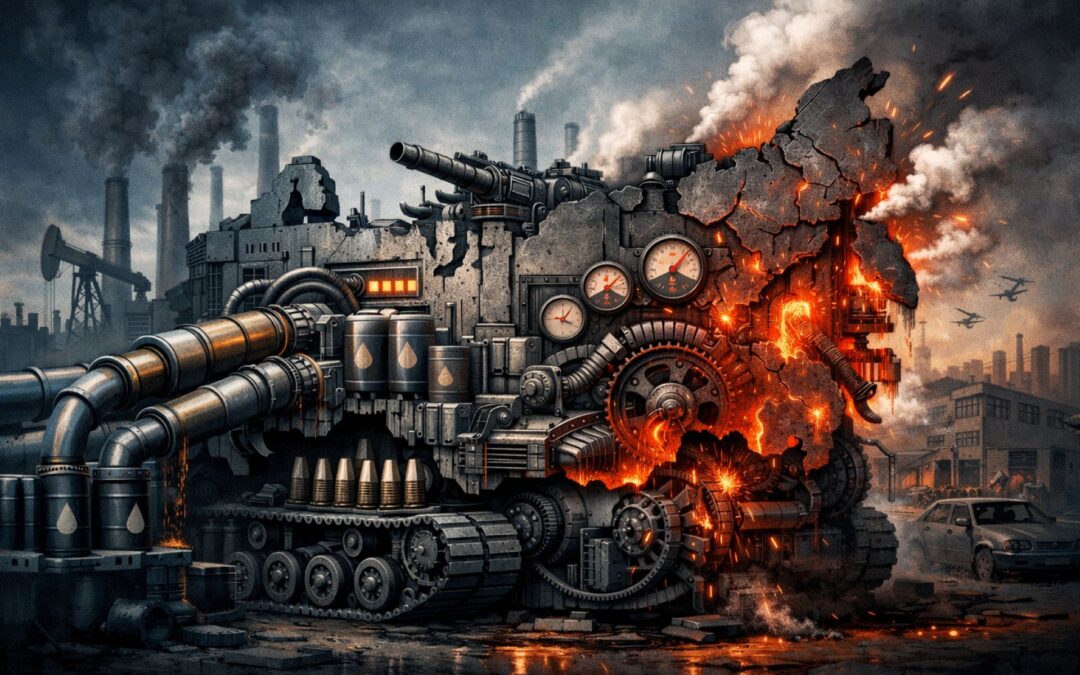
The War That Was Supposed to Be Quick
On February 24, 2022, Russian President Vladimir Putin launched the largest military invasion in Europe since the Second World War. Russian missiles struck Ukrainian cities, armored columns rolled across the border, and the Kremlin expected a swift victory. The objective was straightforward: overthrow Ukraine’s pro-Western government, install a Moscow-friendly leadership, and pull the country firmly back into Russia’s geopolitical orbit.
Western governments responded immediately with what they described as the most comprehensive sanctions regime in modern history. Russian banks were cut off from the global financial system. Key technologies were banned from export. Western companies began exiting the country, and policymakers predicted that Russia’s economy would collapse under the pressure.
But the collapse never came.
Instead, something unexpected happened. Russia’s economy appeared to stabilize—and in some ways even thrive. Energy exports continued flowing to global markets. Government spending surged. Russian GDP growth outpaced that of much of Europe, and daily life inside the country appeared far more normal than many observers had predicted.
To some analysts, this resilience suggested that sanctions had failed and that Russia had successfully insulated itself from Western economic pressure. Moscow seemed to have built a system capable of sustaining a long war while maintaining domestic stability.
Yet beneath the surface, the picture looks far less secure.
The apparent strength of Russia’s wartime economy has been driven by extraordinary levels of government spending, heavy militarization of industry, and continued dependence on volatile energy revenues. These forces have temporarily masked deeper structural weaknesses—rising inflation, labor shortages, declining civilian industries, and growing fiscal pressure.
For the moment, Russia’s war machine continues to run. But the economic engine powering it may be beginning to strain.
The Economic Foundations of Putin’s Russia
To understand how Russia managed to withstand the economic shock of war and sanctions, it is necessary to look at the structure of the economy that Vladimir Putin inherited and reshaped after coming to power.
The collapse of the Soviet Union in 1991 triggered one of the most severe economic contractions in modern history. Under President Boris Yeltsin, Russia adopted a policy known as “shock therapy,” rapidly transitioning from a centrally planned economy to a market-based system. Prices were liberalized almost overnight, state enterprises were privatized, and government controls were dismantled in an attempt to integrate Russia into the global capitalist system.
The results were chaotic.
Industrial production collapsed, GDP fell by roughly half during the 1990s, and millions of Russians saw their savings wiped out by hyperinflation. State institutions weakened, organized crime flourished, and many of the country’s most valuable industries were captured by a small group of politically connected businessmen who became known as oligarchs. For ordinary Russians, the decade was defined by falling living standards, economic insecurity, and widespread social upheaval.
When Vladimir Putin assumed power in 1999, Russia was a country that had lost both its economic stability and its geopolitical influence. His early political project centered on restoring order, rebuilding state authority, and stabilizing the economy.
Fortuitously for Putin, the global energy market soon delivered the conditions needed to accomplish this.
Between the late 1990s and the late 2000s, global oil prices surged dramatically. Russia possessed vast reserves of oil and natural gas, and rising prices transformed these resources into a powerful engine of economic growth. Energy exports poured money into the Russian state, allowing the government to rebuild institutions, pay public-sector wages, and improve living standards.
Over the following decade, Russia’s economy stabilized and began to expand. GDP per capita roughly doubled, government finances improved, and Putin built a political reputation as the leader who had restored stability after the chaos of the 1990s.
Energy exports became the foundation of this system.
Oil and gas revenues accounted for a significant share of Russia’s economy, providing a large portion of government budget revenues and dominating the country’s export earnings. Europe, in particular, became deeply dependent on Russian natural gas supplies through a network of pipelines connecting Siberian energy fields to European markets.
This economic structure shaped the geopolitical strategy of the Russian state. Energy exports not only generated wealth but also created interdependence between Russia and its largest customers. By supplying large quantities of oil and gas to Europe, the Kremlin believed it could make European governments reluctant to impose severe economic retaliation in the event of political conflict.
For years, that strategy appeared to work.
Even as tensions grew between Russia and the West after events such as the 2008 war in Georgia and the 2014 annexation of Crimea, European countries continued purchasing Russian energy. Trade flows remained strong, and Russia retained access to global markets.
By the time the invasion of Ukraine began in 2022, Putin had built an economy that was heavily dependent on natural resources but deeply integrated into global energy markets. Those energy revenues would soon become the financial backbone of Russia’s wartime economy.
How Sanctions Failed to Collapse Russia’s Economy
When Russian troops crossed into Ukraine in 2022, Western governments believed economic pressure could cripple Moscow’s ability to wage war. Sanctions were designed to isolate Russia from global finance, choke off access to advanced technology, and slash the revenues funding the Kremlin’s military machine.
In theory, the strategy seemed powerful. Major Russian banks were cut off from international payment systems, foreign reserves were frozen, and Western companies rapidly withdrew from the Russian market. Export controls targeted critical technologies such as semiconductors and advanced manufacturing equipment.
Many policymakers expected these measures to trigger a rapid financial crisis inside Russia.
But the Russian economy proved far more resilient than anticipated.
One reason was the continued global demand for Russian energy. Prior to the invasion, Europe relied heavily on Russian natural gas, with some countries depending on it for a large share of their energy supply. Even governments that strongly condemned the invasion found it difficult to eliminate Russian imports overnight without triggering severe domestic energy shortages.
As a result, energy exports initially declined far less than expected.
At the same time, Russia quickly redirected large portions of its oil exports toward new buyers. Countries such as India and China dramatically increased their purchases of Russian crude, often buying it at discounted prices compared to global benchmarks. What began as an attempt by the West to isolate Russia instead accelerated a shift in global energy trade toward new markets.
The numbers reflected this adjustment.
Despite sanctions and price caps, Russian fossil fuel exports remained remarkably strong in the early years of the war. Rising global energy prices helped offset the discounts Russia offered to attract new buyers, allowing export revenues to surge. In the first year of the conflict alone, Russian fossil fuel revenues increased sharply, providing hundreds of billions of dollars in income for the state.
These revenues became the financial lifeline of the Russian government.
Oil and gas sales funded public spending, stabilized the national currency, and ensured that the Kremlin had the resources necessary to continue prosecuting the war. Instead of collapsing under sanctions, Russia maintained enough cash flow to keep its economy functioning and its military supplied.
This outcome surprised many Western analysts who had predicted a rapid economic breakdown.
However, the survival of Russia’s economy did not mean that sanctions were irrelevant. Rather, they forced the Kremlin to restructure its economic relationships and rely even more heavily on a narrow set of industries—particularly energy and defense.
In other words, Russia avoided immediate economic collapse, but the structure of its economy became increasingly distorted. The system was now heavily dependent on two pillars: continued energy exports and rapidly expanding wartime spending.
The Wartime Economic Boom
Paradoxically, the war that was expected to destroy Russia’s economy initially helped fuel its growth.
Once it became clear that the invasion of Ukraine would not end quickly, the Kremlin shifted its economic strategy toward sustaining a long war. The government dramatically increased spending, mobilized industry, and redirected financial resources toward the military sector. These policies produced a surge in economic activity that, on the surface, made the Russian economy appear surprisingly strong.
Government spending rose sharply as the state poured money into the defense sector. Military expenditures jumped dramatically in the first year of the war and have continued climbing since. Overall government spending increased substantially as Moscow funded weapons production, military logistics, and the broader industrial base required to sustain the conflict.
This flood of public spending acted as a powerful stimulus for the economy.
Factories expanded their operations, industrial output increased, and employment in defense-related sectors surged. Companies producing weapons, ammunition, and military equipment received large government contracts, while banks were encouraged—sometimes pressured—to provide credit to defense and industrial firms.
The result was a wartime economic boom.
Measured by traditional indicators such as GDP growth and industrial output, the Russian economy appeared to be performing well. Government spending drove investment, wages increased in key sectors, and unemployment remained low. To outside observers, the economy looked far healthier than many had predicted in the early days of the invasion.
But this growth was fundamentally different from normal economic expansion.
Instead of being driven by consumer demand, innovation, or private investment, much of the growth came directly from government spending on war production. The economy was increasingly organized around military priorities rather than civilian prosperity.
War Spending as Economic Stimulus
In many ways, Russia’s wartime spending functioned like a massive economic stimulus program.
When governments dramatically increase spending—especially on manufacturing and industrial production—it can boost economic activity in the short term. Workers are hired, factories increase output, and suppliers benefit from the increased demand for materials and equipment.
Russia’s defense sector became the center of this process. Arms factories expanded production lines, defense contractors hired more workers, and entire supply chains mobilized to support the military effort. In some regions, the war economy created a surge in employment and higher wages for workers connected to defense industries.
These dynamics helped explain why Russia’s GDP growth remained positive despite sanctions and international isolation.
The Militarization of Russian Industry
However, this economic boom came with a significant structural shift.
More and more of Russia’s industrial capacity began to serve the military. Factories that once produced civilian goods were redirected toward the production of weapons, vehicles, and military equipment. State banks and government programs prioritized lending to defense industries, ensuring that the military-industrial complex received the resources it needed.
At the same time, other sectors of the economy began to stagnate.
Industries producing consumer goods, household appliances, and automobiles struggled with shortages of imported components, falling investment, and declining demand. While the defense sector expanded rapidly, large parts of the civilian economy started to slow.
In effect, Russia’s economic growth was becoming increasingly dependent on the war itself.
The military-industrial complex was operating at full capacity, fueled by massive state spending. But beneath the surface, the economy was beginning to tilt heavily toward a wartime footing—one that could mask serious underlying weaknesses.
The Hidden Cracks in Russia’s Economy
The surge in government spending and defense production helped Russia avoid the economic collapse that many observers predicted. But beneath the headline growth numbers, the structure of the Russian economy has become increasingly fragile.
A war-driven economy can generate impressive short-term statistics, yet it often creates deep imbalances. Resources become concentrated in the military sector, government spending distorts markets, and inflationary pressures begin to build. Over time, these pressures start to reveal the limits of wartime growth.
That is increasingly the situation Russia now faces.
One of the clearest warning signs is inflation. Massive government spending combined with labor shortages has pushed wages upward across key sectors of the economy. As factories compete with the military for workers, salaries have risen rapidly, which in turn drives up the cost of goods and services.
This dynamic has created what economists call a wage–price spiral. Workers demand higher wages to keep up with rising prices, businesses raise prices to cover rising labor costs, and the cycle continues. Inflation climbed significantly as the war economy expanded, forcing the Russian central bank to intervene aggressively.
To stabilize the currency and slow price increases, the central bank raised interest rates to extremely high levels. These rate hikes helped support the ruble and limit inflation, but they also created a new problem: borrowing became dramatically more expensive for businesses and households.
High interest rates act as a brake on economic activity. Companies delay investment, consumers reduce spending, and credit becomes harder to obtain. While the military sector continued to receive government support, many civilian industries suddenly found themselves facing tighter financial conditions.
Inflation and the Wage–Price Spiral
The combination of labor shortages and massive government spending has placed enormous pressure on the labor market.
Hundreds of thousands of Russian men have been mobilized into the military or associated defense industries. At the same time, many younger and highly skilled workers—particularly in sectors such as technology and engineering—have left the country since the war began.
With fewer workers available, companies are forced to compete aggressively for labor. Wages have risen rapidly in some sectors as employers try to attract and retain employees. While higher wages can benefit workers in the short term, they also feed directly into rising prices across the economy.
To combat this inflationary pressure, the Russian central bank has pushed interest rates to unusually high levels by global standards. These policies may help control inflation, but they also risk slowing the broader economy.
The Shrinking Civilian Economy
While the defense sector has expanded rapidly, large parts of Russia’s civilian economy have been moving in the opposite direction.
Manufacturing industries not connected to the war effort have faced falling production, limited access to imported technology, and declining investment. Some sectors have experienced significant drops in output as resources are redirected toward military priorities.
Industries producing consumer goods have been particularly affected. Production of items such as automobiles and household appliances has declined significantly in recent years, reflecting both supply chain disruptions and shifting industrial priorities.
The result is an increasingly uneven economic landscape.
On one side, the military-industrial complex is operating at full speed, fueled by government contracts and wartime demand. On the other, much of the civilian economy is stagnating or shrinking as labor, capital, and state support are pulled toward the war effort.
In effect, Russia’s economy is beginning to resemble a classic wartime system—one in which military production expands while civilian economic life gradually contracts.
The Energy Lifeline Keeping the War Machine Running
Despite sanctions, inflation, and the growing strain on the civilian economy, Russia still possesses one enormous advantage: energy.
Oil and natural gas remain the financial backbone of the Russian state. These resources generate a large share of the country’s export earnings and provide a substantial portion of government revenues. As long as these flows continue, the Kremlin retains the ability to finance its military operations and support the broader wartime economy.
In the early months of the war, many Western policymakers believed that sanctions on Russian energy would severely damage this system. However, the global nature of energy markets made it extremely difficult to fully isolate one of the world’s largest producers.
Even as Europe attempted to reduce its dependence on Russian fossil fuels, global demand for oil and gas remained strong. Energy traders quickly found alternative routes and buyers for Russian supplies. Rather than disappearing from global markets, Russian oil simply began flowing to different destinations.
India became one of the most important new customers. Prior to the invasion, India purchased relatively little Russian crude. After the war began, however, Indian refiners dramatically increased imports, attracted by the discounted prices Russia offered in order to bypass Western sanctions.
China also expanded its purchases. Already a major buyer of Russian energy before the war, China increased imports further as Moscow sought to deepen economic ties with Asian markets.
Together, these countries helped absorb much of the oil that Europe once purchased.
This shift did not eliminate the impact of sanctions entirely. Russia often had to sell its oil at discounted prices compared to global benchmarks, and transportation costs increased as shipments traveled longer distances to Asian markets. Nevertheless, the sheer volume of exports meant that energy revenues continued to pour into the Russian state.
For the Kremlin, these revenues have been indispensable.
Energy exports fund a significant portion of the federal budget and provide the financial resources necessary to sustain the war effort. They support military spending, social programs, and the broader government apparatus that keeps the Russian economy functioning.
In many ways, the resilience of Russia’s wartime economy can be traced back to this single factor: the continued ability to sell oil and gas to the rest of the world.
As long as global energy markets remain open to Russian exports, the country retains a powerful financial lifeline. That lifeline has allowed Moscow to withstand sanctions, maintain government spending, and keep the war machine running.
But this dependence on energy also exposes Russia to a critical vulnerability—one that becomes apparent when global oil prices begin to fall.
The Oil Price Problem
Russia’s reliance on energy exports does more than sustain its wartime economy—it also exposes the country to one of its greatest financial vulnerabilities: the global price of oil.
Oil revenues form a central pillar of the Russian government’s finances. A large share of federal budget income comes directly from taxes and duties on oil and gas exports. When prices are high, the Kremlin collects more revenue and can spend more freely. When prices fall, the government’s financial position can deteriorate quickly.
To manage this risk, the Russian government builds its annual budget around a projected oil price. These forecasts determine how much the state expects to earn and how much it can afford to spend on everything from public wages to military operations.
However, this system becomes fragile when market prices diverge from those projections.
If global oil prices fall significantly below the level assumed in the budget, government revenues can drop sharply. This creates larger fiscal deficits and forces the state to either cut spending, borrow more money, or draw down financial reserves.
That risk has become increasingly relevant during the war.
Russia’s main export blend, known as Urals crude, typically trades at a discount compared to global benchmark prices. Sanctions and price caps have widened that discount, meaning Russia earns less per barrel than many other producers. When global oil prices decline, the impact on Russian revenues is therefore amplified.
Even relatively modest price declines can create large budget shortfalls.
At the same time, Russia’s spending obligations have risen dramatically. The war in Ukraine has required massive military expenditures, increased support for defense industries, and higher payments to soldiers and their families. Government spending across the economy has surged as the state attempts to maintain stability during wartime.
The result is a growing mismatch between revenue and expenditure.
If oil prices remain high, Russia can continue financing its war economy without immediate crisis. But if prices fall for a sustained period, the government’s financial position could deteriorate rapidly. Budget deficits would widen, forcing the Kremlin to rely more heavily on borrowing or financial reserves.
This dependence on energy prices means that Russia’s wartime economic resilience ultimately rests on forces largely beyond its control: global commodity markets.
And those markets can be unpredictable.
While short-term price spikes may temporarily boost revenues, longer-term trends—such as slower global growth, increased energy supply, or shifts in energy demand—could place sustained pressure on Russia’s finances.
For a country whose war machine is powered by oil revenue, a prolonged drop in prices could become a serious strategic problem.
Russia’s Shrinking Financial Buffer
For years, Russia attempted to protect itself from volatile energy markets by building financial reserves. During periods of high oil prices, the government saved a portion of its energy revenues in sovereign wealth funds, creating a financial cushion that could be used during economic downturns.
The most important of these reserves is the National Wealth Fund.
The purpose of the fund is simple: when oil revenues exceed the level required for the government’s budget, the surplus is saved. When revenues fall short—such as during a recession or a drop in oil prices—the government can draw from these savings to stabilize the economy and cover budget deficits.
This strategy helped Russia weather previous economic shocks.
During earlier crises, including the global financial crisis and periods of falling oil prices, the government used these reserves to support the currency, fund public spending, and prevent severe fiscal instability. The existence of these financial buffers was one reason many economists believed Russia could endure the economic pressures created by sanctions and war.
And in the early stages of the conflict in Ukraine, the National Wealth Fund played exactly that role.
As government spending surged and economic uncertainty increased, the Kremlin relied on these reserves to help cover deficits and maintain financial stability. The fund effectively acted as a shock absorber, allowing the state to continue spending heavily without immediately resorting to large-scale borrowing or austerity.
But the size of that buffer has been shrinking.
As the war has continued, the liquid portion of the National Wealth Fund—the part that can be easily accessed and spent—has declined steadily. These funds have been used to stabilize the economy, support government spending, and offset fluctuations in energy revenues.
The longer the war lasts, the more pressure this creates on Russia’s financial reserves.
Unlike oil revenues, which depend on global markets, sovereign wealth funds are finite. Every time the government taps these reserves to cover deficits, the remaining buffer becomes smaller. Over time, this reduces the state’s ability to respond to future economic shocks.
If the liquid assets of the fund were to fall significantly further, the Kremlin would face a more difficult financial environment.
Without a substantial reserve cushion, the government would have fewer options to stabilize the economy if oil revenues decline or spending pressures increase. It would be forced to rely more heavily on borrowing, raising taxes, cutting spending, or expanding monetary financing—all of which carry their own economic risks.
For now, Russia still possesses enough financial resources to sustain its wartime economy. But the gradual erosion of its reserves suggests that the country’s financial safety net is becoming thinner.
And as that buffer shrinks, the long-term sustainability of Russia’s war economy becomes increasingly uncertain.
What This Means for the War in Ukraine
The economic pressures building inside Russia do not necessarily translate into immediate changes on the battlefield. In the short term, the Kremlin still possesses enough resources to continue financing the war in Ukraine.
Russia retains large energy reserves, a functioning industrial base, and a government that is willing to prioritize military spending above almost everything else. The state continues to direct resources toward weapons production, military salaries, and logistical support for the armed forces. As long as these priorities remain unchanged, the Russian war effort can continue even if other parts of the economy weaken.
In fact, wartime governments often tolerate economic inefficiencies and declining living standards in order to sustain military operations. Economic stability and balanced growth are no longer the primary objectives. Victory—or at least the avoidance of defeat—becomes the overriding priority.
This appears to be the logic guiding Moscow’s current strategy.
The Russian government has shown a willingness to sacrifice civilian economic performance in order to maintain the war machine. Resources are being concentrated in defense industries, government spending continues to rise, and the state remains committed to financing the conflict even as economic imbalances grow.
For now, this strategy can work.
Energy revenues continue to provide the financial backbone of the state, and the government still has access to domestic borrowing and remaining financial reserves. These tools allow the Kremlin to cover deficits, support defense industries, and maintain the economic activity required to sustain the war.
However, the long-term picture is far more uncertain.
Wars of attrition are not decided solely by military strength on the battlefield. They are also shaped by economic endurance. The ability to sustain production, maintain financial stability, and preserve domestic political support becomes increasingly important as conflicts drag on.
If Russia’s economic pressures continue to intensify—through falling energy revenues, shrinking reserves, or declining civilian output—the state may eventually face harder choices. Financing the war could require deeper borrowing, higher inflation, or further reductions in living standards for the population.
These pressures do not automatically lead to political instability. Authoritarian governments can often maintain control even during prolonged economic hardship. But they can gradually erode the foundations of public support that many leaders rely on to maintain legitimacy.
For Vladimir Putin, whose political authority has long been tied to stability and rising living standards, a prolonged economic slowdown could become a significant challenge.
In the short term, Russia’s war machine still has enough fuel to keep running. In the long term, the sustainability of that system may depend on whether the country’s economic foundations can withstand the pressures of a prolonged conflict.
The Long-Term Future of Russia’s War Economy
The longer the war continues, the more Russia’s economy is being reshaped around the demands of military conflict. What began as a resource-based economy integrated into global markets is gradually transforming into a heavily militarized system dominated by defense production, state spending, and energy exports.
Such systems can survive for extended periods, but they rarely produce sustained prosperity.
One of the most significant long-term risks facing Russia is the gradual erosion of its civilian economic base. As more labor, capital, and government resources are directed toward the military-industrial complex, fewer resources remain available for innovation, consumer industries, and long-term economic development.
This shift can slow productivity growth and reduce the economy’s ability to diversify beyond natural resources.
At the same time, Russia faces serious demographic and labor challenges. The war has removed large numbers of working-age men from the civilian labor force, while hundreds of thousands of skilled professionals have left the country since the invasion began. This loss of human capital could weigh heavily on economic performance in the years ahead.
Sanctions also continue to limit access to advanced technology and international investment.
While Russia has managed to adapt by sourcing components through alternative channels and building closer economic ties with non-Western countries, long-term technological isolation could gradually weaken key sectors of the economy. Industries that rely on sophisticated machinery, advanced electronics, or global supply chains may struggle to maintain competitiveness over time.
Meanwhile, the country’s continued dependence on oil and gas revenues leaves it vulnerable to fluctuations in global commodity markets. Energy exports can generate enormous wealth during periods of high prices, but they also create instability when prices fall or demand shifts.
For Russia, this dependence means that its economic future remains closely tied to forces beyond its direct control.
In the short term, the Kremlin can continue sustaining the war economy through government spending, energy revenues, and financial reserves. But over the longer horizon, these mechanisms may become increasingly difficult to maintain.
Economic growth driven by wartime production, rising public spending, and resource exports can only go so far before structural limits begin to emerge. As the civilian economy weakens, inflation pressures persist, and financial buffers decline, the system that has supported Russia’s war effort may face growing strain.
For now, the Russian war machine continues to operate.
But the deeper economic currents beneath it suggest that the foundations supporting that system are gradually becoming more fragile.