
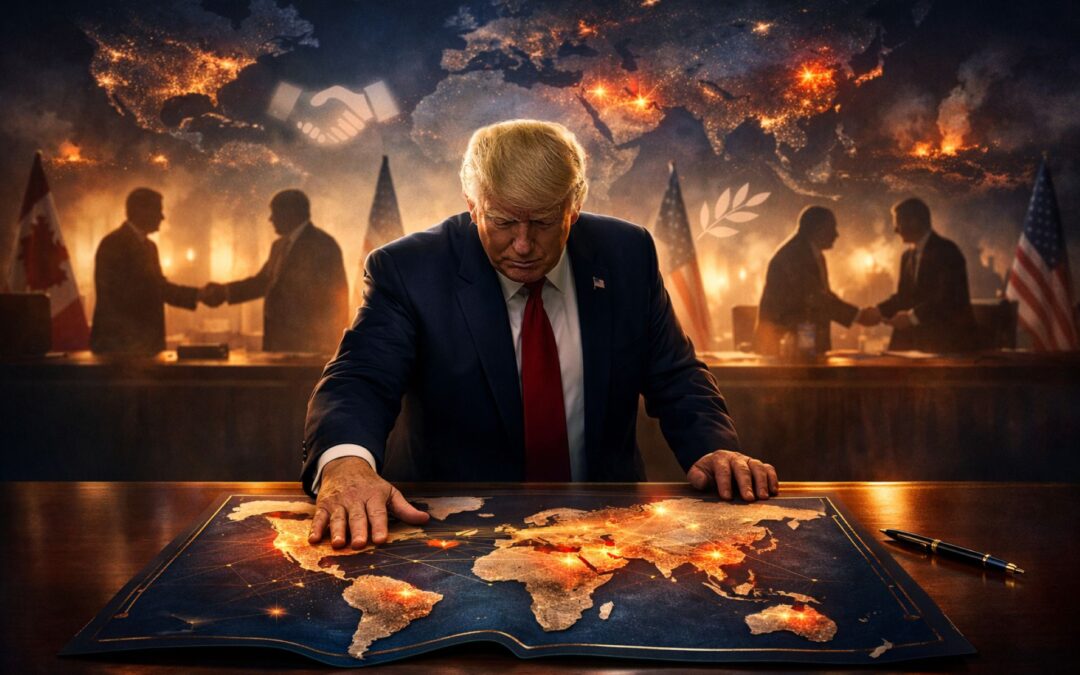
Introduction: The Peacemaker President
Pakistan. Serbia. The Congo. Thailand. Iran.
These places are scattered across continents, separated by culture, geography, and history. Yet in recent months they have been linked together by one striking claim: that Donald Trump personally stopped wars between them.
Supporters say Trump’s unconventional diplomacy has transformed him into one of the world’s most effective peacemakers. Some have even argued that he deserves the ultimate recognition for his efforts — the Nobel Peace Prize.
Trump himself has leaned into that narrative. He has repeatedly claimed that his leadership has ended or prevented multiple wars across the globe, presenting himself as a dealmaker capable of resolving conflicts that have frustrated diplomats for decades.
But bold claims invite scrutiny.
When we examine these supposed peace achievements one by one, a more complicated picture begins to emerge. Some of the conflicts Trump says he ended were never wars to begin with. Others were already largely settled before American diplomacy stepped in. In several cases, what Trump describes as historic peace agreements are actually fragile ceasefires that leave the root causes of conflict unresolved.
Yet dismissing these efforts entirely would also miss an important point.
Trump’s diplomacy reveals something significant about how American power is changing in the twenty-first century. His approach is transactional, theatrical, and often unpredictable. Sometimes it produces real results. Other times it produces little more than headlines.
Understanding what Trump actually accomplished — and what he didn’t — tells us less about a single politician and more about the evolving nature of global diplomacy in an increasingly unstable and multipolar world.
Trump’s Foreign Policy Philosophy
To understand why Trump presents himself as a global peacemaker, it helps to understand the worldview that has shaped his approach to foreign policy.
Unlike many American presidents of the post–Cold War era, Donald Trump did not rise to power through the traditional foreign policy establishment. He did not come from the military, the diplomatic corps, or decades of congressional committee work. Instead, he entered politics as a businessman whose understanding of international relations was shaped by negotiation, leverage, and public perception.
This background heavily influenced the philosophy behind his foreign policy.
America First and Skepticism of Foreign Wars
A central pillar of Trump’s political identity has been his criticism of long-running American military interventions. During his presidential campaigns, he repeatedly attacked the wars in Iraq and Afghanistan as costly mistakes that drained American resources without delivering clear strategic victories.
This position resonated with a growing segment of the American public that had become deeply skeptical of interventionist foreign policy. For decades, the United States had attempted to reshape regions through military force and nation-building projects. By the late 2010s, many voters believed these efforts had produced endless conflicts rather than lasting stability.
Trump positioned himself as the candidate who would break with that tradition.
Under his “America First” doctrine, the United States would reduce its role as the world’s policeman and instead focus on protecting its own economic and strategic interests. In theory, this approach emphasized diplomacy, economic pressure, and selective engagement over prolonged military commitments.
However, that did not mean withdrawing from global affairs altogether. Rather, it meant engaging with the world on very different terms.
The “Art of the Deal” Applied to Diplomacy
Trump often approaches international conflicts the same way he approaches business negotiations: as deals waiting to be made.
In this framework, diplomacy becomes less about long-term institutional processes and more about leverage, incentives, and pressure. Tariffs, sanctions, trade access, and political prestige become bargaining chips that can be used to force rival governments toward negotiations.
This style also relies heavily on unpredictability. Traditional diplomacy often values consistency and carefully crafted messaging. Trump’s approach instead embraces disruption. Sudden threats, dramatic announcements, and personal interventions are used to shift negotiating dynamics.
Supporters argue that this strategy can break diplomatic stalemates by forcing entrenched actors to reconsider their positions. Critics counter that it often prioritizes short-term spectacle over the patient, detailed work required to resolve deep-rooted conflicts.
This tension lies at the heart of Trump’s claims about ending wars.
His diplomacy can sometimes create dramatic moments—ceasefires, summits, and high-profile agreements—but the real test of peacemaking is whether those moments translate into durable political settlements.
Separating Myth From Reality
Trump’s claim to have ended seven wars sounds dramatic. But dramatic claims require careful evaluation.
When politicians talk about peace, they often blur together very different things: temporary ceasefires, symbolic agreements, diplomatic meetings, and genuine peace settlements. In reality, ending a war is rarely a single moment. It is usually a long process involving negotiations, enforcement mechanisms, and political compromises that unfold over years.
To judge Trump’s claims fairly, it helps to apply a simple framework.
The Three Questions That Matter
For each alleged peace achievement, three basic questions need to be answered.
First, was there actually a war or armed conflict taking place?
Some international disputes involve intense rhetoric and political tensions without ever escalating into open warfare.
Second, did the conflict truly end?
Stopping a short round of fighting is not the same thing as resolving the underlying dispute. Many ceasefires simply freeze conflicts in place rather than settling them.
Third, did Trump play a decisive role in stopping the conflict?
Wars end for many reasons: battlefield outcomes, internal political changes, or regional diplomacy. A White House ceremony or announcement does not necessarily mean the United States caused the outcome.
Only if all three questions produce clear “yes” answers can a leader reasonably claim to have ended a war.
Once we apply this test, Trump’s seven claimed victories begin to fall into distinct categories.
Three Types of Diplomatic Claims
Across the cases Trump cites, his supposed peace deals generally fall into three groups.
The first category includes conflicts that were never wars in the first place. In these cases, Trump presents diplomatic engagement around political disputes as though it were the resolution of active military conflict.
The second category involves exaggerated achievements. Here, Trump may have helped facilitate negotiations or encouraged ceasefires, but the deeper conflict remains unresolved.
The third category contains genuine diplomatic successes, where American pressure or mediation appears to have played a meaningful role in stopping real violence.
Understanding these distinctions is crucial. Without them, it becomes easy to confuse short-term diplomatic theater with the far more difficult task of actually ending wars.
Conflicts That Never Really Existed
Some of the wars Trump claims to have ended share a simple problem: they were never wars to begin with.
International politics is full of disputes, tensions, and rivalries. Governments argue over borders, resources, and political recognition all the time. But these disputes only become wars when they escalate into sustained armed conflict.
In several of Trump’s supposed peace victories, that escalation never actually happened.
Egypt and Ethiopia: A Dispute, Not a War
One of the most puzzling examples involves tensions between Egypt and Ethiopia.
The dispute centers around the massive Grand Ethiopian Renaissance Dam, one of the largest hydroelectric projects ever built in Africa. Ethiopia views the dam as essential for its economic development, providing electricity to millions of people and transforming its energy infrastructure.
Egypt, however, depends heavily on the Nile River for its water supply and fears that the dam could significantly reduce downstream water flow. For Cairo, the Nile is not merely an economic resource but a matter of national survival.
This disagreement has produced years of heated diplomatic exchanges and negotiations involving Ethiopia, Egypt, and Sudan. At times, Egyptian officials have issued strong warnings about protecting their water rights.
But despite the political tensions, the dispute has never escalated into a military conflict.
Trump did host negotiations during his presidency aimed at reaching an agreement on how the dam would be filled and managed. However, those talks ultimately failed to produce a binding deal.
In other words, there was no war to stop—and no peace agreement to claim.
Serbia and Kosovo: Old Tensions, No New War
A similar issue appears in Trump’s claim to have resolved tensions between Serbia and Kosovo.
The relationship between the two countries has been strained since the breakup of Yugoslavia in the 1990s. The conflict culminated in the Kosovo War, which ended after a military intervention by NATO forced Serbian forces to withdraw.
Kosovo later declared independence from Serbia in 2008, a move recognized by many Western countries but still rejected by Serbia and several others.
Since then, tensions have periodically flared along ethnic and political lines, particularly in northern Kosovo where many ethnic Serbs live. Border incidents, protests, and political disputes have occurred repeatedly.
But there has been no large-scale war between Serbia and Kosovo for more than two decades.
What Trump often points to is a 2020 agreement signed at the White House focused on economic normalization between the two sides. The deal included commitments to improve economic cooperation and temporarily pause diplomatic campaigns related to Kosovo’s international recognition.
While symbolically important, the agreement did not resolve the central issue at the heart of the dispute: whether Kosovo is a sovereign state or Serbian territory.
The underlying political conflict remains exactly where it has been for years—unresolved and occasionally volatile.
Peace After the War Was Already Won
In other cases, Trump points to real conflicts that did eventually produce agreements or diplomatic ceremonies. The problem is that the decisive moment in those wars had already occurred long before American diplomacy entered the picture.
Instead of ending the conflict itself, Trump’s involvement often amounted to recognizing the outcome that had already been determined on the battlefield.
Armenia and Azerbaijan: Recognition of a Military Reality
One example is the long-running conflict between Armenia and Azerbaijan over the disputed region of Nagorno-Karabakh.
The roots of this conflict stretch back to the collapse of the Soviet Union. Nagorno-Karabakh was internationally recognized as part of Azerbaijan but had a large ethnic Armenian population that sought to join Armenia. As the Soviet Union disintegrated in the late 1980s and early 1990s, tensions exploded into a brutal war.
Armenian forces ultimately gained control of the region and surrounding territories, establishing a de facto Armenian-backed administration. Although the fighting ended with a ceasefire in the mid-1990s, the dispute remained unresolved for decades, periodically erupting into violence.
The balance of power shifted dramatically in 2020.
Azerbaijan, bolstered by stronger finances, advanced military technology, and support from regional allies, launched a major offensive that reclaimed significant territory. A ceasefire ended the fighting, but tensions continued until 2023 when Azerbaijan launched another offensive that decisively crushed the remaining Armenian-backed authorities in the region.
The Armenian population fled and the separatist government effectively dissolved.
By the time diplomatic ceremonies took place in Washington in 2025, the fundamental outcome of the conflict had already been determined. Azerbaijan had won the war and Armenia had been forced to accept the new reality on the ground.
The agreement celebrated at the White House largely formalized that outcome. It included economic arrangements and transportation corridors designed to stabilize relations, but it did not create the decisive shift that ended the conflict.
That shift had already happened on the battlefield.
In this sense, Trump’s role resembled that of a political notary—putting an official stamp on a settlement that military events had already decided.
Ceasefires Mistaken for Lasting Peace
In several of the conflicts Trump cites as diplomatic victories, there was indeed real violence and real danger. But the agreements that followed did not resolve the underlying disputes. Instead, they temporarily halted fighting while leaving the deeper causes of the conflict intact.
This distinction matters. A ceasefire can stop bloodshed in the short term, but without political settlement it often becomes nothing more than a pause before the next round of violence.
Rwanda and the Democratic Republic of Congo
The conflict in eastern Democratic Republic of the Congo is one of the most complex and persistent security crises in the world.
For decades, the mineral-rich eastern provinces of Congo have been plagued by armed militias competing for territory, resources, and political influence. The region contains vast deposits of cobalt, coltan, and other minerals critical to modern electronics and energy technologies, making it both economically valuable and politically unstable.
One of the most significant developments came when the rebel group M23 launched a major offensive and captured large areas of territory, including important urban centers. The group has widely been accused by international observers of receiving support from neighboring Rwanda, which Rwanda denies.
In 2025, a ceasefire agreement known as the Washington Accord was signed under American mediation. The deal called for the withdrawal of Rwandan forces from eastern Congo and for both governments to end support for rebel groups operating across their borders.
On paper, the agreement looked like a breakthrough.
In reality, the violence never truly stopped. Reports from humanitarian organizations and international observers indicated that fighting continued in the region soon after the agreement was announced. Civilian casualties persisted, and rebel groups remained active across large parts of eastern Congo.
In other words, the ceasefire reduced tensions temporarily but did not resolve the deeper political and economic forces driving the conflict.
India and Pakistan: Preventing Escalation
The confrontation between India and Pakistan presents a different kind of case.
The two countries have been rivals since the partition of British India in 1947, when the departing colonial administration divided the subcontinent into two new states along religious lines. The process triggered one of the largest migrations in human history and unleashed devastating communal violence.
The most dangerous flashpoint in their rivalry has always been the region of Kashmir, which both countries claim in full but control only in part.
In 2025, tensions escalated sharply after a deadly attack in Kashmir prompted India to launch airstrikes on targets in Pakistan that it described as terrorist infrastructure. Pakistan responded with military action of its own, raising fears that the crisis could spiral into a broader conflict between two nuclear-armed states.
Trump later announced that a ceasefire had been achieved with American involvement.
While it is plausible that U.S. diplomatic pressure helped de-escalate the crisis, the ceasefire did not solve the underlying dispute over Kashmir. The territorial conflict remains unresolved, and both governments continue to maintain strong military forces along the Line of Control.
The agreement therefore prevented escalation rather than ending the conflict itself.
Israel and Iran: Ending a Phase of Direct Conflict
The relationship between Israel and Iran has been one of the central rivalries shaping Middle Eastern geopolitics for decades.
Since the Iranian Revolution of 1979, the two countries have viewed each other as existential threats. Iran has supported proxy groups across the region—including Hezbollah in Lebanon and Hamas in Gaza—while Israel has conducted covert and military operations aimed at limiting Iran’s regional influence and nuclear ambitions.
In 2024, tensions escalated into direct confrontation when both countries launched strikes against each other’s territory and interests.
Under American mediation, a ceasefire was eventually reached that halted this phase of direct hostilities. Trump claimed credit for ending the conflict between the two long-time adversaries.
However, describing this outcome as “peace” stretches the definition considerably.
The strategic rivalry between Iran and Israel remains fully intact. Iran continues to support regional proxy groups hostile to Israel, while Israel continues to treat Iran’s nuclear program as a major security threat.
The ceasefire stopped immediate escalation, but the broader confrontation between the two states continues to shape the Middle East.
A Genuine Diplomatic Success
Amid the exaggerations and questionable claims, there is at least one case where Trump’s diplomacy appears to have played a clear and meaningful role in stopping a real conflict.
That example lies in Southeast Asia.
Cambodia and Thailand: Trade Leverage as Peacemaking
The dispute between Thailand and Cambodia has simmered for years over sections of their shared border. These tensions often revolve around contested territory near historic temple sites and poorly defined boundary lines left over from colonial-era mapping.
While most of the time these disagreements remain contained, they occasionally flare into violence.
In 2025, the situation escalated sharply after a border skirmish between Thai and Cambodian troops triggered rising political tensions. What began as a limited confrontation soon grew into several days of sustained fighting along parts of the frontier.
The clashes left dozens dead and displaced hundreds of thousands of civilians as both countries mobilized forces and blamed each other for the escalation.
At this point, the United States stepped in.
Donald Trump publicly pressured both governments to enter negotiations, warning that ongoing hostilities could jeopardize trade relations with the United States.
This threat carried real weight.
The U.S. is the largest export market for Cambodia and one of the most important trade partners for Thailand. Both countries depend heavily on American markets for manufacturing exports, making tariffs or trade restrictions a serious economic risk.
Shortly after these warnings, both governments agreed to negotiations.
A ceasefire was announced, and the fighting subsided. Later that year, the two sides signed a broader peace agreement during regional diplomatic meetings, outlining mechanisms to reduce border tensions and improve cooperation.
Unlike many of Trump’s other claims, this case contains the key elements of genuine diplomatic intervention:
There was an active military conflict.
Negotiations followed external pressure.
And the agreement helped produce a sustained reduction in hostilities.
Trump’s leverage came not from traditional diplomatic mediation, but from economic pressure. By linking peace negotiations to trade access, he used America’s economic power as a bargaining tool.
Whether this agreement ultimately proves durable remains to be seen. Border disputes have a habit of resurfacing.
But in this instance, Trump’s unconventional approach appears to have produced a real diplomatic breakthrough.
The Bonus Case: Israel and Hamas
Although it was not one of the seven conflicts Trump claimed to have resolved, the ceasefire between Israel and Hamas offers another example of his diplomatic approach in action.
The war in Gaza had already dragged on for nearly two years, leaving tens of thousands dead and much of the region devastated. The conflict began after Hamas launched the massive October 7 attacks against Israel, triggering a large-scale Israeli military campaign in the Gaza Strip.
By 2025, both sides had suffered heavy losses and international pressure for a ceasefire was growing.
At this point, Donald Trump stepped in to push for negotiations aimed at halting the violence and securing the release of hostages.
The resulting agreement included several important provisions. Hamas agreed to release a number of remaining Israeli hostages and return the bodies of others killed during the conflict. In return, Israel released hundreds of Palestinian prisoners and detainees and began pulling troops back from some areas of Gaza.
The deal also laid out a broader framework for a temporary governance arrangement in Gaza while negotiations continued over the territory’s long-term political future.
Even critics of Trump’s foreign policy acknowledged that his pressure on Israeli leadership played a role in pushing the negotiations forward. The ceasefire was far from a final peace agreement, but it succeeded in ending a particularly intense phase of fighting and addressing the immediate hostage crisis.
Yet the limitations of the deal were immediately clear.
Fundamental questions about the future of Gaza remained unresolved. The role of Hamas in the territory, the possibility of its disarmament, and the broader structure of Palestinian governance all remained open issues. Meanwhile, Israeli leaders continued to view Hamas as a long-term security threat.
The ceasefire therefore represented a temporary pause rather than a permanent settlement.
Still, achieving even that level of progress in one of the world’s most entrenched conflicts was a significant diplomatic moment. It demonstrated Trump’s ability to apply political pressure in pursuit of short-term breakthroughs—even if those breakthroughs fell short of lasting peace.
Trump’s Unconventional Style of Diplomacy
Looking across all of these cases, a clear pattern emerges. Trump’s diplomacy operates very differently from the traditional approach followed by most American presidents and professional diplomats.
Rather than relying primarily on long negotiations, multilateral institutions, and carefully structured peace processes, Donald Trump tends to favor dramatic interventions, economic leverage, and personal pressure on leaders.
This approach has both advantages and serious limitations.
Strength Through Unpredictability
One of Trump’s most distinctive diplomatic tools is unpredictability.
Traditional diplomacy values consistency and stable signaling. Governments carefully coordinate their messaging to avoid misunderstandings that could escalate tensions. Trump often does the opposite. He issues sudden threats, makes bold public claims, and inserts himself personally into negotiations.
Supporters argue that this unpredictability can actually be useful. By disrupting established diplomatic routines, Trump sometimes forces governments to reconsider their positions. Leaders who might otherwise drag negotiations out for months or years can suddenly feel pressure to reach an agreement.
His willingness to use economic tools in particular—such as tariffs, trade access, or sanctions—creates leverage that can move negotiations forward quickly.
In the Cambodia–Thailand case, for example, the threat of tariffs appears to have played a significant role in pushing both countries toward a ceasefire.
From this perspective, Trump’s diplomacy resembles high-stakes dealmaking more than traditional statecraft.
The Limits of Transactional Diplomacy
At the same time, ending wars requires more than dramatic announcements or temporary deals.
Lasting peace usually depends on detailed agreements covering security arrangements, political power-sharing, territorial disputes, economic reconstruction, and enforcement mechanisms. These negotiations often take years and involve complex compromises that must be maintained long after the cameras leave.
This is where Trump’s approach often runs into its limits.
His diplomacy tends to focus on the moment of the deal rather than the long-term process required to sustain it. Ceasefires, summit meetings, and headline-grabbing announcements can create the impression of rapid progress, but they do not necessarily resolve the deeper causes of conflict.
Many of the conflicts Trump claims to have solved—from Kashmir to eastern Congo to the rivalry between Israel and Iran—remain fundamentally unchanged beneath the surface.
In this sense, Trump’s diplomacy excels at producing breakthroughs in the short term but struggles to deliver the patient, detailed work required to transform those breakthroughs into lasting peace.
Does Trump Deserve the Nobel Peace Prize?
After examining each of Trump’s claimed peace deals, the answer to that question becomes clearer.
Not yet.
Donald Trump has certainly played a role in several diplomatic initiatives. In a few cases, his interventions appear to have helped stop active fighting or push rival governments toward negotiations. The border conflict between Cambodia and Thailand and the temporary ceasefire in Gaza demonstrate that his style of diplomacy can sometimes produce real results.
But ending a war is not the same as announcing a ceasefire.
True peace settlements require resolving the underlying political disputes that caused the conflict in the first place. That means addressing issues such as territorial sovereignty, political governance, security guarantees, and economic stability. These agreements typically emerge only after years of negotiations and careful implementation.
Most of the conflicts Trump claims to have solved simply do not meet that standard.
Some, such as the dispute between Egypt and Ethiopia, were never wars to begin with. Others, like the Armenia–Azerbaijan conflict, were already effectively decided on the battlefield before American diplomacy entered the picture. And in several cases—including tensions between India and Pakistan or the rivalry between Israel and Iran—the deeper geopolitical disputes remain entirely unresolved.
This does not mean Trump’s diplomacy is meaningless.
His willingness to intervene aggressively in international crises has demonstrated that the United States still possesses significant leverage in global politics. Economic pressure, trade access, and political prestige remain powerful tools that can sometimes force rival governments to reconsider their positions.
Yet the broader lesson from these cases is that diplomacy rarely produces immediate, permanent victories. Peace is not a single moment or signing ceremony. It is a long and fragile process that must be sustained over time.
Even the Nobel Peace Prize itself reflects this complexity. The prize has often been awarded to controversial figures whose legacies remain deeply debated.
Henry Kissinger received the award in 1973 despite the devastating bombing campaigns during the Vietnam War. Barack Obama was awarded the prize in 2009 while commanding American forces in two ongoing wars.
In other words, the Nobel Prize has never been a perfect measure of who truly brings peace to the world.
What Trump’s diplomacy ultimately reveals is something larger than one politician’s record. It highlights how global power is evolving in an increasingly multipolar world. American influence remains significant, but the ability of any single leader to resolve complex international conflicts is far more limited than political rhetoric often suggests.
And in the end, lasting peace will depend not on bold claims or dramatic announcements—but on the slow, difficult work of diplomacy that continues long after the headlines fade.