
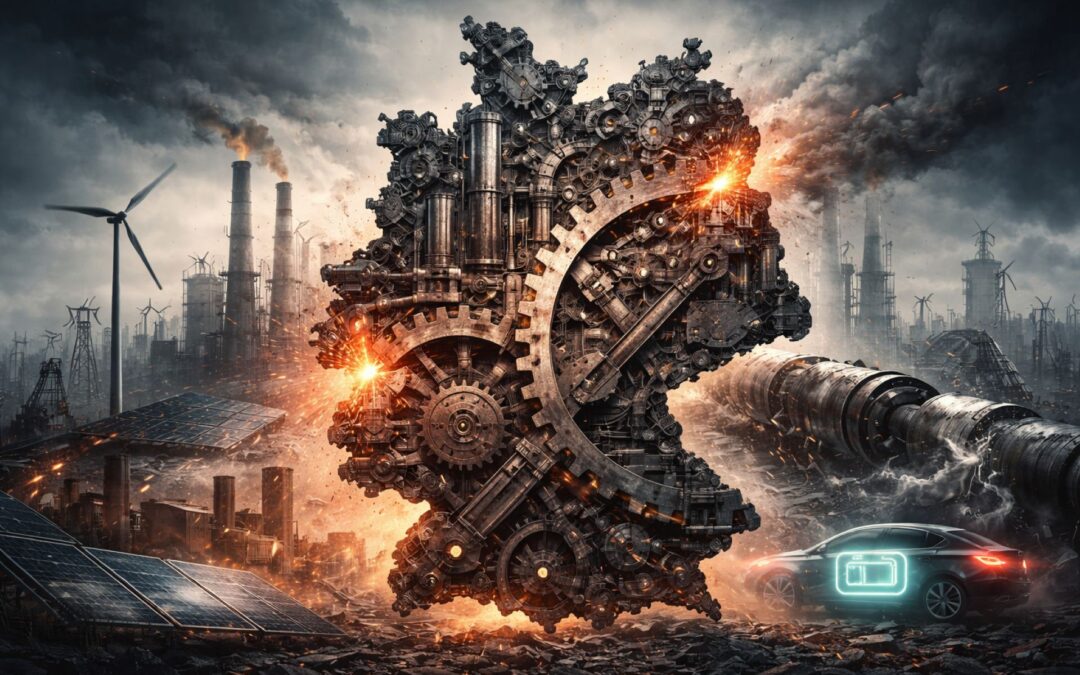
In November 2024, Germany’s governing coalition collapsed under the weight of political infighting and economic stagnation. For many observers, the collapse symbolized something deeper than a routine political crisis. It reflected a growing sense among Germans that their country—long considered the industrial powerhouse of Europe—was losing its economic footing.
Since 2020, Germany’s economy has barely grown. Among major European economies, only a handful have performed worse. Real wages have declined, consumer spending has stagnated, and the once-dominant industrial sector is under increasing pressure from global competitors. Meanwhile, political dissatisfaction has surged, with populist movements gaining unprecedented support.
This situation would have seemed unimaginable just a decade ago. For much of the postwar era, Germany was widely admired as the model of economic discipline and industrial strength. Its companies dominated global markets in automobiles, chemicals, machinery, and precision engineering. German exports flowed across the world, and the country earned the nickname exportweltmeister—the export champion.
But beneath this success lay a fragile structure. Germany’s prosperity was built on a particular economic model: heavy reliance on exports, deep integration into global supply chains, stable industrial employment, and access to cheap energy. For decades, this model delivered remarkable results. Yet in the modern global economy, many of its underlying assumptions have begun to unravel.
The rise of China as both customer and competitor has reshaped global manufacturing. Energy shocks following Russia’s invasion of Ukraine have exposed vulnerabilities in Germany’s energy policy. Demographic decline is shrinking the workforce, while strict fiscal rules limit the government’s ability to respond to new challenges. At the same time, bureaucratic complexity and high taxes have made the country less attractive for entrepreneurs and investors.
What once appeared to be Germany’s greatest strengths—discipline, caution, and stability—are increasingly being questioned. Critics argue that the same conservative policies that once ensured economic resilience may now be preventing the country from adapting to a rapidly changing world.
Germany now finds itself at a critical crossroads. The question facing policymakers, businesses, and citizens alike is simple but profound: can Germany reform its economic model in time to remain a global industrial leader, or is the era of German economic dominance quietly coming to an end?
The answer lies in understanding how the country built its economic miracle in the first place—and how the foundations of that miracle are beginning to shift.
The Postwar Economic Miracle
When World War II ended in 1945, Germany was a devastated nation. Its cities were reduced to rubble, its infrastructure was shattered, and its industrial capacity had been severely damaged by years of bombing. Millions were displaced, the political system had collapsed, and the country faced the immense challenge of rebuilding from near-total destruction.
Yet within just a few decades, West Germany would become one of the most powerful economies in the world. This transformation became known as the Wirtschaftswunder, or the “economic miracle.”
Several key developments laid the foundation for this remarkable recovery.
One of the most important was the currency reform of 1948, which replaced the worthless Reichsmark with the new Deutsche Mark. This reform stabilized prices and restored public confidence in the financial system. At the same time, Ludwig Erhard, the country’s economic minister and later chancellor, implemented sweeping market-oriented reforms. Price controls and many wartime economic regulations were abolished, allowing markets to function again.
These policies formed the basis of what became known as the social market economy—a system that combined free-market capitalism with a strong social safety net. The goal was to promote economic growth and competition while maintaining social stability and worker protections.
The Marshall Plan also played an important supporting role. Through American financial aid and economic cooperation programs, Western Europe received billions of dollars to rebuild infrastructure and industry. For West Germany, these funds helped restart production, modernize factories, and re-establish trade networks.
But the most critical asset Germany possessed was its industrial expertise. Despite the destruction of the war, the country still had a highly skilled workforce, strong engineering traditions, and an established base of industrial firms. German manufacturers quickly began producing high-quality machinery, vehicles, and chemicals that were in high demand around the world.
As global trade expanded during the 1950s and 1960s, West Germany positioned itself as one of the leading exporters of industrial goods. German companies gained reputations for reliability, precision, and engineering excellence. This reputation became the backbone of the country’s economic success.
By the 1960s, West Germany had transformed itself from a war-torn nation into one of the largest economies on earth. Industrial production soared, unemployment fell dramatically, and living standards rose across the country.
The economic miracle did more than rebuild Germany—it created a distinct economic model. This model emphasized industrial production, export competitiveness, technological expertise, and fiscal discipline. For decades, it proved incredibly successful.
However, the same model that powered Germany’s rise would eventually create new vulnerabilities. The more the country relied on industrial exports and global trade, the more exposed it became to changes in the global economic environment.
Those vulnerabilities would become increasingly visible in the decades that followed.
The Export Champion Model
As West Germany’s economy matured in the decades after the war, a distinctive economic strategy began to take shape. Rather than relying primarily on domestic consumption, Germany built its prosperity around one central idea: exporting high-value industrial goods to the world.
Over time, this strategy became the defining feature of the German economy.
German companies specialized in producing complex, high-quality manufactured products that were difficult for competitors to replicate. Automobiles, industrial machinery, precision tools, chemicals, and engineering equipment became the backbone of the country’s export machine. Brands such as Volkswagen, BMW, Mercedes-Benz, Siemens, Bosch, and BASF became global symbols of German engineering excellence.
The country’s industrial structure reinforced this focus. Germany’s manufacturing sector remained unusually large compared to other advanced economies. While many wealthy nations shifted toward service-based economies, Germany maintained a powerful industrial base supported by a network of medium-sized firms known as the Mittelstand. These companies often dominated niche global markets in specialized machinery and components.
This export-driven model proved extraordinarily successful. By the early 2000s, Germany had become one of the world’s largest exporters. Its goods flowed across Europe, Asia, and North America, supplying industries ranging from automotive production to advanced manufacturing.
The country eventually earned the title exportweltmeister, or “export champion.” At its peak, exports accounted for roughly half of Germany’s GDP, one of the highest ratios among major economies. This level of export dependence far exceeded that of countries like the United States or France.
Several factors helped sustain this system.
First, German manufacturers emphasized quality over cost. Rather than competing in low-cost manufacturing, they focused on premium products that commanded higher prices and relied on advanced engineering.
Second, Germany benefited enormously from European integration. The European Union provided a large single market where German products could move freely without tariffs or major regulatory barriers.
Third, Germany’s labor institutions promoted stability. Strong unions, vocational training systems, and cooperation between labor and management helped maintain a highly skilled workforce and stable industrial relations.
Finally, the country maintained a reputation for fiscal discipline and economic stability, which reinforced investor confidence and supported long-term industrial planning.
For many years, this model appeared nearly flawless. Germany ran large trade surpluses, unemployment remained relatively low, and its industrial sector dominated global markets.
However, the model also contained a hidden vulnerability: extreme dependence on global trade and foreign demand. When global markets expanded, Germany prospered. But when global demand weakened or new competitors emerged, the risks of this export-heavy system became far more visible.
In the 21st century, one country in particular would play a decisive role in shaping Germany’s economic fortunes: China.
Germany’s Deep Economic Ties With China
As the global economy entered the 21st century, one country emerged as the single most important driver of global industrial growth: China. Its rapid transformation from a developing economy into the world’s manufacturing powerhouse created enormous demand for machinery, technology, and industrial expertise—precisely the types of products Germany specialized in producing.
For German industry, China quickly became an economic goldmine.
During the 2000s and early 2010s, China embarked on a massive wave of industrialization. Factories were built at unprecedented speed, infrastructure expanded across the country, and manufacturing output surged. To support this expansion, Chinese companies and state-owned enterprises needed advanced machines, chemical inputs, and precision tools. German manufacturers were perfectly positioned to supply them.
German companies exported industrial machinery, specialized equipment, and chemical technologies that helped fuel China’s manufacturing boom. This created a mutually beneficial relationship: China gained access to advanced industrial technology, while Germany gained one of the fastest-growing export markets in the world.
But the relationship extended far beyond industrial equipment.
As China’s middle class grew wealthier, consumer demand began to shift toward premium products. German luxury automobiles became especially popular among Chinese consumers. Brands like Volkswagen, BMW, and Mercedes-Benz saw explosive growth in Chinese sales. Over time, China became the largest single market for many German automakers, accounting for a massive share of their global revenues.
At one point, nearly 40 percent of the global sales of major German car manufacturers came from China. For companies such as Volkswagen in particular, Chinese demand became a cornerstone of their global business model.
This deep economic integration appeared highly beneficial for both sides. German firms enjoyed strong profits and expanding markets, while China continued its rapid economic ascent. For years, the relationship reinforced Germany’s export-driven economic model.
However, there was a critical assumption underlying this partnership: China would remain primarily a customer rather than a competitor.
For a long time, this assumption held true. Chinese manufacturers focused mainly on low-cost production, while Germany dominated the high-end industrial sector. But as China invested heavily in technology, innovation, and industrial capacity, the balance began to shift.
Gradually, Chinese companies began moving up the value chain. They started producing more sophisticated machinery, developing their own advanced technologies, and competing in industries that Germany had long considered its own domain.
What had once been Germany’s greatest export market was quietly transforming into one of its most formidable industrial rivals.
When China Became a Competitor
For many years, the relationship between Germany and China followed a simple pattern: China manufactured at scale, while Germany produced the advanced machinery, engineering equipment, and premium products that powered Chinese industry. German firms exported the tools of industrialization, and China bought them in massive quantities.
But over time, that dynamic began to change.
China did not intend to remain permanently dependent on foreign technology. Through sustained investment in research, education, and industrial policy, the country began moving steadily up the manufacturing value chain. Government programs such as “Made in China 2025” aimed to transform China into a global leader in advanced industries—from robotics and semiconductors to electric vehicles and precision machinery.
As these policies took effect, Chinese companies began competing directly with German manufacturers in sectors that Germany had dominated for decades.
The most dramatic example of this shift can be seen in the automotive industry.
For much of the 20th century and early 21st century, German automakers were widely regarded as the global gold standard in engineering and performance. Volkswagen, BMW, and Mercedes-Benz built reputations for reliability, quality, and technological sophistication. These companies dominated global markets for premium vehicles and enjoyed enormous profits from international sales.
However, the global transition toward electric vehicles (EVs) has reshaped the competitive landscape. Unlike traditional internal combustion engines—where German manufacturers possessed decades of engineering expertise—electric vehicles rely on different technologies, including battery systems, software integration, and electronics.
China moved aggressively to dominate this emerging industry.
Through large-scale subsidies, government investment, and coordinated industrial strategy, Chinese companies rapidly expanded their EV production capabilities. The results were staggering. By 2023, China exported more than 1.6 million electric vehicles, far surpassing Germany’s exports of roughly 686,000 EVs.
Even more striking was where those vehicles were going.
Nearly 40 percent of Chinese EV exports were shipped directly to the European Union, meaning Chinese manufacturers were increasingly competing with German automakers in Germany’s own backyard. The same companies that once relied on German engineering were now selling advanced vehicles in Europe at highly competitive prices.
This shift represents more than just a challenge for the automotive sector. It signals a broader transformation in global industrial competition. Chinese firms are now expanding into many of the same sectors that once formed the core of Germany’s export advantage, including machinery, electronics, and advanced manufacturing technologies.
In other words, China is no longer simply a customer for German industry—it is rapidly becoming one of its most powerful competitors.
For an economy as dependent on manufacturing exports as Germany’s, this transition poses a serious long-term threat.
The Structural Importance of Manufacturing
Few advanced economies rely on manufacturing as heavily as Germany does. While many wealthy nations have gradually shifted toward service-based economies, Germany has maintained a powerful industrial core that remains central to its economic identity.
Manufacturing is not simply one sector among many in Germany—it is the backbone of the entire economy.
Roughly 19 percent of German workers are employed in manufacturing, a share that is more than double that of many other developed economies. In countries like the United States or the United Kingdom, manufacturing employment has declined significantly over the past several decades as industries moved overseas and service sectors expanded. Germany, by contrast, preserved a large portion of its industrial workforce.
This industrial strength is supported by a complex ecosystem of companies, suppliers, and specialized firms. Large multinational corporations such as Volkswagen, Siemens, and BASF operate alongside thousands of smaller companies that produce highly specialized components and machinery. Many of these firms are part of the Mittelstand, a network of medium-sized businesses that dominate niche global markets in everything from precision tools to advanced manufacturing equipment.
These companies form dense industrial clusters that reinforce one another. Suppliers, manufacturers, engineers, and research institutions often operate in close geographic proximity, creating powerful networks of expertise and innovation.
Because of this structure, manufacturing plays an outsized role in Germany’s economic performance. When global demand for industrial goods is strong, the entire economy benefits. Exports rise, employment remains stable, and government revenues increase.
But this structure also creates a significant vulnerability.
If global demand weakens or if German manufacturers lose competitiveness, the consequences ripple throughout the economy. Job losses in manufacturing can quickly spread to related industries, from logistics and transportation to engineering services and regional suppliers.
In recent years, this vulnerability has become increasingly apparent.
Germany’s industrial production has begun to show signs of strain. In 2023, the country’s industrial output declined by roughly 1.5 percent, while China’s continued to grow. Rising energy costs, new international competition, and shifting technological trends are all placing pressure on Germany’s traditional manufacturing strengths.
When a country depends so heavily on industrial production, even modest declines can have profound economic consequences.
And in Germany’s case, the pressures on industry are being compounded by another critical factor: energy policy.
Energy Policy and the Nuclear Phase-Out
Energy has always played a crucial role in Germany’s industrial success. Manufacturing industries such as chemicals, metals, and automotive production require enormous amounts of reliable and affordable energy to remain competitive. For decades, Germany managed to maintain this balance through a mix of energy sources that kept costs relatively stable.
However, a major turning point occurred in 2011 following the Fukushima nuclear disaster in Japan.
In the aftermath of that accident, Germany made the political decision to phase out its nuclear power plants entirely. At the time, nuclear energy accounted for roughly 23 percent of Germany’s electricity generation, providing a stable and relatively inexpensive source of power.
The decision to shut down nuclear plants was driven largely by public concern about nuclear safety. Germany’s government announced an accelerated timetable to retire all nuclear reactors and transition the country toward renewable energy sources such as wind and solar.
This policy became part of a broader strategy known as the Energiewende, or “energy transition.” The goal was to reduce carbon emissions, expand renewable energy, and move away from both nuclear and fossil fuels.
But this transition created significant challenges.
Renewable energy sources such as wind and solar are inherently variable. Their output depends on weather conditions and time of day, which means they cannot always provide stable, consistent power for energy-intensive industries. To compensate for this variability, Germany increasingly relied on natural gas as a backup energy source.
And much of that natural gas came from Russia.
For years, this arrangement seemed economically sensible. Russian gas was abundant and relatively cheap, and pipelines such as Nord Stream provided a steady supply to Germany’s industrial heartland. At the same time, renewable energy capacity continued to expand, allowing Germany to claim progress toward its environmental goals.
However, the transition came with an unintended consequence: energy costs began to rise.
As nuclear plants were shut down and renewable energy expanded, Germany’s electricity production declined and overall energy prices increased. Electricity costs rose significantly compared to previous levels, placing additional pressure on industries that depend on large amounts of power.
For many German citizens, these rising costs were tolerable while the broader economy remained strong. But for industrial companies operating in fiercely competitive global markets, even modest increases in energy prices can significantly affect profitability.
Despite these risks, Germany continued down the path of nuclear phase-out and greater reliance on imported gas.
Then in 2022, a geopolitical shock would expose just how vulnerable that strategy had become.
The Russian Gas Shock and Industrial Collapse
Germany’s energy strategy functioned smoothly for years—until geopolitics intervened.
For decades, the country had built a system that depended heavily on cheap Russian natural gas. The logic behind this arrangement was straightforward. Russia possessed enormous gas reserves, Germany needed reliable energy for its industrial base, and pipelines such as Nord Stream provided a direct and efficient supply route.
As long as relations between Russia and Europe remained stable, this system appeared economically rational.
But in February 2022, Russia invaded Ukraine, triggering the largest geopolitical shock in Europe since the Cold War. The conflict quickly disrupted energy flows across the continent. Western sanctions, political tensions, and the eventual destruction of the Nord Stream pipeline transformed what had once been a stable energy relationship into a full-blown energy crisis.
The impact on Germany was immediate and severe.
At the peak of the crisis in 2022, German natural gas prices surged to levels nearly ten times higher than they had been just two years earlier. Energy markets across Europe were thrown into turmoil as governments scrambled to secure alternative supplies.
While natural gas accounted for only about 15 percent of Germany’s electricity generation, its role in industry was far more significant. Many large manufacturing firms relied on natural gas not only for power but also as a critical input in industrial processes.
Few sectors were hit harder than the chemical industry.
Germany’s chemical companies use vast quantities of energy to produce materials that serve as inputs for countless other industries, from pharmaceuticals to plastics to advanced manufacturing. When energy prices skyrocketed, these companies suddenly faced enormous cost increases.
The most striking example came from BASF, the world’s largest chemical producer and one of Germany’s most important industrial giants. Within a single year, the company saw its energy costs rise by more than €3 billion.
Faced with such dramatic increases, BASF and other companies were forced to make difficult decisions. Production levels were reduced, cost-cutting measures were implemented, and some operations were shifted to regions with lower energy costs.
In certain sectors, the impact was devastating. Energy-intensive industries in Germany experienced a roughly 10 percent decline in output in 2023, marking one of the sharpest industrial contractions in the country’s modern history.
Factories that had operated for decades suddenly became uncompetitive in global markets. For an economy built around manufacturing exports, this represented a profound shock.
The energy crisis revealed a painful truth: Germany’s industrial strength depended heavily on a fragile foundation of cheap and stable energy. Once that foundation was disrupted, the entire system began to strain under the pressure.
And for some of Germany’s largest companies, the response to these pressures would involve a dramatic shift—moving investment and production abroad.
Corporate Retreat and Industrial Relocation
As energy costs surged and industrial competitiveness weakened, some of Germany’s largest corporations began reconsidering where they should operate. For decades, Germany had been the natural home for its most powerful industrial companies. But rising costs, regulatory complexity, and new global opportunities were gradually changing that calculation.
Few cases illustrate this shift more clearly than BASF.
Headquartered in Ludwigshafen, BASF has long been one of the pillars of German industry. It operates the world’s largest integrated chemical complex and produces thousands of chemical products used across industries ranging from pharmaceuticals to plastics to agriculture. The company’s operations are deeply embedded in Germany’s industrial ecosystem.
Yet the energy crisis dramatically altered the economics of its domestic operations.
Within a single year, BASF’s energy expenses rose by more than €3 billion, placing immense pressure on its German facilities. To cope with these rising costs, the company announced significant restructuring measures at its main plant in Ludwigshafen. Production of several key chemical products was scaled back, and the company began implementing cost reductions that totaled hundreds of millions of euros.
But the most consequential decision was not about cutting costs—it was about where future investment would go.
Rather than expanding production in Germany, BASF announced plans to invest nearly €10 billion in a massive new chemical complex in China. The project would become one of the company’s largest investments ever, effectively shifting part of its long-term production strategy toward Asia.
This move carried enormous symbolic significance. A company that had been a cornerstone of Germany’s industrial strength for generations was now investing more heavily abroad than at home.
BASF is not alone in this trend.
Across Germany, industrial companies are increasingly exploring options to relocate production or expand operations in countries where energy is cheaper, taxes are lower, and regulations are less burdensome. The United States, in particular, has become an attractive destination for investment following major government subsidies for manufacturing and energy.
For Germany, the implications are serious. When companies move production overseas, the consequences extend far beyond the loss of individual factories. Entire supply chains can gradually relocate, affecting suppliers, logistics providers, and regional economies that depend on industrial employment.
In a country where manufacturing accounts for a large share of jobs and economic output, such shifts threaten the very foundation of the industrial model that powered Germany’s prosperity for decades.
And the pressures on this model are being compounded by another long-term challenge—Germany’s rapidly aging population.
Germany’s Demographic Crisis
While global competition and energy costs are placing immediate pressure on Germany’s economy, another challenge is quietly unfolding in the background—one that could prove even more difficult to solve in the long run.
Germany is facing a demographic crisis.
Like many developed countries, Germany has experienced a steady decline in birth rates over the past several decades. Today, the country’s fertility rate sits at roughly 1.35 children per woman, far below the level required to maintain a stable population. For a society to sustain its population over time, the fertility rate typically needs to hover around 2.1 children per woman.
The consequences of this demographic imbalance are becoming increasingly visible.
Germany’s population is aging rapidly. By 2030, nearly a quarter of the population is expected to be 67 years or older. At the same time, the number of people in the working-age population is shrinking. Estimates suggest that Germany could lose 300,000 to 400,000 workers each year over the coming decade.
For an economy that relies heavily on industrial production, this presents a serious challenge.
Manufacturing industries depend on skilled labor—engineers, technicians, machinists, and highly trained factory workers. Germany’s vocational training system has historically done an excellent job of producing these skills, but even the best training system cannot compensate for a shrinking workforce.
A smaller labor force means fewer workers available to staff factories, design products, and maintain complex industrial systems. Over time, this could limit the country’s productive capacity and reduce economic growth.
An aging population also places additional strain on government finances.
As more citizens retire, the cost of pensions and healthcare increases while the number of taxpayers declines. This creates a growing fiscal burden that must be supported by a smaller working population.
Immigration has often been proposed as a potential solution to Germany’s demographic challenges. In recent years, the country has accepted large numbers of migrants and refugees in an effort to offset workforce shortages. However, integrating new arrivals into the labor market takes time and can present political and social challenges.
Regardless of how policymakers address the issue, the demographic trend itself is difficult to reverse. Birth rates rarely rise quickly once they have fallen to low levels, and population aging is a long-term process that unfolds over decades.
For Germany, the implications are clear: sustaining a large industrial economy with a shrinking workforce will require higher productivity, increased automation, and careful economic management.
But demographics are not the only structural weakness in Germany’s economy. Another issue lies in how the country’s economic model interacts with domestic consumption—an area where Germany has long been unusually restrained.
Weak Consumer Spending and Economic Imbalance
One of the less visible but deeply important characteristics of Germany’s economy is its unusually weak domestic consumption. While many advanced economies rely heavily on consumer spending to drive growth, Germany’s economic model has historically leaned in the opposite direction.
Germans are famous for their high savings rates.
For decades, households in Germany have tended to save a significantly larger portion of their income than consumers in countries like the United States or the United Kingdom. Cultural attitudes toward financial caution, combined with a strong tradition of fiscal discipline, have reinforced this behavior. Saving has often been viewed as a virtue, while excessive borrowing or consumption is regarded with skepticism.
This tendency fits naturally with Germany’s export-driven economic structure. If domestic consumption is relatively weak, economic growth must come from somewhere else. In Germany’s case, that “somewhere else” has been foreign demand.
As long as global markets were expanding and German exports remained competitive, this imbalance posed little problem. German companies sold their goods abroad, generating large trade surpluses that sustained economic growth.
But when export demand slows, the lack of strong domestic consumption becomes a serious vulnerability.
In recent years, several developments have worsened this imbalance. Rising energy costs, industrial uncertainty, and broader economic stagnation have placed increasing pressure on wages. Since 2020, real wages in Germany have declined by roughly 2 percent, while wages across the OECD have generally continued to grow.
Lower real wages directly affect consumer behavior. When purchasing power declines, households become more cautious, spending less and saving more. In Germany, this cautious mindset has intensified. At one point, Germans were saving five times as much as Americans, reflecting growing uncertainty about the economic future.
The result has been stagnant consumer spending.
In real terms, German household consumption has barely grown over the past decade and remains close to the levels seen in the mid-2010s. This lack of domestic demand creates a negative feedback loop. Weak spending reduces business revenues, which in turn discourages investment and hiring.
In many countries, governments might attempt to stimulate demand through tax cuts or increased public spending. But in Germany’s case, policymakers face a unique constraint that limits their ability to intervene.
This constraint is known as the debt brake.
The Debt Brake and Fiscal Constraints
When the global financial crisis struck in 2008, governments across the world responded by dramatically increasing public spending and borrowing. Many countries accumulated large deficits in an effort to stabilize their economies and prevent deeper recessions.
Germany took a different path.
In 2009, the German government introduced a constitutional fiscal rule known as the debt brake (Schuldenbremse). The rule was designed to enforce strict fiscal discipline and prevent excessive government borrowing in the future.
Under this system, the federal government is limited to running a structural deficit of no more than 0.35 percent of GDP in normal economic conditions. State governments are generally prohibited from running structural deficits altogether.
The intention behind the policy was to protect Germany from unsustainable debt accumulation. Given the country’s historical emphasis on financial stability and fiscal responsibility, the debt brake was widely supported by both policymakers and the public.
In many ways, the rule succeeded in its original purpose.
Germany entered the 2020s with relatively low public debt compared with many other advanced economies. While countries such as the United States, France, and Italy ran deficits of 5 to 7 percent of GDP, Germany maintained far stricter borrowing limits.
However, the same rule that protected Germany from excessive debt also created a new problem: it severely limited the government’s ability to invest and respond to economic challenges.
In recent years, Germany has faced mounting pressures that typically require significant public spending—modernizing infrastructure, supporting energy transitions, investing in new technologies, and maintaining industrial competitiveness. Yet the debt brake constrains how much the government can borrow to fund these initiatives.
This restriction also limits Germany’s ability to implement policies that might stimulate economic growth. For instance, cutting taxes could encourage investment and consumption, but doing so would reduce government revenue and potentially violate the deficit limits imposed by the debt brake.
Reforming the rule is extremely difficult.
Because the debt brake is embedded in Germany’s constitution, modifying it would require a constitutional amendment, which demands broad political consensus. In Germany’s fragmented political landscape, achieving such agreement has proven extraordinarily challenging.
As a result, Germany finds itself in an unusual position. The country possesses strong fiscal capacity and relatively low debt, yet strict legal constraints prevent it from using that capacity more aggressively.
This tension between fiscal discipline and economic flexibility has become one of the central debates in modern German economic policy.
And the consequences of these constraints are visible in another area that has increasingly drawn criticism: Germany’s aging and underfunded infrastructure.
Infrastructure Decay and Underinvestment
Infrastructure rarely attracts headlines during periods of economic stability. Roads, railways, bridges, ports, and digital networks quietly support the movement of goods and people, forming the invisible backbone of modern economies. But when investment in these systems slows for too long, the consequences eventually become impossible to ignore.
In Germany, that moment appears to have arrived.
For years, the country has invested significantly less in infrastructure than other advanced economies. In 2024, Germany spent roughly 1.5 percent of its GDP on infrastructure, compared with an average of about 2.7 percent among high-income countries. While this difference may appear small at first glance, the cumulative effect of decades of underinvestment can be substantial.
Across the country, signs of strain are becoming increasingly visible. Aging bridges require repairs or replacement. Railway networks suffer from delays and congestion. Digital infrastructure lags behind many other developed nations. Even parts of the famous German Autobahn system—once considered the gold standard of highway engineering—are showing signs of deterioration.
For an economy that depends so heavily on industrial production and exports, infrastructure quality is particularly important.
German companies rely on efficient logistics networks to move goods from factories to ports and from ports to global markets. Machinery, automobiles, chemicals, and industrial equipment must be transported quickly and reliably across complex supply chains. When infrastructure becomes outdated or congested, the efficiency of those supply chains begins to suffer.
This problem becomes even more serious when competing countries are investing aggressively in modern infrastructure. Nations such as China have spent enormous sums building high-speed rail networks, advanced ports, and large-scale industrial corridors designed to support manufacturing and trade.
In comparison, Germany’s infrastructure spending has struggled to keep pace with the evolving demands of a globalized economy.
Part of the problem stems from the fiscal constraints imposed by the debt brake, which limit the government’s ability to borrow for large infrastructure projects. But another factor is Germany’s cautious political culture, where large public investments often face intense scrutiny and lengthy approval processes.
Regardless of the cause, the result is clear: Germany’s infrastructure—once a source of national pride—is gradually falling behind the needs of a modern industrial economy.
And infrastructure is not the only factor making Germany less attractive for investment. Another issue lies in the country’s relatively high tax burden, which many businesses view as a growing obstacle to competitiveness.
High Taxes and the Investment Problem
Taxes are a central factor in determining where businesses choose to invest. When companies decide where to build factories, conduct research, or establish headquarters, they typically weigh several key considerations: energy costs, labor availability, regulatory conditions, and the overall tax environment.
In Germany, the tax burden has increasingly become a point of concern for investors.
Compared with many other advanced economies, Germany maintains relatively high taxes on both labor and capital. The average employment tax wedge—the combined burden of income taxes and social contributions—reaches approximately 48 percent of wages, significantly above the OECD average of around 35 percent. This means that a substantial portion of employee compensation is absorbed by taxes and mandatory contributions.
From the perspective of businesses, this raises the cost of hiring workers and reduces flexibility in managing labor expenses.
Corporate taxation presents another challenge. Germany’s combined corporate tax rate is roughly 30 percent, higher than the OECD average of about 23.8 percent. While these rates are not the highest in the world, they are high enough to influence decisions about where multinational companies choose to expand their operations.
Capital gains taxes also add to the burden. Germany applies a flat capital gains tax of about 26.4 percent, which in many cases exceeds the top capital gains tax rate in the United States. For investors and entrepreneurs evaluating potential returns, such differences can make other jurisdictions appear more attractive.
Normally, governments facing these challenges might respond by reducing taxes to encourage investment and stimulate economic activity. Lower corporate taxes can attract foreign capital, encourage domestic business expansion, and boost overall economic dynamism.
However, Germany’s fiscal framework makes such adjustments extremely difficult.
Because of the debt brake, lowering taxes without reducing government spending would increase deficits and potentially violate constitutional limits. This effectively constrains the government’s ability to use tax policy as a tool for economic stimulus or competitiveness.
As a result, Germany finds itself in a difficult position. The country needs to attract investment and encourage entrepreneurship, yet the fiscal rules that enforce financial discipline also limit its flexibility to adjust economic policy.
For businesses evaluating where to locate new projects, this rigid environment can make Germany appear less competitive than countries with more adaptable tax systems.
But taxation alone does not explain the challenges facing entrepreneurs and investors. Another significant factor lies in Germany’s regulatory culture, where complex procedures and lengthy approval processes can slow economic activity.
The Bureaucratic State
Beyond energy costs, taxes, and fiscal constraints, Germany faces another obstacle that has gradually undermined its economic dynamism: bureaucracy.
Germany has long been known for its meticulous legal and administrative systems. Regulations are detailed, procedures are carefully documented, and approvals often pass through multiple layers of oversight. This system reflects a deep cultural commitment to order, stability, and risk management.
Historically, these qualities were seen as strengths. A strong legal framework provided predictability for businesses and ensured that complex industrial systems operated safely and reliably.
But in a rapidly changing global economy, the same system can also become a barrier to speed and innovation.
For entrepreneurs and investors, Germany’s administrative processes can be frustratingly slow. Starting a business in the country often takes more than a month, compared to just a few days in places like the United States. While this difference may seem minor, it reflects a broader regulatory environment that tends to prioritize caution over efficiency.
The delays become even more striking when large infrastructure or energy projects are involved.
For example, building a new wind farm in Germany can require five to six years just to obtain the necessary permits. In other countries with more streamlined regulatory systems, similar projects can move forward in less than a year. Such delays slow the expansion of renewable energy infrastructure and discourage investment in new projects.
Germany’s bureaucratic culture has deep historical roots.
Much of the modern administrative system evolved from the Prussian state, which placed heavy emphasis on legal precision and administrative discipline. After the devastation of World War II, Germany further strengthened its institutional safeguards to prevent political instability and economic mismanagement.
Over time, this emphasis on caution became embedded in many aspects of governance. Regulations multiplied, approval processes expanded, and institutions prioritized avoiding mistakes over moving quickly.
The mentality is captured in a common German saying: “Caution is better than regret.”
While this philosophy promotes stability, it can also create an environment where decision-making becomes excessively slow. Businesses seeking permits, entrepreneurs launching new ventures, and companies attempting to build new facilities often face layers of regulations that delay progress.
In an era where global competitors can move quickly to seize new opportunities, this bureaucratic inertia can become a serious disadvantage.
For Germany, the combination of high costs, strict fiscal rules, and regulatory complexity has begun to erode the competitive advantages that once defined its economic model.
And as economic pressures mount, the consequences are increasingly visible not only in the economy—but also in the country’s political landscape.
Political Consequences of Economic Stagnation
Economic stagnation rarely remains confined to balance sheets and policy reports. Over time, it begins to reshape public sentiment, influence elections, and alter the political landscape. Germany is now experiencing the early stages of this dynamic.
For decades, Germany was considered one of Europe’s most politically stable democracies. Its major parties maintained broad support, coalition governments functioned relatively smoothly, and economic prosperity reinforced public confidence in the country’s institutions.
But as economic pressures have mounted in recent years, that stability has begun to erode.
The collapse of Germany’s governing coalition in 2024 reflected deep divisions over how to address the country’s economic challenges. Disagreements over fiscal policy, energy strategy, and immigration policy created growing tensions within the government. Eventually, those tensions became impossible to manage, leading to the coalition’s breakdown.
At the same time, political dissatisfaction among voters has been rising.
Many Germans feel that their country’s economic model—once a source of pride and security—is no longer delivering the same level of prosperity. Real wages have stagnated, industrial uncertainty has increased, and the cost of energy has become a major public concern.
These frustrations have helped fuel the rise of populist political movements.
The most notable example is the growing support for the Alternative for Germany (AfD) party. Once considered a fringe political force, the AfD has steadily gained traction in national and regional elections. In recent years, it achieved its strongest electoral performance ever, finishing in second place in several key political contests.
Economic anxiety often plays a significant role in such political shifts. When voters perceive that the economic system is no longer working in their favor, they may become more receptive to parties that promise dramatic change or challenge the existing political establishment.
Germany is not unique in this regard. Similar political trends have emerged across many advanced economies facing economic disruption and globalization pressures.
However, the stakes are particularly high in Germany because of its central role within the European Union. As the largest economy in Europe, Germany’s political stability has long been a cornerstone of the EU’s economic and institutional framework.
If economic stagnation continues and political fragmentation deepens, it could complicate not only Germany’s domestic policymaking but also broader European decision-making.
Ultimately, economic policy and political stability are deeply intertwined. As Germany grapples with the structural challenges facing its economy, the decisions made by policymakers in the coming years will shape not only the country’s economic future but also its political trajectory.
The crucial question now is whether Germany can adapt its economic model in time—or whether the structural problems that have emerged will continue to intensify.
Can Germany Fix Its Economy?
Despite the mounting challenges facing Germany’s economy, the situation is far from hopeless. In fact, one of the country’s greatest strengths is that it still possesses enormous economic resources, technological expertise, and fiscal capacity. The real question is not whether Germany can recover—but whether it is willing to make the necessary adjustments to its economic model.
Several areas of reform stand out as potential starting points.
One of the most frequently discussed proposals is reforming or softening the debt brake. While the rule has helped maintain fiscal discipline, its strict limits have also constrained the government’s ability to invest in infrastructure, energy systems, and emerging technologies. Modifying the rule—without abandoning fiscal responsibility altogether—could give policymakers greater flexibility to address structural economic weaknesses.
Another potential reform involves modernizing Germany’s infrastructure. Increased investment in transportation networks, digital infrastructure, and logistics systems could improve supply chain efficiency and reinforce the competitiveness of German exports. For an economy that depends heavily on industrial production and trade, such investments could generate long-term economic benefits.
Energy policy is another critical area. Stabilizing energy costs for industry—whether through expanded renewable capacity, new technologies, or diversified energy supplies—will be essential for maintaining Germany’s manufacturing base. Without reliable and affordable energy, many industrial sectors will struggle to remain competitive in global markets.
There is also growing debate about the country’s tax structure and regulatory environment. Lowering certain taxes, particularly those affecting business investment and employment, could make Germany more attractive for entrepreneurs and multinational companies. At the same time, simplifying bureaucratic procedures and accelerating approval processes could help remove barriers that currently discourage new projects.
Finally, Germany will need to confront its demographic challenges. Policies that encourage higher workforce participation, attract skilled immigration, and increase productivity through automation and technological innovation may help offset the effects of an aging population.
None of these reforms will be easy. Each involves difficult political trade-offs, and Germany’s consensus-driven political system often makes sweeping reforms slow to implement.
Yet Germany also has several advantages that many struggling economies lack. Its public finances remain relatively strong, its industrial base is still globally respected, and its companies continue to possess world-class engineering capabilities.
If policymakers can adapt the country’s economic framework to the realities of the modern global economy, Germany could once again unlock the strengths that made it one of the world’s leading industrial powers.
But if reform proves too slow or politically difficult, the structural pressures now building within the economy may continue to erode the foundations of Germany’s long-standing prosperity.
Conclusion
For decades, Germany stood as a model of industrial strength and economic discipline. Its export-driven manufacturing sector, skilled workforce, and commitment to fiscal stability allowed the country to rebuild from the devastation of World War II and emerge as one of the most powerful economies in the world. The German economic model appeared not only successful, but durable.
Yet the very foundations of that model are now under strain.
Global competition has intensified, particularly from China, which has evolved from a major customer into a formidable industrial rival. Energy shocks exposed vulnerabilities created by Germany’s decision to phase out nuclear power and rely heavily on imported natural gas. At the same time, demographic decline is shrinking the workforce, while weak domestic consumption leaves the economy heavily dependent on foreign demand.
Policy choices have further complicated the situation. Strict fiscal rules limit the government’s ability to invest and respond to economic challenges, while high taxes and complex bureaucracy have made the country less attractive for entrepreneurs and new investment. As these pressures accumulate, Germany’s industrial dominance—once taken for granted—has begun to look increasingly uncertain.
However, the country is far from decline. Germany still possesses extraordinary advantages: world-class engineering expertise, globally recognized industrial firms, strong public finances, and a highly developed economic infrastructure. Few countries are better positioned to adapt if the political will exists to implement meaningful reforms.
The challenge facing Germany today is not merely economic but strategic. The country must decide whether to preserve the structures that defined its past success or reshape its economic model to fit a new global reality.
How Germany answers that question will determine whether it remains one of the world’s leading industrial powers—or gradually becomes another example of how even the most successful economic systems must evolve to survive.