
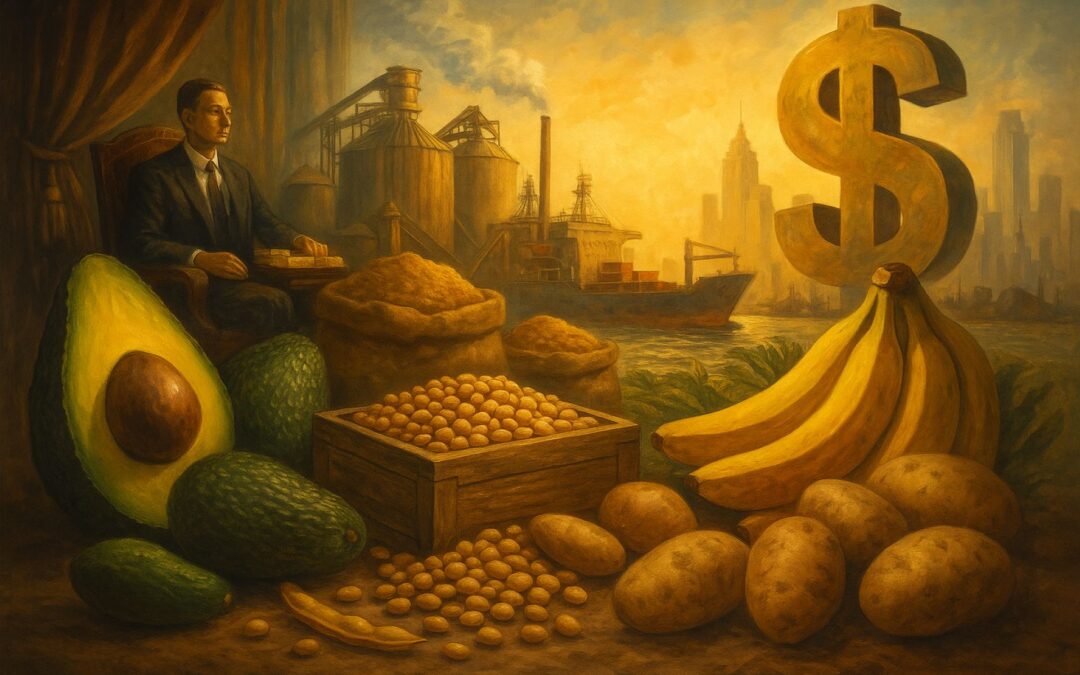
Across history, some of the world’s most formidable fortunes have been built not on gold, oil, or cutting-edge technology, but on the humblest of agricultural staples. Crops so ordinary they barely register in the public imagination—potatoes, soybeans, bananas, avocados—have quietly shaped demographics, powered industries, toppled governments, and turned companies into global power brokers. Their strength lies not in rarity, but in universality: when everyone needs something, those who control it can dictate the flow of economies. Behind each of these crops is a hidden architecture—systems of logistics, infrastructure, and branding—that transformed them from everyday food into empires richer than nations.
Boring, Invisible Power
The most transformative assets in history often begin life as afterthoughts—too plain to spark envy, too common to invite competition. These “boring” assets carry a quiet advantage: they operate under the radar, giving those who recognize their potential a wide, unchallenged runway. Potatoes and soybeans—two of the most unassuming crops in the world—are perfect case studies in how something that looks like humble sustenance can morph into a structural pillar of economic growth, geopolitical leverage, and generational wealth.
The Potato: Caloric Multiplication as a Weapon of Growth
When the potato made its voyage from the Andean highlands to Europe in the 16th century, it faced an uphill battle. Its odd appearance, tendency to sprout underground, and lack of resemblance to known grains made it suspicious to farmers and peasants. In some regions, local superstition labeled it dangerous—believed to cause leprosy or carry poison. But the regions that overcame this mistrust first reaped staggering benefits.
The key was its sheer caloric yield. Potatoes could produce two to three times more calories per acre than wheat or barley. They also grew in poor soils and harsh climates where other staples faltered. This meant that the same plot of land could suddenly sustain more people without any expansion of farmland. Over decades, this shift compounded.
By the late 18th century, countries like Ireland had built entire rural economies on potatoes, enabling population densities that were previously impossible. France, under the encouragement of figures like Antoine-Augustin Parmentier and the symbolic gestures of King Louis XVI—who famously wore a potato flower in his lapel—saw potato farming spread rapidly. In economic terms, this wasn’t just about feeding people; it was about scaling the workforce itself.
A caloric surplus meant healthier, stronger laborers. It reduced the seasonal famine cycles that had historically weakened populations and destabilized economies. By 1800, the average European laborer consumed ten times more potato calories than their ancestors a century earlier. This underpinned the demographic explosion that tripled Europe’s population in a few generations—feeding the furnaces of the Industrial Revolution with human capital as much as coal or iron did.
The Soybean: Industrial Versatility Hidden in a Bean
Where the potato excelled in feeding people, soybeans became indispensable by feeding both industries and animals. Cultivated in China for more than three thousand years, soy had long been valued as a food source, but its real economic force emerged when modern science uncovered its biochemical makeup: 40% protein, 20% oil.
This duality opened doors far beyond agriculture. The oil was adaptable—refined for inks, paints, lubricants, plastics, and cosmetics. The protein was perfect for animal feed, textile processing, and military rations. During World War II, the U.S. government ramped up soybean production to replace imports of critical materials cut off by conflict. Soy products substituted for meat proteins in rations, soy oil replaced industrial lubricants, and soy derivatives were incorporated into synthetic rubber production.
In the post-war era, soybeans entrenched themselves in the global economy through livestock feed. Meat production in China, Brazil, and the U.S.—feeding billions—depends almost entirely on soymeal. Today, 80% of global soybean production goes to animal feed, making it an invisible foundation of modern diets. You may not buy soy directly, but it’s hidden in your chicken breast, your burger, your milk, and your cheese. It’s in biodiesel powering vehicles, in the ink on product labels, in the coatings on tablets and pills.
The Power of Being Underestimated
Both potatoes and soybeans share a critical advantage: they were underestimated. Their ordinariness meant there was no speculative frenzy, no early rush to monopolize them. By the time their strategic potential became obvious, the actors who had quietly secured control over production, distribution, and processing were decades ahead.
Invisibility is a moat. When an asset is both essential and overlooked, it can reshape demographics, industrial capabilities, and geopolitical balance without attracting early resistance. That’s why the potato’s caloric density and the soybean’s versatility didn’t just feed the world—they helped shape it.
Controlling the Entire System
Identifying a valuable asset is only the opening move. The real fortunes are built when that asset is wrapped inside an ecosystem you control from seed to shelf—or, in many cases, from soil to port. When you own the system, you don’t just participate in the market—you set the terms on which it operates. That’s where crops like bananas and soybeans reveal their true economic muscle.
Bananas: How Logistics Became Power
In the late 19th century, bananas were a curiosity in the United States—sweet, tropical, and unlike anything most Americans had ever tasted. But their novelty came with a problem: they rotted quickly. Within days of being picked, they were unsellable. The only way to turn bananas into a viable business was to master time.
Enter the United Fruit Company. They didn’t just grow bananas; they built the infrastructure to move them faster than anyone else. They owned plantations in multiple Central American countries. They constructed private railways that snaked from inland farms to coastal ports. They purchased fleets of refrigerated ships to carry bananas north at speed. They built warehouses, ripening facilities, and distribution hubs in U.S. cities. Every link in the chain—land, transport, storage, and sale—flowed through their hands.
Land laws in places like Honduras placed caps on how much a single company could own. United Fruit responded by creating dozens of shell companies, each acquiring land as if independent, while in reality all were centrally controlled. The result was a near-monopoly on arable land suited to banana production.
But their control went deeper. Company towns sprang up around plantations, complete with housing, schools, hospitals, and police—funded and run by United Fruit. This was paternalism laced with power; the company wasn’t just an employer, it was the de facto government.
By the early 20th century, entire national economies in Honduras, Guatemala, Costa Rica, Panama, and Colombia were tied to banana exports. Weak governance, dependence on a single crop, and heavy foreign ownership created fertile ground for manipulation. In 1954, when Guatemalan President Jacobo Árbenz attempted land reforms that threatened United Fruit’s holdings, the company didn’t negotiate—it lobbied the U.S. government to intervene. Branding Árbenz’s policies as communist infiltration during the Cold War, they secured CIA backing for a coup. Within months, Árbenz was gone, and the company’s grip remained unbroken.
This was more than agricultural trade—it was corporate geopolitics. United Fruit’s control of logistics wasn’t just about moving bananas; it was about shaping the political and economic destinies of entire nations.
Soybeans: The Modern Parallel
While soybeans don’t carry the same cloak-and-dagger drama as bananas, the power dynamics are similar. Farming soy is the least profitable part of the value chain, accounting for roughly 10% of the total economic value. The real profits come from the layers above farming: processing, export infrastructure, trade financing, and market control.
Multinational firms dominate these layers. They own the crushing plants that turn raw soy into oil and meal. They control the silos, the transport fleets, and the export terminals at deepwater ports. They broker international deals that lock in supply contracts years in advance. And they make money in the abstract—through futures markets, currency hedging, and commodity derivatives—where profits can be larger than anything earned from the crop itself.
The Brazilian “Northern Arc” illustrates the strategic value of infrastructure control. For decades, soy from inland farms in Brazil had to be trucked thousands of kilometers south to ports, inflating costs and transit times. The Northern Arc—a network of highways, rail lines, and new deepwater ports in the north—changed that equation. Transit times dropped. Export capacity surged. By 2021, Brazil surpassed the U.S. as the largest soybean exporter in the world. This wasn’t achieved by planting more soy—it was achieved by moving it more efficiently and controlling the path it took to market.
Why the System Matters More Than the Crop
In both bananas and soybeans, the real money was never in the field—it was in the corridors that connected the field to the world. Own those corridors and you can dictate prices, ration supply, and decide who participates in the market at all.
Control of the system also creates political leverage. Governments dependent on your infrastructure hesitate to challenge you. Competitors without access to your ports or railways can’t match your scale. Buyers reliant on your delivery timelines accept your terms.
It’s a lesson that echoes far beyond agriculture: the commodity may spark the business, but the system cements the empire.
Branding: The Bow on Top
Even the most well-oiled supply chain and the most indispensable product still face a ceiling if they’re sold purely as commodities. Commodities compete on price, and price competition erodes margins. The real leap—from profitable to wildly lucrative—happens when a product transcends its category and becomes a story. Branding is the mechanism that transforms necessity into desire, and desire into pricing power. In agriculture, it has taken crops like avocados and bananas from mere food items to cultural symbols worth billions.
Avocados: Turning Scarcity Into Luxury
For much of the 20th century, avocados were a regional indulgence, mostly grown and consumed in Mexico and Central America. Their commercial reach was limited by nature itself: they require specific climates, consume large volumes of water, ripen quickly, and spoil easily. These constraints made large-scale export unappealing.
The shift began in the 1990s when U.S. trade restrictions on Mexican avocados were lifted. Almost immediately, grower cooperatives and marketing boards recognized that they couldn’t win by flooding the market—they couldn’t produce enough without astronomical costs. Instead, they decided to make people want avocados so badly that they’d pay premium prices for them.
The strategy zeroed in on a rising cultural wave: health and wellness. In the early 2000s, avocados were rebranded as a “superfood”—rich in healthy fats, loaded with nutrients, and good for the heart. The Hass Avocado Board, alongside the California Avocado Commission and Mexican growers, invested millions into national marketing campaigns. These campaigns linked avocados to youth, vibrancy, and aspirational living. The narrative wasn’t “buy this fruit”; it was “live this lifestyle.”
Scarcity, previously a logistical headache, became a selling point. Because production couldn’t be scaled rapidly, high demand didn’t lead to oversupply—it led to higher prices. Avocado toast became a brunch staple, a status marker on Instagram, and a cultural shorthand for a certain kind of urban, health-conscious consumer. Super Bowl ads featuring guacamole turned the fruit into a social event essential. From 2000 to 2022, U.S. avocado consumption quadrupled, and the global export market surged past $7 billion annually. Today, it’s projected to hit $34 billion by 2034—not because the fruit changed, but because the story around it did.
Bananas: The First Mass-Market Produce Brand
Long before influencer culture, bananas underwent their own image transformation. By the mid-20th century, United Fruit Company had already mastered the logistical challenge of delivering bananas fresh to consumers. But to dominate the market, they needed more than infrastructure—they needed emotional connection.
Enter Miss Chiquita, a smiling cartoon banana introduced in 1944. She wasn’t just an advertising gimmick; she was the face of an entire cultural campaign. United Fruit sponsored radio jingles, printed recipe books, and partnered with public health campaigns to link bananas to nutrition and vitality. By placing bananas in the same mental space as wholesome family meals and healthy living, they made a tropical import feel like a domestic staple.
This brand-building was so effective that when the company rebranded as Chiquita Brands International, they kept Miss Chiquita at the forefront. Over decades, the mascot became synonymous with quality and trust, reinforcing consumer loyalty even as other fruit brands struggled to differentiate themselves.
How Branding Unlocks Margins
Branding shifts the basis of competition from cost to perception. A commodity without branding competes solely on price, which means the cheapest producer usually wins. A branded commodity competes on meaning—health, status, identity—and meaning can command premiums far beyond production cost.
For avocados, the brand narrative turned a fragile, hard-to-scale fruit into a global luxury good without changing its fundamental product characteristics. For bananas, branding ensured dominance in a category where multiple producers could have competed purely on freshness and cost.
In agriculture, this is the final lever of control. Potatoes built the labor force. Soybeans built industrial versatility. Bananas built logistical empires. Avocados—and bananas before them—proved that the most enduring profits come when you make people believe they’re buying more than food. They’re buying into a story. And stories, unlike crops, can be scaled infinitely without planting a single extra seed.
Conclusion
The story of big agriculture’s rise is not a tale of chance. It is a masterclass in spotting overlooked value, building systems of control, and shaping public perception. Potatoes fueled population growth that powered industrial revolutions. Soybeans became the invisible engine of global food and manufacturing supply chains. Bananas demonstrated the political and economic might of controlling infrastructure. Avocados perfected the art of scarcity-driven branding. Together, they reveal a universal truth: in the right hands, even the most mundane resources can become instruments of dominance. The world’s agricultural titans don’t just grow food—they cultivate influence, weaving it into the very fabric of global power.