
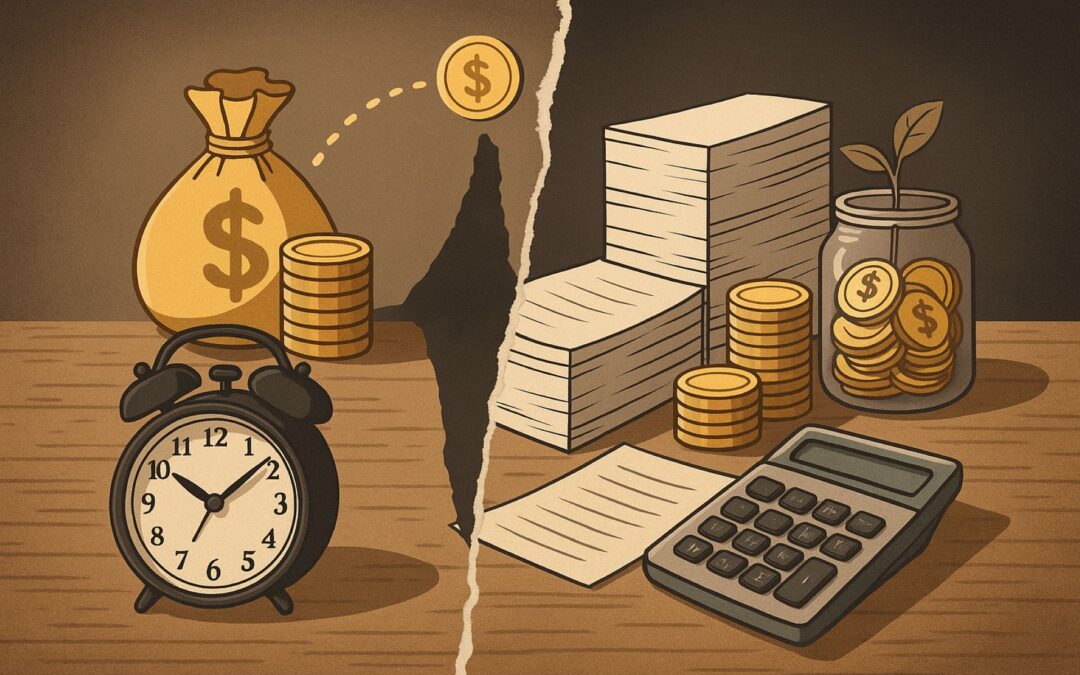
Everyone loves the idea of waking up richer than they were the night before. The thought of money quietly flowing into your account while you sleep, travel, or do absolutely nothing is intoxicating. This is the dream of passive income — a phrase that’s been splashed across book covers, online courses, and social media posts for decades.
But the dream and the truth rarely match. Behind the glossy marketing lies a far more complex reality: passive income isn’t a magical pipeline of cash, and it’s certainly not free. It’s the product of assets that take time, money, or both to create — assets that demand skill to maintain and discipline to protect. Understanding the origins, mechanics, and hidden costs of passive income is the only way to separate fantasy from fact.
The Myth
Passive income’s modern reputation rests on a glossy, airbrushed illusion — the idea that once you’ve “set things up,” you can step back forever while your bank balance fattens itself. This image has been deliberately crafted and polished by marketers, content creators, and authors who understand one thing very well: nothing sells faster than the promise of effort-free wealth.
Its roots, however, are completely unromantic. Before Instagram influencers filmed themselves sipping cocktails on Balinese beaches, “passive income” lived in the dry, bureaucratic language of the U.S. tax code. It wasn’t a motivational catchphrase. It wasn’t a lifestyle. It was a legal category with an entirely different purpose — to define and limit how certain types of investment income could be used to reduce taxes.
But the shift from legal jargon to financial fantasy happened in stages:
- The Rebrand – Self-help and finance writers of the 1990s began appropriating the term, using it to describe income streams that didn’t require traditional nine-to-five labor. It was catchy, aspirational, and vague enough to mean almost anything.
- The Internet Effect – As online business models exploded in the 2000s and 2010s, the phrase became the headline hook for courses, e-books, and coaching programs. “Passive income” was packaged as the inevitable outcome of starting a YouTube channel, building a drop shipping store, or buying an Airbnb property.
- The Social Proof Machine – Platforms like YouTube, TikTok, and Instagram provided the perfect stage for cherry-picked success stories. You’d see the top 0.1% who “made it,” not the thousands who quietly failed.
Reality sits in a far less glamorous corner:
- YouTube requires years of consistent posting, skill in storytelling, editing, and algorithm understanding. Monetization thresholds keep rising, and most creators earn less than the price of a weekly grocery run.
- Drop shipping sounds automated but is a logistical minefield. Ads must be monitored daily, suppliers can vanish overnight, and refund disputes can eat profit margins alive.
- Rental property can be profitable, but without significant capital and property management infrastructure, it feels more like firefighting than investing.
What’s sold as “passive” is often simply deferred work — months or years of intense input before any sense of ease arrives. Even then, maintenance, oversight, and risk never vanish. The term “passive” became a marketing device because “front-loaded grind” doesn’t sell courses.
The IRS Backstory
To see why the original meaning of passive income is so far removed from its current pop-culture definition, you need to rewind to the mid-1980s.
At the time, high-income professionals and wealthy investors were exploiting what became known as the passive loss loophole. It worked like this:
- The Setup – A wealthy individual, say a surgeon earning $600,000 a year, invests in a real estate partnership or limited partnership business they don’t manage.
- The Paper Loss – The investment generates a large loss on paper due to depreciation, interest deductions, and other allowable accounting measures. Let’s say $250,000.
- The Offset – The investor applies that $250,000 loss against their $600,000 active income. Their taxable income drops to $350,000, dramatically reducing their tax bill — often by six figures.
The kicker? These losses weren’t necessarily real in the cash sense. The property or business could still be generating positive cash flow while showing a tax loss. Investors were essentially turning accounting quirks into tax savings without lifting a finger in the day-to-day operations.
By the mid-80s, the IRS realized that billions in taxable income were disappearing annually through this maneuver. In response, the Tax Reform Act of 1986 introduced a sharp distinction:
- Active income – Money earned from actual work or business participation.
- Passive income – Money earned from ventures in which you do not materially participate.
The new rule was simple but powerful: passive losses could no longer offset active income. If you lost money on a rental property you didn’t manage, you couldn’t use that loss to shrink your salary’s tax liability.
This was the birth of “passive income” as a legal term — designed not to empower investors, but to close a lucrative tax loophole. It was an accounting label intended to prevent abuse of the tax system, not a roadmap to wealth creation.
Only later did marketers, seeing the term’s appeal, strip it from its original context and inject it with promise, glamour, and the intoxicating aroma of financial freedom.
The Reality
The first thing to accept about “passive income” is that the word passive is misleading to the point of being dangerous. In practical terms, what people mean when they use it are cash-generating assets — investments or creations that, once established, can produce income without demanding your full-time presence.
But these assets do not appear spontaneously. They must be built, bought, or inherited, and each route carries significant costs:
- Capital — Acquiring an income-generating asset often demands substantial sums. Buying a dividend stock portfolio, purchasing rental property, or investing in a private business isn’t something most people can fund from spare change.
- Time — If you lack money, you’ll need to substitute sweat equity. This could mean years of writing, recording, designing, coding, or building before the asset produces meaningful returns.
- Expertise — Without knowledge of the field, you risk building something unprofitable or buying something overpriced. Inexperienced landlords, for instance, often underestimate costs and overestimate rental demand.
The internet’s favorite “passive income” examples are actually just asset-based business models with varying degrees of ongoing work. For example:
- Dividend stocks require market research, portfolio management, and tax planning.
- Real estate demands legal compliance, repair oversight, and tenant relations — unless you outsource all of it, which cuts into profits.
- Royalties require not just creating the asset but also ensuring it reaches a wide audience to drive ongoing sales or licensing deals.
The more valuable and consistent the income stream, the higher the initial barrier. That’s why the wealthy dominate these categories: they already have capital, teams, and networks to turn an idea or purchase into a functioning cash flow machine. For everyone else, the road to “passivity” is long, steep, and paved with active labor.
Dividend Investing
Dividend investing is the archetype of what most people think passive income should be: a steady, predictable flow of money in exchange for ownership. You buy shares in a company, hold them, and periodically receive a slice of the profits.
How it works:
Public companies that generate healthy profits often reward shareholders by distributing a portion of those profits as dividends, typically on a quarterly basis. Some are blue-chip giants with decades-long histories of consistent payouts — think Coca-Cola, Johnson & Johnson, or Procter & Gamble. Others are “dividend growth” companies, steadily increasing their payouts year after year.
Why it’s attractive:
- No active management is required beyond the initial research and purchase.
- Dividends can be reinvested to accelerate portfolio growth through compounding.
- The income stream is relatively predictable, especially with companies that have stable cash flows.
The hidden reality:
- Yields are modest. Most reputable companies pay between 2% and 5% annually. At a 4% yield, $10,000 invested produces only $400 per year before taxes.
- Scale is essential. To generate $40,000 annually — enough to replace a modest income — you’d need around $1 million invested at that same 4% yield.
- Market risk still applies. Stock prices fluctuate. The value of your holdings can drop significantly, even if the dividend payments continue.
- Dividends can be cut. Companies under financial stress sometimes slash or suspend payouts, instantly reducing your income.
For many investors, dividends aren’t a quick path to freedom — they’re a preservation strategy. You accumulate wealth through active income, then park it in dividend-yielding assets to create stability and cash flow without selling your principal.
Real Estate
Real estate sits at the crossroads of tangible investment and operational business. On paper, the formula is seductively simple: buy a property, rent it out, collect monthly income, and watch your net worth climb as the property appreciates. In marketing speak, it’s the kind of asset that “works while you sleep.” But anyone who has actually owned and managed rental property knows the truth — unless carefully structured, it’s less “sleep” and more “sleep interrupted by tenant emergencies.”
The entry point:
There are multiple ways to invest in real estate:
- Single-family rentals – Popular with beginners, but highly dependent on finding and keeping reliable tenants.
- Multi-family units – Higher income potential but more complex management.
- Short-term rentals (Airbnb, Vrbo) – Potentially lucrative in high-demand locations, but demand is seasonal, regulations can shift suddenly, and guest turnover means more maintenance.
- Commercial property – Can yield larger returns but often requires significantly higher capital and longer vacancy management.
The operational reality:
- Tenant issues: Late payments, property damage, neighbor complaints, and legal disputes.
- Maintenance: Plumbing failures, HVAC breakdowns, roof repairs — all of which can be urgent, expensive, and disruptive.
- Vacancies: Every empty month is income lost, while expenses continue.
- Regulations: Landlord-tenant laws, zoning restrictions, licensing requirements for short-term rentals.
The “passive” version:
Real estate can approach true passivity, but only when it’s scaled and structured:
- Use leverage to purchase multiple units and spread risk.
- Hire professional property management to handle leasing, maintenance, and tenant communication.
- Implement standardized systems for repairs, rent collection, and record-keeping.
Even then, the investor’s role shifts from hands-on landlord to portfolio manager. This requires oversight, strategic decision-making, and periodic capital injections for renovations or expansions. The wealthy thrive here because they can deploy capital at scale, absorb occasional losses, and afford experienced teams — advantages that small investors often lack.
Royalties and Licensing
Royalties and licensing income stem from intellectual property — intangible assets you create or own that others pay to use. This could be a book, a song, a software program, a patented invention, or even digital designs. Every time your creation is sold, streamed, licensed, or integrated into another product, you earn a fee.
Types of royalties:
- Publishing royalties – For authors whose books sell through retail or digital platforms.
- Music royalties – Payments to songwriters, composers, and recording artists from streaming, radio play, or sync licensing in films and commercials.
- Patent royalties – Fees from companies that manufacture or sell products using your patented invention.
- Software licensing – Ongoing payments for the right to use proprietary software or code.
- Design licensing – Agreements allowing manufacturers to use a graphic, pattern, or character on products.
Why it’s appealing:
- Once the asset exists, royalties can continue for years or decades.
- The income is tied to usage or sales, so a popular work can scale dramatically without additional effort.
- In some cases, royalties can be sold upfront for a lump sum (royalty buyouts), giving creators immediate liquidity.
The reality check:
- Exposure outweighs quality. A brilliant novel no one reads won’t generate royalties. Conversely, a catchy, marketable song with heavy promotion can earn millions.
- Platform matters. Being signed to a major publisher or label offers distribution and marketing that independent creators struggle to match.
- Rights management is crucial. Without proper contracts, you can lose control of your work or see your royalties diluted by intermediaries.
- Success is often front-loaded. Many creative works earn the bulk of their royalties in the first months or years, tapering sharply afterward.
Case in point: Mariah Carey’s All I Want for Christmas Is You is estimated to bring in $2–3 million annually — 30 years after release. But this wasn’t just about writing a good song. Carey was already a global brand, backed by a major label with massive promotional capabilities. The song was released strategically, captured cultural timing, and benefited from repeated seasonal play. For an unknown artist without such machinery, even an equally catchy track would likely vanish unnoticed.
Royalties can indeed be a powerful, scalable income source, but getting to that point requires either significant personal brand equity or access to powerful distribution channels — and often both.
Digital Products and Content
Digital products are often marketed as the crown jewel of passive income. The pitch is intoxicatingly simple: create something once, and it sells forever while you focus on other things. This could be an online course, an e-book, a stock photography library, a video series, a paid newsletter, a membership community, or even downloadable templates.
Why it’s so attractive:
- Low replication cost: Unlike physical goods, digital products can be copied infinitely with negligible marginal cost. Once it’s made, delivering another copy is virtually free.
- Global reach: Your market isn’t limited by geography — a customer in Tokyo can buy the same course as one in Toronto.
- Potential for automation: Sales, delivery, and even customer service can be handled with software tools.
The reality check:
Two hard truths make this model far less “set it and forget it” than advertised:
- No audience, no revenue – The internet is flooded with digital products. Without attention, yours will drown in obscurity. Building a customer base means building a distribution channel — email lists, social media followings, paid ads, or partnerships. This can take years of consistent output before your first meaningful sale.
- Shelf life decay – Most digital products have a steep revenue curve: they spike at launch, then fade quickly. Interest drops as algorithms push newer content, competitors emerge, and trends shift. Unless you continuously refresh, market, or release new offerings, the income can dry up in weeks.
Operational realities:
- Marketing is constant. Even automated funnels require monitoring, optimization, and occasional overhaul.
- Support needs remain. Customers ask questions, request refunds, or run into technical issues — all of which require attention.
- Platform dependency is risky. If you rely on a marketplace like Udemy, Etsy, or Amazon, you’re at the mercy of their policies, fees, and algorithm changes.
An honest example: A creator who launches a course might see $20,000 in sales the first month, then $2,000 the next, then $200 unless they keep running ads, posting content, or relaunching with new bonuses. While technically the product exists and can earn money without additional creation, the demand for it needs constant stoking — which means ongoing work.
Private Equity and Limited Partnerships
Private equity (PE) and limited partnerships (LPs) represent some of the most lucrative forms of so-called passive income, but they sit firmly in the realm of the wealthy for one simple reason: the buy-in is expensive, and the game is closed to outsiders without connections.
How it works:
- Private equity involves investing directly in private companies — either acquiring them entirely or buying a stake — with the goal of increasing their value and selling at a profit.
- Limited partnerships are investment structures where you contribute capital to a business but have no operational role. You share in profits while the general partners manage day-to-day activities.
Why it appeals to the wealthy:
- Strong returns: Well-managed private equity deals can yield 8–20% annually, and sometimes significantly more if the business is sold at a high valuation.
- Truly hands-off: Limited partners don’t manage operations, employees, or strategy — they simply receive their share of profits.
- Exclusive opportunities: Many deals are invitation-only, accessible only through personal networks, high-net-worth investor groups, or specialized funds.
The barriers:
- High minimum investments: Often $100,000 or more for credible deals. Institutional funds may require millions.
- Illiquidity: Capital is locked up for years — 5 to 10 is common — with no option to withdraw early.
- Risk concentration: If the business fails, you could lose your entire investment. Diversification requires multiple large investments, further raising the entry bar.
- Due diligence: Access to trustworthy operators and a proven track record is critical. Without insider knowledge, the risk of backing a poorly managed business is high.
Example scenario:
A limited partner invests $250,000 in a regional healthcare company expansion. The general partners use this capital to open new locations, grow market share, and eventually sell the company to a national chain after seven years. The LP’s share of the sale nets them $600,000. On paper, that’s passive income — they never hired staff, negotiated leases, or handled customers. But the “passivity” came only after deploying significant capital, trusting capable managers, and waiting nearly a decade for the payoff.
Private equity and LP structures are, in essence, capital-powered passivity. They demonstrate a core truth about this entire topic: the less you work for the income, the more you must pay for the privilege of earning it.
The Hidden Cost
Passive income sounds effortless, but in reality, it’s simply income that no longer costs you daily labor — and that’s because you already paid the price upfront. That price always comes in one or more of three currencies: time, capital, or systems.
1. Time
If you don’t have money, you will pay in hours, weeks, and years. Time-built passive income often means years of work before a single dollar comes in.
- Example: An author might spend two years writing and editing a book, querying publishers, or building a self-publishing platform. Even then, royalties might trickle in slowly at first.
- Example: A YouTube creator could film hundreds of videos before reaching monetization thresholds, then another year before their ad revenue is significant.
The problem with the time currency is that it’s non-refundable — you can’t get it back if the project fails. This is why time-rich, cash-poor people often struggle in the passive income game: the long runway to profitability means they might run out of patience or resources before reaching the “passive” phase.
2. Capital
If you lack time but have money, you buy your way in. This is how wealthy investors create passive income — they simply purchase an already-working asset.
- Example: Buying a rental property that already has tenants and a property manager in place. The income starts immediately, though it still needs oversight.
- Example: Acquiring $1 million worth of dividend stocks to generate $40,000 per year without touching the principal.
The catch here is obvious: you need significant cash upfront, and you need to protect it. Bad investments can destroy capital far faster than labor builds it.
3. Systems
If you have neither time nor unlimited capital, you’ll need to create systems — a blend of technology, automation, and delegation that replaces your effort with processes.
- Example: A successful Etsy shop owner hires a virtual assistant to handle customer queries and outsources production to a print-on-demand service, freeing themselves from daily order fulfillment.
- Example: A real estate investor uses property management software, automated rent collection, and a vetted repair team to keep operations smooth without daily involvement.
Systems are the “lever” that turns active income into semi-passive income. But building them requires both upfront effort and ongoing maintenance.
The bottom line: Wealthy people look like they’re doing nothing because they already paid in one or more of these currencies years ago. They either built the asset from scratch, bought it outright, or engineered systems to keep it producing without them. Passive income isn’t the absence of cost — it’s the relocation of cost to the past.
The Truth
Passive income is often pitched as the path to getting rich. In reality, it’s the strategy for staying rich.
If your monthly bills — your burn rate — are covered by income from assets you don’t actively manage, you’re insulated from sudden job loss, business failure, or market downturns. But getting to that point almost always requires an initial phase of active income generation, careful spending, and deliberate reinvestment.
The Real Numbers
According to U.S. data, about 1 in 5 households earns some passive income in a given year. The median amount? Roughly $4,200 annually — about $350 per month. It’s a nice supplement, but hardly the kind of cash flow that lets you quit your job.
How True Financial Freedom is Built
- Earn actively first. Build your income through employment, entrepreneurship, or both.
- Spend below your means. The gap between income and expenses is your investment fuel.
- Acquire assets deliberately. Dividend-paying stocks, rental properties, royalties, private equity stakes — choose based on your resources and expertise.
- Cover your burn rate. Once your assets generate enough to reliably pay your monthly bills, you’ve reached a level of security that few achieve.
The Mindset Shift
Instead of seeing passive income as a golden ticket, think of it as a firewall. It doesn’t make you bulletproof, but it buys you time and options when life throws curveballs. The people who enjoy it the most aren’t the ones who stumbled into a magic formula — they’re the ones who spent years constructing it, brick by brick, so that it stands when they need it most.
Conclusion
Passive income is not a shortcut to sudden wealth — it’s the safeguard that protects wealth once you’ve built it. Its true value lies in stability, not speed. Those monthly checks, dividends, royalties, or rent payments are the rewards for capital deployed wisely, time invested patiently, or systems engineered carefully.
If you’re just starting out, chasing passive income too early can be a costly distraction. Your first priority is to grow your active income, live below your means, and channel the surplus into assets that will one day carry the load for you. That’s how you build a financial firewall — one that stands strong in good times and bad, not because it was effortless, but because you laid every brick with intention.