
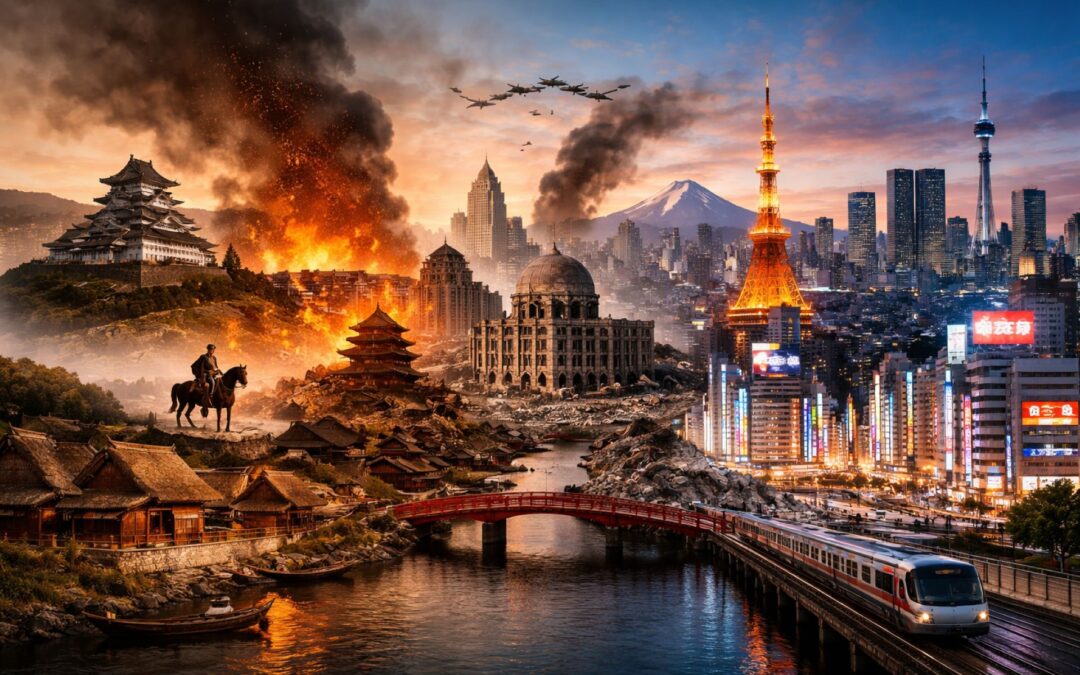
Introduction: A City Built on Reinvention
Tokyo is not supposed to exist in the form we see today.
A sprawling metropolis of over 37 million people, a global financial powerhouse, and one of the most efficient urban systems on Earth—Tokyo feels almost inevitable in hindsight. But its story is anything but. It did not rise steadily, nor did it grow under a single uninterrupted vision. Instead, Tokyo was built through cycles of chaos, collapse, and relentless reinvention.
Long before neon skylines and bullet trains, this land was a quiet, marshy edge of Japan—a place of fishermen, farmers, and scattered settlements. For centuries, it remained peripheral, overshadowed by imperial capitals like Kyoto and Nara. Nothing about its early existence suggested that it would one day become the beating heart of a nation.
And yet, again and again, history forced transformation upon it.
Warlords turned it into a strategic stronghold. Shoguns reshaped it into the political center of Japan. Fires reduced it to ashes, only for it to be rebuilt with greater ambition. Earthquakes leveled it. Bombings nearly erased it. Economic collapses tested its resilience. Each time, Tokyo did not just recover—it evolved.
This is what defines Tokyo.
Not permanence, but adaptation.
Not stability, but survival through change.
To understand Tokyo is to understand a pattern: rise, destruction, reinvention, expansion. A cycle repeated across centuries, driven by geography, power, disaster, and human determination.
This is the story of how a forgotten fishing village became the most unstoppable city in the world.
The Earliest Settlements: Geography Before Power
Long before Tokyo became a city, it was simply a landscape—one shaped perfectly for human survival.
Archaeological evidence suggests that people had been living in this region for thousands of years. The land around present-day Tokyo offered something rare and valuable: a combination of fertile plains, flowing rivers, coastal access, and natural protection from surrounding hills. For early hunter-gatherers, it was an ideal environment. Food was abundant, water was accessible, and the terrain allowed small communities to thrive without constant movement.
As agriculture spread across Japan, this region became even more significant. The introduction of wet-rice cultivation transformed the land into a stable agricultural zone. The flat plains could be easily irrigated, and the nearby waterways made it possible to sustain larger populations. What had once been temporary settlements slowly evolved into more permanent villages.
And yet, despite these advantages, this area remained on the margins of power.
Japan’s early political and cultural centers were concentrated elsewhere—first in Nara, then in Kyoto. These cities were closer to the imperial court, the aristocracy, and the religious institutions that shaped the country’s identity. In comparison, the eastern plains where Tokyo now stands were considered distant and underdeveloped—a frontier rather than a center.
For centuries, this region existed in the background of Japanese history.
But its geography quietly held potential.
The same rivers that supported early farming could later carry goods. The bay that sustained fishermen could become a gateway for trade. The flat land that hosted small villages could one day support a massive population.
At this stage, Tokyo was not yet important.
But it was ready.
All it needed was power to arrive.
The Birth of Edo: From Village to Stronghold
The transformation of this quiet landscape began not with emperors, but with warriors.
By the late Heian and early Kamakura periods, the eastern regions of Japan were no longer ignored. As central authority weakened, local samurai clans began to rise, carving out their own territories. Power was no longer defined solely by imperial favor—it was increasingly shaped by military strength and control over land.
It was in this shifting world that a small settlement known as Edo began to take form.
The name itself, meaning “entrance to the bay,” reflected its geography. Situated near the edge of Tokyo Bay and connected by rivers that reached deep into the inland plains, Edo occupied a position that was both defensible and economically promising. It was still modest—more village than city—but its location made it valuable.
In the 12th century, a local warrior established a foothold here, adopting the name Edo and laying the foundation for what would follow. Over time, a small fort was constructed—primitive by later standards, but significant enough to mark the settlement as more than just a rural outpost. This early structure would eventually evolve into Edo Castle, the nucleus around which the future city would grow.
For the next few centuries, Edo remained under the control of minor regional clans. It was not yet a center of power, but it was no longer invisible. Traders, artisans, and farmers began to gather around the growing stronghold, slowly expanding the settlement beyond its original limits.
The real shift came in the 15th century.
A more powerful samurai lord took control of Edo and began to reshape it deliberately. He fortified the castle, expanded the surrounding town, and encouraged migration into the area. Roads were improved, waterways were utilized more effectively, and Edo started to connect with other important regions like Kamakura and the broader Kanto plain.
For the first time, Edo was being built with intention.
Still, it was far from dominant. It remained one of many competing centers in a fragmented Japan, overshadowed by older and more established cities. But the foundations had been laid: a strategic location, a growing population, and a fortified core.
Edo was no longer just a village.
It was becoming a stronghold.
And in a country on the brink of chaos, that made all the difference.
The Warring States Period: Chaos Creates Opportunity
If Edo’s early growth gave it a foundation, the chaos of the 15th and 16th centuries gave it relevance.
Japan entered one of the most turbulent phases in its history—the Sengoku period, or the Age of Warring States. Central authority collapsed, and the country fractured into dozens of competing domains ruled by powerful samurai warlords. Alliances shifted constantly, betrayals were common, and warfare became a permanent condition of life.
In this environment, stability was rare—but opportunity was everywhere.
Edo, still a modest stronghold, found itself caught in the middle of this struggle. Control of the region passed between rival clans, each recognizing its strategic importance. Its access to waterways, its defensible terrain, and its position within the Kanto plain made it too valuable to ignore.
But Edo did not thrive because it was peaceful.
It survived because it was useful.
As warlords fought to expand their influence, places like Edo became logistical hubs—points from which armies could move, supplies could be gathered, and territories could be administered. Even when battles were not fought directly within its borders, the constant movement of troops, merchants, and resources brought activity to the region.
At the same time, the very instability of the era prevented any single power from fully developing it. Edo grew, but unevenly. Its progress was repeatedly interrupted by conflict, leadership changes, and shifting priorities. It was a place in motion, but without direction.
Yet this period did something crucial.
It elevated Edo from obscurity to strategic significance.
By the late 16th century, as larger and more ambitious warlords began to unify Japan, the importance of the Kanto region—and Edo within it—became impossible to ignore. Whoever controlled Edo would have a stronghold in one of the most valuable parts of the country.
All it needed now was someone with the vision to see beyond its present state.
Someone who could turn potential into power.
That moment was about to arrive.
Tokugawa Ieyasu and the Making of Edo
The man who would change Edo forever did not choose it because it was impressive.
He chose it because it wasn’t.
In 1590, after consolidating his power, the warlord Toyotomi Hideyoshi reassigned one of his most powerful allies—Tokugawa Ieyasu—to the Kanto region. It was a strategic move. By sending Ieyasu far from the traditional centers of power like Kyoto and Osaka, Hideyoshi hoped to keep him in check.
What Ieyasu received was Edo.
At the time, it was far from ideal. The castle was in poor condition, the surrounding land was marshy, and the infrastructure was underdeveloped. Compared to the great cities of Japan, Edo was still a backwater.
But Ieyasu saw something others had overlooked.
He saw space.
He saw waterways that could be controlled and expanded. He saw flat land that could support a massive population. He saw a defensible location, surrounded by rivers and open terrain. Most importantly, he saw the opportunity to build something entirely new—free from the constraints of older political centers.
So he began to rebuild.
Under Ieyasu, Edo was transformed with deliberate precision. Marshlands were drained. Land was reclaimed. Canals were dug to transport goods efficiently across the region. Roads were constructed to connect Edo with the rest of the Kanto plain and beyond. The castle was expanded into a massive fortified complex that would serve as both a military stronghold and an administrative center.
What had once been a modest stronghold was becoming a planned city.
Then came the turning point.
In 1600, Ieyasu defeated a coalition of rival warlords at the Battle of Sekigahara, securing his dominance over Japan. Three years later, he was appointed shogun by the emperor, establishing the Tokugawa shogunate—a military government that would rule the country for over 250 years.
And he chose Edo as its capital.
This decision changed everything.
Power shifted away from Kyoto, where the emperor still resided, to Edo, where real authority now lay. The city became the center of governance, administration, and military control. Daimyo from across Japan were required to maintain residences there. Resources, people, and attention began to flow into the city at an unprecedented scale.
Edo was no longer an emerging settlement.
It was the heart of Japan.
And under Tokugawa rule, it was about to grow into one of the largest cities on Earth.
Edo Becomes the Heart of Japan
Once Tokugawa Ieyasu established his rule, Edo did not grow gradually—it expanded with force and intention.
The Tokugawa shogunate created a system that made Edo the center of everything that mattered. Political authority, economic flow, and social structure all converged on the city. While the emperor remained in Kyoto as a symbolic figure, real power now operated from Edo, and that reality reshaped the entire country.
One of the most important mechanisms behind this transformation was the sankin-kōtai system.
Under this policy, regional lords—daimyo—were required to spend alternating years in Edo while leaving their families there permanently as a form of political hostage. This ensured loyalty, but it also had an unintended consequence: it turned Edo into a magnet for movement.
Every year, massive processions of samurai, servants, and administrators traveled to and from the city. These were not small delegations—they were vast, expensive caravans that required housing, supplies, and infrastructure. Roads were expanded, post stations were established, and entire industries grew around supporting this constant flow of people.
Edo became a city of circulation.
At the same time, the shogunate invested heavily in its physical expansion. The city was structured around Edo Castle, which stood at its center like a command hub. Surrounding it were layers of defensive walls, moats, and carefully planned districts. A network of canals allowed goods—rice, timber, fish, salt—to move efficiently across the city, feeding a rapidly growing population.
And that population grew at an extraordinary pace.
Within decades, Edo had transformed from a regional stronghold into one of the largest cities in the world. By the 18th century, its population had crossed one million—a staggering number for the time, rivaling or exceeding major European cities.
But Edo was not just large.
It was organized.
The city was divided into distinct zones based on function and status. Samurai districts occupied prime areas near the castle. Merchants and artisans lived in designated neighborhoods further out. Markets, workshops, and transport hubs were integrated into a system that allowed the city to function with surprising efficiency despite its size.
Everything in Edo was structured around control and flow—of people, goods, and power.
What had once been a quiet settlement at the edge of Japan was now its operational core.
Edo was no longer rising.
It had arrived.
Life in Edo: Order, Culture, and Control
If Edo was the heart of power, it was also a city built on strict control.
Every aspect of life was organized within a rigid social hierarchy. At the top stood the emperor and court nobility in Kyoto, but in reality, authority flowed downward from the shogun in Edo. Beneath him were the samurai—the warrior class that governed and enforced order. Below them were farmers, then artisans, and finally merchants, who despite often being wealthy, occupied the lowest official rank in society.
This structure was not just symbolic—it shaped daily life.
Where you lived, what you wore, what you could own, and even how you behaved were influenced by your place in this hierarchy. Samurai resided in carefully planned districts near the castle. Merchants and craftsmen filled the bustling commercial quarters. Farmers, though essential, remained tied to rural production systems that supported the city.
And yet, within this rigid framework, something unexpected flourished.
Culture.
Edo became one of the most vibrant urban centers of its time, not because of its rulers, but because of its people. The merchant class, despite their low social status, accumulated wealth and began to shape the cultural identity of the city. With money to spend and limited political power, they invested in entertainment, art, and leisure.
Entire districts emerged to serve this demand.
The most famous was Yoshiwara, a licensed pleasure district where social boundaries softened. Here, samurai, merchants, and commoners could momentarily escape the constraints of everyday life. Teahouses, bathhouses, and theaters became spaces where the city came alive after dark.
From this environment, new forms of art and expression took shape.
Kabuki theater captivated audiences with dramatic performances and stylized storytelling. Ukiyo-e woodblock prints captured scenes of urban life—actors, courtesans, sumo wrestlers—turning the everyday into something iconic. These were not elite art forms created for the court; they were born from the streets of Edo, reflecting the desires and realities of its people.
This was the paradox of Edo.
A city governed by strict rules, yet bursting with creativity.
A society defined by hierarchy, yet driven by those at its margins.
Control created stability.
And stability created culture.
A City of Fire: Destruction as a Constant
For all its order and growth, Edo was a city built to burn.
Nearly every structure in the city was made of wood. Houses stood tightly packed together. Open flames were used daily for cooking, heating, and lighting. And during the dry winter months, strong winds could carry even a small spark across entire neighborhoods.
Disaster was not a possibility.
It was inevitable.
Fires broke out frequently, so often that they came to be known as the “flowers of Edo”—a grim reflection of how common they had become. But nothing compared to what happened in 1657.
The Great Fire of Meireki began as a single blaze and quickly spiraled out of control. Driven by powerful winds, it tore through the city for three days. Entire districts were consumed. The fire reached the outskirts of Edo Castle itself. By the time it ended, an estimated 100,000 people were dead—roughly a tenth of the city’s population.
Edo had been reduced to ash.
And yet, what followed would define the city’s future.
The shogunate responded not just by rebuilding, but by rethinking the structure of the city. Roads were widened to act as firebreaks. Open spaces were introduced to prevent flames from spreading unchecked. Certain districts were reorganized to reduce density. Firefighting systems were improved, and specialized brigades were established to respond more effectively to outbreaks.
It was one of the earliest examples of large-scale urban redesign driven by disaster.
But even these changes could not eliminate the threat entirely.
Fires continued to sweep through Edo in the decades and centuries that followed. Entire neighborhoods would vanish overnight, only to be rebuilt again. For the people of Edo, destruction became part of the rhythm of life—a recurring interruption that demanded resilience.
And over time, that resilience became embedded in the city itself.
Edo learned how to rebuild quickly.
It learned how to adapt its structure after each loss.
It learned that permanence was an illusion.
Fire did not just destroy Edo.
It trained it.
Isolation and Stagnation: The Cost of Stability
For over two centuries, Edo existed in a state that seemed almost impossible for a city of its size: prolonged peace.
Under the Tokugawa shogunate, Japan adopted a policy known as sakoku—a system of national isolation that tightly restricted foreign contact. Trade was limited to a few controlled ports, and Japanese citizens were largely forbidden from leaving the country. External influences were minimized, and the flow of new ideas from abroad was deliberately contained.
On the surface, this created stability.
Edo thrived within a closed system. Its population grew, its economy functioned efficiently, and its cultural life continued to expand. The absence of large-scale war meant that the city could develop without the disruptions that had defined earlier centuries. Infrastructure improved, commerce flourished, and daily life became more predictable.
But this stability came at a cost.
Without external competition or influence, innovation slowed. Technological and industrial developments that were transforming other parts of the world during the same period—particularly in Europe—had little impact on Japan. Edo, despite being one of the largest cities on Earth, remained pre-industrial in its structure.
The social system, too, began to show cracks.
The samurai class, once the backbone of military power, found itself increasingly irrelevant in a time of peace. Many fell into financial hardship, dependent on fixed stipends that no longer matched economic realities. Meanwhile, merchants—officially at the bottom of the hierarchy—grew wealthier and more influential, creating a silent imbalance between status and power.
Tensions built beneath the surface.
The rigid social order that had once provided clarity now began to feel restrictive. Economic shifts challenged traditional roles. Cultural vibrancy continued, but it existed within boundaries that were becoming harder to justify.
Edo was still functioning.
But it was no longer evolving.
And beyond its borders, the world was changing rapidly—industrializing, expanding, and connecting in ways that Japan had chosen to ignore.
This isolation could not last forever.
Eventually, the outside world would arrive.
And when it did, it would force Edo—and all of Japan—to confront a reality it had long avoided.
The Black Ships: When the World Arrived
For over 200 years, Japan had controlled its borders.
Then, in 1853, the world forced its way in.
That year, a fleet of American warships appeared in Edo Bay under the command of Commodore Matthew Perry. Their arrival was unlike anything the Japanese had seen before. The ships were large, heavily armed, and powered by steam—technology that symbolized the industrial strength Japan had deliberately shut out.
To the people of Edo, they became known as the “Black Ships.”
They were not there to negotiate.
They were there to open Japan.
Perry carried a clear message from the United States: Japan must establish trade relations, or it would face consequences. The display of military power made the situation unmistakable. The Tokugawa shogunate, which had maintained internal stability for centuries, suddenly found itself unprepared for a threat it could neither match nor ignore.
When Perry returned the following year with an even larger fleet, the decision was made.
Japan would open.
In 1854, the Convention of Kanagawa was signed, granting American ships access to Japanese ports. Soon after, similar treaties were imposed by European powers—Britain, Russia, France, and the Netherlands. These agreements were unequal, heavily favoring foreign interests and undermining Japan’s sovereignty.
The impact was immediate.
What had been a controlled, insulated system began to fracture. The shogunate’s inability to resist foreign pressure exposed its weakness. Confidence in its leadership declined, and opposition grew among powerful samurai factions who believed that Japan had been humiliated.
Edo, as the center of political authority, became the focal point of this crisis.
Debates intensified. Loyalties shifted. Tensions escalated.
What began as a diplomatic encounter quickly turned into a national reckoning.
The arrival of the Black Ships did more than open Japan to the world.
It destabilized the very system that had built Edo.
And once that system began to break, there was no way to contain the consequences.
A new era was coming.
But it would not arrive peacefully.
The Fall of Edo and Birth of Tokyo
The collapse of Edo did not happen slowly.
It unraveled with speed, pressure, and inevitability.
After the forced opening of Japan, dissatisfaction with the Tokugawa shogunate spread rapidly. Many samurai and regional leaders saw the treaties with foreign powers as a sign of weakness—proof that the shogunate could no longer protect the country. What had once been a system of stability was now seen as an obstacle to survival in a changing world.
Opposition movements began to unite under a powerful idea:
Restore power to the emperor.
This was not just a political shift—it was a complete restructuring of authority. For centuries, the emperor had been a symbolic figure, while real power rested with the shogun in Edo. Now, that balance was about to reverse.
The tension escalated into open conflict.
In 1868, the Boshin War broke out—a civil war between forces loyal to the shogunate and those supporting imperial restoration. Key domains sided against the Tokugawa regime, and despite its long dominance, the shogunate could not withstand the combined pressure.
Edo, the very center of its power, became the focal point of this final struggle.
But unlike many cities in history, Edo was not destroyed in its fall.
Through negotiation and strategic surrender, the city was largely spared from widespread devastation. The Tokugawa leadership stepped down, and control passed to the imperial forces without the kind of destruction that often accompanies regime change.
This peaceful transition made something unprecedented possible.
A complete transformation without total collapse.
Soon after, the young Emperor Meiji formally assumed power. In a symbolic and strategic move, he relocated his court from Kyoto to Edo. The city, once the seat of the shogunate, was now to become the center of a new Japan.
And with that change came a new name:
Tokyo — the Eastern Capital.
The renaming was more than cosmetic.
It marked the end of feudal Japan and the beginning of a modern nation-state. Edo, with all its history tied to the old order, was redefined as Tokyo—a city meant to represent progress, centralization, and a new national identity.
The shift was profound.
Power had moved.
The system had changed.
And the city itself had been reborn—not through destruction this time, but through reinvention.
Tokyo had arrived.
But its greatest transformation was only just beginning.
The Meiji Transformation: Building a Modern Capital
If the fall of Edo marked a political revolution, the Meiji era turned Tokyo into a construction site for the future.
The new leadership understood something clearly: if Japan did not modernize rapidly, it risked being dominated—or even colonized—by Western powers. The fate of other nations in Asia was a warning they could not ignore.
Tokyo would become the proof that Japan could change.
The transformation began with infrastructure.
Western engineers, architects, and planners were brought in to redesign the city. Traditional wooden structures were gradually replaced or supplemented with stone and brick buildings. Broad roads were laid out to accommodate modern traffic. Gas lamps illuminated streets that had once gone dark at night. Telegraph lines connected Tokyo to other parts of the country, shrinking distances in ways that had never been possible before.
Then came connectivity.
Japan’s first railway line linked Tokyo to the port of Yokohama, creating a direct channel for trade and international exchange. Movement of goods and people accelerated. What had once been a relatively self-contained city was now part of a rapidly expanding national and global network.
But the transformation was not just physical.
It was social.
The rigid class system of the Edo period was dismantled. The samurai class, once the backbone of the old order, was gradually dissolved. Their privileges were removed, their stipends ended, and their role in society fundamentally altered. In their place emerged a new structure built around centralized governance, merit, and modernization.
Western influence became increasingly visible.
Clothing styles changed. Government institutions adopted new systems. Schools, universities, banks, and modern industries began to appear across the city. Tokyo was no longer just adapting—it was actively redefining itself.
This period was not without tension.
Rapid change disrupted traditional ways of life. Cultural identity was challenged as foreign ideas mixed with long-standing customs. But despite resistance, the direction was clear.
Tokyo was no longer a feudal city.
It was becoming the capital of a modern nation-state.
By the end of the Meiji era, the transformation was undeniable. Japan had emerged as an industrializing power, and Tokyo stood at the center of that shift—a city rebuilt not just in form, but in purpose.
Once again, Tokyo had reinvented itself.
This time, to face the modern world.
Disaster Strikes Again: The Great Kanto Earthquake
Just as Tokyo began to stabilize as a modern capital, disaster returned—sudden, violent, and overwhelming.
On September 1, 1923, the Great Kanto Earthquake struck.
The tremors themselves were devastating, but it was what followed that turned the disaster into a catastrophe. Buildings collapsed across the city. Infrastructure failed instantly. And within minutes, fires began to spread—dozens of them, ignited by broken gas lines, overturned stoves, and collapsing structures.
Tokyo, once again, was burning.
Strong winds from a nearby typhoon fanned the flames, turning isolated fires into unstoppable infernos. Entire districts were engulfed. Escape became nearly impossible in densely populated areas. In some places, firestorms formed—walls of heat that consumed everything in their path.
By the time it was over, more than 100,000 people were dead.
Over two million were left homeless.
Large parts of Tokyo had been reduced to rubble and ash.
It was one of the most destructive urban disasters in modern history.
And yet, like every crisis before it, this moment became a turning point.
The destruction created space—both physically and politically—for large-scale redesign. Authorities introduced wider roads to act as firebreaks. New building regulations encouraged the use of more durable materials. Parks and open areas were expanded, not just for recreation, but as emergency zones in future disasters.
The city’s infrastructure was reimagined.
Tokyo also expanded outward. As people displaced by the earthquake moved into newly developing areas, suburban growth accelerated. The city was no longer confined to its earlier boundaries—it began spreading into a larger metropolitan region.
This reconstruction was not just about recovery.
It was about resilience.
The earthquake had exposed the vulnerabilities of a rapidly modernizing city. The response addressed those weaknesses, laying the groundwork for a more robust urban system.
Tokyo had been shattered.
But in rebuilding, it once again became something larger than before.
The cycle continued.
War and Ruin: Tokyo in World War II
The rebuilding of Tokyo after the earthquake was ambitious.
But it would not last.
By the 1930s, Japan had entered a new phase—one defined not by reconstruction, but by expansion and militarization. Political power increasingly shifted toward military leaders, and Tokyo, as the capital, became the command center of a nation preparing for war.
At first, the effects on daily life were subtle.
Rationing began. Propaganda appeared across the city. Resources were redirected toward the war effort. But Tokyo itself remained largely intact—its people distant from the frontlines.
That illusion did not last.
After the United States entered World War II, the war came to Tokyo from the sky.
The first major air raid in 1942 caused limited physical damage, but it shattered any sense of security. It proved that Tokyo was vulnerable. What followed in the coming years was far more devastating.
American bombing campaigns intensified.
Then, on the night of March 9–10, 1945, Tokyo experienced one of the deadliest air raids in history.
Hundreds of bombers flew over the city, dropping incendiary bombs designed to ignite fires. In a city still filled with wooden structures, the result was catastrophic. Entire districts were consumed in flames. Firestorms swept through neighborhoods, trapping civilians with no escape.
In a single night, tens of thousands of people were killed.
Millions were displaced.
Vast portions of Tokyo were reduced to ash.
By the time the war ended later that year, more than half the city had been destroyed. Infrastructure was shattered. Industry was crippled. The population was exhausted, grieving, and struggling to survive.
Tokyo, once again, lay in ruins.
But this destruction was different.
Previous disasters had been local, accidental, or natural. This was the result of total war—systematic, deliberate, and overwhelming. It marked not just the destruction of a city, but the collapse of an entire national trajectory.
When Japan surrendered in August 1945, Tokyo entered a new phase—not just of rebuilding, but of redefinition under foreign occupation.
The city had lost more than buildings.
It had lost direction.
And the next chapter would determine what it would become.
Occupation and Reinvention: A New Japan Emerges
When the war ended, Tokyo was not just damaged—it was disoriented.
The city that had once commanded an empire now stood under foreign control.
American forces, led by General Douglas MacArthur, occupied Japan and established their headquarters in Tokyo, directly across from the Imperial Palace. From there, they began overseeing one of the most comprehensive national transformations in modern history.
This was not just reconstruction.
It was redesign.
A new constitution was introduced, fundamentally changing Japan’s political structure. The emperor, once seen as divine, was reduced to a symbolic figure. Democratic institutions were established. Civil liberties were guaranteed. The military, which had dominated national policy, was dismantled.
Tokyo became the center of this transition.
But while these changes reshaped the nation at a structural level, life on the ground was far more difficult.
The immediate post-war years were marked by scarcity. Food shortages were severe. Basic goods were hard to obtain. Informal markets—often operating outside legal systems—became essential for survival. People traded whatever they could, navigating a fragile and uncertain economy.
And yet, even in hardship, something new began to take root.
American cultural influence entered the city in visible ways. Jazz music played in clubs. Baseball gained popularity. Hollywood films attracted audiences eager for distraction. Western fashion, language, and lifestyle elements slowly blended with Japanese traditions, creating a new cultural landscape.
Tokyo was absorbing change again—but this time from outside.
By 1952, the occupation officially ended. Japan regained sovereignty, and Tokyo was once again under Japanese control. But the country it returned to was fundamentally different from the one that had entered the war.
The foundations had been reset.
What followed would be one of the most remarkable economic transformations in history.
Tokyo, once reduced to ruins, was about to rise again—this time as the center of a global economic powerhouse.
The cycle of reinvention was far from over.
The Economic Miracle: Rise of a Global Metropolis
What followed the occupation years was not just recovery.
It was acceleration.
From the 1950s onward, Japan entered a period of rapid economic growth that would come to be known as the “economic miracle.” Fueled by industrial expansion, technological innovation, and strong government coordination, the country transformed itself into one of the world’s leading economies.
And at the center of it all was Tokyo.
Factories, offices, and corporate headquarters spread across the city. Entire districts were reshaped to accommodate new industries. Infrastructure expanded at a scale that matched the country’s ambitions. Tokyo was no longer rebuilding what had been lost—it was building something entirely new.
Connectivity became a defining feature of this transformation.
In 1964, the Shinkansen—the world’s first high-speed rail system—began operations, linking Tokyo with Osaka. It was more than a transportation upgrade; it was a symbol. A declaration that Japan had entered a new era of speed, efficiency, and modern engineering.
That same year, Tokyo hosted the Summer Olympics.
For the first time, the world saw the city not as a site of war or destruction, but as a model of recovery and progress. The Olympics became a global showcase—a way for Japan to reintroduce itself on its own terms. Modern stadiums, highways, and infrastructure projects reshaped the urban landscape, leaving behind a city designed for the future.
The momentum continued through the 1960s and 1970s.
Tokyo expanded outward, absorbing surrounding towns and developing into a vast metropolitan region. Public transportation systems became increasingly sophisticated, allowing millions of people to move through the city with precision and reliability. Urban planning evolved to manage density without sacrificing functionality.
By the 1980s, Tokyo had become one of the most important cities in the world.
Its economy was booming. Its industries were globally competitive. Its real estate market surged to extraordinary levels, with land prices reaching unprecedented heights. Tokyo was no longer catching up—it was setting the pace.
From the ashes of war, it had risen into a global metropolis.
Once again, Tokyo had reinvented itself.
But rapid growth brings its own risks.
And the next phase would test whether this new version of the city could sustain its success.
Bubble, Crisis, and Stability: Modern Challenges
By the late 1980s, Tokyo stood at the peak of its power.
Its economy was booming. Its global influence was unmatched. Property prices soared to levels that seemed almost unreal—at one point, land in Tokyo was considered more valuable than entire countries. The city had become a symbol of limitless growth, where expansion felt inevitable and decline seemed impossible.
But that illusion did not last.
In the early 1990s, the bubble burst.
Real estate prices collapsed. Financial markets faltered. What followed was not a quick correction, but a prolonged period of economic stagnation that came to be known as the Lost Decade—though in reality, its effects stretched far longer. Growth slowed. Confidence weakened. The momentum that had defined Tokyo for decades suddenly stalled.
And yet, the city did not collapse.
Unlike previous crises—fires, earthquakes, war—this was not a physical destruction. It was economic, psychological, systemic. Tokyo had to adjust not by rebuilding structures, but by recalibrating expectations.
Stability replaced rapid expansion.
Even as the economy struggled, Tokyo maintained its core strengths. Its infrastructure remained world-class. Its public systems continued to function with precision. Daily life, though affected, did not descend into chaos. The city adapted quietly, absorbing the shock without losing its identity.
But challenges did not end there.
In 1995, Tokyo faced a different kind of threat when a domestic terrorist group carried out a chemical attack on the subway system. It was a rare moment of vulnerability in an otherwise safe city—an event that exposed how even the most advanced systems could be disrupted from within.
Then came natural reminders of fragility.
In 2011, a massive earthquake struck northeastern Japan. While Tokyo was not at the epicenter, the tremors were strongly felt. The event reignited awareness of the city’s exposure to natural disasters—a risk that has never fully disappeared.
And more recently, the COVID-19 pandemic disrupted urban life on a global scale.
Tokyo, like other major cities, faced lockdowns, economic slowdown, and uncertainty. Even the Olympic Games, meant to symbolize continuity and progress, were delayed and held without spectators—a stark contrast to the triumph of 1964.
Through all of this, one thing remained consistent.
Tokyo endured.
Not through explosive growth this time, but through resilience, stability, and quiet adaptation.
The challenges had changed.
But the pattern had not.
Tokyo Today: The Ultimate Megacity
Today, Tokyo is not just a city.
It is a system.
With a metropolitan population exceeding 37 million people, it stands as the largest urban agglomeration in the world. It stretches across a vast expanse of interconnected districts, suburbs, and satellite cities—so seamlessly integrated that the boundaries between them often disappear.
And yet, despite its scale, Tokyo functions with remarkable precision.
Its public transportation system moves millions of people daily with near-perfect timing. Trains arrive within seconds of schedule. Infrastructure operates quietly in the background, rarely drawing attention to itself. The complexity is immense—but so is the coordination.
This is not accidental.
It is the result of centuries of adaptation.
Tokyo has learned how to manage density without chaos. It has built systems that absorb pressure rather than break under it. Whether it is handling massive commuter flows, responding to natural disasters, or maintaining public order, the city operates with a level of efficiency that few others can match.
But Tokyo is not defined by systems alone.
It is also a city of contrasts.
Ancient temples stand beside glass skyscrapers. Traditional neighborhoods exist within minutes of hyper-modern commercial districts. Cultural continuity and technological innovation coexist, not as opposites, but as layers within the same urban experience.
This balance is part of what makes Tokyo unique.
It has never fully abandoned its past, even as it has embraced the future.
Economically, it remains one of the most influential cities in the world—a center for finance, technology, media, and global commerce. Culturally, it continues to shape trends that extend far beyond Japan, from design and fashion to entertainment and lifestyle.
And yet, beneath all of this, the same pattern still exists.
Tokyo is always preparing.
For the next earthquake.
For the next disruption.
For the next transformation.
Because history has taught it one thing above all else:
Nothing is permanent.
Everything can change.
And when it does, Tokyo will adapt—just as it always has.
Conclusion: The Pattern That Built Tokyo
Tokyo’s story is not defined by what it built.
It is defined by what it survived.
From a quiet fishing settlement to a samurai stronghold, from the seat of a shogunate to the capital of a modern nation, from ashes after fires and earthquakes to ruins after war—Tokyo has never followed a straight path. Every phase of its history has been interrupted. Every version of the city has, at some point, been erased or reshaped.
And yet, it never stopped.
What makes Tokyo unique is not its size, its economy, or even its efficiency. It is the pattern that runs through its entire existence—a cycle of disruption followed by reinvention. Where other cities might collapse under repeated crises, Tokyo has used each one as a moment to rebuild differently, often better.
Disaster did not weaken it.
It refined it.
Each fire improved its planning. Each political shift redefined its purpose. Each external shock forced it to adapt faster than before. Over time, this created something more than just a city—it created a system designed to endure change.
That is why Tokyo feels different.
It is not static. It is not fragile. It is constantly adjusting, constantly evolving, constantly preparing for what comes next.
In many ways, Tokyo is not a finished place.
It is a process.
A city that was never meant to become what it is—but did so anyway, through centuries of pressure, transformation, and resilience.
And if history is any indication, it is not done yet.