
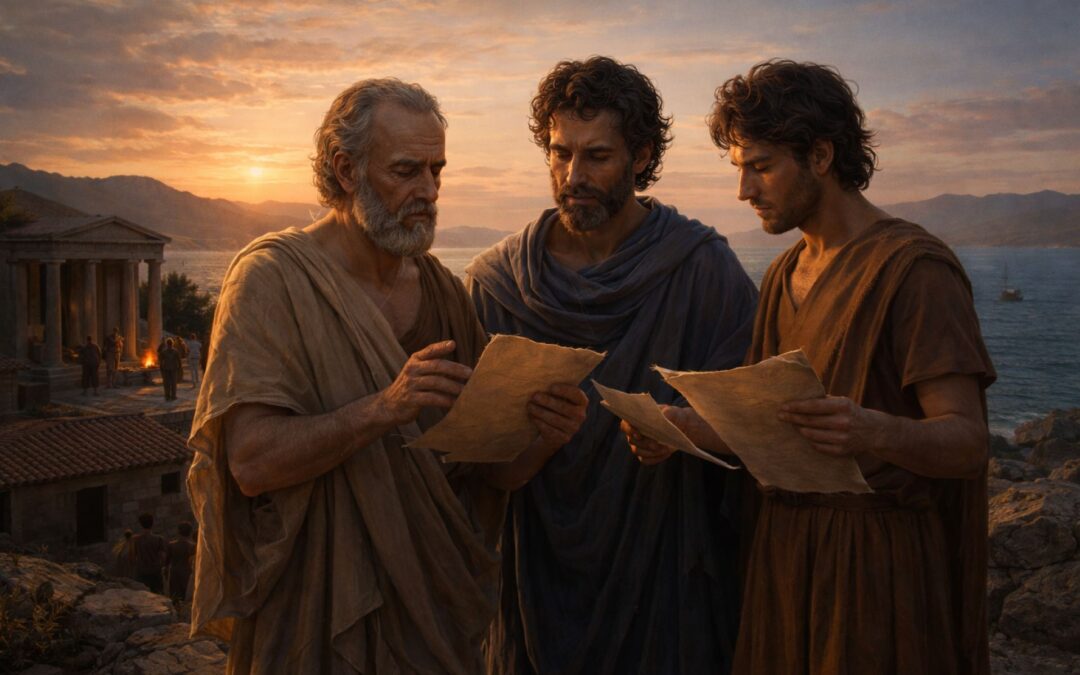
A World Still Ruled by Gods
Long before philosophy became a discipline, before science claimed authority over the natural world, human beings lived within stories.
In the 7th century BC, the world was alive with gods.
Across the Near East, powerful civilizations like Lydia and Babylonia shaped trade, warfare, and culture. Egypt stood as a monument to divine kingship, its traditions stretching back millennia. In China, the Zhou dynasty still held influence, quietly preparing the ground for thinkers like Confucius and Laozi. And in the Mediterranean, a small and fragmented region called Greece was beginning to stir after a long and uncertain decline.
This was not yet the Greece of marble statues and philosophical schools. It was a recovering civilization, emerging from what historians call the Greek Dark Age. Literacy had only recently returned, borrowed and adapted from the Phoenicians. Coinage was spreading from the East. Independent city-states—poleis—were forming, each with its own identity, customs, and ambitions.
But despite these changes, one thing remained constant: the way people understood reality.
The world was explained through myth.
Thunder was not a physical phenomenon—it was the will of Zeus. Earthquakes were not geological—they were the anger of Poseidon. The rising and setting of the sun, the changing of seasons, the unpredictability of fate—all of it was woven into a grand narrative populated by gods who looked, acted, and erred like human beings.
These stories were not naive inventions. They were the glue of society. Mythology provided order, meaning, and continuity. It told people where they came from, why things happened, and how to live. To question these stories was not just intellectually risky—it was socially disruptive.
And yet, in one particular place, something began to shift.
Not dramatically at first. Not loudly. But decisively.
In a coastal city on the edge of the Greek world, a different kind of question started to emerge—not who causes things, but what causes them.
That subtle shift would change everything.
Miletus: The City Where Thinking Changed
On the western coast of Asia Minor, facing the Aegean Sea, stood the city of Miletus.
It was not the largest city in the Greek world, nor the most powerful. But it occupied something far more important than territory—it occupied a crossroads. Trade routes from the East met the maritime networks of the Greeks. Ideas traveled alongside goods. Babylonian astronomy, Egyptian geometry, Phoenician writing systems—all of it flowed, directly or indirectly, into places like Miletus.
This mattered more than it might seem.
Unlike isolated societies, where traditions tend to harden into unquestioned truths, Miletus was exposed to alternatives. Different customs, different explanations, different ways of seeing the world. When multiple systems of belief coexist, something subtle begins to happen: certainty weakens. What once felt absolute starts to look contingent.
Why do we believe this and not that?
Miletus, in this sense, was not just economically vibrant—it was intellectually unstable in the best possible way.
It was also a city shaped by independence. Like other Greek poleis, it was not governed by a distant emperor or unified doctrine. There was no single authority dictating what must be believed. Religion was embedded in life, yes—but it was not centralized or dogmatically enforced in the way later systems would be.
This created space.
Space for speculation. Space for disagreement. Space for individuals to look at the world and wonder whether the inherited stories were explanations—or just traditions.
Imagine walking through its streets. The smell of bread from local ovens. The hum of merchants negotiating prices. The temples, ever-present, where rituals were performed with quiet devotion. Everything appears stable on the surface, anchored in custom and belief.
And yet, beneath that surface, something is shifting.
A few individuals begin to feel uneasy with the answers they have been given.
Not rebellious in the modern sense. Not seeking to destroy tradition. But dissatisfied. Curious in a deeper way. Instead of asking which god is responsible, they begin asking whether gods are necessary to explain anything at all.
It’s a dangerous line of thought.
Because once you start pulling at that thread, the entire fabric of explanation begins to unravel.
Miletus became the place where that unraveling began—not through chaos, but through inquiry.
And from that inquiry, a new way of thinking was born.
From Mythos to Logos: A Radical Break
The change that began in Miletus was not immediately visible.
There were no revolutions, no declarations, no sudden rejection of the gods. Temples still stood. Rituals were still performed. People still told the same stories about Zeus, Poseidon, and the rest of the Olympians.
And yet, something fundamental had shifted.
For centuries, human beings had explained the world through mythos—narrative, tradition, and divine storytelling. When something happened, the answer lay in intention. A god wanted it to happen. A force with personality and will stood behind every event.
But the thinkers emerging in Miletus began to approach the world differently. They moved toward logos—reason, structure, and explanation grounded in observation.
Instead of asking who caused this?, they asked what caused this?
That distinction may seem small. It is anything but.
To explain lightning as the anger of Zeus is to end inquiry. The answer is already complete. There is nothing more to investigate, nothing to test, nothing to refine. The explanation is final because it rests on authority—divine, unquestionable.
But to ask what lightning is—what it consists of, how it forms, why it behaves the way it does—is to open a door that cannot easily be closed. It demands observation. It invites disagreement. It requires explanations that can stand on their own, without appealing to tradition.
This was the radical move.
Not atheism. Not the denial of the divine. But the refusal to use myth as the default explanation for natural phenomena.
For the first time, nature itself became the object of study.
The world was no longer a stage governed by unpredictable personalities. It began to look like something structured—something that followed patterns, something that could be understood on its own terms.
This shift did not instantly produce correct answers. In fact, most of the early theories that followed were deeply flawed by modern standards.
But accuracy was not the breakthrough.
Method was.
The Milesians were not remarkable because they got things right. They were remarkable because they changed the rules of the game. They treated the world as something that could be explained without relying on inherited stories, something that could be questioned, revised, and improved.
And once that shift happens, there is no going back.
Because logos, once introduced, does something mythos never could—it allows knowledge to evolve.
From this point forward, explanation would no longer be fixed. It would become a process.
And that process began with a man who looked at the world and asked a deceptively simple question:
What is everything made of?
Thales: The First to Ask “What Is Everything Made Of?”
If the shift from mythos to logos marks the birth of philosophy, then Thales of Miletus stands at its beginning.
He is often called the first philosopher in the Western tradition—a title reinforced by none other than Aristotle. Whether or not he truly was the first is less important than what he represents: a new kind of thinker, one who sought explanations in nature itself rather than in divine stories.
But there is something elusive about Thales.
He wrote nothing down—at least nothing that survived. What we know of him comes from later figures like Herodotus and Diogenes Laërtius. And in those accounts, he appears almost larger than life: predicting eclipses, measuring the heavens, introducing geometry to Greece, even engineering practical solutions in times of need.
Some of these stories are likely exaggerated. Others may be entirely fictional.
But they all point to a single truth—Thales was known as a man who looked beyond the obvious.
One famous anecdote captures this perfectly. While gazing at the stars, absorbed in understanding the heavens, Thales is said to have fallen into a well. A servant girl, watching this unfold, laughed and mocked him: how could someone so eager to understand the sky fail to see what was right in front of him?
The story is humorous, but also revealing. It highlights a tension that would follow philosophy ever since—the tension between practical life and abstract inquiry. To many of his contemporaries, Thales must have seemed impractical, even foolish.
But what he was doing was something entirely new.
He was asking what lies beneath appearances.
Instead of explaining the world through gods, Thales proposed that everything originates from a single underlying substance—a first principle, or arche. This was not a mythological claim. It was an attempt at a universal explanation grounded in observation.
And his answer was simple:
Everything comes from water.
At first glance, this might seem naive. But within the context of his time, it was a bold and remarkably coherent idea. Water was everywhere. It sustained life. It changed form—liquid, vapor, ice. It nourished plants, filled the seas, fell from the sky. Even the human body depended on it.
From these observations, Thales constructed a theory: if something is so fundamental to life, so present in all things, perhaps it is the underlying substance from which everything arises.
He even extended this idea further. The Earth, he believed, floated on a vast, primordial ocean. Earthquakes were not the result of divine anger, but disturbances in this watery foundation.
He was wrong, of course.
But that misses the point.
What matters is that Thales replaced a divine explanation with a natural one. He didn’t say, “Poseidon causes earthquakes.” He asked, “What physical process could explain them?”
That question changed everything.
For the first time, the world was being interpreted through patterns rather than personalities, through observation rather than tradition. Thales may not have discovered the true nature of reality, but he did something arguably more important—he showed that reality could be investigated.
And in doing so, he set a precedent.
Knowledge was no longer something to inherit. It became something to pursue.
Anaximander: The Courage to Go Beyond the Obvious
If Thales of Miletus opened the door, Anaximander stepped through it—and then pushed it even further.
He belonged to the next generation, likely a student or at least a close intellectual successor to Thales. But where Thales grounded his thinking in something tangible, Anaximander moved in a more daring direction.
He abstracted.
Unlike his predecessor, Anaximander left something behind—fragments of written work. Though most of it has been lost, what remains offers a rare glimpse into one of the earliest attempts to articulate a philosophical worldview in direct language.
And it is not easy to interpret.
One of his surviving fragments speaks of things returning to their origin, giving “justice” for their existence over time. It sounds almost poetic, even mystical. But beneath that language lies something more systematic: an attempt to describe a universe governed not by personalities, but by principles.
Anaximander agreed with Thales on one crucial point—there must be a fundamental source underlying everything. A first principle, an arche, from which all things emerge and to which they eventually return.
But he rejected Thales’ answer.
Water, he argued, could not be the source of everything.
The reasoning is subtle but powerful. If water is the origin of all things, how do we explain its opposites? How does fire arise from water? Or dryness from something essentially wet? A single, defined element seems too limited to produce the diversity we observe in the world.
So Anaximander proposed something radically different.
The origin of all things, he claimed, is the apeiron—the boundless, the indefinite, the infinite.
This was a profound leap.
Unlike water, the apeiron is not something you can see, touch, or observe directly. It has no specific qualities. It is not wet or dry, hot or cold. It is, in a sense, beyond all distinctions.
And precisely because it is undefined, it can give rise to everything.
From this boundless source, opposites emerge—hot and cold, wet and dry, light and dark. The world as we experience it is the result of these oppositions coming into being, interacting, and eventually dissolving back into the apeiron.
In modern terms, it might sound almost metaphysical, even speculative to the point of abstraction.
But within its context, it was a bold and necessary move.
Anaximander recognized a limitation in earlier thinking and refused to accept an answer that did not fully account for the complexity of the world. Instead of settling for what seemed intuitive, he reached for something more comprehensive—even if it meant sacrificing concreteness.
His curiosity did not stop there.
He also proposed that the Earth is not supported by anything at all. It does not rest on water or pillars or divine structures. Instead, it remains suspended in space, held in place by its position at the center of a symmetrical universe.
This idea, simple as it may sound now, was revolutionary.
To suggest that the Earth floats freely—without support—required a complete reimagining of how the world is structured. It implied that there is something beyond the Earth, something like space, within which celestial bodies move.
For a time when most people conceived of the world as simply “sky above, ground below,” this was an extraordinary conceptual leap.
Of course, Anaximander’s cosmology was far from accurate. He imagined the Earth as a cylindrical form and the heavens as rings of fire. But again, accuracy is not the measure here.
What matters is the direction of thought.
With Anaximander, philosophy becomes more than observation—it becomes construction. He is no longer just looking at the world; he is building a framework to explain it, one that attempts to account for change, diversity, and structure all at once.
In doing so, he introduces something essential to the philosophical tradition:
The willingness to abandon what is obvious in favor of what is more complete.
And that willingness would shape everything that followed.
Anaximenes: Bringing Philosophy Back to the Tangible
After the bold abstraction of Anaximander, the next thinker in Miletus took a step that feels, at first, like a retreat—but is better understood as a correction.
Anaximenes was likely a student or close follower of Anaximander. And like his predecessors, he was committed to the same central question: what is the underlying principle—the arche—from which everything arises?
But he was not satisfied with the answer he inherited.
The apeiron, the boundless, was too vague. Too abstract. If the origin of everything cannot be observed, described, or even meaningfully imagined, then how can it truly explain anything?
For Anaximenes, a first principle had to be more than logically possible—it had to be connected to experience.
So he returned to something familiar.
Not water, like Thales, but air.
At first glance, this might seem like a step backward. Had philosophy really progressed, only to circle back to another basic element?
But Anaximenes’ thinking was more sophisticated than it appears.
He did not treat air as just another substance among others. He saw it as something dynamic—something capable of transforming into everything else through natural processes.
Where Thales offered a foundation, and Anaximander offered an abstraction, Anaximenes offered a mechanism.
His key insight lay in two opposing processes: condensation and rarefaction.
Air, when it becomes more condensed, transforms into other forms—first into wind, then clouds, then water, and eventually into earth and stone. As it becomes denser, it becomes heavier, colder, and more solid.
But air can also move in the opposite direction. When it becomes less dense—when it rarefies—it grows hotter and lighter, eventually becoming fire.
From this perspective, the diversity of the world is not the result of separate elements, but of a single substance changing its state.
Everything we see—solid, liquid, or fiery—is part of a continuous process.
This was a remarkable shift.
For the first time, the idea of transformation through natural processes takes center stage. The world is no longer explained by static substances alone, but by the way those substances change. Reality becomes fluid, dynamic, constantly in motion.
In this sense, Anaximenes moves closer to something we would recognize as a scientific mindset. He is not just identifying what things are made of—he is trying to explain how they become what they are.
Of course, his theory is not correct. Air does not condense into stone, nor rarefy into fire in the way he imagined.
But once again, correctness is secondary.
What matters is that Anaximenes insisted on a principle that could be observed, tested—at least in a rudimentary sense—and connected to everyday experience. He grounded philosophy in processes that people could, in some way, witness: breath, wind, heat, pressure.
And in doing so, he completed something important.
With Thales, Anaximander, and Anaximenes, we see not just three isolated ideas, but a progression:
From the concrete, to the abstract, and back to the concrete—each step refining the last.
They disagreed. They challenged one another. They replaced each other’s ideas without hesitation.
And that, more than any single theory, is where the real breakthrough lies.
A Tradition of Disagreement: The Real Breakthrough
What makes the Milesians remarkable is not that they agreed—it’s that they didn’t.
Thales of Miletus proposed water as the foundation of everything. Anaximander rejected that idea and replaced it with the boundless apeiron. Then Anaximenes dismissed the apeiron as too abstract and returned to a tangible principle—air—while adding a theory of transformation.
Each thinker built on the previous one, but not by refining it gently.
They challenged it.
They replaced it.
They moved forward by disagreeing.
This is easy to overlook, but it represents a profound shift in how knowledge itself is treated.
Before this, explanations were inherited. They came from tradition, from poets, from priests, from stories that were meant to be preserved rather than questioned. To doubt them was to step outside the accepted order of things.
But in Miletus, something different took shape.
Ideas became provisional.
They were no longer sacred. They were not immune to criticism. They existed to be examined, tested against observation, and—if necessary—discarded.
For perhaps the first time in recorded history, we see a pattern emerge:
A thinker proposes an explanation.
Another thinker evaluates it, finds its weaknesses, and offers a better one.
The process continues.
This is not just philosophy.
This is the beginning of intellectual progress as we understand it today.
Because progress depends on something counterintuitive—the willingness to be wrong.
If Thales had been treated as an unquestionable authority, his theory would have become doctrine. If Anaximander’s abstraction had been accepted as final, inquiry might have stalled in metaphysical speculation. If Anaximenes had simply echoed his teacher, nothing new would have emerged.
Instead, each thinker treated the previous idea as something to engage with, not something to preserve.
And that changed the trajectory of thought.
Disagreement, in this context, is not a flaw. It is the engine.
It forces clarity. It exposes assumptions. It pushes ideas beyond their initial limits. It prevents stagnation.
More importantly, it transforms knowledge from a static collection of truths into a living process—something that evolves over time.
This is the real legacy of the Milesians.
Not water, not the apeiron, not air.
But the method of questioning itself.
Once that method takes hold, it becomes almost impossible to stop.
Why They Were Wrong—and Why That Doesn’t Matter
From a modern perspective, the Milesians got almost everything wrong.
Thales of Miletus believed the world originated from water. Anaximander imagined a boundless, undefined source and a cylindrical Earth suspended in space. Anaximenes thought air could transform into all matter through compression and expansion.
None of these theories hold up under scientific scrutiny.
We know the Earth is not a disc or cylinder. We know matter is not reducible to water or air. We understand processes like earthquakes, weather, and cosmic structure in ways that would have been unimaginable to them.
So what are we supposed to do with their ideas?
Dismiss them as primitive attempts? Intellectual curiosities at best?
That would be a mistake.
Because if we judge them purely by correctness, we miss what actually made them extraordinary.
The Milesians were not working with accumulated knowledge. They had no scientific method as we know it, no established framework of experimentation, no access to centuries of prior refinement. They were starting, in many ways, from nothing—except observation and the willingness to think differently.
And what they produced was not truth, but something far more foundational:
A new way of arriving at truth.
They made a decisive move away from explanation by authority. They did not say, “This is how things are because tradition tells us so.” Instead, they attempted to construct explanations that could stand on their own—based on reason, consistency, and what could be observed in the world.
That shift is far more important than whether their conclusions were correct.
Because once you adopt that approach, error becomes part of the process.
In fact, it becomes necessary.
A wrong theory, if it is constructed rationally, can be challenged. It can be improved. It can be replaced by something better. But a fixed belief—especially one protected from criticism—cannot evolve at all.
This is why the Milesians matter.
They were wrong in a way that allowed future thinkers to be less wrong.
Their ideas created friction. They provoked questions. They exposed limitations. And in doing so, they laid the groundwork for a tradition that does not aim for immediate certainty, but for continuous refinement.
It is tempting to look back and see only the distance between their theories and our own.
But the real connection lies not in what they believed, but in how they believed it.
They treated knowledge as something to be built, not inherited.
And once that mindset takes root, being wrong is no longer a failure.
It becomes the beginning of understanding.
The Birth of Intellectual Freedom
What began in Miletus was not just a new way of explaining the world—it was a new way of thinking within it.
When Thales of Miletus replaced myth with observation, when Anaximander questioned that observation and pushed toward abstraction, and when Anaximenes brought the discussion back to tangible processes, they were doing more than proposing theories.
They were loosening the grip of inherited certainty.
In a world where explanations had long been handed down rather than examined, this was a subtle but powerful act of independence. It did not require rejecting tradition outright. It simply required refusing to treat it as final.
And that refusal changes everything.
Because once you allow a belief to be questioned, it becomes something else entirely. It is no longer an unquestioned truth—it becomes a proposition. Something that must justify itself.
This is where intellectual freedom begins.
Not in rebellion for its own sake, but in the quiet willingness to ask, Is this actually true?
That question is far more disruptive than it appears.
It unsettles authority. It weakens dogma. It creates space for alternative explanations. And perhaps most importantly, it shifts responsibility onto the individual. You are no longer just a receiver of knowledge—you become a participant in its formation.
But this freedom comes with a cost.
To question what everyone else accepts is to risk isolation. To admit uncertainty is to give up the comfort of fixed answers. To remain open to being wrong is to live without the illusion of finality.
The Milesians stepped into that uncertainty.
They did not arrive at perfect answers. They did not construct flawless systems. But they demonstrated something far more enduring: that understanding the world is not about preserving certainty—it is about refining it.
And this has consequences far beyond philosophy.
Every field that depends on progress—science, politics, culture, even personal growth—rests on the same principle. Ideas must be allowed to evolve. They must be exposed to criticism, tested against reality, and, when necessary, abandoned.
Without that, thought stagnates.
What began as a shift from mythos to logos eventually becomes something broader—a shift from passive acceptance to active inquiry.
And that shift is still unfolding.
Because the real legacy of the Milesians is not just that they asked new questions.
It’s that they made it possible for anyone else to ask them too.
What the Milesians Can Teach Us Today
It is easy to admire the Milesians from a distance.
They feel safely historical—figures from a time so far removed from ours that their struggles seem abstract, almost symbolic. But the conditions that shaped their thinking are not as distant as they appear.
We, too, live in a world saturated with explanations.
Not myths in the ancient sense, but narratives all the same—social, political, cultural. We are surrounded by claims presented as obvious, repeated until they feel self-evident, reinforced by the environments we inhabit. In many ways, the structure is the same. Only the content has changed.
And just like in Miletus, most of these explanations are not questioned.
They are absorbed.
This is where the Milesians become relevant.
What Thales of Miletus and those who followed him demonstrated was not just curiosity, but a particular kind of discipline—a refusal to settle too quickly on an answer simply because it is widely accepted.
They remind us that skepticism is not cynicism.
To question a belief is not to reject it outright. It is to examine it, to test its strength, to see whether it holds under scrutiny. In a time where information is abundant but not always reliable, this distinction becomes crucial.
Blind acceptance is dangerous, but so is reflexive doubt.
The challenge is to remain open without becoming ungrounded—to hold beliefs lightly enough that they can be updated, but firmly enough that they still guide action.
The Milesians also offer something else, something more subtle.
They show that disagreement is not a failure of understanding—it is part of it.
Anaximander did not hesitate to reject Thales. Anaximenes did not hesitate to challenge Anaximander. And yet, this chain of disagreement did not fragment knowledge—it advanced it.
Contrast that with the tendency to defend ideas simply because they are ours.
To protect them, to reinforce them, to avoid anything that might destabilize them. In doing so, we turn beliefs into identities—and once that happens, changing them feels like losing something essential.
The Milesians took a different approach.
Their ideas were tools, not possessions.
They used them to understand the world, and when those tools proved insufficient, they replaced them. There was no need to preserve an idea simply because it had been proposed before.
This mindset is difficult.
It requires a kind of intellectual humility that does not come naturally. It means accepting that what you believe today may not survive tomorrow. It means valuing the pursuit of truth over the comfort of certainty.
But it is also the only way progress happens.
In a sense, the Milesians were not just early philosophers.
They were early practitioners of a way of thinking that remains essential: observe carefully, question honestly, and remain willing to revise.
Not because it guarantees that you will always be right.
But because it ensures you are never permanently wrong.
Conclusion
Somewhere in the crowded streets of Miletus, surrounded by temples, trade, and tradition, a different kind of thought quietly took shape.
It did not announce itself as a revolution. It did not seek to overthrow the old ways overnight. But with figures like Thales of Miletus, Anaximander, and Anaximenes, something irreversible had begun.
The world was no longer explained solely through stories.
It became something to investigate.
What started as a simple question—what is everything made of?—opened a path that would stretch across centuries. That path would lead to more refined philosophies, to the emergence of science, to entire systems of thought built on the assumption that the world is intelligible, structured, and open to inquiry.
The Milesians did not arrive at the truth.
But they made truth something that could be pursued.
And that distinction matters more than any individual idea they proposed.
Because once knowledge becomes a process rather than a possession, it gains a kind of momentum. Each generation inherits not just answers, but methods. Not just conclusions, but questions.
We are still moving along that path.
Every time we challenge a belief, revise an assumption, or search for explanations beyond what is given, we participate—whether knowingly or not—in the same tradition that began in Miletus.
A tradition built not on certainty, but on curiosity.
Not on final answers, but on the willingness to keep asking.