
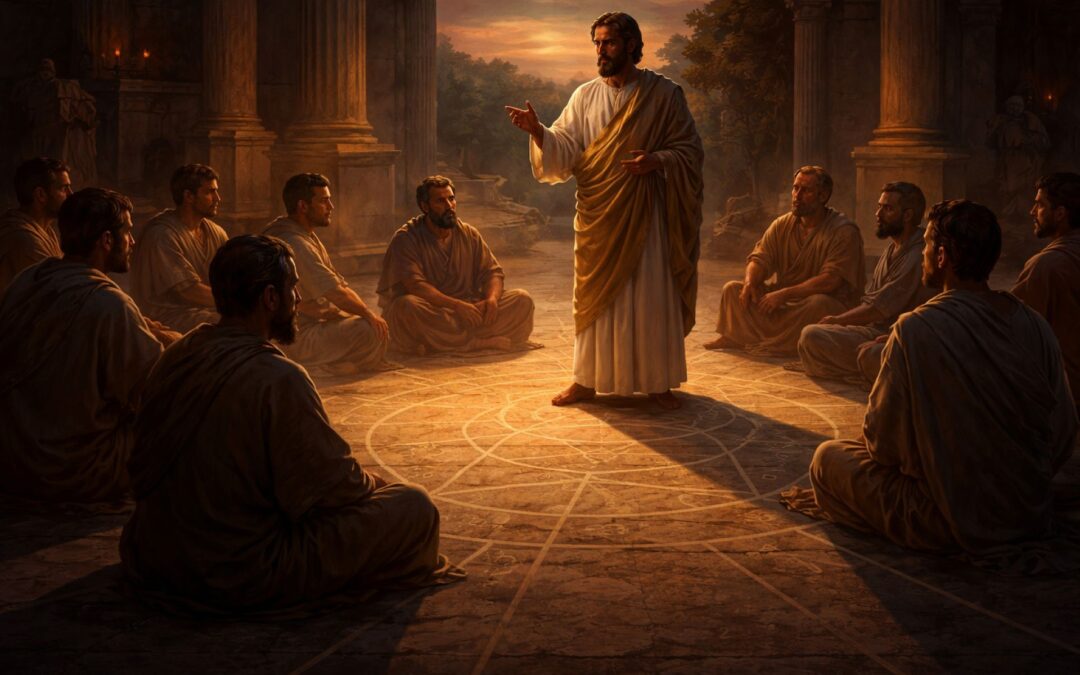
The Stranger in Croton
Imagine walking the streets of 6th-century BC Croton, a Greek city in Southern Italy. At first glance, everything appears to be in order. The economy is strong. Trade flows. The city holds influence across the region. It has even established itself as a center of learning.
But something feels off.
Beneath the surface, a quiet decay has begun to take hold. Wealth has turned into indulgence. Power has hardened into arrogance. Violence simmers just beneath daily life. And you—like many others—can feel it. A subtle sense that things are drifting, that something essential is being lost.
You don’t yet have the language to describe it. Only a question lingers:
Where is this all heading?
Then, one day, you see him.
A stranger moves through the streets, surrounded by a small group of followers. He doesn’t look like a ruler or a soldier, yet people make space for him. There is something unusually composed about him—something deliberate in the way he walks, the way he gestures, the way he speaks.
He is not loud, yet he draws attention effortlessly.
You notice his students listening with a kind of intensity that borders on reverence. He speaks, and they don’t interrupt. He moves, and they follow. There is an order to it, almost like a performance—but one that feels natural, not forced.
You slow your pace without realizing it.
For a moment, the noise of the city fades into the background. You don’t know what he’s saying, not entirely, but something about it suggests certainty. Not the kind that argues or persuades—but the kind that simply exists, as if it doesn’t need validation.
And that’s what unsettles you.
Because in a world that feels increasingly unstable, certainty is not just attractive—it’s magnetic.
You keep walking, but your attention stays behind. The image lingers. The voice echoes. The presence stays with you longer than it should.
Later, in a crowded tavern, you ask about him.
The answers only deepen the mystery.
Someone tells you his name is Pythagoras—a sage who teaches a way of life, not just ideas. A man who traveled far and returned with knowledge of numbers, stars, and music. Someone who claims that reality itself follows a hidden order.
Another voice, louder and less sober, insists that he is no mere man—but the son of Apollo. A being touched by the divine. Someone sent to restore balance in a world that has lost it.
Then a politician scoffs.
To him, Pythagoras is neither sage nor god, but something far more dangerous: a manipulator. A man gathering influence, building a following, and quietly positioning himself for power.
“A charlatan,” he says. “And a threat.”
The room fractures into opinions.
A teacher. A mystic. A fraud. A visionary. A danger.
No one agrees. Everyone is certain.
And somewhere between those contradictions, a question begins to take shape—not just about the man, but about the nature of belief itself.
Because the truth is, you don’t know what you saw that day.
A philosopher… or something else entirely.
The Pythagorean Problem
If you try to understand Pythagoras the way you would understand most historical figures, you run into a problem almost immediately.
There is no clear Pythagoras.
No writings authored by him. No contemporary accounts that describe him in a reliable, grounded way. No stable foundation from which to reconstruct his life with confidence. What we have instead is a patchwork—stories, second-hand reports, interpretations layered upon interpretations—many of them written centuries after his death.
And they don’t agree.
Some sources describe him as a philosopher of extraordinary insight, a man who uncovered deep truths about the structure of reality. Others portray him as a mystic, immersed in rituals, symbols, and strange taboos. Some elevate him to near-divine status. Others dismiss him as a fraud, a manipulator, or a political agitator.
At a certain point, you’re no longer studying a person.
You’re studying a legend.
Scholars have a name for this uncertainty: the “Pythagorean problem.” It refers to the difficulty—perhaps the impossibility—of separating what Pythagoras actually taught from what was later attributed to him.
And that distinction matters more than it seems.
Because over time, his followers began attaching ideas, discoveries, and teachings to his name—whether or not he had anything to do with them. Mathematics, philosophical doctrines, ethical rules, mystical practices—all of it slowly accumulated under the label “Pythagorean.”
The result is a kind of intellectual fog.
Take the most famous example: the theorem that bears his name. The relationship between the sides of a right-angled triangle—commonly written as a² + b² = c²—is one of the most well-known principles in mathematics.
But there’s strong evidence that civilizations long before Pythagoras already understood this relationship. The Babylonians, Egyptians, Indians, and Chinese all had knowledge of it in various forms.
So why does his name carry it?
Not because he necessarily discovered it—but because his name became a vessel. A symbol. A point of authority to which ideas could be attached.
And once that process begins, it becomes self-reinforcing.
The more authority a name holds, the more people are willing to attribute things to it. And the more things are attributed to it, the greater its authority becomes.
Over time, the distinction between origin and attribution disappears entirely.
This is why some scholars go so far as to question whether Pythagoras, as he is commonly described, ever truly existed at all. Not necessarily as a person—but as a coherent figure.
Instead, what may have survived is something more abstract:
A constructed identity.
A convergence point for ideas, beliefs, and practices that evolved over generations.
And yet, dismissing him entirely would be too easy—and probably inaccurate.
Because even if the details are uncertain, the impact is not.
Something happened in Croton. Something powerful enough to attract followers, provoke opposition, and leave a lasting imprint on philosophy, mathematics, and spiritual thought.
The challenge, then, is not to uncover the “true” Pythagoras in a strict historical sense.
That version may be gone.
The challenge is to understand how he was seen—how he was experienced by those around him—and what that reveals about the nature of authority, belief, and the human desire for certainty.
Because in the end, the mystery is not a flaw in the story.
It is the story.
From Samos to the Edge of the Known World
Before Pythagoras became a figure of mystery in Croton, before the followers and the rumors and the quiet sense of something larger than a man—there was Samos.
An island off the coast of Ionia. Busy, prosperous, outward-looking. A place where ships arrived carrying not just goods, but ideas. Egyptian grain, Phoenician glass, Mesopotamian textiles—and along with them, fragments of distant cultures, beliefs, and ways of thinking.
If you were born into wealth there, as Pythagoras likely was, the world did not feel closed.
It felt available.
His father is said to have been a merchant, a man whose life was defined by movement and exchange. That alone would have shaped something fundamental. Travel was not an abstract possibility—it was a reality embedded in daily life. The horizon was not a boundary; it was an invitation.
And in a place like Samos, curiosity had somewhere to go.
Education, too, was within reach. Ionia at the time was one of the most intellectually active regions in the Greek world. Thinkers were beginning to ask a different kind of question—not “what do the gods will?” but “what is the world made of?”
Figures like Thales and Anaximander had already started moving thought in that direction, searching for an underlying principle—the arche—that explained everything. Water, the boundless, air—each was an attempt to reduce the chaos of experience into something intelligible.
Pythagoras likely encountered these ideas, either directly or through their influence.
But he didn’t stay.
At some point, he left Samos—and what follows is less a clear journey and more a web of possibilities. Egypt, Babylon, Phoenicia, perhaps even further east. The accounts differ, sometimes wildly. Some claim he studied with Egyptian priests for years, absorbing their mathematical and religious knowledge. Others suggest he was taken to Babylon as a prisoner of war, where he encountered a completely different intellectual tradition.
There are even stories—less grounded, but persistent—that place him in contact with sages in India, or with figures like Zarathustra.
Whether these journeys happened exactly as described is almost beside the point.
What matters is the pattern they suggest.
Pythagoras was not shaped by a single tradition. He appears, at least through the lens of history, as a collector—someone who moved across cultures, absorbing ideas wherever he went, and bringing them into a single framework.
Mathematics from one place. Religious concepts from another. Astronomical observations, musical theory, ritual practices—all of it converging into something new.
Or at least, something that felt new.
This matters because it explains the strange duality that defines him later.
He is, at once, a rational thinker and a mystical teacher.
A man who sees numerical patterns behind musical harmony—and also one who speaks of the soul’s journey across lifetimes.
That combination doesn’t emerge in isolation. It requires exposure. It requires synthesis.
By the time he returns to the Greek world, Pythagoras is no longer just a man from Samos.
He is something more complex.
Not entirely Greek. Not entirely foreign. Not bound to a single way of seeing the world.
And that, perhaps, is what made him so compelling.
Because when someone speaks with the authority of multiple traditions—when they seem to carry knowledge from beyond the familiar—they don’t just sound informed.
They sound like they’ve seen something others haven’t.
And in a time already searching for answers, that kind of presence is difficult to ignore.
Why Croton Was Ready for Someone Like Pythagoras
By the time Pythagoras arrived in Croton, the city didn’t just need a teacher.
It needed direction.
On paper, Croton was thriving. It was wealthy, influential, and culturally significant—a place that had everything a successful Greek city was supposed to have. But prosperity often carries a hidden cost. When material success is secured, the question quietly shifts from how to survive to how to live.
And that question is far more dangerous.
Because survival has clear rules. Living well does not.
In that gap, something begins to erode. Discipline softens into indulgence. Freedom drifts into excess. Values that once held a society together become negotiable. What was once a structure becomes a choice—and eventually, a burden.
Croton was not collapsing.
But it was losing its center.
This is the kind of environment where new ideas don’t just appear—they take root. Not because they are necessarily true, but because they offer something that is missing.
Clarity.
Pythagoras arrived not as a politician, not as a reformer, but as something more subtle—and in many ways, more powerful.
He offered a way of life.
Not loose advice. Not abstract speculation. A system.
A structure that promised order in a world that felt increasingly disordered. A path that replaced uncertainty with rules. A framework that told people not just what to think, but how to live.
And that is what made him dangerous—or compelling, depending on where you stood.
Because most people don’t crave freedom as much as they think they do.
They crave stability.
They crave a sense that their actions align with something larger. That their lives are not just a series of random choices, but part of a coherent pattern.
Pythagoras gave them that pattern.
He didn’t simply explain the world—he reorganized it. He presented reality as something structured, harmonious, governed by principles that could be understood and, more importantly, lived.
And crucially, he embodied it.
He wasn’t just teaching ideas; he was the proof of them. His composure, his discipline, his certainty—it all reinforced the message. He looked like someone who had already solved the problem everyone else was struggling with.
That kind of presence doesn’t just attract attention.
It creates belief.
But there’s another layer to this.
Croton wasn’t just morally uncertain—it was politically unstable. Power was concentrated, contested, and often fragile. In such an environment, any organized group with a shared identity and strong internal cohesion becomes a force to reckon with.
And that’s exactly what Pythagoras began to build.
Not a loose gathering of students, but a community. One defined by shared practices, shared values, and—most importantly—shared loyalty.
From the outside, it may have looked like a philosophical school.
But from within, it was something closer to a parallel society.
And that is when admiration begins to turn into suspicion.
Because a man with ideas is one thing.
A man with followers is another.
Croton may have been ready for Pythagoras—but not necessarily for what he would become.
The Brotherhood of Silence
If Pythagoras had simply taught ideas in public spaces, he might have been remembered as just another philosopher.
But he didn’t.
What he built in Croton was not a school in the conventional sense. It was selective, structured, and deliberately closed off from the outside world. Entry was not guaranteed. Curiosity alone was not enough. You had to be chosen—or at least, approved.
And once inside, you didn’t simply learn.
You transformed.
One of the most striking features of the Pythagorean community was its emphasis on silence. New initiates were often required to remain silent for extended periods—sometimes years. They listened, observed, absorbed—but did not speak.
At first glance, this seems extreme.
But silence serves a purpose.
It breaks habits. It dissolves ego. It removes the impulse to argue, to assert, to resist. Without the ability to speak, the individual loses one of their primary tools of identity. What remains is something more malleable—more receptive.
In that state, ideas don’t just get understood.
They settle in.
And when someone finally speaks after prolonged silence, they don’t speak casually. Words regain weight. Expression becomes deliberate. The person that emerges is not quite the same as the one who entered.
This is not just education.
It is conditioning.
But silence was only the beginning.
The community operated with strict rules. Personal possessions were often shared. Daily life was structured. Diet, behavior, even small rituals were governed by principles that reinforced discipline and unity.
Everything pointed in one direction:
The individual was secondary to the system.
From the inside, this likely felt liberating. The burden of constant decision-making was lifted. Life became simpler, more defined. You didn’t have to question every step—you followed a path that had already been laid out.
But from the outside, it looked very different.
Secrecy breeds suspicion.
The Pythagoreans did not openly share their teachings. They did not explain their practices to the public. They existed as a contained group, bound by internal rules that outsiders could only guess at.
And where information is scarce, imagination fills the gaps.
Rumors spread.
Some said they possessed hidden knowledge about the cosmos. Others believed they practiced strange rituals. Some saw them as enlightened. Others saw them as dangerous.
Both reactions came from the same source:
Lack of transparency.
And then there was Pythagoras himself.
Within the group, he was not just a teacher. He was an authority. His words carried weight not because they were debated, but because they were accepted. Questioning him was not the norm—alignment was.
That dynamic changes everything.
Because when ideas cannot be challenged, they don’t evolve.
They solidify.
And when a group organizes itself around a central figure, bound by shared beliefs, strict rules, and limited external contact, it begins to resemble something more than a philosophical community.
It begins to resemble a closed system.
A system that sustains itself.
A system that protects its own structure.
A system that, once established, becomes very difficult to question from within.
This is where the line starts to blur.
Between discipline and control.
Between teaching and influence.
Between a school… and something closer to a cult.
Purification, Discipline, and the Pythagorean Way of Life
To understand the Pythagorean community, you have to look beyond its structure and into its intention.
Because all the rules—the silence, the shared possessions, the strict routines—were not random. They pointed toward a single goal:
Purification.
Not in a superficial sense, but in something far more absolute. The Pythagoreans believed that human life, as it normally unfolded, was flawed at its core. Too chaotic. Too impulsive. Too entangled in desire, excess, and ignorance.
To live as most people did was, in their view, to remain trapped.
So they sought to become something else.
Their practices were designed to strip away what they saw as impurities—habits, attachments, indulgences—and replace them with order, restraint, and awareness. This is why discipline was not optional within the community. It was the path itself.
Diet, for instance, was not just about health.
It was philosophical.
Pythagoras is often associated with vegetarianism, and not simply as a preference. It was rooted in a belief about the nature of life itself: that the soul does not end with the body. It continues. It moves. It can pass from human to animal and back again.
What we call reincarnation.
If that is true, then the boundary between species dissolves. The animal you consume may carry a soul that was once human. Or one that will be. Eating meat, in that sense, is not just an act of consumption—it becomes something morally ambiguous, even dangerous.
So abstinence was a form of respect.
A recognition that life, in all its forms, is interconnected.
But the dietary rules didn’t stop there.
Beans, famously, were forbidden. Why exactly remains unclear. Some explanations are practical, others symbolic, and some simply strange. But the reason almost doesn’t matter. What matters is that the rule existed—and was followed.
Because rules, even arbitrary ones, serve a deeper function.
They reinforce obedience. They create identity. They separate those inside from those outside.
And the more specific and unusual the rule, the stronger that separation becomes.
Beyond food, the Pythagorean way of life extended into ritual and behavior. There were instructions for how to enter and leave sacred spaces. What to do when thunder struck. How to handle moments of impurity. When to cut hair. When not to.
To an outsider, it might have looked excessive. Even irrational.
But from within, it formed a complete system.
Every action had meaning. Every detail was part of a larger structure aimed at aligning the individual with something beyond themselves.
Harmony.
That was the word that tied it all together.
The Pythagoreans believed the universe itself was ordered—not chaotic, but structured, balanced, governed by principles that could be understood. And if the universe had a kind of internal harmony, then the human being, as part of that universe, could either live in alignment with it… or against it.
Most people, in their view, lived against it.
Driven by impulse. Distracted by pleasure. Pulled in different directions without coherence.
The Pythagorean path was an attempt to reverse that.
To bring the individual into alignment with the structure of reality itself.
And that required discipline—not occasionally, but constantly.
Because harmony is not something you stumble into.
It is something you practice.
Day by day. Action by action. Choice by choice.
This is where the philosophy begins to take on a deeper shape.
It is no longer just about rules.
It is about transformation.
A deliberate effort to become a different kind of human being—one that is no longer ruled by chaos, but guided by order.
And once you accept that premise, the strictness of the system no longer feels excessive.
It feels necessary.
All Things Are Number
At the center of everything Pythagoras taught—behind the rituals, the discipline, the strange rules—there was a single, radical idea:
Reality is structured.
Not symbolically. Not metaphorically.
Literally.
While earlier thinkers searched for a physical substance behind the world—water, air, the boundless—Pythagoras shifted the question entirely. He wasn’t asking what the world is made of.
He was asking how it is organized.
And his answer was as simple as it was profound:
Number.
Not just as a tool for counting or measuring, but as the underlying principle of existence itself. For Pythagoras, numbers were not human inventions. They were features of reality—patterns embedded into the fabric of the universe.
Everything that exists, everything that happens, follows a structure that can be expressed numerically.
This was not an abstract claim.
It was an insight drawn from observation.
Patterns repeat. Shapes hold proportions. Movements follow cycles. What appears chaotic on the surface begins to reveal consistency when examined closely enough. And consistency, when understood, can be expressed as relationship—ratio, proportion, order.
Number becomes the language of that order.
And once you see it, you can’t unsee it.
The world transforms.
What was once a collection of separate things becomes a system. What felt unpredictable begins to show regularity. Even beauty starts to take on a different meaning—not as something subjective, but as something grounded in proportion and balance.
This is where Pythagoras departs from both myth and common experience.
He suggests that beneath the visible world—the colors, sounds, sensations—there is a deeper layer. One that doesn’t depend on perception.
A rational structure.
Something that exists whether we notice it or not.
This idea carries a quiet but powerful implication.
If reality is structured, then it is knowable.
Not in a mystical sense, but in a precise one.
It can be studied. Understood. Perhaps even predicted.
And this is where the philosophical becomes almost spiritual.
Because for the Pythagoreans, understanding this structure was not just an intellectual pursuit—it was a path.
To recognize the order behind things was to move closer to truth. And to align oneself with that order was to live more correctly, more harmoniously.
Numbers, then, were not just descriptive.
They were normative.
They didn’t just explain the world—they indicated how one should relate to it.
This is what makes Pythagorean thought so unusual.
It doesn’t separate science from spirituality.
It merges them.
Mathematics becomes more than calculation. It becomes a way of seeing. A way of orienting oneself within reality.
And once that perspective takes hold, everything begins to shift.
Music is no longer just sound—it is ratio.
Movement is no longer just motion—it is pattern.
Even the human soul, in some interpretations, becomes something that participates in this structure—a part of the larger numerical harmony that defines existence.
At that point, the idea stops being theoretical.
It becomes total.
A framework through which the entire world is interpreted.
And when a single idea begins to explain everything, it gains a different kind of power.
Not just explanatory power.
But persuasive power.
Because it doesn’t just answer questions.
It reshapes the way questions are asked.
Music, Ratio, and the Hidden Order of Reality
The idea that “all things are number” can sound abstract—almost too clean to apply to the messiness of real life.
But for Pythagoras, this wasn’t just philosophy.
It was something you could hear.
Music became one of the clearest windows into the structure he believed governed reality. Not because it was mystical in itself, but because it revealed something measurable hiding beneath something emotional.
A melody moves you. It feels fluid, expressive, almost unpredictable.
And yet, behind that experience lies something precise.
When a string on a lyre is plucked, the sound it produces depends on its length. Shorten the string, and the pitch rises. Divide it in certain proportions—simple ratios like 2:1 or 3:2—and the resulting tones don’t just change; they harmonize.
They fit.
What sounds beautiful to the ear corresponds to relationships that are mathematically simple.
This is the key insight.
Harmony is not arbitrary.
It is structured.
The intervals that form the foundation of music—octaves, fifths, fourths—can all be expressed as numerical ratios. What we perceive as pleasing or balanced has an underlying order that can be described, measured, and reproduced.
Emotion follows structure.
And that realization is quietly transformative.
Because it suggests that even in domains we consider subjective—like art or music—there is an objective layer. A hidden framework that shapes our experience without announcing itself.
Pythagoras didn’t just observe this.
He extended it.
If musical harmony emerges from numerical relationships, then perhaps harmony in a broader sense—cosmic, moral, existential—follows the same principle. Perhaps the universe itself is composed not of random parts, but of elements arranged in proportion.
A kind of grand composition.
This is where the idea of the “music of the spheres” begins to take shape. The notion that celestial bodies—the sun, the moon, the planets—move according to mathematical relationships that, if we could perceive them, would form a kind of cosmic harmony.
Not audible in the literal sense, but real in structure.
The universe, in this view, is not silent.
It is ordered.
And that order is beautiful—not because we project meaning onto it, but because it possesses an inherent coherence.
For the Pythagoreans, this wasn’t just a poetic idea.
It had consequences.
If the cosmos is structured harmoniously, then living well means aligning oneself with that structure. Just as a musical note must fit within a scale to sound right, a human life must align with the underlying order of reality to achieve balance.
Disharmony—whether in music or in life—is not just unpleasant.
It is a deviation.
This brings us back to their practices.
The discipline, the restrictions, the emphasis on purification—they were not arbitrary impositions. They were attempts to tune the individual, to bring them into resonance with something larger.
To make life itself… harmonious.
Whether this is true is another question.
But the elegance of the idea is undeniable.
That beneath the surface of things—beneath noise, chaos, and contradiction—there exists a structure. A pattern. A set of relationships that hold everything together.
And that if you could understand those relationships, even partially, you wouldn’t just hear the world differently.
You would live differently.
Philosophy or Control?
Up to this point, Pythagoras can be seen as something admirable.
A thinker searching for order. A teacher offering discipline in a world drifting toward excess. A man attempting to align human life with a deeper structure of reality.
But this is also where the picture becomes uncomfortable.
Because the same elements that make a system powerful… can also make it controlling.
A structured worldview offers clarity. But it also narrows interpretation. When everything is explained through a single framework, alternative perspectives don’t just seem different—they begin to seem wrong.
And once a belief system moves from “this might be true” to “this is how reality works,” questioning it becomes difficult.
Not intellectually.
Socially.
Within the Pythagorean community, ideas were not treated as open propositions. They were embedded into a way of life. You didn’t just think differently—you lived differently. You ate differently, behaved differently, followed rules that separated you from the rest of society.
And that separation matters.
Because the more distinct a group becomes, the stronger its internal identity—and the weaker its connection to the outside world.
This creates a kind of closed loop.
The group reinforces its own beliefs. The lifestyle confirms the philosophy. The philosophy justifies the lifestyle. Over time, the distinction between truth and practice fades.
It all becomes one.
And at the center of it sits a figure like Pythagoras.
Charismatic. Certain. Untouched by doubt, at least in appearance.
His authority didn’t come from debate or argument. It came from presence. From the sense that he knew—not tentatively, but absolutely. And in uncertain times, that kind of certainty is incredibly persuasive.
Because doubt is exhausting.
People don’t just want answers. They want answers that feel final.
This is where philosophy begins to resemble something else.
Because when a system demands obedience, discourages questioning, and centers itself around a figure whose authority is rarely challenged, it shifts from exploration to structure—from inquiry to alignment.
And alignment, once established, tends to protect itself.
Those who deviate are not just mistaken—they are outsiders. Those who leave are not just independent—they are lost. In some accounts, former members of the Pythagorean community were symbolically “erased,” treated as if they no longer existed.
That is not just a philosophical disagreement.
That is social control.
To be clear, this does not mean Pythagoras set out with manipulative intent. It is entirely possible—likely, even—that he believed deeply in what he taught. That he saw his system as a path toward truth, harmony, and a better way of living.
But intent does not change structure.
A system can be sincere and still be restrictive. It can aim for truth and still suppress questioning. It can elevate its followers while quietly limiting their freedom.
This is the tension at the heart of Pythagoras.
Was he guiding people toward a deeper understanding of reality?
Or was he creating a system that shaped how reality could be understood?
The difference is subtle.
But it matters.
Because one invites inquiry.
The other defines it.
Why the Pythagoreans Turned Political
At some point, a community like this stops being invisible.
It begins quietly—ideas shared, practices adopted, a small group forming around a common vision. But as the group grows, as its internal cohesion strengthens, it starts to exert influence beyond its own boundaries.
And influence, whether intended or not, has consequences.
The Pythagoreans were not just thinkers sitting in isolation. They were organized. Disciplined. Unified by a shared worldview and a structured way of life. That alone made them different from the average citizen of Croton.
But difference, when combined with coordination, becomes power.
Members of the Pythagorean community began to enter public life. They participated in politics, held positions of influence, and, in some cases, shaped decisions that affected the city itself. From their perspective, this may have felt like a natural extension of their philosophy.
If you believe you understand the structure of reality—if you believe you have access to a more harmonious way of living—then applying those principles to society doesn’t feel like control.
It feels like improvement.
Why wouldn’t you want to bring order to a disordered world?
Why wouldn’t you want to guide a society that seems to be drifting?
But from the outside, it looked very different.
To the average citizen, the Pythagoreans were already strange. Secretive. Bound by rules no one fully understood. A group that didn’t quite behave like everyone else, that operated with its own internal logic.
And now, they were entering positions of power.
That’s when curiosity turns into concern.
Because power is not just about ideas—it’s about who gets to decide which ideas matter. And when a tightly knit group begins to influence political structures, it raises a fundamental question:
Whose vision is being implemented?
The Pythagoreans did not present themselves as just another faction. They believed in a way of life that extended into every aspect of existence. Their philosophy was not limited to personal conduct—it had implications for how society itself should be organized.
And that kind of comprehensive worldview tends to expand.
It doesn’t stay contained.
To those within the group, this expansion likely felt justified. Perhaps even necessary. But to those outside, it began to feel like something else entirely:
Encroachment.
A group with shared beliefs, strong internal loyalty, and increasing political influence can easily be perceived as a threat—especially when its operations are not fully transparent.
Trust begins to erode.
Suspicion takes its place.
And once that shift happens, perception matters more than reality.
It no longer matters whether the Pythagoreans intended to dominate or simply to guide. What matters is how they were seen.
As outsiders. As a closed circle. As a force that operated differently—and therefore, potentially against the interests of the broader population.
This is where tension escalates.
Because societies can tolerate difference.
They struggle to tolerate difference with power.
And when that line is crossed, conflict becomes almost inevitable.
The Fall of the Cult
It didn’t collapse slowly.
It broke.
For a time, the Pythagorean community held its shape—disciplined, unified, and increasingly influential. But the very qualities that gave it strength also made it fragile. Tight cohesion creates resilience internally, but it amplifies pressure from the outside.
And pressure had been building.
Suspicion had already taken root in Croton. The secrecy, the unusual practices, the growing political presence—none of it sat comfortably with those who remained outside the circle. What once appeared intriguing now felt exclusionary. What once seemed disciplined now appeared rigid, even controlling.
And then something shifted.
The exact details are unclear—as they often are with Pythagoras—but multiple accounts point to a turning point where opposition erupted into action. Not quiet resistance. Not debate.
Violence.
Gathering places associated with the Pythagoreans were attacked. Houses were set on fire. Members of the community were hunted, dispersed, or killed. What had once been a structured and influential group was suddenly exposed—no longer protected by its internal unity.
A closed system can maintain itself under stable conditions.
It struggles when confronted directly.
The Pythagoreans had built something distinct, something separate. That separation had strengthened their identity—but it had also isolated them. When conflict came, there was no broader base of support to absorb the impact.
They stood apart.
And they fell apart.
Pythagoras himself is said to have fled, possibly to the nearby city of Metapontum. What happened after that remains uncertain. Some accounts claim he died shortly after. Others suggest more dramatic endings—starvation, exile, a final withdrawal from public life.
The man disappears, much like he appeared.
Without clarity.
But the collapse of the community is more than just an event.
It reveals something structural.
A system that defines itself too sharply against its surroundings eventually creates tension it cannot control. The stronger the internal identity, the sharper the external contrast. And when that contrast becomes too pronounced, coexistence becomes difficult.
Especially when power is involved.
From the outside, the destruction of the Pythagoreans may have felt like a correction. A rebalancing. The removal of something that had grown too insular, too influential, too detached from the rest of society.
From the inside, it would have felt very different.
Like persecution.
Like the destruction of something meaningful. Something disciplined. Something that, in their eyes, offered a better way of living.
Both perspectives can exist at the same time.
And that’s what makes the fall difficult to reduce to a simple narrative.
It wasn’t just a collapse.
It was a clash.
Between a structured system and a broader society.
Between internal certainty and external skepticism.
Between a group that believed it had found order—and a world that was not ready to accept it.
The Strange Afterlife of Pythagoras
If the story ended with the destruction of the Pythagorean community, Pythagoras would be little more than a historical curiosity.
A failed experiment. A man who built something intense and unusual—and lost it.
But that’s not what happened.
In a strange way, the fall of the cult may have made his influence stronger.
Because once the structure collapsed, the ideas were no longer contained.
They spread.
Fragments of Pythagorean thought survived in scattered groups across Southern Italy and beyond. The original community was gone, but the framework—the fascination with number, harmony, purification—continued to circulate, evolve, and reappear in different forms.
And then, centuries later, something unexpected happened.
A revival.
In the first century AD, a movement now known as Neopythagoreanism emerged. It drew heavily on the image of Pythagoras—not necessarily the historical figure, but the constructed one. The sage. The mystic. The man who understood the deeper order of reality.
By this point, the line between fact and myth had dissolved almost completely.
And that didn’t weaken his influence.
It amplified it.
Because a figure without clear boundaries becomes adaptable. You can shape him to fit new ideas, new contexts, new philosophies. You can emphasize the mathematical Pythagoras, the spiritual Pythagoras, the ethical teacher, the divine messenger—whatever the moment requires.
He becomes less of a person…
And more of a symbol.
This is also where the internal split among his followers becomes more visible. Some focused on the religious and ritualistic aspects—the rules, the practices, the purification. Others leaned into the intellectual side—mathematics, music, astronomy, the study of structure itself.
Two paths emerging from the same origin.
The akousmatikoi and the mathematikoi.
One oriented toward living the teaching.
The other toward understanding it.
And this division reveals something important.
The Pythagorean system was never just one thing.
It contained multiple layers—practical, philosophical, spiritual—and different people were drawn to different parts of it. Once the central authority disappeared, those layers began to separate, to evolve independently.
And with that separation came something inevitable.
Attribution.
Over time, more and more ideas were assigned to Pythagoras. Sayings, theories, discoveries—many of them likely originating from later followers or entirely unrelated sources—were absorbed into the expanding image of who he was supposed to be.
This is the Pythagorean problem, unfolding in real time.
The name becomes a container.
And the container keeps growing.
But why would his followers do this?
Why attach their own ideas to the name of a long-dead teacher?
Because authority scales.
An idea presented as your own must prove itself. It must be argued, defended, justified. But an idea presented as coming from a revered figure carries weight immediately.
It arrives pre-validated.
Especially when that figure is already surrounded by mystery, reverence, and the suggestion of divine insight.
By attributing their thoughts to Pythagoras, later followers weren’t just preserving his legacy.
They were strengthening their own.
And so, the figure of Pythagoras expands across time—not through direct transmission, but through accumulation.
Layer upon layer.
Story upon story.
Until what remains is not a clear historical person, but something more enduring:
A myth with intellectual gravity.
And that kind of myth doesn’t disappear.
It adapts.
It resurfaces.
It finds new contexts in which to matter.
Even now, traces of Pythagorean thinking persist—in the way we link beauty to proportion, in the way we search for patterns behind complexity, in the instinct to believe that beneath the chaos of experience, there is something ordered, something structured, something we might one day fully understand.
Whether that belief is true is still an open question.
But the impulse itself has proven remarkably resilient.
And in that sense, Pythagoras never really left.
What Pythagoras Still Reveals About Human Nature
Strip away the mystery, the myths, the contradictions, and what remains is not just a man or a movement.
It’s a pattern.
Pythagoras is interesting not only because of what he may have taught—but because of what formed around him. The reactions he provoked. The kind of following he inspired. The way his ideas evolved, spread, and solidified over time.
Because these things didn’t happen by accident.
They reveal something about us.
Humans are not just seekers of knowledge.
We are seekers of structure.
We want the world to make sense—not partially, but completely. We are drawn to explanations that don’t leave loose ends, to systems that don’t just answer questions but eliminate uncertainty altogether.
And when someone offers that—when someone presents a framework that explains reality in a clear, cohesive way—it does more than inform.
It reassures.
Pythagoras offered such a framework.
A universe governed by number. A life guided by discipline. A path that leads from chaos to harmony. It’s elegant. It’s coherent. It feels complete.
And completeness is powerful.
Because uncertainty is difficult to live with. Doubt lingers. It creates friction. It forces constant reevaluation. Most people don’t enjoy that process. They endure it.
So when a system appears that removes that burden—when it replaces open questions with structured answers—it becomes attractive, even if those answers are strict, even if they come with limitations.
Especially if they come with limitations.
Because limits create clarity.
They define what is acceptable, what is true, what is right. They reduce the overwhelming complexity of reality into something manageable. Something you can live by without constantly questioning it.
That’s the appeal.
But it comes with a trade-off.
The more complete a system becomes, the less room it leaves for deviation. The more it explains, the more it resists being questioned. Over time, what begins as insight can harden into doctrine.
And doctrine, by its nature, protects itself.
This is not unique to Pythagoras.
You see it everywhere.
In philosophical schools that become rigid. In religious traditions that begin as interpretation and end as authority. In modern ideologies that claim to explain everything and leave little room for doubt.
The structure repeats.
A compelling idea emerges. It attracts people. It organizes them. It evolves into a system. And eventually, the system begins to shape not just what people believe—but how they are allowed to think.
That is the deeper relevance of Pythagoras.
Not whether he discovered a theorem. Not whether he truly believed in reincarnation. Not even whether he was a philosopher or a cult leader.
But how easily the two can overlap.
Because the difference between a guiding idea and a controlling system is not always in the idea itself.
It’s in how it is held.
If an idea invites questioning, it remains alive.
If it demands acceptance, it begins to close.
Pythagoras stands at that boundary.
A figure who may have uncovered something real about the structure of the world—but who also became the center of a system that shaped how others were allowed to engage with that truth.
And that tension is not something we’ve outgrown.
If anything, we’ve refined it.
We still look for certainty. We still gravitate toward systems that promise clarity. We still follow voices that speak with conviction, especially when the world feels unstable.
The context changes.
The pattern doesn’t.
And that’s why Pythagoras still matters.
Not because we can fully understand him.
But because, in trying to, we begin to understand ourselves.
Conclusion
Pythagoras begins as a figure you glimpse in passing—a stranger in the streets, surrounded by followers, carrying an air of certainty that feels almost otherworldly.
And in a way, that is exactly how he remains.
Not fully known. Not fully understood. Always just slightly out of reach.
What we are left with is not a clean biography, but a layered image. A philosopher who may not have written a single word, yet shaped centuries of thought. A seeker of order who saw numbers where others saw chaos. A teacher who offered not just ideas, but a complete way of living.
And perhaps, a man who built something that went beyond philosophy.
Something that organized people, shaped behavior, and defined truth from within its own boundaries.
Whether we call that a school, a movement, or a cult depends on how we interpret the same set of facts—or fragments of facts.
But that ambiguity is not a weakness in the story.
It is the point.
Because Pythagoras forces us to confront something uncomfortable:
That the search for truth and the desire for certainty are not always aligned.
The more we want clarity, the more vulnerable we become to systems that promise it. The more we seek order, the easier it is to accept structure without questioning where it leads. And the more complete a worldview appears, the more likely we are to step into it fully—sometimes without noticing the cost.
Pythagoras offered a vision of reality that was elegant, coherent, and deeply appealing.
A universe governed by number. A life guided by discipline. A path from chaos to harmony.
But the same vision also carried the seeds of something else.
Authority. Structure. Control.
And that duality has never disappeared.
We still build systems around ideas. We still follow voices that seem certain. We still search for frameworks that make the world feel understandable, even if they simplify more than they reveal.
The names change.
The pattern remains.
So the real question is not whether Pythagoras was a genius or a manipulator, a philosopher or a cult leader.
It is this:
What happens when an idea becomes powerful enough that people stop questioning it?
Because that is where philosophy ends…
And something else begins.