
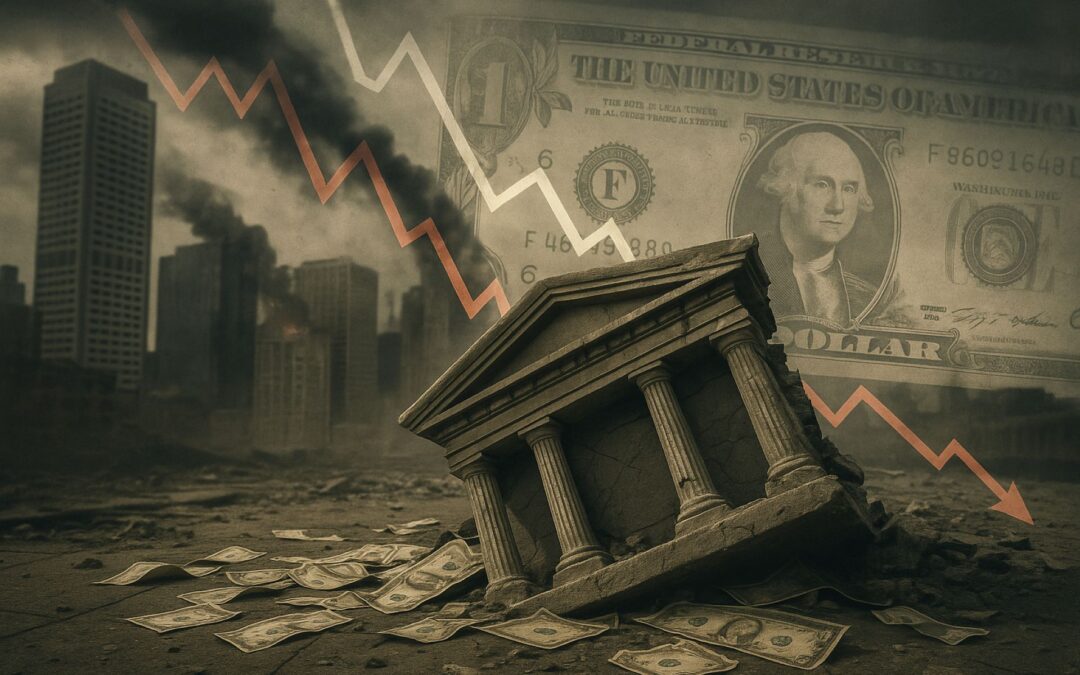
The 2008 financial crisis wasn’t just a headline—it was a global earthquake that shattered lives, businesses, and economies in a matter of months. What began as a seemingly unstoppable housing boom in the United States spiraled into the most severe economic disaster since the Great Depression. Trillions in wealth vanished, millions of jobs disappeared, and entire nations teetered on the brink of collapse.
Yet beneath the chaos lay a story of cheap money, reckless lending, and blind faith in financial innovation that promised safety but delivered catastrophe. To understand how it all unraveled—and why the scars are still visible today—we need to retrace the chain of events that led to the global financial crisis.
The Perfect Storm
The 2008 financial crisis wasn’t simply another recession on a chart—it was a once-in-a-century collapse that ripped through every corner of the global economy. Within months, nearly $19 trillion of household wealth in the United States alone was obliterated. That meant retirement accounts people had been building for decades were cut in half. College savings funds evaporated. Families that had once felt secure suddenly faced financial ruin.
Unemployment surged to 10%, the highest in a generation. That translated into more than 8 million jobs lost—millions of stories of careers cut short, small businesses shuttered, and working-class families left scrambling for food, housing, and healthcare. The stock market, a symbol of American prosperity, fell by over 50% from its 2007 peak. Entire pension funds that promised security for teachers, firefighters, and factory workers were thrown into jeopardy.
The swiftness of the unraveling made it uniquely terrifying. In previous recessions, downturns developed over years. This time, the destruction seemed instantaneous. Banks that had stood for more than a century toppled in days. Markets that had seemed invincible went dark almost overnight. The imagery of the time—foreclosed homes, boarded-up businesses, Wall Street bankers carrying boxes of belongings from offices—became emblems of modern fragility. What began as a housing slump metastasized into a global financial catastrophe, reminding the world that prosperity is always more fragile than it looks.
Cheap Money, Lofty Dreams
The seeds of the crisis were planted in the early 2000s, in the aftermath of the dotcom bust. With the economy faltering, the Federal Reserve, led by Alan Greenspan, embarked on an unprecedented series of interest rate cuts. Eleven reductions brought the benchmark rate down to 1.75%, the lowest level in four decades. Cheap money coursed through the economy, and borrowing became irresistible.
Homeownership, long celebrated as the pinnacle of the American Dream, became the political obsession of the era. Lawmakers pressed mortgage giants Fannie Mae and Freddie Mac to make housing more accessible, even to lower-income families with unstable finances. What followed was a lending boom that turned cautious banking into a reckless free-for-all.
Banks and mortgage brokers, enticed by the flood of demand and fat commissions, shredded traditional lending standards. Suddenly, proof of income wasn’t necessary. Stable employment wasn’t necessary. Even assets weren’t necessary. Anyone with a pen and a dream could walk away with a mortgage. Out of this recklessness emerged the infamous “NINJA loans”—No Income, No Job, No Assets.
For millions of Americans, it felt like a miracle. People who had been shut out of the housing market were suddenly holding keys to new homes. Suburbs expanded, construction boomed, and “house flipping” became a cultural craze. On the surface, the housing surge was painted as a triumph of economic inclusion. In reality, it was a house of cards. Loans were being given to people who, statistically, had little chance of paying them back. Instead of fueling long-term stability, the system was inflating one of the largest bubbles in history.
The Rise of Shadow Banking
Behind the optimism of cheap credit and record homeownership, a more sinister transformation was underway. Over decades, financial deregulation had chipped away at the post-Depression safeguards that once kept banks restrained. Out of the gaps in oversight grew a sprawling “shadow banking system”—investment banks, hedge funds, and insurance firms that acted like traditional banks but without the guardrails.
This shadow system thrived on leverage—the art of borrowing enormous sums to multiply potential profits. In April 2004, the Securities and Exchange Commission delivered Wall Street its golden ticket: it loosened the “net capital rule,” freeing large investment banks from leverage restrictions. Before this, banks could borrow about $12 for every $1 they held in capital. After the rule change, they could borrow virtually without limit. In practice, some investment banks operated at 30:1 or even 40:1 leverage. A mere 3% decline in the value of their assets could wipe them out.
But the danger was cloaked in financial innovation. Banks didn’t hold onto risky mortgages. Instead, they packaged them into Mortgage-Backed Securities (MBS) and even more exotic products known as Collateralized Debt Obligations (CDOs). These products were designed to look diversified, complex, and above all, safe. The reality was that they were stuffed with risky subprime mortgages.
The final stamp of credibility came from credit rating agencies—Moody’s, Standard & Poor’s, Fitch—who were supposed to act as impartial watchdogs. Instead, they became complicit. Paid by the very banks creating these securities, they assigned AAA ratings to assets that were little more than ticking time bombs. Investors worldwide—from pension funds in Europe to municipalities in Asia—trusted those ratings.
This was the fatal illusion of the era: risk wasn’t being eliminated, it was being disguised. The shadow banking system had created an alternate universe where garbage loans could be repackaged as pristine investments. And as long as housing prices rose, nobody bothered to question it.
Garbage In, Garbage Out
The financial machine of the early 2000s was built to run at full speed, regardless of what kind of fuel was poured into it. Mortgage lenders had little incentive to assess whether borrowers could actually repay. Their profits came not from long-term repayment but from originating the loan and passing it along. Once the papers were signed, the debt was sold upstream to investment banks.
The banks then worked their magic. They bundled thousands of mortgages together, slicing them into tranches—layers supposedly ranked by safety. At the top were “senior tranches,” marketed as ultra-secure. At the bottom were “equity tranches,” seen as risky but offering higher returns. In theory, this structure insulated investors from losses, since defaults would hit the bottom layers first. In practice, defaults were far more widespread than the models had ever imagined.
The real problem was that quality no longer mattered. Banks were earning enormous fees for every mortgage they packaged into Mortgage-Backed Securities (MBS) or Collateralized Debt Obligations (CDOs). The more loans, the more profits. Wall Street traders received bonuses based not on the long-term stability of these products, but on short-term revenue. This created a perverse incentive to shovel in as many loans as possible, even if the borrowers had no ability to pay.
Credit rating agencies greased the gears of this machine. Paid handsomely by the banks, they used flawed risk models that assumed housing markets would never fall nationwide. As a result, even securities stuffed with toxic subprime mortgages were stamped with AAA ratings—the same rating given to U.S. Treasury bonds. Pension funds, insurers, and foreign governments snapped them up, believing they were as safe as sovereign debt.
The logic seemed airtight: spread enough risk around and no one bears the brunt. But risk didn’t vanish—it merely accumulated in hidden corners of the system. The “garbage in, garbage out” problem reigned supreme. Loans that never should have been approved were repackaged so many times that they appeared pristine. Yet underneath the gloss, they were still the same rotten mortgages, waiting to explode.
Cracks in the Façade
By the mid-2000s, the illusion of endless growth began to fray. Homeownership had soared to record highs. Construction boomed. House-flipping shows dominated television. But beneath the exuberance, stress fractures were forming.
The first warning sign appeared in 2006 when the U.S. yield curve inverted—a classic predictor of recession. This meant short-term interest rates were higher than long-term ones, signaling that investors were losing confidence in future growth. A handful of analysts and hedge fund managers began to sound alarms, warning that the housing bubble was unsustainable. They were largely dismissed as alarmists. After all, hadn’t everyone agreed that housing prices only ever went up?
By 2007, the cracks widened into fissures. Home prices stopped climbing and began to fall. Suddenly, borrowers who had taken out adjustable-rate mortgages faced higher monthly payments just as their home values declined. Millions found themselves “underwater”—owing more on their mortgage than their home was worth. For many, default became inevitable.
Defaults rippled through the system like aftershocks. Subprime lenders, who had thrived on risky loans, began to collapse. New Century Financial, once one of the nation’s largest subprime lenders, declared bankruptcy. Smaller mortgage originators folded almost weekly.
Then came the shockwaves on Wall Street. In July 2007, two Bear Stearns hedge funds imploded under the weight of bad mortgage securities. Investors were stunned—if a prestigious firm like Bear Stearns could lose billions on supposedly safe assets, what did that mean for the rest of the system? Confidence cracked.
Banks grew skittish, reluctant to lend to one another. Credit markets, the lifeblood of daily financial operations, began to freeze. The façade of stability was crumbling, revealing the rot beneath. What had been hailed as financial innovation was now exposed as a fragile tower built on borrowed money and blind faith.
Collapse on Wall Street
By 2008, the financial system was unraveling in plain sight. What had begun as a string of defaults among subprime borrowers snowballed into a full-blown liquidity crisis at the very heart of Wall Street. The year opened with banks already bleeding from mortgage-related losses, but by March, the situation turned dire. Bear Stearns, a Wall Street institution founded in 1923, had leveraged itself heavily into mortgage-backed securities. When its creditors lost confidence and refused to extend short-term loans, Bear collapsed in a matter of days.
The Federal Reserve stepped in, orchestrating a fire-sale to JPMorgan Chase. The price? Just $2 a share—barely the cost of a cup of coffee. For perspective, Bear had traded above $170 a share the previous year. The message was clear: even titans could fall overnight. Panic spread through the financial world like a contagion.
By September, the crisis reached its crescendo. The government seized Fannie Mae and Freddie Mac, the mortgage giants that underpinned nearly half of the U.S. housing market. Their books were poisoned with bad loans, and their collapse would have shattered the global system even faster. Federal intervention was meant to calm the storm, but it only highlighted how unstable things had become.
Then came the breaking point. On September 15th, Lehman Brothers—founded in 1850 and once considered indestructible—declared bankruptcy. Its $600 billion balance sheet was riddled with toxic mortgage assets. The U.S. government, wary of fueling further moral hazard after bailing out Bear Stearns, refused to intervene. The shock was seismic. Lehman’s collapse was the largest bankruptcy in U.S. history, sending shockwaves through every corner of global finance.
Almost immediately, the dominoes fell. AIG, the world’s largest insurer, faced catastrophic losses on the credit default swaps it had sold to guarantee mortgage securities. Without intervention, its collapse would have triggered a cascade of failures across the globe. The Federal Reserve rushed in with an $85 billion rescue. But by then, credit markets were frozen. Interbank lending evaporated. Overnight, businesses couldn’t access the short-term funding needed for daily operations. Wall Street’s intricate web of financial engineering had imploded, and the world’s economic machinery ground to a halt.
Main Street’s Nightmare
While Wall Street boardrooms fought for survival, ordinary Americans bore the brunt of the collapse. The housing bust devastated families across the country. Over four million Americans lost their homes entirely. Another 4.5 million faced foreclosure proceedings, caught in a limbo where they were still technically homeowners but unable to pay their mortgages. Entire neighborhoods were dotted with “For Sale” signs, abandoned houses, and overgrown lawns. Communities that once thrived turned into ghost towns almost overnight.
Jobs disappeared at a terrifying pace. From 2008 through 2009, the U.S. economy shed 8.7 million jobs. Factories closed, construction halted, and small businesses folded under the weight of disappearing credit and collapsing demand. Unemployment surged to 10%—a number that translated into millions of families struggling to pay bills, buy groceries, or afford healthcare.
The crisis shredded retirement plans and long-term savings. 401(k)s and pension funds, which had been heavily invested in supposedly “safe” mortgage-backed securities, suffered enormous losses. For many Americans nearing retirement age, decades of careful planning vanished in months.
And the devastation didn’t stop at America’s borders. European banks that had gorged on U.S. mortgage securities teetered on collapse. Iceland’s banking system imploded, forcing the nation to seek emergency international aid. Stock markets from London to Tokyo fell by 40% to 60%, wiping out trillions in global wealth. International trade contracted sharply—nearly 10% in 2009—the steepest decline since World War II.
For everyday people, the financial jargon of “CDOs,” “credit default swaps,” and “leverage ratios” meant little. What mattered was the visible reality: lost jobs, foreclosed homes, and vanished savings. Wall Street had gambled with exotic products few understood, but Main Street was left to pick up the wreckage. The financial crisis may have been born in boardrooms, but its pain was felt most acutely around kitchen tables.
Lessons Written in Pain
In the rubble of the Great Recession, economists, policymakers, and ordinary citizens alike began piecing together the autopsy of what went wrong. The findings revealed not just a series of isolated errors, but a chain reaction of systemic failures that fed on one another.
The first lesson was about deregulation. For decades, financial markets had been gradually untethered from the strict controls put in place after the Great Depression. Glass-Steagall, the law that once separated commercial banking from investment banking, was repealed in 1999. This allowed banks to gamble with depositors’ money, blurring the line between safe lending and speculative risk-taking. By the mid-2000s, a “shadow banking system” had flourished, creating trillions in exposure without oversight or safeguards. The lesson: when risk has no leash, it runs wild.
The second failure was in the so-called watchdogs. Credit rating agencies—the institutions responsible for vetting the safety of bonds and securities—became complicit in the frenzy. Instead of protecting investors, they succumbed to conflicts of interest. Since they were paid by the very banks issuing securities, they had every incentive to stamp AAA ratings on bundles of subprime mortgages. Pension funds, municipalities, and foreign governments trusted these labels, only to later discover they were investing in toxic waste.
Third was the role of policy missteps. The Federal Reserve, under Greenspan and later Bernanke, kept interest rates extremely low throughout the early 2000s, flooding the economy with cheap credit. While this policy was intended to stimulate growth after the dotcom crash, it fueled an unsustainable housing bubble. Moreover, regulators operated under the ideology that financial markets could police themselves. Greenspan himself would later admit his belief in the self-regulating nature of banks was a “flaw” in his thinking.
Finally, the crisis exposed the myth that complexity equals safety. Wall Street’s “quants”—mathematical wizards designing exotic products—believed their models could slice risk into harmless pieces. They built algorithms that assumed regional housing markets were uncorrelated, meaning defaults in Florida wouldn’t affect defaults in Nevada. In reality, the entire housing market was tied together by the same loose credit and speculative mania. When the bubble burst, the correlations were nearly perfect—defaults everywhere, all at once.
The pain of 2008 taught a brutal truth: when risk is hidden behind layers of financial engineering, it doesn’t vanish. It multiplies.
The Bailouts and Backlash
As the financial system teetered on collapse in late 2008, the U.S. government made a decision that would define the era: step in with massive bailouts to prevent a total meltdown. The Troubled Asset Relief Program (TARP) authorized $700 billion to inject capital into banks, buy up toxic assets, and stabilize credit markets. It was one of the largest government interventions in economic history.
From a purely financial standpoint, the move worked. The capital injections prevented cascading bankruptcies that could have brought down not just Wall Street, but the entire global banking network. Credit began to thaw, and panic slowly receded. Without TARP, the recession might have spiraled into another Great Depression.
But politically and socially, the bailouts were toxic. Millions of Americans watched their homes foreclosed, their savings wiped out, their jobs vanish—and yet it was the banks, the architects of the disaster, that were rescued with taxpayer money. Wall Street bonuses persisted even as Main Street bled. The outrage was palpable. Protesters gathered in city squares, furious that the system had saved the guilty while punishing the innocent.
The term “moral hazard” entered the national lexicon. Critics argued that by rescuing reckless banks, the government had set a precedent: take huge risks, reap the profits when they pay off, and expect taxpayers to bail you out when they don’t. It looked less like capitalism and more like cronyism.
The Obama administration, sworn in amid the wreckage, sought to address the deeper rot. In early 2009, it passed the American Recovery and Reinvestment Act, a $787 billion stimulus designed to revive jobs, rebuild infrastructure, and provide relief to struggling households. It was a bid to restore confidence not just in markets, but in government itself.
Meanwhile, policymakers pursued reform. In 2010, Congress passed the Dodd-Frank Act, the most sweeping financial overhaul in generations. It forced banks to hold more capital, imposed routine stress tests, and created the Consumer Financial Protection Bureau (CFPB) to safeguard borrowers. The Volcker Rule, a key provision, barred banks from engaging in speculative trading with depositor funds. Globally, new Basel III rules raised capital requirements for banks worldwide.
Still, the scars of the bailout ran deep. To this day, many Americans see 2008 as proof that the system is rigged—that Wall Street’s failures will always be absorbed by taxpayers while Main Street is left to suffer. The anger birthed political movements across the spectrum, from Occupy Wall Street to populist waves that reshaped elections.
The bailout saved the system. But it also shattered trust in it.
The Lingering Scars
Though the Great Recession was officially declared over in June 2009, the reality on the ground told a very different story. Recovery was slow, uneven, and deeply painful for millions of families. It took years—nearly a decade in some cases—for the wounds of 2008 to even begin to heal.
Unemployment remained stubbornly high. At its peak, one in ten Americans was out of work, and even as jobs gradually returned, many were lower-paying or part-time compared to the ones lost. For a generation of young graduates entering the workforce, the timing could not have been worse. Saddled with student loans, they faced a labor market with scarce opportunities, leaving many underemployed for years. This “lost generation” carried the burden of delayed careers, delayed homeownership, and delayed families.
Housing, the epicenter of the crisis, took almost a decade to recover. Millions of foreclosed homes left deep scars on neighborhoods. Property values plunged, and for countless families, their largest source of wealth evaporated. Some never recovered. Others walked away entirely, abandoning “underwater” mortgages in towns across Florida, Nevada, and California. The suburban dream turned into ghostly cul-de-sacs of empty houses, symbols of a bubble gone bust.
Financially, the effects rippled far beyond housing. Retirement savings were decimated. For older Americans nearing retirement, there wasn’t enough time to rebuild their portfolios. Many delayed retirement indefinitely, while others were forced back into the workforce. The stock market, which had fallen nearly 40%, didn’t claw back to its pre-crisis highs until 2013. For ordinary families, the sense of financial security that had underpinned the American middle class was shaken to its core.
Psychologically, the scars ran even deeper. Trust in institutions—banks, regulators, politicians—plummeted. Millions came to believe the system was rigged, that rules applied differently to Wall Street than to Main Street. This disillusionment fueled anger that reverberated through politics and culture for years. From Occupy Wall Street protests in 2011 to the populist waves that reshaped U.S. and European elections later in the decade, the aftershocks of 2008 were as much political as they were economic.
The recession officially ended, but the lived experience lingered. The scars weren’t just visible in balance sheets—they were etched into neighborhoods, households, and the collective memory of an entire generation.
The Final Warning
The crisis of 2008 was not a freak accident—it was the predictable outcome of a system that mistook complexity for security and hubris for wisdom. Wall Street genuinely believed it had mastered risk. Sophisticated models, exotic instruments, and layers of financial engineering seemed to promise stability. In truth, they had only buried the danger deeper. When housing prices cracked, all that hidden risk surfaced at once, pulling down banks, insurers, and entire economies.
The ultimate lesson was sobering: complexity is not safety—it is camouflage. If an investment is so convoluted that even seasoned professionals struggle to explain it, it is not a marvel of modern finance. It is a ticking time bomb. The 2008 crisis revealed that the more complicated the system became, the more fragile it was.
Another warning lies in the illusion of eternal growth. Policymakers, bankers, and homeowners alike clung to the belief that housing prices could only rise. That collective faith created a bubble so vast it seemed indestructible. But history is merciless with illusions. Bubbles always burst, and when they do, they do so violently.
The crisis also left behind an uncomfortable paradox. The bailouts prevented a second Great Depression, but they entrenched the perception that large financial institutions were “too big to fail.” This moral hazard has lingered in the global system. Banks today are larger than ever, and while regulations like Dodd-Frank and Basel III have added guardrails, the underlying fragility of global finance has not disappeared.
The final warning is as relevant today as it was in 2008: when greed collides with complacency, collapse is never far away. The Great Recession was not just about bad loans or reckless bankers. It was about a culture that believed risk could be engineered out of existence, that innovation excused irresponsibility, and that prosperity was permanent.
The memory of 2008 endures as a cautionary tale. Prosperity is fragile. Trust is brittle. And when the lessons of the past are forgotten, history has a way of reminding us—brutally—that no system, no matter how sophisticated, is invincible.