
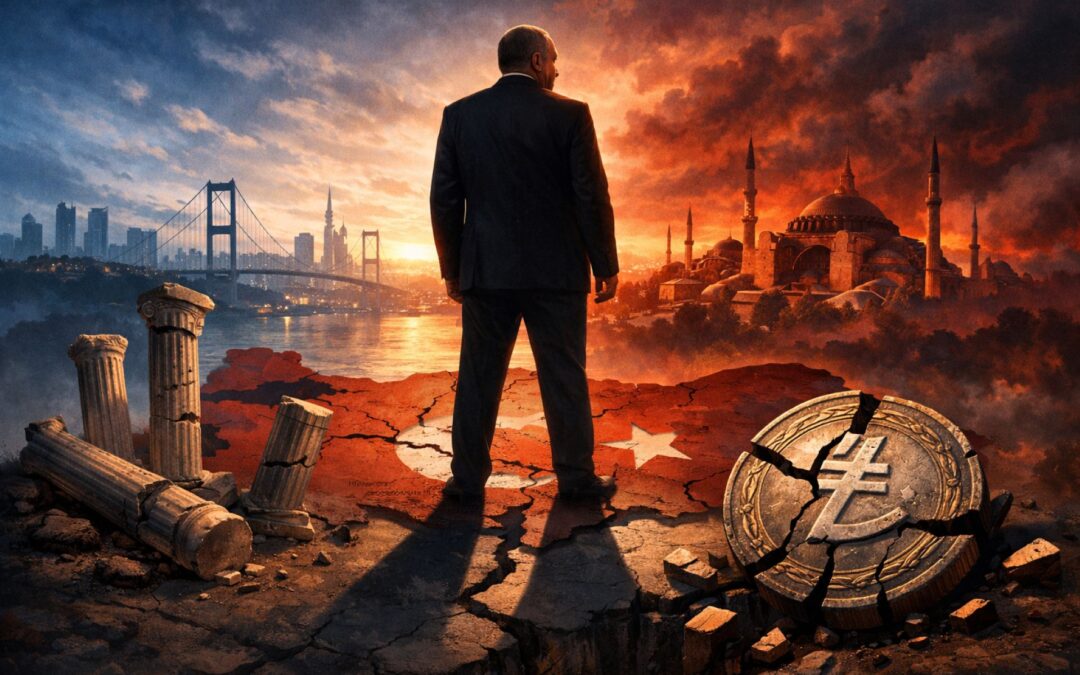
On the night of July 15, 2016, Turkey stood on the edge of political collapse. Tanks rolled onto the streets of Istanbul and Ankara, fighter jets thundered overhead, and factions within the Turkish military attempted to overthrow President Recep Tayyip Erdogan. For several tense hours, the fate of the country hung in the balance.
But Erdogan refused to disappear.
Broadcasting from a smartphone via FaceTime while on holiday, he called on ordinary citizens to defend the elected government. Within minutes, thousands of Turks poured into the streets, confronting soldiers and blocking military vehicles. By the following morning, the coup attempt had collapsed. Erdogan returned to Istanbul victorious, emerging not just as the country’s president but as the man who had defeated yet another military intervention in Turkish politics.
Nearly a decade later, that dramatic night has taken on a deeper significance. The failed coup marked a turning point in Erdogan’s rule and in the trajectory of modern Turkey. In the years that followed, power became increasingly concentrated around the presidency, political opposition faced growing pressure, and many of the institutions that once anchored Turkey’s democracy began to weaken.
At the same time, the country’s economic model started to unravel. Years of debt-driven growth gave way to currency crises, soaring inflation, and declining investor confidence. The Turkish lira lost much of its value, while unconventional economic policies deepened the instability.
Yet Erdogan’s story is not simply one of decline. Under his leadership, Turkey has also become far more assertive on the global stage. From Syria to Europe, Ankara has positioned itself as a major regional power capable of influencing events well beyond its borders.
This contradiction lies at the heart of Erdogan’s legacy. He has strengthened Turkey’s geopolitical influence while undermining the democratic and economic institutions that once supported its long-term stability.
To understand why many observers believe Erdogan is damaging Turkey’s future, it is necessary to examine his rise to power, the economic model that fueled his early success, and the institutional transformation that has reshaped the country over the past two decades.
From Working-Class Outsider to Dominant Political Force
A Conservative Voice in a Secular Republic
To understand Erdogan’s grip on Turkish politics, it is essential to understand the country he first entered as a young politician.
Modern Turkey was founded in 1923 by Mustafa Kemal Ataturk after the collapse of the Ottoman Empire. Ataturk’s vision was revolutionary. He sought to transform a deeply religious and traditional society into a modern, secular republic aligned with Europe. Religious authority was pushed out of public institutions, Islamic courts were abolished, and strict limits were placed on the role of religion in politics.
For decades, this secular system dominated Turkish political life. But it also created a divide. Much of Turkey’s urban elite embraced Ataturk’s secular reforms, while many working-class and rural communities remained socially conservative and religious.
Erdogan emerged as a political figure representing this overlooked segment of society. Born in 1954 to a working-class family in Istanbul, he grew up in a conservative environment and attended a religious vocational school known as an Imam Hatip school. These institutions combined standard academic subjects with Islamic education and were often viewed with suspicion by Turkey’s secular establishment.
For Erdogan and many of his supporters, the secular political elite seemed disconnected from the values and traditions of ordinary Turks. This cultural divide would later become one of the central themes of his political message.
The Istanbul Mayorship That Changed Turkish Politics
Erdogan’s breakthrough came in 1994, when he ran for mayor of Istanbul.
At the time, Istanbul was not just Turkey’s largest city—it was the economic and cultural heart of the country. Winning the mayoralty meant controlling a vast urban administration and gaining a powerful national platform.
Erdogan’s victory shocked the political establishment. Running as a candidate associated with Islamist political movements, he defeated rivals backed by Turkey’s mainstream parties. Many secular politicians feared that his victory signaled the rise of political Islam.
Yet Erdogan’s performance as mayor surprised many critics. During his four-year tenure, he focused on practical issues such as waste management, transportation, and water shortages—problems that had plagued the city for years. His administration improved municipal services and earned a reputation for efficiency.
For many voters, Erdogan began to appear less like a radical ideologue and more like a capable manager who could deliver results.
Prison, Martyrdom, and the Birth of the AKP
Erdogan’s political career took a dramatic turn in 1999.
During a public rally two years earlier, he had recited a nationalist poem that contained religious imagery. In Turkey’s rigidly secular political environment, the speech was interpreted as inciting religious hatred. Erdogan was arrested, removed from office, and sentenced to prison.
The decision backfired.
Instead of ending his career, the imprisonment transformed Erdogan into a political martyr for many conservative voters. To his supporters, he became a symbol of resistance against an overbearing secular establishment that sought to suppress religious voices in politics.
After serving his sentence, Erdogan returned to politics with renewed momentum. In 2001, he helped found a new political party: the Justice and Development Party, known by its Turkish initials AKP.
Unlike earlier Islamist parties, the AKP carefully moderated its image. Rather than campaigning on overt religious ideology, it positioned itself as a conservative, pro-business movement promising economic reform, democratic stability, and improved living standards.
The strategy proved extraordinarily successful. In the 2002 general election, the AKP won a landslide victory and Erdogan soon became prime minister.
It marked the beginning of a political era that would come to dominate Turkey for more than two decades.
The Economic Boom That Cemented Erdogan’s Power
Debt-Fueled Growth and Rising Living Standards
When Erdogan’s Justice and Development Party (AKP) came to power in 2002, Turkey was still recovering from a devastating financial crisis that had erupted the year before. Inflation had spiraled out of control, banks had collapsed, and millions of Turks had seen their savings wiped out.
The economic reforms implemented after that crisis created a foundation for recovery, but it was Erdogan who benefited politically from the boom that followed.
During his early years in power, the Turkish economy expanded rapidly. From 2003 to 2017, real GDP grew at an average annual rate of nearly 6 percent, far outperforming most European economies. Poverty rates fell dramatically, dropping from roughly 42 percent in the early 2000s to around 14 percent a decade later. Income inequality also declined, and millions of Turks experienced rising living standards.
For many voters—especially in the conservative working-class communities that formed the core of Erdogan’s political base—this economic transformation was deeply meaningful. Access to better housing, infrastructure, and employment opportunities made the AKP appear not just ideological but effective.
Economic growth became the foundation of Erdogan’s political dominance.
How Foreign Capital Supercharged the Turkish Economy
Behind this growth story, however, was a powerful engine that many voters did not fully see: foreign capital.
Turkey’s economic model relied heavily on money flowing into the country from abroad. International investors, attracted by Turkey’s strong growth and political stability, poured capital into Turkish banks and businesses.
Local banks borrowed in foreign currencies—primarily dollars and euros—and converted those funds into Turkish lira to lend domestically. This flood of credit fueled a surge in investment and consumption across the country.
Construction projects exploded. Massive infrastructure programs transformed cities, new housing developments spread across urban areas, and public works projects—from bridges to airports—became symbols of Turkey’s rising economic ambitions.
For years, the model worked. Cheap credit supported consumer spending, infrastructure investment stimulated growth, and the government enjoyed rising popularity as prosperity spread.
Why the Early Erdogan Years Looked Like a Success Story
By the early 2010s, Erdogan’s economic record appeared remarkable.
Turkey had become one of the fastest-growing economies in the world. Foreign investors viewed the country as a promising emerging market. The government had strengthened its political legitimacy by delivering tangible improvements in people’s daily lives.
For Erdogan, the economic boom achieved something politically crucial. It united several different groups behind his leadership.
Working-class conservatives supported him for representing their cultural values. Business leaders benefited from rapid economic expansion. Many international investors initially saw Turkey as a stable and promising partner.
But beneath the surface of this success story, structural weaknesses were quietly building.
The very model that had powered Turkey’s economic rise—heavy borrowing from abroad and rapid credit expansion—also created vulnerabilities that would later threaten the country’s financial stability.
The Structural Weakness in Turkey’s Economic Model
A High-Consumption, Low-Savings Economy
Despite its rapid economic expansion in the 2000s, Turkey’s growth model had a fundamental weakness: the country consistently consumed far more than it produced.
Turkey developed into a high-consumption, low-savings economy. Households spent heavily, businesses invested aggressively, and large infrastructure projects reshaped the country’s cities. But domestic savings were not sufficient to finance this surge in economic activity.
Instead, much of the spending was supported by borrowing from abroad.
Foreign investors were willing to supply this capital during the early years of Erdogan’s rule because Turkey appeared politically stable and economically promising. Strong growth and improving living standards created the impression that the country had entered a new era of sustained prosperity.
But the reliance on external financing meant that Turkey’s economic expansion depended heavily on the confidence of international lenders.
Dependence on Foreign Borrowing
As the Turkish economy expanded, borrowing from overseas steadily increased.
Local banks played a central role in this process. They borrowed large amounts of money in foreign currencies—mainly dollars and euros—from international financial markets. These funds were then converted into Turkish lira and lent to businesses and consumers inside the country.
This process injected enormous liquidity into the economy. Construction projects multiplied, consumer credit expanded rapidly, and corporate investment surged.
However, this model created a hidden risk.
Because much of the borrowing was denominated in foreign currencies, the stability of the system depended on the Turkish lira maintaining its value. If the lira weakened significantly, the cost of repaying these debts would rise dramatically.
As long as investors continued to trust Turkey’s economic management, this vulnerability remained manageable. But if that confidence were ever shaken, the consequences could be severe.
The Current Account Problem
One clear sign of this imbalance was Turkey’s persistent current account deficit.
A current account deficit occurs when a country imports more goods and services than it exports. Turkey consistently ran large deficits because it relied heavily on imported energy and other commodities.
Two imports in particular played an important role. Turkey imported large quantities of oil and natural gas to power its economy, much of it from countries such as Russia and Azerbaijan. At the same time, Turkish households bought large amounts of gold, often using it as a store of value during periods of economic uncertainty.
These imports contributed to a growing gap between what Turkey produced and what it consumed. To finance this gap, the country relied on foreign capital inflows.
As long as investors remained confident, the system functioned smoothly. But the model left Turkey vulnerable to sudden shifts in global financial sentiment.
And eventually, that shift arrived.
When Investors Lost Confidence
The 2018 Currency Crisis
For more than a decade, Turkey’s economic model had depended on a steady inflow of foreign capital. As long as international investors believed the country was stable and well managed, they were willing to continue financing its current account deficit and expanding external debt.
But around 2018, that confidence began to crack.
Several factors converged at once. Turkey’s foreign debt had grown significantly, inflation was rising due to years of rapid credit expansion, and investors began to question whether the country’s economic leadership was willing to take the difficult steps needed to stabilize the situation.
The result was a sudden shift in sentiment. International investors started pulling their money out of Turkish assets, selling the lira and withdrawing funds from local markets.
This triggered a full-scale currency crisis.
The Collapse of the Turkish Lira
The Turkish lira lost around 40 percent of its value against the US dollar in 2018 alone. What had once been a relatively stable emerging-market currency quickly became one of the most volatile in the world.
The consequences were severe.
Because much of Turkey’s debt was denominated in foreign currencies, the collapse of the lira made those debts far more expensive to repay. Businesses and banks that had borrowed in dollars or euros suddenly faced rising repayment costs, putting pressure on balance sheets across the economy.
At the same time, the weakening currency drove up the cost of imported goods. Energy prices surged, consumer goods became more expensive, and inflation accelerated rapidly.
The government attempted to slow the collapse by using foreign currency reserves to support the lira. But this strategy only provided temporary relief. The deeper problem—declining investor confidence—remained unresolved.
Inflation and Economic Stagnation
As the currency crisis unfolded, inflation surged to painful levels.
By 2018, consumer prices were rising at roughly 25 percent annually. Economic growth slowed sharply, and unemployment climbed as businesses struggled with rising costs and financial uncertainty.
What had once appeared to be a powerful growth engine now looked increasingly fragile.
Under normal circumstances, central banks respond to currency crises and rising inflation by raising interest rates. Higher interest rates make a country’s currency more attractive to investors and help reduce inflation by slowing credit growth.
But in Turkey, the response would prove anything but conventional.
Instead of tightening monetary policy to stabilize the economy, Erdogan began pushing the country in a very different direction.
Erdogan’s War Against Economic Orthodoxy
The Unusual Theory of Interest Rates and Inflation
When Turkey’s currency crisis erupted, most economists expected the government to follow a familiar playbook. In situations where inflation surges and a currency collapses, central banks typically raise interest rates to stabilize the economy.
Higher interest rates make a country’s assets more attractive to investors, strengthen the currency, and reduce inflation by slowing the growth of credit and consumption.
But President Erdogan rejected this conventional wisdom.
For years, he had promoted a deeply unconventional economic belief: that high interest rates actually cause inflation rather than reduce it. According to this view, cutting interest rates would ultimately lower prices and stimulate economic growth.
This idea runs directly counter to mainstream economic theory. Yet Erdogan repeatedly insisted on applying it to Turkish policy.
As inflation rose and the lira weakened, he pressured the central bank to cut interest rates rather than increase them. The result was a monetary strategy that baffled international investors and alarmed many economists inside Turkey.
The Purge of Central Bank Governors
The conflict between Erdogan and Turkey’s central bank soon became unavoidable.
Central bankers typically operate with a degree of independence so they can make decisions aimed at long-term economic stability rather than short-term political goals. But Erdogan increasingly viewed that independence as an obstacle to his agenda.
Between 2019 and 2023, he dismissed four different central bank governors.
Each replacement was expected to follow the president’s preferred economic strategy. Whenever policymakers attempted to raise interest rates to combat inflation, they risked losing their positions.
This pattern created a perception that monetary policy was no longer guided by economic realities but by political pressure from the presidency.
Why Monetary Policy Lost Credibility
As Erdogan’s unconventional policies continued, the credibility of Turkey’s economic institutions deteriorated.
Investors rely heavily on predictable and independent policymaking when deciding where to place their capital. When central banks appear politically controlled, markets begin to doubt whether inflation will ever be brought under control.
That doubt translated into capital flight.
Foreign investors increasingly withdrew funds from Turkish markets, while many domestic investors sought safer places to store their wealth. The Turkish lira continued to weaken, inflation surged to extreme levels, and economic uncertainty deepened.
At one point, underlying inflation climbed above 70 percent—an extraordinary figure for a country that had once been viewed as a promising emerging-market success story.
Only after the 2023 election did Erdogan begin allowing more conventional policies to return, including significant interest rate increases aimed at stabilizing the economy. Even then, the damage to Turkey’s financial credibility had already been severe.
But Erdogan’s economic policies were only one part of a broader transformation.
While financial instability was shaking the economy, the country’s political institutions were also undergoing a profound shift.
The Slow Erosion of Democratic Institutions
The Aftermath of the 2016 Coup Attempt
The failed coup attempt in July 2016 marked a decisive turning point in Erdogan’s rule.
In the immediate aftermath, the government declared a nationwide state of emergency and launched one of the largest political purges in modern Turkish history. Authorities claimed the coup had been orchestrated by followers of Fethullah Gülen, a powerful Islamic preacher who had once been allied with Erdogan but had since become one of his most bitter rivals.
The government moved quickly to dismantle Gülen’s network.
Tens of thousands of civil servants, judges, teachers, soldiers, and police officers were dismissed from their jobs or detained. Universities were purged, media outlets were shut down, and large segments of the military leadership were replaced.
Supporters of Erdogan argued that these measures were necessary to protect the state from further conspiracies. Critics, however, believed the purge went far beyond targeting coup plotters and instead became a tool for eliminating political opponents and consolidating power.
Regardless of interpretation, the scale of the crackdown dramatically reshaped Turkey’s political landscape.
Centralizing Power Around the Presidency
The institutional transformation accelerated in 2017.
In a nationwide referendum, Turkish voters approved a constitutional change that replaced the country’s parliamentary system with a powerful presidential system. The reform abolished the position of prime minister and transferred executive authority directly to the presidency.
Under the new system, Erdogan gained sweeping powers.
He could appoint ministers without parliamentary approval, issue presidential decrees with the force of law, and exercise greater influence over the judiciary. The reforms effectively concentrated executive power in a way that Turkey had not seen since the early decades of the republic.
Supporters argued that the new system would create a stronger and more decisive government capable of responding quickly to crises. Opponents warned that it weakened the checks and balances necessary for a functioning democracy.
Over time, the presidency became the dominant center of political authority in the country.
The Crackdown on Media and Political Opposition
Alongside these institutional changes came increasing pressure on Turkey’s media environment and political opposition.
Independent journalists and media organizations faced mounting legal challenges, fines, and arrests. International watchdog groups began ranking Turkey among the worst countries in the world for press freedom, placing it alongside authoritarian regimes where journalists operate under constant threat.
Political rivals also encountered growing obstacles.
The prosecution of opposition figures became more common, and critics frequently accused the government of using the judicial system to sideline political challengers. The arrest of Istanbul mayor Ekrem Imamoglu—one of Erdogan’s most prominent opponents—became a particularly controversial example.
Financial markets reacted sharply to the news, reflecting fears that democratic competition in Turkey was narrowing even further.
Despite these developments, Turkey has not become a fully authoritarian state. Elections are still held, opposition parties continue to exist, and Erdogan still seeks legitimacy through the ballot box.
Yet the balance between democratic competition and centralized authority has shifted dramatically.
And as political institutions have weakened, Erdogan has simultaneously attempted to reshape another pillar of modern Turkey: its secular identity.
Religion, Populism, and the Reshaping of Turkish Society
Challenging Ataturk’s Secular Legacy
One of the most significant transformations under Erdogan has been the gradual shift away from the strict secularism that defined the Turkish Republic for nearly a century.
When Mustafa Kemal Ataturk founded modern Turkey in 1923, he deliberately sought to separate religion from the state. Religious institutions were placed under government control, Islamic courts were abolished, and public life was designed to reflect a modern, secular national identity rather than the traditions of the Ottoman Empire.
For decades, this secular framework shaped Turkish politics and culture.
Erdogan, however, has increasingly challenged that legacy. While Turkey remains constitutionally secular, his government has promoted a vision of society in which religion plays a much more visible role in public life.
Much of this approach reflects Erdogan’s political strategy. His core support base consists largely of socially conservative voters who felt marginalized by the secular elite that dominated Turkey’s institutions for much of the twentieth century.
By framing himself as the defender of traditional values against an out-of-touch establishment, Erdogan built a powerful populist narrative that resonated strongly with these communities.
The Expansion of Imam Hatip Religious Schools
Perhaps the clearest example of this shift can be seen in Turkey’s education system.
Erdogan has openly spoken about his desire to raise what he calls a “pious generation.” One of the main tools for achieving this goal has been the expansion of Imam Hatip schools—religious vocational institutions that combine standard academic subjects with Islamic education.
These schools teach mathematics, science, and literature alongside courses in Arabic, Islamic jurisprudence, and the study of the Quran.
When Erdogan’s AKP first came to power in 2002, there were roughly 450 Imam Hatip schools across Turkey. Over the next two decades, their numbers expanded dramatically.
By 2023, the country had around 1,700 such schools, with student enrollment increasing several times over. Government funding for these institutions also rose significantly, giving them a larger share of education spending than their proportion of students might suggest.
Supporters of the policy argue that it simply reflects the cultural values of a conservative society. Critics, however, believe the expansion represents a deliberate attempt to reshape Turkish identity through the education system.
The Cultural Divide Between Conservatives and Secular Turks
Despite Erdogan’s efforts, the religious transformation of Turkish society has not been as straightforward as his supporters might hope.
Surveys suggest that religiosity in Turkey has actually declined during his time in power. Polling data indicates that the share of Turks who identify as religious has gradually fallen over the past two decades.
At the same time, large segments of the population continue to support the secular principles that have defined the Turkish state since Ataturk.
This has created a persistent cultural divide.
On one side stand conservative voters who view Erdogan as a leader restoring traditional values and correcting what they see as decades of elite domination. On the other side are secular Turks who fear that the country is drifting away from its modern, democratic foundations.
The result is a deeply polarized society in which debates about religion, identity, and politics remain intensely contested.
Yet Erdogan’s ambitions extend far beyond domestic cultural change. While reshaping Turkish society at home, he has also pursued a far more assertive role for Turkey on the global stage.
Turkey’s Assertive Foreign Policy Under Erdogan
Balancing NATO, Russia, and the European Union
While Erdogan’s domestic policies have been controversial, his foreign policy has been far more assertive—and in some cases strategically effective.
Turkey occupies one of the most important geopolitical positions in the world. It sits at the crossroads of Europe, the Middle East, and Central Asia, controls access to the Black Sea through the Bosporus Strait, and serves as a key member of NATO’s southern flank.
Under Erdogan, Turkey has used this strategic position more aggressively than at any point in recent decades.
Ankara has attempted to balance relationships with multiple global powers at once. It remains a NATO member and maintains military cooperation with Western allies, yet it has also cultivated closer ties with Russia and pursued a more independent foreign policy than many of its European partners would prefer.
This balancing act has often frustrated Western governments but has also increased Turkey’s diplomatic leverage. By positioning itself between competing blocs, Erdogan has ensured that Turkey remains an indispensable player in several regional conflicts.
The Syrian War and Regional Influence
Nowhere has this assertive approach been more visible than in Syria.
When the Syrian civil war erupted after the Arab Spring in 2011, Turkey quickly became one of the most active regional players in the conflict. Erdogan’s government supported opposition groups seeking to remove Bashar al-Assad from power and provided military assistance to factions fighting the Syrian regime.
Turkey also launched several military incursions into northern Syria. These operations aimed both to influence the outcome of the war and to limit the expansion of Kurdish militant groups along Turkey’s southern border.
Over time, the Syrian conflict became one of the defining arenas of Erdogan’s foreign policy.
When Assad’s government finally collapsed in 2024, Turkey emerged as one of the most influential actors shaping Syria’s political future. The new leadership in Damascus has developed close ties with Ankara, strengthening Turkey’s position in the region.
This outcome reinforced Erdogan’s image as a leader willing to project power beyond Turkey’s borders.
The Refugee Crisis and Leverage Over Europe
The Syrian war also created another geopolitical opportunity for Turkey: the refugee crisis.
Millions of Syrians fled their homes as the war intensified. Many traveled through Turkey in hopes of reaching Europe. At its peak, Turkey hosted more than 3.8 million Syrian refugees, making it the largest refugee-hosting country in the world.
Managing such a massive population posed enormous challenges, but it also gave Erdogan significant political leverage.
European governments were deeply concerned about the possibility of large numbers of refugees entering the European Union. As a result, the EU negotiated agreements with Turkey to limit migration flows in exchange for financial assistance and political concessions.
These deals provided billions of euros in funding for refugee support and strengthened Ankara’s negotiating position with European leaders.
In effect, the refugee crisis turned Turkey into a gatekeeper between the Middle East and Europe.
Through this combination of military involvement, diplomatic maneuvering, and strategic geography, Erdogan has elevated Turkey’s role in international politics.
But this global influence also highlights a deeper contradiction. Even as Turkey has become more powerful abroad, many of the institutions that once supported its stability at home have grown weaker.
The Paradox of Erdogan’s Legacy
A Stronger Regional Power but a Weaker Democracy
After more than two decades in power, Erdogan’s legacy is deeply contradictory.
On one hand, Turkey today plays a far more prominent role in global affairs than it did at the beginning of the century. The country has expanded its influence across the Middle East, gained leverage over Europe through migration policy, and positioned itself as a key power broker in regional conflicts.
Few world leaders have remained politically dominant for as long as Erdogan. His ability to survive crises—from mass protests to a military coup attempt—has demonstrated extraordinary political resilience.
Yet the domestic cost of that dominance has been significant.
Turkey’s democratic institutions have weakened as power has become increasingly centralized around the presidency. Media freedom has deteriorated, political rivals face mounting legal pressure, and the judiciary is widely viewed as less independent than it once was.
The arrest of Istanbul mayor Ekrem Imamoglu illustrates this dynamic. As one of Erdogan’s most popular political challengers, Imamoglu’s prosecution is widely interpreted by critics as an attempt to remove a serious opponent before future elections.
Whether that interpretation is correct or not, the episode has reinforced concerns that political competition in Turkey is becoming increasingly uneven.
The Institutional Damage to Turkey’s Economy
The economic consequences of Erdogan’s leadership extend far beyond the currency crisis or the spike in inflation.
Perhaps the most lasting damage has been the weakening of the institutions that underpin a stable economy.
Successful economies rely on predictable rules, independent regulators, and credible policymaking. Investors need to believe that central banks will fight inflation, that courts will enforce contracts fairly, and that governments will not change the rules unpredictably.
In Turkey, many of these institutional safeguards have been eroded.
Political pressure on the central bank undermined confidence in monetary policy. Legal uncertainty has discouraged investment. And repeated policy reversals have made it harder for businesses to plan for the future.
These changes help explain why the Turkish lira has suffered such dramatic depreciation and why capital has repeatedly flowed out of the country during periods of instability.
Why Many Turks Now Want Change
Despite Erdogan’s continued electoral victories, public frustration has grown.
Economic hardship has played a major role in this shift. High inflation has eroded purchasing power, while currency volatility has made everyday financial planning difficult for households and businesses alike.
Polling data suggests that a significant majority of Turks now believe it is time for political change.
Ironically, Erdogan’s own political story reflects the same dynamic. His rise to national prominence began when he was imprisoned as the popular mayor of Istanbul, a charismatic figure standing against a deeply unpopular government.
Now, decades later, his administration has imprisoned another mayor of Istanbul—Ekrem Imamoglu—who has emerged as one of the most powerful symbols of opposition to Erdogan’s rule.
The parallel is striking.
It suggests that the political forces that once propelled Erdogan to power may eventually work against him.
Conclusion
Recep Tayyip Erdogan’s political journey is one of the most remarkable stories in modern global politics. Rising from a working-class background in Istanbul, he transformed himself from a controversial mayor and political prisoner into the most dominant leader Turkey has seen in generations.
During his early years in power, Erdogan presided over a period of rapid economic growth that lifted millions of Turks out of poverty and reshaped the country’s infrastructure. His government expanded access to housing, modernized transportation networks, and gave political representation to conservative voters who had long felt excluded from Turkey’s secular political establishment.
But the same leadership that once delivered stability and prosperity has gradually weakened many of the institutions that sustained those achievements.
Debt-driven growth created economic vulnerabilities that eventually erupted into currency crises and soaring inflation. Political centralization weakened democratic checks and balances. And the erosion of central bank independence and rule of law undermined investor confidence in the Turkish economy.
At the same time, Erdogan has pursued a far more assertive foreign policy, transforming Turkey into a key regional power with influence stretching from the Middle East to Europe. This has elevated Ankara’s geopolitical importance, but it has not solved the structural challenges facing the country at home.
The result is a deeply contradictory legacy.
Turkey today is more visible and influential on the world stage than it was two decades ago. Yet its democratic institutions are weaker, its economy more fragile, and its political system increasingly polarized.
Whether Erdogan ultimately strengthens or damages Turkey’s long-term future will depend on how the country navigates the institutional changes he has set in motion. But one thing is already clear: the decisions made during his long rule will shape Turkey’s political and economic trajectory for decades to come.