
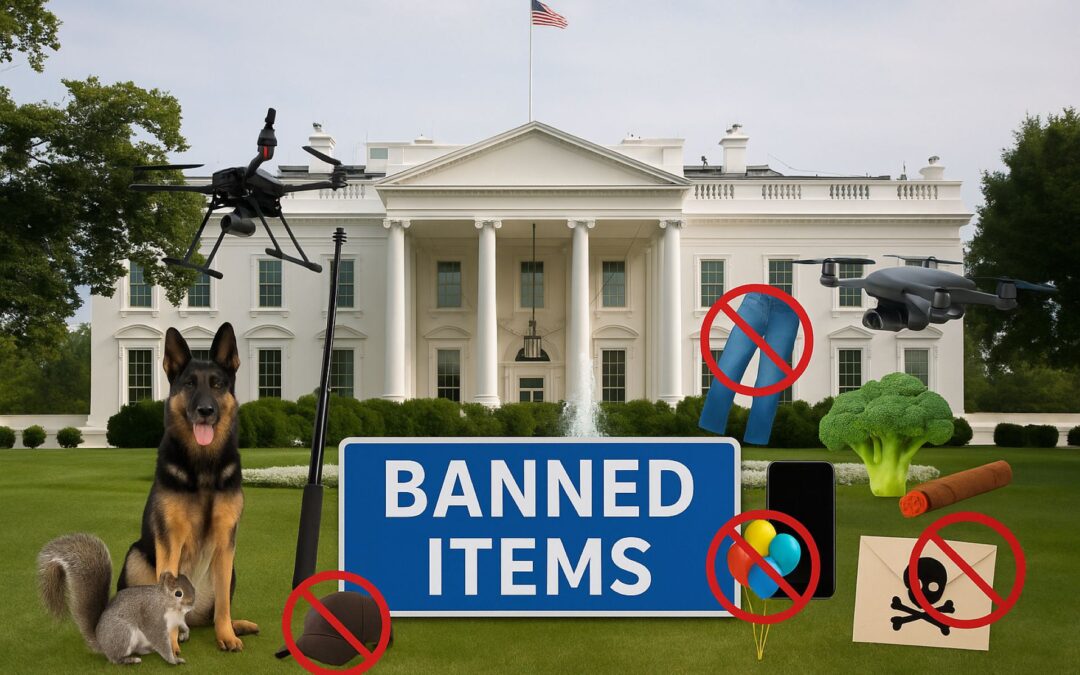
The White House is more than just a residence—it’s the epicenter of American power, where every detail is scrutinized and every tradition carries weight. But behind the pomp and circumstance lies a long list of things that have been forbidden inside its walls, some for security, others for symbolism, and a few simply because a president didn’t like them.
From Eisenhower’s vendetta against squirrels to George H.W. Bush’s war on broccoli, from drones crashing on the South Lawn to a ban on women’s pants during freezing winters, the story of what’s been excluded from the White House is as revealing as what’s been welcomed.
These bans may seem quirky, but each one captures a moment in time—reflecting presidential personalities, shifting cultural norms, and the ever-changing demands of security in the most famous house in the world.
Squirrels on the South Lawn
Dwight D. Eisenhower approached leisure with the same seriousness he brought to commanding armies. Golf, to him, wasn’t just recreation—it was discipline disguised as sport. So when he had a putting green installed on the White House South Lawn in 1954, it was meant to be his sanctuary, a small square of control in a world otherwise defined by nuclear standoffs and Cold War brinkmanship.
But peace on the green was short-lived. Washington’s squirrel population saw the manicured lawn as prime real estate for digging, burying, and play. Dozens of furry intruders turned Eisenhower’s carefully maintained turf into a mess of craters and half-buried nuts. To a man obsessed with order, this was an affront. Legend has it that, in a fit of exasperation, Eisenhower barked at his valet: “Next time you see one of those squirrels on my green, take a gun and shoot it.”
While no firing squads were ever assembled, the president’s staff took his frustration seriously. The Secret Service launched Operation Squirrel—a campaign to trap the animals and relocate them far from 1600 Pennsylvania Avenue. Newspapers picked up the story, running with the image of the president of the United States at war with rodents. Animal rights groups voiced outrage, painting Eisenhower as a tyrant with a vendetta against wildlife.
What might have seemed trivial elsewhere became a parable of power inside the White House. For Eisenhower, squirrels weren’t just pests; they were reminders that even in the world’s most secure residence, chaos could still seep through the cracks. His war on squirrels entered folklore, a footnote to a presidency otherwise consumed by geopolitics and governance.
Broccoli Ban of George H.W. Bush
George H.W. Bush’s declaration against broccoli remains one of the strangest and most personal bans in White House history. In March 1990, during a press conference, Bush announced with characteristic bluntness: “I do not like broccoli. And I haven’t liked it since I was a little kid. And I’m president of the United States, and I’m not going to eat any more broccoli.” It was both comic relief and a striking reminder that even the most powerful man in the world was still, in some ways, a picky eater.
Bush’s personal disdain became a national controversy. He banned broccoli from the White House kitchen and from Air Force One, wielding presidential authority to enforce what most children only dreamed of: a broccoli-free diet. The backlash was swift. California broccoli growers, who feared sales might take a hit, staged a playful protest by shipping 10 tons of broccoli to the capital. Trucks rolled in loaded with the green vegetable, making headlines across the country.
Bush, unfazed, had the shipment donated to local food banks. To him, the broccoli ban wasn’t about economics or symbolism—it was about taste. His candor gave Americans a glimpse of the man behind the office: a president who, despite his patrician upbringing and global responsibilities, shared a childlike aversion to vegetables.
The incident became part of Bush’s public persona, a reminder that the presidency wasn’t all solemn statecraft. It also revealed something subtle about power. If you disliked something enough as a child, you could simply refuse it. If you disliked it enough as president, you could have it erased from your daily environment entirely. The broccoli ban turned into a cultural moment, inspiring jokes, cartoons, and dinner-table debates across the country.
Balloons and Selfie Sticks
At first glance, balloons seem harmless, even joyful—symbols of birthdays, parades, and celebration. But inside the gates of the White House, where every sound and movement is filtered through the lens of national security, even a child’s party favor can trigger chaos. The problem lies in the pop. A single balloon bursting on the South Lawn can mimic the sharp crack of gunfire, instantly forcing Secret Service agents into emergency mode.
The risk wasn’t just hypothetical. In 2016, a stray cluster of helium balloons drifted toward the White House grounds. As they floated above the perimeter, security protocols kicked in. Barriers were raised, access was locked down, and officials were rushed to secure locations, all because of what turned out to be a rogue bundle of party balloons. Agents held their fire—aware of the potential for a tragic misunderstanding—and waited until the inflatables descended harmlessly before whisking them away. But the message was clear: balloons could no longer be trusted near the president’s home.
Selfie sticks posed an entirely different kind of threat, one born of the social media age. As tourists swarmed Washington, D.C., the telescopic poles became a must-have accessory for capturing panoramic shots of the White House. But for agents tasked with protecting history and human life, they represented risk. In the wrong hands, a selfie stick was a club. Even in innocent hands, it was an accident waiting to happen: swinging around in crowded rooms, knocking over priceless artifacts, or even tripping security staff. Imagine a GoPro flying loose across the East Room during a state dinner—chaos doesn’t even begin to cover it.
The Secret Service drew a hard line. Both balloons and selfie sticks were officially prohibited from the grounds, joining the growing catalogue of unusual contraband. For the average tourist, the rules might have seemed excessive. But for the men and women charged with guarding not just a building but a symbol of democracy, there was no such thing as an overreaction.
The Biting Dogs
The image of a president strolling the White House grounds with a loyal dog at his side is as American as the flag itself. Dogs humanize leaders, offering companionship amid the isolation of office. But for Joe Biden, his German shepherds—Major and Commander—brought more than companionship. They brought trouble.
Major, a rescue adopted in 2018, initially captured hearts as the first shelter dog to ever live at 1600 Pennsylvania Avenue. His arrival was celebrated as a feel-good story, a symbol of Biden’s down-to-earth character. But behind closed doors, whispers of trouble began circulating. Major had a habit of nipping staffers and even Secret Service agents. Training sessions were arranged, but the incidents continued. Eventually, the decision was made to send Major to live with friends in Delaware, a quiet exile for a dog who couldn’t adjust to life under the most intense spotlight in the world.
Then came Commander. Bigger, younger, and brimming with energy, he seemed destined to fill the void Major left behind. Instead, he doubled the chaos. Reports revealed that Commander bit at least 11 people, including Secret Service officers whose job was already stressful without the added hazard of sharp canine teeth. The bites weren’t just playful nips—they sent at least one agent to the hospital.
For the Secret Service, it became untenable. Protecting the president required absolute focus, not the distraction of dodging lunges from a presidential pet. Reluctantly, the decision was made: Commander, like Major before him, would leave the White House. The episodes highlighted a rarely discussed truth—life at 1600 Pennsylvania Avenue is not just hard for presidents and staff. Even pets can find it overwhelming.
The Mail That Killed
The White House has always been a magnet for letters, petitions, and packages. Some bring adoration, others anger, and many carry nothing more dangerous than a request for an autograph. But in the weeks following September 11, 2001, the mail stream turned deadly.
Envelopes dusted with anthrax spores were sent to media offices and government buildings, including mail addressed to the White House. Though none of the contaminated letters made it past the screening facility, the damage was catastrophic. Five people—including postal workers—lost their lives, and seventeen others fell gravely ill. The attacks spread panic across the nation, igniting fears that bioterrorism could slip past even the strongest defenses. In an era already defined by terror alerts and color-coded warnings, the anthrax scare deepened the collective anxiety.
The response was swift and uncompromising. Every piece of White House mail would now be diverted to offsite facilities for irradiation, chemical analysis, and scrutiny under advanced scanners. What once had been a simple letter to the president now underwent the same kind of examination as contraband crossing international borders. The anthrax crisis revealed how something as ordinary as a stamp and envelope could be weaponized.
And the threat didn’t end in 2001. In 2013, Barack Obama was the target of ricin-laced letters, mailed by a Mississippi man who thought he could bypass the system. He couldn’t. In 2020, during Donald Trump’s presidency, another plot surfaced—a woman attempting to send ricin hidden in mail. Both attempts were intercepted before they came close to the Oval Office. But they underscored a chilling reality: the president’s mailbox is as much a battlefield as any foreign front. What’s banned now isn’t just suspicious powders or poisons—it’s the very possibility of trust in unsolicited mail.
Teddy Roosevelt’s Christmas Tree Ban
The White House has always doubled as a cultural stage, where traditions are observed not just for family, but for the nation. Christmas, with its trees and ornaments, is one of its most visible showcases. Yet under Theodore Roosevelt, the celebration looked starkly different. A man of fierce conservationist convictions, Roosevelt despised the cutting of live trees for decoration. To him, every felled pine or spruce represented unnecessary damage to the forests he worked so hard to preserve.
So, when Christmas approached, he made a radical decision: no tree in the White House. His stance wasn’t simply aesthetic; it was ideological. Roosevelt had built his reputation on protecting wilderness, creating national parks, and expanding conservation efforts. To allow a tree indoors—even for a single season—felt like hypocrisy. His children, however, didn’t share his zeal for preservation. Archie Roosevelt, in particular, couldn’t imagine Christmas without the twinkle of a decorated evergreen. In secret, he smuggled a small tree into his bedroom and adorned it with homemade decorations.
The story quickly became family legend and a symbol of tension between principle and tradition. Was Roosevelt’s ban a strict policy or more of a personal edict? Historians debate it to this day. But the message he intended was unmistakable: the White House, like the nation, should not indulge in wasteful practices that harmed the environment.
In that sense, Roosevelt’s Christmas tree ban was less about the holiday itself and more about instilling a lesson. Even at the seat of power, personal convictions could reshape national customs. And though Christmas trees would return to the White House after his tenure, his decision left a lasting impression—reminding Americans that the choices of a single leader could echo through their celebrations.
Pants for Women
For much of the White House’s history, the building itself reflected the rigid cultural codes of its time. One of the most enduring unspoken rules was directed at women: skirts and dresses were considered proper attire, while pants were seen as inappropriate, even rebellious. The First Ladies, female staff, and visitors all conformed to this sartorial expectation, not because a law demanded it, but because tradition enforced it. The White House, after all, was a stage for appearances, and appearances carried the weight of national identity.
That unspoken dress code persisted into the 20th century, until a crisis of energy—not fashion—finally broke it. In the winter of 1973, the United States was hit by the OPEC oil embargo, triggering an energy shortage that forced the government to implement strict conservation measures. Among them: lowering the thermostats in federal buildings, including the White House. Offices that were once comfortably warm became icy chambers. Staff bundled up in sweaters and scarves, but for the women who still had to wear skirts or dresses, the cold was punishing.
Gradually, practicality overcame propriety. Female aides began wearing pantsuits, slacks, and trousers simply to endure the frigid work environment. And once the ice—literally and metaphorically—was broken, there was no going back. The old taboo dissolved almost overnight. Women could now walk the halls of power dressed for both warmth and dignity.
The transition marked more than a small wardrobe change; it symbolized a shift in the culture of Washington itself. The White House, once bound by outdated notions of femininity, had adapted to the realities of a modern workplace. In the end, pants became a quiet emblem of progress, proof that tradition can bend when practicality—and equality—demand it.
Smoking Indoors
For decades, the White House was cloaked not just in the grandeur of history but also in literal clouds of smoke. Cigars, cigarettes, and pipes were ubiquitous. Franklin Roosevelt puffed on cigarettes from his ivory holder during wartime strategy sessions. John F. Kennedy famously stockpiled Cuban cigars—reportedly 1,200 of them—just before signing the trade embargo. Lyndon B. Johnson lit up without hesitation, filling rooms with a haze that clung to drapes, furniture, and even the portraits on the walls.
At the time, smoking was not just accepted; it was fashionable. The scent of tobacco became part of the atmosphere of power, mingling with the clinking of glasses at receptions and the scratch of pens on official documents. To light up in the Oval Office was to project confidence, control, and authority. Guests expected it, staff tolerated it, and presidents indulged without a second thought.
But by the late 20th century, America’s relationship with tobacco was changing. Medical research laid bare the dangers of smoking, and cultural attitudes shifted sharply. The White House, always under the public eye, could not ignore the new reality. In the 1990s, First Lady Hillary Clinton took decisive action: she banned indoor smoking altogether. The move was not just about protecting health but also about aligning the presidency with a nation increasingly aware of secondhand smoke and its consequences.
President Bill Clinton, who enjoyed cigars, adapted in his own peculiar way. He was often seen chewing on unlit cigars, a compromise between habit and the new rules. The symbolism was striking—the image of indulgence remained, but the practice had been extinguished.
The smoking ban transformed the White House environment. What had once been a haze-filled atmosphere became a smoke-free space, reflecting the country’s shift toward wellness and modernity. It was the end of an era, where the aroma of cigars had mingled with diplomacy, and the beginning of a new one, where clean air was considered just as important as clean policy.
The Drone Scare
The White House has long been shielded by stone walls, iron fences, and armed guards, but in January 2015, a threat arrived from above—silent, small, and almost comically modern. In the dead of night, a drone buzzed over the White House perimeter and crash-landed on the South Lawn, just steps from one of the most secure residences on earth. For a moment, the impenetrable fortress of American democracy looked startlingly vulnerable.
Alarms rang, agents scrambled, and a full-scale investigation was launched. The nation awoke to headlines suggesting that the White House could be breached by a device no bigger than a toy. The culprit, as it turned out, wasn’t a terrorist or foreign operative but an off-duty government employee who had been drinking and lost control of his drone while “messing around.” Embarrassing? Absolutely. Harmless? Not entirely.
The incident revealed a glaring gap in security preparedness. Drones, once the realm of hobbyists and tech enthusiasts, had suddenly become a national security concern. If one man’s late-night experiment could set off such a panic, what could a malicious actor accomplish? The answer was enough to trigger sweeping changes. From that day forward, drones were not just frowned upon—they were outlawed anywhere near the White House. The surrounding airspace was hardened into a no-fly zone, reinforced by sophisticated counter-drone technology capable of disabling or destroying any unmanned intruder.
The drone scare was more than a fluke. It was a turning point in security strategy, marking the moment when the White House had to adapt to an era where threats came not only from guns and bombs but from buzzing machines small enough to fit in a backpack.
Denim in the Oval Office
The Oval Office is not just a workplace—it is a stage set for history. Every visitor, every handshake, every photograph becomes part of the national record. George W. Bush understood this symbolism keenly, which is why he imposed an unusual rule: no jeans in the Oval Office. To Bush, denim represented casualness, informality, even irreverence. And the Oval Office, in his view, demanded nothing less than reverence.
The rule wasn’t limited to weekdays or official ceremonies. Even on weekends, when the pace slowed and the West Wing felt more like a residence than a command center, jeans were still unwelcome. Staff and guests alike were expected to dress in suits or at least business attire. The ban on denim wasn’t about fashion—it was about projecting the dignity of the presidency, ensuring that the office itself always commanded respect.
But rules, of course, bend for exceptions. One man famously defied the denim prohibition: Bono, the frontman of U2. Known for his rockstar nonchalance and signature black jeans, Bono walked into the Oval Office in denim, and no one dared stop him. His celebrity status gave him a pass where others would have been turned away at the door. For Bush, the Oval Office had to remain a sanctuary of decorum—but for Bono, jeans were practically a second skin.
The episode illustrates the delicate balance between symbolism and reality inside the White House. Dress codes aren’t just about appearances; they’re about the values projected to the public. By banning denim, Bush sought to elevate the Oval Office above the mundane. Yet the Bono exception reminded everyone that, in the end, personality and cultural clout sometimes bend even the firmest rules.
Cell Phones in the West Wing
By the late 2010s, smartphones had become indispensable—an extension of memory, communication, and identity. Staffers at the White House were no different, glued to their devices between meetings, texts, and social media feeds. But in 2018, Chief of Staff John Kelly issued an order that abruptly severed this dependence: personal cell phones were banned from the West Wing.
The reasoning was rooted in security. The Trump administration was plagued by leaks, with transcripts of calls, internal debates, and sensitive deliberations finding their way into the press almost daily. Phones, with their cameras, microphones, and encrypted apps, were seen as Trojan horses capable of recording and transmitting information at any moment. Even unintentional breaches—like a staffer snapping a photo or replying to a text—posed risks in an environment where a single detail could spark international repercussions.
The policy was sweeping. Staff were required to leave their phones in lockers before entering the West Wing and instead rely on clunky, outdated government-issued devices. The frustration was immediate. Personal routines were disrupted, and aides complained of being cut off from family, news, and the digital world. Yet the inconvenience underscored a deeper point: within those walls, security outweighed comfort. The West Wing was not just an office—it was a nerve center of power, where even a vibration in a pocket could carry dangerous implications.
For some, the phone ban felt draconian, a symptom of paranoia. For others, it was a long-overdue correction to a culture too casual with information. Either way, it marked a new chapter in White House operations: even in the digital age, the world’s most powerful building demanded analog discipline.
Cameras on Tours
For decades, a visit to the White House was an experience remembered only in stories and postcards. Cameras, remarkably, were banned from public tours for nearly 40 years. The reasons were both practical and ceremonial. Officials worried that flash photography could damage historic artworks, from priceless oil paintings to delicate furnishings. Security staff complained that cameras slowed down lines, clogged hallways, and distracted visitors. And perhaps most importantly, the White House wasn’t eager to see its interiors plastered across millions of amateur snapshots before the age of curated public relations.
This ban endured long after technology advanced. Families walked through the East Room, the State Dining Room, and the Red Room with their hands empty, forced to absorb the moment without digital proof. For many, it was a disappointment. A White House visit was a once-in-a-lifetime opportunity, and being unable to capture it felt oddly restrictive in a country built on openness.
The tide finally turned in 2015, when First Lady Michelle Obama dramatically ended the ban. In a short video, she gleefully tore apart a “No Photography” sign, announcing that visitors could once again take pictures during tours. The move reflected the cultural shift of the times: by then, Instagram and Snapchat had made photography a universal language. To deny tourists the chance to document their White House experience seemed archaic.
The lifting of the ban symbolized more than modernization; it was an embrace of transparency. Visitors could now leave with tangible mementos, sharing their experiences with friends, family, and followers online. What had once been hidden behind rules of formality was now opened to the lenses of millions of Americans, reframing the White House not just as a fortress of power but also as a place where history could be seen—and shared—in real time.
Party Crashers
The White House is often imagined as impenetrable—a fortress where every guest list is checked and every detail accounted for. Yet in 2009, that illusion shattered spectacularly when a Virginia couple, Tareq and Michaele Salahi, slipped into President Obama’s very first state dinner without an invitation. Their infiltration was not a high-tech hack, nor a Mission Impossible stunt. It was audacity paired with appearances. Dressed in glamorous evening wear and radiating confidence, they breezed past layers of security that were supposed to be airtight.
Once inside, the Salahis mingled with Washington’s elite as though they belonged. They posed for photographs, sipped cocktails, and even shook hands with the president himself. For a few surreal hours, two uninvited reality TV hopefuls shared the spotlight with cabinet officials, foreign dignitaries, and the nation’s commander-in-chief. The Secret Service, distracted by the smooth choreography of the dinner, failed to notice the breach until the couple themselves posted selfies online—photos that showed them grinning beside Joe Biden and other high-ranking officials.
The fallout was immediate and brutal. The breach was labeled a colossal embarrassment for the Secret Service, triggering congressional hearings and internal investigations. The Salahis, meanwhile, became infamous overnight, securing the notoriety they had sought for their reality TV ambitions. Their names were promptly added to the White House’s permanent blacklist, ensuring they would never again set foot near an official event.
The incident was more than a headline-grabbing embarrassment; it was a wake-up call. It revealed that security lapses weren’t always about weapons or explosives. Sometimes, the greatest weakness was human error—a misplaced assumption that someone “looked the part.” From then on, guest vetting protocols became stricter, and the phrase “Don’t let this happen again” became a mantra within the Secret Service.
Alcohol-Free White House
Hospitality at the White House has always been as political as it is personal. A well-stocked bar and flowing wine at state dinners often smoothed the way for diplomacy, allowing leaders to relax and bond. But not every administration agreed that alcohol belonged in the People’s House. In the late 1870s, First Lady Lucy Webb Hayes, known as “Lemonade Lucy,” drew a firm moral line. A devout Methodist and supporter of the temperance movement, she convinced President Rutherford B. Hayes to ban all alcohol from official White House functions.
At her events, guests were served fruit punch, lemonade, and other nonalcoholic refreshments in place of the brandy and wine that once flowed freely. Diplomats and politicians whispered jokes that the parties were “drier than the speeches.” European envoys, accustomed to lavish banquets, found the atmosphere oddly restrained, even stiff. Yet Lucy held firm, believing that the White House should embody moral leadership as much as political leadership.
This wasn’t the last time prohibition seeped into 1600 Pennsylvania Avenue. In the 1930s, Eleanor Roosevelt also imposed limits, though hers were less absolute. Hard liquor was banished, but wine was still poured at formal dinners. Her stance reflected both personal conviction and the lingering influence of national Prohibition, which had ended only recently. Still, her rules reshaped the social culture of the Roosevelt White House, setting a more austere tone during official events.
Yet alcohol, like many traditions, proved resilient. Later presidents restored it without hesitation. Franklin Roosevelt was famous for his evening martinis, John F. Kennedy favored daiquiris, and Lyndon Johnson handed out scotch on his Texas ranch as liberally as campaign buttons. Still, the bans of Lucy Hayes and Eleanor Roosevelt linger in memory, reminders that the White House has always been a mirror of its occupants’ values. When the host believed alcohol compromised dignity, the champagne flutes stayed empty.
Conclusion
Look closely at the White House’s list of prohibitions, and you’ll see more than just a catalogue of oddities. You’ll see a portrait of America itself—its anxieties, its evolving values, and its leaders’ peculiar quirks. Some bans were born of necessity: drones, anthrax, ricin. Others were deeply personal: broccoli, denim, cigars. Still others reflected broader cultural tides: women in pants, alcohol at state dinners, cameras for tourists.
Taken together, they remind us that the presidency isn’t just about laws and policies—it’s also about human preference, symbolism, and sometimes sheer whimsy. What’s forbidden inside those walls is just as telling as what’s permitted, showing us that history is written not only in treaties and speeches, but in the small, sometimes strange rules that govern life at 1600 Pennsylvania Avenue.