
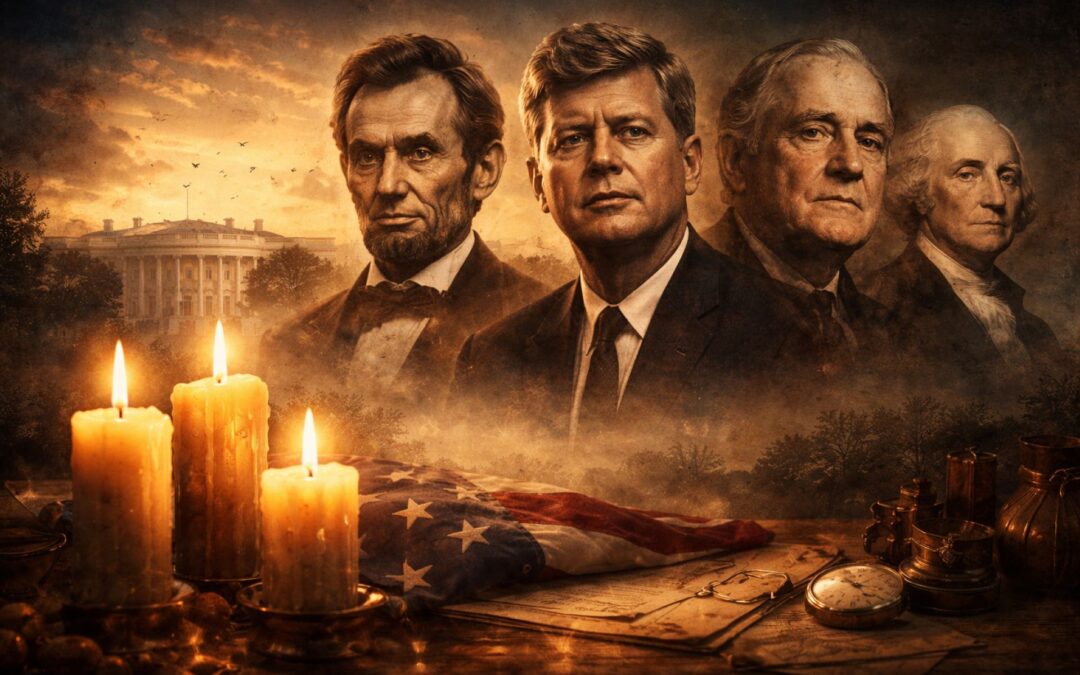
Power, Mortality, and the Final Words of Leaders
Power has a way of making people seem larger than life.
The President of the United States is often seen as the most powerful person in the world—surrounded by security, backed by institutions, and remembered through history as a symbol of authority. But strip away the title, and what remains is something far more human.
Because presidents don’t die like legends.
They die like everyone else.
Some died in agony, struggling to breathe as outdated medicine made things worse. Others were taken suddenly—by bullets, by infection, or by sheer bad luck. One died after eating contaminated cherries. Another spent his final moments commenting on soup. Some left behind powerful final words that echoed through history, while others slipped away in silence, their last thoughts never recorded.
And sometimes, history itself seemed to intervene—like when two founding fathers died on the exact same day, as if their lives had been written to end together.
But these deaths are more than just strange anecdotes or historical trivia.
They reveal something deeper.
They show us how medicine evolved—from bloodletting to modern care. They expose the fragility behind even the highest office. And perhaps most importantly, they remind us that no matter how powerful someone becomes, the ending is always the same.
This is the story of how every US president died—and what their final moments say about power, history, and the inevitability of the end.
The Early Presidents: When Medicine Failed Power
At the birth of the United States, political power was rising—but medicine was still stuck in the dark ages.
In the late 18th and early 19th centuries, doctors didn’t fully understand infection, bacteria, or even how the human body really worked. Treatments were based on theories that sound almost medieval today. And for the first presidents of the United States, that ignorance often proved fatal.
Take George Washington.
In the winter of 1799, after riding through cold, snowy weather, Washington developed a severe throat infection—likely epiglottitis. Today, it’s a condition that can be treated relatively easily with antibiotics and airway support. But back then, doctors turned to what they believed was a cure: bloodletting.
They drained nearly 80 ounces of blood from his body.
Instead of helping, it weakened him further, pushing his already struggling system toward collapse. As he lay dying, Washington remained composed. “I die hard, but I am not afraid to go,” he said. His final words—“’Tis well”—were calm, almost accepting.
It’s a striking image: the most powerful man in the young republic, brought down not just by illness, but by the very people trying to save him.
And Washington wasn’t alone.
Many early presidents faced diseases that today would be considered manageable—tuberculosis, heart conditions, infections—but in their time, these were often death sentences. Medical knowledge lagged far behind political progress. The country was modernizing. Medicine wasn’t.
What makes this era particularly brutal is that death wasn’t just inevitable—it was often made worse by intervention.
Doctors probed, drained, and experimented, believing they were restoring balance to the body. In reality, they were accelerating decline. The line between treatment and harm was dangerously thin, and even presidents couldn’t avoid it.
In a way, these early deaths reveal a quiet irony.
The leaders who helped design a new, forward-looking nation were still trapped in an ancient understanding of life and death. Power could build institutions, win wars, and shape constitutions—but it couldn’t outpace the limits of science.
And in those limits, even presidents were helpless.
Coincidences, Timing, and the Myth of Destiny
Adams and Jefferson: Dying on the Same Day
Few moments in American history feel as eerie—and as perfectly symbolic—as the deaths of John Adams and Thomas Jefferson.
They began as allies in revolution. Jefferson drafted the Declaration of Independence, while Adams became its fiercest advocate. Together, they helped shape the foundation of a new nation.
But politics turned them into rivals.
The election of 1800 fractured their friendship, and for years, they remained distant—two giants of the same cause, now standing on opposite sides. Yet time softened that divide. In their later years, they reconnected through letters, rebuilding a bond that had once seemed permanently broken.
And then came July 4th, 1826.
Exactly fifty years after the Declaration of Independence.
Jefferson, gravely ill, lingered through the final hours of July 3rd. When he asked, “Is it the Fourth?” and was told it was not yet, he held on. As if the date itself mattered. As if his life’s story needed that final symmetry.
He died the next day.
Hundreds of miles away, John Adams was also nearing the end. Frail and unaware of Jefferson’s passing just hours earlier, Adams spoke his final words:
“Thomas Jefferson survives.”
But Jefferson did not.
He had already died.
It is one of those rare moments where history feels almost scripted—two men, once allies and rivals, leaving the world on the same day that defined their legacy.
The Fourth of July Pattern
Adams and Jefferson were not the only presidents tied to this strange pattern.
James Madison, the fourth president, came remarkably close to joining them. As he lay dying in 1836, those around him reportedly hoped he might live just a few more days—to reach July 4th and complete what was beginning to look like a pattern in history.
But Madison declined further intervention. When offered stimulants to prolong his life, he refused, signaling that he was ready. He died on June 28th—just days short.
Then came James Monroe.
The fifth president, and the last of the Founding-era leaders to hold office, died on July 4th, 1831—becoming the third president to pass away on Independence Day.
By then, the coincidence had transformed into something larger.
Three of the early architects of the United States—all linked, in life and death, to the same date that defined the nation’s birth.
Was it destiny? Pure chance? Or simply the human tendency to find patterns in randomness?
Whatever the explanation, these moments turned ordinary deaths into something far more enduring—blurring the line between history and mythology, and reminding us that even in death, symbolism has power.
Deaths in Public Service: Presidents Who Fell While Working
For most leaders, retirement marks the end of public life.
For some presidents, it never really did.
John Quincy Adams is perhaps the clearest example of this. After serving as the sixth president of the United States, he didn’t step away into a quiet, comfortable retirement. Instead, he returned to politics—this time as a member of the House of Representatives.
It was an unusual path, and in many ways, a humbling one. From the highest office in the land to a legislative seat. But Adams didn’t see it that way. For him, public service wasn’t tied to rank—it was a lifelong duty.
And that duty followed him to the very end.
In 1848, while in the House chamber, Adams rose to cast a vote. It was a routine act—something he had done countless times. But in that moment, his body gave out. He suffered a massive stroke, collapsing at his desk in the middle of Congress.
There was no quiet room. No family gathered at a bedside. No slow fading into the night.
Just the floor of the House of Representatives.
He was carried out by fellow lawmakers, but it was clear that the end had come. As he lay dying, Adams spoke his final words:
“This is the last of Earth. I am content.”
There’s something striking about that moment.
Not just the words—but the setting.
Adams didn’t die removed from the world he had spent his life shaping. He died in the middle of it. In the very place where decisions were made, debates were fought, and the machinery of government continued to turn.
It represents a different kind of ending.
Not one defined by illness alone, but by identity. For Adams, there was no separation between life and service. The two were the same. And so, when one ended, so did the other.
In a way, it’s one of the most fitting—and revealing—deaths of any president.
Because it shows that for some leaders, power isn’t just something they hold.
It’s something they live until their very last breath.
The Many Faces of Natural Death
Disease, Aging, and Quiet Endings
For most presidents, death didn’t come suddenly or dramatically.
It came slowly.
Through illness, aging, and the gradual breakdown of the body—reminding us that for all the power they once held, they were ultimately subject to the same forces as everyone else.
Andrew Jackson, one of the toughest and most combative presidents in American history, spent much of his life surviving things that should have killed him. He fought duels, carried bullets in his body, and even beat an attempted assassin with a cane.
But in the end, none of that mattered.
Jackson died not in battle, but in bed—worn down by tuberculosis, heart failure, and a condition known as dropsy, where the body fills with fluid. Surrounded by family, the man who had built his reputation on strength and defiance left behind a softer final message:
“Oh, do not cry. Be good children, and we shall all meet in heaven.”
It’s a stark contrast. A reminder that even the most hardened figures can become gentle at the end.
Others followed a similar path.
Martin Van Buren, the eighth president, lived a long life but struggled with asthma and heart problems. He died quietly at his estate, his final words reflecting a simple, personal faith: “There is but one reliance.”
Rutherford B. Hayes, the 19th president, passed away from heart failure after years out of office. His final thoughts weren’t about politics or legacy, but about reunion—“I know that I’m going where Lucy is,” referring to his wife.
Grover Cleveland, who served two non-consecutive terms, died at 71 from heart failure. His last words carried a quiet sense of reflection: “I have tried so hard to do right.”
These deaths share a common thread.
They are not defined by chaos or violence, but by acceptance.
No dramatic final moments. No sudden shock. Just a gradual understanding that the end has come.
And in many cases, the final words of these presidents reveal something deeply human—not power, not ambition, but relationships, faith, and the desire for peace.
When Personal Tragedy Becomes Decline
Not all natural deaths are quiet in the same way.
Some are shaped long before the final moment—by grief, by loss, and by the slow unraveling of a person’s inner world.
Franklin Pierce’s story is one of the most tragic.
Just weeks before he took office as president, Pierce witnessed the death of his young son in a horrific train accident. The trauma shattered him. What followed wasn’t just political difficulty—it was personal collapse.
Pierce sank into depression. He turned to alcohol. Over time, his health deteriorated, and his liver was destroyed by cirrhosis.
When he died in 1869, it wasn’t just the end of a presidency—it was the end of a long, painful decline that had begun years earlier.
And unlike many others, Pierce didn’t leave behind famous last words.
He died alone.
There’s something haunting about that absence.
Because while history remembers presidents for their decisions and their legacies, their deaths often tell a different story—one of vulnerability, loss, and the weight of experiences that follow them long after they leave office.
In these quieter, more personal endings, the presidency fades away.
And what remains is simply the human being underneath.
Strange, Ironic, and Unbelievable Deaths
The Presidency’s Worst Luck Stories
Not every presidential death fits into a neat narrative of age or illness.
Some feel like pure bad luck—events so absurd or mistimed that they almost read like dark comedy.
William Henry Harrison is the most famous example. On the day of his inauguration, he chose to give a nearly two-hour speech in freezing rain without a coat. For generations, people believed this led directly to his death from pneumonia.
But modern analysis suggests something even more ironic.
Harrison didn’t fall sick until weeks later. The likely cause wasn’t the weather—it was contaminated drinking water at the White House, possibly leading to typhoid fever or septic shock. In other words, the president may have been killed not by exposure, but by the very place he moved into.
He lasted just 31 days in office—the shortest presidency in American history.
Then there’s James K. Polk.
Unlike Harrison, Polk survived his presidency. But just three months after leaving office, while traveling through the American South, he contracted cholera—a brutal disease that causes severe dehydration and rapid decline.
After years of holding one of the most powerful positions in the world, Polk was undone not by politics, but by a microscopic organism.
And yet, his final words weren’t bitter or afraid.
They were deeply personal:
“I love you, Sarah, for all eternity. I love you.”
Even in a painful, undignified death, the final moment returned to something simple—love.
The Bizarre Cases
And then there are the deaths that feel almost unbelievable.
Zachary Taylor, the 12th president, died after consuming large amounts of raw cherries and milk on a hot summer day. At the time, food safety standards were practically nonexistent, and what followed was likely severe gastroenteritis.
Three days later, he was dead.
For years, people suspected poisoning—after all, he was a sitting president during a time of rising national tension. But later investigations found no evidence of foul play.
It really may have just been bad food.
Then there’s Millard Fillmore.
Unlike Taylor, Fillmore lived a long life after leaving office. But his final moment is remembered not for drama, but for its sheer ordinariness.
As he lay dying, he was given soup.
His response?
“The nourishment is palatable.”
That was it.
No grand statement. No emotional farewell. Just a polite review of his last meal.
These stories feel strange because they break our expectations.
We expect powerful figures to have meaningful, dramatic endings. But sometimes, history offers something else entirely—randomness, irony, and moments that feel almost trivial.
And maybe that’s the point.
Because death doesn’t follow narrative rules.
Even for presidents.
When Medicine Became the Killer
If early presidents were victims of limited medical knowledge, some later presidents were victims of something even more unsettling:
Medical intervention itself.
James Garfield’s death is one of the most disturbing examples in American history—not because of the attack, but because of what happened after.
In 1881, just months into his presidency, Garfield was shot at a train station in Washington, D.C. The bullets did not immediately kill him. In fact, neither bullet hit a vital organ. By all accounts, he should have survived.
But then the doctors arrived.
At the time, germ theory was still not fully accepted. Sterilization was inconsistent. And physicians, confident in their methods, began probing Garfield’s wound with unwashed hands and unsterilized instruments—trying to locate the bullet.
They never found it.
Instead, they introduced infection.
One doctor even punctured Garfield’s liver during the process. What began as a survivable injury turned into a slow, agonizing decline. Over the next 80 days, Garfield’s condition worsened as infections spread through his body.
He suffered. He weakened. And eventually, he died.
His final words captured the pain of that long ordeal:
“Swaim, can’t you stop the pain?”
It’s a haunting moment—not just because of the suffering, but because it didn’t have to happen.
Garfield wasn’t killed by the assassin.
He was killed by the treatment.
His death marked a turning point in how people viewed medicine. It exposed the dangers of outdated practices and accelerated the push toward sterilization and modern surgical standards.
But the story carries a deeper irony.
By this point, medicine was supposed to be advancing. The world was moving forward. Science was beginning to replace superstition.
And yet, for Garfield, that progress came too late.
His death sits in a strange in-between moment in history—where doctors had just enough knowledge to intervene, but not enough to do so safely.
It’s a reminder that progress isn’t always smooth.
Sometimes, it creates new dangers before it eliminates old ones.
And in that fragile transition, even a president could become a casualty.
Assassinations: When Power Meets Violence
Abraham Lincoln: The Nation’s Turning Point
Some presidential deaths feel personal.
Others change the course of history.
Abraham Lincoln’s assassination did both.
In April 1865, the Civil War had just effectively ended. The Union had survived. Slavery was on its way to abolition. For many, Lincoln represented not just leadership, but the possibility of healing a fractured nation.
And then, in a single moment, that future was shattered.
While attending a play at Ford’s Theatre, Lincoln sat in a private box with his wife. It was meant to be a rare evening of relaxation after years of relentless pressure. But behind him, John Wilkes Booth stepped forward and fired a single shot into the back of Lincoln’s head.
The president didn’t die immediately.
He was carried across the street to a boarding house, where he lingered through the night. He never regained consciousness.
What makes Lincoln’s death especially striking is not just the violence, but the quietness of his final moments before it.
According to accounts, his last words were spoken casually to his wife, reassuring her about what others might think of them holding hands in public.
“She won’t think anything about it.”
There was no sense of danger. No dramatic realization.
Just an ordinary, human moment—interrupted by extraordinary violence.
And with that, the country lost not just a president, but a stabilizing force at a critical turning point.
Garfield and McKinley
Lincoln’s assassination shocked the nation, but it didn’t end the threat.
In 1881, James Garfield became the second president to be assassinated. As he walked through a train station, he was shot by a disgruntled office seeker. Like Lincoln, Garfield’s fate was sealed not just by the bullet, but by what followed.
He didn’t die immediately.
Instead, he endured weeks of suffering—his condition worsening not from the wound itself, but from the medical treatment that followed. His death blurred the line between assassination and medical failure, turning it into one of the most prolonged and painful presidential deaths in history.
Two decades later, William McKinley became the third.
In 1901, while attending a public event in Buffalo, McKinley greeted visitors in a receiving line. One of them, an anarchist, approached with a concealed weapon and shot him at close range.
At first, it seemed he might survive.
But doctors failed to locate the bullet, and infection set in. Eight days later, McKinley died. His final words reflected a quiet resignation:
“God’s will be done, not ours.”
By this point, a pattern had emerged.
Presidents were vulnerable—not just to illness, but to violence in public spaces.
McKinley’s death forced a permanent change. The Secret Service, which had previously focused on financial crimes, was now assigned full-time to protect the president.
Security became part of the office itself.
John F. Kennedy: The Modern Shock
If Lincoln’s assassination defined a turning point in the 19th century, John F. Kennedy’s did the same for the 20th.
In 1963, Kennedy rode through Dallas in an open motorcade, waving to crowds. It was a moment designed for visibility—for connection between the president and the public.
That visibility became his vulnerability.
Shots rang out. In seconds, the president was fatally wounded.
Unlike Garfield or McKinley, there was no prolonged struggle. No chance of recovery. The attack was immediate, decisive, and captured in a way no previous assassination had been.
For the first time, a presidential death unfolded in the modern media age—broadcast, analyzed, and replayed endlessly.
Kennedy’s final words were simple, almost conversational. When told that Dallas couldn’t deny its affection for him, he replied:
“No, you certainly can’t.”
Moments later, he was gone.
His death wasn’t just a tragedy—it was a national trauma.
It marked the end of a certain kind of innocence, where the president could move freely among the public without overwhelming protection. After Kennedy, that illusion disappeared.
These assassinations reveal a different side of presidential mortality.
Not the slow decline of illness, or the randomness of fate—but the deliberate act of violence.
A reminder that power doesn’t just attract responsibility.
It attracts danger.
Warriors, Survivors, and the Illusion of Invincibility
Some presidents seemed impossible to kill.
They survived violence, illness, and situations that would have ended most lives. They built reputations not just as leaders, but as fighters—men who refused to go down.
And yet, in the end, even they couldn’t escape the same fate as everyone else.
Andrew Jackson was one of the most relentless figures to ever occupy the presidency. Before and during his time in office, he fought duels, carried bullets lodged in his body, and lived with constant physical pain.
In 1835, he became the target of the first attempted assassination of a US president. The attacker fired not one, but two pistols—both misfired.
Jackson didn’t run.
He charged the man and beat him with a cane.
It’s the kind of story that turns a person into legend. A president who couldn’t be killed. A man who seemed to defy fate itself.
But Jackson didn’t die in battle.
He died slowly, weakened by tuberculosis, heart failure, and years of physical strain. The man who had survived so much was ultimately undone not by violence, but by time.
Then there’s Theodore Roosevelt.
If Jackson was relentless, Roosevelt was unstoppable.
In 1912, while running for president again as a third-party candidate, Roosevelt was shot in the chest just before delivering a speech. The bullet passed through his coat, a steel eyeglass case, and a folded speech manuscript—slowing it enough to prevent immediate death.
Most people would have been rushed to a hospital.
Roosevelt walked onto the stage and spoke for 84 minutes.
With a bullet still lodged in his chest.
It’s almost absurd in its defiance—a moment that cemented his image as one of the toughest leaders in American history.
And yet, even Roosevelt couldn’t outrun mortality.
Years later, after enduring a brutal expedition in the Amazon that left him weakened by infection and illness, he died in his sleep from a blood clot at the age of 60.
Quietly.
No audience. No dramatic final stand.
Just the end.
These stories create an illusion.
They make it seem as though some individuals are above ordinary limits—that strength, willpower, or sheer toughness can push death away indefinitely.
But they can’t.
Surviving danger is not the same as escaping it.
Jackson survived assassination attempts. Roosevelt survived gunshots and near-fatal expeditions. For years, they seemed untouchable.
Until they weren’t.
Because in the end, invincibility is temporary.
And even the strongest figures in history eventually face the same quiet conclusion.
The Decline of Power: Illness in Office
Power often looks strongest from the outside.
But behind closed doors, several presidents were quietly falling apart—physically, mentally, and emotionally—while still holding the highest office in the world.
Woodrow Wilson is one of the clearest examples.
During his presidency, Wilson suffered a massive stroke that left him partially paralyzed and severely impaired. For a time, the full extent of his condition was hidden from the public. Decisions were filtered. Access was controlled. The image of a functioning leader was maintained, even as the reality told a different story.
In his final years, Wilson himself seemed to recognize what had happened to him.
“I am a broken piece of machinery,” he said. “When the machine is broken, I am ready.”
It’s a striking admission—not just of physical decline, but of identity. For a man who had once wielded immense influence, the loss of function felt like the loss of self.
Franklin D. Roosevelt’s story carries a similar weight, though in a different way.
Elected four times, FDR led the United States through two of its greatest crises—the Great Depression and World War II. To the public, he projected confidence and control. But behind that image, his health was steadily deteriorating.
He suffered from high blood pressure, heart disease, and the long-term effects of polio. By his fourth term, the strain had become overwhelming.
In 1945, while posing for a portrait, Roosevelt suddenly complained of severe pain in his head.
“I have terrific pain in the back of my head.”
Moments later, he collapsed from a massive stroke.
Even for a man who had carried the weight of global war, the end came abruptly—without ceremony, without warning.
Then there’s Warren G. Harding.
Unlike Wilson or Roosevelt, Harding’s decline wasn’t hidden—it was chaotic.
His presidency was plagued by scandals, eroding public trust and placing immense pressure on him. In an attempt to reconnect with the country, Harding embarked on a cross-country speaking tour.
But the stress took its toll.
He fell ill, developed pneumonia, and while recovering in a hotel room, suffered a fatal heart attack. His last words, spoken to his wife as she read to him, were simple:
“That’s good. Go on, read some more.”
There’s a quiet normalcy to it—a man listening to his wife, unaware that the moment would be his last.
These stories reveal something uncomfortable about power.
We often imagine leadership as strength, control, and endurance. But in reality, some of the most powerful people in history were making decisions while physically compromised, mentally exhausted, or on the edge of collapse.
The office continued.
The image held.
But the person inside was breaking.
And in the end, the decline couldn’t be hidden forever.
Modern Presidents: Longevity, Medicine, and Privacy
As the United States moved into the 20th century, something began to change.
Presidents started living longer.
Not because the job became easier—but because medicine finally began to catch up.
Advances in antibiotics, surgery, diagnostics, and hospital care transformed what it meant to fall ill. Conditions that once guaranteed death could now be treated, managed, or delayed. And for the first time, presidents had access to the very best care available in the world.
The result was a shift—not just in lifespan, but in how presidents died.
Harry Truman, who took office after Roosevelt’s death, lived for decades after leaving the presidency. When he finally passed away at 88, it was from pneumonia, complicated by organ failure. There were no dramatic final words—he had slipped into a coma.
Dwight D. Eisenhower, a war hero turned president, also lived long after his time in office. He suffered multiple heart attacks and strokes throughout his life, but modern medical care extended his years. In the end, his death came in a hospital setting, controlled and monitored. His final words reflected a quiet readiness:
“I want to go. God take me.”
Even Richard Nixon, a president whose life was marked by political turmoil, did not meet a sudden or violent end. After suffering a stroke at home, he was rushed to the hospital, where he eventually slipped into a coma and died at the age of 82.
What’s striking about these deaths is not just their causes—but their environment.
Hospitals replaced homes.
Doctors replaced guesswork with protocol.
And death, once chaotic and unpredictable, became more controlled—more managed.
But alongside this medical progress came something else:
Privacy.
Earlier presidential deaths were often public, dramatic, and widely documented. Final words were recorded, repeated, and turned into part of national memory.
Modern presidents, however, often died behind closed doors.
Gerald Ford, who lived to 93, died peacefully at home. But his family chose not to disclose his final words. The moment remained private—shielded from public consumption.
This reflects a broader shift.
As medicine improved and life extended, death became less of a public spectacle and more of a personal event. The presidency remained visible—but the final moments of those who held it did not.
It’s an interesting paradox.
Presidents became more protected in life—and more private in death.
And in that transition, the way we remember their final moments began to change.
The Era of Long Lives
If the early presidents were defined by fragility, modern presidents are defined by longevity.
For much of American history, reaching old age was uncertain—even for those with wealth and power. Disease, limited medical knowledge, and unpredictable conditions meant that many presidents died in their 60s or early 70s.
But in the late 20th and early 21st centuries, that pattern began to shift dramatically.
Ronald Reagan, once one of the most charismatic figures in American politics, lived to the age of 93. His final years were marked by Alzheimer’s disease—a slow, relentless condition that eroded memory and identity. By the time he died, there were no clear final words, no defining last statement.
Just silence.
It’s a different kind of ending—one where the person the world once knew fades long before the body does.
George H. W. Bush followed a similar path of longevity. He lived to 94, one of the longest-lived presidents in American history. In his final years, he struggled with Parkinson’s disease, which gradually limited his mobility and independence.
And yet, in his final moments, what remained was something deeply personal.
His last words, spoken during a phone call with his son, were simple:
“I love you, too.”
After decades in public life, the final exchange was not about politics or legacy—but about family.
Then came Jimmy Carter.
For years, Carter seemed almost timeless. Even into his 90s, he remained active, engaged, and visible. And then, he crossed a threshold no president had reached before.
100 years old.
When he passed away in December 2024, it marked a historic moment—the first US president to reach a full century of life. His final days were quiet, and like many modern presidents, his exact last words were not publicly recorded.
But in his final weeks, he expressed something that echoed across many presidential deaths:
A readiness to reunite with his wife.
It’s a pattern that appears again and again.
In the end, after power, influence, and decades of public life, what matters most becomes deeply personal—relationships, memories, and the people who defined their lives beyond politics.
This era of long lives tells a different story.
Not of sudden endings or dramatic deaths—but of extended time. Time to reflect. Time to fade. Time to outlive the very moments that once defined them.
And in that extended timeline, the presidency becomes just one chapter in a much longer human story.
Patterns, Statistics, and What It All Means
When you step back from the individual stories, a larger picture begins to emerge.
Not just of how presidents died—but of how that story has changed over time.
Out of all US presidents, eight died while in office.
Four were assassinated—Abraham Lincoln, James Garfield, William McKinley, and John F. Kennedy. Their deaths were sudden, violent, and deeply tied to the political tensions of their time.
The other four—William Henry Harrison, Zachary Taylor, Warren G. Harding, and Franklin D. Roosevelt—died of natural causes while still serving. Their deaths reflect a different kind of vulnerability, where illness, stress, and environment proved just as dangerous as any external threat.
But beyond these dramatic cases, most presidents died after leaving office—and their deaths tell a quieter story.
In the 18th and 19th centuries, the average lifespan of a president hovered around 70 years. Disease was common. Medical care was limited. Even the most powerful figures were at the mercy of conditions that today are often manageable.
By the 20th century, that number began to rise.
Presidents started living into their late 70s and beyond. Advances in medicine, better living conditions, and increased awareness of health all played a role. What once ended lives early was now delayed—or avoided entirely.
And in the modern era, that trend has only accelerated.
Presidents routinely live into their 80s and 90s. Some, like Jimmy Carter, even reach 100. The office itself has not become less demanding—but the systems surrounding it have become more protective, more advanced, and more capable of sustaining life.
There are other patterns too.
Some deaths feel symbolic—like Adams and Jefferson dying on the same day, tied forever to the Declaration of Independence.
Others feel random—like Zachary Taylor’s fatal illness after a summer meal.
Some are public and dramatic. Others are private and quiet.
But across all of them, one truth remains constant.
The presidency may be one of the most powerful positions in the world—but it does not change the ending.
Every president, regardless of legacy, influence, or era, arrives at the same point.
And in that moment, power fades.
What remains are the final words, the circumstances, and the stories we tell afterward—trying to make sense of something that, in the end, is universal.
Conclusion
In the end, the presidency does not change the most fundamental truth of all.
Everyone dies.
Not as a president. Not as a symbol. But as a person.
Looking across these stories, what stands out isn’t just how different these deaths were—but how similar they ultimately feel. The causes vary—disease, violence, coincidence, age—but the final moments often return to the same themes.
Acceptance. Pain. Love. Faith. Silence.
George Washington faced death with calm resolve. Andrew Jackson softened into a farewell for his family. James Polk expressed love. Eisenhower asked to go. George H. W. Bush told his son, “I love you.”
And others left nothing behind at all.
No grand statements. No dramatic final lines. Just an ending.
It’s easy to think of presidents as larger than life—figures defined by power, decisions, and legacy. But their deaths strip all of that away. In those final moments, there is no office, no authority, no control.
Only the human being.
And maybe that’s why these stories matter.
Not because of the office they held, but because of what they reveal beneath it.
That even at the very top—at the peak of power—life remains fragile, unpredictable, and deeply human.
The title ends.
The story doesn’t.
It simply becomes something else—something remembered, retold, and reflected on by those who come after.