
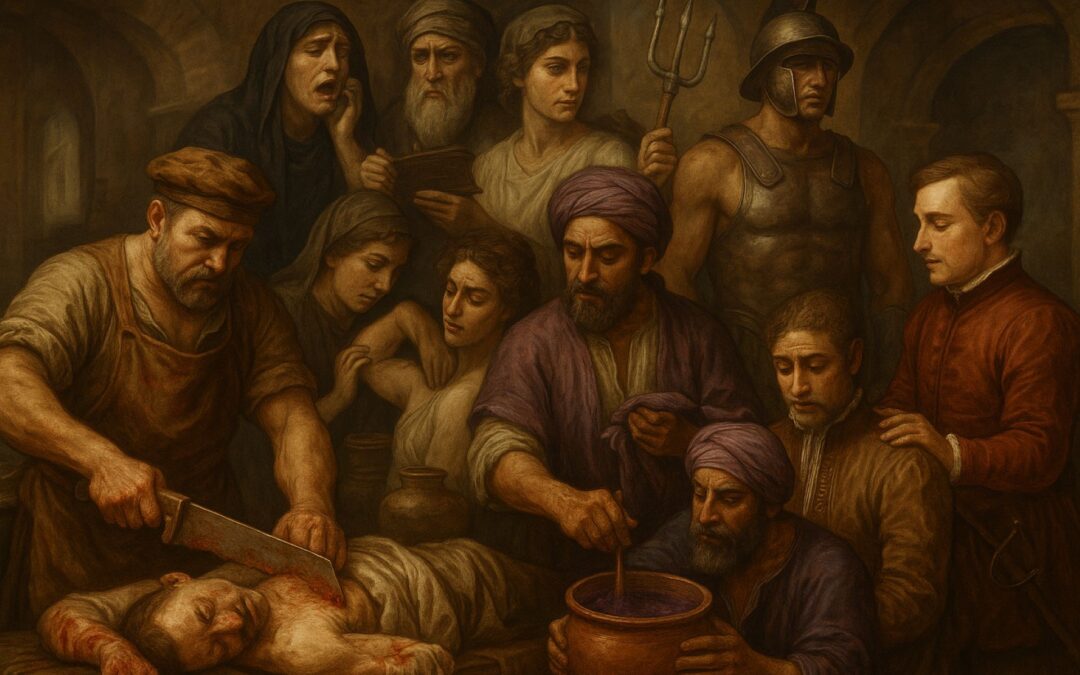
History is littered with oddities—strange occupations that sound more like punchlines than professions. Yet for those who practiced them, these roles weren’t curiosities. They were livelihoods, often lucrative ones. From barber surgeons who swapped razors for bone saws to purple dyers who stank of rotting snails but held fortunes in their vats, the ancient world teemed with jobs that blurred the line between the grotesque and the prestigious. Some earned wealth through pain, others through spectacle, and a few through sheer proximity to power. What unites them all is the reminder that society has always rewarded the unusual, especially when necessity, vanity, or superstition demanded it.
The Barber Surgeon
To modern eyes, the barber’s striped pole is little more than an old-fashioned emblem. In the Middle Ages, though, it was a warning sign as much as an advertisement. Behind the red-and-white swirl waited a man equally comfortable trimming your beard, pulling a tooth, or sawing off a leg.
The barber surgeon emerged out of necessity. Learned physicians were rare, costly, and often more philosophers than practitioners. They prescribed diets, astrology charts, or herbal concoctions, but rarely dirtied their hands with the crude realities of wounds and infections. The barber surgeon filled the gap, offering both vanity and survival in one package.
Inside his shop, you might find bowls for bloodletting, iron hooks, cautery irons heated in the fire, and saws blackened from repeated amputations. Customers sat in the same chair whether they wanted a shave or a surgery. Hair trimmings swept the same floor where bloody bandages piled up to dry. Hygiene was primitive, but options were few—so the barber surgeon became indispensable.
Their role was so critical that kings and nobles often kept personal barber surgeons on retainer, relying on them after hunts or battles. Henry VIII recognized their importance formally, merging the barbers’ and surgeons’ guilds in 1540. This gave them status, legal rights, and official recognition as professionals—not mere butchers with razors.
The rewards were considerable. Barber surgeons could name their own price, since few dared compete in such grisly work. Wealthier practitioners operated in large towns, serving the aristocracy and earning enough to climb the social ladder. The daring ones traveled, setting up temporary stalls in markets and fairs, offering “flying services” like wandering surgeons of fortune. In an age when pain relief was brandy and a firm grip, these men lived at the edge of horror—but walked away with purses heavy with silver.
The Tyrian Purple Dyer
If the barber surgeon dealt in blood, the Tyrian dyer dealt in stench. Along the rocky coasts of Phoenicia and the Mediterranean, men labored among mountains of shells, pounding them open to harvest a few drops of slimy glandular fluid from the murex snail. Alone, it was foul-smelling and nearly useless. But through a long, secretive process of fermenting, heating, and mixing, it transformed into a radiant purple dye that seemed to glow with power.
The dye was so potent it never faded. Ancient writers described garments that, rather than dulling with age, became more lustrous the longer they were worn. This permanence gave Tyrian purple an almost mystical aura, a visible sign of immortality and divine favor. Emperors draped themselves in it as though the gods themselves had woven their robes.
But the labor required was staggering. A single ounce of dye demanded the destruction of thousands of snails. To dye an emperor’s toga took a quarter of a million. Workshops reeked of decay, attracting swarms of flies and making workers outcasts in their own cities. Towns pushed dye pits outside their walls, banishing the stench but acknowledging the treasure within.
The profit margin was extraordinary. An ounce of purple dye cost more than a skilled craftsman’s three years of wages. A full garment was worth more than estates. For dyers, this meant handling liquid currency, each vat representing a fortune. They were despised for their stink but envied for their wealth.
The exclusivity was enforced by law. In Rome, only emperors were permitted to wear Tyrian purple. Ordinary citizens risked execution for daring to dress above their station. This turned dyers into silent gatekeepers of power. Their hands, coated in snail slime, controlled one of the strongest status symbols the world has ever known.
The Augur
In Rome, strategy began not with sharpened swords but with sharpened eyes fixed on the sky. The augur stood as mediator between mortal ambition and divine approval, and no campaign, no law, no great public undertaking dared move forward without his blessing. His tools were not weapons but a crooked staff and cages of sacred birds.
The ritual was exacting. Standing on a consecrated hilltop, the augur would divide the sky into quadrants and watch intently as eagles, ravens, or hawks traced their patterns through the air. Their direction of flight, their number, even the sound of their calls became the vocabulary of the gods. Closer to earth, flocks of sacred chickens were fed grain before battle. Pecking greedily meant divine favor. Refusing to eat was a dire omen—an omen generals ignored at their peril.
This system, known as “taking the auspices,” carried immense authority. A general could prepare legions, polish armor, and ready supplies, but a handful of hens could halt the campaign. The augur’s verdict was final. To defy it was to risk not only divine wrath but public outrage, for Romans believed success depended on the gods’ sanction. One infamous commander mocked the ritual, hurling the sacred chickens into the sea with a sneer: “If they won’t eat, let them drink!” His army was crushed soon after, and his irreverence passed into history as both blasphemy and folly.
The augur was more than a priest. He was a kingmaker. A single unfavorable omen could derail a senator’s ambitions, stall a law in the assembly, or delegitimize an emperor’s rise. His pronouncements shaped politics as surely as legions shaped borders. Paid in land, honors, and the gratitude (or fear) of Rome’s most powerful men, the augur transformed superstition into authority—and superstition into wealth.
The Armpit Plucker
Step into a Roman bathhouse and the air was thick with steam, chatter, and the occasional shriek of pain. That cry did not come from a brawl but from one of the strangest luxury services of the empire: the armpit plucker. Known more elegantly as the olipolis, these specialists made a living by ripping hair out of armpits, strand by excruciating strand.
Why would anyone submit to such torture? In Roman society, smooth skin signaled refinement. Body hair, especially under the arms, was equated with barbarism, poverty, or neglect. To appear in public with hairy armpits was to broadcast that one was either too poor or too uncultured to pay for proper grooming. For the wealthy, vanity overruled pain, and so the bathhouses rang with the sharp rhythm of tweezers and muffled groans.
Appointments were booked weeks or even months in advance, particularly among Rome’s elite circles. Senators, aristocratic matrons, and wealthy merchants lined up to endure the ritual, not unlike modern patients enduring cosmetic surgeries in the name of status. The philosopher Seneca, known for his stoicism, complained bitterly about the racket—proof that the olipolis were everywhere.
Their earnings far surpassed those of many artisans. Though their work was neither glamorous nor respected in name, it was demanded with such regularity that they became staples of Roman daily life. They turned bodily discomfort into steady profit, living proof that wealth often flows to those willing to do what others find too unpleasant. In a world where appearances mattered as much as politics, the olipolis held surprising economic power, plucking their way to prosperity one hair at a time.
The Water Scribe
In the vast expanse of Rome, water wasn’t just a necessity—it was a symbol of civilization. Aqueducts arched across valleys, channeling crystal streams into a metropolis of more than a million souls. Fountains gushed, baths steamed, and gardens glittered with artificial streams. Yet behind this spectacle stood a cadre of men whose job was both mundane and menacing: the water scribes.
At first glance, they seemed little more than bureaucrats. They carried tablets, measuring rods, and the authority of the state. Their task was to monitor aqueducts and ensure fair distribution. But in truth, they held Rome’s lifeblood in their hands. With a stroke of their stylus, they could cut off a senator’s luxurious bathhouse or expose a noble’s illicit pipe diverting public water into private fountains. Even the highest-born Romans quailed at their inspections, for no title shielded one from the water scribes’ accusations.
The stakes were enormous. Water meant health, luxury, and prestige. Rich families often bribed the scribes to ignore hidden connections, offering sacks of silver to keep their fountains flowing. But here was the irony: the fines levied against water theft were often larger than the bribes themselves. A clever scribe could earn more by prosecuting than by turning a blind eye. This balancing act made them as much extortionists as officials, playing both sides while padding their purses.
The danger was real. Those who enforced the rules too strictly found themselves marked men, slain in alleys by desperate aristocrats unwilling to lose their luxuries. The survivors thrived, walking the razor’s edge between corruption and righteousness. For them, the aqueduct wasn’t just engineering—it was empire’s artery, and they controlled the pulse. Their wealth was measured not only in coins but in influence, for in Rome, the one who controlled the water controlled the world.
The Professional Mourner
Where modern funerals are often quiet affairs, in antiquity they were theater—and professional mourners were the stars. Known as preficae in Rome, these women turned grief into performance, filling the streets with wails, tearing at their hair, and beating their chests in orchestrated sorrow. Their goal was not authenticity but amplification: to make the deceased seem grander by the sheer volume of grief on display.
The wealthiest families spared no expense. Dozens of mourners might accompany a coffin, creating a chorus of anguish that reverberated through the city. To mourn alone was to die in obscurity; to be mourned loudly was to signal influence, wealth, and enduring status. It was grief as spectacle, sorrow as social currency.
The practice grew stranger still with the archimimus—the impersonator. Dressed as the deceased, he mimicked their gestures, gait, and speech, leading the procession like a macabre double. Imagine a Roman crowd watching someone stride ahead of the bier, laughing with the same crooked chuckle or repeating favorite phrases of the departed. It was eerie, theatrical, and deeply Roman.
Beyond Rome, professional mourning took even more extreme forms. In ancient Egypt, elite mourners devoted their entire lives to the role. They shaved their heads and bodies, tattooed themselves with divine names, and lived under restrictions that set them apart from ordinary citizens. Their identity was fused with lamentation, their livelihood built on perpetual grief.
And the profession never fully died. Even today, in parts of the Middle East, Africa, and Asia, mourners-for-hire still exist, and in modern Britain, companies rent them out by the hour. A strange continuity runs through history: sorrow, however private, has always had its market value. In the cries of the professional mourner, grief was not only expressed—it was monetized, dramatized, and immortalized.
The Ice Harvester
Long before refrigerators, when cold drinks in tropical lands were unimaginable luxuries, a remarkable trade emerged—harvesting ice and shipping it across oceans. In 19th-century New England, men trudged out onto frozen lakes in brutal midwinter, armed with massive saws, chisels, and horse-drawn sledges. Their work was both methodical and perilous. First, they scored the ice into neat grids, carving the lake into a checkerboard of frozen slabs. Then, using iron saws nearly as tall as themselves, they cut out blocks weighing hundreds of pounds each. Horses, fitted with spiked shoes to prevent slipping, dragged the blocks to shore, where teams packed them in sawdust for insulation.
Every step bristled with danger. A single misstep could send a man plunging into freezing waters, where hypothermia claimed lives in minutes. Even above the surface, hazards abounded: ice blocks toppled onto men, crushing bones; frostbite gnawed at hands and faces; and exhaustion stalked every movement. Yet the rewards were astonishing. A successful harvester could earn in three months what most laborers struggled to make in an entire year.
What followed was nothing short of miraculous for the time: those blocks of ice, stacked in insulated holds, were shipped as far as India and the Caribbean. Imagine the wonder of wealthy families in Calcutta sipping chilled drinks in the sweltering heat, their ice having traveled halfway across the globe. Entire fortunes were carved from frozen lakes, and some harvesters built mansions from the profits of melting water. The ice trade transformed a fleeting winter resource into a commodity worth millions—proving that even nature’s most ephemeral offerings could be turned into gold with ingenuity and grit.
The Nomenclator
Roman politics thrived on memory. In a society built on status, lineage, and grudges, forgetting a name could be catastrophic. That’s where the nomenclator came in. These slaves were living encyclopedias of society, trained to memorize not just names but the entire web of Roman life—family trees, feuds, affairs, political allegiances, even whispered scandals.
Picture a senator striding into a crowded forum, surrounded by hundreds of citizens. He couldn’t possibly recall every acquaintance. But his nomenclator, walking discreetly at his side, whispered just in time: “That’s Lucius, son of Gaius. He’s furious because you blocked his cousin’s trade deal last year. Smile, but don’t mention grain prices.” Armed with such information, the senator could glide through the crowd like a master performer, his memory appearing flawless when in fact it was borrowed.
The position was paradoxical. Though technically slaves, skilled nomenclators commanded immense value. They were rewarded with gold, gifts, and privileges, because their knowledge was dangerous. A nomenclator who slipped could ruin his master’s career, while one who excelled could propel him to power. Some became so adept they acted almost as bodyguards, spotting potential assassins by remembering old enmities and signaling danger before it struck.
Living constantly in the world of secrets was like treading a minefield. One wrong whisper, one misplaced name, and reputations exploded. But when successful, the nomenclator became indispensable—the human memory bank of Rome’s elite. Their very existence proves how fragile power is, how much it relies not only on might or money but on the precise recall of who was who, who hated whom, and who might be useful in the next political game.
The Gladiator
Few professions in antiquity carried such a volatile blend of terror and triumph as that of the gladiator. To some, it was a punishment—slaves and prisoners of war condemned to fight for the amusement of roaring crowds. To others, it was a chosen path, one of the only avenues where a man of low birth could achieve wealth, fame, and a form of immortality.
Training began in gladiatorial schools called ludi, where men were drilled daily under the eyes of seasoned instructors. Their diets were surprisingly advanced: barley gruel, beans, and ash supplements to strengthen bones, earning them the nickname hordearii—“barley men.” They received medical care rivaling that of Rome’s elites, because their bodies were investments. A crippled gladiator was a financial loss, while a healthy one was a goldmine.
Each fighter cultivated a distinct style. The murmillo, with heavy armor and a broad sword, fought like a human tank. The retiarius, lightly armored, wielded only a net and trident—mocked by some, but adored for his audacity. Others, like the secutor or the thraex, brought their own flair to the arena. The matchups were theatrical, designed to entertain as much as to test skill. Contrary to modern myth, not every fight ended in death; trained gladiators were too valuable to waste. Defeat often meant performing the dramatic missio—raising a finger in surrender and waiting for the crowd’s verdict.
And the crowd adored them. Their faces appeared on pottery, mosaics, and graffiti. Women collected their sweat and even scraped the dust from their skin, mixing it into cosmetics and perfumes believed to carry aphrodisiac powers. Gladiators were Rome’s rock stars, desired, feared, and envied. Successful fighters like Spiculus earned palaces, treasure, and freedom, rising from obscurity to celebrity. Yet the shadow of death always hovered close, for every cheer could turn to condemnation with the tilt of a thumb. It was a profession of peril—but also of unparalleled glory.
The Groom of the Stool
If the gladiator embodied public spectacle, the Groom of the Stool embodied private influence. This peculiar office in the English royal court revolved around the king’s most intimate routine: using the toilet. The groom’s job was, on the surface, to attend the monarch during this act, ensuring cleanliness and comfort. But beneath the indignity lay astonishing power.
The groom had the king’s ear in his most unguarded moments. No courtiers, no advisors, no rivals—just the monarch and his attendant. In that rarefied privacy, matters of state could be whispered, alliances cemented, and enemies undone. To hold the king’s confidence in such moments was to wield influence beyond ministers and generals.
The position came with immense perks. Grooms received estates, titles, and direct access to the royal purse. Some became wealthier than dukes, controlling vast sums as they managed the monarch’s private finances. They were gatekeepers of favor, able to sway appointments, distribute patronage, and shape policy. Far from ridicule, noble families vied for the role, pushing their sons into the position as a sure path to wealth and proximity to the throne.
The role endured for centuries, surviving through the Tudor and Stuart courts, and astonishingly, it lingered into the Victorian era. Only in 1901, with the death of Queen Victoria, was it finally abolished. Until then, the Groom of the Stool stood as a reminder that power often resides not in grand offices or gilded thrones, but in the quiet, vulnerable moments where kings are most human. To attend to a monarch’s body was to command a kingdom’s ear.
Conclusion
Looking back, these strange careers reveal more than just eccentricity—they expose the priorities of their times. Rome’s obsession with omens elevated augurs above generals. Fashion’s hunger for exclusivity made snail-crushers wealthier than artisans. Vanity turned armpit pluckers into indispensable fixtures of the bathhouse, while royal politics raised a toilet attendant to the rank of power broker. In every era, wealth has flowed not only to those who worked hardest, but to those willing to serve the quirks, fears, and desires of their societies. The lesson lingers: what seems bizarre today may one day be remembered as brilliant, because value has never belonged to the ordinary. It has always belonged to the unexpected.