
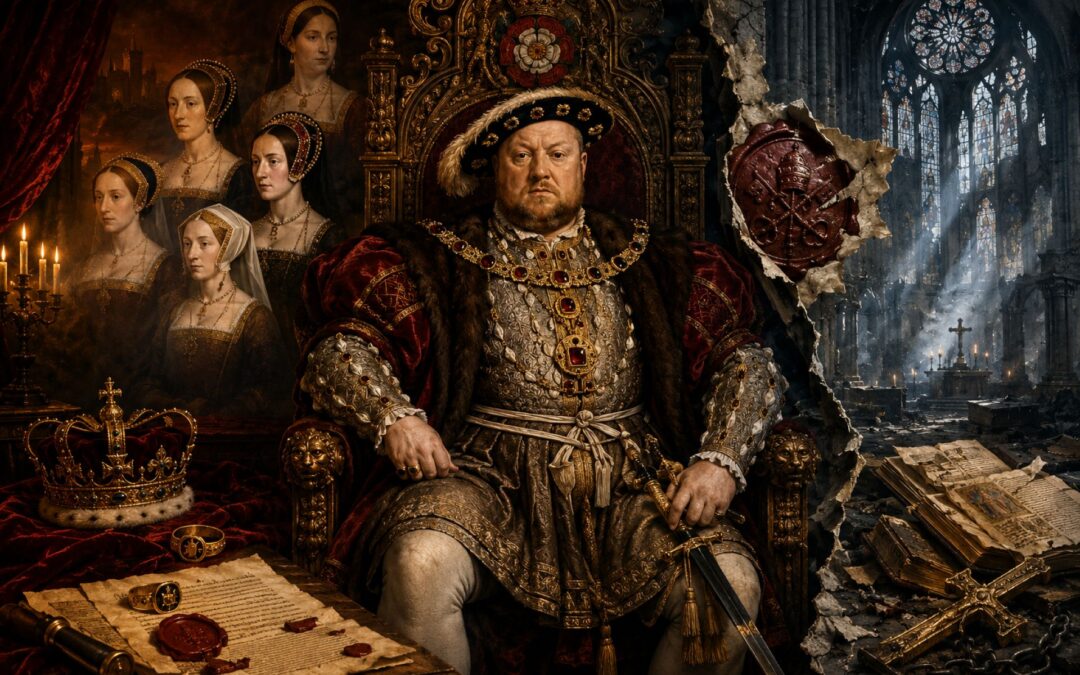
Few kings in English history loom as large—or as controversially—as Henry VIII. Today, he is remembered for a handful of dramatic facts: six marriages, two executed queens, a break with the Catholic Church, and a reign marked by both extravagance and brutality. The popular image of Henry is that of a gluttonous tyrant—an aging monarch with a temper, a festering leg wound, and a habit of removing heads whenever someone displeased him.

Yet the story of Henry VIII is far more complex than the caricature suggests.

When he first came to the throne in 1509, Henry was not feared but adored. He was young, charismatic, highly educated, and physically impressive—a Renaissance prince who excelled at music, languages, sports, and theology. Compared to the cautious and unpopular rule of his father, Henry VII, the new king appeared generous, energetic, and full of promise. Many believed England had entered a golden age.

But the ambitions that made Henry appealing at the beginning of his reign—his hunger for glory, his intense pride, and his belief in the divine authority of kings—would ultimately reshape both his personality and his kingdom. Over the course of nearly four decades on the throne, Henry’s quest for military fame, dynastic security, and personal control would push him into conflict with powerful nobles, foreign rulers, the Pope himself, and eventually even his own wives.

In the process, Henry VIII did something few monarchs in history have ever achieved: he permanently altered the religious and political structure of his country. His decision to break with the Roman Catholic Church created the Church of England, triggered decades of religious upheaval, and transformed England’s relationship with Europe.

By the time Henry died in 1547, the bright and promising prince who had once charmed the nation had become a feared and unpredictable ruler. Yet despite the turmoil of his reign—and perhaps partly because of it—Henry achieved one of his greatest ambitions.

More than any other Tudor monarch, Henry VIII ensured that he would never be forgotten.

The Tudor Dynasty and the Birth of a Spare Prince

Henry VIII’s story begins not with triumph, but with the aftermath of one of the most turbulent periods in English history. For nearly thirty years before his birth, England had been torn apart by a dynastic struggle known as the Wars of the Roses. Rival branches of the royal Plantagenet family—the House of Lancaster and the House of York—had fought a series of bloody conflicts over who had the rightful claim to the English throne.

These wars were not tidy political disputes. They were chaotic, violent power struggles in which kings were overthrown, nobles switched allegiances, and entire families were wiped out. England’s aristocracy was left fractured and exhausted by decades of civil war.

The conflict finally came to an end in 1485 when Henry Tudor defeated King Richard III at the Battle of Bosworth Field. By claiming the throne as Henry VII, he founded the Tudor dynasty. His rule restored a fragile peace to England, but it was a peace built on caution, suspicion, and strict control over the nobility.

Henry VII ruled carefully. Having taken the crown by force, he knew his claim could easily be challenged. To secure his position, he kept tight financial and political control over England’s powerful nobles, frequently imposing heavy fines and restrictions to prevent potential rebellions. Stability returned to the kingdom, but his government was often viewed as harsh and calculating.

Within this fragile new dynasty, producing strong heirs was essential. Henry VII needed sons who could secure the Tudor line and prevent England from slipping back into civil war.

In 1486, his first son was born: Arthur, Prince of Wales. Named deliberately after the legendary King Arthur, the child symbolized the hope of a new and stable future for England. Arthur was groomed from birth to become king.

Five years later, in 1491, another son was born: Henry.

Unlike his older brother, Henry was never expected to rule. In royal dynasties, the first son was the heir, while younger sons were often prepared for other careers—typically within the Church. This ensured they remained influential without competing for the throne.

As a result, the young Prince Henry grew up in a very different environment from his older brother. Arthur was raised within the royal court and trained specifically for kingship. Henry, meanwhile, spent much of his childhood away from the center of power, living with his mother and sisters while receiving a broad humanist education.

Yet this upbringing would have an unexpected effect. Instead of being raised solely as a future ruler, Henry received one of the finest educations available in Europe.

He studied Latin, theology, philosophy, and literature. He learned music and became a skilled performer. He excelled in athletic pursuits such as hunting, jousting, and tennis. Teachers and scholars who met him described him as intelligent, charming, and full of confidence.

Ironically, the boy who was never meant to be king was developing into the kind of Renaissance prince that many believed a king should be.

For the moment, however, Henry’s destiny seemed clear. His older brother Arthur would inherit the throne, continue the Tudor dynasty, and rule England.

Henry would remain what royal families often called the “spare.”

History, however, had other plans.

The Unexpected Heir to the English Throne

The carefully planned future of the Tudor dynasty changed abruptly in 1502.

Henry VII had spent years arranging an important diplomatic alliance with Spain, one of the most powerful kingdoms in Europe. To seal this partnership, his eldest son Arthur was married to Catherine of Aragon, the daughter of the Spanish monarchs Ferdinand and Isabella. The marriage united two influential royal houses and strengthened England’s position in European politics.

Arthur and Catherine were married when they were both still very young, but the match was considered a major diplomatic success. The Tudor dynasty appeared secure, and England’s alliance with Spain promised stability and influence abroad.

Only months after the marriage, however, disaster struck.

Arthur suddenly fell ill and died at the age of fifteen.

His death sent shockwaves through the English court. The Tudor dynasty had been built around the assumption that Arthur would become king, and now the entire succession plan had collapsed. More immediately, the carefully negotiated alliance with Spain was suddenly in danger. If Catherine returned to Spain as a widow, England might lose one of its most valuable political partnerships.

In the midst of this crisis, the young Prince Henry—still only around ten years old—was suddenly thrust into a role he had never been prepared for.

Overnight, the second son became the heir to the English throne.

The political solution that followed was as pragmatic as it was unusual. To preserve the alliance with Spain, Henry VII proposed that the new heir should marry his brother’s widow, Catherine of Aragon.

Under normal circumstances, this would have been forbidden. A passage in the Book of Leviticus in the Bible specifically condemned marriage between a man and his brother’s widow. To allow the union, Henry VII needed special permission from the Pope.

The Pope granted a papal dispensation allowing the marriage to proceed.

At the time, the arrangement seemed like a practical compromise that secured both the Tudor succession and England’s diplomatic alliance with Spain. Few could have predicted that this decision—made simply to preserve political stability—would eventually trigger one of the most dramatic religious transformations in English history.

For the young Prince Henry, the sudden change in circumstances must have been overwhelming. He was moved from a relatively quiet upbringing into the center of royal politics and court life. Expectations shifted rapidly: instead of preparing for a church career, he now had to prepare to rule an entire kingdom.

Compounding this upheaval, tragedy struck Henry personally as well. Only a few months after his brother’s death, his mother, Elizabeth of York—one of the most stabilizing influences in his life—died during childbirth.

The loss deeply affected the young prince.

Meanwhile, Henry VII continued to rule with the same cautious suspicion that had characterized his reign. Years of suppressing rebellions had made the aging king increasingly paranoid. Heavy financial penalties and strict oversight of the nobility created resentment among England’s elite.

By the time Henry VII died in 1509, many in England were ready for change.

And when the eighteen-year-old Prince Henry ascended the throne as King Henry VIII, the country greeted him not with fear—but with excitement.

The Golden Prince and the Promise of a New King

When Henry VIII became king in 1509 at just eighteen years old, England greeted him with extraordinary enthusiasm. After the cautious, financially strict, and often unpopular rule of Henry VII, the arrival of the young monarch felt like the dawn of a new era.

Henry VIII seemed to embody the ideal of the Renaissance prince.

He was tall, athletic, charismatic, and strikingly handsome. Contemporary accounts describe him as energetic, charming, and highly intelligent. He spoke several languages, composed music, wrote poetry, and excelled at courtly sports such as hunting, jousting, and tennis. Unlike his father, who had ruled with suspicion and restraint, the young king radiated confidence and generosity.

The contrast between father and son could hardly have been greater.

Henry VII had governed carefully, hoarding wealth and keeping the nobility under tight financial control in order to maintain stability after the Wars of the Roses. Henry VIII, by contrast, was eager to display royal magnificence. Court celebrations became lavish affairs filled with music, tournaments, feasts, and elaborate festivities. The king himself delighted in participating in these spectacles, dancing, singing, and competing alongside his courtiers.

To many observers, England had finally received the vibrant, heroic monarch it deserved.

Shortly after his accession, Henry fulfilled the long-standing diplomatic arrangement made by his father and married Catherine of Aragon. By this point, Henry genuinely admired and respected her. Catherine was intelligent, politically capable, and well educated, and early accounts suggest that their marriage was both affectionate and stable. Unlike many royal unions of the era, which were purely political arrangements, theirs appeared to contain a degree of genuine partnership.

Catherine also proved herself capable of leadership. During Henry’s military campaigns later in his reign, she would even act as regent in England, demonstrating both political skill and loyalty to the crown.

In these early years, Henry’s rule appeared promising in nearly every respect.

He was widely supported by the nobility, popular among the people, and eager to prove himself on the international stage. More importantly, he possessed a powerful sense of ambition. Henry did not merely want to rule England—he wanted to become a legendary king, remembered alongside the great warrior monarchs of medieval history.

Above all, he longed for military glory.

For centuries, English kings had sought fame through campaigns in France, a traditional rival and historical battleground of English ambitions. Victories in France were considered one of the highest marks of royal prestige.

Henry VIII was determined to follow that path.

Yet while the young king dreamed of conquest and heroism, the advisors who surrounded him were far more cautious. War was expensive, dangerous, and unpredictable. Many members of the royal council preferred stability and financial restraint rather than ambitious military adventures.

But Henry’s desire for glory would soon find an ally who could help him bypass these restraints—and set England on the path toward war.

The Pursuit of Glory: War With France

From the beginning of his reign, Henry VIII was determined to prove himself as a warrior king.

For centuries, English monarchs had built their reputations through military campaigns in France. The memory of earlier victories—particularly those of kings like Edward III and Henry V—still loomed large in English political culture. To many nobles, conquering French territory was not merely a matter of strategy or wealth; it was a matter of honor and legacy.

Henry was deeply influenced by this tradition.

Young, ambitious, and eager to make his mark on history, he dreamed of leading armies into France and achieving the kind of legendary victories that would immortalize his reign. Yet at first, his own council stood in his way. The advisors who had served his father understood the enormous cost of war and were reluctant to finance such an expensive undertaking.

Henry, however, soon found a powerful supporter who was willing to help him pursue his ambitions: Cardinal Thomas Wolsey.

Wolsey was a highly capable and politically astute churchman who quickly rose to prominence in Henry’s government. Recognizing the king’s desire for glory, Wolsey encouraged Henry’s military ambitions while simultaneously expanding his own influence within the royal administration. Over time, Wolsey became one of the most powerful men in England, effectively running the government while Henry focused on grander pursuits.

With Wolsey’s assistance, Henry finally got the opportunity he had been waiting for.

In 1513, England joined a coalition against France led by the Pope and other European powers. Henry personally led an invasion of northern France, launching his first major military campaign as king.

The campaign produced a notable success known as the Battle of the Spurs. English forces defeated a French army that fled the battlefield so quickly that the encounter earned its mocking name—suggesting the French soldiers relied more on the spurs of their horses to escape than on their swords to fight.

Henry’s forces also captured the towns of Thérouanne and Tournai.

Although these victories were modest compared to the sweeping conquests Henry had imagined, they were celebrated enthusiastically in England. The young king returned home with the reputation of a victorious warrior, and for a moment it seemed that his dreams of glory were beginning to come true.

Meanwhile, events in England provided another dramatic victory.

While Henry was campaigning in France, Scotland—an ally of France—invaded northern England. Catherine of Aragon, acting as regent in her husband’s absence, oversaw the English response. At the Battle of Flodden in 1513, English forces defeated the Scottish army and killed King James IV of Scotland.

It was one of the most decisive victories England had ever achieved against its northern rival.

The combination of military success abroad and triumph at home elevated Henry’s prestige. England had demonstrated its strength, and the young king appeared to be fulfilling the expectations of a powerful and energetic ruler.

Yet beneath the celebrations, a serious problem remained unresolved.

Henry and Catherine of Aragon still did not have a surviving male heir.

The Succession Crisis and the Problem of an Heir

For all of Henry VIII’s victories and popularity, one issue increasingly overshadowed his reign: the question of succession.

In the early sixteenth century, producing a male heir was considered one of the most important duties of a monarch. Without a clear successor, the stability of the kingdom could quickly unravel. England’s recent memory of the Wars of the Roses served as a stark reminder of how dangerous disputed succession could be. Rival claims to the throne had plunged the country into decades of civil war.

Henry was determined to avoid repeating that disaster.

At first, there was every reason to believe the problem would solve itself. Catherine of Aragon became pregnant several times during the early years of their marriage, raising hopes that the Tudor dynasty would soon be secure.

But tragedy struck repeatedly.

Several of Catherine’s pregnancies ended in miscarriages or stillbirths. One son was born alive but died only a few weeks later. Each loss weakened Henry’s confidence that the royal line would continue through their marriage.

Finally, in 1516, Catherine gave birth to a healthy child who survived infancy.

The child, however, was not the son Henry desperately wanted.

She was a daughter—Princess Mary.

Although Mary’s birth was celebrated, the absence of a male heir remained a serious concern. At the time, the idea of a female monarch ruling England was deeply controversial. While women could inherit the throne under certain circumstances, many nobles feared that a queen’s marriage might place the kingdom under the influence of a foreign power or trigger disputes over authority.

As the years passed, Catherine’s ability to produce another child seemed increasingly uncertain. By the early 1520s she was approaching forty, and the likelihood of another successful pregnancy was diminishing rapidly.

For Henry, the implications were alarming.

Without a legitimate son, the Tudor dynasty might collapse after his death. The kingdom could once again fall into factional struggles as rival claimants competed for power. Henry began to interpret his lack of a male heir not merely as unfortunate chance but as a possible sign of divine disapproval.

His attention turned to a troubling passage in the Bible, found in the Book of Leviticus, which warned that a man who married his brother’s widow would remain childless.

Henry had done exactly that.

At the time of his marriage to Catherine, the Pope had granted special permission allowing the union. But as Henry’s frustration grew, he began to question whether the papal dispensation had been valid in the first place. Perhaps the marriage itself had violated God’s law—and perhaps the repeated loss of children was a punishment.

Whether Henry genuinely believed this interpretation or simply found it politically convenient remains a subject of debate among historians.

What is clear is that by the mid-1520s, Henry’s thoughts had begun to move toward a radical solution.

If his marriage to Catherine was invalid, then perhaps it could be annulled.

And if that happened, Henry could marry again in the hope of producing the son he so desperately wanted.

The woman who would soon become the center of this plan was already present at court—and she was about to change the course of English history.

Anne Boleyn and the King’s Great Obsession

By the mid-1520s, Henry VIII had begun to look elsewhere for the solution to his dynastic crisis.

The woman who captured the king’s attention was Anne Boleyn, one of Catherine of Aragon’s ladies-in-waiting. Anne was not a conventional choice for a queen. She did not come from one of Europe’s great royal families, but she possessed qualities that made her stand out in the Tudor court.

Anne was intelligent, confident, and highly educated. Having spent time in the courts of the Netherlands and France, she was sophisticated, fashionable, and well versed in the cultural currents of Renaissance Europe. She was also closely connected to emerging reformist religious ideas that were spreading across the continent.

Most importantly for Henry, she was captivating.

The king had previously taken several mistresses, a common practice among European monarchs, and he had even had an affair with Anne’s sister, Mary Boleyn. But Anne proved very different from the women Henry had pursued before. Rather than becoming another royal mistress, Anne made it clear that she would not accept that role.

If Henry wanted her, she intended to become queen.

This refusal only intensified the king’s fascination. Henry began sending Anne passionate letters and poems, many of which still survive today. In them he declared his love, promised her his devotion, and expressed his determination to be with her.

Anne’s strategy was remarkably effective. By keeping Henry at a distance, she increased both his desire and his urgency to resolve his marital situation. What may have begun as infatuation gradually evolved into a political crisis that engulfed the English court.

Henry now became convinced that his marriage to Catherine of Aragon had been invalid from the beginning. The biblical passage he had been contemplating seemed to offer justification: if marrying his brother’s widow had violated divine law, then his marriage should never have been permitted.

The solution he proposed was not a divorce in the modern sense but an annulment—a declaration that the marriage had never been legitimate.

Henry expected the process to be straightforward.

After all, the Pope had originally granted permission for the marriage. Surely the Pope could simply reverse that decision and declare the union invalid.

Henry therefore turned to the man he trusted to manage the situation: Cardinal Thomas Wolsey, his powerful chief minister and one of the most influential figures in Europe. Wolsey was both the king’s closest political advisor and the Pope’s representative in England.

Henry instructed Wolsey to arrange the annulment quietly and quickly.

But what Henry underestimated was how complicated the situation had become.

Catherine of Aragon was not merely the queen of England. She was also the aunt of Charles V, the Holy Roman Emperor and one of the most powerful rulers in Europe. By the late 1520s, Charles’s armies had effectively placed the Pope under his influence.

Granting Henry an annulment would have meant humiliating Charles’s aunt and potentially provoking the emperor’s anger.

As a result, the king’s private marital dispute quickly escalated into a major international political dilemma.

What Henry had imagined would be a simple legal matter was about to turn into a prolonged and humiliating confrontation with the authority of the Catholic Church.

The Break With Rome and the Birth of the Church of England

What Henry VIII expected to be a quick legal decision soon turned into years of political frustration.

Cardinal Wolsey initially attempted to handle the annulment case within England, hoping to persuade the Pope to authorize a special court that could rule in Henry’s favor. But the situation in Europe made such a decision extremely difficult. The Pope, effectively under the influence of Emperor Charles V, had little incentive to approve a ruling that would publicly disgrace Catherine of Aragon.

As a result, the case stalled.

A papal representative, Cardinal Campeggio, was eventually sent to England to oversee the proceedings alongside Wolsey. Yet the process dragged on endlessly. Hearings were delayed, legal arguments were debated, and no final judgment was reached. For nearly two years the matter remained unresolved.

Henry grew increasingly furious.

To the king, the situation was simple. He believed his marriage violated divine law, and as the ruler of England he expected the Church to recognize that reality. Instead, he saw the Pope as deliberately obstructing justice and interfering in the affairs of his kingdom.

The failure of the annulment proceedings also destroyed Cardinal Wolsey’s position. Wolsey had built his career on maintaining the king’s favor, and now he had failed at the one task Henry cared about most. Stripped of his offices and accused of treason, Wolsey fell from power and died shortly afterward while awaiting trial.

With his trusted advisor gone and the Pope refusing to cooperate, Henry began to consider a far more radical solution.

If the Pope would not grant the annulment, then perhaps the Pope should no longer have authority in England at all.

Henry gathered scholars and theologians to argue that the English church had once been independent and that papal authority over England had gradually developed over time rather than being divinely mandated. According to this interpretation, the king—not the Pope—was the rightful authority over religious matters within his own kingdom.

Parliament began passing laws that gradually weakened papal influence.

Appeals to Rome were restricted. Church revenues that had previously been sent to the papacy were redirected to the English crown. Finally, in 1534, the Act of Supremacy formally declared Henry VIII to be the Supreme Head of the Church of England.

The decision marked a historic turning point.

For centuries, England had been part of the Roman Catholic Church and had recognized the Pope as the highest religious authority. Now, the English monarch himself claimed that authority. The country had effectively separated from Rome, creating what would become known as the Church of England.

This religious transformation was not driven primarily by theological debate but by the king’s personal and political goals. Henry still retained many traditional Catholic practices within the new church. What mattered most was that he now controlled it.

With papal authority removed from England, the obstacle preventing Henry from ending his marriage disappeared.

Catherine of Aragon was declared no longer his lawful wife.

And Anne Boleyn was crowned queen.

Power, Wealth, and the Dissolution of the Monasteries

Henry’s break with Rome was not only a religious revolution—it also created an enormous opportunity for the English crown to seize wealth and power.

For centuries, monasteries had been among the most powerful institutions in England. They owned vast tracts of land, controlled significant financial resources, and played major roles in local communities. Monasteries operated hospitals, provided charity for the poor, and served as centers of learning and religious life.

They were also loyal to the Catholic Church.

Once Henry declared himself the head of the English church, these institutions represented both a political threat and a tempting source of wealth. If monasteries remained loyal to the Pope, they could become centers of resistance against the king’s new religious authority.

Henry’s chief minister, Thomas Cromwell, helped devise a plan that would address both problems at once.

Royal commissioners were sent across England to inspect monasteries and report on their activities. The investigations highlighted corruption, moral failings, and financial mismanagement within many religious houses. Whether these reports were exaggerated or selectively interpreted remains debated among historians, but they provided the justification Henry needed.

Beginning in 1536, Parliament authorized the Dissolution of the Monasteries.

Monasteries across England were shut down, their lands confiscated, and their immense wealth transferred to the crown. Precious artifacts, church property, and vast estates were seized by the government. Monks and nuns were forced to abandon their communities, while many monastic buildings were dismantled or sold.

The scale of the transformation was enormous.

Hundreds of religious institutions disappeared within only a few years, and the English monarchy suddenly gained control over an immense amount of property and income. Much of this land was redistributed or sold to nobles and wealthy landowners, creating a new class of supporters who benefited directly from Henry’s religious reforms.

This redistribution of wealth helped secure political loyalty to the new church.

Those who had gained property from the dissolution now had a strong incentive to defend Henry’s break from Rome. Returning England to papal authority would have meant surrendering the lands and wealth they had acquired.

However, not everyone accepted the changes quietly.

In northern England, resentment over the destruction of monasteries contributed to a major uprising known as the Pilgrimage of Grace in 1536. Tens of thousands of rebels demanded the restoration of traditional religious institutions and the removal of some of Henry’s advisors.

The rebellion briefly threatened royal authority.

Henry responded with promises of negotiation, but once the movement lost momentum, the crown crushed the revolt with brutal force. Rebel leaders were executed, and the monarchy’s determination to enforce the new religious order became unmistakably clear.

By the late 1530s, the transformation of the English church was largely complete.

The monasteries were gone, their wealth absorbed by the crown and redistributed among loyal supporters. Henry’s authority over religious institutions was firmly established, and opposition had been violently suppressed.

Yet even as Henry’s power grew, his personal life—and his marriages—continued to shape the course of his reign.

The woman for whom he had overturned the religious order of England was about to face a fate no one at court could have predicted.

The Turning Point: Injury, Paranoia, and Rising Tyranny

By the mid-1530s, Henry VIII had achieved what few monarchs in European history had ever dared to attempt. He had broken England away from the authority of the Pope, seized enormous wealth through the dissolution of the monasteries, and established himself as the supreme head of a national church.

Yet instead of bringing stability, this period marked the beginning of a darker transformation in the king’s rule.

One of the most significant events contributing to this shift occurred in 1536, when Henry suffered a severe accident during a jousting tournament. Jousting had long been one of the king’s favorite activities. It allowed him to demonstrate the physical strength and knightly valor that he believed defined a great monarch.

During the tournament, however, Henry was thrown violently from his horse.

The fall was serious. The king was reportedly unconscious for a significant period of time, and his injuries were severe. Although he recovered enough to continue ruling, the accident left lasting physical damage, particularly to his leg. The injury developed into chronic ulcers that caused constant pain and frequently became infected.

From that point onward, Henry’s physical health steadily declined.

Because he could no longer exercise as he once had, the king gained enormous weight while continuing his famously rich diet. The once athletic monarch gradually became increasingly immobile and dependent on attendants. The painful ulcers in his leg also emitted a foul odor and required continuous medical attention.

Some historians believe the jousting accident may have had neurological effects as well, possibly worsening Henry’s temper and impulsiveness. While it is impossible to prove definitively, many scholars note that the king’s behavior appeared to grow increasingly harsh and unpredictable after the injury.

Executions became more frequent.

Henry had always believed strongly in royal authority, but now his rule took on a far more ruthless character. Loyalty to the king’s supremacy over the church became a matter of life and death. Anyone who openly rejected Henry’s authority as head of the Church of England could be charged with treason.

Prominent figures—including respected scholars and clergy—were executed for refusing to acknowledge the king’s religious supremacy.

At the same time, Henry’s court grew increasingly tense and dangerous. Advisors who had once enjoyed the king’s favor could quickly fall from power if they failed him. The fate of Cardinal Wolsey served as a warning to others: proximity to the king brought immense influence but also enormous risk.

This atmosphere of suspicion and fear reached even the highest levels of the royal household.

Most ominously, it began to affect the woman whose rise to power had triggered England’s religious revolution: Queen Anne Boleyn.

Only three years after Henry had risked everything to marry her, the relationship between king and queen was already beginning to unravel.

The Fate of Anne Boleyn

Anne Boleyn’s rise to the throne had reshaped the religious and political landscape of England. Yet only a few years after Henry had overturned the authority of the Pope in order to marry her, Anne’s position had become dangerously unstable.

The central problem remained the same one that had haunted Henry’s first marriage: the need for a male heir.

Anne had become pregnant multiple times after her marriage to Henry in 1533, raising hopes that the Tudor dynasty would finally be secured. But like Catherine of Aragon before her, Anne struggled to produce a surviving son. Her first child, born in 1533, was a daughter—Princess Elizabeth, who would later become one of England’s most famous monarchs.

At the time, however, the birth of another girl was a serious disappointment for the king.

Subsequent pregnancies ended in miscarriage, and Henry’s patience began to wear thin. Meanwhile, Anne had developed powerful enemies at court. Her sharp personality and rapid rise to power had alienated many members of the nobility, and some of the king’s advisors began to view her as a political liability.

Among these advisors was Thomas Cromwell, who had replaced Cardinal Wolsey as Henry’s most influential minister.

Cromwell had once cooperated with Anne in advancing the religious reforms that followed the break with Rome. But by the mid-1530s the relationship between them had deteriorated, particularly over disagreements about how the wealth from dissolved monasteries should be used. As tensions grew, Cromwell appears to have concluded that removing Anne might both stabilize the court and strengthen his own position with the king.

At the same time, Henry’s attention had already begun to drift toward another woman at court: Jane Seymour, one of Anne’s ladies-in-waiting.

In 1536, events moved rapidly.

Several men associated with the royal court—including a musician and members of the nobility—were suddenly arrested and accused of committing adultery with the queen. Under interrogation, confessions were obtained that alleged Anne had engaged in multiple affairs and had even plotted the king’s death.

The charges were sensational and almost certainly fabricated.

Nevertheless, once the accusations had been made, Anne’s fate was effectively sealed. In a highly controlled trial, a jury composed largely of individuals who feared the king’s displeasure found her guilty of adultery, incest, and treason.

On May 19, 1536, Anne Boleyn was executed at the Tower of London.

The queen who had once inspired Henry to defy the Pope and transform the religious structure of England was gone only three years after becoming his wife.

Even more astonishing was what happened next.

The very next day, Henry VIII became engaged to Jane Seymour.

Within days, she would become his third queen.

Jane Seymour and the Birth of the Long-Awaited Son

Henry VIII wasted little time after the execution of Anne Boleyn.

Within days of Anne’s death in May 1536, the king married Jane Seymour, one of Anne’s former ladies-in-waiting. Unlike her predecessor, Jane was known for her quiet and gentle demeanor. She avoided the political boldness that had defined Anne’s time at court and instead presented herself as modest, obedient, and deeply respectful of the king.

This approach quickly won Henry’s favor.

After the dramatic turmoil of his previous marriage, Jane represented a return to a more traditional image of queenship—loyal, supportive, and focused on the essential duty of producing a male heir. The entire court understood that Jane’s success or failure would likely determine the future stability of the Tudor dynasty.

For Henry, the stakes could not have been higher.

Despite the political upheaval he had already caused, the central issue that had driven his break with Rome remained unresolved: he still did not have a legitimate son to inherit the throne.

Jane Seymour soon became pregnant, raising cautious optimism throughout the kingdom.

In October 1537, the long-awaited moment finally arrived. Jane gave birth to a healthy baby boy—Prince Edward.

For Henry, the birth of a male heir was the fulfillment of one of his greatest ambitions. The Tudor line was now secure, and the years of anxiety surrounding the succession appeared to be over. Celebrations erupted across England as the birth of the prince was announced.

Yet the triumph was immediately overshadowed by tragedy.

Only days after Edward’s birth, Jane Seymour fell gravely ill, likely from complications related to childbirth. Despite the efforts of physicians, she died shortly afterward.

Henry was devastated.

Unlike some of his previous marriages, Henry appears to have held genuine affection for Jane. She had given him the son he had desired for decades, and her death transformed what should have been the happiest moment of his reign into a deeply personal loss.

Jane Seymour was later buried at St. George’s Chapel in Windsor, and Henry would eventually request to be buried beside her. Of all his wives, she was the only one who gave him the son he had sought for so long.

But although Henry now had a male heir, the king’s personal life—and his marriages—were far from finished.

Over the next decade, Henry would marry three more times, and the instability of his court would only intensify as his health declined and his temper grew increasingly volatile.

The King’s Later Marriages and Increasing Instability

Even after finally securing a male heir, Henry VIII’s personal life remained turbulent. Jane Seymour’s death in 1537 left the king a widower once again, and although he mourned her deeply, political realities soon pushed him toward another marriage.

Henry needed alliances in Europe, particularly as England’s break with Rome had left the kingdom diplomatically isolated.

His chief minister, Thomas Cromwell, arranged a marriage with Anne of Cleves, the sister of a powerful German Protestant duke. The match was intended to strengthen England’s ties with Protestant states on the continent and protect the country from potential Catholic aggression.

Before the marriage, Henry was shown a flattering portrait of Anne painted by the famous artist Hans Holbein. The image suggested a graceful and attractive bride.

But when Anne finally arrived in England in 1540, Henry was reportedly shocked by her appearance.

The king immediately disliked the match and claimed he felt no attraction to his new queen. Although the marriage went forward for political reasons, Henry soon demanded that it be annulled. The union lasted only six months before it was dissolved.

The failure of the marriage proved disastrous for Thomas Cromwell, who had arranged it. Once Henry’s most powerful advisor, Cromwell quickly fell from favor and was accused of treason. In July 1540, he was executed—another victim of the dangerous politics surrounding the king.

On the very same day that Cromwell was executed, Henry married again.

His fifth wife was Catherine Howard, a young and beautiful member of the powerful Howard family. She was believed to be around seventeen years old at the time of the marriage, while Henry was approaching fifty.

Initially, Henry was infatuated with Catherine, proudly displaying his new queen at court. But the relationship soon collapsed in scandal. Investigations revealed that Catherine had engaged in romantic relationships both before and possibly during her marriage to the king.

In the highly dangerous environment of Henry’s court, such accusations were treated as treason.

In 1542, Catherine Howard was executed at the Tower of London, becoming the second of Henry’s wives to meet that fate.

By this stage of his life, Henry was no longer the energetic and charismatic prince who had once dazzled Europe. His health had deteriorated severely. The old leg injury continued to cause chronic infections, his weight had increased dramatically, and he often had to be physically lifted onto his horse.

Despite his declining condition, the king married once more.

His sixth and final wife was Catherine Parr, a well-educated widow who proved to be a capable companion during the king’s final years. Unlike some of Henry’s earlier wives, Catherine Parr played an important stabilizing role within the royal family. She helped reconcile Henry with his daughters Mary and Elizabeth and encouraged a more unified household.

Even Catherine Parr, however, was not entirely safe from the king’s temper.

At one point she became involved in theological debates with Henry, expressing views influenced by Protestant reformers. The king briefly considered arresting her for heresy, but Catherine skillfully defused the situation by presenting her arguments as respectful attempts to learn from the king’s wisdom.

In the end, Catherine Parr survived Henry—something only one of his six wives managed to do.

By the 1540s, however, the king himself was nearing the end of his life. His health was failing rapidly, and the once-dynamic monarch who had reshaped England’s religious and political landscape was becoming increasingly frail and unpredictable.

Yet even in his final years, Henry remained determined to pursue one last opportunity for military glory.

The Aging King and His Final War

By the 1540s, Henry VIII was a very different man from the athletic and charismatic prince who had first taken the throne. Years of illness, injuries, and excess had transformed him into a physically weakened and deeply irritable monarch.

The leg wound he had suffered in the jousting accident years earlier had never properly healed. Chronic ulcers caused constant pain and infection, and the injury limited his ability to remain physically active. Despite this, Henry continued to consume enormous amounts of rich food, and his weight increased dramatically. By the end of his life, he required assistance simply to mount a horse or move comfortably around the palace.

His declining health also seemed to intensify his suspicious and unpredictable temperament.

Executions continued throughout his later reign, and the atmosphere at court remained tense. Advisors and nobles understood that royal favor could change quickly, and the consequences of displeasing the king could be fatal.

Yet even in this deteriorating condition, Henry had not abandoned his ambition for military glory.

France remained England’s traditional rival, and the French monarchy had continued to support Scotland in its long-standing conflicts with England. Henry believed that a renewed campaign in France could restore England’s prestige and demonstrate that he was still capable of leading his kingdom to victory.

In 1544, the aging king personally led another military expedition across the English Channel.

Despite his poor health, Henry insisted on overseeing the campaign himself. English forces advanced toward the northern French city of Boulogne, an important fortified port. After a lengthy siege, the city finally surrendered to the English army.

For Henry, the victory represented a final moment of triumph. It offered one last opportunity to present himself as the warrior king he had always aspired to be.

In practical terms, however, the campaign achieved far less than the king had hoped.

The war placed enormous financial strain on England, draining the royal treasury and forcing the government to adopt increasingly desperate economic measures. Within a few years, Boulogne would be returned to France as part of a peace agreement, making the costly campaign largely symbolic in the long run.

Nevertheless, the siege of Boulogne provided Henry with the heroic moment he had always sought. The aging monarch could claim one more victory before the end of his reign.

But by this stage, his physical condition was rapidly worsening.

In January 1547, at the age of fifty-five, Henry VIII died after weeks of declining health. The once-vigorous prince who had promised a new golden age for England had ruled for nearly four decades and left behind a kingdom profoundly changed by his decisions.

The Tudor dynasty passed to his long-awaited son, Edward VI, who became king at only nine years old.

Henry’s death closed one of the most dramatic and transformative reigns in English history—but the consequences of his actions were only just beginning to unfold.

The Legacy of Henry VIII and the End of the Tudor Line

Henry VIII’s reign transformed England more profoundly than that of almost any other monarch in its history.

When he first took the throne, England was a firmly Catholic kingdom tied closely to the religious and political authority of Rome. By the time he died in 1547, that relationship had been permanently altered. The creation of the Church of England had placed religious authority under the English crown and set the country on a path that would shape its politics, identity, and conflicts for generations.

The consequences of Henry’s decisions continued long after his death.

His son Edward VI inherited the throne as a child and ruled through powerful advisors who pushed England further toward Protestant reform. Under Edward’s government, many Catholic traditions were removed from the English church, accelerating the religious transformation that Henry himself had only partially begun.

However, Edward’s reign was short. He died in 1553 at the age of fifteen.

The crown then passed to Henry’s eldest daughter, Mary I, the daughter of Catherine of Aragon. Mary was a devout Catholic and attempted to reverse her father’s break with Rome by restoring papal authority in England. Her reign became infamous for the persecution of Protestant reformers, earning her the historical nickname “Bloody Mary.”

Mary ruled for only five years before dying without an heir.

The throne then passed to Elizabeth I, Henry’s daughter with Anne Boleyn. Elizabeth adopted a more moderate religious settlement, establishing a version of the Church of England that blended Protestant doctrine with certain traditional practices. Under her rule, England experienced relative stability and cultural flourishing during what later historians would call the Elizabethan Age.

Yet despite the success of Elizabeth’s reign, one of Henry’s greatest fears ultimately came true.

None of his three children produced an heir.

When Elizabeth I died in 1603, the Tudor dynasty came to an end. The English throne passed to James VI of Scotland, who became James I of England, beginning the rule of the Stuart dynasty.

Ironically, the king who had spent so much of his life obsessing over the survival of his dynasty ultimately saw that dynasty vanish within two generations.

And yet Henry VIII succeeded in another ambition that had always driven him.

He ensured that his name would never fade from history.

His reign reshaped the English church, redistributed enormous wealth through the dissolution of the monasteries, and established a model of royal authority that would influence the future of the English state. But beyond these political and religious changes, Henry remains unforgettable for another reason: the dramatic personal story that unfolded during his rule.

The ambitious young prince who once dazzled Europe gradually became a suspicious and ruthless monarch whose court was filled with intrigue, executions, and shifting loyalties.

Few rulers have lived lives so full of ambition, conflict, and spectacle. And for that reason, centuries later, Henry VIII remains one of the most recognizable and endlessly fascinating figures in English history.