
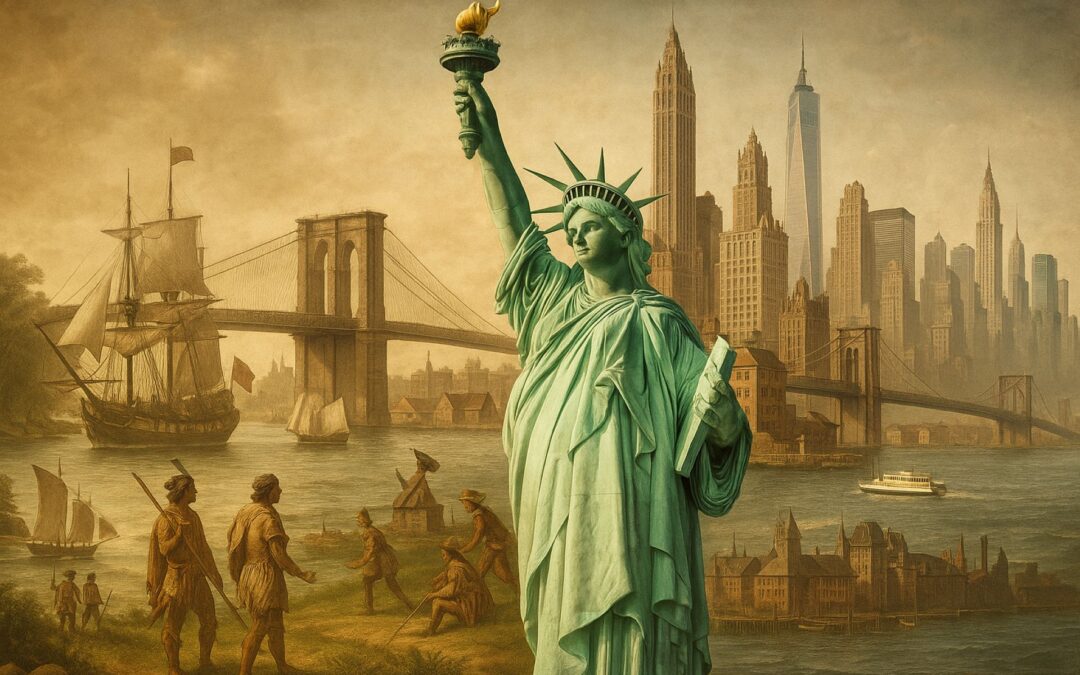
New York City is not just a place—it is a story, written in stone, steel, and human ambition. From its earliest days as Lenape hunting grounds to its reinvention as the world’s financial and cultural capital, the city has lived many lives. Colonized by the Dutch, seized by the English, tested in revolution, and transformed by immigration, it has always been more than a backdrop; it is a stage where history plays out in grand, unrelenting drama. Its bridges and skyscrapers speak of confidence, its neighborhoods echo with countless languages, and its resilience reveals why it endures as a symbol of possibility. To trace the history of New York is to watch the evolution of a city that never stops remaking itself.
Before the Skyline
Long before the clamor of honking taxis and the glow of neon lights, the land that would become New York City was a sanctuary of nature. The region’s geography was shaped by glaciers that retreated some 10,000 years ago, leaving behind fertile valleys, rocky outcrops, and tidal estuaries. The Hudson River flowed broad and deep, its waters teeming with fish such as shad, sturgeon, and eel. The shorelines were thick with oak, chestnut, and hickory trees, while marshlands sheltered flocks of geese and herons. Beaver dams punctuated streams, their industrious builders unwittingly fueling a future trade empire.
For thousands of years, Algonquian-speaking peoples lived in harmony with this environment. The Lenape, whose name means “the people,” were the most prominent group in the region. They organized themselves into clans, each led by sachems who governed not through force but by consensus and reputation. Life revolved around seasonal cycles: spring planting of maize, beans, and squash; summer fishing expeditions in dugout canoes; autumn hunts for deer and bear; winter gatherings in longhouses where stories and traditions were passed down orally. Spiritual life was inseparable from nature—the rivers were sacred arteries, animals were considered kin, and rituals honored the balance of the natural world.
The Lenape saw land not as a commodity but as a communal trust, something to be used wisely and shared. Their trade networks extended across rivers and trails, linking them with tribes as far as the Great Lakes and the Chesapeake. For nearly 8,000 years, their world was one of relative stability, punctuated by intertribal disputes but anchored in reciprocity and respect. This equilibrium endured until the horizon filled with sails—white, alien, and brimming with intentions that would rupture the balance forever.
The First Europeans
The dawn of the 16th century brought seismic change to the Americas. European monarchs, emboldened by Columbus’s voyages, dispatched fleets in search of new lands, trade routes, and dominion. In 1524, Giovanni da Verrazzano, an Italian navigator commissioned by France, steered his ship La Dauphine into the mouth of what is now New York Harbor. From his deck, he gazed upon a wide bay fringed by wooded hills and dotted with islands. He recorded the presence of friendly native inhabitants, remarking on their hospitality and the abundance of the land. Though he claimed the region for France, his visit was fleeting—an entry in a logbook that would lie dormant for nearly a century.
It was the Dutch who would return with a vision rooted not in glory but in commerce. In 1609, Henry Hudson, an Englishman under contract with the Dutch East India Company, sailed the Halve Maen into the harbor and up the river that would immortalize his name. His mission was to find the Northwest Passage, a mythical waterway connecting the Atlantic to the Pacific. Instead, he discovered a river valley rich in fur-bearing animals and navigable waterways—perfect for trade. Hudson’s reports electrified Dutch merchants, who saw in the region an untapped frontier for the fur trade, particularly beaver pelts prized in Europe for their use in hat-making.
Within years, Dutch traders established outposts along the Hudson River, exchanging metal tools, textiles, and firearms with the Lenape and Mohican tribes in return for pelts. Canoes laden with furs soon made their way to ships bound for Amsterdam, fueling both fashion and fortune. Unlike Spain, whose empire sought gold, or France, which emphasized missionary work, the Dutch came as merchants. Their eyes were on ledgers, not crowns, and their presence in this distant harbor was less about conquest than about profit. Still, the seeds of settlement had been sown, and the stage was set for a permanent foothold on the southern tip of Manhattan.
New Amsterdam
The Dutch West India Company, formed in 1621 to advance Dutch interests in the Americas, was the engine that drove settlement in the region. Unlike monarchies that planted colonies for prestige or faith, the Dutch approach was pragmatic: profit first. By 1624, the Company dispatched families to settle New Netherland, dispersing them along the Hudson, Delaware, and Connecticut Rivers. Yet the jewel in this colonial project quickly became Manhattan, strategically perched at the gateway to the river that bore Hudson’s name.
In 1625, work began on Fort Amsterdam at the southern tip of Manhattan Island. Constructed of earthworks and timber palisades, the fort served dual purposes: a bulwark against potential European rivals and a safeguard for the valuable furs flowing through the harbor. Around the fort sprouted a hodgepodge of dwellings, warehouses, and workshops. This was the birth of New Amsterdam, not as a grandiose capital but as a rough-hewn company town.
The settlement was a crossroads from the beginning. Dutch, Walloon, German, Scandinavian, English, African (both enslaved and free), and even a scattering of Sephardic Jews called New Amsterdam home. Its diversity was remarkable for the time, reflecting both the cosmopolitan nature of the Dutch Republic and the colony’s dependence on trade. Streets were muddy, sanitation poor, and laws strictly tied to the Company’s interests. Yet the colony grew steadily. In 1626, Peter Minuit, the director-general, negotiated the fateful purchase of Manhattan from the Lenape. The exchange—trinkets and goods valued at 60 guilders—symbolized the chasm between European and indigenous views of land ownership. To the Dutch, land was bought and sold like a ledger entry; to the Lenape, it was something lent and shared.
As decades passed, the colony’s challenges multiplied. Trade rivalries with the English intensified, piracy plagued shipping lanes, and tensions with Native tribes occasionally erupted into violence. The colony’s governance often wavered between harsh control and lenient neglect. Yet despite its fragility, New Amsterdam laid down enduring foundations: a tradition of commerce, a spirit of pluralism, and a strategic location that would eventually make Manhattan the epicenter of American ambition.
From Dutch to English
The 17th century was a period of unrelenting rivalry on the high seas. England and the Netherlands, both maritime powers, vied for dominance of global trade routes. Their conflicts spilled into colonial outposts, and New Netherland was a tempting prize.
By the 1650s, New Amsterdam’s population hovered around 2,000, its economy buoyed by fur but also increasingly reliant on agriculture, brewing, and trade with the Caribbean. Yet the colony remained vulnerable. Its defensive walls, erected in 1653 along what would become Wall Street, were a response to fears of English invasion. Governor Peter Stuyvesant, a one-legged autocrat with a wooden peg and a reputation for severity, attempted to impose discipline on the fractious settlement. He enforced strict laws on religion, commerce, and public morality, alienating settlers in the process. Many bristled under his authority, longing for greater freedoms more in line with the Dutch Republic’s traditions.
In 1664, the English made their move. A small fleet, dispatched by the Duke of York, sailed into the harbor and demanded surrender. Outnumbered and lacking support, Stuyvesant capitulated without resistance. With barely a musket fired, New Amsterdam became New York. Fort Amsterdam was rechristened Fort James, and the colony now bore the name of its new proprietor, James, Duke of York—later King James II.
English rule brought both continuity and change. The city’s commercial character remained intact; merchants still thrived, ships still crisscrossed the Atlantic, and the diverse population carried on their livelihoods. Yet English law and custom reshaped governance, introducing new forms of property rights, courts, and political structures. More ominously, slavery deepened under English administration. By the 1740s, roughly 20 percent of New York’s inhabitants were enslaved Africans, their labor underpinning industries from shipbuilding to domestic service.
The city briefly returned to Dutch hands in 1673, during another Anglo-Dutch conflict, but the Treaty of Westminster in 1674 restored it permanently to England. By then, the colony had found its identity: not purely Dutch, not purely English, but a hybrid community forged by commerce, diversity, and ambition. This layered foundation would shape New York’s destiny, preparing it to play an outsized role in the birth of a new nation.
Revolution and Liberty
By the mid-18th century, New York had become one of the largest and most important cities in the American colonies. Its harbor bustled with ships, its markets hummed with activity, and its population was a mix of merchants, artisans, enslaved Africans, and immigrants from across Europe. Yet prosperity did not shield the city from the mounting tensions between Britain and its colonies.
When Parliament passed the Stamp Act in 1765, mandating that colonists pay taxes on paper goods, the outrage was immediate. New York became the stage for the Stamp Act Congress, a gathering of delegates from nine colonies who issued a declaration of rights and grievances. The Sons of Liberty, a radical group of patriots, found fertile ground in New York’s taverns and streets, organizing protests, intimidating tax collectors, and galvanizing public sentiment against British overreach. Still, New York remained a city of divided loyalties. Many merchants, dependent on trade with Britain, feared rebellion. A sizable number of loyalists made their presence felt, creating a city simmering with suspicion and conflict.
When the Revolutionary War broke out in 1775, New York was a strategic prize. George Washington, commanding the Continental Army, recognized its importance and stationed his troops in and around the city. But the British struck swiftly. In August 1776, the Battle of Long Island ended in disaster for the Americans. Washington’s forces, vastly outnumbered and outmaneuvered, barely escaped across the East River under cover of night. New York fell to the British, and it would remain under their control for the rest of the war. The city became the crown’s North American headquarters, a garrisoned outpost teeming with redcoats, Hessian mercenaries, loyalist refugees, and enslaved people who had fled to British lines in search of freedom.
The occupation left scars: fires devastated swathes of the city, poverty spread among patriots driven into hiding, and thousands of prisoners languished on prison ships in Wallabout Bay. Yet when the war ended with the Treaty of Paris in 1783, New York reemerged as a beacon of liberty. On November 25, 1783, American forces triumphantly reentered the city on Evacuation Day, marking the final departure of British troops. Just two years later, in 1785, New York was chosen as the national capital. Federal Hall on Wall Street became the cradle of American democracy: George Washington was inaugurated here in 1789, the first Congress convened, and the Bill of Rights took shape. In less than a decade, New York had transformed from a British military stronghold into the political heart of a newborn republic.
A Port Ascendant
The dawn of the 19th century saw New York pivot from political capital to economic powerhouse. Although the seat of government shifted to Philadelphia and then to Washington, D.C., New York seized a new role: the beating financial heart of America. Wall Street, once the site of a wooden defensive wall, became synonymous with banking and investment. In 1792, two dozen brokers signed the Buttonwood Agreement beneath a tree on Wall Street, creating the foundation for the New York Stock Exchange. The city’s financial institutions, led by the Bank of New York—founded by Alexander Hamilton—gave New York the capital it needed to rise.
The city’s fortunes were supercharged by infrastructure. The Erie Canal, completed in 1825, was an engineering marvel that linked the Great Lakes to the Hudson River and, by extension, to the Atlantic Ocean. Suddenly, Midwestern grain, timber, and iron could flow to New York Harbor faster and cheaper than ever before. Goods and wealth poured in, transforming New York into the nation’s busiest port. By mid-century, it handled more trade than Boston, Philadelphia, and Baltimore combined.
This prosperity attracted people in staggering numbers. Immigrants arrived by the tens of thousands: Irish fleeing famine, Germans escaping failed revolutions, Italians chasing opportunity, Eastern European Jews seeking refuge from pogroms. They disembarked at Castle Garden (and later Ellis Island), their first sight of America often the Statue of Liberty after 1886. Many settled in crowded tenements on the Lower East Side, neighborhoods that became kaleidoscopes of culture. Italian grocers stood beside Jewish tailors, Irish dockworkers lived next to German butchers, and languages from across Europe mingled in the streets.
But growth had its dark side. Overcrowded tenements became breeding grounds for disease—cholera and typhus swept through the city in deadly waves. Fires, like the Great Fire of 1835, reduced entire districts to ash. Crime festered in impoverished neighborhoods, where gangs like the Dead Rabbits and Bowery Boys clashed in brutal turf wars. Social tensions boiled over during the Civil War. In 1863, resentment against the Union draft—particularly the rule allowing wealthy men to pay for substitutes—sparked the New York Draft Riots. For five harrowing days, mobs rampaged through the city, attacking African American residents, looting businesses, and defying federal troops.
Yet through turmoil, New York grew stronger. Its port, its banks, and its diversity made it indispensable to the Union and to the nation. By the late 19th century, the city was no longer merely an American metropolis—it was the gateway to the world, a place where global commerce and human migration converged in an unstoppable tide.
The Gilded Age of Culture and Commerce
By the latter half of the 19th century, New York had transformed from a rough-hewn port into a city of ambition and spectacle. Wealth accumulated at a staggering pace, fueled by trade, finance, and industry. This era—later called the Gilded Age—was marked by contradictions: dazzling cultural achievements set against poverty-ridden slums, opulent mansions rising only blocks away from crowded tenements.
One of the defining achievements of the period was the creation of Central Park. Conceived by Frederick Law Olmsted and Calvert Vaux, the park opened in 1858 and was unlike anything America had seen before: an expansive green oasis carved into the heart of a dense, industrial city. With winding paths, open meadows, and man-made lakes, it offered New Yorkers a retreat from the relentless pace of urban life. At the same time, grand cultural institutions began to bloom. The Metropolitan Museum of Art, founded in 1870, showcased treasures from around the world, while the American Museum of Natural History (1869) introduced the public to science, exploration, and discovery. The New York Public Library, established in 1895, embodied the city’s intellectual ambitions, its shelves lined with knowledge for rich and poor alike.
Art and entertainment thrived. Broadway’s theaters became the nation’s stage, attracting actors, playwrights, and audiences eager for drama and spectacle. Carnegie Hall, completed in 1891, offered world-class acoustics and a venue for the world’s greatest musicians. Newspapers—The New York Times, The Herald, and The World—fueled a culture of information, competition, and influence. The press became so powerful that “yellow journalism” could sway public opinion and even nudge foreign policy.
But perhaps nothing symbolized the city’s rising stature like its bridges and monuments. The Brooklyn Bridge, completed in 1883, was a marvel of engineering and vision—a span of steel and stone that linked Manhattan to Brooklyn. It represented not just infrastructure but aspiration, a city unafraid to tackle the impossible. Then, in 1886, the Statue of Liberty arrived, a gift from France. Towering over the harbor, it became an emblem of welcome and hope for millions of immigrants. By 1892, Ellis Island opened as the federal immigration station, processing a tidal wave of humanity—Italians, Poles, Greeks, Russians, and countless others—who reshaped New York’s cultural fabric. To those who passed under Lady Liberty’s gaze, the city was not just a destination but the embodiment of possibility.
This was a time when New York announced itself as both the cultural capital of the nation and the economic gateway to the world. Yet behind the grandeur, inequality, corruption, and unrest festered—a tension that would carry into the next century.
Roaring and Reeling
The early decades of the 20th century brought both triumph and turmoil, encapsulating the city’s dual nature of exuberance and vulnerability. On one hand, New York dazzled with innovation. In 1904, the subway system opened, carving steel arteries beneath the streets and connecting neighborhoods in ways once unimaginable. Bridges like the Williamsburg (1903) and Manhattan (1909) further bound the expanding city together, knitting boroughs into one sprawling metropolis.
Above ground, the skyline soared to unprecedented heights. Architects and developers competed to build taller, bolder, more awe-inspiring structures. The Woolworth Building, completed in 1913, was dubbed the “Cathedral of Commerce,” while the Chrysler Building (1930) dazzled with its Art Deco crown. In 1931, the Empire State Building claimed the title of tallest building in the world, a gleaming testament to human ambition in the very heart of New York. These towers were not mere offices—they were monuments to capitalism, confidence, and the city’s unshakable belief in its destiny.
Yet below the grandeur, the streets throbbed with a different kind of energy. The 1920s—the Jazz Age—saw Prohibition outlaw the sale of alcohol, but New York simply bent the rules. Speakeasies sprouted everywhere, hidden behind unmarked doors and false fronts. Jazz spilled from smoky clubs in Harlem, where musicians like Duke Ellington and Louis Armstrong redefined sound. The Harlem Renaissance gave voice to a new generation of Black artists, poets, and intellectuals, making New York the cultural vanguard of a changing America. It was a decade of decadence, glamour, and defiance, where the city lived fast and shone bright.
Then came the crash. In October 1929, the stock market collapsed, and the euphoria of the Roaring Twenties curdled into despair. Banks shuttered, businesses folded, and unemployment soared. By the early 1930s, millions were out of work, and shantytowns—mockingly dubbed “Hoovervilles”—sprang up in Central Park and other corners of the city. Hunger, poverty, and desperation stalked its streets. The Empire State Building, completed just as the Depression set in, became a paradox: a gleaming monument that stood largely empty for years, derisively nicknamed the “Empty State Building.”
Recovery was slow, but necessity kept New York moving. When World War II erupted in 1939, the city’s industries roared back to life. Shipyards, factories, and warehouses churned out goods for the Allied cause. Its ports became critical arteries of the war effort, sending soldiers, tanks, and supplies across the Atlantic. The conflict reinvigorated New York’s economy, and when the war ended, the city emerged not weakened but elevated, ready to claim a new role on the world stage.
The Global Capital
When World War II ended in 1945, the map of power was redrawn. Europe’s cities lay in ruins, Asia reeled from devastation, but New York emerged intact and energized. It became more than just America’s largest city—it became a global capital. In 1952, the newly formed United Nations established its headquarters along the East River, a glass-and-steel monument to diplomacy and cooperation. From that moment forward, the world looked to New York not only for finance and culture, but for leadership on the international stage.
Wall Street accelerated this new identity. American industry dominated global markets, and New York’s financial institutions became the nexus through which capital flowed. The New York Stock Exchange swelled in influence, rivaling and eventually overtaking London as the preeminent financial hub of the world. Corporate headquarters clustered in Midtown skyscrapers, while banks and brokers crowded into Lower Manhattan. The city that once traded furs had become the nerve center of global finance.
At the same time, culture flourished. Paris had long been the center of the art world, but in the postwar decades, New York seized that mantle. Abstract Expressionists like Jackson Pollock and Mark Rothko redefined modern art, while later Pop Artists such as Andy Warhol and Roy Lichtenstein turned New York into a factory of bold, provocative creativity. The city’s neighborhoods—Greenwich Village, SoHo, Harlem—became synonymous with experimentation, music, and literary ferment. Broadway remained America’s theater district, producing musicals that became cultural exports in their own right.
Yet this global ascendance did not shield New York from decline. By the 1970s, the city was buckling under multiple crises: economic stagnation, deindustrialization, and soaring crime. Manufacturing jobs vanished, leaving entire communities struggling. Fiscal mismanagement pushed the city to the brink of bankruptcy in 1975, forcing President Gerald Ford to famously tell New York, in newspaper shorthand, to “drop dead.” Streets became synonymous with danger—muggings, arson, and drug epidemics scarred its reputation. Entire neighborhoods, particularly in the Bronx, fell into decay, their burned-out buildings a grim backdrop to urban life.
And yet, New York did what it always does: it endured. Redevelopment projects began reshaping the city. Glass towers rose in Midtown and Lower Manhattan, symbols of modern ambition. The World Trade Center, completed in 1973, was the most audacious of these projects—a pair of colossal towers that defined the skyline and embodied the city’s unyielding drive. Even as crime and poverty gnawed at its edges, New York refused to bow. Its paradox remained intact: a place of struggle and hardship, yet simultaneously the epicenter of wealth, art, and aspiration.
Reinvention and Resilience
Few cities in history have been as adept at reinvention as New York. Its story is one of cycles—decline, renewal, collapse, and resurgence. Fires have leveled its neighborhoods, epidemics have thinned its people, financial crashes have hollowed out its wealth, and foreign powers have occupied its streets. And yet, each time, the city has clawed back, often stronger and more ambitious than before.
The resilience comes from its people. Immigrants, strivers, and dreamers have always been its lifeblood. Each wave of newcomers brought not just labor but reinvention: Irish dockworkers, Jewish tailors, Italian masons, Puerto Rican musicians, Dominican entrepreneurs, Chinese restaurateurs. Their contributions built neighborhoods, reshaped cultures, and gave New York its unparalleled diversity. This constant infusion of energy meant the city never stood still—it was always becoming something new.
By the late 20th and early 21st centuries, this adaptability proved vital. The city faced the shock of 9/11, when the Twin Towers—symbols of its modern ambition—were brought down in an act of terror. The attack scarred the skyline and the psyche of New Yorkers, yet it did not break them. The recovery, slow and painful, gave rise to memorials of resilience and to new architecture like One World Trade Center, a soaring replacement that signaled defiance and renewal.
Economically, New York reinvented itself again as industries shifted. Finance remained its core, but media, technology, and design surged. Silicon Alley in Manhattan and Brooklyn’s tech corridors turned the city into a hub of digital innovation. Cultural life continued to thrive, from Broadway musicals to cutting-edge art in Chelsea galleries. Tourism swelled, as millions flocked to see the skyline, Central Park, Times Square, and the museums that chronicled its past and present.
Today, New York is a paradox made flesh: chaotic yet ordered, historical yet ever-modern, battered yet indestructible. Its 8.3 million residents, spread across five boroughs, embody a microcosm of the world. What makes New York extraordinary is not just its size, wealth, or monuments, but its ability to adapt—its instinct for survival, its appetite for reinvention. Each challenge becomes a crucible, each setback a prelude to resurgence. In this lies the true genius of New York: a city that never simply exists, but constantly reinvents what it means to be the greatest city in the world.
Conclusion
Across four centuries, New York City has been razed, rebuilt, glorified, and maligned—yet it has never been defeated. It has absorbed waves of immigrants, withstood depressions and riots, endured occupation and terror, and still emerged stronger. Its strength lies not in its skyline or its institutions, but in the restless energy of its people who insist on renewal.
Today, the city stands as a paradox: chaotic yet ordered, diverse yet unified, fragile yet indomitable. New York is more than the sum of its past—it is a living organism, ever-adapting, always striving, forever new. To understand it is to recognize the enduring spirit of reinvention that makes it, quite simply, the world’s greatest city.