
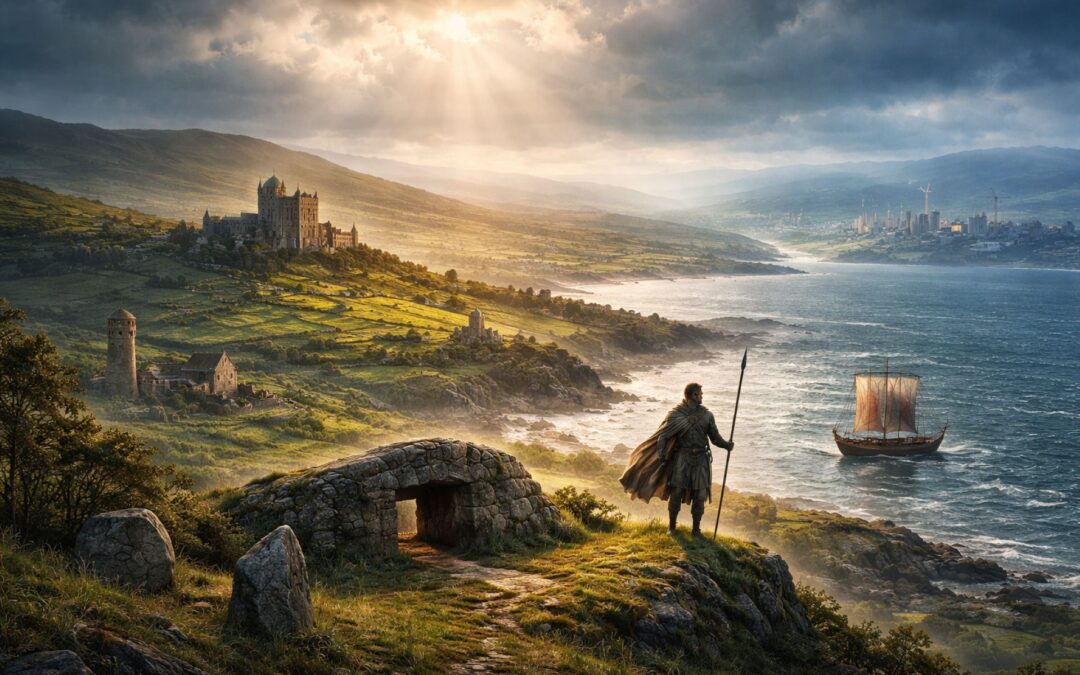
Ireland’s history is a story of deep cultural roots, repeated conquest, and a long struggle over identity and sovereignty. Today the island is divided between two political entities: the Republic of Ireland, which occupies most of the island, and Northern Ireland, which remains part of the United Kingdom. This division is relatively recent, dating back just over a century to the partition of Ireland in 1921. Yet the forces that created it were centuries in the making.
For much of its past, Ireland was shaped by waves of migration, invasion, and religious transformation. From the arrival of Celtic tribes who built a uniquely Gaelic culture, to the spread of Christianity that turned Ireland into one of medieval Europe’s centers of learning, the island developed a distinct identity long before the emergence of modern nation-states. However, this cultural evolution was repeatedly disrupted by foreign incursions, first by Viking raiders and settlers and later by Norman and English conquerors who sought to extend their authority across the island.
Over time, these external interventions fundamentally altered Ireland’s political and social structure. English rule brought new systems of governance, land ownership, and religion that clashed with the traditions of Gaelic Ireland. Large-scale colonization projects introduced Protestant settlers to a largely Catholic population, creating a deep religious and political divide that would shape Irish history for centuries. These tensions eventually gave rise to nationalist movements seeking independence from British control.
The 19th and early 20th centuries saw these demands intensify, fueled by traumatic events such as the Great Famine and the growing desire for self-government. Revolutionary movements culminated in the Irish War of Independence and the eventual creation of the Irish Free State. Yet the solution came with a profound compromise: the island would be partitioned, leaving six counties in the north within the United Kingdom while the rest formed an autonomous Irish state.
Partition did not end Ireland’s struggles. In Northern Ireland, decades of discrimination and sectarian division erupted into a prolonged conflict known as the Troubles, which lasted for nearly thirty years and claimed thousands of lives. Only with the Good Friday Agreement in 1998 did a fragile but historic peace emerge.
The history of Ireland is therefore not only the story of a nation’s struggle for independence, but also a complex tale of identity, religion, and coexistence. From ancient Gaelic kingdoms to modern peace agreements, Ireland’s past reveals how centuries of conflict ultimately shaped the divided island that exists today—and how recent decades have opened the possibility of a more cooperative future.
The Origins of Gaelic Ireland
Early Human Settlement and Megalithic Culture
Human presence in Ireland stretches back thousands of years before written history. The earliest inhabitants likely arrived around 8000 BC, migrating from Britain and continental Europe after the last Ice Age as rising sea levels gradually isolated the island. These early communities lived as hunter-gatherers, relying on fishing, wild plants, and animals to sustain themselves in Ireland’s dense forests and rugged landscape.
Although little is known about their daily lives, these prehistoric peoples left behind remarkable traces of their culture. Across Ireland, archaeologists have uncovered numerous megalithic tombs—large stone burial structures that date back to the Neolithic period around 3000 BC. Among the most famous is the passage tomb at Newgrange in the Boyne Valley, an immense stone monument aligned with the winter solstice sunrise. Such structures demonstrate not only sophisticated engineering but also a complex spiritual world in which ritual, burial practices, and astronomical observation played important roles.
Over time, Ireland’s early inhabitants transitioned from nomadic hunting to settled farming communities. They cultivated crops, raised livestock, and gradually transformed the natural landscape into farmland and permanent settlements. These developments laid the foundations for the societies that would later flourish across the island.
The Arrival of the Celts and the Rise of Gaelic Society
By the middle of the first millennium BC, a new cultural influence began to dominate Ireland: the Celts. Originating in central Europe, Celtic peoples had spread widely across the continent, bringing with them distinctive languages, art styles, and social traditions. When Celtic culture reached Ireland, it gradually merged with the island’s existing communities and reshaped its identity.
Over time, the Celtic language evolved into Gaelic, which would become the dominant language of the island for centuries. Alongside this linguistic transformation emerged a rich cultural tradition characterized by intricate metalwork, elaborate storytelling, and a strong warrior ethos.
Gaelic society was not organized as a unified kingdom. Instead, Ireland was divided into a patchwork of small territories known as túatha. Each túath was ruled by a local king or chieftain who governed alongside a network of nobles, warriors, and learned elites. Although the island occasionally acknowledged a High King, his authority was often symbolic rather than absolute, as rival clans frequently competed for power.
Despite this political fragmentation, Gaelic Ireland developed a strong cultural cohesion rooted in language, law, and shared traditions. Brehon law—a sophisticated legal system transmitted orally by trained jurists—regulated everything from land ownership to social status and compensation for crimes.
Clan Kingdoms, Druids, and Oral Tradition
Religion and culture in early Gaelic Ireland were deeply intertwined. The inhabitants practiced a polytheistic Celtic faith centered on nature, sacred sites, and a pantheon of deities associated with war, fertility, and the natural world. Religious authority was held by druids, who acted as priests, scholars, and judges within society.
Equally important were the island’s poets, storytellers, and historians. In a society where literacy had not yet become widespread, these figures preserved genealogies, myths, and heroic tales through oral tradition. Their stories formed the foundation of Ireland’s legendary cycles, including the mythological tales of the Tuatha Dé Danann and the heroic exploits of warriors such as Cú Chulainn.
For centuries, Gaelic Ireland remained largely insulated from the major empires that dominated Europe. Unlike neighboring Britain, which was conquered by Rome, Ireland lay beyond the empire’s frontier and retained its independent cultural development. This relative isolation allowed Gaelic traditions to flourish and persist.
Yet this period of cultural continuity would not last forever. In the centuries ahead, new religious influences and foreign invaders would arrive on Irish shores, transforming the island’s society and connecting it more closely to the wider European world.
Christianity and the Rise of Ireland as a Center of Learning
The Mission of St. Patrick and the Christianization of Ireland
During the early centuries of the first millennium AD, Ireland remained culturally distinct from much of Europe. While the Roman Empire had brought Christianity to many parts of the continent, Ireland lay beyond its borders and continued to follow its traditional Celtic religious practices. This situation began to change in the late 4th and early 5th centuries when Christianity gradually spread to the island.
One of the most influential figures associated with this transformation was St. Patrick. According to tradition, Patrick had once been captured by Irish raiders and enslaved in Ireland as a young man. After escaping and later becoming a Christian missionary, he returned to the island determined to spread the new faith. Through preaching, persuasion, and the support of local rulers, Patrick and other missionaries began converting many Irish communities to Christianity.
Over the following generations, the new religion spread steadily across the island. By the 6th century, Christianity had largely replaced the old pagan traditions, though elements of Celtic spirituality and symbolism continued to influence Irish religious practices. Rather than completely erasing older traditions, Christianity in Ireland often blended with them, creating a uniquely Irish expression of the faith.
Monasteries, Literacy, and the Preservation of Knowledge
One of the most important consequences of Christianity’s arrival was the introduction of literacy and formal education. Monasteries soon became the central institutions of Irish religious and intellectual life. These monastic communities served not only as places of worship but also as centers of scholarship, learning, and artistic production.
Across Ireland, monasteries developed into thriving hubs where monks studied scripture, copied manuscripts, and recorded historical traditions that had previously been preserved only through oral storytelling. This process helped transform Ireland into one of the most literate societies in early medieval Europe.
Irish monks produced beautifully decorated religious texts known as illuminated manuscripts. Among the most famous examples is the Book of Kells, an extraordinary work of art that combines Christian scripture with intricate Celtic designs and symbolism. Such manuscripts demonstrated the remarkable artistic and intellectual achievements of Irish monastic culture.
In addition to preserving religious writings, Irish scholars also recorded elements of the island’s earlier myths, genealogies, and legal traditions. As a result, much of what is known today about early Gaelic society survived because medieval monks chose to document these stories and customs.
Irish Monks and Their Influence Across Europe
Ireland’s monastic culture eventually extended far beyond the island itself. During the early Middle Ages, many Irish monks traveled across Europe as missionaries and scholars, helping to spread Christianity and learning to regions that had experienced disruption after the fall of the Roman Empire.
These Irish missionaries founded monasteries throughout Britain and continental Europe, including influential religious centers in places such as Scotland, France, Switzerland, and Italy. Through their work, they contributed to the revival of education and religious life in parts of Europe that had fallen into political instability and cultural decline.
For this reason, medieval Ireland was sometimes referred to as the “land of saints and scholars.” Its monasteries played a vital role in preserving classical learning, maintaining written traditions, and transmitting knowledge across a fragmented European landscape.
Yet this flourishing intellectual culture also made Ireland an attractive target for outsiders. The wealth accumulated by monasteries—along with their valuable manuscripts and treasures—would soon draw the attention of seafaring raiders from Scandinavia. Beginning in the late 8th century, a new wave of invaders would arrive on Irish shores, ushering in another dramatic chapter in the island’s history.
Viking Raids and the Birth of Ireland’s First Towns
The Viking Raids Begin
Toward the end of the 8th century, a new and formidable threat appeared along the coasts of Ireland. Beginning around 795 AD, Viking raiders from Scandinavia launched a series of attacks on the island’s coastal monasteries and settlements. These seafaring warriors, arriving in swift longships, targeted Ireland’s wealthy religious communities, which often contained valuable treasures such as gold chalices, manuscripts, and other religious artifacts.
The early Viking raids were sudden and destructive. Monasteries, which had previously been centers of peace and scholarship, were vulnerable to these attacks because they were usually located near the coast and lacked significant defenses. Raiders looted valuables, destroyed buildings, and frequently captured people to be sold as slaves in the growing Viking trading networks.
For decades, these assaults remained sporadic hit-and-run raids. However, over time the Vikings began to establish more permanent footholds in Ireland, transforming their activities from temporary plundering expeditions into long-term settlement and trade.
Norse Settlements and the Creation of Coastal Cities
By the 9th and 10th centuries, Viking groups had established fortified coastal bases known as longphorts. These bases gradually developed into permanent settlements and trading centers, marking a major turning point in Irish history. Prior to the Viking arrival, Ireland had largely consisted of rural settlements and small tribal territories. The Norse settlements introduced urban life to the island for the first time.
Several of Ireland’s most important cities were founded during this period. Dublin, which began as a Viking settlement in the mid-9th century, soon became the largest and most prosperous Norse town in Ireland. Other major settlements such as Wexford, Waterford, Cork, and Limerick also emerged from Viking trading posts.
These towns became crucial nodes in a vast Viking trading network that stretched across Europe and beyond. Goods, slaves, and precious metals flowed through these ports, linking Ireland to distant regions such as Scandinavia, the Mediterranean, the Middle East, and even the North Atlantic colonies of the Vikings.
Dublin, in particular, gained notoriety as one of the largest slave markets in Western Europe during the Viking Age. Captives taken during raids in Ireland and Britain were often transported through the city and sold to traders from across the Viking world.
Despite their growing economic influence, the Vikings never fully conquered Ireland. Much of the island’s interior remained under the control of Gaelic kings and chieftains. Over time, many Norse settlers assimilated into Irish society, intermarrying with local populations and adopting elements of Gaelic culture. These mixed communities became known as the Norse-Gaels.
The Battle of Clontarf and the Decline of Viking Power
Relations between the Viking towns and the Gaelic kingdoms were often tense and marked by frequent warfare. Irish rulers sometimes allied with Viking groups, while at other times they fought to expel them from the island.
The most famous conflict between these forces occurred in 1014 at the Battle of Clontarf. Brian Boru, the High King of Ireland, led a coalition of Irish forces against a combined army of Viking warriors and their Irish allies near Dublin. The battle was fierce and costly, resulting in the deaths of thousands of fighters on both sides.
Although Brian Boru himself was killed during the conflict, his forces achieved a decisive victory. The defeat significantly weakened Viking political power in Ireland. While the Norse settlements remained important centers of trade and commerce, they gradually lost their dominance over Irish affairs.
In the decades that followed, Ireland experienced a period of relative economic growth and stability. Yet the island’s political structure remained fragmented among competing regional kings. This lack of unity would soon invite a new and even more transformative foreign intervention—one that would permanently entangle Ireland’s fate with that of England.
The Anglo-Norman Invasion and the First English Presence
Dermot MacMurrough and the Invitation to the Normans
By the 12th century, Ireland remained politically fragmented despite the weakening of Viking power. The island was still divided among numerous competing Gaelic kingdoms, with rival rulers frequently fighting for territory and influence. This internal rivalry created opportunities for outside forces to intervene in Irish affairs.
One such opportunity arose in 1166 when Dermot MacMurrough, the King of Leinster, was driven from power by a coalition of Irish rivals led by the High King Rory O’Connor. Determined to reclaim his throne, MacMurrough sought military assistance from across the Irish Sea in England.
There he appealed to the Norman rulers who had established themselves in Britain following the Norman Conquest of 1066. MacMurrough promised land and titles in Ireland to any knights willing to help him regain control of Leinster. Among those who accepted the offer was the powerful Norman noble Richard de Clare, better known as Strongbow.
In 1169, Norman knights and soldiers landed in Ireland to support MacMurrough’s cause. Their heavily armored cavalry and advanced military tactics gave them a decisive advantage over many Irish forces. Within a short period, they successfully restored MacMurrough to power and began conquering neighboring territories.
Strongbow’s Conquest and the Intervention of Henry II
The rapid success of the Norman forces soon attracted the attention of King Henry II of England. Henry feared that the ambitious Norman lords might establish an independent kingdom in Ireland beyond his control. To prevent this possibility, he decided to intervene directly.
In 1171, Henry II crossed the Irish Sea with a large army, becoming the first English king to set foot in Ireland. His arrival forced many of the Norman leaders to acknowledge him as their sovereign, ensuring that their conquests would remain under English authority rather than forming a separate Norman state.
Henry declared himself Lord of Ireland and began establishing English rule over parts of the island. This marked the beginning of centuries of English political involvement in Ireland. Although the English crown now claimed authority over Ireland, its actual control remained limited and uneven.
The Pale and the Limits of Norman Authority
Following Henry II’s intervention, Norman barons continued to expand their influence across eastern and southern Ireland. They constructed castles, introduced feudal systems of land ownership, and established towns modeled after those in England and Normandy.
However, the Norman conquest of Ireland was never fully completed. English authority remained strongest in the region surrounding Dublin, an area that became known as the Pale. Within this territory, English law, language, and customs dominated.
Beyond the Pale, Gaelic Irish rulers continued to control much of the island. In many cases, Norman settlers living outside the Pale gradually assimilated into Irish society. They adopted the Irish language, married into Gaelic families, and embraced local customs, eventually becoming culturally indistinguishable from the native Irish population.
This blending of cultures frustrated the English crown, which attempted to maintain a clear distinction between English settlers and the Irish. Despite these efforts, by the late Middle Ages English power in Ireland had weakened significantly.
Over time, native Irish dynasties regained strength across much of the island, setting the stage for a resurgence of Gaelic influence. Yet this temporary recovery would soon be challenged again when the English monarchy—now under the ambitious Tudor dynasty—launched a far more determined effort to bring Ireland fully under its control.
Gaelic Resurgence and the Decline of English Control
Norman Assimilation into Irish Society
In the centuries following the Anglo-Norman invasion, English authority in Ireland gradually weakened. While the Norman knights had initially conquered significant portions of the island, their power began to decline as they became increasingly isolated from England and surrounded by a predominantly Gaelic population.
Over time, many Norman families began adopting the customs and language of the Irish people among whom they lived. They intermarried with Gaelic families, embraced Irish laws and traditions, and even took on Irish-style titles. These families became known as the “Old English,” distinguishing them from later English settlers who would arrive in Ireland centuries afterward.
As this cultural blending continued, many Norman lords began to rule their territories in a manner similar to Gaelic chieftains. Their allegiances often shifted, and some even fought alongside native Irish clans against English authority. This gradual assimilation blurred the distinctions between conqueror and conquered, weakening the influence of the English crown across much of Ireland.
The Statutes of Kilkenny and English Attempts to Maintain Control
Concerned by the growing Gaelicization of English settlers, the English government attempted to enforce strict policies to preserve English identity and authority in Ireland. One of the most notable efforts came in 1367 with the enactment of the Statutes of Kilkenny.
These laws sought to prevent English settlers from adopting Irish customs and integrating into Gaelic society. They prohibited intermarriage between English and Irish families, banned the use of the Irish language among English settlers, and forbade the adoption of Irish dress and cultural practices.
The statutes also attempted to limit cooperation between English settlers and Gaelic lords, reinforcing a legal and cultural divide between the two populations. However, enforcing these laws proved extremely difficult. Outside the narrow region of the Pale around Dublin, English influence was limited and often ineffective.
As a result, the Statutes of Kilkenny had little lasting impact. Over time, many Norman-descended families continued to adopt Irish customs and operate as independent regional rulers rather than loyal representatives of English authority.
The Re-Emergence of Powerful Gaelic Dynasties
By the 15th century, English royal power in Ireland had shrunk dramatically. The Pale remained under English control, but beyond its borders much of the island was effectively governed by Gaelic dynasties and semi-independent Norman families.
Powerful Irish clans reasserted their dominance across large territories. Families such as the O’Neills in Ulster and the O’Briens in Thomond regained significant influence, ruling their lands according to traditional Gaelic systems of law and leadership.
Even many of the Norman-descended lords operated similarly to Gaelic chiefs, maintaining local armies and engaging in regional rivalries. Ireland during this period resembled a patchwork of autonomous territories rather than a unified political entity.
For the English crown, this situation was increasingly unacceptable. By the beginning of the 16th century, a new dynasty had come to power in England—the Tudors—who were determined to reassert control over Ireland and transform it into a fully governed kingdom under English rule.
Their efforts would mark the beginning of one of the most transformative and violent periods in Irish history, bringing the collapse of the traditional Gaelic order and permanently altering the island’s political and religious landscape.
The Tudor Conquest and the End of Gaelic Ireland
Henry VIII Declares the Kingdom of Ireland
At the beginning of the 16th century, the English crown resolved to reassert its authority over Ireland more decisively than ever before. Under the Tudor dynasty, English rulers sought to transform Ireland from a loosely controlled lordship into a fully governed kingdom firmly under English rule.
One of the most significant turning points came during the reign of King Henry VIII. In the 1530s, Henry broke with the Roman Catholic Church and established the Church of England, triggering the Protestant Reformation in England. This religious transformation soon became entangled with English policy in Ireland.
In 1541, the Irish Parliament passed legislation declaring Henry VIII the King of Ireland, replacing the earlier title of Lord of Ireland that had existed since the Norman invasion. This move formally elevated Ireland into a separate kingdom under the English crown and symbolized the beginning of a more centralized and assertive English administration.
To extend English control, Tudor officials attempted to incorporate Irish chieftains into the English political system through a policy known as “surrender and regrant.” Gaelic rulers were encouraged to surrender their traditional titles and lands to the crown and receive them back under English law as recognized noble titles.
While some Irish leaders accepted these arrangements, many resisted the erosion of their traditional authority. Tensions between English officials and Gaelic lords soon escalated into open conflict.
Resistance from Irish Lords and the Plantation of Munster
Resistance to English expansion emerged in several regions of Ireland, particularly among powerful noble families who feared losing their autonomy. One of the most significant centers of opposition occurred in the province of Munster, where the Fitzgerald family—the powerful Earls of Desmond—led rebellions against English authority.
The Desmond Rebellions in the late 16th century represented a major challenge to Tudor rule. English forces ultimately crushed the uprisings after years of brutal fighting. In the aftermath, the crown confiscated vast amounts of land from the defeated rebels.
These lands were redistributed to English settlers in a process known as plantation. The Plantation of Munster introduced Protestant English landowners to territories that had previously been controlled by Gaelic and Old English families. Although the number of settlers remained relatively limited compared to later plantations, this policy marked the beginning of a major transformation in Irish land ownership.
The plantation system created a new class of Protestant landowners loyal to the English crown while displacing many native Irish inhabitants. This change intensified tensions between Ireland’s Catholic majority and the increasingly powerful Protestant elite.
The Nine Years’ War and the Defeat of Gaelic Resistance
The most serious challenge to Tudor authority came in the final years of the 16th century during the Nine Years’ War. This conflict was led by Hugh O’Neill, the powerful Earl of Tyrone, who sought to unite Gaelic Ireland against English rule.
O’Neill succeeded in rallying many Irish lords and clans into a broad alliance aimed at preserving the traditional Gaelic political order. For several years, his forces inflicted significant defeats on English armies, making the rebellion one of the most dangerous threats the Tudor state had faced in Ireland.
The conflict also drew international attention. Catholic Spain, eager to undermine Protestant England, sent military assistance to support the Irish rebels. In 1601, Spanish troops landed in southern Ireland and joined forces with the Irish insurgents.
However, the decisive confrontation came later that year at the Battle of Kinsale. English forces defeated the combined Irish and Spanish armies, marking a turning point in the war. Although resistance continued for a short time, the rebellion soon collapsed.
In 1603, Hugh O’Neill formally surrendered to the English crown. A few years later, in 1607, O’Neill and several other Gaelic leaders fled Ireland in what became known as the Flight of the Earls. Their departure effectively marked the end of the old Gaelic aristocratic order.
With the traditional Gaelic leadership gone, the English crown gained control over the entire island for the first time. Yet this victory also paved the way for an even more radical transformation of Irish society—one that would fundamentally reshape the island’s demographic, political, and religious landscape through large-scale colonization.
Plantations, Colonization, and the Birth of a Divided Society
The Plantation of Ulster
Following the defeat of the Gaelic lords and the Flight of the Earls in 1607, the English crown moved quickly to consolidate its control over Ireland. With the traditional Gaelic leadership removed, vast territories—particularly in the northern province of Ulster—were declared forfeited to the crown.
In 1609, King James I launched one of the most ambitious colonization projects in Irish history: the Plantation of Ulster. Large portions of land that had previously belonged to Irish chieftains were confiscated and redistributed to Protestant settlers from Britain. These settlers were primarily drawn from England and Scotland, especially Scottish Presbyterians and English Anglicans.
Unlike earlier plantations, which had been smaller and less systematic, the Ulster plantation was carefully organized. Settlers were encouraged to build fortified towns, establish farms, and create communities that would be loyal to the English crown. The aim was not only economic development but also the creation of a stable Protestant population that could maintain English authority in the region.
Protestant Settlers and Changing Land Ownership
The arrival of British settlers dramatically altered the demographic and political landscape of Ulster. Tens of thousands of newcomers established themselves on lands that had once been controlled by Gaelic Irish families. Towns were rebuilt according to English models, and many places received new English names. For example, the city of Derry was renamed Londonderry to acknowledge the financial support of London merchants who helped fund the plantation.
By the mid-17th century, approximately 30,000 British settlers had been established in Ulster alone. These communities introduced new agricultural methods, economic structures, and religious institutions that differed significantly from those of the native Irish population.
The plantations created a new Protestant landowning class that enjoyed political and legal privileges under English rule. Meanwhile, many Irish Catholics were displaced from their ancestral lands or forced into tenant farming under the authority of Protestant landlords.
This restructuring of land ownership and power created deep divisions within Irish society. Religious identity became increasingly linked with political and economic status, with Protestants largely occupying positions of authority while Catholics were marginalized.
The Seeds of Religious and Political Division
The plantation system laid the foundations for the sectarian divisions that would dominate Irish history for centuries. In Ulster especially, the coexistence of Protestant settlers and Catholic natives produced a society divided along religious, cultural, and political lines.
The Protestant settlers generally viewed themselves as loyal subjects of the English crown and defenders of Protestantism. In contrast, the Catholic Irish population often saw the plantations as an unjust seizure of their land and an attempt to suppress their culture and religion.
These tensions simmered for decades before erupting into open conflict in the mid-17th century. As political turmoil engulfed England during the English Civil War, the fragile balance in Ireland collapsed. Long-standing grievances over land, religion, and power soon ignited a violent uprising that would plunge the island into one of the most destructive periods in its history.
Rebellion, Cromwell, and the Protestant Ascendancy
The Irish Rebellion of 1641
The tensions created by decades of plantation and religious discrimination finally erupted in 1641. In October of that year, Irish Catholic leaders launched a rebellion aimed at regaining lands that had been confiscated during earlier plantations and securing greater political rights for Catholics.
The uprising began in Ulster, where Irish rebels attempted to seize key towns and strongholds controlled by Protestant settlers. Although the rebels initially claimed that they were acting in defense of the Catholic faith and the authority of the English king, the situation quickly spiraled into widespread violence.
Many Protestant settlers were attacked and driven from their homes, while retaliatory attacks by Protestant militias led to further bloodshed. Rumors and exaggerated reports of atrocities spread rapidly across Britain and Ireland, deepening religious hostility and fear between the communities.
As the rebellion expanded, Ireland descended into a complex and chaotic conflict involving multiple factions: Irish Catholic rebels, Protestant settlers, royalist forces loyal to the English king, and eventually the English Parliament’s armies.
Cromwell’s Brutal Reconquest of Ireland
The conflict in Ireland became even more destructive after the English Civil War concluded in 1649 with the victory of the Parliamentarian forces. The new English government, led by Oliver Cromwell, viewed Ireland as a dangerous stronghold of Catholic resistance and royalist support.
Determined to suppress the rebellion and secure English control, Cromwell personally led an army to Ireland in 1649. His campaign quickly became infamous for its severity. Towns that resisted Parliamentarian forces were subjected to brutal punishment.
The sieges of Drogheda and Wexford became particularly notorious. After capturing these towns, Cromwell’s troops massacred large numbers of soldiers and civilians, actions that shocked contemporaries and left a lasting legacy of bitterness in Irish historical memory.
Over the next several years, Cromwell’s forces systematically reconquered the island, crushing organized resistance and imposing harsh penalties on the Catholic population.
Penal Laws and the Rise of the Protestant Elite
The aftermath of Cromwell’s conquest brought sweeping changes to land ownership and political power in Ireland. Vast estates belonging to Catholic landowners were confiscated and redistributed to English soldiers, creditors, and Protestant supporters of the Parliamentarian government.
By the early 1650s, the transformation was dramatic. Irish Catholics, who had once owned the majority of the island’s land, were left with only a small fraction—roughly 10 percent. Many were displaced to poorer regions of the country, particularly the western province of Connacht.
Although the English monarchy was restored in 1660, the political dominance of Protestants in Ireland continued to grow. After the Glorious Revolution of 1688 and the defeat of the Catholic King James II by the Protestant William of Orange at the Battle of the Boyne in 1690, the Protestant position became firmly entrenched.
In the years that followed, a series of laws known as the Penal Laws were introduced to restrict the rights of Catholics. These laws barred Catholics from holding public office, voting, serving in parliament, carrying weapons, or owning significant amounts of land.
The result was the emergence of the Protestant Ascendancy—a small Anglican elite that controlled Ireland’s political institutions, landownership, and economic power. Meanwhile, the Catholic majority, which made up more than three-quarters of the population, was largely reduced to tenant farming and rural poverty.
Although the 18th century brought a degree of stability compared to the violence of earlier decades, the deep inequalities created during this period ensured that resentment and demands for reform would continue to grow in Irish society.
Revolution, Reform, and the End of the Irish Parliament
Enlightenment Ideas and the United Irishmen
During the 18th century, Ireland entered a period that was comparatively more stable than the turbulent decades that preceded it. The Protestant Ascendancy remained firmly in control of political power, governing through the Irish Parliament in Dublin. However, this parliament represented only a narrow segment of society—primarily wealthy Anglican landowners—while the Catholic majority remained largely excluded from political participation.
Despite this inequality, new intellectual currents were beginning to circulate across the Atlantic world. The ideas of the Enlightenment, along with the revolutionary movements in America and France, inspired many Irish thinkers to question the existing political order.
Among the most influential reform movements to emerge during this time was the Society of United Irishmen, founded in Belfast in 1791. This organization brought together both Protestant Presbyterians—particularly in Ulster—and Catholics who shared a common goal: to reform the political system and establish a more representative government.
Led by figures such as Theobald Wolfe Tone, the United Irishmen envisioned an Ireland where religious divisions would be overcome and political power would be based on democratic principles rather than sectarian privilege. Initially, the movement sought parliamentary reform, but as tensions escalated, many members began advocating for full independence from British rule.
The Rebellion of 1798
The growing influence of revolutionary ideas alarmed the British authorities, who feared that Ireland could become another center of rebellion similar to those that had already erupted in America and France. The government responded by suppressing radical organizations and arresting many leaders of the United Irishmen.
In 1798, tensions finally erupted into open revolt. The United Irishmen launched a widespread uprising aimed at overthrowing British rule and establishing an independent Irish republic. Rebel forces gained significant support in several regions, particularly in County Wexford, where thousands of insurgents fought against British troops and loyalist militias.
The rebellion quickly descended into brutal warfare. Both sides committed acts of violence, and many civilians were caught in the conflict. Although the rebels initially achieved some successes, the British military’s superior organization and resources ultimately overwhelmed the insurgents.
By the end of the year, the rebellion had been crushed. Tens of thousands of people had died in the fighting and reprisals that followed. Wolfe Tone was captured and later died in prison, becoming one of the earliest martyrs of Irish nationalism.
The Act of Union and Ireland’s Incorporation into the United Kingdom
The failure of the 1798 rebellion convinced many British leaders that the existing political arrangement in Ireland was unstable. They believed that the Irish Parliament—dominated by Protestant elites yet increasingly influenced by reform movements—could no longer guarantee political stability.
To address this concern, the British government pushed for a fundamental restructuring of the relationship between Ireland and Britain. The result was the Act of Union, which came into effect on January 1, 1801.
Under the terms of the union, the Kingdom of Ireland was formally merged with Great Britain to create the United Kingdom of Great Britain and Ireland. The Irish Parliament in Dublin was abolished, and Irish representatives were instead sent to sit in the British Parliament at Westminster in London.
Supporters of the union argued that it would strengthen the political integration of the two islands and reduce the likelihood of future rebellions. However, many Irish people saw it as the loss of the last remaining vestige of Irish self-government.
Although the union created a new political framework, it did not resolve Ireland’s deep social and economic problems. In fact, within a few decades, the island would face one of the most devastating disasters in its history—a catastrophe that would permanently reshape Irish society and intensify the demand for independence.
The Great Famine and the Transformation of Irish Society
Dependence on the Potato Economy
By the early 19th century, Ireland had become one of the most densely populated regions in Europe. The island’s population had grown rapidly, surpassing eight million people by the 1840s. Yet this population growth masked deep economic vulnerability.
Much of the rural population lived in extreme poverty as tenant farmers or agricultural laborers. Land ownership remained heavily concentrated in the hands of a Protestant landlord class, while the majority of Irish Catholics rented small plots of land on which they attempted to survive.
For many families, the potato had become the foundation of daily survival. The crop was highly nutritious, easy to grow, and capable of producing large yields even on small patches of land. As a result, millions of Irish people came to depend almost entirely on potatoes as their staple food.
This dependence created a fragile system. If the potato crop were to fail, a large portion of the population would suddenly lose its primary source of sustenance.
The Catastrophe of the Famine
That catastrophic failure arrived in 1845 when a fungal disease known as potato blight spread across Ireland. The blight rapidly destroyed potato crops throughout the island, causing widespread harvest failures. Unfortunately, the disease returned in successive years, ensuring that the crisis deepened rather than quickly passing.
Between 1845 and 1849, Ireland experienced one of the most devastating famines in modern European history. With the potato crop repeatedly destroyed, millions of people found themselves without food.
The British government, which governed Ireland at the time, attempted some relief measures. However, these responses were often slow, limited, or poorly organized. At the same time, large quantities of food continued to be exported from Ireland to Britain and other markets, even as much of the local population faced starvation.
The consequences were catastrophic. Roughly one million people died from starvation or famine-related diseases during these years. Entire communities were devastated, and the social fabric of rural Ireland began to collapse.
Mass Emigration and the Global Irish Diaspora
For many Irish families, survival meant leaving the island altogether. As the famine worsened, vast numbers of people emigrated in search of better opportunities abroad. Many departed on overcrowded ships bound for North America, Britain, or Australia.
These voyages were often dangerous, with disease and poor conditions claiming many lives during the journey. Because of the high mortality rates on some vessels, they became known as “coffin ships.”
By the time the famine subsided around 1850, approximately another one million Irish people had emigrated. Ireland’s population had fallen dramatically, shrinking by roughly a quarter in just a few years.
The long-term impact of the famine was profound. The Irish-speaking rural culture that had survived for centuries was severely weakened, as many of its communities were destroyed or dispersed. At the same time, Irish emigrants established vibrant diaspora communities around the world, particularly in the United States, Canada, and Britain.
Perhaps most importantly, the famine deepened Irish resentment toward British rule. Many people blamed the British government for failing to adequately respond to the crisis. In the decades that followed, this bitterness would fuel the growth of Irish nationalist movements that sought greater autonomy—or complete independence—from Britain.
Nationalism, Revolution, and the Road to Independence
The Home Rule Movement
In the decades following the Great Famine, Irish politics increasingly centered on the demand for greater self-government. While earlier nationalist movements had focused on rebellion, many leaders in the late 19th century pursued a constitutional path toward autonomy within the United Kingdom.
This effort became known as the Home Rule movement. Rather than seeking complete independence, supporters of Home Rule aimed to establish an Irish parliament that would govern domestic affairs while remaining under the broader framework of the United Kingdom.
One of the most influential advocates of this cause was Charles Stewart Parnell, a charismatic political leader who helped transform Irish nationalism into a powerful force within British politics. Through disciplined parliamentary tactics and widespread popular support, Parnell and his allies pushed the issue of Irish self-government onto the British political agenda.
Throughout the late 1800s, several Home Rule bills were introduced in the British Parliament. These proposals sought to restore a form of legislative autonomy to Ireland. However, fierce opposition—particularly from Protestant unionists in Ulster who feared domination by a Catholic-majority government—prevented these measures from becoming law.
The Easter Rising of 1916
Despite the setbacks faced by the Home Rule movement, the demand for Irish self-determination continued to grow. By the early 20th century, tensions between Irish nationalists and British authorities had intensified, particularly after the Home Rule Act of 1914 was passed but immediately suspended due to the outbreak of the First World War.
During the war, more than 200,000 Irishmen served in the British armed forces. Yet a small group of radical nationalists believed the conflict presented an opportunity to strike for independence while Britain was preoccupied elsewhere.
In April 1916, members of the Irish Republican Brotherhood and other revolutionary groups launched an armed uprising in Dublin known as the Easter Rising. Approximately 1,600 rebels seized key locations across the city and proclaimed the establishment of an independent Irish Republic.
The rebellion lasted only about a week before British forces overwhelmed the insurgents. Much of central Dublin was heavily damaged during the fighting, and the rebellion initially failed to win widespread support among the Irish population.
However, the British government’s response dramatically shifted public opinion. The execution of several rebel leaders, including Patrick Pearse and James Connolly, transformed them into martyrs and generated sympathy for the cause of Irish independence.
The Irish War of Independence
Following the First World War, the momentum of Irish nationalism accelerated rapidly. In the 1918 general election, the nationalist party Sinn Féin won a landslide victory across most of Ireland. Rather than taking their seats in the British Parliament, Sinn Féin representatives established an independent Irish assembly known as the Dáil Éireann.
At the same time, a military organization known as the Irish Republican Army (IRA) began a campaign of guerrilla warfare against British authorities. Using ambushes, assassinations, and hit-and-run tactics, the IRA targeted British forces and institutions across Ireland.
The conflict, known as the Irish War of Independence, lasted from 1919 to 1921. British forces responded with harsh reprisals, including the deployment of paramilitary units such as the Black and Tans, whose actions further inflamed public anger.
As the violence escalated, pressure grew on both sides to find a political solution. By 1921, exhaustion from years of conflict and increasing international scrutiny pushed the British government and Irish leaders toward negotiations.
These talks would ultimately produce an agreement that ended the war—but also introduced a solution that would permanently reshape the island’s political landscape: the partition of Ireland.
Partition and the Birth of Two Irelands
The Anglo-Irish Treaty
The Irish War of Independence came to an end in December 1921 with the signing of the Anglo-Irish Treaty. Negotiations took place in London between representatives of the British government and leaders of the Irish nationalist movement. After years of guerrilla warfare and mounting international pressure, both sides were eager to reach a settlement.
Under the terms of the treaty, most of Ireland would leave the United Kingdom and become the Irish Free State. This new state would function as a self-governing dominion within the British Commonwealth, similar to Canada or Australia. It would control its own domestic affairs while maintaining a symbolic relationship with the British crown.
However, the treaty required Irish officials to swear an oath of allegiance to the British monarch, a condition that many republicans found deeply controversial. While the agreement represented a significant step toward independence, it fell short of the full republic that many Irish revolutionaries had envisioned.
The Creation of the Irish Free State
The Anglo-Irish Treaty fundamentally reshaped Ireland’s political structure. Twenty-six of the island’s thirty-two counties formed the Irish Free State, which officially came into existence in 1922.
The new state inherited the responsibility of governing a country that had endured centuries of conflict and economic hardship. Irish leaders faced the immense task of building national institutions, stabilizing the economy, and establishing a functioning political system.
Despite the limitations imposed by the treaty, the creation of the Free State marked a historic milestone. For the first time in centuries, most of Ireland was governed by Irish leaders rather than British authorities.
Yet the treaty also introduced a new and controversial arrangement that would shape Irish politics for decades to come.
Northern Ireland and the Unionist Majority
One of the most contentious aspects of the treaty was the partition of Ireland. The six northeastern counties of Ulster—Antrim, Armagh, Down, Fermanagh, Londonderry, and Tyrone—remained part of the United Kingdom as Northern Ireland.
This arrangement reflected the demographic and political realities of the region. In Ulster, a large Protestant population identified strongly with Britain and feared being governed by a Catholic-majority Irish state. These communities, known as unionists, strongly opposed Irish independence and insisted on remaining within the United Kingdom.
As a result, Northern Ireland was granted its own devolved government based in Belfast, while the rest of the island formed the Irish Free State.
Partition created two separate political systems on the island and entrenched the divide between unionists and nationalists. Many Irish republicans saw the arrangement as a betrayal of the goal of a fully united Ireland, while unionists believed partition was necessary to protect their identity and political rights.
The division of the island solved the immediate problem of ending the war with Britain, but it also created new tensions. In the south, disagreements over the treaty soon led to a bitter civil war among Irish nationalists themselves. Meanwhile, in Northern Ireland, the new political system would become increasingly dominated by Protestant unionists, leaving the Catholic minority marginalized and resentful.
Civil War and the Creation of the Irish Republic
The Irish Civil War
Although the Anglo-Irish Treaty ended the war with Britain, it immediately divided the Irish nationalist movement. Many leaders accepted the treaty as a pragmatic compromise that delivered substantial independence after centuries of British rule. Others rejected it, arguing that it betrayed the goal of a fully sovereign Irish republic.
The most contentious issue was the requirement that members of the new Irish government swear an oath of allegiance to the British monarch. For many republicans who had fought for complete independence, this oath was unacceptable.
These disagreements soon escalated into open conflict. In 1922, the Irish Civil War erupted between pro-treaty forces, who supported the agreement and formed the new government, and anti-treaty republicans who continued to oppose any ties to Britain.
The conflict was bitter and deeply personal, as former comrades in the struggle for independence now found themselves on opposing sides. Fighting broke out across the country, involving ambushes, sieges, and reprisals. The war was marked by intense animosity and internal divisions within Irish society.
One of the most tragic moments of the conflict came with the assassination of Michael Collins, a leading figure in the independence movement and a key architect of the Anglo-Irish Treaty. Collins had played a central role in organizing the Irish resistance against British rule and later led the pro-treaty forces during the civil war.
By 1923, the pro-treaty National Army had largely defeated the anti-treaty republicans, bringing the conflict to an end. Although the fighting had lasted less than a year, the civil war left lasting scars on Irish politics and society.
Consolidation of the Irish Free State
Following the civil war, the Irish Free State faced the daunting task of rebuilding a country exhausted by years of violence. Under leaders such as W. T. Cosgrave, the government focused on stabilizing the state’s institutions, establishing a functioning legal system, and restoring economic order.
Despite the turmoil of the preceding decade, the Free State gradually developed into a stable parliamentary democracy. Political life eventually reorganized around two major parties whose origins lay in the opposing sides of the civil war: Cumann na nGaedheal, which supported the treaty, and Fianna Fáil, led by Éamon de Valera, who had opposed it.
When de Valera’s party came to power in 1932, it began implementing policies aimed at reducing Ireland’s remaining constitutional ties to Britain. Over time, these changes would transform the Irish Free State into a more fully independent state.
The Emergence of the Republic of Ireland
One of the most important milestones in this process came in 1937 with the adoption of a new Irish constitution. Drafted under the leadership of Éamon de Valera, the constitution renamed the country simply as Ireland and removed most references to the British monarchy from the state’s political framework.
Although the country still technically remained within the British Commonwealth for a time, the new constitution asserted Ireland’s sovereignty and established a political system centered on an elected president and a national parliament.
The final step toward full independence occurred in 1949 when Ireland formally declared itself a republic and withdrew from the Commonwealth altogether. From that point onward, the Republic of Ireland operated as a completely independent state.
However, while the southern part of the island had achieved independence, the division created by partition remained unresolved. In Northern Ireland, political power remained dominated by unionists who sought to maintain ties with Britain, while the Catholic nationalist minority increasingly protested discrimination and unequal treatment.
These tensions would eventually escalate into a new period of conflict—one that would come to define Northern Ireland for much of the late 20th century.
Northern Ireland and the Troubles
Discrimination and Civil Rights Movements
After the partition of Ireland, Northern Ireland developed as a distinct political entity within the United Kingdom. Its government, based in Belfast, was dominated by Protestant unionists who strongly supported maintaining the union with Britain. For decades, the political system was effectively controlled by this unionist majority.
Within this structure, the Catholic nationalist minority often experienced discrimination in several areas of daily life. Access to housing, employment, and political representation frequently favored Protestant communities. Electoral boundaries were sometimes manipulated in ways that ensured continued unionist control of local governments.
By the 1960s, growing frustration among Catholics led to the emergence of a civil rights movement that sought equal treatment and political reform. Inspired in part by the civil rights struggles occurring in the United States, activists organized marches and demonstrations demanding fair housing policies, voting rights, and an end to discrimination.
However, many unionists viewed these protests as a threat to Northern Ireland’s political stability and its place within the United Kingdom. As tensions escalated, confrontations between protesters, police, and counter-demonstrators became increasingly common.
Escalation into Sectarian Violence
The fragile situation deteriorated rapidly toward the end of the 1960s. In 1969, violent clashes between Catholic nationalists and Protestant loyalists broke out in several cities, particularly Belfast and Derry. In response to the growing unrest, the British government deployed troops to Northern Ireland to restore order.
Initially, many Catholic communities welcomed the British army as a neutral force that could protect them from loyalist violence. Over time, however, relations between the army and nationalist communities worsened.
One of the most significant turning points occurred in 1972 during an event known as Bloody Sunday. During a civil rights march in the city of Derry, British soldiers opened fire on demonstrators, killing thirteen unarmed civilians. The incident provoked widespread outrage and strengthened support for militant nationalist groups.
As violence intensified, Northern Ireland entered a prolonged period of conflict known as the Troubles. Armed organizations emerged on both sides of the divide. The Provisional Irish Republican Army (IRA) sought to end British rule in Northern Ireland and unite the island under a single Irish state. On the other side, loyalist paramilitary groups such as the Ulster Volunteer Force (UVF) and the Ulster Defence Association (UDA) aimed to defend Northern Ireland’s union with Britain.
The Long Conflict Between Nationalists and Unionists
For nearly three decades, Northern Ireland experienced a cycle of bombings, assassinations, riots, and military operations. Civilians frequently found themselves caught in the middle of the conflict as attacks targeted public spaces, political figures, and security forces.
The violence was not confined to Northern Ireland alone. IRA attacks occasionally occurred in mainland Britain, while loyalist groups targeted nationalist communities within Northern Ireland. British security forces remained heavily involved, attempting to contain the conflict while also becoming participants in controversial incidents.
By the 1980s and early 1990s, thousands of people had been killed and many more injured. The ongoing violence deeply affected everyday life, creating an atmosphere of fear and mistrust across communities.
Despite the intensity of the conflict, political leaders and international mediators gradually began seeking ways to negotiate a peaceful resolution. Exhaustion from years of violence, combined with changing political conditions, eventually opened the door for a breakthrough that would reshape Northern Ireland’s future.
The Good Friday Agreement and a New Era
Negotiations and Ceasefires
By the early 1990s, decades of violence had left Northern Ireland deeply scarred. Thousands of people had been killed during the Troubles, and entire communities lived under the constant threat of bombings, shootings, and sectarian clashes. Yet growing exhaustion with the conflict gradually created momentum for peace.
Behind the scenes, secret negotiations began between political leaders and representatives of armed groups. In 1994, a major breakthrough occurred when the Irish Republican Army declared a ceasefire, temporarily halting its armed campaign. Loyalist paramilitary groups soon followed with their own ceasefires, opening the possibility for meaningful political dialogue.
International diplomacy played an important role in encouraging these efforts. The governments of both the United Kingdom and the Republic of Ireland worked together to facilitate talks, while figures such as U.S. Senator George Mitchell helped mediate negotiations between the various parties.
These discussions involved a complex mix of unionist and nationalist political leaders, as well as representatives of the British and Irish governments. Despite deep mistrust between many participants, the shared desire to end decades of violence gradually pushed the negotiations forward.
The Power-Sharing Government
After years of talks, a landmark agreement was reached on April 10, 1998. Known as the Good Friday Agreement, it established a new political framework designed to accommodate both unionist and nationalist communities in Northern Ireland.
One of the key features of the agreement was the creation of a power-sharing government in Belfast. Under this arrangement, political authority would be shared between representatives of both communities, ensuring that neither side could dominate the other.
The agreement also recognized the complex identities of people living in Northern Ireland. Residents were granted the right to identify as British, Irish, or both, and they could hold citizenship of either country. Additionally, cross-border institutions were established to encourage cooperation between Northern Ireland and the Republic of Ireland.
Crucially, the agreement affirmed that Northern Ireland would remain part of the United Kingdom unless a majority of its population voted otherwise in the future. This provision reassured unionists while also leaving open the possibility of Irish reunification if public opinion were to shift.
Peace, Prosperity, and the Future of the Island
The Good Friday Agreement marked a turning point in Irish history. Although tensions did not disappear overnight, the agreement dramatically reduced violence and created the foundation for a more peaceful political environment.
Northern Ireland gradually began to recover from decades of conflict. Cities such as Belfast and Derry, once associated with unrest and danger, experienced increased investment, tourism, and economic development. The presence of armed checkpoints and military patrols slowly faded from everyday life.
Meanwhile, the Republic of Ireland entered a period of remarkable economic growth during the late 1990s and early 2000s. Known as the “Celtic Tiger” era, this transformation turned Ireland from one of Western Europe’s poorer countries into one of its most dynamic economies.
Today, the island of Ireland remains politically divided between two states. However, the cooperation fostered by the Good Friday Agreement has created closer ties between Northern Ireland and the Republic than ever before. Shared institutions, open borders, and expanding economic connections have reshaped relations across the island.
While debates about the future of Irish unity continue, the peace established in 1998 represents one of the most significant achievements in the island’s long and often turbulent history.
Conclusion: Ireland’s Long Journey from Division Toward Reconciliation
Ireland’s history is a long and complex narrative shaped by cultural resilience, foreign conquest, religious division, and persistent struggles for self-determination. From the early Gaelic societies that dominated the island for centuries to the arrival of Christianity and the intellectual flourishing of medieval monasteries, Ireland developed a unique cultural identity that would endure even through periods of turmoil.
Yet this identity was repeatedly challenged by outside forces. Viking raids introduced new trade networks and urban life, while the Anglo-Norman invasion brought Ireland into the political orbit of England. Over the following centuries, English conquest, religious conflict, and colonization profoundly transformed Irish society. The plantation system and the rise of the Protestant Ascendancy created deep political and economic inequalities that divided the population along religious and cultural lines.
These tensions eventually fueled the rise of Irish nationalism. Movements for reform, rebellion, and independence culminated in the creation of the Irish Free State in the early 20th century. However, the compromise that achieved independence also partitioned the island, leaving Northern Ireland within the United Kingdom and setting the stage for further conflict.
For much of the late 20th century, Northern Ireland was consumed by the Troubles, a violent struggle rooted in decades of discrimination, political rivalry, and competing national identities. The conflict left thousands dead and deeply scarred communities on all sides.
The Good Friday Agreement of 1998 marked a historic turning point. By establishing a power-sharing government and recognizing the legitimacy of both Irish and British identities, it created the foundations for peace and cooperation after decades of violence.
Today, Ireland stands dramatically transformed from the famine-ravaged and colonized land of earlier centuries. The Republic of Ireland has developed into a modern and prosperous nation, while Northern Ireland has benefited from the stability and opportunities brought by peace.
Although the island remains divided into two political jurisdictions, the relationships between them have grown closer through economic cooperation, open borders, and shared institutions. Ireland’s history, once defined by conquest and conflict, increasingly points toward a future shaped by dialogue, partnership, and the possibility—however distant—of a more unified island.