
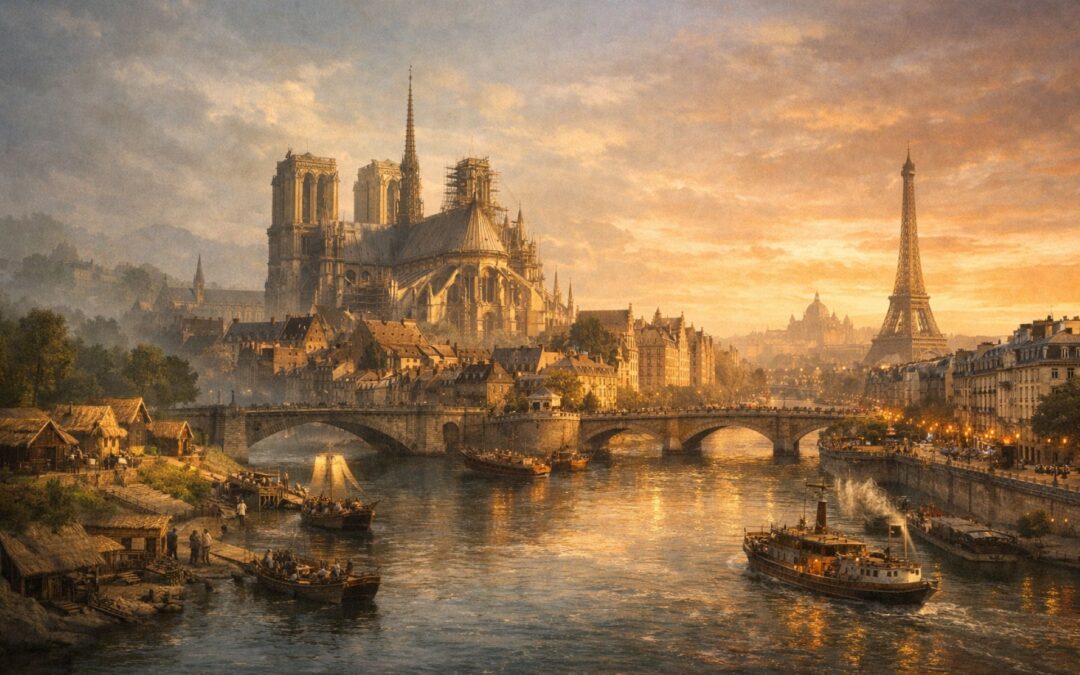
Paris is often described as the most beautiful city in the world, a place where art, architecture, culture, and history converge along the banks of the Seine. Yet the city’s story stretches far beyond the elegant boulevards, cafés, and monuments that define modern Paris. Beneath its polished façade lies a history spanning more than two millennia—one marked by conquest, faith, revolution, war, and constant reinvention.
What began as a small settlement of a Gallic tribe on a river island gradually evolved into one of the most influential cities in human history. Paris has served as the political heart of France, the intellectual engine of Europe, the birthplace of revolutionary ideas, and a global center for art and culture. Over the centuries, the city has endured Roman conquest, Viking raids, medieval plagues, religious massacres, revolutionary upheavals, foreign occupation, and world wars. Yet each time it emerged transformed, often stronger and more influential than before.
The physical city itself tells this story. Roman ruins lie beneath medieval churches, Gothic cathedrals rise above ancient streets, and grand 19th-century boulevards cut through neighborhoods that once housed medieval markets and narrow alleys. Every era left its mark on the urban landscape, turning Paris into a living record of European civilization.
More than simply a capital, Paris has long functioned as a stage upon which some of history’s most consequential events unfolded. It witnessed the birth of the French monarchy, the intellectual ferment of the Enlightenment, the explosion of the French Revolution, the imperial ambitions of Napoleon, and the artistic revolutions that reshaped modern culture. From medieval scholars at the University of Paris to Impressionist painters and avant-garde writers, generations of thinkers and creators have turned the city into a magnet for innovation and ideas.
The story of Paris is therefore not just the story of a city. It is the story of how geography, power, culture, and human ambition combined to shape one of the great urban centers of the world. From its humble beginnings as a tribal river settlement to its role as a global capital of art, fashion, and intellectual life, Paris stands as one of the most enduring and influential cities in history.
To understand Paris is to follow a journey through centuries of transformation—across empires, revolutions, and renaissances—revealing how this remarkable city continually reinvented itself while preserving the legacy of its past.
The Origins of Paris: From the Parisii to Roman Lutetia
The Parisii and the Birth of a River Settlement
The earliest chapter in the history of Paris begins long before the city bore its famous name. Archaeological evidence suggests that humans had inhabited the region around the Seine River for nearly 10,000 years, drawn by fertile land, abundant water, and access to trade routes. However, the foundations of the city itself emerged much later, during the Iron Age, when a Celtic tribe known as the Parisii settled along the banks of the Seine between roughly 250 and 225 BC.
The Parisii established a small but strategically positioned settlement on the Île de la Cité, the natural island in the center of the river that would later become the historic core of Paris. Its location offered several advantages. The island could be easily defended, while the surrounding river channels allowed control of vital trade routes that connected northern Europe to the Mediterranean world. This geographic position transformed the settlement into an important commercial crossroads.
The Parisii took advantage of this strategic location by building bridges and fortifications that regulated movement along the river. Trade flourished, and the settlement became prosperous enough to mint its own gold coins—a remarkable achievement for a tribal society. Merchants traveling between regions passed through the settlement, exchanging goods such as grain, metals, and crafts. Though modest in size, the town already possessed the characteristics that would define Paris for centuries: commerce, connectivity, and strategic importance.
Yet prosperity also brought danger. As the Roman Republic expanded its influence across Gaul in the 1st century BC, wealthy settlements such as that of the Parisii inevitably attracted Roman attention.
Roman Conquest and the Creation of Lutetia
The Roman conquest of Gaul under the command of Julius Caesar dramatically altered the fate of the Parisii settlement. During Caesar’s campaigns in the 50s BC, Roman forces moved steadily through the region, confronting the various Gallic tribes that resisted Roman rule. In 52 BC, the Roman army reached the settlement known as Lutetia, where the Parisii and their allies attempted to resist Roman domination.
The confrontation culminated in the Battle of Lutetia. Roman forces defeated the Gallic tribes, and the region was absorbed into the Roman Empire. Following the conquest, the Romans rebuilt the settlement according to their own urban planning principles and renamed it Lutetia Parisiorum, meaning “Lutetia of the Parisii.”
Under Roman rule, the town expanded significantly. Most of the new development took place on the left bank of the Seine, where the Romans constructed a carefully planned city organized along a north–south axis. At its center stood the forum, the focal point of civic life that included temples, administrative buildings, and marketplaces. Public infrastructure typical of Roman towns soon followed.
One of the most impressive structures built during this period was a large amphitheater, capable of seating up to 15,000 spectators—nearly double the town’s population. The presence of such a structure reflected both Roman architectural ambition and the empire’s desire to integrate local populations into Roman culture through entertainment and public life.
Despite these developments, Lutetia remained relatively small compared with other Roman cities in Gaul such as Lyon. Its population during the early centuries of Roman rule likely remained below 10,000. Nevertheless, it gradually evolved into a regional center, benefiting from the stability and trade networks that the Roman Empire provided.
Early Christianity and the Transformation of the Roman Town
A turning point in the cultural history of Lutetia came during the 3rd century AD with the arrival of Christianity. At this time, the Roman Empire still adhered to traditional pagan beliefs and often persecuted Christians who refused to participate in imperial religious practices.
According to tradition, Christianity was introduced to the region by Saint Denis, a missionary who became the first bishop of Paris. Denis reportedly refused to renounce his faith during a period of persecution and was executed by beheading on a hill north of the city. The site of his martyrdom later became known as Montmartre, derived from the Latin Mons Martyrum, meaning “Hill of the Martyrs.”
Over time, the location developed into an important religious site, and a church was eventually built over Denis’s grave. Today, the Basilica of Saint-Denis still stands as one of the most significant religious monuments associated with early Parisian Christianity.
During the late Roman period, however, the city faced increasing threats from migrating tribes and political instability throughout the empire. By the late 3rd century, waves of barbarian raids forced many residents to abandon the exposed areas of the left bank and relocate to the more defensible Île de la Cité. Stones from abandoned Roman buildings were dismantled and reused to construct defensive walls around the island, forming the first fortified core of what would eventually become medieval Paris.
It was also during this period that the settlement’s identity began to change. The name Lutetia gradually faded from official use, replaced by Civitas Parisiorum, meaning “City of the Parisii.” Within a few centuries, the name would evolve further into the Latin Parisius—and eventually the modern name, Paris.
From Roman Outpost to Frankish Capital
Collapse of Roman Authority and Barbarian Threats
By the 5th century, the stability that had allowed Lutetia to grow under Roman rule began to unravel. The Western Roman Empire was entering its final period of decline, weakened by internal political turmoil, economic instability, and mounting pressure from migrating Germanic tribes across Europe. Like many Roman cities, Lutetia found itself increasingly vulnerable as imperial authority weakened.
The population had already begun concentrating around the fortified Île de la Cité, where defensive walls provided protection against raids. The once-thriving Roman districts on the left bank gradually fell into disuse as residents abandoned exposed areas and dismantled Roman monuments to reuse their stones for fortifications.
During this era of uncertainty, the city faced repeated threats from invading groups such as the Huns and the Franks. According to tradition, one of the figures credited with helping preserve the city during this turbulent time was Saint Geneviève, who would later become the patron saint of Paris. When the armies of Attila the Hun advanced toward Gaul in the mid-5th century, many inhabitants prepared to flee the city. Geneviève urged the population to remain and trust in divine protection. Although the historical details remain debated, Paris ultimately escaped destruction, and Geneviève’s leadership elevated her to legendary status in the city’s history.
As Roman political control collapsed across Gaul, the city that had once been Lutetia now entered a new historical phase shaped by the emerging Germanic kingdoms.
The Rise of Clovis and the Frankish Kingdom
The decisive transformation of Paris came with the rise of the Franks, a Germanic people who gradually took control of northern Gaul during the late 5th century. Their leader, Clovis I, would become one of the most important figures in the early history of France.
Clovis consolidated Frankish power through a series of military campaigns that defeated rival tribes and remnants of Roman authority. By the end of the 5th century, he had established control over much of northern Gaul. Around this time, Paris gained new significance when Clovis chose the city as a principal seat of his kingdom.
The decision had both strategic and symbolic importance. Paris occupied a central position within the expanding Frankish realm and retained its defensible island core on the Seine. Moreover, the city already possessed strong Christian institutions, which aligned with Clovis’s own conversion to Christianity—a moment that profoundly shaped the future of France.
Clovis’s conversion around 496 AD strengthened the alliance between the Frankish monarchy and the Christian Church. Paris, with its growing religious importance, became a natural center for the emerging Frankish state. After Clovis’s death in 511, he was buried in the city, further cementing Paris’s status as a royal and religious center.
Though the Frankish kingdom would eventually shift its political focus to other regions, this early association between the monarchy and Paris laid the foundations for the city’s long-term role as the heart of France.
Paris in the Early Medieval World
Despite its symbolic status, Paris remained a relatively modest city during the early medieval period. After the rise of the Carolingian dynasty in the 8th century—most famously represented by Charlemagne—political power moved away from Paris toward other imperial centers within the expanding Frankish Empire.
As a result, Paris became something of a provincial city during this time. It retained importance as a religious hub, filled with churches and monasteries that continued to attract pilgrims and clergy. These institutions accumulated wealth through donations, land ownership, and patronage from nobles and kings.
However, the very prosperity of these religious establishments made the city vulnerable. The wealth stored within churches and monasteries attracted the attention of raiders from across Europe, particularly the seafaring warriors who would soon become infamous throughout the continent.
During the early Middle Ages, Paris therefore existed in a fragile balance—no longer a major political capital, yet still a valuable and symbolic city. Its religious institutions preserved learning and culture, while its strategic position along the Seine ensured that it remained connected to wider trade networks.
This uneasy stability would soon be shattered in the 9th century when a new threat appeared along the rivers of Europe: the Vikings.
Vikings, Walls, and the Survival of the City
Viking Raids Along the Seine
During the 9th century, a new and formidable threat emerged across Western Europe: the Vikings. These seafaring warriors from Scandinavia launched a series of raids along major European rivers, using their swift longships to penetrate deep inland and strike wealthy towns and monasteries. The Seine River, which flowed directly through Paris, became one of their preferred routes into the heart of Frankish territory.
Paris, with its religious institutions and accumulated wealth, presented an especially tempting target. Viking raiders repeatedly sailed upriver to plunder the city and surrounding settlements. Early attacks often forced local rulers to pay heavy ransoms to persuade the Vikings to withdraw, a common practice across the Frankish kingdoms during this period.
However, such payments only encouraged further incursions. By the late 9th century, Viking forces launched increasingly ambitious campaigns against the city, culminating in one of the most dramatic sieges in its early history.
Strengthening the City’s Defenses
The most famous Viking assault occurred in 885 AD, when a large Viking fleet sailed up the Seine and laid siege to Paris. The city’s defenders, led by Count Odo and Bishop Gozlin, refused to surrender despite being vastly outnumbered.
At the time, Paris’s defensive strength lay primarily in its location on the Île de la Cité, which was protected by fortified bridges that connected the island to both banks of the river. These bridges functioned as crucial defensive choke points, preventing Viking ships from easily passing through the city.
For months, Viking forces attempted to break through these defenses. They launched assaults, constructed siege engines, and repeatedly tried to force their way past the bridges. Yet the defenders of Paris held firm, repelling attack after attack.
The siege lasted nearly a year. Eventually, Frankish forces arrived to relieve the city, and the Vikings withdrew. Although much of the surrounding countryside had been devastated, Paris itself survived the siege intact.
The successful defense of the city carried enormous symbolic importance. It demonstrated that Paris could resist even the most feared raiders of the era and reinforced its reputation as a strategically vital stronghold.
Paris Begins to Recover
Following the Viking raids, Frankish rulers recognized the need to strengthen the city’s defenses and infrastructure. In the centuries that followed, new fortifications were gradually constructed, particularly along the right bank of the Seine, where the population was beginning to expand beyond the original island settlement.
By the 10th and 11th centuries, Paris slowly began to recover from the disruptions of the early medieval period. Trade resumed along the river, markets expanded, and the city’s religious institutions continued to grow in wealth and influence.
At the same time, a new political dynasty was rising that would fundamentally reshape the city’s future. In 987 AD, the Capetian dynasty ascended to the French throne, marking the beginning of a new era in which Paris would steadily evolve from a fortified medieval town into the political and cultural heart of the Kingdom of France.
The Rise of Medieval Paris
The Capetian Dynasty and the Return of Royal Power
The transformation of Paris into one of Europe’s most important cities began with the rise of the Capetian dynasty in 987. When Hugh Capet was crowned king of France, he ruled only a relatively small domain centered around the region of Île-de-France. Yet the location of Paris within this territory would prove decisive for the city’s future.
Unlike earlier Frankish rulers who governed vast and shifting territories, the Capetian kings based their authority in and around Paris. Although their early power remained limited, successive generations gradually expanded their influence over neighboring regions. As the monarchy consolidated control, Paris increasingly became the political nucleus of the emerging French kingdom.
The presence of the royal court encouraged growth throughout the city. Administrative institutions developed, noble families established residences near the seat of power, and the surrounding countryside provided food and resources to sustain the expanding population. By the 11th and 12th centuries, Paris was steadily evolving from a fortified medieval settlement into the central city of the French monarchy.
The Île de la Cité remained the heart of royal authority. Here the early Capetian kings constructed palaces that served as their primary residence, anchoring the monarchy directly within the city. The royal presence helped attract merchants, craftsmen, and scholars, laying the groundwork for Paris’s emergence as a major urban center.
The University of Paris and the Intellectual Capital of Europe
One of the most significant developments in medieval Paris was the rise of the University of Paris, founded around 1150. During the Middle Ages, universities were rare institutions that served as centers of advanced learning, drawing scholars from across Europe.
The University of Paris quickly gained a reputation as one of the most prestigious intellectual institutions of the medieval world. It specialized particularly in theology and philosophy, disciplines that shaped the intellectual life of Christian Europe. Students and teachers flocked to the city from distant kingdoms, turning Paris into a hub of scholarship and debate.
Much of this academic life was concentrated on the Left Bank of the Seine, which became known as the city’s intellectual quarter. Monasteries and religious schools had already established a presence in this area, including important abbeys such as Saint-Germain-des-Prés and Sainte-Geneviève. Over time, the district developed into a dense network of colleges, lecture halls, and student residences.
The influence of the university extended far beyond the city itself. Some of the most influential thinkers of the medieval era studied or taught in Paris, including theologians, philosophers, and scholars whose writings shaped European intellectual traditions for centuries.
As the number of students increased, the neighborhood around the university developed a vibrant atmosphere filled with bookshops, scriptoria, and lodging houses catering to scholars. The district would eventually earn the name the Latin Quarter, reflecting the language used by students and teachers in academic life.
Commerce, Markets, and the Economic Heart of the Kingdom
While the Left Bank became associated with learning and religion, the Right Bank emerged as the economic engine of medieval Paris. Here, markets, workshops, and merchant houses multiplied as trade expanded throughout the kingdom.
Paris’s location on the Seine played a crucial role in its economic growth. The river served as a major transportation route connecting inland regions with broader European trade networks. Goods ranging from grain and wine to textiles and metalwork flowed through the city’s ports and marketplaces.
Guilds soon emerged to organize the activities of craftsmen and merchants. These guilds regulated production standards, protected members from unfair competition, and ensured economic stability within various trades. Bakers, blacksmiths, cloth merchants, and other artisans formed tightly structured professional communities that shaped the city’s economic life.
As commerce expanded, Paris experienced a dramatic rise in population. By the late 12th century, the city had grown far beyond its original island core, spreading across both banks of the Seine. This rapid expansion created new challenges related to infrastructure, sanitation, and security.
Recognizing the need for stronger defenses, King Philip II undertook a major program to fortify the growing city. Completed in 1213, a massive stone wall surrounded much of Paris, complete with towers and gates designed to protect the capital from potential enemies. Philip II also ordered the paving of the city’s streets and constructed a powerful fortress on the northern edge of the city—the Louvre, originally built as a defensive stronghold.
By the beginning of the 13th century, Paris had firmly established itself as the political, intellectual, and economic center of France. The foundations were now in place for the city to enter its next great phase of development—one that would leave an indelible mark on its skyline and identity through some of the most remarkable architectural achievements of the medieval world.
Gothic Paris: Cathedrals, Kings, and Urban Expansion
The Construction of Notre-Dame
Few monuments symbolize medieval Paris more powerfully than Notre-Dame Cathedral. Its construction marked a defining moment in the city’s transformation into one of Europe’s most important religious and architectural centers.
The project began around 1160 under Bishop Maurice de Sully, who envisioned a grand cathedral that would reflect both the spiritual authority of the Church and the growing prominence of Paris. The first stone was laid in 1163, and although construction would continue for nearly two centuries, the cathedral quickly became the focal point of religious life in the city.
Notre-Dame was built in the emerging Gothic architectural style, which sought to create vast, light-filled spaces that inspired awe and devotion. Its soaring vaults, pointed arches, and intricate stonework represented a dramatic departure from earlier Romanesque churches. The cathedral’s towering façade, decorated with statues and elaborate carvings, soon dominated the skyline of medieval Paris.
Beyond its architectural grandeur, Notre-Dame also served as a stage for major religious and political events. Royal ceremonies, national celebrations, and public gatherings took place within its walls. Over time, the cathedral became not only a place of worship but also a symbol of the spiritual identity of France itself.
Sainte-Chapelle and the Zenith of Gothic Architecture
The Gothic style reached one of its most breathtaking expressions during the reign of King Louis IX, later known as Saint Louis. Deeply devoted to Christianity, Louis sought to strengthen the religious prestige of the French monarchy by acquiring sacred relics associated with the Passion of Christ.
To house these relics—most famously the Crown of Thorns—the king commissioned the construction of Sainte-Chapelle, a royal chapel built between 1241 and 1248 on the Île de la Cité.
Unlike Notre-Dame, which emphasized monumental scale, Sainte-Chapelle achieved its impact through extraordinary elegance and light. Its upper chapel was designed almost entirely around vast stained-glass windows that rise nearly from floor to ceiling. These windows depict hundreds of biblical scenes and fill the interior with brilliant colored light.
Sainte-Chapelle represented the pinnacle of Gothic craftsmanship and reflected the close relationship between religion and monarchy in medieval France. The chapel served as both a sacred shrine and a political symbol, reinforcing the idea that the French king ruled under divine authority.
Together, Notre-Dame and Sainte-Chapelle helped transform Paris into one of the most important religious centers in Europe.
Population Growth and the Largest City in Europe
While monumental churches reshaped the city’s skyline, Paris was also undergoing rapid demographic expansion. By the early 14th century, the city’s population had grown to roughly 200,000 inhabitants, making it the largest and most populous city in Europe at the time.
This growth brought both prosperity and challenges. New neighborhoods spread outward from the original city core, while markets, workshops, and guild halls filled the expanding urban landscape. Streets became increasingly crowded, and the demand for housing and infrastructure intensified.
To manage the growing city, new fortifications were constructed during the reign of King Charles V in the second half of the 14th century. Between 1356 and 1383, an expanded defensive wall was built to encompass the city’s rapidly spreading districts. Along the eastern edge of the city, Charles ordered the construction of a powerful new fortress: the Bastille.
Originally designed as a defensive stronghold to protect the city from invasion, the Bastille would later acquire a very different symbolic role in French history.
Despite the architectural grandeur and growing wealth of medieval Paris, life for most inhabitants remained harsh. The expanding population produced overcrowded neighborhoods, poor sanitation, and frequent outbreaks of disease. Social divisions between rich and poor became increasingly visible, and tensions simmered beneath the surface of urban life.
As the city entered the later Middle Ages, these underlying pressures would combine with external crises—plague, war, and political conflict—to plunge Paris into one of the most difficult periods of its history.
Crisis and Catastrophe in the Late Middle Ages
The Black Death and Urban Disease
Despite its growing wealth and influence, medieval Paris was far from a comfortable place to live. Rapid population growth had produced crowded neighborhoods filled with narrow streets, poorly ventilated homes, and inadequate sanitation. Waste often accumulated in public spaces, and contaminated water supplies were common. These conditions made the city particularly vulnerable to disease.
In 1348, one of the most devastating pandemics in human history reached Paris: the Black Death. Originating in Asia and spreading across Europe through trade routes, the plague swept through densely populated cities with terrifying speed.
Paris was hit hard. Within a short period, tens of thousands of residents died—estimates suggest that around 50,000 people perished during the first outbreak alone. Entire neighborhoods were left deserted as families fled the city or succumbed to the disease.
The plague did not disappear after its initial wave. Instead, it returned repeatedly over the following centuries, striking the city in periodic outbreaks that continued into the 17th century. These recurring epidemics created a constant atmosphere of fear and uncertainty for Parisians.
Disease also revealed the stark inequalities within medieval society. Wealthier residents sometimes managed to escape outbreaks by leaving the city for rural estates, while the poor were forced to remain in the overcrowded districts where infection spread most rapidly.
Social Hierarchy and Daily Life in Medieval Paris
Life in medieval Paris was structured around a rigid social hierarchy that determined nearly every aspect of daily existence.
At the base of society stood the urban poor, who made up the majority of the population. This group included laborers, servants, peasants who had migrated to the city, beggars, and the sick. Many struggled to survive from day to day, often living in cramped and unsanitary conditions.
Above them were the craftsmen, a vital group within the urban economy. Artisans such as bakers, blacksmiths, tailors, and carpenters owned their own tools and workshops. Most belonged to guilds, powerful organizations that regulated production, controlled competition, and provided a degree of economic security for their members.
Next came the merchants and bankers, a relatively small but influential class that played a crucial role in the city’s economic life. Although they made up only around 15 percent of the population, their wealth allowed them to finance trade, construction, and large-scale commercial ventures.
Alongside this group stood the clergy, which included priests, monks, scholars, and university students. The Church formed a powerful institution within medieval society, operating its own legal system and social hierarchy. For many individuals, particularly those with academic talent, joining the clergy offered one of the few paths for upward social mobility.
At the very top of society was the hereditary nobility, whose members often served the monarchy and lived in proximity to the royal court. Their political influence and wealth placed them far above the rest of the population.
Although this hierarchy structured everyday life, tensions between classes were never far beneath the surface. Economic hardship, disease, and political instability frequently intensified social unrest.
The Hundred Years’ War and English Occupation
As if plague and poverty were not enough, Paris also endured one of the longest and most destructive conflicts in European history: the Hundred Years’ War between France and England, which lasted from 1337 to 1453.
The war brought devastation across large parts of France, and Paris was deeply affected. Bands of soldiers frequently ravaged the surrounding countryside, destroying farms and disrupting food supplies. Refugees fleeing violence in rural areas often poured into the city, worsening overcrowding and strain on resources.
In 1420, Paris suffered a major political blow when it was captured by English forces during the later stages of the war. Under the terms of the Treaty of Troyes, the English king Henry VI was recognized as the ruler of both England and France. In 1431, the young king was crowned inside Notre-Dame Cathedral, symbolizing English control over the French capital.
The English occupation lasted for several years and triggered a large exodus of Parisians who refused to live under foreign rule. Economic activity slowed, and the city’s population declined significantly.
Eventually, French forces succeeded in reclaiming Paris in 1436, restoring the city to French control. Though the war would continue for several more years, the recapture of the capital marked a turning point.
By the late 15th century, peace gradually returned to the kingdom. Paris began to recover from the devastation of plague and war, and its population once again started to grow. With stability returning, the city soon entered a new era marked by cultural revival, architectural innovation, and the spread of new ideas that would reshape Europe during the Renaissance.
Renaissance Paris and the Cultural Revival
The Return of Prosperity
By the late 15th century, Paris began to recover from the devastation caused by plague, war, and political instability. The end of the Hundred Years’ War allowed France to enter a period of relative stability, and the capital gradually regained its economic and demographic strength.
As peace returned, the population of Paris grew rapidly once again. By 1500, the city had reached roughly 250,000 inhabitants, making it one of the largest urban centers in Europe. Markets revived, trade expanded along the Seine, and new construction projects began to reshape the urban landscape.
The city also became increasingly connected to the broader cultural transformations sweeping across Europe during the Renaissance. New ideas about art, science, education, and classical learning spread through France, and Paris quickly became one of the main centers where these intellectual currents took root.
Royal patronage played an important role in this revival. The French monarchy, eager to strengthen the prestige of the kingdom, invested heavily in cultural projects that promoted Paris as a center of refinement and scholarship.
Francis I and the Renaissance Transformation
The reign of King Francis I (1515–1547) marked one of the most significant turning points in the cultural development of Paris. Francis was deeply influenced by the Renaissance ideals emerging from Italy and sought to transform France into a leading center of artistic and intellectual life.
Under his rule, Paris experienced a wave of architectural and urban improvements. Bridges were constructed across the Seine to improve transportation and commerce, while fountains and public spaces were added to beautify the growing city. One of the notable civic developments of the period was the construction of the early Hôtel de Ville, which would become the seat of the city’s municipal government.
Francis I also actively encouraged artistic and intellectual exchange between France and Italy. He invited renowned artists and scholars to the French court and supported the development of new cultural institutions.
This patronage helped integrate Paris into the broader European Renaissance, transforming the city into a place where classical learning, artistic experimentation, and architectural innovation flourished.
Paris as Europe’s Printing and Learning Center
During the 16th century, Paris strengthened its reputation as one of Europe’s most important intellectual capitals. The University of Paris, already renowned throughout the medieval world, continued to attract scholars from across the continent.
Francis I further expanded the city’s intellectual influence by founding a new educational institution in 1531, later known as the Collège de France. Unlike traditional university faculties, this institution promoted the study of subjects that were still considered controversial or innovative at the time, including Greek, Hebrew, and mathematics.
The spread of the printing press played a crucial role in amplifying the city’s intellectual impact. By the mid-16th century, Paris had become one of Europe’s leading centers of publishing. Around 75 printing presses operated in the city, producing books that circulated across the continent.
By the end of the century, Paris was publishing more books than any other European city. These publications helped disseminate new scientific discoveries, philosophical ideas, and literary works that shaped the intellectual climate of the Renaissance.
Yet even as Paris experienced this remarkable cultural revival, deep religious tensions were building across France. Conflicts between Catholics and Protestants would soon plunge the country—and the city itself—into one of the most violent chapters of its history.
Religious Violence and the Wars of Faith
Catholic Paris in a Divided France
By the second half of the 16th century, the cultural revival that had flourished during the Renaissance began to give way to deepening religious tensions across France. The spread of Protestantism, particularly the Calvinist movement known in France as the Huguenots, challenged the dominance of the Catholic Church and divided the country along religious lines.
Between 1562 and 1598, France was engulfed in a series of brutal conflicts known as the French Wars of Religion. These wars were not merely theological disputes but also struggles for political power among rival noble factions and royal claimants.
Paris remained overwhelmingly Catholic during this period and quickly became a stronghold of Catholic resistance against Protestant influence. Many of the city’s inhabitants viewed the growth of Protestant communities as a threat to both religious orthodoxy and social stability. This atmosphere of suspicion and hostility created a volatile environment in which violence could easily erupt.
The city’s political leaders and religious authorities frequently aligned themselves with Catholic factions, intensifying the conflict between the two sides.
The St. Bartholomew’s Day Massacre
The tensions between Catholics and Protestants reached a horrific climax in August 1572 during one of the most infamous events in French history: the St. Bartholomew’s Day Massacre.
At the time, many prominent Protestant leaders had gathered in Paris to celebrate the marriage between Henry of Navarre, a Protestant nobleman who would later become King Henry IV, and Margaret of Valois, a Catholic princess. The marriage had been intended as a political gesture aimed at reconciling the two religious factions.
Instead, it triggered one of the bloodiest episodes of the era.
On the night of August 23, 1572, the royal council ordered the assassination of several Protestant leaders staying in the city. However, the targeted killings quickly spiraled out of control. Catholic mobs began attacking Protestant residents throughout Paris, turning the city into a scene of chaos and violence.
Over the following days, thousands of Protestants were murdered in the streets, their homes looted and destroyed. Estimates suggest that around 3,000 people were killed in Paris alone, while the violence soon spread to other cities across France.
The massacre shocked Europe and left a deep scar on the French national consciousness. It intensified the religious wars and further deepened distrust between the two communities.
A City Scarred by Religious Conflict
The decades of religious warfare had devastating consequences for Paris. Political instability, economic disruption, and repeated outbreaks of violence weakened the city and caused widespread hardship.
Many residents fled the capital during these turbulent years. By the beginning of the 17th century, Paris was still recovering from the aftermath of religious conflict. Entire neighborhoods had suffered damage, and several large construction projects—including expansions of the Louvre, the Hôtel de Ville, and the Tuileries Palace—had been left unfinished.
The city needed a period of peace and reconstruction.
That opportunity finally arrived when Henry IV, the former Protestant leader who had converted to Catholicism to secure the throne, became king of France. Determined to restore stability and rebuild the kingdom after decades of turmoil, Henry IV launched an ambitious effort to revive Paris and transform it into a thriving royal capital once again.
Rebuilding the Capital Under the Bourbon Kings
Henry IV and the Reconstruction of Paris
By the beginning of the 17th century, Paris was still struggling to recover from decades of religious conflict and political instability. Large portions of the city had fallen into disrepair, economic activity had slowed, and many residents had fled during the years of violence. Restoring order and rebuilding the capital became one of the most urgent priorities of the new king, Henry IV.
Henry IV proved to be one of the most important urban reformers in the city’s history. Determined to stabilize the kingdom and strengthen royal authority, he launched a broad program to restore Paris’s prosperity and physical infrastructure.
Among his most notable projects was the creation of Place Dauphine, a new public square built on the western tip of the Île de la Cité. Designed with uniform facades and orderly streets, it represented a new vision of urban planning that emphasized symmetry and beauty.
Henry IV also oversaw the construction of the Pont Neuf, completed in 1607. Despite its name meaning “New Bridge,” the Pont Neuf is actually the oldest surviving bridge in Paris today. Unlike earlier bridges that were crowded with houses and shops, the Pont Neuf was designed as an open structure, providing wide views of the river and creating a public gathering place for Parisians.
The bridge quickly became a lively social center where merchants, performers, and ordinary citizens gathered. In many ways, it symbolized Henry IV’s broader effort to make Paris a more open and vibrant city.
However, these reforms came to a sudden and tragic end when the king was assassinated in 1610 by a religious fanatic while traveling through the streets of Paris. Although his life was cut short, Henry IV left behind the foundations for a new era of urban development.
Louis XIII, Richelieu, and the Cultural Capital of Europe
Following Henry IV’s death, the French monarchy continued efforts to strengthen Paris under the reign of Louis XIII and his powerful chief minister, Cardinal Richelieu.
Their goal was not only to stabilize the kingdom politically but also to elevate Paris into the leading cultural center of Europe. Inspired by the grandeur of Rome and other great European cities, they encouraged the development of new architectural styles and cultural institutions.
During this period, several important urban projects reshaped the city. Five new bridges were constructed across the Seine, improving communication between different parts of Paris. Major public buildings were erected, and artistic patronage flourished.
The government also founded influential cultural institutions designed to promote intellectual and artistic excellence. Among the most significant was the Académie Française, established in 1635 to regulate the French language and encourage literary development. Additional organizations such as the Royal Academy of Painting and Sculpture helped cultivate artistic talent and reinforce Paris’s growing reputation as a center of culture.
These developments transformed Paris into a vibrant hub for writers, artists, and intellectuals. The city’s cultural influence began to extend far beyond France, shaping artistic and intellectual trends throughout Europe.
Louis XIV and the Shift to Versailles
Despite the cultural flourishing of Paris during the early Bourbon period, the relationship between the monarchy and the capital remained uneasy. This tension became especially clear during the reign of Louis XIV.
When Louis XIV inherited the throne in 1643, he was still a child. During his early years, France experienced a series of rebellions known as the Fronde, in which powerful nobles and segments of the population challenged royal authority. Much of the unrest occurred in Paris, leaving a deep impression on the young king.
These events fostered a lasting distrust of the capital. When Louis XIV eventually consolidated his power, he decided to distance the monarchy from the turbulent political environment of Paris.
In 1671, he relocated the royal court to the newly constructed Palace of Versailles, located outside the city. Versailles became the primary residence of the French monarchy and the center of royal administration.
Although the king’s departure removed the royal court from Paris, the city itself continued to grow and prosper. The removal of the old medieval defensive walls opened new opportunities for urban expansion. In their place, broad tree-lined boulevards were created, improving circulation and transforming the city’s appearance.
By 1680, Paris’s population had reached roughly 500,000 inhabitants, making it one of the largest cities in Europe. A growing middle class emerged alongside the traditional aristocracy, and the city’s theaters, cafés, and restaurants became popular gathering places.
While most Parisians still lived in poverty, the city was steadily evolving into a lively urban center where commerce, culture, and social life intersected—setting the stage for the intellectual revolution that would soon emerge during the Enlightenment.
Enlightenment Paris and the Seeds of Revolution
Cafés, Philosophers, and the Enlightenment
By the early 18th century, Paris had grown into one of Europe’s most vibrant intellectual centers. Although much of the city still retained its medieval character—with narrow streets, overcrowded housing, and poor sanitation—new ideas were circulating through its cafés, salons, and academic circles.
The Enlightenment, a movement emphasizing reason, science, and individual liberty, found fertile ground in Paris. Writers, philosophers, and scholars gathered in cafés and private salons to debate politics, religion, philosophy, and the nature of society itself.
Among the most influential figures of this intellectual movement were Voltaire and Jean-Jacques Rousseau, whose writings challenged traditional authority and questioned the legitimacy of absolute monarchy. Their ideas spread widely through books, pamphlets, and public discussions, fueling a growing culture of critical debate.
Cafés played a particularly important role in this intellectual life. These establishments served as informal meeting places where thinkers, journalists, and ordinary citizens could exchange news and discuss political developments. Information circulated quickly through these networks, creating an environment in which revolutionary ideas could flourish.
Paris thus became not only the political heart of France but also the intellectual engine driving profound social and political change across Europe.
Social Inequality and Economic Crisis
Despite its cultural vitality, Paris in the 18th century remained deeply divided by social inequality. Wealth and privilege were concentrated among the aristocracy and the clergy, while the majority of the population struggled with rising living costs and economic hardship.
France’s financial system was under severe strain during the reign of King Louis XVI. Years of expensive wars—including support for the American Revolution—had left the royal treasury heavily indebted. Attempts to resolve the financial crisis often involved raising taxes on the population, particularly the lower and middle classes.
At the same time, poor harvests during the late 1780s drove up the price of bread, a staple food for most Parisians. Food shortages became increasingly common, and hunger spread among the city’s poorer neighborhoods.
These economic pressures intensified resentment toward the monarchy and the privileged classes, who were widely perceived as insulated from the hardships faced by ordinary people. Public anger grew as the government appeared unable to solve the kingdom’s financial problems.
The Growing Tension Between Crown and People
By 1789, the relationship between the French monarchy and the people of Paris had reached a breaking point. Political frustration combined with economic desperation created a highly volatile atmosphere within the city.
When Louis XVI dismissed his finance minister—who had been seen by many as a reformer attempting to address the kingdom’s financial crisis—large demonstrations erupted in Paris. Protesters gathered in the streets, demanding political change and relief from economic hardship.
What began as protests soon escalated into widespread unrest. Crowds clashed with royal authorities, and rumors of military repression fueled panic among the population.
Within this tense environment, the people of Paris began to arm themselves and organize against the royal government. The stage was now set for one of the most dramatic moments in the city’s history—the outbreak of the French Revolution, an event that would not only transform Paris but also reshape the political order of Europe.
Paris and the French Revolution
The City That Sparked a Revolution
In the summer of 1789, tensions that had been building for years finally erupted in Paris. Economic hardship, political frustration, and the spread of Enlightenment ideas had created a volatile atmosphere across the city. When rumors circulated that the monarchy was preparing to suppress unrest with military force, Parisians began organizing themselves in defense.
Crowds armed themselves by seizing weapons from local armories and searching for gunpowder to support their growing militias. The focus of their attention soon turned toward a massive fortress that loomed over the eastern edge of the city—the Bastille.
Although the Bastille housed only a small number of prisoners by this time, it carried enormous symbolic weight. For many Parisians, it represented the arbitrary power of the monarchy and the oppression of royal authority.
On July 14, 1789, thousands of citizens marched toward the fortress. After hours of confrontation between the crowd and the soldiers defending it, the Bastille was stormed and captured. The fall of the fortress quickly became the defining moment that marked the beginning of the French Revolution.
The destruction of the Bastille reverberated across France and Europe. It signaled that royal authority had been decisively challenged by the people themselves.
The Fall of the Monarchy
In the years that followed, Paris became the political epicenter of the revolution. Power shifted rapidly between competing political factions as the country attempted to transform itself from an absolute monarchy into a constitutional system.
The revolutionary government introduced sweeping reforms. Feudal privileges were abolished, the rights of citizens were formally declared, and many institutions tied to the old regime were dismantled.
Yet political tensions within the revolutionary movement soon intensified. Radical groups gained influence in Paris, and the revolution entered a far more violent phase.
In 1792, the monarchy was formally abolished, and France was declared a republic. The fate of the king was sealed shortly afterward.
On January 21, 1793, King Louis XVI was executed by guillotine at the Place de la Révolution (today known as Place de la Concorde). The execution shocked Europe and symbolized the complete collapse of the old political order.
Terror, Transformation, and the Birth of the Republic
The execution of the king did not bring stability to France. Instead, the revolution entered one of its most turbulent periods known as the Reign of Terror.
During this time, revolutionary leaders sought to eliminate perceived enemies of the republic. Political rivals, suspected counterrevolutionaries, and even former allies were arrested and executed in large numbers. Paris witnessed constant political upheaval as revolutionary factions struggled for power.
Despite the violence, the revolutionary period fundamentally transformed French society. The monarchy had been abolished, traditional social hierarchies had been challenged, and the concept of citizenship had been redefined.
By the late 1790s, however, the instability of revolutionary politics had left France exhausted. A new leader would soon emerge from the chaos—an ambitious young general whose rise would once again reshape the future of Paris and the entire nation: Napoleon Bonaparte.
Napoleon and the Imperial Capital
From Revolutionary Chaos to Imperial Order
By the end of the 1790s, France was weary after years of revolutionary turmoil. Political instability, economic disruption, and constant factional conflict had weakened the government that replaced the monarchy. The revolutionary administration known as the Directory struggled to maintain authority, and many citizens longed for stability.
In November 1799, a young and highly successful general named Napoleon Bonaparte seized that opportunity. Through a coup d’état, he overthrew the Directory and replaced it with a new political system known as the Consulate, naming himself First Consul. Although the new regime technically preserved republican institutions, real power rested firmly in Napoleon’s hands.
Under Napoleon’s leadership, France gradually regained a sense of order after a decade of upheaval. Paris, which had been the center of revolutionary politics and violence, now became the administrative and symbolic heart of a new regime built around strong centralized authority.
Napoleon consolidated his power further in 1804, when he crowned himself Emperor of the French inside Notre-Dame Cathedral. The ceremony, conducted in the presence of Pope Pius VII, symbolized the transition from revolutionary republic to imperial monarchy—though one rooted in the legacy of the revolution.
Monumental Architecture and Urban Renewal
While Napoleon spent much of his reign campaigning across Europe, he also devoted considerable attention to transforming Paris into a capital worthy of his expanding empire. Inspired by the grandeur of ancient Rome, he sought to reshape the city through monumental architecture that celebrated French military glory and imperial prestige.
Among the projects commissioned during his rule were several new bridges across the Seine, designed to improve transportation and connect the city’s growing districts. Napoleon also initiated construction of grand monuments intended to commemorate the victories of the French army.
One of the most famous was the Arc de Triomphe, conceived as a triumphal arch honoring the soldiers who fought in the Revolutionary and Napoleonic wars. Although construction began during Napoleon’s reign, the monument would not be completed until several decades later.
Another important structure built during this period was the Vendôme Column in Place Vendôme. Inspired by the Roman column of Trajan, it was cast from bronze made by melting down captured enemy cannons and topped with a statue of Napoleon himself.
Through these projects, Napoleon sought to present Paris as the political and cultural center of a powerful new empire.
Paris as the Symbol of French Power
Napoleon’s transformation of Paris extended beyond architecture. The city became the administrative heart of a vast political system that stretched across much of Europe. Government ministries, military headquarters, and imperial institutions all operated from the capital.
Despite the authoritarian nature of Napoleon’s rule, the city experienced renewed stability and economic recovery after the chaos of the revolution. Public works improved infrastructure, and commercial activity resumed.
However, Napoleon’s ambitions ultimately pushed France into nearly constant warfare with the other great powers of Europe. After years of conflict, his empire collapsed following military defeats and the invasion of France by allied armies.
In 1815, after his final defeat at the Battle of Waterloo, Napoleon was forced to abdicate. Paris was briefly occupied by foreign troops from Britain, Austria, Russia, and Prussia, marking the end of the imperial era.
The defeat paved the way for the restoration of the Bourbon monarchy, but the political stability of France remained fragile. In the decades that followed, Paris would once again become the stage for political revolutions, social unrest, and dramatic transformations that reshaped the modern city.
Revolutions and the Industrial City
Restoration and Political Instability
Following Napoleon’s defeat in 1815, Paris entered a new period of political uncertainty. The victorious European powers restored the Bourbon monarchy, placing King Louis XVIII on the throne. Unlike the absolute monarchs of the past, Louis XVIII ruled as a constitutional monarch, accepting certain limits on royal authority and governing alongside an elected legislature.
Although the restoration brought temporary stability, tensions soon re-emerged between conservative royalists who wanted to restore the old order and liberals who supported the political changes brought about by the revolution.
When Louis XVIII died in 1824, his brother Charles X succeeded him as king. Charles pursued a far more conservative agenda, attempting to strengthen royal authority and reverse many of the reforms that had been introduced after the revolution. His policies alienated large sections of the population, especially in Paris where political activism remained strong.
The situation reached a breaking point in July 1830 when Charles issued a series of decrees restricting freedom of the press and dissolving the elected legislature. Parisians responded with anger. Within days, mass demonstrations erupted across the city.
The Revolutions of 1830 and 1848
The protests of July 1830 quickly escalated into armed resistance. Barricades appeared throughout the streets of Paris as citizens fought against royal troops during three days of intense urban conflict, an event later known as the July Revolution.
Facing widespread opposition, Charles X was forced to flee the city and abdicate the throne. In his place, the political establishment installed Louis-Philippe, a monarch who styled himself as the “Citizen King.” He ruled under a constitutional monarchy and attempted to balance royal authority with the interests of the growing middle class.
Under Louis-Philippe, Paris experienced significant economic growth. Industrialization accelerated, railways were constructed, and new factories emerged across the region. The city’s population expanded rapidly, approaching one million inhabitants by the mid-19th century.
Yet prosperity was unevenly distributed. Many workers lived in crowded and impoverished conditions while wealth concentrated among industrialists and financiers. Social tensions continued to simmer beneath the surface.
These tensions erupted again in 1848, when economic downturns and political dissatisfaction triggered another wave of demonstrations in Paris. As protests intensified, the army refused to suppress the crowds, forcing Louis-Philippe to abdicate and flee into exile.
France once again became a republic, and the country held its first presidential election later that year.
Industrialization and Rapid Urban Growth
The election of Louis-Napoleon Bonaparte, nephew of Napoleon I, marked the beginning of another dramatic transformation in French politics. Initially elected as the first President of the French Republic, Louis-Napoleon soon sought to consolidate his power.
When the constitution prevented him from seeking reelection, he carried out a coup d’état in December 1851. The following year he proclaimed himself Emperor Napoleon III, establishing the Second French Empire.
During this period, Paris underwent one of the most radical urban transformations in its history. The city had grown enormously during the early industrial era, but its medieval streets and infrastructure were poorly suited for modern life. Overcrowding, traffic congestion, and unsanitary conditions posed serious challenges for a rapidly expanding population.
Napoleon III believed that Paris needed a complete redesign to become a modern imperial capital. To accomplish this, he appointed Georges-Eugène Haussmann as prefect of the Seine and tasked him with overseeing a massive program of urban reconstruction that would fundamentally reshape the city’s appearance and structure.
The changes introduced under Haussmann would permanently redefine Paris, giving it many of the boulevards, parks, and architectural features that still characterize the city today.
Haussmann and the Reinvention of Paris
Napoleon III’s Vision for a Modern Capital
When Napoleon III established the Second French Empire in 1852, he inherited a capital that had grown rapidly during the early industrial era but remained largely medieval in structure. Much of Paris was still composed of narrow, winding streets packed with overcrowded buildings. Sanitation was poor, traffic was chaotic, and outbreaks of disease remained a constant threat.
Napoleon III believed that the capital of France should reflect the power and prestige of a modern empire. Inspired in part by the wide avenues and orderly design of cities he had seen during his exile in London, he envisioned a transformed Paris—one that would be healthier, more efficient, and architecturally impressive.
To realize this ambitious vision, Napoleon III appointed Georges-Eugène Haussmann as Prefect of the Seine in 1853. Haussmann was given extraordinary authority to redesign the city on a massive scale. Over the next two decades, his urban renewal program would fundamentally reshape Paris and leave a lasting imprint on its appearance.
The Haussmann Renovation
Haussmann’s plan required the demolition of large sections of the medieval city. Entire neighborhoods of tightly packed buildings were cleared to make way for broad new streets and avenues that cut through the dense urban fabric.
One of the most significant changes involved expanding the boundaries of Paris. Haussmann annexed surrounding suburbs, increasing the number of districts from 12 to 20 arrondissements, a system that still defines the administrative organization of the city today.
The new design centered on wide tree-lined boulevards that allowed for better traffic flow and easier movement across the city. These boulevards also served a political purpose. Their broad, open layout made it far more difficult for revolutionaries to construct barricades, which had played a major role in earlier uprisings.
Haussmann also introduced strict building regulations that required new construction to follow a unified architectural style. Buildings were constructed with uniform heights and elegant cream-colored limestone facades, producing the distinctive visual harmony that continues to characterize central Paris.
Boulevards, Parks, and the New Urban Landscape
The transformation of Paris extended far beyond streets and buildings. Haussmann’s redesign introduced modern infrastructure that improved living conditions throughout the city.
A new system of water supply and sewer networks was built to address long-standing sanitation problems. Thousands of gas streetlights were installed, dramatically improving nighttime safety and giving Paris the nickname “The City of Light.”
Public green spaces were also incorporated into the new urban design. Four large parks were created at the cardinal points of the city, providing residents with places for recreation and leisure. These included the Bois de Boulogne in the west and the Bois de Vincennes in the east.
Haussmann also oversaw the construction of several monumental public buildings. One of the most famous projects of this period was the Palais Garnier Opera House, an extravagant structure that symbolized the cultural ambition of the Second Empire.
The redesigned city quickly became a center of global commerce and finance. Paris developed into a major industrial hub, while the Paris Bourse emerged as an important financial market for international investment.
Although Haussmann’s renovation displaced thousands of residents and destroyed parts of the medieval city, it permanently reshaped Paris into a modern capital. The broad boulevards, grand architecture, and integrated infrastructure established during this period continue to define the city’s urban landscape today.
Yet the achievements of Napoleon III’s reign would soon be overshadowed by a catastrophic war that plunged Paris into siege, hunger, and revolution once again.
War, Siege, and the Paris Commune
The Franco-Prussian War and the Siege of Paris
The dramatic transformation of Paris under Napoleon III came to an abrupt end with the outbreak of the Franco-Prussian War in 1870. The conflict pitted the French Empire against the rising power of Prussia, led by the statesman Otto von Bismarck and the Prussian king Wilhelm I.
France entered the war expecting a swift victory, but the outcome proved disastrous. In September 1870, French forces suffered a crushing defeat at the Battle of Sedan, where Napoleon III himself was captured by Prussian troops. The emperor was forced to abdicate, and the Second French Empire collapsed.
With the French army in disarray, Paris suddenly found itself exposed to the advancing Prussian forces. By the autumn of 1870, the Prussian army had surrounded the city, beginning a siege that would last several months.
Life inside the besieged city quickly became desperate. Food supplies dwindled as the blockade prevented deliveries from the surrounding countryside. As winter approached, hunger spread among the population.
Parisians resorted to increasingly extreme measures to survive. When traditional food supplies ran out, residents began eating horses, cats, dogs, rats, and even animals from the Paris zoo. Despite these hardships, the city endured months of bombardment and deprivation.
Finally, after weeks of suffering, the French government negotiated a surrender. On January 28, 1871, Paris capitulated, and Prussian forces briefly occupied parts of the city.
Hunger, Desperation, and Collapse
The surrender of Paris did not bring stability. Instead, the humiliating defeat and harsh peace terms triggered widespread anger among the population. Many Parisians believed the national government had betrayed the city by surrendering too quickly.
Tensions between the radical working-class population of Paris and the conservative national government soon exploded into open rebellion.
In March 1871, revolutionary activists seized control of the city and established a new municipal government known as the Paris Commune. Inspired by socialist and anarchist ideas, the leaders of the Commune sought to introduce sweeping social reforms and greater democratic control over urban governance.
The Radical Experiment of the Paris Commune
The Paris Commune lasted for only about two months, but it remains one of the most dramatic episodes in the city’s history. During its brief existence, the Commune attempted to restructure society by promoting workers’ rights, expanding democratic participation, and reducing the power of traditional institutions.
However, the national government, which had relocated to Versailles, refused to accept the authority of the revolutionary regime in Paris. In May 1871, government troops launched a full-scale assault to retake the capital.
The result was one of the bloodiest episodes in French history. During a period known as “The Bloody Week,” fierce street battles erupted across Paris as government forces fought against Commune defenders.
Thousands of people were killed during the fighting, and many others were arrested or executed afterward. Entire neighborhoods were damaged by the violence, and the revolutionary experiment of the Commune came to a brutal end.
After the suppression of the uprising, Paris was placed under strict government control. The authorities sought to restore order and prevent further rebellions.
Yet despite the trauma of war, siege, and civil conflict, Paris soon entered one of the most vibrant and prosperous periods of its history—a cultural golden age known as the Belle Époque, when the city would once again become the center of global art, innovation, and modern life.
The Belle Époque: Paris at the Center of the World
Expositions, Consumer Culture, and the Modern City
After the turmoil of the Franco-Prussian War and the violent suppression of the Paris Commune, the city gradually entered a remarkable period of recovery and transformation known as the Belle Époque, or “Beautiful Era.” Spanning roughly from the late 19th century until the outbreak of the First World War in 1914, this period marked one of the most vibrant chapters in the city’s history.
Paris flourished as a global capital of innovation, culture, and modern urban life. Economic growth accelerated, new technologies reshaped everyday experiences, and the city became a magnet for visitors from across the world.
One of the defining features of the Belle Époque was a series of international expositions held in Paris between 1855 and 1900. These massive world fairs showcased the latest achievements in industry, science, architecture, and the arts. Millions of visitors traveled to Paris to witness displays of technological progress and artistic creativity.
The period also witnessed the rise of modern consumer culture. Large department stores such as Le Bon Marché and Galeries Lafayette introduced new forms of shopping that emphasized luxury goods, elaborate displays, and mass consumption. These stores became landmarks of Parisian life and helped shape the city’s reputation as a center of fashion and commerce.
The Eiffel Tower and the Symbol of Modernity
Perhaps the most famous symbol of the Belle Époque—and of Paris itself—is the Eiffel Tower. Constructed for the 1889 Exposition Universelle, the tower was originally intended as a temporary structure commemorating the centennial of the French Revolution.
Designed by engineer Gustave Eiffel, the iron tower rose more than 300 meters above the city, making it the tallest structure in the world at the time. Its bold design represented a dramatic break from traditional architectural forms and celebrated the possibilities of modern engineering.
Initially, many artists and intellectuals criticized the tower as an unsightly industrial structure that clashed with the elegance of Parisian architecture. Yet the public quickly embraced it. The tower became one of the most visited attractions of the exposition and was eventually preserved as a permanent monument.
Today, the Eiffel Tower stands not only as the defining landmark of Paris but also as a global symbol of modernity and technological ambition.
Paris as the Capital of Modern Art
During the Belle Époque, Paris also emerged as the undisputed center of modern art. Artists from across Europe and beyond traveled to the city in search of inspiration, education, and creative freedom.
Earlier in the century, painters such as Édouard Manet and Claude Monet had pioneered the Impressionist movement, which challenged traditional artistic conventions by emphasizing light, color, and everyday scenes. Their work revolutionized the art world and helped establish Paris as the birthplace of modern painting.
By the late 19th and early 20th centuries, the city had become home to an extraordinary concentration of artistic talent. Creative figures such as Pierre-Auguste Renoir, Pablo Picasso, Henri de Toulouse-Lautrec, and Henri Matisse lived and worked in Paris, experimenting with new artistic styles that would shape the future of visual art.
Neighborhoods such as Montmartre and later Montparnasse became vibrant artistic communities where painters, writers, and musicians gathered in studios, cafés, and cabarets.
Through this explosion of creativity, Paris secured its reputation as the artistic capital of the modern world. Yet the optimism and cultural brilliance of the Belle Époque would soon be shattered by the outbreak of a devastating conflict that engulfed Europe—the First World War.
Paris in the Age of World Wars
The First World War and the Defense of the City
The optimism and prosperity of the Belle Époque came to an abrupt end in 1914 with the outbreak of the First World War. As European powers mobilized for war, Paris once again found itself threatened by advancing armies.
In the early months of the conflict, German forces rapidly advanced toward the French capital, raising fears that Paris might fall. The situation reached a critical point in September 1914, when German troops approached the outskirts of the city.
In a dramatic and symbolic moment, hundreds of Parisian taxis were requisitioned by the French military to transport soldiers to the front lines. Around 600 taxis carried approximately 6,000 troops to reinforce French defenses during the First Battle of the Marne.
The battle ultimately halted the German advance and saved Paris from immediate capture. Although the city remained behind the front lines for most of the war, it still endured the realities of modern warfare.
German forces launched aerial bombardments and Zeppelin raids, while long-range artillery known as the Paris Gun fired shells into the city from more than 80 miles away. These attacks brought the war directly into the daily lives of Parisians.
Despite these hardships, Paris survived the war without being occupied. When the conflict ended in 1918, the city remained standing—but the social and economic consequences of the war were severe.
Cultural Revival in the 1920s
The aftermath of the First World War brought widespread economic difficulties. Inflation, unemployment, and shortages created serious challenges for many Parisians.
Yet during the 1920s, the city once again experienced a remarkable cultural resurgence. Paris became a magnet for artists, writers, musicians, and intellectuals from around the world.
The city’s cafés and literary circles attracted influential figures such as Ernest Hemingway, James Joyce, and composer Igor Stravinsky. Many expatriate writers and artists found inspiration in the vibrant atmosphere of the city.
The 1920s also witnessed the flourishing of jazz music, which became popular in Parisian nightlife. Jazz clubs provided opportunities for musicians from diverse backgrounds, including members of the city’s small but growing Black communities, to showcase their talent and influence European music.
This cultural renaissance reinforced Paris’s status as a global center of creativity and artistic experimentation.
Political Tension in the 1930s
Beneath the surface of cultural brilliance, however, social and political tensions were intensifying across Europe. The economic turmoil of the Great Depression in the 1930s deepened divisions within French society.
Political movements on both the far left and far right gained support, and Paris became a focal point for demonstrations, political rallies, and ideological clashes.
These tensions formed part of the broader instability that would eventually culminate in another catastrophic conflict. When Germany invaded Poland in September 1939, France declared war, marking the beginning of the Second World War.
Although preparations were made to defend the city—including evacuating thousands of children and constructing bomb shelters—the German army soon launched a rapid campaign that bypassed French defensive lines.
In June 1940, German troops entered Paris without encountering significant resistance, beginning one of the darkest chapters in the city’s history.
Occupation and Liberation During the Second World War
German Occupation of Paris
When German forces entered Paris in June 1940, the fall of the city occurred with astonishing speed. French military defenses had collapsed during the German invasion, and the government fled south to establish a new administration in the town of Vichy. Paris itself was declared an open city, meaning it would not be defended in order to avoid widespread destruction.
As a result, German troops marched into the capital almost unopposed.
For the next four years, Paris became the administrative center of German authority in occupied France. Many hotels, government buildings, and public spaces were requisitioned by the German military command. Cafés, theaters, and cinemas were forced to operate under strict supervision while also accommodating German officers and officials.
Daily life for Parisians changed dramatically. Food and fuel were rationed, shortages became common, and strict curfews were imposed. German propaganda was widespread, and the population lived under constant surveillance.
Repression, Resistance, and Deportations
The occupation was particularly devastating for the Jewish population of Paris. Anti-Jewish laws were introduced that stripped Jewish residents of civil rights and forced them out of public life.
Jewish Parisians were required to wear the yellow Star of David as a visible marker of their identity. Many lost their jobs, businesses, and homes as discrimination intensified.
Beginning in 1942, mass arrests and deportations took place across the city. More than 12,000 Jews from Paris were rounded up and sent to concentration camps such as Auschwitz, where most were murdered.
Despite the oppressive conditions, resistance movements gradually formed throughout the city. Members of the French Resistance carried out acts of sabotage, distributed underground newspapers, gathered intelligence, and assisted Allied forces.
Although these groups initially operated in secrecy, resistance activity steadily expanded as the war progressed.
Liberation in 1944
By the summer of 1944, the tide of war had begun to turn against Germany. Following the Allied landings in Normandy in June 1944, Allied armies pushed toward Paris while resistance groups inside the city prepared for an uprising.
In August 1944, Parisian resistance fighters launched a rebellion against the German occupiers. Street fighting erupted across the city as barricades once again appeared in the streets—echoing earlier revolutions in Parisian history.
As Allied forces approached, the German military commander in Paris faced orders from Adolf Hitler to destroy the city before retreating. However, the order was never carried out.
On August 25, 1944, Allied troops entered Paris and liberated the city to scenes of immense celebration. Crowds filled the streets, waving French flags and greeting the soldiers who had finally ended four years of occupation.
The liberation marked the beginning of a new chapter for Paris. Though the city had avoided the massive destruction suffered by many other European capitals, it now faced the challenge of rebuilding after years of war, hardship, and social upheaval.
Postwar Transformation and the Modern Metropolis
Reconstruction and Social Change
After the liberation of 1944, Paris emerged from the Second World War physically intact compared to many other European cities, but the social and economic scars of occupation were deep. The postwar years were marked by a determined effort to rebuild infrastructure, restore public life, and modernize the city for a new era.
France embarked on a broader national reconstruction program aimed at revitalizing industry, transportation, and housing. In Paris, urban planners began addressing long-standing problems such as overcrowding, aging infrastructure, and housing shortages that had worsened during the war.
Large-scale development projects were launched on the outskirts of the city to accommodate a growing population. Modern apartment complexes and suburban communities began to expand beyond the historic center, gradually transforming the wider metropolitan region into a vast urban network.
At the same time, the city worked to restore its architectural heritage and cultural institutions. Museums reopened, theaters resumed performances, and public life slowly returned to the cafés, boulevards, and squares that had long defined the Parisian experience.
Immigration and Cultural Transformation
One of the most significant changes in postwar Paris came through immigration, particularly from France’s former colonies in North and Central Africa. As the French colonial empire dissolved in the mid-20th century, many people from countries such as Algeria, Morocco, Tunisia, and Senegal migrated to the capital in search of economic opportunity.
These new communities profoundly reshaped the social and cultural landscape of Paris. Immigrant populations brought new languages, cuisines, traditions, and artistic influences that gradually blended into the city’s already diverse cultural identity.
While immigration enriched the cultural fabric of Paris, it also introduced new social challenges. Issues related to housing, employment, and integration became central topics in political debates during the second half of the 20th century.
Despite these tensions, the multicultural character of modern Paris became one of its defining features.
Paris in the Late 20th Century
By the 1980s, Paris had reestablished itself as one of the world’s most influential cultural capitals. The city’s historic architecture, artistic heritage, and vibrant intellectual life continued to attract visitors, artists, and scholars from around the globe.
Major urban renewal projects helped preserve the city’s iconic landmarks while adapting infrastructure to modern needs. Museums such as the Louvre underwent major expansions, public transportation systems were improved, and cultural institutions continued to flourish.
Paris also maintained its global reputation as a center of fashion, cuisine, literature, and art. Fashion houses, luxury brands, and culinary traditions strengthened the city’s image as a global hub of elegance and creativity.
By the end of the 20th century, Paris had successfully balanced preservation with modernization. Its historic neighborhoods, grand boulevards, and monumental landmarks remained largely intact while the surrounding metropolitan region continued to expand.
Through centuries of conquest, revolution, war, and cultural transformation, the city had continually reinvented itself—emerging each time with renewed vitality and influence.
Conclusion: The Eternal Reinvention of Paris
Across more than two thousand years of history, Paris has repeatedly demonstrated an extraordinary capacity for transformation. What began as a small river settlement founded by the Parisii tribe gradually evolved into a Roman town, a medieval capital, a revolutionary epicenter, and eventually one of the most influential cities in the modern world.
At every stage of its history, Paris stood at the crossroads of power, culture, and ideas. Roman conquest reshaped the early settlement into Lutetia, while the rise of the Frankish kingdom elevated the city’s political importance. During the Middle Ages, Paris grew into Europe’s intellectual and religious center through the influence of the University of Paris and the construction of monumental Gothic cathedrals such as Notre-Dame.
The city also endured immense hardship. Plague devastated its population, foreign armies occupied its streets, and internal conflicts repeatedly plunged it into chaos. Yet these crises often became catalysts for reinvention. The French Revolution transformed Paris into the symbolic birthplace of modern republican ideals, while the sweeping urban redesign under Haussmann created the elegant boulevards that still define the city today.
Paris has also played a central role in shaping global culture. During the Belle Époque and throughout the 20th century, artists, writers, philosophers, and musicians flocked to the city, making it a center of creative innovation that influenced art, literature, and intellectual life across the world.
Even in the face of war and occupation, the city proved remarkably resilient. From the liberation of 1944 to the social and cultural transformations of the postwar era, Paris continually adapted to changing political and economic realities while preserving its historical character.
Today, Paris stands not merely as the capital of France but as one of the great urban civilizations of human history. Its streets, monuments, and neighborhoods reflect layer upon layer of historical experience—each era leaving its mark on the city’s identity.
The enduring fascination of Paris lies precisely in this blend of continuity and change. Through centuries of upheaval and renewal, the city has remained a place where ideas are born, cultures intersect, and history unfolds. It is this remarkable ability to reinvent itself while honoring its past that ensures Paris will continue to captivate the world for generations to come.