
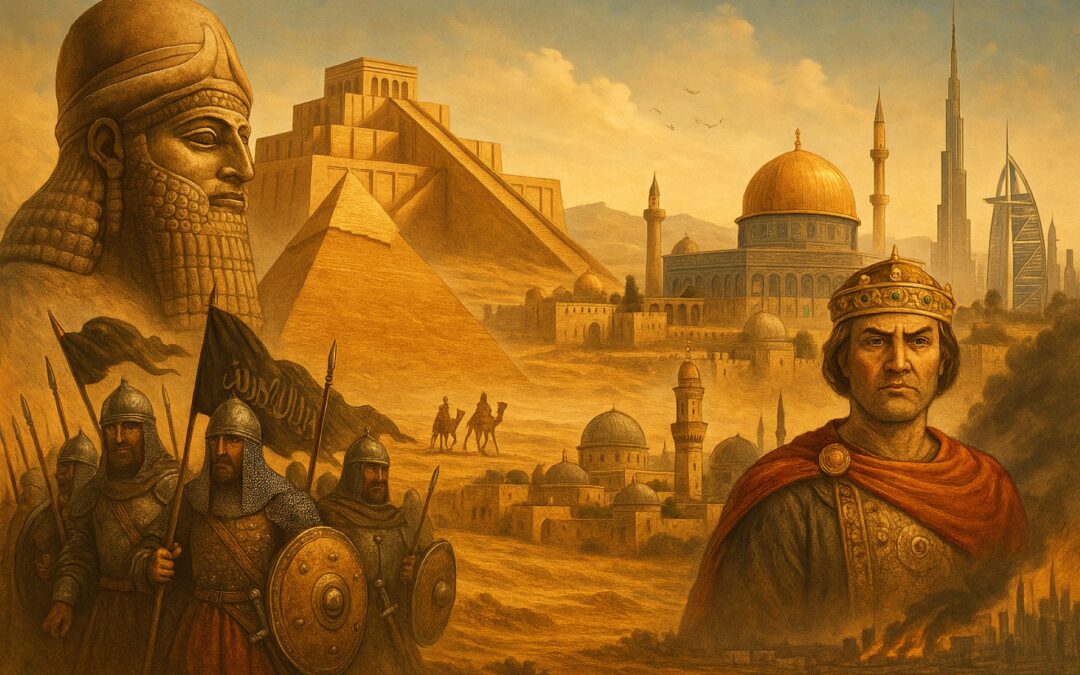
The Middle East is not just a region—it is the very stage upon which the drama of human civilization first unfolded. From the ziggurats of Mesopotamia to the pyramids of Egypt, from Alexander’s conquests to the Abbasid Golden Age, it has been the birthplace of cities, empires, and ideas that shaped the course of the world.
For millennia, armies clashed across its deserts, prophets preached in its marketplaces, and merchants carried its treasures along global trade routes. Every empire that touched it—from Rome to the Ottomans, from Britain to the United States—left scars and legacies that continue to define the present.
To study the history of the Middle East is to follow the unbroken thread of human ambition, faith, and conflict, stretching from the dawn of writing to the struggles of the modern age.
Mesopotamia and the Birth of Civilization
The Middle East’s story begins in the fertile river valleys of Mesopotamia, where nomadic bands of hunters and herders made a radical shift that would alter human history forever: the transition to agriculture and permanent settlement. The twin rivers, the Tigris and Euphrates, provided both life and uncertainty—nourishing soil through annual floods but also unleashing destruction when waters rose unpredictably. Out of this precarious relationship with nature came the earliest cities known to humankind.
By the late 4th millennium BC, the Sumerians had established great urban centers such as Uruk, Lagash, and Ur. These were not merely villages grown larger—they were fully formed cities, buzzing with temples, marketplaces, administrative halls, and vast walls of baked brick. Uruk alone housed tens of thousands of people, making it the largest city of its age.
The Sumerians pioneered cuneiform writing, pressing wedge-shaped symbols into clay tablets. What began as a system to track barley rations and trade soon blossomed into a vehicle for poetry, epic storytelling, mathematics, and legal codes. The Epic of Gilgamesh, one of the world’s oldest surviving works of literature, emerged from this milieu, telling of kings, gods, and humanity’s quest for meaning.
Beyond writing, the Sumerians devised astonishing innovations: the wheel, the plow, irrigation systems, and standardized weights and measures. They built ziggurats—towering temple complexes that reached for the heavens—serving as both religious sanctuaries and symbols of urban might. Governance, too, evolved. Councils of elders gave way to monarchs who wielded divine authority, laying the foundation for centralized rule.
To the west, along the Nile, Egypt forged a parallel but distinct path. Around 3,150 BC, Upper and Lower Egypt were unified under a single pharaoh. The Nile’s predictable floods provided stability unmatched by Mesopotamia, allowing Egyptian civilization to endure with remarkable continuity. Monumental pyramids, hieroglyphic writing, and a centralized bureaucracy reflected Egypt’s vision of cosmic order.
Together, Mesopotamia and Egypt became humanity’s twin beacons of early civilization. This arc of fertile land stretching from the Persian Gulf to the Nile—later called the Fertile Crescent—was not just geography but destiny, a crucible where humanity first discovered how to harness nature, organize society, and etch its story into permanence.
Empires of the Ancient World
The Middle East soon became a stage for empires—political experiments that tested the limits of human ambition. The first great empire was carved by Sargon of Akkad around 2,300 BC. Rising from obscurity, Sargon created a state that united Mesopotamian city-states under a single authority. This was a profound leap: no longer a collection of independent cities vying for dominance, Mesopotamia became a centralized, multiethnic empire. The Akkadians developed new military tactics, employed professional soldiers, and extended their rule from the Persian Gulf to the Mediterranean.
Though the Akkadian Empire eventually fragmented, its model endured. Babylon, under Hammurabi, rose in the 18th century BC and codified justice through the famous Hammurabi’s Code, one of the earliest surviving sets of laws. “An eye for an eye” was not merely a phrase—it was a structured attempt to balance justice and order in a complex, stratified society.
Later, the Assyrians took the art of empire to ferocious new heights. From their capitals at Nineveh and Ashur, they fielded disciplined armies equipped with iron weapons, siege engines, and cavalry. Their conquests were brutal, often involving mass deportations designed to break rebellion. Yet they also built sprawling libraries, like that of King Ashurbanipal, preserving a treasure trove of Mesopotamian knowledge. The Assyrian legacy was one of terror, efficiency, and administrative brilliance.
Meanwhile, along the Levantine coast, the Phoenicians pursued a very different path to influence. From ports like Tyre and Sidon, their fleets crisscrossed the Mediterranean, establishing colonies as far as Carthage in North Africa. They became renowned traders of purple dye, cedar wood, and glass. But their most enduring gift to humanity was linguistic: the invention of a phonetic alphabet. By reducing language to a series of simple symbols, they laid the foundation for Greek, Latin, and ultimately the alphabet we use today.
By the 6th century BC, the Middle East entered a new era under the Persians. Cyrus the Great established the Achaemenid Empire, which swallowed Mesopotamia, Egypt, and much of West Asia. Unlike the Assyrians, the Persians ruled with a policy of tolerance and integration. Local customs, religions, and languages were preserved, while royal roads, standardized coinage, and efficient governors known as satraps stitched the empire together.
The rise and fall of these early empires created a pattern that would define Middle Eastern history: innovation born from necessity, conquest driven by ambition, and collapse triggered by overreach. Each empire added another layer to the region’s identity, leaving behind institutions, ideas, and symbols that continued to shape civilizations long after their political power faded.
Alexander and the Hellenistic Age
The arrival of Alexander the Great in 334 BC unleashed a tidal wave of cultural transformation. Marching from Macedon with an army trained to perfection, Alexander smashed through the Persian Empire’s defenses at battles like Issus and Gaugamela. By 330 BC, the Achaemenid dynasty had fallen, and the Middle East—from Asia Minor to the Indus Valley—was under Macedonian command. Yet Alexander was not only a conqueror; he was a visionary who sought to blend Greek and Eastern worlds into something larger than either.
Though his empire fractured soon after his death in 323 BC, Alexander’s impact endured. His generals carved the territories into successor kingdoms: the Seleucids in Syria and Mesopotamia, the Ptolemies in Egypt, and other Hellenistic dynasties in Anatolia and Central Asia. These realms became laboratories of cultural fusion. Greek language and architecture mixed with Persian administration, Egyptian religion, and Mesopotamian science.
Urban centers like Alexandria became intellectual magnets. Its famed library aspired to collect every book in existence, while scholars advanced mathematics, astronomy, and medicine. Antioch thrived as a melting pot of cultures, where Greek philosophers debated Eastern mystics. The visual landscape also transformed: Greek theaters rose in cities once ruled by Persian satraps, while statues of Zeus stood alongside depictions of Mesopotamian deities.
This Hellenistic world was cosmopolitan at its core. Traders, poets, scientists, and rulers moved fluidly across boundaries, weaving East and West together. The age was not one of domination but of synthesis, ensuring that Greek culture would survive long after Macedonian rule faded, deeply embedded into the DNA of the Middle East.
Rome and the Rise of Christianity
As the Hellenistic kingdoms waned, another titan advanced from the west. Rome, first as a Republic and later as an Empire, expanded steadily into the Eastern Mediterranean. By the 1st century BC, the Levant, Anatolia, and Egypt had all been absorbed. For Rome, the Middle East was both a granary and a jewel—Egypt’s Nile Valley supplied grain to feed Rome’s swelling population, while Syria became a vital frontier against Parthian rivals.
Roman governance brought order through infrastructure. Roads, aqueducts, and fortified cities stitched the provinces into an imperial network. The Pax Romana, a two-century-long “Roman Peace,” allowed trade to flow from India through the Middle East to Rome, enriching merchants and provincial elites alike. Cities like Palmyra in the Syrian desert thrived as cosmopolitan crossroads of east-west exchange.
Yet Rome’s most transformative contribution was not material but spiritual. In a remote Roman province, Judea, the teachings of Jesus of Nazareth began spreading among marginalized communities. His message of compassion, justice, and salvation resonated across social classes. Initially persecuted, early Christians carried the faith along Roman roads, quietly establishing congregations from Antioch to Alexandria.
By the 4th century, Christianity had risen from outlawed sect to state religion. Emperor Constantine’s Edict of Milan legalized the faith, and soon after, Christianity became Rome’s defining creed. Pagan temples gave way to churches; bishops became political as well as spiritual leaders. In 330 AD, Constantine founded Constantinople, a Christian imperial capital that cemented the Middle East’s place as the heartland of a new religious civilization. The transformation was so profound that the cultural map of the Middle East was permanently redrawn, with Christianity shaping its spiritual and political trajectory for centuries to come.
Byzantines, Persians, and the Dawn of Islam
The collapse of Rome in the west left its eastern half—the Byzantine Empire—holding onto the torch of Roman tradition. From Constantinople, Byzantine emperors ruled Anatolia, the Levant, and Egypt. Their empire was Christian, Greek-speaking, and fiercely proud of its Roman inheritance. Yet it faced a formidable rival to the east: the Sassanid Persians.
The Byzantine-Sassanid rivalry defined Late Antiquity. For centuries, the two powers clashed over Armenia, Mesopotamia, and Syria. Their wars drained treasuries, devastated farmlands, and destabilized frontiers. The climactic conflict from 602 to 628 AD left both empires battered. Byzantine victories under Emperor Heraclius came at immense cost; the Persians, exhausted by defeat, lost legitimacy at home. Both superpowers were shadows of their former selves, ripe for disruption.
Into this vacuum burst a new force—Islam. In the early 7th century, Muhammad, a merchant from Mecca, began preaching a message of monotheism that resonated across Arabia. His teachings emphasized unity, justice, and submission to one God, reinterpreting traditions of Judaism and Christianity. By the time of his death in 632 AD, Muhammad had united the fractious Arab tribes into a single community bound by faith.
What followed was unprecedented. The Rashidun Caliphs, Muhammad’s immediate successors, launched campaigns that overwhelmed both Byzantines and Persians. Within decades, Damascus, Jerusalem, and Cairo had fallen, while the once-mighty Sassanian Empire collapsed entirely. Islam was not just a new religion—it was a political and cultural revolution that reordered the Middle East.
Arabic replaced Greek, Aramaic, and Persian as the dominant administrative tongue. Mosques became centers of both worship and governance. Jews, Christians, and other minorities remained under Islamic rule, recognized as “People of the Book” but subject to special taxes and laws. Still, the relative tolerance and protection offered allowed the coexistence of multiple traditions within the new empire.
The rise of Islam marked a watershed moment. The ancient rivalry of Byzantium and Persia was eclipsed, and the Middle East was transformed from a battleground of empires into the heartland of a new civilization that would expand across three continents.
Caliphates and the Golden Age
The early Islamic conquests had created not just a sprawling empire but also a new civilizational order. The Rashidun Caliphs consolidated the faith, but it was under the Umayyads (661–750) that Islam spread its political reach to an extraordinary scale. From their capital in Damascus, the Umayyads ruled over lands stretching from the Iberian Peninsula to the Indus River. They standardized Arabic as the language of governance, turning it into a vehicle for administration, literature, and religious scholarship. Monumental architecture, such as the Dome of the Rock in Jerusalem, symbolized both political power and spiritual authority.
Yet the Umayyad regime faced deep divisions. Many resented the privileged status of Arab Muslims, while newly converted non-Arabs struggled under unequal treatment. The Shia movement, loyal to the descendants of Ali, rejected the legitimacy of Umayyad rulers. These grievances culminated in the Abbasid revolution, which toppled the dynasty in 750.
The Abbasids established their capital in Baghdad, and with it, a new era began—the so-called Golden Age of Islam. Baghdad quickly became the jewel of the known world: a city of palaces, libraries, mosques, and marketplaces. The House of Wisdom attracted scholars from every corner of the empire who translated Greek, Persian, and Indian works into Arabic. The very foundations of modern science and mathematics were laid here. Algebra was codified, algorithms were invented, and astronomy flourished. Physicians like Al-Razi and Ibn Sina advanced medical knowledge far beyond what Europe could imagine at the time.
Baghdad also thrived as a hub of commerce. Silk, spices, gems, and manuscripts flowed along the Silk Road, linking China and India to the Mediterranean. Literature flourished too, with masterpieces like One Thousand and One Nights capturing the imagination of generations. The Abbasid caliphate was not merely an empire—it was a civilizational supernova, whose light illuminated the globe.
Crusades and Mongol Devastation
As the Abbasid empire weakened, fragmentation and rivalry made the Islamic world vulnerable. In 1095, Pope Urban II called for a holy war to reclaim Jerusalem, sparking the First Crusade. Waves of European knights and soldiers descended on the Levant, capturing the holy city in 1099 and establishing fragile Crusader states along the Mediterranean coast. For nearly two centuries, the Crusades pitted Latin Christianity against Islam in brutal cycles of conquest and reprisal.
Muslim resistance gradually coalesced. Leaders like Saladin, the Kurdish sultan who recaptured Jerusalem in 1187, became legendary for their military skill and magnanimity. Later, the Mamluks of Egypt, a dynasty of slave-soldiers turned rulers, proved to be the most formidable defenders of the Islamic world. By 1291, the last Crusader stronghold at Acre had fallen, ending the European presence in the Levant.
But even greater devastation was on the horizon. From the east came the Mongols, a relentless force of cavalry and fire. In 1258, Hulagu Khan stormed Baghdad. The city—the intellectual and cultural crown of the Islamic world—was reduced to ashes. Libraries were burned, scholars massacred, and the Abbasid caliphate extinguished. Chroniclers wrote of rivers running black with ink and red with blood. The Mongol conquest was a cultural catastrophe of incalculable proportions.
Yet the Mongol advance was not unstoppable. At the Battle of Ain Jalut in 1260, the Mamluks dealt the Mongols their first major defeat, halting their westward surge. From then on, the Mamluks held Egypt and Syria as guardians of Islam, while the Mongols established the Ilkhanate in Persia. The Middle East had endured calamity, but resilience defined its survival.
The Rise of the Ottomans
In the centuries after the Mongol storm, the Middle East remained fragmented. Anatolia was dotted with small Turkish principalities known as beyliks, remnants of the once-mighty Seljuks. Out of this patchwork rose a dynasty destined to reshape the region—the Ottomans, named after their founder Osman I.
At first, the Ottomans were little more than a frontier state. But through shrewd alliances, relentless campaigns, and an ability to absorb diverse peoples, they expanded steadily. Their moment of global significance arrived in 1453 when Sultan Mehmed II, known as “the Conqueror,” besieged Constantinople. After weeks of cannon fire and assault, the city fell. Renamed Istanbul, it became the beating heart of a new Islamic empire and the symbolic end of the Christian Byzantine world.
The Ottomans expanded across three continents. They dominated Anatolia, the Balkans, the Levant, North Africa, and eventually the Arabian Peninsula. In 1517, Sultan Selim I defeated the Mamluks, taking Egypt and the holy cities of Mecca and Medina, and claimed the mantle of caliph. The empire was not just vast—it was multiethnic and multireligious, governed through the millet system that granted autonomy to Christian, Jewish, and other minority communities.
At its zenith under Suleiman the Magnificent in the 16th century, the Ottoman Empire stood among the world’s great powers, rivaling the Habsburgs in Europe and the Safavids in Persia. Yet beyond its military conquests, the Ottomans also cultivated a rich cultural legacy. Istanbul glittered with mosques and palaces, Ottoman calligraphy flourished, and Islamic law was refined into a sophisticated legal system.
But the empire’s rise also reignited old rivalries. In Persia, the Safavid dynasty consolidated power and made Shia Islam its state creed. The Sunni Ottomans and Shia Safavids clashed repeatedly, deepening a sectarian divide that still echoes across the Middle East today.
Decline and European Encroachment
By the late 17th century, the Ottoman Empire—once the awe of the world—was showing unmistakable signs of decline. Its armies, once unstoppable, suffered defeats at the hands of rising European powers. The failed siege of Vienna in 1683 marked a turning point: Europe was no longer on the defensive but increasingly on the offensive. The empire’s administrative machinery, once innovative, calcified into layers of corruption and inefficiency. Bureaucrats purchased offices, provincial governors siphoned taxes, and the janissary corps, once an elite fighting force, became a conservative lobby resisting reform.
Externally, Europe was racing ahead with the Scientific Revolution, the Enlightenment, and industrialization. The Ottomans, by contrast, clung to older systems, falling behind militarily and economically. European rivals chipped away at the empire’s borders: Austria pushed from the north, Russia sought warm-water ports on the Black Sea, and France and Britain tightened their grip on Mediterranean trade routes. The Ottoman Empire became known derisively as “the sick man of Europe.”
In the 19th century, Ottoman leaders attempted to reverse the decline through sweeping reforms. The Tanzimat (“reorganization”) reforms introduced new legal codes, secular schools, and modernized armies modeled on European systems. Railroads, telegraphs, and conscription were implemented to strengthen the state. While these reforms slowed decay and created pockets of progress, they also provoked resistance from conservatives who saw them as betrayals of tradition.
Meanwhile, Europe’s imperial ambitions in the Middle East grew bolder. Britain tightened control over Egypt, especially after the opening of the Suez Canal in 1869, which made the region the lynchpin of global trade. France advanced in North Africa. Persia (modern Iran), though never colonized outright, was carved into spheres of influence by Britain and Russia. When oil was discovered in Iran in 1908, Western powers immediately recognized the region’s new strategic significance, foreshadowing a century in which petroleum would dominate Middle Eastern geopolitics.
World War I and the Birth of Modern Borders
The First World War dealt the final blow to the Ottoman Empire. In 1908, the Young Turks—a reformist nationalist movement—seized power and aligned the empire with Germany and Austria-Hungary. Ottoman armies fought on multiple fronts: against Russia in the Caucasus, Britain in Mesopotamia and Palestine, and Allied forces at Gallipoli. Despite some moments of defiance, the war proved disastrous.
Arab leaders, weary of Ottoman domination, entered into negotiations with Britain. Sharif Hussein of Mecca launched the Arab Revolt in 1916, lured by British promises of an independent Arab kingdom after the war. Yet at the same time, Britain and France were secretly negotiating the Sykes-Picot Agreement, which divided the Middle East into zones of influence. Adding to the duplicity, the Balfour Declaration of 1917 promised a Jewish homeland in Palestine. These conflicting promises laid the foundation for decades of turmoil.
By 1918, the Ottomans were defeated. The Treaty of Sèvres (1920) formalized the empire’s dismantling. Anatolia itself nearly fell under Allied occupation, but Mustafa Kemal Atatürk rallied Turkish resistance, leading to the War of Independence and the founding of the Republic of Turkey in 1923. The rest of the empire’s Arab provinces were parceled out as mandates under the League of Nations: Britain controlled Iraq, Palestine, and Transjordan, while France took Syria and Lebanon.
The new borders were artificial lines drawn by colonial cartographers, often ignoring ethnic, tribal, and sectarian realities. Kurdish populations found themselves divided between Turkey, Iraq, Syria, and Iran. Sunnis and Shias were bound uneasily within Iraq. Lebanon’s delicate religious balance was frozen into a rigid political system. These divisions, born from imperial convenience, would later ignite conflicts that persist to this day.
Decolonization and the Arab-Israeli Conflict
Though Britain and France emerged from World War I with new possessions, their hold was tenuous. Anti-colonial sentiment grew steadily across the Middle East during the interwar years. Nationalist movements demanded independence, often erupting into protests, strikes, and uprisings. Iraq gained formal independence in 1932 but remained tethered to British military and economic influence. Egypt too was technically independent after 1922, yet Britain maintained troops in the Suez Canal zone.
But no issue proved as explosive as Palestine. Jewish immigration increased sharply after the Balfour Declaration and amid persecution in Europe. Tensions with Arab communities escalated into violence throughout the 1920s and 1930s. For Palestinians, the influx of Jewish settlers represented a betrayal of Britain’s wartime promises. For Jews, it was a lifeline from anti-Semitism and Nazi persecution. The contradictions hardened into intractable hostility.
World War II shifted the balance. European colonial powers were weakened, and nationalist aspirations surged. In 1947, the United Nations voted to partition Palestine into Jewish and Arab states. Jewish leaders accepted; Arab leaders rejected, seeing it as the theft of Arab land. When Israel declared independence in 1948, neighboring Arab states—Egypt, Transjordan, Syria, and Iraq—invaded. Against all odds, Israel not only survived but expanded its territory beyond the UN plan.
The consequences were seismic. Over 700,000 Palestinians fled or were expelled, becoming refugees in neighboring Arab states. The 1948 war, known as the Nakba (“catastrophe”) among Palestinians, cemented the Israeli-Arab conflict as the central fault line of modern Middle Eastern politics. Arab states, humiliated by defeat, turned increasingly toward radical nationalism and military regimes promising redemption.
By the mid-20th century, the colonial era was ending. Syria, Lebanon, and Jordan gained independence; Iraq threw off British tutelage; Egypt emerged as a regional power under Gamal Abdel Nasser. Yet decolonization did not bring stability. Instead, it unleashed a new era defined by competing nationalisms, Cold War interventions, and above all, the unresolved Palestinian question—a wound that continues to bleed into the present.
Revolutions, Wars, and U.S. Intervention
By the latter half of the 20th century, the Middle East was no longer a colonial playground but a crucible of revolution, nationalism, and Cold War rivalry. The most transformative shock came in 1979, when the Iranian Revolution toppled the Shah, a Western-backed monarch who had sought to modernize Iran through secular reforms. In his place rose Ayatollah Ruhollah Khomeini, who established the Islamic Republic. For the first time in centuries, an Islamic theocracy was not only conceived but successfully institutionalized. The revolution sent tremors across the region, unsettling conservative Arab monarchies and challenging secular Arab nationalist regimes.
Iraq, under Saddam Hussein, perceived this new Shi’a-led republic as an existential threat. In 1980, Iraq launched a brutal invasion of Iran, beginning an eight-year war of attrition that devastated both societies. Chemical weapons, trench warfare, and attacks on civilian populations marked the conflict, which ended inconclusively in 1988. Iraq emerged battered and deeply indebted, particularly to wealthy Gulf states like Kuwait.
In desperation and ambition, Saddam turned against his former patrons. In 1990, he invaded Kuwait, claiming historic rights and seeking control over its oil wealth. The invasion triggered a swift response from a U.S.-led coalition, which launched Operation Desert Storm in 1991. The Gulf War expelled Iraqi forces within weeks, but its impact lasted far longer. It marked the beginning of an enduring U.S. military presence in the Gulf, with bases established in Saudi Arabia, Qatar, and Bahrain.
For many in the region, this visible American footprint was deeply provocative. Islamist groups portrayed it as a new form of Western imperialism propping up corrupt regimes. The resentment laid fertile ground for radical movements like al-Qaeda, which framed the U.S. presence as a religious and political affront. The Middle East had once again become the world’s geopolitical chessboard—this time dominated not by European powers, but by the United States.
The 21st Century: Terror, Uprisings, and Shifting Alliances
The dawn of the new millennium was defined by violence and upheaval. On September 11, 2001, al-Qaeda operatives, many of them Saudi nationals radicalized by U.S. presence in the Gulf, launched the deadliest terrorist attacks in American history. In response, the United States declared a global “War on Terror,” with the Middle East as its epicenter.
The U.S. invasion of Afghanistan in 2001 was followed by the far more controversial invasion of Iraq in 2003, justified by the claim that Saddam Hussein possessed weapons of mass destruction. No such weapons were found. Though Hussein’s regime collapsed quickly, the aftermath descended into chaos. Sectarian violence between Sunnis and Shi’as ripped Iraq apart, and the power vacuum gave rise to jihadist militias that would later coalesce into ISIS.
The Arab Spring in 2011 briefly suggested a new dawn. Ordinary citizens, empowered by social media and fueled by discontent, rose against entrenched dictatorships in Tunisia, Egypt, Libya, Yemen, and Syria. At first, it appeared as though the region might pivot toward democracy. Tunisia transitioned relatively peacefully, but elsewhere the uprisings soured. In Egypt, a brief experiment with democracy ended in a military coup. Libya and Yemen slid into anarchy.
Nowhere was the tragedy deeper than in Syria, where Bashar al-Assad clung to power with ruthless violence. The uprising spiraled into a brutal civil war, drawing in regional and global powers. Russia and Iran backed Assad, while Turkey, the Gulf states, and Western powers supported various rebel factions. The war displaced millions, shattered ancient cities like Aleppo, and turned Syria into the bloodiest battleground of the 21st century.
Amid this chaos, ISIS rose like a storm. Exploiting the instability of Iraq and Syria, it declared a caliphate in 2014, capturing vast swaths of territory and committing atrocities with medieval brutality. Slick online propaganda drew recruits from across the globe, turning ISIS into both a territorial threat and a global terror brand. By 2017, U.S.-led airstrikes, Kurdish fighters, Iraqi militias, and Assad’s allies dismantled its territorial grip. Yet its ideology survived, lingering in insurgencies and radical cells.
Meanwhile, geopolitical rivalries deepened. Iran expanded its influence through proxy groups in Iraq, Syria, Lebanon, and Yemen—what critics called the “Shia Crescent.” Saudi Arabia and its Gulf allies countered with their own interventions, fueling proxy wars from Yemen to Syria. Turkey reasserted regional ambitions, flexing military power in Syria, Libya, and the Caucasus. The Middle East had become multipolar: a tangled web of rivalries with no single hegemon, but many competing power centers.
The Present Landscape
Today, the Middle East stands as a paradox of progress and paralysis. On one side, the Gulf monarchies—particularly the United Arab Emirates, Qatar, and Saudi Arabia—showcase glittering skyscrapers, financial hubs, and futuristic visions. Projects like Saudi Arabia’s NEOM city promise high-tech utopias. Oil wealth, once the region’s curse, is being reinvested into diversification: tourism, green energy, and global finance. These states market themselves as modern, cosmopolitan, and indispensable to the world economy.
Yet beneath the glass towers lies a region scarred by war, displacement, and authoritarianism. Syria remains fractured, Yemen endures one of the world’s worst humanitarian crises, and Libya is still divided among rival militias. Sectarianism remains unresolved; the Sunni-Shi’a divide, hardened by centuries of rivalry, continues to fuel proxy wars.
Diplomatically, the Abraham Accords of 2020 marked a dramatic shift. Several Arab states—including the UAE, Bahrain, Sudan, and Morocco—normalized relations with Israel, breaking with decades of consensus that recognition must await a resolution of the Palestinian question. Shared hostility toward Iran and fatigue with the stalemate over Palestine drove these moves, signaling that pragmatism had begun to outweigh ideology.
Yet the Palestinian issue remains a raw wound. Gaza and the West Bank simmer under occupation and blockade, and regional protests show that the conflict is far from forgotten. For many in the Arab world, normalization feels like betrayal, widening the gulf between rulers and populations.
Meanwhile, global powers still circle the region. The United States maintains its alliances and military bases, though its appetite for direct intervention has waned after the failures in Iraq and Afghanistan. Russia has entrenched itself in Syria, while China quietly expands its economic footprint, securing oil supplies and investment deals.
Thus, the Middle East in the 21st century is not a story of triumph or collapse but of contradiction: rapid modernization alongside persistent bloodshed, breathtaking wealth beside crushing poverty, bold diplomacy overshadowed by unresolved grievances. It remains, as it has always been, the world’s crossroads—where civilizations meet, rivalries collide, and history refuses to rest.
Conclusion
The history of the Middle East is a chronicle of power and fragility, of splendor and suffering. It has given the world alphabets, law codes, faiths, and philosophies. It has endured invasions, revolutions, and foreign interventions, yet continues to reinvent itself, always at the center of global currents.
Today, glittering Gulf skylines rise beside cities reduced to rubble; old sectarian divides coexist with bold new alliances. Its destiny remains contested, but its importance is unquestionable. The Middle East is not a relic of the past—it is a living crossroads of history, where the echoes of ancient empires still reverberate in every conflict, every treaty, every call to prayer, and every rising skyline. It is a region that refuses to be forgotten because it has never stopped shaping the world.