
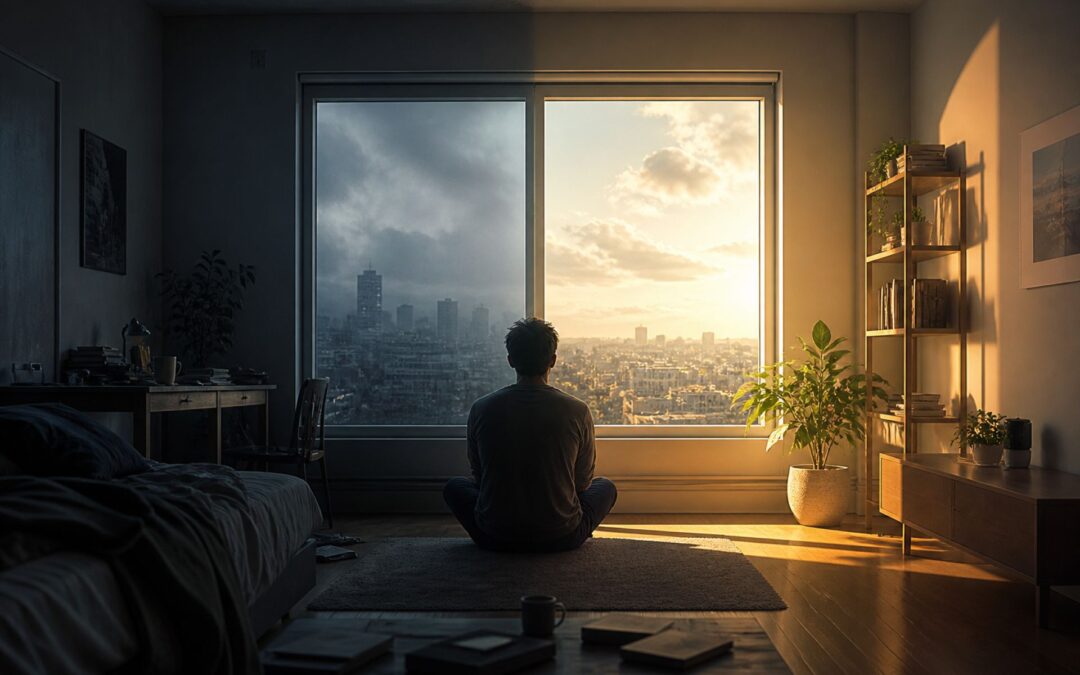
The Uneasy Silence of Being Alone
There’s a particular kind of silence that feels heavier than it should.
It shows up on quiet evenings, in empty rooms, in moments when there’s nothing to distract you. Maybe it’s a Saturday night with no plans. Maybe it’s the pause after you put your phone down and realize there’s no one to text. On paper, nothing is wrong. And yet, something feels off—restless, uncomfortable, almost like you’re missing something you can’t quite name.
Most people instinctively try to escape this feeling. They reach for noise, for company, for anything that fills the space. A quick scroll. A casual conversation. Background television. Not because these things are deeply fulfilling, but because they soften the discomfort of being alone.
But here’s the question we rarely stop to ask: what exactly is so uncomfortable about being alone?
Is it the silence itself? The absence of people? Or is it something else—something more subtle, more internal?
Because if you look closely, the discomfort doesn’t always match the situation. There are people who spend entire days alone and feel completely at ease. And there are others who sit in crowded rooms and feel an even deeper sense of isolation.
Which suggests something important.
The uneasiness of being alone may not come from the state of aloneness itself, but from the meaning we attach to it.
We’ve been conditioned to associate being alone with lack. Lack of connection. Lack of belonging. Lack of importance. So when we find ourselves in solitude, it doesn’t feel neutral—it feels like something is missing, like something is wrong.
And that interpretation quietly shapes our experience.
The silence isn’t just silence anymore. It becomes a reminder. The empty room isn’t just a space. It becomes a reflection. And the absence of others begins to feel like an absence of something within ourselves.
But what if that interpretation isn’t the only way to see it?
What if the discomfort isn’t built into being alone—but learned over time?
That possibility changes everything.
Why Loneliness Feels So Real
Loneliness has a way of convincing you that it’s something objective—something rooted in reality rather than perception.
When you feel lonely, it doesn’t feel like a mindset. It feels like a fact.
You’re alone. You feel disconnected. Something is missing. And the mind quickly turns that into a conclusion: this is what being alone feels like.
But that conclusion doesn’t always hold up.
There are moments when you’re physically alone and feel completely content—absorbed in a book, lost in thought, or simply at ease with yourself. In those moments, the absence of others doesn’t register as a problem. It just… is.
And then there are moments when you’re surrounded by people—friends, colleagues, even family—and yet the feeling creeps in anyway. A quiet sense of disconnection. A subtle distance. As if you’re present, but not truly there.
If loneliness were purely about physical isolation, this wouldn’t happen.
Which suggests that loneliness is not just about being alone, but about how we experience ourselves in that aloneness.
At its core, loneliness is less about the absence of people and more about the presence of a certain interpretation. It’s the feeling that something essential is lacking. That connection should be there—but isn’t. That you are, in some way, cut off.
And once that interpretation takes hold, it begins to reinforce itself.
You notice the silence more. You become more aware of the absence. Your thoughts start circling around what’s missing instead of what’s present. The mind, in trying to make sense of the feeling, deepens it.
That’s why loneliness can feel so real. Because it isn’t imagined—it’s experienced. But the source of that experience isn’t always the situation itself. It’s the meaning layered on top of it.
Two people can be in the exact same condition—alone in a room—and live completely different realities. One feels peaceful, even fulfilled. The other feels restless, empty, and disconnected.
The difference isn’t the circumstance.
It’s the lens.
The Tribal Mindset We Still Carry
Part of the reason loneliness feels so intense has very little to do with your current life—and everything to do with your past.
Not your personal past, but your evolutionary one.
For most of human history, being alone wasn’t a lifestyle choice. It was a threat. Survival depended on the group. The tribe meant protection from predators, access to food, shared knowledge, and a sense of belonging. To be separated from it wasn’t just uncomfortable—it was dangerous.
So the human mind adapted accordingly.
It learned to treat isolation as a problem to be solved immediately. It wired discomfort into aloneness as a kind of alarm system. Feel bad, seek the group, restore safety. That response wasn’t a flaw. It was incredibly useful.
The problem is that the environment has changed—but the wiring hasn’t.
Today, in most parts of the world, you don’t need a tribe to survive in the same way. You can live alone, work independently, and meet your basic needs without constant social interaction. The external conditions have shifted dramatically.
But internally, the signal is still there.
That uneasy feeling when you’re alone? Part of it is ancient. It’s the echo of a time when being alone meant vulnerability. When silence meant exposure. When distance from others could be fatal.
And because this response is so deeply ingrained, it often goes unquestioned. We assume the discomfort must mean something is wrong in the present. That we shouldn’t be alone this much. That something needs to be fixed.
But that’s not necessarily true.
Sometimes, what you’re feeling isn’t a reflection of your current reality—it’s a leftover instinct reacting to a world that no longer exists.
Understanding this doesn’t instantly erase loneliness. But it creates space.
Space to pause before reacting. Space to question whether the discomfort is truly about your situation—or just a signal that’s firing out of habit.
And in that space, something subtle begins to shift.
Being alone no longer feels like an immediate problem to escape.
It starts to feel like something you can actually examine.
Aloneness: A Neutral State We Misunderstand
At some point, it becomes necessary to separate two things we often treat as identical: being alone and feeling lonely.
They are not the same.
One is a situation. The other is an experience.
Aloneness is simply the condition of being by yourself. No built-in meaning. No emotional weight attached to it. It doesn’t tell you whether something is right or wrong. It doesn’t demand a reaction. It just describes what is happening.
Loneliness, on the other hand, is charged. It carries a quiet sense of lack, a feeling that something essential is missing. It turns a neutral situation into a negative experience.
And the moment we blur these two together, something subtle happens.
We stop seeing aloneness clearly.
Instead of recognizing it as a neutral state, we automatically interpret it through the lens of loneliness. Being alone becomes something to fix, something to escape, something that shouldn’t last too long. The situation itself gets judged before we’ve even had a chance to experience it.
Language plays a role here.
The word lonely immediately suggests a problem. It implies suffering. But alone doesn’t carry the same emotional charge. It’s quieter, more open. It leaves room for interpretation.
Yet in practice, we rarely give it that room.
We inherit the assumption that being alone must feel bad. And because of that assumption, we often create the very experience we’re trying to avoid. The mind fills the silence with thoughts about what’s missing. It compares, evaluates, questions. And before long, neutrality turns into discomfort.
But if aloneness is truly neutral, then the discomfort isn’t inevitable.
It’s conditional.
Which means it can change.
The moment you stop treating aloneness as a problem, something interesting happens. The urgency fades. The need to escape softens. You’re no longer reacting to the situation—you’re actually experiencing it.
And what you find there isn’t always what you expected.
Sometimes, it’s just silence.
Sometimes, it’s clarity.
And sometimes, it’s the beginning of a very different relationship with yourself.
The Philosophical Case for Solitude
Long before modern psychology tried to make sense of loneliness, philosophers were already questioning our fear of being alone.
One of them was Zhuangzi, who offered a simple but striking image. He described fish stranded on dry land, gathering together and keeping each other alive by moistening one another with what little they had left. It’s an image of cooperation—but also of desperation.
Then comes the twist.
He suggests it would be better for those fish to forget each other entirely and return to the rivers and lakes.
At first glance, it sounds counterintuitive. Isn’t mutual support a good thing? Isn’t staying together what keeps them alive?
But that’s exactly the point.
There’s a difference between connection that arises from fullness and connection that arises from necessity. When beings are forced together simply to survive, the relationship is no longer free. It becomes a kind of dependency—one that binds rather than enriches.
Zhuangzi wasn’t dismissing human connection. He was questioning the kind of connection that comes from fear, from lack, from the inability to stand on one’s own.
And that idea feels surprisingly relevant today.
In a world where survival no longer demands constant togetherness, we still carry the impulse to cling. Not always because we genuinely enjoy someone’s presence, but because we feel uncomfortable without it. Because being alone feels like something we shouldn’t tolerate for too long.
So we stay in conversations that don’t interest us. We maintain relationships that drain us. We surround ourselves with noise—not because it adds something meaningful, but because silence feels like something to avoid.
From this perspective, solitude isn’t the problem.
Dependence is.
The ability to be alone—to not need constant reinforcement from others—becomes a kind of freedom. It allows relationships to exist without pressure. Without the hidden demand that the other person must fill a gap within us.
And when that pressure disappears, something shifts.
Connection becomes lighter. More honest. Less driven by fear.
Solitude, then, is not a deficiency to overcome.
It’s a condition that reveals whether our connections are chosen—or required.
Why Relationships Can’t Cure Loneliness
It’s a common assumption: if loneliness hurts, then connection must be the cure.
So we look outward.
We seek friendships, relationships, constant interaction—anything that might fill the quiet sense of emptiness. And for a while, it often works. The presence of others distracts us, reassures us, gives us something to hold onto.
But the relief rarely lasts.
Because what we’re trying to fix isn’t always external.
Osho pointed this out with unusual clarity. He argued that when we use relationships as a way to escape loneliness, we’re not actually resolving it—we’re postponing it.
The underlying feeling remains.
And because of that, something subtle enters the relationship: dependence.
If another person becomes the source of your sense of completeness, then their presence starts to feel necessary. Not just enjoyable—but required. And the moment something becomes required, fear follows.
Fear of losing them.
Fear of distance.
Fear of change.
Even in the presence of love, there’s an undercurrent of anxiety.
This is why people can feel lonely even in relationships. Not because the other person is absent, but because the emptiness they were meant to fill is still there—just temporarily covered.
And over time, that creates strain.
Expectations grow heavier. The relationship starts carrying more weight than it was meant to. Instead of two individuals sharing their lives, it becomes one person trying to stabilize themselves through another.
Which is an impossible task.
No relationship, no matter how strong, can permanently compensate for a lack of inner stability. People change. Circumstances shift. Even the deepest connections are not immune to time.
And somewhere beneath it all, we know this.
Which is why trying to escape loneliness through others often comes with an unspoken tension. A sense that what we’re relying on isn’t entirely secure.
So the problem isn’t connection itself.
It’s the role we assign to it.
When relationships are used to avoid loneliness, they become fragile. But when they arise from a place of inner completeness, they become something else entirely—something lighter, freer, and far more stable.
The Shift From Emptiness to Completeness
At the center of loneliness, there’s usually a quiet assumption: something is missing.
It’s not always clearly defined. It doesn’t have a precise shape. But it’s there—a sense that you are incomplete as you are, and that something outside of you is needed to make things whole.
This assumption drives more than we realize.
It influences the way we approach relationships, the way we spend our time, even the way we see ourselves. If you believe you are incomplete, then naturally, you will look for completion elsewhere. In people. In attention. In constant engagement with the outside world.
But there’s a problem with this approach.
Anything external is, by nature, unstable.
People come and go. Circumstances shift. Even the most reliable sources of comfort are subject to change. So if your sense of completeness depends on something outside of you, it will always be vulnerable.
That vulnerability is often mistaken for love, attachment, or emotional depth. But beneath it, there’s a quieter reality: dependence.
The shift begins when that assumption is questioned.
What if the feeling of emptiness isn’t evidence of something missing—but a habit of perception? What if it’s not pointing to an external gap, but to an internal relationship that hasn’t been explored?
Because when you stop immediately trying to fill the emptiness, something unexpected happens.
You start to encounter it directly.
At first, it can feel uncomfortable. There’s nothing to distract you. No one to lean on. Just the raw experience of being with yourself. But if you stay with it—without rushing to escape—it begins to change.
The emptiness softens.
Not because something external has filled it, but because the need to fill it begins to dissolve. You realize that what felt like a lack was, in many ways, undefined space—space that your mind interpreted negatively out of habit.
And in that space, something else can emerge.
A sense of self-sufficiency. Not in the sense of isolation or indifference, but in the sense that your well-being is no longer entirely dependent on external conditions.
This is what completeness looks like.
Not perfection. Not constant happiness. But a quiet stability that doesn’t collapse in the absence of others.
From here, relationships take on a different character. They are no longer attempts to complete you. They become ways to share what is already there.
And that changes everything.
The Paradox of Aloneness
There’s a quiet irony at the heart of all this.
The more you fear being alone, the more your relationships become strained by that fear. And the more you become comfortable with aloneness, the easier connection begins to feel.
At first, this seems counterintuitive.
You would expect that needing people more would bring you closer to them. That seeking constant connection would strengthen relationships. But in reality, the opposite often happens.
Neediness creates pressure.
When you rely on others to stabilize your inner state, interactions stop being simple. There’s an unspoken expectation beneath them—stay, respond, reassure, don’t change. And even if it’s never expressed directly, it’s felt.
People sense when they are being leaned on too heavily.
Conversations become less about sharing and more about maintaining. Presence becomes obligation. And over time, this weight can push others away, even if the intention was simply to feel close.
On the other hand, when you are at ease with being alone, something shifts.
You no longer approach people from a place of lack. There’s no urgency to extract something from the interaction. No hidden demand that the other person must make you feel a certain way.
And because of that, connection becomes lighter.
You listen more openly. You engage more honestly. You allow space—for yourself and for others—without immediately trying to close it. There’s less fear of silence, less fear of distance, less fear of things changing.
Paradoxically, this often draws people in.
Not because you’re trying to attract them, but because the absence of pressure makes interaction feel natural. There’s nothing to defend against, nothing to carry.
In this sense, aloneness doesn’t isolate you.
It frees you.
It removes the weight that turns connection into something fragile and replaces it with a kind of ease that allows relationships to form and unfold on their own terms.
And perhaps most importantly, it changes what connection is for.
It’s no longer something you need in order to feel complete.
It becomes something you choose to share.
Learning to Enjoy Your Own Company
Understanding aloneness intellectually is one thing. Living it is something else entirely.
Because when the moment actually arrives—when you’re alone with nothing to distract you—the old patterns don’t just disappear. The impulse to reach for your phone, to fill the silence, to escape the stillness… it’s still there.
And that’s where the real shift begins.
Not in forcing yourself to enjoy solitude, but in learning to stop resisting it.
Most of the discomfort we associate with being alone comes from that resistance. The subtle belief that this moment shouldn’t be happening. That something else would be better. That you’re missing out on something more important.
But when you drop that resistance—even slightly—the experience starts to change.
The silence feels less oppressive. The restlessness softens. What once felt like emptiness begins to feel more like space.
And space, when you don’t rush to fill it, has a different quality.
It allows you to think without interruption. To notice things you usually overlook. To experience your own mind without constant external input shaping it. At first, this can feel unfamiliar, even uncomfortable. But over time, it becomes something else.
Familiar.
You begin to recognize your own patterns. Your reactions. Your thoughts as they arise and pass. You start to see that not every moment needs to be filled, and not every feeling needs to be solved.
And slowly, your relationship with yourself changes.
You’re no longer someone you’re trying to escape from.
You become someone you can sit with.
This doesn’t mean every moment of solitude becomes peaceful or enjoyable. There will still be restlessness. There will still be days when you’d rather be around others. But the difference is that being alone no longer feels like a problem that needs immediate fixing.
It becomes an option you can actually inhabit.
And once that happens, solitude stops feeling like absence.
It starts to feel like presence.
Conclusion
Being alone was never the real problem.
What hurts is the story we attach to it—the quiet assumption that aloneness means something is missing, that it reflects a lack rather than a possibility. Over time, that assumption becomes so familiar that it feels like truth.
But it isn’t.
Aloneness, in itself, is neutral. It doesn’t demand suffering. It doesn’t impose emptiness. It simply creates space. What fills that space depends on how we meet it.
When we resist it, we experience loneliness.
When we accept it, something else becomes possible.
Not constant happiness. Not some idealized state of perfect self-sufficiency. But a quieter, more stable way of being—one that isn’t entirely dependent on who is or isn’t around us.
From that place, relationships don’t disappear.
They change.
They become lighter, freer, less driven by fear. Not something we cling to in order to feel whole, but something we choose to share from a place that is already complete.
And perhaps that’s the real shift.
Not learning how to avoid being alone—but learning how to no longer be afraid of it.