
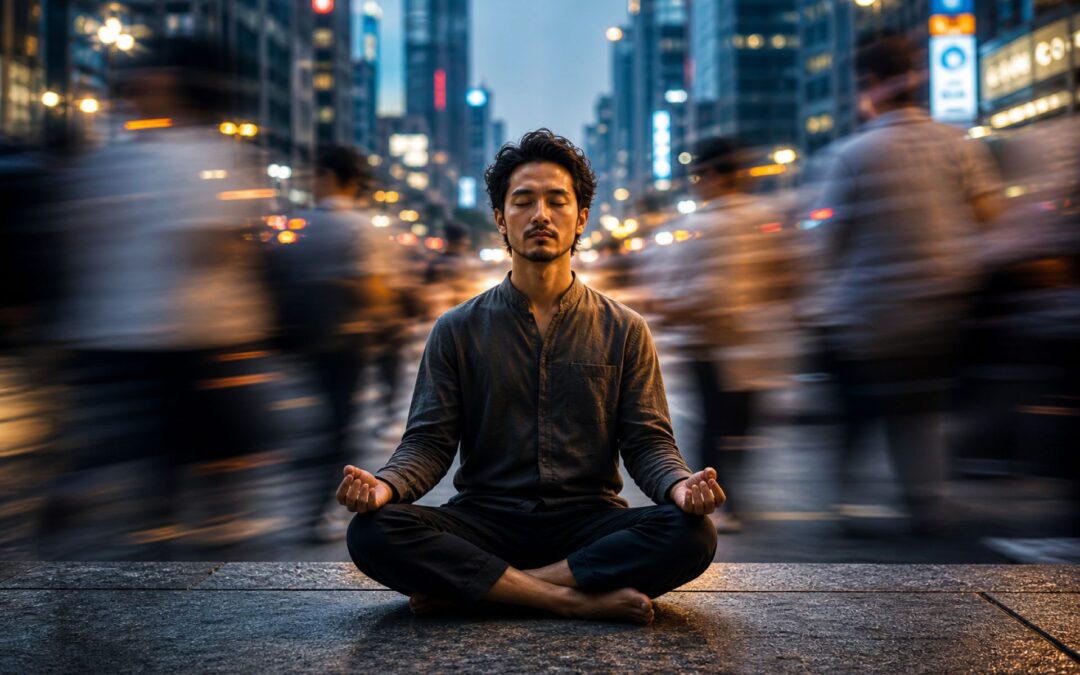
Buddhism is often seen as a religion—rich with rituals, symbols, and centuries of tradition. But beneath all of that lies something far more practical: a system for understanding the human mind and reducing suffering.
At the center of this system is a collection of teachings attributed to Gautama Buddha, many of which are preserved in the Dhammapada. These teachings are not abstract ideas meant only for monks or spiritual seekers. They are observations about how we think, how we suffer, and how we can live with greater clarity and ease.
What makes Buddhist wisdom enduring is its simplicity. It doesn’t ask you to believe in something blindly. Instead, it invites you to look closely at your own experience—your desires, your fears, your habits—and see how they shape your inner world.
In a time where distraction is constant and restlessness feels normal, these teachings offer something rare: a way to step back, understand the chaos of the mind, and gradually move toward peace.
This article is not a strict interpretation of Buddhist doctrine. It is a modern, grounded reading of some of its most powerful insights—ideas that remain just as relevant today as they were thousands of years ago.
If there is a single thread connecting all of them, it is this: inner peace is not something you find—it is something you cultivate, deliberately and patiently, through understanding.
Attachment Is the Root of Suffering
One of the most fundamental insights in Buddhism is also one of the most uncomfortable: much of our suffering is self-created through attachment.
Attachment, in this sense, is not the same as caring. It is the tendency to cling—to people, outcomes, identities, and expectations—as if they are permanent. We don’t just enjoy things; we depend on them. We build our sense of stability on things that are, by nature, unstable.
The problem is simple: everything changes.
People grow apart. Success fades. Health declines. Even the way we see ourselves shifts over time. But instead of accepting this, we resist it. We hold on tightly, hoping things will stay the way they are. And when they inevitably don’t, we experience loss—not just of the thing itself, but of the illusion that it would last.
This is where suffering begins.
Take something as ordinary as success. You work toward a goal, achieve it, and for a brief moment, there’s satisfaction. But soon, that feeling fades. Then comes the need for more—more recognition, more validation, more achievement. What once brought joy now becomes a baseline. You are no longer enjoying it; you are attached to maintaining it.
The same applies to relationships. Loving someone deeply is not the problem. The suffering begins when love turns into dependence—when your emotional stability becomes tied to another person’s presence, behavior, or approval. When change enters the picture, as it always does, it feels like something essential has been taken from you.
Buddhism doesn’t suggest that we detach from life in a cold, indifferent way. It suggests something far more subtle: to fully experience life while understanding its impermanence.
There is a quiet freedom in this shift.
When you stop expecting things to last forever, you begin to appreciate them for what they are, while they are. Moments become richer, not because they are permanent, but because they are fleeting. You don’t cling to them—you participate in them.
Letting go, then, is not about losing something. It is about releasing the false idea that you ever possessed it in the first place.
And in that release, a different kind of peace begins to emerge.
Desire Is Not the Enemy—Misguided Desire Is
If attachment explains why we suffer, desire explains why the mind never rests.
At first glance, Buddhism can seem anti-desire—as if the goal is to eliminate wanting altogether. But that’s a misunderstanding. Desire, in itself, is not the problem. In fact, without desire, there would be no movement in life. You wouldn’t seek knowledge, improve your situation, or even read something like this.
The real issue is not desire—it is misguided desire.
There is a difference between a desire that brings clarity and one that creates agitation. Some desires are expansive. They lead to growth, understanding, and a deeper sense of alignment. Others are compulsive. They pull you outward, constantly chasing something just beyond reach.
The mind, when untrained, doesn’t distinguish between the two. It treats every impulse as urgent.
This is why craving feels so powerful. It doesn’t ask whether something is good for you. It simply demands attention. And once you give in, it reinforces itself. The more you follow it, the stronger it becomes.
But Buddhism doesn’t suggest suppressing desire through force. That approach often backfires. The more you try to eliminate desire, the more it hides, waiting for the right moment to resurface.
Instead, the emphasis is on training the mind.
A trained mind begins to observe desire rather than immediately obey it. It creates a small but crucial gap between impulse and action. In that gap, something changes. You start to see the nature of your desires more clearly—where they come from, what they lead to, and whether they actually serve you.
This is where discernment develops.
You begin to notice that some desires leave you feeling grounded and focused, while others leave you restless and dissatisfied—even when fulfilled. Over time, the pull of destructive desires weakens, not because you forced them away, but because you understand them.
And understanding has a quiet authority. It doesn’t fight—it dissolves.
In this sense, inner peace is not about having no desires. It is about no longer being controlled by the wrong ones.
The Danger of Chasing Sensual Pleasure
Not all desires are equal—and nowhere is this clearer than in the pursuit of sensual pleasure.
In Buddhism, sensual pleasure refers to experiences that stimulate the senses: food, entertainment, sex, comfort, stimulation, novelty. None of these are inherently wrong. The problem begins when they stop being occasional enjoyments and become the center of your life.
Because sensual pleasure has a pattern.
It promises satisfaction, delivers it briefly, and then fades—often faster than expected. What follows is not lasting contentment, but a subtle emptiness. And that emptiness creates the urge to seek the next hit, the next distraction, the next moment of relief.
This is how the cycle forms.
At first, it feels harmless. A little indulgence here, a small escape there. But over time, the threshold increases. What once satisfied you no longer does. You need more intensity, more frequency, more stimulation. And slowly, without realizing it, your sense of control weakens.
You are no longer choosing pleasure. You are being pulled by it.
This is where the ancient Buddhist idea of Mara becomes relevant—not as a literal being, but as a symbol. Mara represents the forces that keep the mind trapped in illusion, distraction, and desire. Every time you chase pleasure without awareness, you move a little further away from clarity and a little deeper into that cycle.
The consequences are rarely immediate, which makes them easy to ignore.
Overindulgence dulls sensitivity. Constant stimulation makes stillness uncomfortable. The mind becomes restless, impatient, unable to sit with itself. And in that restlessness, deeper dissatisfaction begins to grow.
What’s often overlooked is that this pursuit doesn’t just affect the individual—it shapes behavior. When pleasure becomes the priority, it can lead to excess, exploitation, and harm. Not always in extreme ways, but in subtle, cumulative ones that erode integrity over time.
Buddhism doesn’t demand the rejection of all pleasure. It asks for awareness and moderation.
The shift is simple but difficult: instead of chasing pleasure, you begin to observe it. You enjoy it when it arises, but you don’t build your life around it. You stop expecting it to provide lasting fulfillment.
And when that expectation fades, something interesting happens.
You become less dependent on external stimulation—and more at ease in its absence.
Suffering Can Be a Source of Transformation
If there is one idea in Buddhism that feels counterintuitive, it is this: suffering is not just something to escape—it is something that can be used.
At first, this sounds almost unreasonable. When we suffer, the natural response is resistance. We want the discomfort gone as quickly as possible. We distract ourselves, suppress it, or try to replace it with something more pleasant. But in doing so, we often miss what suffering reveals.
Because suffering, when observed instead of avoided, has a certain clarity to it.
It exposes attachment. It reveals expectations. It shows us where we have built our sense of stability on something fragile. In that sense, suffering is not random—it points directly to the areas of our life that are out of alignment.
This is not just theory. The life of Gautama Buddha itself reflects this pattern. His journey toward enlightenment didn’t begin in comfort, but in confrontation with suffering—aging, sickness, and death. Instead of turning away, he chose to understand it. And in that understanding, something shifted.
The same possibility exists, on a smaller scale, in everyday life.
Pain forces reflection. It slows us down. It disrupts the automatic patterns we usually operate on. While it may feel like something is breaking, something else is also being created: awareness.
And awareness changes how we move forward.
Many of the qualities we associate with depth—compassion, patience, creativity—are often shaped through difficult experiences. Without having felt pain ourselves, it’s hard to truly understand it in others. Without disruption, it’s difficult to question our assumptions.
This is where the Buddhist metaphor of the lotus becomes meaningful. The lotus doesn’t grow in clean water—it grows in mud. What appears unpleasant or undesirable becomes the very condition for something refined to emerge.
The point is not to glorify suffering or seek it out. It is to recognize that when it does arise—and it inevitably will—it doesn’t have to be wasted.
Instead of asking, “How do I get rid of this?” the question becomes, “What is this showing me?”
And sometimes, that shift in perspective is the beginning of transformation.
The People Around You Shape Your Mind
We like to think of our thoughts as entirely our own—as if the way we see the world is purely individual. But in reality, the mind is highly influenced by its environment, especially by the people we spend time with.
This is something Buddhism emphasizes with surprising directness.
The people around you don’t just affect your mood—they shape your thinking patterns, your values, and even your sense of what is normal. Spend enough time in a certain environment, and you begin to absorb it. Not consciously, but gradually, through repetition.
If you’re surrounded by restlessness, negativity, or shallow priorities, it becomes difficult to maintain clarity. Even if you try to resist it, the influence seeps in. What once felt wrong can start to feel acceptable. What once felt important can begin to fade.
This is why the Buddha placed so much importance on association.
Ideally, one should seek the company of those who are grounded, thoughtful, and oriented toward growth. Not because they are perfect, but because they move in a direction that reinforces awareness rather than distraction. Being around such people doesn’t just inspire—it stabilizes.
But Buddhism goes one step further, and this is where it becomes uncomfortable.
It suggests that solitude is preferable to bad company.
That idea goes against a common fear: the fear of being alone. Many people would rather stay in environments that pull them down than face the discomfort of solitude. But when you’re constantly surrounded by noise—external or social—it becomes almost impossible to hear your own thoughts clearly.
Solitude, in contrast, creates space.
It removes external influence long enough for you to observe your own mind. At first, this can feel unsettling. Without distraction, unresolved thoughts and emotions surface. But over time, something else emerges: clarity.
This doesn’t mean withdrawing from people entirely. It means being intentional.
You begin to ask simple but important questions:
Who influences me?
What kind of thinking do they reinforce?
Do they bring me closer to clarity—or further away from it?
And just as importantly:
Am I willing to be alone, if necessary, to protect that clarity?
Because inner peace is not only shaped by what you think—but also by who you allow into your mental space.
A Trained Mind Is the Foundation of Peace
At the center of Buddhist practice lies a simple but demanding idea: if you want peace, you must train the mind.
Not control it forcefully. Not silence it through distraction. But understand it so deeply that it no longer dominates you.
Most of us live with an untrained mind.
Thoughts appear, and we follow them automatically. One idea leads to another, then another, until we are caught in a loop—replaying the past, anticipating the future, reacting to things that aren’t even happening. Over time, this constant mental activity begins to feel like reality itself.
But Buddhism draws a clear distinction: you are not your thoughts.
This sounds obvious, but in practice, it is difficult to grasp. Because when a thought arises—especially a strong one—it doesn’t feel like something separate. It feels like you. And so, without realizing it, you identify with it, react to it, and reinforce it.
This is where meditation comes in.
Not as a ritual or a performance, but as a method of observation.
When you sit quietly and pay attention, something subtle begins to happen. You start to notice thoughts as they arise. You see how quickly they shift, how inconsistent they are, how little control you actually have over their appearance.
And more importantly, you begin to see that you don’t have to follow them.
This creates distance—not in a cold or detached way, but in a clarifying one. The mind doesn’t stop producing thoughts, but its grip loosens. You are no longer pulled in every direction.
Over time, this changes your relationship with your own mind.
Overthinking loses its intensity. Emotional reactions become less automatic. You become more present—not because you forced yourself to be, but because there is less noise pulling you away.
This is what a trained mind looks like.
It is not empty. It is not passive. It is steady.
And in that steadiness, something becomes possible that is otherwise rare: a sense of peace that is not dependent on circumstances.
Actions Have Consequences—Even If Delayed
One of the more grounded ideas in Buddhism is also one of the easiest to ignore: your actions shape your future, even when the effects aren’t immediate.
In Buddhist thought, this is often explained through karma—not as a mystical force, but as a principle of cause and effect applied to human behavior. What you repeatedly do, think, and pursue doesn’t disappear. It accumulates. It forms patterns. And those patterns eventually define your experience.
The difficulty is that consequences are often delayed.
You can indulge in something harmful and feel no immediate cost. In fact, it might even feel rewarding in the moment. Whether it’s dishonesty, overindulgence, manipulation, or avoidance, many actions provide short-term relief or pleasure without any visible downside.
This delay creates a dangerous illusion.
It makes it seem as though there are no consequences at all.
But over time, the effects begin to surface—not always dramatically, but gradually. Habits become dependencies. Small compromises turn into character. Repeated actions shape the way you think, and the way you think shapes the way you live.
A person who consistently avoids discomfort becomes fragile.
A person who repeatedly lies becomes disconnected from truth—even internally.
A person who constantly chases pleasure becomes restless, unable to be still.
None of this happens overnight. That’s precisely why it’s so easy to overlook.
Buddhism asks you to extend your awareness beyond the present moment—not in a speculative way, but in a practical one. To consider not just what an action gives you now, but what it turns you into over time.
Because every action has a direction.
Some actions move you toward clarity, stability, and self-respect. Others move you toward confusion, dependency, and dissatisfaction. And while the results may not be visible immediately, they are being shaped nonetheless.
This is what makes personal responsibility unavoidable.
You cannot escape the patterns you reinforce. You can only become more or less aware of them.
And once you see this clearly, the question changes.
It’s no longer, “What do I feel like doing right now?”
It becomes, “What kind of life am I building through this?”
That shift, subtle as it is, has long-term consequences of its own.
Conclusion
Taken individually, these teachings may seem simple. But together, they form a coherent way of looking at life—one that shifts the focus from external control to internal understanding.
At the core of Buddhist wisdom is a quiet but demanding idea: most of what disturbs us is not the world itself, but the way we relate to it.
We attach to what changes.
We chase what cannot satisfy us for long.
We avoid discomfort instead of learning from it.
We surround ourselves with influences that shape us unconsciously.
We let our minds run unchecked.
And we act without considering the long-term direction of our choices.
None of this is unusual. It is simply how an unexamined mind operates.
What Buddhism offers is not an escape from life, but a different way of engaging with it. A way that replaces reaction with awareness, impulse with understanding, and restlessness with steadiness.
Inner peace, in this sense, is not something distant or mystical. It is the natural result of seeing clearly—of understanding how your mind works, and gradually loosening the patterns that create unnecessary suffering.
This is not a quick process. It requires attention, patience, and a willingness to question your own habits. But it is also practical. It begins with small shifts: noticing attachment, observing desire, choosing your influences more carefully, sitting with your thoughts instead of being carried by them.
Over time, these shifts compound.
And what emerges is not a perfect life, but a more stable one. A life where peace is not constantly interrupted by every change, every desire, or every thought that arises.
In the end, the teachings of Buddhism don’t promise that life will stop being difficult.
They suggest something more realistic—and more powerful:
That you can learn to meet it differently.