
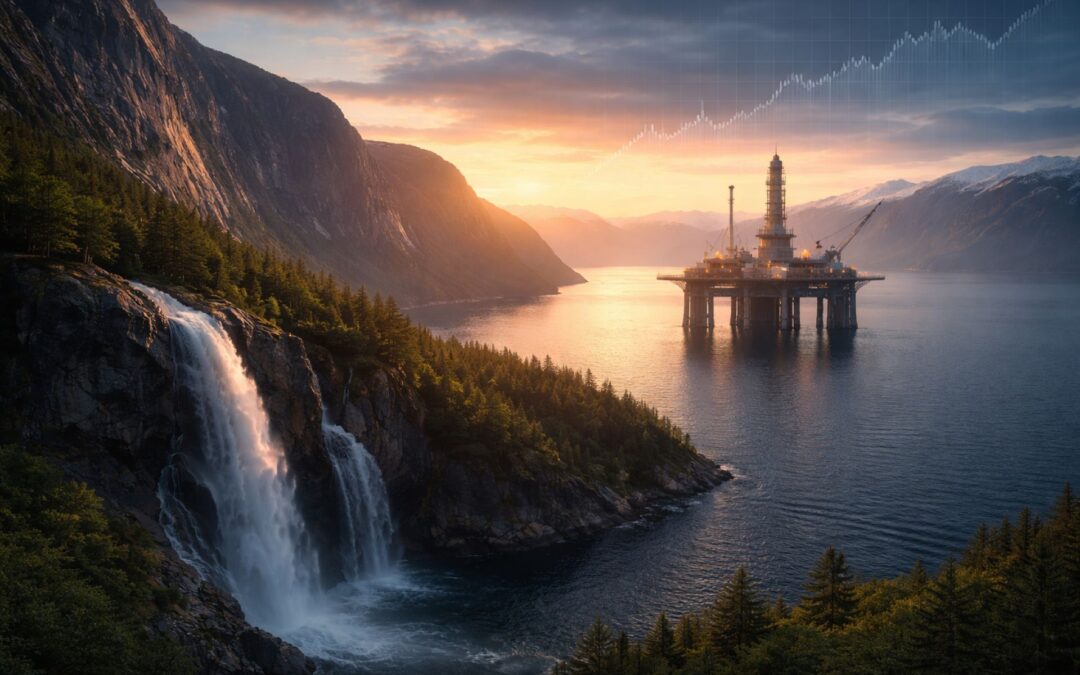
Norway consistently ranks among the richest countries in the world. It boasts one of the highest GDPs per capita, universal healthcare, generous parental leave, strong labor protections, and one of the lowest corruption levels globally. Its citizens enjoy both material prosperity and social security. On the surface, it looks like the perfect economy.
The simple explanation is oil. Norway discovered massive petroleum reserves in the North Sea in 1969, and everything changed.
But that explanation is incomplete.
Oil made Norway wealthy. Institutions made Norway stable. Discipline made Norway sustainable.
Long before the first barrel of crude was pumped from the Ekofisk field, Norway had already built the foundations of an open, export-driven economy. It had navigated poverty, mass emigration, global depressions, world wars, and occupation. It had developed hydropower infrastructure, industrial capabilities, and a political culture that valued equality and long-term planning.
When oil arrived, Norway did something most resource-rich nations fail to do: it designed rules to protect itself from its own success.
This is not just a story about natural resources. It is a story about how geography, trade, democracy, social reform, and fiscal restraint combined to create one of the most balanced wealth machines in modern history.
To understand Norway’s rise, we have to go back to a time when it was anything but rich.
The Foundations Before Oil: Trade, Shipping, and Survival
A Harsh Geography That Forced Economic Openness
In the early 1800s, Norway was not a wealthy nation. It was a rugged, sparsely populated land of just 900,000 people, and nearly 90% of them lived in rural farming communities. Only about 3% of the land was suitable for agriculture. The terrain was mountainous, the climate cold, and growing food at scale was nearly impossible.
Scarcity shaped Norway’s economic DNA.
Because it could not feed itself, Norway was forced to trade. Grain had to be imported. Machinery and textiles had to be brought in from abroad. In return, Norway exported what it had in abundance: timber, fish, iron products, and glass. Its geography—though harsh—offered one critical advantage: the longest coastline in Europe.
That coastline became an economic lifeline.
Its proximity to Great Britain, the dominant industrial power of the 19th century, proved decisive. The United Kingdom became Norway’s primary trading partner, supplying machinery and technical expertise while purchasing Norwegian exports. This relationship integrated Norway into the broader European economy early on, making it outward-facing rather than insular.
But integration also meant vulnerability. When Britain slowed, Norway felt it. As an open economy dependent on foreign demand, external shocks hit hard.
Still, trade was not optional. It was survival.
The Merchant Fleet Advantage
Out of necessity, Norway developed one of the largest merchant fleets in the world relative to its population size. Shipping became a national strength.
From the 1840s to the 1870s, Norway experienced strong economic growth. Currency stability under the silver standard, improved agricultural productivity, and expanding foreign trade supported this expansion. Shipbuilding surged. Norwegian vessels carried goods not just for Norway but for international markets.
The merchant fleet accomplished two crucial things:
- It lowered transportation costs for Norwegian exports.
- It created employment outside agriculture.
In a country where arable land was scarce, shipping offered upward mobility. It also embedded Norway deeper into global commerce, reinforcing its identity as a trading nation.
By the start of World War I, Norway had the fourth-largest merchant navy in the world.
Yet progress was uneven. When steamships began replacing sail vessels in the mid-19th century, Norway struggled to adapt quickly. Lacking technical expertise, it was slow to transition. During the Long Depression of the 1870s, economic stagnation and overpopulation intensified pressure on society.
And then came one of the largest population outflows in European history.
Growth, Overpopulation, and Mass Emigration
Between the 1830s and early 1900s, roughly 800,000 Norwegians emigrated—primarily to the American Midwest. At the time, Norway had the second-highest emigration rate in Europe, behind only Ireland.
This was not a sign of prosperity. It was a pressure release valve.
Rapid population growth collided with limited agricultural capacity and industrial bottlenecks. Steamship technology made transatlantic travel safer and cheaper. For many Norwegians, America represented land, opportunity, and escape from economic stagnation.
Mass emigration had complex effects. In the short term, it reflected hardship. In the long term, it eased labor market pressure and reduced strain on domestic resources. Remittances and transatlantic networks also tied Norway even more closely to global markets.
Hardship shaped national psychology.
Norway learned early that survival depended on adaptability, openness, and institutional stability. It learned the risks of overreliance on a narrow economic base. It learned how vulnerable small, open economies are to global downturns.
These lessons would matter decades later.
Because before oil ever entered the picture, Norway had already developed three enduring traits:
- Integration into global trade
- A strong maritime sector
- A pragmatic, outward-looking economic culture
Hydropower: Norway’s First Strategic Breakthrough
Turning Mountains and Water Into Energy
If the sea shaped Norway’s early trade economy, its mountains and rivers would shape its industrial future.
Norway’s geography—steep valleys, elevated plateaus, fast-flowing rivers, and powerful waterfalls—created near-perfect conditions for hydroelectric power. At a time when coal dominated much of Europe’s energy mix, Norway possessed something different: abundant, renewable water power.
By the 1890s, Norway began harnessing this natural advantage.
Hydropower provided something transformative—cheap, reliable electricity at scale. For a small country with limited domestic coal reserves, this was not just an energy solution. It was a competitive advantage.
Electricity allowed Norway to leapfrog certain stages of industrial development. Rather than relying on imported fossil fuels, it could build industries around high-energy production using domestic resources.
In effect, geography became strategy.
Early Industrialization
Hydroelectricity unlocked energy-intensive industries that would have otherwise been impossible in a country with so little coal.
Norway developed aluminium production, chemical manufacturing, and fertilizer industries—sectors that required enormous electricity inputs. Aluminium, in particular, is famously energy-hungry. Norway’s cheap hydropower made it competitive in global markets despite its small size.
This marked the country’s first true industrial breakthrough.
Industrial growth in the early 1900s coincided with political transformation. In 1905, Norway peacefully dissolved its union with Sweden and became fully independent. The newly sovereign nation leaned heavily on its hydropower-driven industries to fuel economic expansion.
Economic growth began translating into social reform.
As industrialization advanced, Norway introduced labor protections and welfare measures, including accident insurance for seamen, health insurance programs, protections for women and children, and a 10-hour workday. Industrial growth and social reform moved together rather than in opposition.
This pattern would later define the Nordic model.
Hydropower did more than generate electricity. It demonstrated that Norway could convert natural resources into structured, long-term development. It proved that state planning, infrastructure investment, and industrial policy could reshape the economy.
And it laid the groundwork for something even larger.
Because when oil was eventually discovered decades later, Norway already understood how to turn resource wealth into industrial capacity rather than short-term consumption.
Before oil, Norway had already learned how to think strategically about energy.
War, Crisis, and the Birth of the Nordic Model
Economic Trauma of Two World Wars
By the early 20th century, Norway had built a functioning industrial base powered by hydropower and supported by a strong merchant fleet. But global conflict would severely test this progress.
At the outbreak of World War I in 1914, Norway declared neutrality. Yet neutrality did not shield it from economic damage. As an open trading nation with the fourth-largest merchant navy in the world, Norway found itself caught between warring powers.
Germany attacked neutral ships trading with Allied nations. Allied naval control restricted Norway’s exports to Germany. Roughly half of Norway’s merchant fleet was lost during the war. Thousands of sailors perished.
The interwar period brought little relief. Like many export-dependent economies, Norway was hit hard by the Great Depression. Global trade collapsed. By 1933, unemployment peaked at 33.4%. For a small, open economy, external demand shocks were devastating.
Then came World War II.
Again declaring neutrality, Norway was invaded by Germany in April 1940. The country was occupied for five years. Its industries were redirected toward the German war effort, supplying aluminium, iron ore, nickel, and fish. Domestic life deteriorated into rationing, shortages, and repression.
Resistance movements formed despite the risks of imprisonment and execution. Norway would not regain full sovereignty until 1945.
By the end of the war, infrastructure was damaged, shipping capacity had been depleted, and the economy required rebuilding almost from scratch.
The experience left a lasting imprint: economic vulnerability demanded structural resilience.
Marshall Aid and Institutional Reset
After the war, Norway received approximately $400 million through the U.S. Marshall Plan. These funds were critical in rebuilding infrastructure, restoring industrial capacity, and stabilizing the economy.
But financial aid alone does not explain what happened next.
Norway made a deliberate political choice to pursue a social democratic mixed economic system. This model—later known as the Nordic model—sought to combine market capitalism with strong social protections and state coordination.
The goal was clear: prevent the instability and inequality that had plagued earlier decades.
The post-war economic framework emphasized:
- Full employment
- Income equality
- Strong labor unions
- Progressive taxation
- Universal social services
Rather than relying purely on free-market forces, Norway expanded public sector involvement in planning and infrastructure. Hydropower development accelerated. Energy-intensive industries continued to grow.
While Norway’s growth during the 1950s and 1960s lagged slightly behind some Western European economies, living standards steadily improved. Income distribution became more equal. Social security systems expanded.
The country was building institutional depth.
The Core Principles of the Nordic Model
The Nordic model rests on a balancing act.
High taxes fund universal benefits. Strong unions negotiate wages centrally. The state ensures healthcare, education, childcare, and social security are widely accessible. In exchange, businesses operate in a stable, predictable environment with skilled labor and social cohesion.
This model reduces extreme inequality while preserving private enterprise.
Crucially, Norway developed strong democratic institutions and low corruption during this period. Transparency, consensus politics, and long-term planning became normalized.
This mattered enormously.
Because when oil was discovered in 1969, Norway was not an unstable petrostate waiting to implode. It was already a functioning democracy with institutional guardrails.
The welfare state existed before oil. The social contract existed before oil. The political culture of consensus existed before oil.
Oil would amplify the system.
It would not define it.
1969: The Oil Discovery That Changed Everything
Ekofisk and the North Sea Revolution
In the summer of 1969, the American company Phillips Petroleum Company made a discovery in the North Sea that would permanently alter Norway’s economic trajectory: the Ekofisk oil field.
At the time, it was one of the largest offshore oil discoveries in the world.
Norway had little prior experience in petroleum extraction. It was a small industrial nation with strong shipping, hydropower, and manufacturing capabilities—but nothing comparable to managing vast offshore oil reserves.
The discovery presented both opportunity and danger.
Oil revenues promised extraordinary wealth. But history offered warnings. Countries rich in oil often suffered from corruption, currency inflation, weakened industries, and political instability—the so-called “resource curse.”
Norway faced a defining question: would oil control the country, or would the country control the oil?
The Crucial Decision: State Control
In 1972, Norway created Statoil (now known as Equinor), a state-owned oil company designed to ensure that petroleum wealth would remain within Norway rather than flow primarily to foreign corporations.
This was not nationalization in the traditional sense. Foreign companies were allowed to operate in Norway’s oil sector—but under strict regulatory and taxation frameworks.
The Norwegian government implemented a petroleum taxation system that ensured a significant share of profits flowed to the state. Through licensing systems, joint ventures, and state participation, Norway maximized revenue capture without fully excluding private expertise.
Three principles guided the early oil strategy:
- National control over resources
- Strong taxation of petroleum profits
- Gradual development to avoid overheating the economy
Oil revenues surged during the 1970s, especially amid high global oil prices. Government income expanded dramatically. This accelerated funding for Norway’s welfare state—improving healthcare systems, childcare, education, and parental leave policies.
Yet the government resisted the temptation to treat oil as a spending spree.
Instead of viewing oil as immediate income, Norway began to treat it as national capital.
That mindset would soon produce one of the most significant economic institutions in modern history.
Avoiding the Resource Curse
What Destroys Other Oil Economies
Oil wealth can be a blessing—but it often becomes a trap.
Many resource-rich countries experience what economists call the “resource curse.” Instead of strengthening an economy, sudden resource windfalls distort it.
One common mechanism is Dutch disease. When a country exports large volumes of oil or gas, foreign buyers must purchase the local currency to pay for those exports. This increases demand for the currency, causing it to appreciate. A stronger currency makes other domestic industries—like manufacturing, agriculture, or technology—less competitive in global markets.
Over time, non-oil sectors shrink.
High oil revenues also tend to inflate wages in the resource sector. Labor shifts toward oil and gas because that is where the highest pay is. Costs rise across the economy. Manufacturing struggles. Innovation outside energy slows.
Even more dangerous is the political dimension. Large, centralized resource revenues can weaken accountability. Governments may rely on oil income instead of broad-based taxation. When citizens are not taxed heavily, the pressure for transparency and representation can weaken. Corruption often follows.
History is filled with examples of oil wealth undermining institutions rather than strengthening them.
Norway understood this risk early.
Why Norway Was Different
When oil was discovered in 1969, Norway already had something most petro-states did not: strong democratic institutions.
The country had decades of experience with parliamentary governance, low corruption, strong labor unions, and consensus-based policymaking. The welfare state and progressive taxation system were already in place. Oil revenues would supplement an existing system—not replace it.
Transparency became central to petroleum governance. Contracts, licensing processes, and taxation structures were built within a democratic framework. Revenue flows were visible. Institutions remained accountable.
Equally important, Norway did not allow oil to crowd out all other sectors. Although competitiveness in certain industries declined due to rising labor costs, Norway maintained investments in education, technology, maritime services, and industrial expertise.
The political culture favored long-term planning over short-term gains.
Rather than dramatically increasing domestic spending as revenues surged, policymakers asked a deeper question: how can oil wealth benefit future generations?
That question led to the creation of Norway’s most powerful economic safeguard.
The Oil Fund: Norway’s Masterstroke
Creation of the Government Petroleum Fund (1990)
By the late 1980s, oil revenues were flowing steadily into the Norwegian state. The challenge was no longer whether oil would generate wealth—but how that wealth should be managed.
In 1990, Norway passed legislation establishing the Government Petroleum Fund, later renamed the Government Pension Fund Global. Its purpose was simple but revolutionary: separate oil income from day-to-day government spending.
Instead of allowing petroleum revenues to flow directly into the domestic economy, Norway would invest them abroad.
This decision addressed two major risks at once.
First, it reduced upward pressure on the Norwegian currency, helping to limit Dutch disease effects. Second, it transformed temporary oil income into a diversified financial asset that could generate returns long after oil production declines.
Oil was treated not as income—but as national savings.
Initially, the fund invested primarily in foreign government bonds. Over time, its mandate expanded to include global equities and other diversified assets, though still largely excluding heavy direct exposure to fossil fuel companies.
By investing abroad rather than domestically, Norway avoided overheating its own economy while building a global portfolio.
Rules That Prevent Political Misuse
Creating a fund was only half the solution. Rules were the real safeguard.
Norway introduced what is commonly known as the “3 percent rule.” The government is permitted to spend only the expected real return of the fund—estimated at about 3% annually—rather than the principal itself.
This rule ensures that:
- The core capital remains intact
- Spending is predictable and disciplined
- Politicians cannot raid the fund for short-term electoral gains
Exceptions can be made during severe economic downturns, but the long-term commitment to fiscal discipline has remained strong.
The fund operates under strict transparency standards. Its holdings are publicly disclosed. Ethical guidelines govern investments, including exclusions for certain weapons manufacturers and companies that violate human rights standards.
Institutional trust reinforces financial prudence.
The Largest Sovereign Wealth Fund in the World
Today, Norway’s sovereign wealth fund is the largest in the world, valued at approximately $1.9 trillion. It owns around 1.5% of all listed companies globally.
On a per capita basis, that equates to roughly $340,000 per Norwegian citizen.
The fund generates returns that now cover a significant share of Norway’s annual government budget. It provides long-term financial stability independent of current oil prices.
More importantly, it converts volatile commodity income into diversified global wealth.
Few countries have managed natural resource revenue with this level of restraint.
Norway did not eliminate all economic trade-offs. Oil still dominates parts of the economy. Wage pressures remain real. Competitiveness challenges persist.
But by insulating petroleum profits from political cycles and investing for the long term, Norway transformed a finite resource into a permanent financial foundation.
The Hidden Trade-Offs
Rising Labor Costs and Competitiveness Pressures
Oil made Norway wealthy—but it also made Norway expensive.
During the oil boom years, particularly from the 1970s through the early 2000s, high profitability in the petroleum sector pushed wages upward. Skilled workers gravitated toward oil and gas, where salaries were significantly higher than in manufacturing or traditional export industries.
This created structural wage pressure across the economy.
As labor costs rose, certain non-oil industries struggled to compete internationally. Manufacturing margins narrowed. Export sectors outside energy faced currency appreciation and cost disadvantages. Even with strong productivity, competing with lower-cost economies became increasingly difficult.
Norway accepted this trade-off to some extent.
The country chose high wages, strong labor protections, and social stability over becoming a low-cost industrial competitor. Instead of racing to the bottom, it leaned into high-skill sectors, advanced maritime services, offshore engineering, and technology tied to energy infrastructure.
Still, the tension remains.
Oil wealth reduces urgency for diversification. When a single sector generates 24% of GDP, 32% of state revenue, and roughly 52% of exports, the economy inevitably carries concentration risk.
Ongoing Dependence on Energy Exports
Despite decades of prudent management, Norway remains deeply tied to oil and gas.
Even with the sovereign wealth fund acting as a financial buffer, petroleum production continues to anchor the economy. Global energy prices directly influence fiscal revenues, exchange rates, and growth cycles.
The country has made efforts to broaden its base—investing in renewable energy, maritime technology, aquaculture, and advanced services—but oil remains central.
There is also a long-term structural question: what happens when global energy demand transitions away from fossil fuels?
Norway has partially anticipated this shift. Domestically, 96% of electricity comes from hydropower. Over 90% of new car sales are electric vehicles, making Norway a global leader in EV adoption. Investments in offshore wind and renewable technologies continue to expand.
Yet the paradox persists.
Norway is both a climate-conscious leader and one of Europe’s largest oil and gas exporters. Following Russia’s invasion of Ukraine and subsequent European sanctions on Russian gas, Norway became Europe’s largest supplier of natural gas.
Geopolitical demand has reinforced its energy role rather than diminished it.
The Norwegian model is not without tension. It balances fossil fuel exports with renewable domestic energy use. It relies on oil revenue while investing globally to reduce long-term exposure.
This balance is not perfect—but it is deliberate.
Norway Today: Wealth With Responsibility
A Renewable Energy Powerhouse at Home
Modern Norway presents a striking contrast.
While it remains one of the world’s significant oil and gas exporters, its domestic energy system is overwhelmingly renewable. Roughly 96% of Norway’s electricity comes from hydropower. Mountains and rivers that once powered early industrialization now sustain a clean energy grid at national scale.
This has allowed Norway to electrify large parts of its economy without relying heavily on fossil fuels domestically.
The transportation sector illustrates this shift clearly. Over 90% of new car sales are electric vehicles, making Norway the global leader in EV adoption per capita. Aggressive incentives, infrastructure investment, and policy consistency drove this transition.
Norway exports hydrocarbons—but consumes clean energy.
The contradiction is often debated, yet it reflects the country’s pragmatic approach: maximize existing resource advantages while preparing for long-term transition.
Europe’s Energy Anchor
Geopolitics has recently amplified Norway’s strategic importance.
After Russia’s invasion of Ukraine and the resulting European sanctions on Russian gas, Norway became Europe’s largest supplier of natural gas. As continental Europe scrambled to secure energy stability, Norway’s offshore fields became critical to regional energy security.
This strengthened government revenues and reinforced Norway’s role as a reliable partner in European energy markets.
Yet Norway continues to channel those revenues into its sovereign wealth fund rather than dramatically increasing domestic spending. The long-term framework remains intact.
Balancing Growth and Social Equity
Norway consistently ranks high on measures of human development, income equality, institutional trust, and quality of life. Universal healthcare, subsidized education, parental leave, childcare support, and strong labor protections are not side benefits of wealth—they are central design features of the economic system.
High progressive taxation funds these programs. In return, social cohesion remains strong.
The model rests on mutual expectations:
- Citizens trust institutions.
- Institutions maintain transparency.
- Wealth is managed collectively, not privately captured.
Oil accelerated Norway’s rise—but governance defined its trajectory.
Today, Norway stands as a rare example of a resource-rich country that avoided institutional decay, converted volatile commodity income into diversified global wealth, and maintained a broad social contract.
Its economy is not perfect. Diversification challenges remain. Oil dependence is still significant. Global energy transitions pose future uncertainty.
But the architecture of Norwegian wealth is intentional.
Conclusion: The Architecture of Sustainable Wealth
Norway did not become wealthy overnight. And it did not become wealthy by accident.
Long before oil, Norway had already built the foundations of an open trading economy. It had developed maritime expertise, industrialized through hydropower, strengthened democratic institutions, and constructed a social contract rooted in equality and collective responsibility.
When oil was discovered in 1969, Norway faced a crossroads that has derailed many nations before it. Instead of allowing petroleum wealth to overwhelm its institutions, Norway reinforced them.
It created a state oil company to maintain national control.
It designed a taxation system to capture resource rents.
It built the world’s largest sovereign wealth fund.
It imposed strict fiscal rules to prevent political misuse.
Most importantly, it treated oil not as income—but as capital.
That distinction changed everything.
Oil revenues were invested abroad to prevent currency distortion. Only a small percentage of returns could be spent annually. Transparency was maintained. Democratic oversight remained intact.
The result is a system where resource wealth supports social stability without consuming it.
Norway still faces structural challenges. Energy exports dominate its trade profile. High wages limit certain forms of competitiveness. The global shift away from fossil fuels presents long-term uncertainty.
Yet Norway enters the future with advantages few countries possess:
- A $1.9 trillion sovereign wealth fund
- A highly educated workforce
- Strong institutions
- A renewable-heavy domestic energy system
- Deep public trust
Oil created opportunity.
Institutions created durability.
Discipline created sustainability.
Norway’s economy is not “perfect.” But it is deliberate.
And in a world where natural resource windfalls often end in instability, Norway stands as a rare example of how wealth—when governed wisely—can strengthen a nation rather than weaken it.