
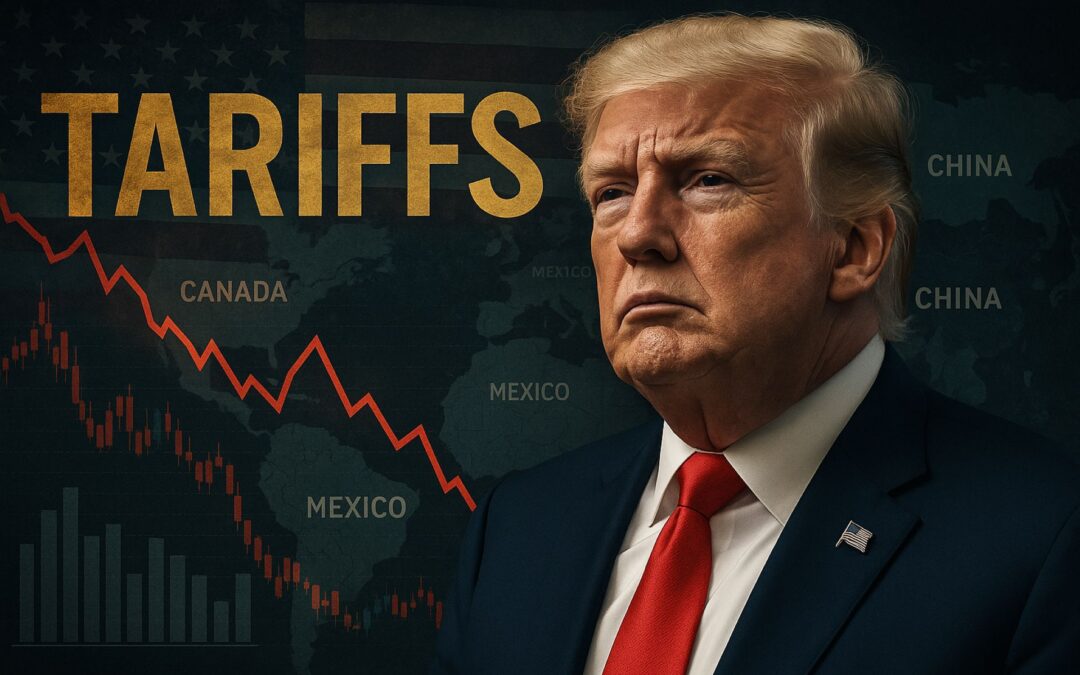
In February 2025, global markets were shaken by a familiar policy tool: tariffs. Shortly after returning to power, Donald Trump announced sweeping tariffs targeting major U.S. trading partners including China, Mexico, and Canada. The announcement immediately triggered market uncertainty. The Nasdaq dropped nearly 10 percent, investors scrambled to interpret the administration’s strategy, and economic forecasts across North America began to deteriorate.
At the center of the debate is a simple but deeply consequential question: do tariffs actually work?
To Trump and many of his supporters, tariffs represent a way to restore American manufacturing, reduce reliance on foreign imports, and protect domestic workers. The logic sounds straightforward—if foreign goods become more expensive, domestic companies should benefit.
But the modern global economy is far more complicated than that.
Tariffs don’t just affect foreign competitors. They ripple across supply chains, influence currency markets, trigger retaliatory trade policies, and reshape global investment decisions. What begins as a protectionist policy aimed at helping domestic industries can quickly create unintended consequences that spread across the entire economy.
Understanding why tariffs remain so controversial requires looking far beyond modern politics. The roots of the debate stretch back more than two centuries, to the early days of the United States, when tariffs were not just an economic policy—but the foundation of the federal government itself.
To understand why tariffs still dominate political conversations today, we need to start where the idea first took hold: the birth of American protectionism.
The Tariff Shock That Shook Global Markets
When Donald Trump announced a new wave of tariffs in early 2025, the reaction was immediate and dramatic. Financial markets responded with volatility, investors began reassessing global supply chains, and governments across the world started preparing countermeasures. What had begun as a campaign promise quickly evolved into a global economic event.
The tariffs targeted some of the United States’ largest trading partners, including China, Mexico, and Canada—countries deeply embedded in American supply chains. These measures threatened to disrupt the flow of hundreds of billions of dollars in goods moving across borders every year.
Markets dislike uncertainty, and tariffs create exactly that.
Within days of the announcement, stock markets began to slide as investors attempted to evaluate the potential consequences. The Nasdaq dropped nearly 9.5 percent, reflecting concerns about rising costs, disrupted trade networks, and slower economic growth. Economic forecasts for the United States, Canada, and Mexico were also revised downward as economists began factoring in the potential fallout.
But the immediate market reaction was only the beginning.
When tariffs are imposed, the effects rarely remain contained within a single country. Instead, they set off a chain reaction across the global economy. Governments begin exploring retaliatory tariffs, companies rethink where they manufacture products, and multinational corporations start restructuring supply chains to avoid the new trade barriers.
In response to Trump’s tariff policy, world leaders began discussing new trade agreements, alternative supply routes, and strategies to reduce dependence on the United States as a trading partner. Supply chains that once ran smoothly across North America and Asia suddenly faced the possibility of major restructuring.
This raises a critical question: are tariffs actually capable of delivering the economic revival their supporters promise, or do they simply create new disruptions in an already interconnected global economy?
To answer that question, we need to go back to the origins of tariffs in American economic history—long before globalization, modern supply chains, or even the income tax existed.
The Original Case for Tariffs
Alexander Hamilton and the Birth of Protectionism
The debate over tariffs in the United States did not begin with Donald Trump. In fact, it dates back to the earliest days of the republic.
In 1789, the United States was a young and fragile nation trying to establish itself in a world dominated by powerful industrial economies, particularly Great Britain. At the time, Britain championed the idea of free trade. British manufacturers were highly productive, technologically advanced, and already integrated into global markets. For them, free trade meant access to foreign markets and an advantage over less developed economies.
But American policymakers quickly realized that adopting Britain’s free trade philosophy could be disastrous for a country still trying to build its own industries.
This is where Alexander Hamilton entered the picture.
In his famous Report on Manufactures, Hamilton laid out one of the earliest and most influential arguments for protectionism. His reasoning was straightforward: new industries cannot compete immediately with established global powers. Without government protection, foreign producers with superior technology and lower costs would dominate the market, preventing domestic industries from ever developing.
Hamilton proposed tariffs as a solution.
By imposing taxes on imported goods—or in some cases banning them entirely—the government could temporarily shield domestic industries from foreign competition. This would give American manufacturers time to grow, innovate, and become competitive on the global stage.
Hamilton also supported government subsidies, which he called “bounties,” to further support domestic production.
The idea was not that protection should last forever. Instead, tariffs were meant to serve as a temporary tool—a way to nurture what economists later called “infant industries.” Once those industries matured, the protection could be removed and companies would be strong enough to compete internationally.
For a young country trying to industrialize, the argument made sense. Protectionism gave American manufacturers breathing room during a period when the global playing field was anything but level.
Why Early America Relied on Tariffs
Tariffs in early America were not just about protecting industries. They were also the primary way the federal government raised money.
During the late eighteenth and nineteenth centuries, tariffs accounted for the overwhelming majority of federal revenue. In fact, during the early years of the United States, tariffs made up roughly 95 percent of government income.
This system worked largely because the federal government was extremely small by modern standards. There were no large welfare programs, no vast federal agencies, and very little public infrastructure spending. The government’s financial needs were modest, and tariffs on imported goods provided a simple way to fund them.
For decades, tariffs served two purposes simultaneously: they protected domestic industries and financed the government.
This historical legacy is important because many modern supporters of tariffs—including Donald Trump and his advisors—often look back at this era as a golden age of American industrial policy. In their view, tariffs helped build the country’s manufacturing base while avoiding the need for large domestic taxes.
But as the United States grew, industrialized, and took on a larger role in global trade, the economic system that once relied heavily on tariffs began to change dramatically.
From Revenue Engine to Political Tool
The Three Historical Phases of U.S. Tariffs
For much of the nineteenth century, tariffs were the backbone of the American government’s finances. But as the economy expanded and the role of government grew, the function of tariffs began to evolve.
The history of tariffs in the United States can broadly be divided into three major phases: inception, transition, and reform.
During the inception phase, tariffs were overwhelmingly a source of government revenue. In the early years of the republic, tariffs accounted for nearly 95 percent of federal income. This made sense in a country with a relatively small government and limited administrative capacity. Collecting tariffs at ports was far easier than building a nationwide tax system.
Over time, however, the American economy became larger and more complex. Industrialization accelerated, urban populations expanded, and the federal government began taking on new responsibilities. As these changes unfolded, tariffs gradually became less central to federal revenue.
This led to the transition phase, during which tariffs still played an important role but no longer dominated government finances. By this stage, tariffs accounted for roughly half of federal revenue. Other sources of income began to emerge as the government sought more stable and predictable funding mechanisms.
Eventually, the United States entered the reform phase, where tariffs were no longer the primary financial engine of government. Today, tariffs contribute only around 2 percent of federal revenue—a tiny fraction compared to their historic importance.
This transformation did not happen overnight. It was driven by major political and economic shifts that reshaped how the United States funded its government.
How the Income Tax Replaced Tariffs
One of the most significant turning points in American fiscal policy came during the Civil War.
Facing enormous wartime expenses, the U.S. government introduced its first federal income tax in 1861. The tax applied to incomes above $800 and was intended as a temporary measure to help finance the war effort. Although the tax was eventually repealed, it demonstrated that the federal government could generate revenue directly from citizens rather than relying primarily on trade.
The real transformation came decades later with the 16th Amendment, ratified in 1913.
This amendment formally established a permanent federal income tax, fundamentally changing how the U.S. government funded itself. Instead of relying on tariffs collected at ports, the government could now generate revenue through taxes on personal income.
This shift was driven by the expanding role of government. As the United States entered the twentieth century, public spending increased dramatically. Programs related to infrastructure, education, military expansion, and eventually social welfare required far more stable revenue streams than tariffs could provide.
Over time, the income tax became the dominant source of federal revenue.
For modern advocates of tariffs, however, this shift represents something more than a fiscal change. Many view the pre-1913 era as a time when American industry was protected, domestic manufacturing was strong, and the government relied less on direct taxation.
This nostalgic view of American economic history helps explain why tariffs remain politically attractive—even in a world where global trade and complex supply chains have transformed how economies function.
But history alone does not determine whether tariffs work in practice.
To understand their real-world impact, we need to examine what happened the last time the United States attempted a large-scale tariff strategy: Trump’s first term in office.
Trump’s First Tariff Experiment
Donald Trump’s support for tariffs is not new. During his first presidency, tariffs became one of the central pillars of his economic strategy. The goal was clear: revive American manufacturing, reduce reliance on foreign imports, and confront what he saw as unfair global trade practices—particularly those involving China.
Beginning in 2018, the Trump administration imposed tariffs on a wide range of products. These included steel, aluminum, solar panels, washing machines, and hundreds of billions of dollars worth of Chinese imports. Altogether, the tariffs affected roughly $380 billion in goods, making them one of the largest protectionist trade actions in modern American history.
The political messaging surrounding the policy was simple and powerful.
Tariffs were framed as part of an “America First” strategy—one designed to protect American workers from what the administration described as decades of unfair competition from overseas manufacturers. For many voters, particularly in industrial regions that had lost manufacturing jobs over previous decades, the promise of rebuilding domestic industry resonated strongly.
But the real question was never about political messaging.
The critical question was whether tariffs could actually produce the economic outcomes they promised: stronger domestic industries, more manufacturing jobs, and a reduced dependence on foreign production.
At first glance, some of the early numbers appeared encouraging. Certain industries, particularly steel, experienced modest increases in production and employment after tariffs were introduced. Supporters of the policy pointed to these early gains as evidence that protectionism was working.
However, once economists began examining the broader economy, the picture became far more complicated.
Tariffs do not operate in isolation. They affect prices, supply chains, investment decisions, and trade relationships across the entire global economy. As these wider effects began to unfold, many of the expected benefits of tariffs proved far smaller than their supporters had hoped.
To see why, it helps to look closely at one of the most visible examples of Trump’s tariff strategy: the attempt to revive the American steel industry.
The Steel Tariff Case Study
The Intended Benefits for American Industry
One of the most prominent examples of Trump’s tariff strategy was the decision to impose tariffs on imported steel.
In March 2018, the administration introduced a 25 percent tariff on foreign steel imports. The logic behind the move seemed straightforward. If imported steel became more expensive, American manufacturers would have a competitive advantage, allowing domestic steel producers to increase production and hire more workers.
For many supporters of the policy, the steel industry symbolized the broader decline of American manufacturing. Factories had closed, jobs had disappeared, and communities that once depended on heavy industry had struggled to recover.
Tariffs were meant to reverse this trend.
And in the short term, there were signs that the policy had some impact. Between 2017 and 2021, U.S. steel production increased by roughly 5.1 percent. Employment in the industry also rose modestly, with approximately 5,400 new jobs added.
For policymakers advocating protectionism, these numbers seemed to validate the strategy. Domestic producers were benefiting from reduced foreign competition, and the industry appeared to be stabilizing after years of decline.
But these gains tell only part of the story.
Why the Job Gains Were Marginal
While the steel industry did experience modest improvements, the overall scale of those gains was surprisingly small when viewed in context.
The addition of 5,400 jobs may sound significant at first, but compared to the size of the broader U.S. workforce, it was relatively minor. The American economy employs over 150 million workers, and even within manufacturing alone, the steel sector represents only a tiny portion of total employment.
More importantly, steel production jobs had already been declining for decades due to automation, technological improvements, and global competition. Even after the tariffs, employment levels in the industry remained far below the peaks seen before the 2008 financial crisis.
In other words, tariffs did not reverse the long-term structural forces reshaping manufacturing.
Even more significant was what happened outside the steel industry. When tariffs raise the price of a key industrial input like steel, the costs ripple outward to other sectors that rely on that material. Industries such as automotive manufacturing, construction, and machinery production suddenly face higher production costs.
This means that policies designed to help one relatively small industry can end up creating new challenges for far larger sectors of the economy.
And this is where the hidden costs of tariffs begin to emerge.
The Hidden Costs of Protectionism
Rising Consumer Prices
Tariffs are often presented as a way to make foreign products less competitive, but in practice they function as a tax on imports. And like most taxes, someone eventually has to pay the cost.
In many cases, that cost falls on consumers.
When tariffs raise the price of imported goods, companies that rely on those products face higher expenses. Businesses can absorb those costs temporarily, but over time they often pass them along to customers in the form of higher prices.
This dynamic became visible during Trump’s first round of tariffs.
After tariffs were imposed on steel, domestic steel prices rose by roughly 2.4 percent. On its own, that increase may appear modest, but steel is a fundamental input used across a wide range of industries—from automobiles and appliances to infrastructure and construction.
In some cases, the price increases were far more noticeable.
Tariffs on imported washing machines, for example, caused prices in the United States to rise by about 12 percent within a single year. The policy was intended to help domestic manufacturers compete with foreign brands, but the immediate result was that American households ended up paying more for everyday appliances.
This illustrates a key tradeoff at the heart of protectionism. Policies designed to protect domestic industries often shift costs onto consumers, effectively redistributing money within the economy rather than creating new wealth.
Retaliatory Tariffs from Trading Partners
Tariffs also rarely go unanswered.
International trade operates within a system of mutual agreements and economic interdependence. When one country raises barriers to imports, its trading partners often respond with their own tariffs in retaliation.
That is exactly what happened after the United States introduced tariffs during Trump’s first term.
Major trading partners including Canada, China, the European Union, India, and Mexico responded with tariffs targeting American exports. These countermeasures affected a wide range of products, including agricultural goods, industrial equipment, and manufactured products.
For American exporters, this meant losing access to markets that had previously been open.
Farmers were among the hardest hit. Agricultural exports rely heavily on international demand, and retaliatory tariffs made American crops less competitive in global markets. In response, the U.S. government eventually approved billions of dollars in financial assistance to farmers to offset the losses caused by the trade conflict.
What began as a policy designed to strengthen domestic industries quickly evolved into a broader trade dispute affecting multiple sectors of the economy.
And the ripple effects did not stop there.
The biggest challenge created by tariffs may not be the industries they directly target, but the much larger sectors of the economy that depend on those industries to operate.
Why Tariffs Hurt More Industries Than They Help
The Downstream Industry Problem
One of the most overlooked consequences of tariffs is how they affect industries that rely on the targeted products as inputs. While tariffs may help a specific sector, they can simultaneously create problems for a much larger group of businesses.
Economists often refer to this as the downstream industry problem.
Take steel as an example. Steel production itself employs a relatively small number of workers in the United States. But the industries that rely on steel—automotive manufacturing, construction, machinery, transportation equipment, and countless other sectors—employ vastly more people.
According to economists at Harvard University and the University of California, Davis, for every job in steel production, roughly 80 jobs exist in industries that use steel.
When tariffs increase the price of steel, these downstream industries suddenly face higher production costs. Automakers must pay more for materials. Construction companies see the cost of infrastructure projects rise. Manufacturers producing everything from refrigerators to industrial equipment experience higher input costs.
This creates a difficult tradeoff. Policies designed to protect a relatively small number of workers in the steel industry can unintentionally put pressure on far larger sectors of the economy.
In some cases, companies facing rising costs may respond by cutting jobs, delaying investments, or moving production overseas to avoid the tariffs altogether.
Manufacturing Investment Decline
Another important indicator of the effectiveness of tariffs is whether they encourage new investment in domestic manufacturing.
Supporters of tariffs often argue that protection from foreign competition will encourage companies to build new factories and expand production within the United States. If imports become more expensive, domestic manufacturers should theoretically have greater incentives to increase capacity.
However, the evidence from Trump’s first round of tariffs suggests that this effect was limited.
During the period following the introduction of tariffs, foreign direct investment in U.S. manufacturing declined significantly, falling by roughly 38 percent compared to the three years prior. Instead of triggering a major wave of new industrial investment, the policy introduced uncertainty into global supply chains.
Companies planning long-term investments must consider stability. When trade policy becomes unpredictable—when tariffs can appear suddenly or escalate into trade disputes—many firms choose to delay investment decisions or look for alternative locations.
Rather than sparking a domestic manufacturing boom, the tariffs often created hesitation among global investors.
But the challenges facing tariffs become even clearer when we step back and look at the broader global economy—particularly the rise of China as the world’s manufacturing powerhouse.
The China Problem Trump Is Trying to Solve
At the center of Trump’s tariff strategy lies a much larger geopolitical and economic concern: China’s rise as a global manufacturing superpower.
Over the past few decades, China has transformed the global economy. After joining the World Trade Organization in 2001, the country rapidly integrated into international trade networks and became the world’s dominant manufacturing hub. Chinese factories began producing massive volumes of consumer goods, electronics, machinery, and industrial inputs that flowed into markets across the world.
For many consumers, this transformation delivered clear benefits. Cheap Chinese imports helped drive down prices for everyday products, making goods more affordable for households in the United States and other developed economies.
But the shift also had major consequences for manufacturing employment.
As production moved overseas, many factories in the United States and Europe shut down or relocated. Entire industrial regions struggled to adapt as companies chased lower costs abroad. For critics of globalization—including Trump—China’s manufacturing boom became the symbol of this economic transformation.
From this perspective, tariffs appear to offer a solution.
During his first term, Trump imposed 25 percent tariffs on approximately $50 billion worth of Chinese imports, aiming to reduce the country’s export advantage and encourage companies to move production back to the United States.
At first glance, the policy appeared to have some impact. The U.S. trade deficit with China declined, suggesting that fewer goods were being imported directly from Chinese manufacturers.
But when economists looked at the broader global picture, they discovered something important.
While the bilateral trade deficit with China shrank, the overall U.S. trade deficit actually grew by roughly 14 percent during Trump’s presidency.
Why?
Because global supply chains rarely disappear—they simply adapt.
Instead of importing goods directly from China, American companies began sourcing similar products from other countries such as Vietnam, Mexico, and Southeast Asian manufacturing hubs. In some cases, Chinese companies themselves relocated assembly operations to these countries to bypass U.S. tariffs.
The product remained essentially the same. The route it took to reach the United States simply changed.
This illustrates one of the central challenges facing tariff-based trade policy. In a deeply interconnected global economy, tariffs rarely eliminate trade—they often just redirect it.
And understanding why this happens requires looking deeper into the structural forces driving global trade imbalances.
Why Tariffs Cannot Fix Global Trade Imbalances
China’s Structural Savings Problem
To understand why tariffs struggle to solve trade imbalances, it’s important to look beyond trade policy and examine the deeper forces shaping China’s economy.
The fundamental issue is not simply that China exports a lot. The deeper issue is that China saves far more than it spends.
In most economies, household consumption drives economic growth. Consumers buy goods and services, businesses respond by producing more, and the cycle of demand and supply keeps the economy moving. But China operates under a very different model.
Chinese households save a remarkably large portion of their income. Today, China’s household savings rate sits at roughly 30 percent, far higher than most major economies. For comparison, the savings rate in the eurozone is around 16 percent, while in the United States it is roughly 4.5 percent.
This imbalance has enormous consequences.
When households save a large share of their income, domestic consumption remains relatively weak. That means Chinese factories often produce far more goods than the domestic market can absorb. To maintain economic growth, those excess goods must be sold abroad.
The result is a persistent export surplus.
This dynamic is not accidental. It is the product of decades of economic policy that prioritized industrial investment and export growth over consumer spending. Policies such as the one-child policy, limited social safety nets, and a financial system designed to support industrial expansion all contributed to a culture of high household savings.
In other words, China’s export dominance is not simply the result of trade loopholes or unfair tariffs. It is rooted in the structure of its economy and the behavior of its households.
And that makes the problem far harder for tariffs alone to solve.
How Supply Chains Simply Shift
When tariffs raise the cost of imports from one country, companies rarely stop importing those goods entirely. Instead, they search for alternative suppliers.
This is exactly what happened during the U.S.–China trade conflict.
When tariffs made Chinese imports more expensive, American businesses began sourcing similar products from other countries. Manufacturing shifted toward places like Vietnam, Mexico, and other Southeast Asian economies that could provide comparable goods at competitive prices.
In many cases, Chinese companies themselves played a role in this transition.
Rather than exporting directly from China, some firms relocated portions of their production process to neighboring countries. For example, Chinese solar panel manufacturers moved assembly operations to Vietnam, allowing them to ship products to the United States without being subject to the same tariffs.
The supply chains changed, but the global production system continued functioning.
This illustrates a key reality of modern globalization: supply networks are flexible and adaptive. Tariffs can alter trade routes, but they rarely eliminate the underlying economic forces driving global production.
As a result, tariffs often reshape trade flows rather than fundamentally changing them.
This raises an important question: if tariffs cannot easily solve structural trade imbalances, why do they remain so politically attractive?
The Politics Behind Tariffs
Despite the mixed economic results, tariffs remain one of the most politically powerful economic tools available to policymakers.
Part of the reason is that tariffs are highly visible. When a government imposes tariffs on foreign goods, the policy sends a clear signal: the government is taking action to protect domestic industries and workers. For many voters—especially those in regions that have experienced manufacturing decline—this message resonates strongly.
In the United States, this political dynamic has been particularly important in industrial and blue-collar states that once relied heavily on manufacturing. Over the past several decades, globalization and technological change reshaped these regions. Factories closed, jobs disappeared, and communities struggled to replace the industries that had sustained them for generations.
Tariffs offer a simple narrative in response to that economic pain.
By targeting foreign competitors, politicians can frame tariffs as a way to restore fairness in global trade and defend domestic workers from what they describe as unfair competition. Even if the broader economic effects are complex, the political message remains straightforward: protect American jobs.
There is also another political argument behind tariffs.
Supporters sometimes claim that tariffs can help reduce economic inequality by shifting economic power back toward domestic industries and workers. The idea is that by limiting foreign competition, companies will invest more at home, creating jobs and raising wages.
However, as the economic evidence from earlier tariff policies shows, these outcomes are far from guaranteed. While certain industries may benefit, the broader effects on employment and investment are often far more limited.
Still, tariffs remain politically attractive because they promise a clear solution to a complicated problem.
But beyond the domestic political appeal, Trump’s tariff strategy also reflects a deeper economic theory—one that centers not on trade alone, but on the global role of the U.S. dollar.
The Dollar Problem in Global Trade
Why the U.S. Dollar Is Structurally Strong
To fully understand Trump’s tariff strategy, it’s important to look beyond trade policy and examine a deeper issue in the global financial system: the role of the U.S. dollar.
Today, the U.S. dollar functions as the world’s primary reserve currency. Governments, banks, and corporations across the world rely on dollars to conduct international trade, settle financial transactions, and store wealth.
Central banks hold massive reserves of dollar-denominated assets—especially U.S. Treasury bonds—because they are considered safe, liquid, and reliable. International commodities such as oil are typically priced in dollars, and many global financial contracts are denominated in the currency.
This constant demand for dollars has a powerful side effect: it keeps the currency persistently strong.
A strong currency makes imports cheaper, which benefits consumers. But it also creates challenges for exporters. When the dollar is expensive relative to other currencies, American-made goods become more costly for foreign buyers, making it harder for U.S. manufacturers to compete internationally.
Some economists believe this dynamic contributes to the decline of domestic manufacturing.
How a Strong Dollar Hurts U.S. Manufacturing
This argument has been championed by several economic advisors within Trump’s orbit, including economist Stephen Miran. According to this view, the decline of American manufacturing is not simply the result of globalization or unfair trade practices.
Instead, the deeper problem is that the U.S. dollar may be structurally overvalued because of its role in the global financial system.
When the dollar remains strong due to global demand, American exports become relatively expensive compared to goods produced in other countries. Meanwhile, imports become cheaper for American consumers and businesses.
Over time, this imbalance can encourage companies to shift production overseas where costs are lower and currencies are weaker.
In this framework, tariffs serve a different purpose than traditional protectionism. Instead of merely shielding domestic industries from competition, tariffs could theoretically be used as a tool to influence currency dynamics and global trade relationships.
But this idea leads to an even more ambitious proposal—one that seeks to reshape the international financial system itself.
The Mar-A-Lago Accord Theory
Stephen Miran’s Plan to Restructure Global Trade
One of the more ambitious ideas circulating among Trump’s economic advisors involves using tariffs as leverage to reshape the global financial system itself.
This theory has been articulated most clearly by economist Stephen Miran, who proposed a plan for restructuring global trade relationships through coordinated currency adjustments. In a paper titled A User’s Guide to Restructuring the Global Trading System, Miran argues that the root of America’s trade imbalance lies in the structural strength of the U.S. dollar.
Because the dollar serves as the backbone of global finance, it remains in constant demand. Governments and financial institutions hold large reserves of dollar-denominated assets, while international businesses use the currency to settle transactions. This persistent demand keeps the dollar strong even when the United States runs large trade deficits.
From Miran’s perspective, this system puts American manufacturers at a disadvantage.
His proposed solution is a large-scale international agreement designed to weaken the dollar and rebalance global trade. Inspired by historical agreements such as the 1985 Plaza Accord and the 1944 Bretton Woods Agreement, Miran envisions a new deal that would encourage major economies to coordinate currency policies.
Because both of those historic agreements were named after the locations where they were negotiated, Miran’s proposal has been informally dubbed the “Mar-A-Lago Accord.”
Can Tariffs Force a Currency Realignment?
Under this proposed framework, tariffs would not simply function as trade barriers. Instead, they would act as negotiating tools designed to pressure other countries into participating in a coordinated currency adjustment.
The basic idea works like this.
Countries participating in the agreement would sell U.S. dollars in foreign exchange markets, strengthening their own currencies while weakening the dollar. A weaker dollar would make American exports cheaper in global markets, potentially improving the competitiveness of U.S. manufacturers.
At the same time, participating nations would continue purchasing long-term U.S. government bonds. This would help keep interest rates low in the United States while maintaining global demand for American financial assets.
In theory, such an agreement could rebalance trade flows without completely dismantling the existing global financial system.
However, implementing a plan of this scale would require unprecedented international cooperation. Convincing major trading partners to intentionally strengthen their own currencies—and potentially harm their export industries—would be extremely difficult.
Even if tariffs were used as leverage, there is no guarantee that other countries would agree to such a restructuring of the global monetary system.
And if they refused, the strategy could lead to escalating trade tensions rather than coordinated reform.
This highlights one of the central risks of using tariffs as a geopolitical tool. In a deeply interconnected world economy, policies designed to pressure other countries can sometimes push them toward alternative alliances and financial systems instead.
The Strategic Risks of Trump’s Tariff Strategy
Supply Chain Diversification
One of the biggest unintended consequences of aggressive tariff policies is that they encourage countries and companies to reconfigure their supply chains.
When the United States imposes tariffs on imports, foreign companies and governments do not simply accept the new restrictions. Instead, they begin searching for ways to reduce their exposure to American trade policy.
This often leads to supply chain diversification.
Rather than relying heavily on the U.S. market, businesses begin expanding production and trade relationships elsewhere. Manufacturers move factories to countries not affected by tariffs, global companies shift their sourcing strategies, and governments negotiate new trade agreements that bypass the United States.
We have already seen this dynamic during previous trade conflicts.
After the U.S. imposed tariffs on Chinese goods, many manufacturers began relocating production to Vietnam, Mexico, and other emerging manufacturing hubs. These countries benefited from the shift as companies attempted to avoid the new trade barriers.
The end result was not necessarily the return of manufacturing to the United States—but rather a reorganization of global production networks.
In a globalized economy, supply chains are flexible. When barriers appear in one place, companies often find alternative routes rather than abandoning international production altogether.
The Potential Decline of Dollar Dominance
Tariffs also carry another long-term strategic risk: they may accelerate efforts by other countries to reduce their dependence on the U.S. dollar.
The dollar’s global dominance has been one of the United States’ greatest economic advantages. Because so much international trade is conducted in dollars, the United States enjoys extraordinary financial influence. Governments hold dollar reserves, international contracts rely on dollar pricing, and global investors treat U.S. assets as safe havens.
However, this system relies heavily on trust and stability.
If major trading partners begin to view the United States as an unpredictable or hostile trade partner, they may begin exploring alternative financial arrangements. This could include conducting more trade in other currencies, building regional financial systems, or reducing reliance on U.S. financial infrastructure.
Such changes would take years, or even decades, to unfold. But once large economies begin building alternatives, reversing the trend becomes extremely difficult.
In other words, policies intended to strengthen American economic power could inadvertently encourage the rest of the world to gradually move away from the financial system that gives the United States its global influence.
And this raises a final, fundamental question: even if tariffs can deliver short-term political benefits, can they realistically reshape the modern global economy?
The Real Limits of Tariffs in a Globalized Economy
Tariffs were developed in a very different world.
When Alexander Hamilton first argued for protectionism in the late eighteenth century, economies were far less interconnected than they are today. Most goods were produced domestically, international supply chains were limited, and global trade represented a much smaller share of economic activity.
In that environment, tariffs could genuinely help young industries develop.
By raising the price of foreign goods, governments could protect domestic manufacturers long enough for them to grow stronger and more competitive. For a country trying to industrialize, this strategy sometimes worked.
But the modern global economy operates on an entirely different scale.
Today, production is spread across vast international networks. A single product—whether a car, smartphone, or appliance—may rely on components manufactured in dozens of countries before reaching the final consumer. Companies design supply chains to minimize costs, maximize efficiency, and take advantage of specialized production around the world.
In such a system, tariffs rarely produce simple outcomes.
Instead of forcing production back to the country imposing tariffs, companies often respond by shifting supply chains to other countries. Manufacturing does not necessarily return home—it simply moves elsewhere.
At the same time, tariffs can introduce significant economic uncertainty. Businesses making long-term investments in factories and infrastructure need stable trade environments. When trade policies become unpredictable, companies may delay expansion plans or redirect investment to regions where the rules appear more stable.
There is also the issue of scale.
The industries most commonly protected by tariffs—such as steel or basic manufacturing—represent a relatively small portion of modern advanced economies. Meanwhile, sectors such as technology, services, healthcare, and finance now make up a much larger share of economic output.
This means that policies designed to protect traditional manufacturing sectors may have limited impact on the broader economy.
None of this means tariffs are completely ineffective. In certain situations, they can serve strategic purposes—such as protecting national security industries or responding to specific unfair trade practices.
But expecting tariffs to fundamentally reverse decades of globalization may be unrealistic.
The global economy has evolved into a complex web of trade relationships, financial flows, and production networks. Changing that system requires far more than simply raising the price of imports.
And this brings us back to the central question behind Trump’s tariff strategy: what happens when political promises collide with economic reality?
Conclusion
Tariffs have been part of economic policy for centuries. In the early days of the United States, they played a crucial role in funding the government and protecting young industries trying to compete with more advanced economies. For a developing nation in the eighteenth and nineteenth centuries, protectionism could make sense.
But the world that made those policies effective has changed dramatically.
Today’s global economy is deeply interconnected. Supply chains stretch across continents, financial markets operate around the clock, and manufacturing depends on networks of specialized production rather than isolated national industries. In such a system, tariffs rarely produce the straightforward outcomes their supporters promise.
The evidence from recent history reflects this reality. Trump’s first round of tariffs produced modest gains in certain industries, such as steel, but those gains were small compared to the broader economic effects. Consumers faced higher prices, downstream industries encountered rising costs, and trading partners responded with retaliatory tariffs.
Perhaps most importantly, global trade flows did not disappear. They simply shifted.
Companies adjusted their supply chains, moving production to countries not affected by the tariffs. The bilateral trade deficit with China declined, but the overall U.S. trade deficit continued to grow. The underlying economic forces driving global trade remained largely unchanged.
This does not mean the concerns behind tariff policies are entirely misplaced. Many communities have struggled with the consequences of globalization, and the decline of manufacturing has had real economic and social impacts.
But tariffs alone are unlikely to solve those challenges.
Reviving domestic industry requires a much broader set of policies—investment in technology, education, infrastructure, and innovation. Without addressing those deeper structural issues, tariffs risk becoming a symbolic gesture rather than a sustainable economic strategy.
As the next phase of American trade policy unfolds, the real test will not be whether tariffs can make headlines or win political support. The real question is whether they can reshape the global economy in the way their advocates promise.
So far, the evidence suggests that doing so may be far more difficult than it sounds.